Weird Wednesdays: The Chameleon House at Lake Michigan

This house can “change” appearances–The Chameleon House!

Anderson Architecture completed this home in 2006 atop a hill overlooking a cherry orchard and Lake Michigan. The striking structure took less than eight weeks to build thanks to the use of prefabricated materials. The steel frame of this house is wrapped in corrugated, translucent acrylic slats, allowing it to take on and reflect the changing colors of the landscape, like a chameleon blending into its habitat. Because it sits on a steep hill, the entrance of the home leads to the third floor, letting residents descend to the bedrooms or walk up to the living area.

From sah-archipedia.org:

Creativity in designing with twenty-first-century materials at a relatively low cost marks the Brondyk vacation house. The Brondyks needed a tall house for a small site, one that would afford a spectacular rooftop view spanning the surrounding farmland west to Lake Michigan, and one that would fit their modest budget. Anderson Anderson Architecture’s designs for original, finely crafted modern homes in the Pacific Northwest found in architectural publications attracted their attention. (The Chameleon House would appear in 100 More of the World’s Best Houses [2005].)

A steel-beamed frame supports the eighteen-hundred-square-foot building. Prefabricated sandwich insulation panel (SIP) walls rise nine stories in the towerlike house, covering the roof as well as the walls. The walls extend above the roof forming a railing for the open deck. Galvanized corrugated sheet metal resembling barn roofing clads the walls. Projecting two feet from the walls are aluminum frames that anchor recycled translucent polyethylene slats and serve as window-washing platforms and emergency exit structures. The panels reflect the light and seem to mimic the surroundings of the house, precipitating the choice of “Chameleon House” as the nickname for the dwelling.

The interior is arranged vertically and each level consists of one room; the rooms are linked by stairs and stair landings. Industrial tread and railings make up the stairs. A double-height window faces Lake Michigan in the common living spaces. Four-foot-wide maple-clad plywood panels are applied directly to the oriented strand board (OSB).

Some see the house as adventuresome and progressive, others as an intrusion on the pristine farmland and forests along the Leelanau Scenic Heritage Route that preservationists are trying to protect. The latter would have preferred that the house had been sited out of sight.

There are few shots of the home’s interior because it is a private home.

SOURCE: SAH:ARCHIPEDIA.ORG

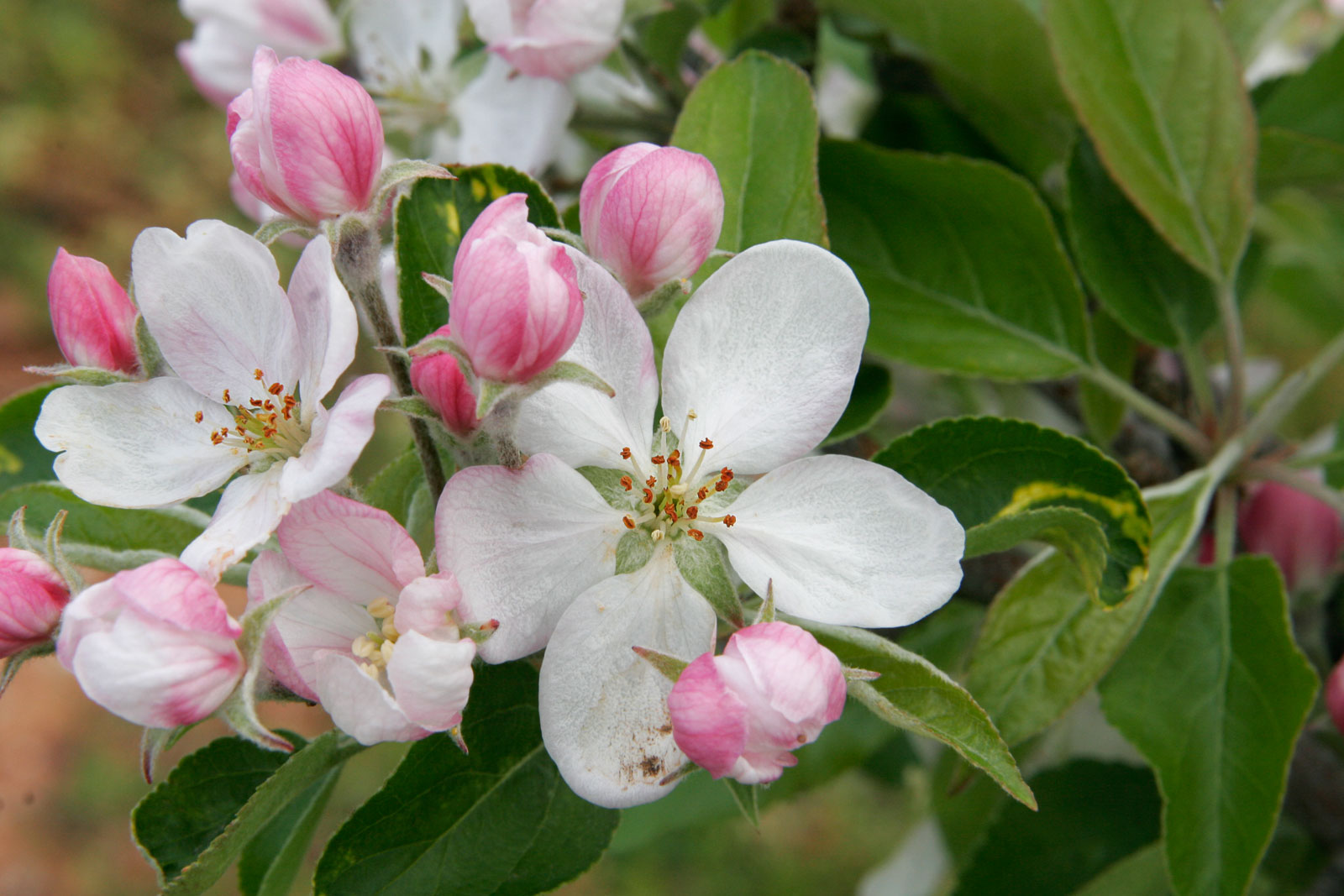
Michigan State Flower: Apple Blossom

From FACTS.NET:

Apple Blossoms Symbolize Hope and New Beginnings

The delicate white and pink petals of apple blossoms are often associated with new beginnings, making them a popular symbol for hope and renewal.

Apple Blossoms Are Rich in Symbolism

In various cultures, apple blossoms are linked to love, fertility, and abundance, representing the promise of a fruitful harvest and a prosperous future.

Apple Blossoms Attract Pollinators

The sweet fragrance and nectar of apple blossoms attract bees and other pollinators, playing a vital role in the pollination process and the production of apples.

Apple Blossoms Herald the Arrival of Spring

The sight of apple blossoms in bloom signals the end of winter and the arrival of spring, bringing joy and a sense of rejuvenation to orchards and gardens.

Apple Blossoms Are the Precursor to Apples

After the blossoms fade, they give way to small, green apple fruits, signifying the successful pollination and the beginning of fruit development.

Apple Blossoms Have Five Petals

Each apple blossom typically consists of five delicate petals, creating a visually appealing and symmetrical floral display.

Apple Blossoms Are Part of the Rosaceae Family

Apple blossoms belong to the Rosaceae family, which includes a wide range of flowering plants such as roses, cherries, and strawberries.

Apple Blossoms Are Celebrated in Festivals

In many apple-growing regions, the blooming of apple blossoms is commemorated with festivals and events, showcasing the beauty and significance of these delicate flowers.

Apple Blossoms Are Used in Traditional Medicine

In some cultures, apple blossoms are utilized in herbal remedies for their purported medicinal properties, including soothing teas and tinctures.

Apple Blossoms Have Inspired Art and Literature

The enchanting beauty of apple blossoms has inspired numerous artists, poets, and writers, who have depicted their allure in paintings, poems, and prose.

Apple Blossoms Are Featured in Wedding Ceremonies

Apple blossoms are a popular choice for wedding bouquets and decorations, symbolizing love, purity, and the promise of a fruitful union.

Apple Blossoms Are a Source of Honey

The nectar from apple blossoms is gathered by bees to produce a light and flavorful apple blossom honey, prized for its delicate taste and aromatic notes.

Apple Blossoms Are Vulnerable to Frost

Late spring frosts can pose a threat to apple blossoms, potentially impacting the pollination process and leading to reduced fruit yield.

Apple Blossoms Are Cultivated Worldwide

Apple blossoms are admired globally and are cultivated in various climates, from temperate regions to subtropical areas, reflecting their widespread appeal.

Apple Blossoms Are the Focus of Photography

Photographers often capture the ethereal beauty of apple blossoms, showcasing their delicate petals and the mesmerizing sight of orchards in full bloom.

Apple Blossoms Are an Integral Part of Ecosystems

Beyond their aesthetic value, apple blossoms play a crucial role in supporting diverse ecosystems by providing nectar and pollen for a multitude of insect species.

Apple Blossoms Have Varieties with Different Colors

While white and pink are the most common hues, there are apple blossom varieties that exhibit shades of red, creating a captivating display of floral diversity.

Apple Blossoms Inspire Appreciation for Nature

The enchanting presence of apple blossoms serves as a reminder of the natural world’s beauty, fostering appreciation for the interconnectedness of plants, pollinators, and the environment.

Apple blossoms, with their captivating beauty and rich symbolism, continue to captivate the imagination and inspire a sense of wonder, marking the beginning of the apple tree’s annual cycle and symbolizing the promise of a bountiful harvest.

SOURCE: FACTS.NET

What Shall We Bake Today?

I found this recipe quite by accident, but it looks so cute, I had to share.  Owl Cookies!

Ingredients

2/3 cup butter, softened

1 cup creamy peanut butter

1 cup packed brown sugar

1 large egg, room temperature

1 teaspoon vanilla extract

1-1/3 cups all-purpose flour

1 cup quick-cooking oats

1 teaspoon baking powder

1/2 teaspoon salt

1-ounce unsweetened chocolate, melted

12 whole cashews

24 striped chocolate kisses, unwrapped

24 semisweet chocolate chips

Directions

In a large bowl, beat butter, peanut butter and brown sugar until blended. Beat in egg and vanilla. In another bowl, mix flour, oats, baking powder and salt; gradually beat into creamed mixture.

If necessary, cover and refrigerate dough 1 hour or until firm enough to shape. Divide dough in half; shape 1 portion into an 8-in.-long roll. Mix melted chocolate into remaining dough. Roll chocolate dough between 2 sheets of waxed paper into an 8-in. square. Place plain roll on top of chocolate dough. Wrap chocolate dough around plain dough, pinching together at the seam to seal. Wrap and refrigerate 3 hours or until firm.

Preheat oven to 350°. Unwrap and cut dough crosswise into 24 slices 3/8 in. thick. To make owls, place two slices side by side on an ungreased baking sheet; pinch the top of each slice for ears. Place a cashew between slices for a beak. Repeat with remaining dough.

Bake 12-15 minutes or until set. Cool on pans 5 minutes before removing to wire racks. While cookies are warm, place 2 kisses on each cookie, pointed side down, for eyes. (Kisses will melt slightly.) Top each kiss with a chocolate chip. Cool completely.

ENJOY!

Northern Flicker

From birdsandblooms.com:

With eye-catching and distinct spotted plumage, the northern flicker is arguably the most beautiful woodpecker in North America. But their unique behaviors and characteristics are what really excite birders across the country.

Flickers in the East (yellow-shafted) have tan faces, gray crowns, red napes, black mustaches and yellow under wings and tail. Flickers in the West (red-shafted) have gray faces, brown crowns, no nape crescents, red mustaches and salmon under wings and tail. In the center of the continent, many flickers are intermediate between the two forms. These birds are 13 inches long with a wingspan of 20 inches. The slight curve in a northern flicker’s beak comes in handy for digging for insects such as beetles or ants.

Female Northern Flicker

Though both sexes share the same flashy field marks, the red or black face mustache is not present on the female northern flicker.

Juvenile Northern Flicker

Young male northern flickers (both yellow- and red-shafted forms) have a very pale orange mustache at first, which is replaced with the classic black or red mustache that adults sport before mid-autumn. So, in late summer or early fall, we might see young male flickers with patchy mustache marks, but a bird with a subtle face pattern is much more likely to be female.

What Do Northern Flickers Eat?

Similar to downy and hairy woodpeckers, northern flickers are primarily insect eaters, but they are harder to entice to backyard feeders. Flickers forage for beetles, flies and moth caterpillars, but ants are their favorite treat, and they work hard to get them. Using their curved bills, they dig underground (the same way other woodpeckers hammer into wood) where the protein-packed larvae live.

“I think it’s so neat that they prefer to feed on the ground—it’s different from other woodpecker behavior,” says Emma Greig, head of Project FeederWatch (feederwatch.org) at the Cornell Lab of Ornithology. “They like to feed on ants and use their long sticky barbed tongues to capture them. They’re like the anteaters of the woodpecker world.”

In fall and winter, flickers dine on wild berries and weed seeds, including poison ivy, dogwood, sumac, wild cherry, elderberries, bayberries and sunflower seed. This is the best time of year to lure them into your backyard.

Best Northern Flicker Bird Feeders

“Entice flickers with peanut hearts or sunflower seeds on a platform, the ground or a large hopper feeder,” says Emma. “They like foraging on the ground, which is why ground feeders are the most ideal. “When insects are scarce, any type of suet is a reasonable option for flickers,” Emma says. “They visit hanging cages or suet attached to a tree.”

If you don’t see flickers at your feeder right away, keep trying. “Even if you can’t entice them with store-bought food, create a flicker-friendly habitat if you have an open area of lawn in which they could forage,” Emma says. “Just be sure not to use pesticides if you want to attract flickers.

More Ways to Attract Northern Flickers

Northern flicker populations are in decline in certain regions of the U.S., but you can give them a boost by adding a nest box they’ll use. Go to nestwatch.org for more information and consult our chart for specific birdhouse requirements. Flickers prefer birdhouses high above the ground.

Bird baths are another option—all species need fresh water.

Nests and Eggs

A mated pair works together to excavate a nesting cavity in a dead tree, utility pole or fence post. The female lays six to eight white eggs inside. Northern flicker fathers do the heavy lifting when it comes to keeping the eggs warm. Their incubating duties leave them sitting on eggs all night long and half the day as well.

During breeding season, rival flickers face off in a display called a “fencing duel.” Two birds face each other, bills pointed up, bobbing their heads while drawing a loop or figure eight pattern in the air.

“This was the second year that northern flickers made a nest in an old maple tree on my property. I wanted to capture all aspects of their nest building and raising their nestlings. Here the male (above) was returning to the nest to feed them. When I saw this image, I was so excited. I think it shows the beauty of the bird with its yellow wing undersides, which are only caught when the flicker is in flight,” says reader Jeffrey Kauffman.

SOURCE: BIRDSANDBLOOMS.COM

The World’s Greatest Mysteries: Part 2

From Mentalfloss.com:

6 What happened to Roald Amundsen?

Exploration is a dangerous business. All 129 men who comprised the polar exploration venture known as the Franklin Expedition died in the years after the mission’s 1845 launch. The case of Amelia Earhart, the pilot who vanished with her navigator Fred Noonan while attempting to circumnavigate the globe in 1937, continues to make front page news despite little progress being made. We still don’t know what happened to British explorer Percy Fawcett, who vanished in the Amazonian jungle in 1925 while searching for the legendary lost city of Z, or Henry Hudson, who was placed in a small boat and cast adrift in waters off northeastern Canada following a mutiny in 1611.

The disappearance of legendary Norwegian explorer Roald Amundsen is a little different. Amundsen had certainly been at the forefront of polar exploration—he was the first to sail the Northwest Passage and, a few years later, he beat England’s Robert Falcon Scott to the South Pole by several weeks. But Amundsen didn’t die while charting new territory; he vanished on a rescue mission while trying to come to the aid of Italian pilot and aeronautical engineer Umberto Nobile, whose airship had crashed while exploring the Arctic in 1928. Amundsen’s own plane is thought to have gone down somewhere around Bear Island in Norway’s Svalbard archipelago. Fishermen found something strange in the area in 1933, but the object fell back into the sea before it could be recovered; a high-tech 2009 search came up empty. Amundsen’s fate remains a mystery, but according to Norway’s Roald Amundsen’s House, three objects that were recovered soon after Amundsen’s disappearance might suggest a crash south of Bear Island.

7 Who was D.B. Cooper?

No survey of historical mysteries would be complete without the tale of the man known as D.B. Cooper, the only person to have hijacked a commercial plane in the United States and gotten away with it (or at least evaded capture). Plenty of notorious criminals have managed to remain unidentified for decades or longer—we still don’t know the identities of Jack the Ripper, the Axeman of New Orleans, or the Zodiac Killer, to name a few—but Cooper belongs to a very different category. Other than showing a flight attendant a device he claimed was a bomb, his crime was nonviolent, and it was stunning in its boldness.

The day before Thanksgiving in 1971, Cooper boarded a flight from Portland, Oregon, to Seattle. A little after 3 p.m., he handed a flight attendant a note, flashed his supposed bomb, and made his demand: He was to be given $200,000 in cash and four parachutes, saying, “No funny stuff or I’ll do the job.” The plane landed in Seattle, traded its passengers and most of the flight attendants for Cooper’s ransom, and took off again.

As the plane flew over an area somewhere between Seattle and Reno, Cooper jumped into the cold, rainy night, buffeted by 200-mph winds, with nothing but the business suit (and possibly a trench coat) he was wearing, two parachutes, and $200,000 (a little more than $1.5 million in today’s currency). The ensuing manhunt, officially known as NORJAK, for “Northwest Hijacking,” lasted 45 years and yielded 800 suspects but no arrests. Cooper has become a folk hero to many, inspiring songs, movies, TV shows, podcasts, books, and even an annual gathering of enthusiasts known as “CooperCon.”

It’s likely Cooper didn’t survive the jump, which was so dangerous that an experienced parachutist would probably never have attempted it in the first place. In 1980, some of the ransom money was found near the Columbia River, leading some to suspect Cooper had perhaps parachuted into the water and died, but a 2020 study that examined diatom species on the recovered bills found they were exposed to water around May-June rather than November. Though the FBI officially dropped the case in 2016, amateur sleuths are still trying to crack the mystery. One theory even claims Cooper was a transgender woman named Barbara Dayton, who died in 2002 at the age of 76.

8 What happened to the lightkeepers of Flannan Isle?

There’s an entire category of historical mysteries devoted to vanishings—people who just seemed to disappear into thin air, leaving no physical clues about what might have happened to them. Jimmy Hoffa is probably the textbook example; nearly 50 years after he disappeared from the parking lot of a Detroit restaurant, his body still hasn’t been found. But 75 years before Hoffa met his fate, Scotland was investigating its own unexplained vanishing—three of them, in fact.

In December 1900, a steamship was passing by the Flannan Isles when its crew noticed the lighthouse had gone dark. Then, on December 26, a relief lighthouse keeper found the Flannan Isle structure abandoned. A search turned up no trace of the men, but there were signs that a violent storm had torn across the island: Supplies were strewn across the ground well above sea level, iron railings were twisted, and an enormous boulder had been dislodged. 

The subsequent investigation assumed the men had been caught in the storm and swept out to sea, but troubling details remained. For instance, if the men had ventured into the storm to secure equipment as had been assumed, why did one of them leave his raingear behind? A theory suggested by shepherds who grazed their sheep on the island connected the men’s deaths to a powerful marine spout that would sporadically shoot dangerous volumes of compressed seawater into the air. Perhaps one man stayed behind while the other two went out into a storm to secure equipment, saw from the lighthouse that conditions were right for the water to erupt, and rushed out to warn the others, only for all three to be swept out to sea in the storm. Others discount the compressed water explanation, but broadly agree that two of the men were outside doing something and for some reason the third man had to run outside in a hurry. A few years later, the poet Wilfrid Wilson Gibson invented stories of an overturned chair and partially eaten food, helping to create an enduring mystery.

9 Was King Arthur real?

The story of King Arthur is one of the most influential and widely studied literary cycles in Western culture, but there’s one big thing we don’t know about it: Did Arthur really exist?

There’s a vague reference to a legendary hero named Arthur in the Welsh poem Y Gododdin dated to around the 6th or 7th century, but it’s not that simple. The story survives in a couple different versions written centuries later, and only one of them mentions Arthur. Whether the Arthur reference is a 7th century original, a 13th century addition, or something in between is a contested area of scholarship.

The first explicit accounts date back to the 9th century Historia Brittonum, which documented 12 battles supposedly fought against the Saxons by a British military commander identified as Arthur. His feats were impressive, to say the least—in the 12th battle, he supposedly killed over 900 enemy soldiers all by himself.

Cleric Geoffrey of Monmouth built on Arthur’s legend in the 12th century with his History of the Kings of Britain, and subsequent Arthurian poems and romances added now-familiar elements such as the Round Table and the quest for the Holy Grail. It wasn’t until the 15th century that Thomas Malory came along and gave us what many now think of as the definitive story of King Arthur, Le Morte d’Arthur. 

When we ask whether Arthur really existed, it’s important to decide which version of him we’re asking about. If it’s the one that began with Geoffrey—a glorious king who once ruled most of Europe—the answer is probably no. If such a ruler had existed, odds are slim he would have been omitted from the historical record. But the Historia Brittonum’s earlier account of a great military leader called Arthur might have some basis in fact. The author probably got some of the details wrong—it would have been logistically impossible for one man to have fought in all 12 of the battles—but it’s not impossible that at some point in the dim and distant past there was a real military leader who rallied the fractured tribes of early medieval Britain against their Saxon invaders.

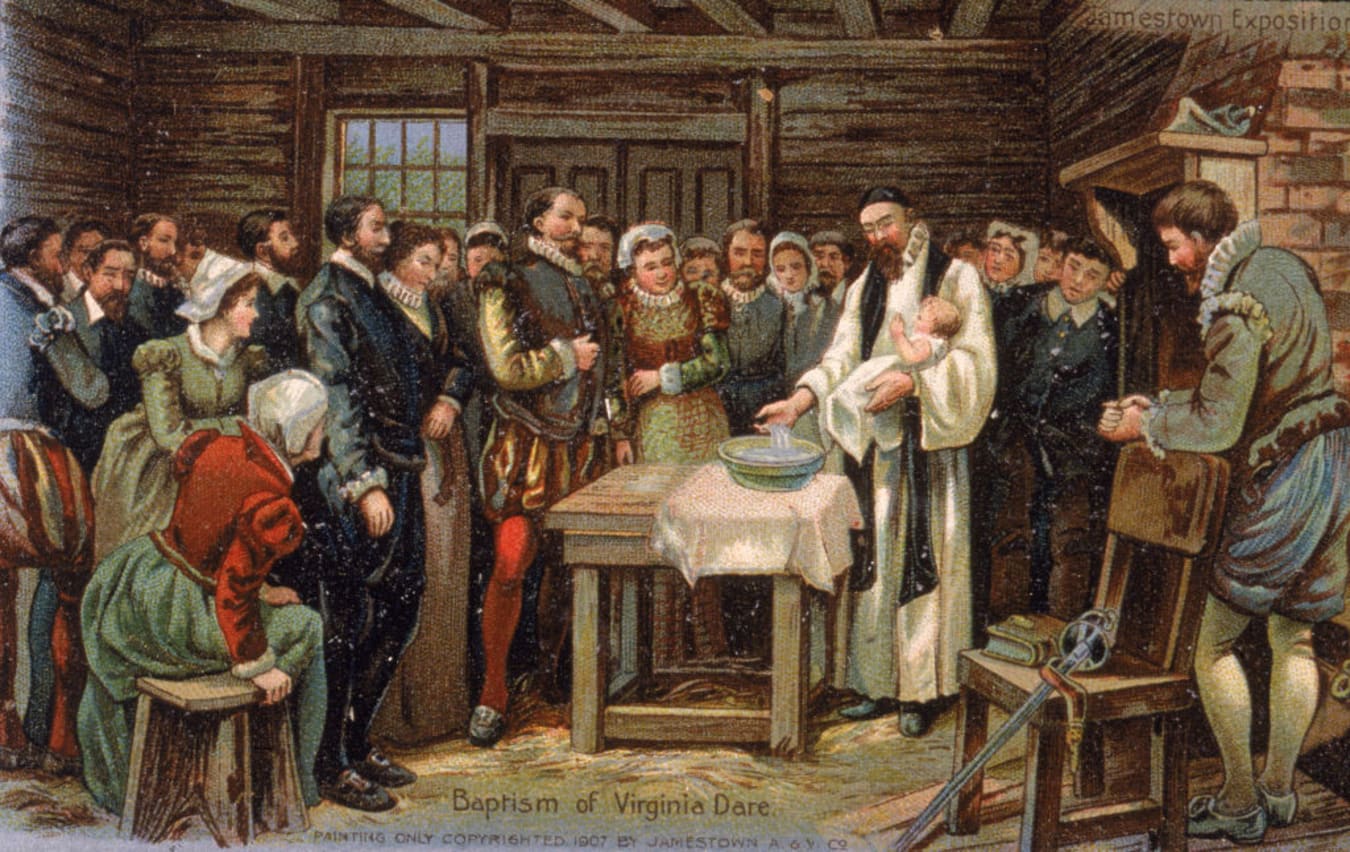
10 What happened to the Roanoke colony?

( Pat’s Note: I do a deeper dive into this particular mystery later in the month.)

England’s plan to colonize North America did not get off to a smooth start. By the time artist-turned-explorer John White and about 115 colonists arrived on Roanoke Island off the coast of modern-day North Carolina in 1587, the settlement already had a reputation. It had been abandoned once in 1586, and a garrison of 15 men who were later deposited there, tasked with holding the land on England’s behalf, also disappeared, leaving behind nothing but a single skeleton to greet the next batch of colonists, who weren’t even supposed to be staying there. (The plan had been to proceed up to the Chesapeake Bay after stopping at Roanoke Island, but the conventional story is that the captain refused to go further.) There’s no reason to have expected White’s colony—which settled in an area where their recent predecessors had had trouble securing food, encountered formidable weather, and were quickly burning through any good will the Native American populations had shown them—would have fared any better.

The colonists arrived too late in the year to grow their own food, and White returned to England for more supplies. The first Anglo-Spanish War delayed his return, and when he finally got back in 1590, everyone was gone. But White didn’t seem puzzled by their disappearance. Someone had carved the word CROATOAN, the name of both a nearby island and the friendly Native American group who inhabited it, into a palisade post (or maybe a tree). White had instructed that if the colonists found themselves in distress, they should carve a type of cross alongside the location, but there was no cross—so he interpreted as a “certaine token of their safe being at Croatoan.” But a storm stopped him from sailing there to look for them, and he was never able to raise the money to finance another expedition to the New World. 

Hard archeological evidence for White’s proclamation “of their safe being at Croatoan” is still lacking. Most researchers think the settlers were either killed by Native Americans who’d turned hostile to European colonizers or, more likely, were absorbed into friendlier Native populations.  

According to archeologist Charles Ewen, the idea that there’s anything particularly strange about the colony’s disappearance might be a relatively modern development. “It’s no big mystery until you start to get a historical type of writing in the 1800s,” he told The New York Times in 2020, pointing out that failed colonization attempts were hardly out of the ordinary (though Ewen himself is skeptical of the Croatoan explanation for a lack of actual evidence). Science writer Andrew Lawler, author of The Secret Token: Myth, Obsession, and the Search for the Lost Colony of Roanoke, told Salon that “the ‘Lost Colony’ is a product of the 19th century”—a time, he says, when “the idea of the colonists assimilating with the Native Americans was a taboo.”

SOURCE: MENTAL FLOSS

Massachusetts State Flower: Mayflower

According to plant folklore, the mayflower plant was the first spring-blooming plant the pilgrims saw after their first arduous winter in the new country. Historians believe that the mayflower plant, also known as trailing arbutus or mayflower trailing arbutus, is an ancient plant that has existed since the last glacier period.

Mayflower Plant Info

Mayflower plant (Epigaea repens) is a trailing plant with fuzzy stems and clusters of sweet-smelling pink or white blooms. This unusual wildflower grows from a specific type of fungus that nourishes the roots. The seeds of the plant are dispersed by ants, but the plant rarely produces fruit and trailing arbutus wildflowers are nearly impossible to transplant. Due to the plant’s particular growing requirements and destruction of its habitat, mayflower trailing arbutus wildflowers have become very rare. If you are lucky enough to see a mayflower plant growing in the wild, do not attempt to remove it. The species is protected by law in many states, and removal is prohibited. Once trailing arbutus disappears from an area, it will probably never return.

How to Grow Trailing Arbutus

Fortunately for gardeners, this beautiful perennial wildflower is propagated by many garden centers and nurseries—especially those that specialize in native plants. Mayflower trailing arbutus requires moist soil and partial or full shade. Like most woodland plants growing under tall conifers and deciduous trees, Mayflower plant performs well in acidic soil. Mayflower arbutus grows where many plants fail to thrive. Keep in mind that although the plant tolerates cold climates as low as USDA zone 3, it won’t tolerate warm, humid weather in USDA zone 8 or above. The plant should be planted so the top of the root ball is about one inch below the surface of the soil. Water deeply after planting, then mulch the plant lightly with organic mulch such as pine needles or bark chips.

Trailing Arbutus Plant Care

Once mayflower plant is established in a suitable location, it requires virtually no attention. Keep the soil lightly moist, but not soggy, until the plant is rooted, and you see healthy new growth. Continue to keep the plant lightly mulched to keep the roots cool and moist.

SOURCE: GARDENINGKNOWHOW.COM
DIY: Thanksgiving Place Cards

I normally do not go to the trouble of place cards at our Thanksgiving meal.  There is usually only 4 of us and we all know each other…lol.  But I did see this idea for a place card that I thought would just be an interesting “pumpkin” craft.

The supplies list is simple: Styrofoam balls, yarns, sticks, craft paint and a glue gun.

Wrap yarn around the ball until covered, then glue the yarn end to the bottom.

Cut a leaf out of paper; add a name and glue to the top. Enjoy!!

Strange Presidential Elections in US History

Happy Election Day! Elections do not always run smoothly, not here, not anywhere I’m guessing.  Livescience.com had an interesting article on 6 of the strangest presidential elections in our history.

From livescience.com:

Political news would have you thinking the 2016 presidential election was the nastiest, most contentious and most important our nation ever faced. However, in the annals of American elections, that one barely registers at least for sheer strangeness.

In fact, electoral politics have always been a down-and-dirty business, starting at least as early as 1800, when our founding fathers proved themselves adept at bitter battles. Other elections have featured nasty accusations, bizarre happenstance and even the death of one of the candidates.

Read on for six of the strangest presidential elections in U.S. history.

An unexpected upset: 2016

The full history of the 2016 presidential election has yet to be written, but it seems pretty certain to be one for the history books.

First, there was the raucous primary season, in which 17 Republican candidates vied on a crowded stage for the nomination, the largest presidential primary field in U.S. history. Former reality-TV star and real estate mogul Donald Trump dominated headlines from the beginning, often with Tweets and statements that seemed outright bizarre. He insinuated that fellow Republican Ted Cruz’s father might have had something to do with the assassination of John F. Kennedy and at one point defended the size of his penis in a debate. Meanwhile, on the Democratic side, presumptive nominee Hillary Clinton faced an unexpected challenge from Vermont senator Bernie Sanders.

Things did not get less weird after Trump and Clinton clinched their nominations. Clinton struggled against questions about her use of a private email server during her time as Secretary of State. The issue seemed settled in July when the Federal Bureau of Investigation recommended against criminal charges, but reared its head again less than two weeks before the election when the FBI announced that it was reviewing potentially new evidence found on the computer of Anthony Weiner, the husband of Clinton’s close aide Huma Abedin, during an investigation into whether Weiner had been sexting an underage girl. Yes, it almost makes that Andrew Jackson-John Quincy Adams contest look like a walk in the park, huh? Just two days before the election, the FBI cleared Clinton again.

Meanwhile, Trump refused to release his tax returns during the campaign, something that every candidate since Gerald Ford has done as a matter of course. He was widely criticized for racist remarks, such as questioning whether the “Mexican” judge in charge of his fraud case (oh, there’s a fraud case — a presidential first) could be impartial. (The judge was an American citizen of Mexican heritage.)    

The wildest bombshell of all came in early October, when a tape surfaced of Trump having a vulgar discussion about grabbing women by their private parts and trying to seduce a married woman. Leading up to the election, the polls were variable, but most pundits expected a clean Clinton victory. Instead, as election night ticked on, the electoral votes piled up for Trump. He ended up taking 290 electoral votes to Clinton’s 232, winning the presidency. But in a final twist, the popular vote tally went to Clinton, only the fifth time in U.S. history the electoral and popular votes haven’t matched. 

The very first one: 1788-1789

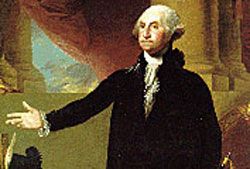
But let’s go back now to the first presidential election in our nation’s history, which was one-of-a-kind in that it was literally no contest. Organized political parties had yet to form, and George Washington ran unopposed. His victory is the only one in the nation’s history to feature 100 percent of the Electoral College vote.

The real question in 1788 was who would become vice president. At the time, this office was awarded to the runner-up in the electoral vote (each elector cast two votes to ensure there would be a runner-up.) Eleven candidates made a play for the vice-presidency, but John Adams came out on top.

It’s a tie: 1800

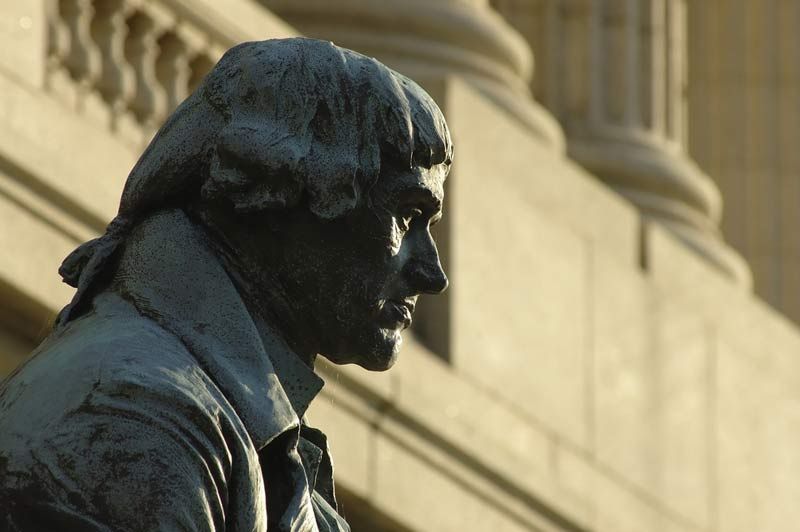
Electoral politics got serious in 1800. Forget the hand-holding peace of George Washington’s first run — political parties were in full swing by this time, and they battled over high-stakes issues (taxes, states’ rights and foreign policy alignments). Thomas Jefferson ran as the Democratic-Republican candidate and John Adams as the Federalist.

At the time, states got to pick their own election days, so voting ran from April to October (and you thought waiting for the West Coast polls to close was frustrating). Because of the complicated “pick two” voting structure in the Electoral College, the election ended up a tie between Jefferson and his vice-presidential pick, Aaron Burr. One South Carolina delegate was supposed to give one of his votes on another candidate, so as to arrange for Jefferson to win and Burr to come in second. The plan somehow went wrong, and both men ended up with 73 electoral votes.

That sent the tie-breaking vote to the House of Representatives, not all of whom were on board with a Jefferson presidency and Burr vice-presidency. Seven tense days of voting followed, but Jefferson finally pulled ahead of Burr. The drama triggered the passage of the 12th amendment to the U.S. Constitution, which stipulates that the Electoral College pick the president and vice-president separately, doing away with the runner-up complications.

Things get nasty: 1828

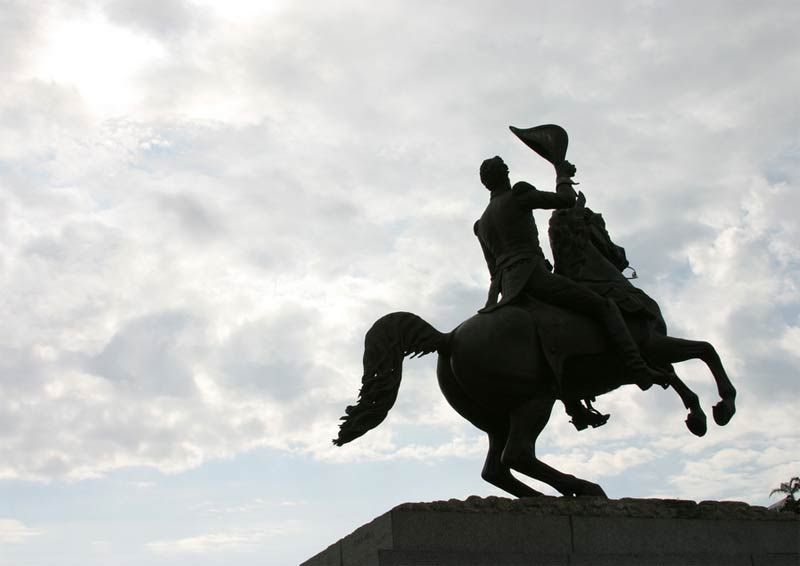
Anything involving dueling war veteran Andrew Jackson was liable to get dirty, but the 1828 electoral battle between Jackson and John Quincy Adams took the cake for mudslinging. Jackson had lost out to Adams in 1824 after Speaker of the House Henry Clay cast a tie-breaking vote. When Adams chose Clay as his Secretary of State, Jackson was furious and accused the two of a “corrupt bargain.”

And that was before the 1828 election even got started, when Adams was accused of pimping out an American girl to a Russian Czar. Jackson’s wife, Rachel, was called a “convicted adulteress,” because she had, years earlier, married Jackson before finalizing her divorce to her previous husband. Rachel died after Jackson won the election, but before his inauguration; at her funeral, Jackson blamed his opponents’ bigamy accusations. “May God Almighty forgiver her murderers, as I know she forgave them,” Jackson said. “I never can.”

To round out a rough election, Jackson’s inauguration party (open to the public) turned into a mob scene, with thousands of well-wishers crowding into the White House. “Ladies fainted, men were seen with bloody noses, and such a scene of confusion took place as is impossible to describe,” wrote Margaret Smith, a Washington socialite who attended the party.

Running against a corpse: 1872

In 1872, incumbent Ulysses S. Grant had an easy run for a second term — because his opponent died before the final votes were cast.

Grant had the election in the bag even before his opponent, Horace Greeley, died, however. The incumbent won 286 electoral votes compared with Greeley’s 66 after election day. But on Nov. 29, 1872, before the Electoral College votes were in, Greeley died and his electoral votes were split among other candidates. Greeley remains the only presidential candidate to die before the election was finalized.

The hanging chads: 2000

Democrat Al Gore beat Republican George W. Bush in the popular vote in the 2000 election, but the electoral vote was a close, and controversial, call. As election night drew to a close, New Mexico, Oregon and Florida remained too close to call.

It would be Florida that determined the winner, but not until the Supreme Court weighed in. For a month, the outcome of the election remained in recount limbo, as Gore’s campaign contested the vote count in several close counties and the Florida and U.S. Supreme Courts engaged in a tug-of-war over whether to halt the recounts or extend their deadlines. Among the challenges faced by the hand counts: determining whether semi-attached scraps of paper, or “hanging chads,” on punch-card ballots should count as votes.

Ultimately, on Dec. 12, the Supreme Court ruled 7-2 that a statewide recount was unconstitutional, alongside a further decision that the smaller recounts could not go forward. The decision meant the original vote counts stood, giving the election to Bush.

SOURCE: LIVESCIENCE.COM
King Tut’s Treasures

Today is the anniversary of the discovery of King Tut’s tomb and history.com had a wonderful article detailing just some of the amazing artifacts found in the tomb.

From history.com:

It was one hundred years ago on November 4, 1922, that British archaeologist Howard Carter and an Egyptian team discovered an ancient stairway hidden for more than 3,000 years beneath the sands of Egypt’s Valley of the Kings. Twenty-two days later, Carter descended those stairs, lit a candle, poked it through a hole in a blocked doorway and waited as his eyes grew accustomed to the dim light.

“[D]etails of the room within emerged slowly from the mist, strange animals, statues, and gold, everywhere the glint of gold,” wrote Carter. “I was struck dumb with amazement.” When Carter’s patron, Lord Carnarvon, anxiously asked if Carter could see anything, the stunned archeologist replied, “Yes, wonderful things.”

Carter and the Egyptian team had found the lost tomb of Tutankhamun, the boy king of Egypt, who was buried in a small and overlooked tomb in 1323 B.C. King Tut may not have been a mighty ruler like Ramesses the Great, whose tomb complex covers more than 8,000 square feet of underground chambers, but unlike Ramesses and other pharaohs, King Tut’s treasures hadn’t been looted or damaged by floods. They were nearly intact.

A century later, the discovery of King Tut’s tomb, which contained more than 5,000 priceless artifacts, remains the greatest archeological find of all time.

“I don’t think there’s anything that can hold a candle to it in terms of outright richness, and in terms of the cultural and archeological information that it contains,” says Tom Mueller, a journalist who wrote a National Geographic article about Carter’s historic discovery and the opening of Cairo’s Grand Egyptian Museum, the new home for King Tut’s treasures.

Most people would recognize the iconic objects from the collection, like King Tut’s solid gold coffin and funerary mask, but even the smallest items—alabaster unguent bowls, King Tut’s walking stick or his sandals—are “works of supreme artistry,” says Mueller, who spent days with museum staff as they restored King Tut’s artifacts for display. “It’s no wonder that these treasures have branded themselves in the international consciousness since 1922.”

Here are nine fascinating artifacts recovered from King Tut’s tomb, from the biggest finds to some hidden treasures.

1 An Iron Dagger

On the surface, this iron-bladed dagger doesn’t look like a spectacular find, but King Tut died several centuries before the start of the Iron Age, when advances in technology allowed for the forging of iron and steel from mineral deposits.

During King Tut’s time, the few iron objects on record were made from metals that literally fell from the heavens in the form of meteorites. “There were theories that the iron dagger was a gift from a foreign king who would have presented it as a ‘gift from the gods,’” says Mueller, “as an omen of something powerful. That really got my attention.” A solid-gold dagger with an ornately decorated sheath was also found in the folds of King Tut’s mummy placed ceremoniously on his right thigh.

2 A Scarf with a Surprise

Inside a small wooden chest made from ebony and cedar, Carter and his team found a gold-plated leopard head, and a gorgeous pair of ceremonial objects known as the pharaoh’s crook and flail, always depicted as held across his chest. But alongside these priceless items was something conspicuously commonplace—a knotted up linen scarf.

When the archeologists untangled the scarf, they found several gold rings inside. But how did they get in there? From other clues, it became clear to Carter that King Tut’s tomb hadn’t remained completely untouched. Thieves must have broken in soon after the tomb was sealed and made off with the smallest and most valuable items they could carry, like gold jewelry. Unlike other pharaonic tombs, which had been fully ransacked over the centuries, King Tut’s tomb “had only been lightly looted,” says Mueller. The scarf packed with gold rings was evidence that the thieves may have even been caught in the act or scared off by guards and left their loot behind. It was hastily packed into a box when the tomb was resealed, not to be opened for another 3,200 years.

3 A Game of Chance and Fate

A senet gaming board from Tutankhamun’s tomb, 14th century BC. Made from wood veneered with ebony and inlaid with ivory. From the collection of the Egyptian National Museum, Cairo, Egypt. Egyptians played board games and one of King Tut’s favorites (judging from the fact that there were four sets in his tomb) was a game called senet. Historians don’t agree on the exact rules of the checkers-like game, but it involved moving your game piece through a series of 30 squares by throwing knucklebones or casting sticks. The Egyptian Book of the Dead, which details the journey of the soul through the afterlife, says that playing senet is a popular pastime for the deceased. Eternal life may even have been at stake. “There’s evidence that it was a game played against the god of death,” says Mueller, “so it’s also a game of fate.”

4 King Tut’s Lost Daughters

One of the reasons why King Tut fell through the cracks of Egyptian history was that his reign was so short (around a decade) and he didn’t leave behind any heirs or offspring. But thanks to Carter’s discovery, we know that King Tut’s wife Ankhesenamun—whom he married at age 12—bore two stillborn daughters who were buried in their father’s tomb.

Inside an unmarked box, Carter’s team found two tiny wooden coffins, each bearing a gilded inner coffin that contained the mummified remains of King Tut’s daughters. The fetuses appeared to be 25 and 37 weeks old and died from unknown causes.

Mueller says that there’s a tendency to paint King Tut’s tomb as macabre, given the fascination with things like King Tut’s curse. “Yes, this is a tomb with several dead people in it,” says Mueller, “but in a way, the Egyptian view of the afterlife—their obsession with it—softens all of that. It becomes death as a work of art. King Tut’s preparation for the afterlife becomes a museum.” Archeologists also found a lock of King Tut’s grandmother’s hair in the tomb, which may have been a family keepsake.

5 Gold Sandals

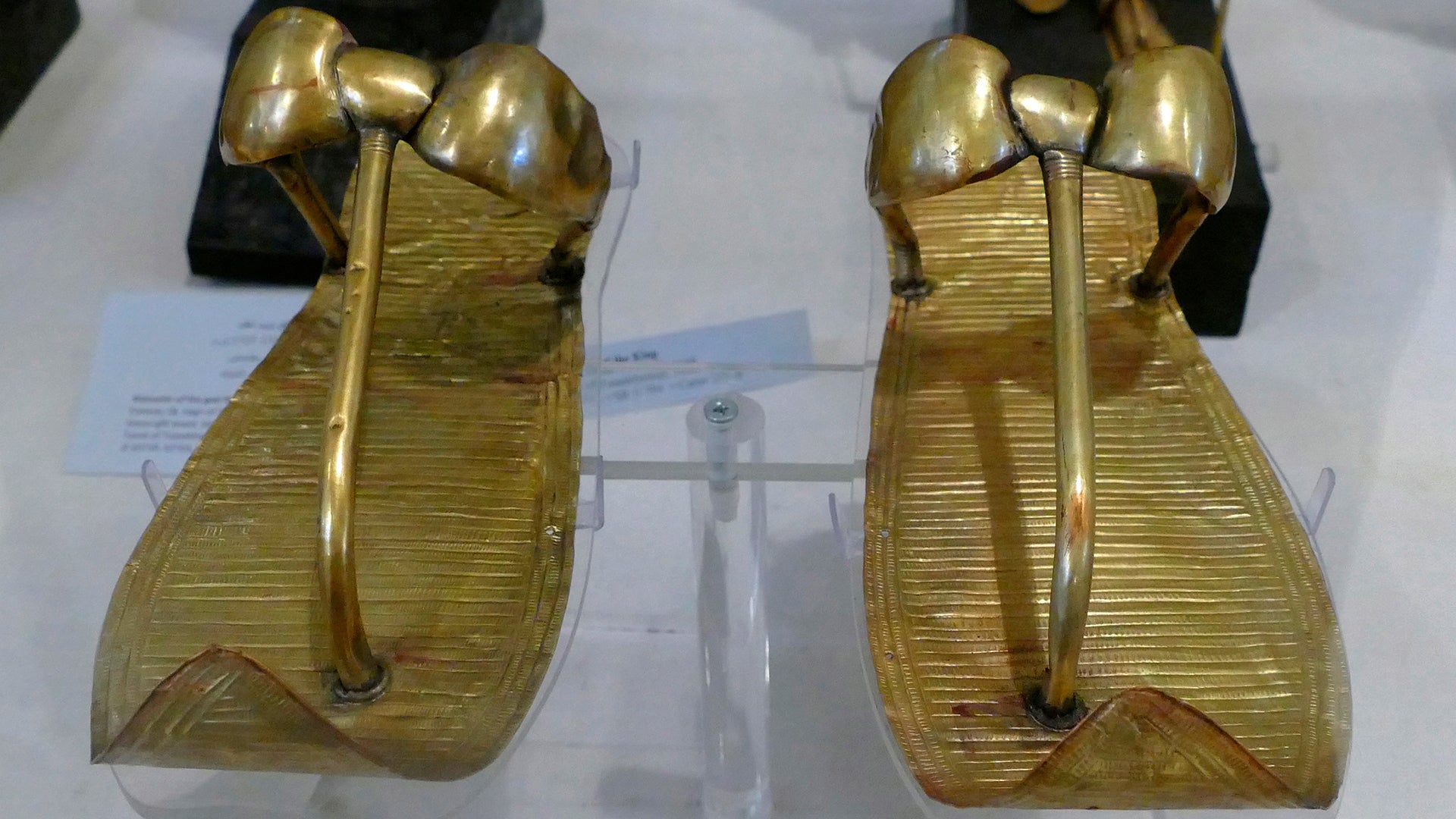
In one of the crowded antechambers, Carter found a painted wooden chest that he described as “one of the greatest artistic treasures of the tomb… we found it hard to tear ourselves away from it.” Inside were sequin-lined linens, an alabaster headrest and a very special pair of sandals. These were King Tut’s golden court sandals, ornately decorated footwear that he’s seen wearing in some of the statuettes found in the tomb. Made from wood and overlaid with bark, leather and gold, the eye-catching parts are the soles of the sandals, which depict the nine traditional enemies of Egypt. That wasn’t an accident. “He’d be symbolically walking on their faces all day,” says Mueller.

6 A Small Army of Servants

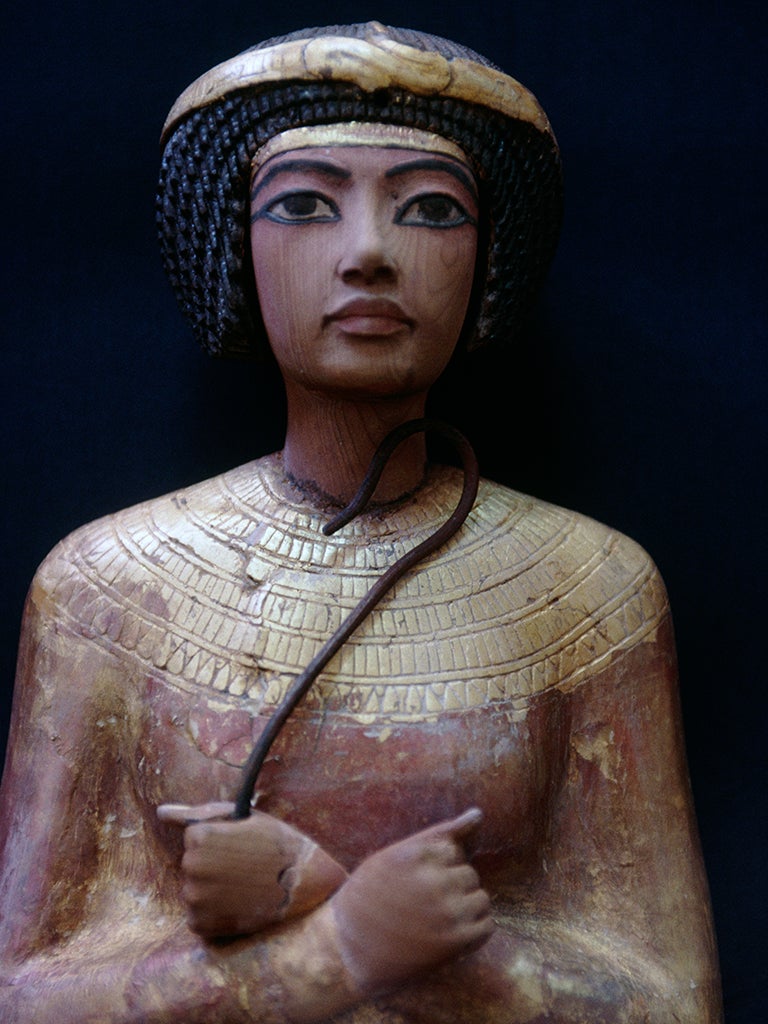
Thousands of years before King Tut, at the dawn of Egyptian civilization, powerful rulers were buried with their royal servants, who sacrificed their lives to serve their master in the eternities. By the late Middle Kingdom, human servants were replaced by small figurines called ushabti, who were inscribed with a magical spell to forever do the deceased’s bidding in the afterlife. For the average Egyptian burial, one or two ushabti were placed in the deceased’s tomb. In King Tut’s tomb, there were 413 ushabti, a small army of foot-tall figurines made from various materials including faience, a glass-like pottery with striking colors. Some of King Tut’s ushabti held copper tools like yokes, hoes and picks to do manual labor for the pharaoh in the afterlife.

7 King Tut’s Undergarments

Not every treasure in King Tut’s tomb was made of gold. The young pharaoh, who died at 19 after just nine or 10 years on the throne, was also buried with some of his clothing. Among the ancient textiles found in the tomb were 100 sandals, 12 tunics, 28 gloves, 25 head coverings, four socks (with a separate pocket for the big toe, so they could be worn with sandals) and 145 loincloths, triangular-shaped pieces of woven linen that both men and women wore as underwear. “I really like his underwear,” says Mueller. “King Tut was kitted out for the afterlife, right down to the undergarments. They’re quite spectacular, little loincloth-like things. They’re incredible.” King Tut’s undergarments were a step above non-royal underwear. According to textile historians, the weave of an ordinary Egyptian linen loincloth had 37 to 60 threads per inch, but King Tut’s underwear had 200 threads per inch, giving the cloth a silk-like softness.

8 A Dazzling Resting Place for the King’s Organs

The gilded shrine of canopic jars or canopic chest from King Tut’s tomb. This detail shows the goddess Selket. During the mummification process, Egyptian embalmers carefully removed the lungs, liver, intestines and stomach from the body, embalmed the organs, and placed them in vessels called Canopic jars. The final resting place for King Tut’s organs was one of the most exquisite objects in the entire tomb. Carter found Tut’s Canopic jars stored inside an alabaster chest, itself housed within a magnificent wooden funerary shrine covered in gold leaf. “Facing the doorway stood the most beautiful monument that I have ever seen,” wrote Carter, “so lovely that it made one gasp with wonder and admiration.”

What really struck Mueller when he saw the golden shrine in person were the four Egyptian goddesses of death guarding the young pharaoh’s embalmed organs on all sides. The goddesses Isis, Nephthys, Neith and Selket are depicted in naturalistic poses with form-fitting dresses that inspired flapper fashion in the 1920s. “Here are these gorgeous goddesses looking over his innards for all eternity,” says Mueller.

9 The Iconic Golden Mask

For Carter, the greatest prize among the 5,000 objects in the tomb was the mummy of King Tut himself. But to get to the mummy, Carter and his team had to slowly and painstakingly work through a series of nesting shrines and coffins that were never meant to be opened by human hands.

First there were four box-like golden shrines, each slightly smaller than the last. Inside the last shrine was the heavy stone sarcophagus. Once the stone lid was removed, it revealed the first of three coffins. The first coffin, as well the second one nested inside of it, were wooden coffins overlaid with gold foil and designed to look like the god Osiris lying in repose. The third and final coffin was a jaw-dropper: a solid gold casket weighing 296 pounds also depicting Osiris with the ceremonial crook and flail across his chest.

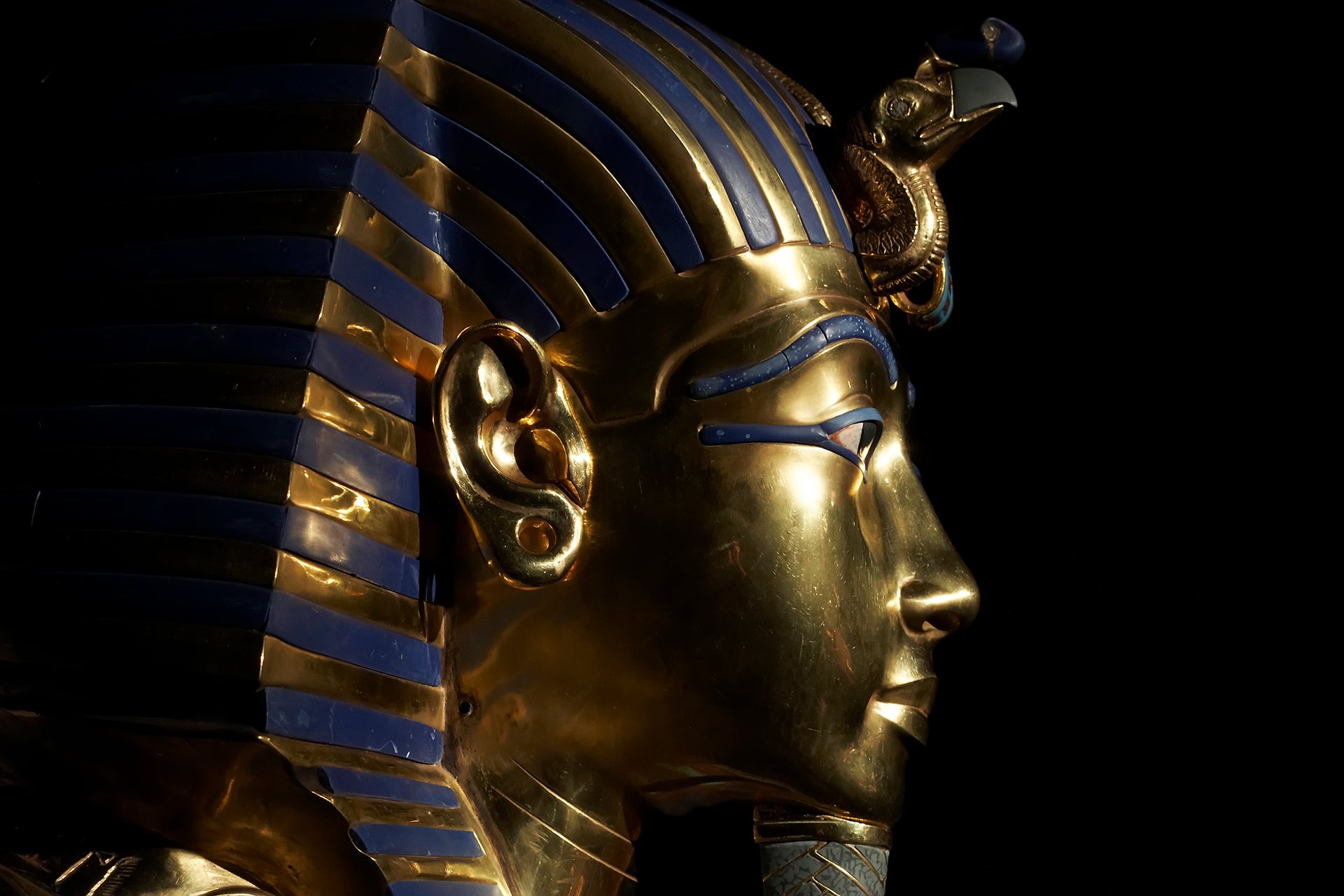
With trembling hands, Carter opened the golden coffin and found himself face to face with the iconic funerary mask of Tutankhamun. The 22-pound, solid-gold mask rested directly on the head and shoulders of King Tut’s mummy, and portrayed the handsome young king as Osiris, complete with the pharaonic false beard. “The golden mask of King Tut is probably the best-known and most widely recognized archeological treasure ever,” says Mueller. King Tut’s mummy, when carefully removed and unwrapped, contained 143 different amulets, bracelets, necklaces and other priceless artifacts among its ancient bandages. 

SOURCE: HISTORY.COM