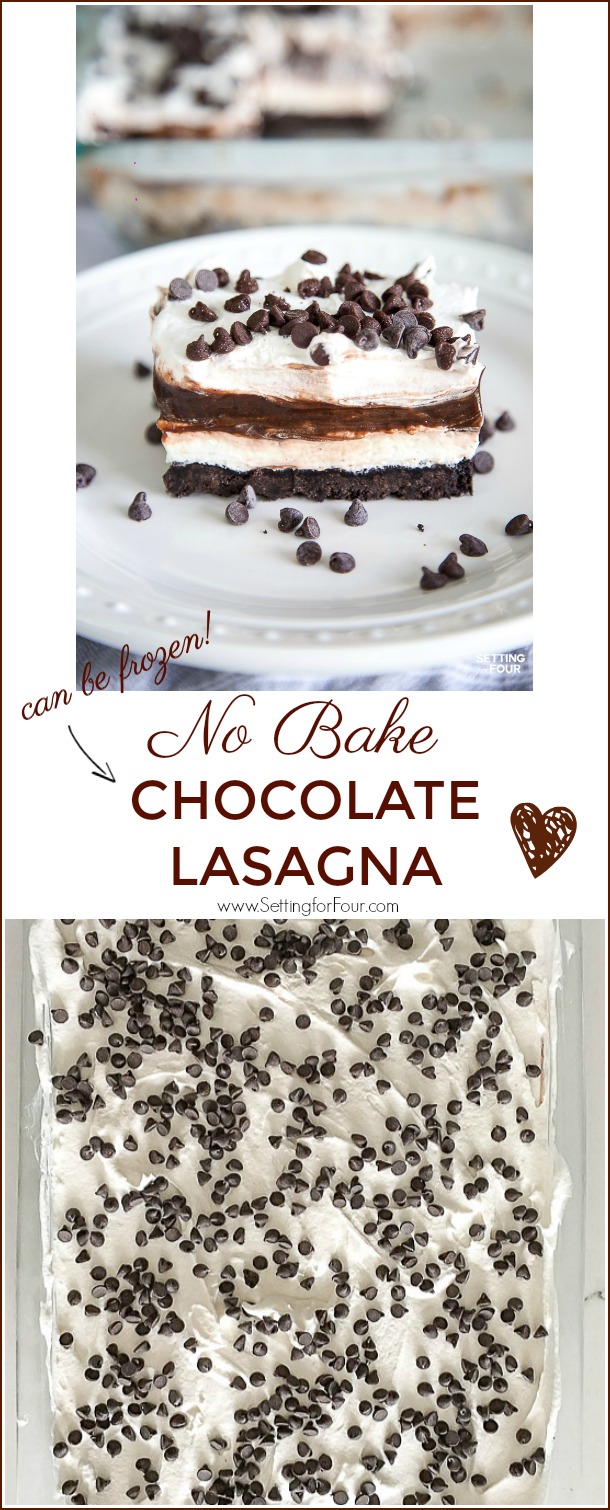
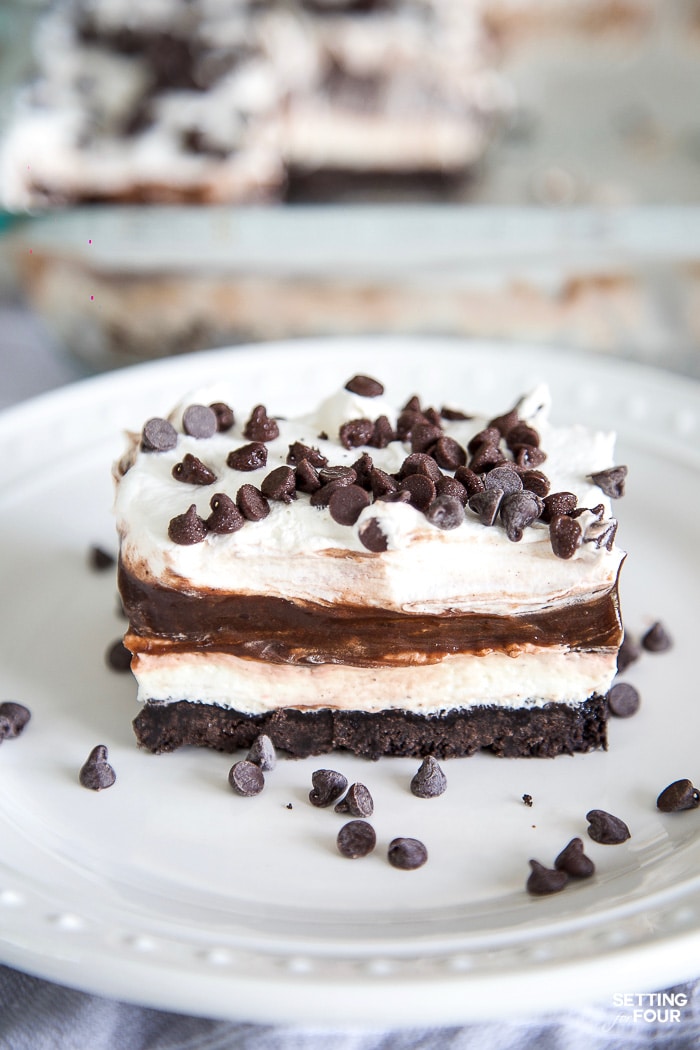
Picnic season is starting, so let’s make an easy, no bake dessert! Chocolate Lasagna!
Recipe Ingredients:
1 package regular Oreo cookies (not the Double Stuff kind) – about 36 cookies
5 Tablespoon butter, melted
8-ounce package cream cheese, softened
1/4 cup granulated sugar
2 Tablespoons cold milk
Optional – 4 tbsp chocolate liqueur such as Godiva Chocolate Liqueur or Bailey’s.( If you don’t want to use this, just leave it out! No substitution of another liquid is required.)
12-ounce tub Cool Whip, divided
2 of 3.9-ounce packages Chocolate Instant Pudding
3 1/4 cups cold milk
1 1/2 cups mini chocolate chips
Instructions:
Crush 36 Oreo cookies. You can use a food processor, but you could also place them in a large ziploc bag and crush them with a rolling pin or meat tenderizer mallet. Crush until the Oreos have turned into fine crumbs.
Add the Oreo crumbs to a large bowl. Stir in melted butter. Use a fork to mix the butter into the cookie crumbs. Transfer the mixture into a 9 x 13 inch baking dish, pressing the crumbs into the bottom of the dish. Place the baking dish into the refrigerator and work on the additional layers.
In a large bowl mix the cream cheese with a mixer until light and fluffy. Add 2 Tablespoons of milk and sugar. Mix well. Add the chocolate liquor if desired. Stir in 1 1/2 cups Cool Whip and completely mix. Spread this mixture over the Oreo crust.
In a bowl, add 3 and 1/4 cups cold milk to the chocolate instant pudding. Whisk for several minutes until the pudding starts to thicken. Use a spatula to spread the pudding mixture over the cream cheese layer. Allow the dessert to firm up on the countertop for 5 minutes.
Spread the remaining Cool Whip on top. Next sprinkle mini chocolate chips over the top. Place in the freezer for 1 hour, or the refrigerator for 4 hours then serve.
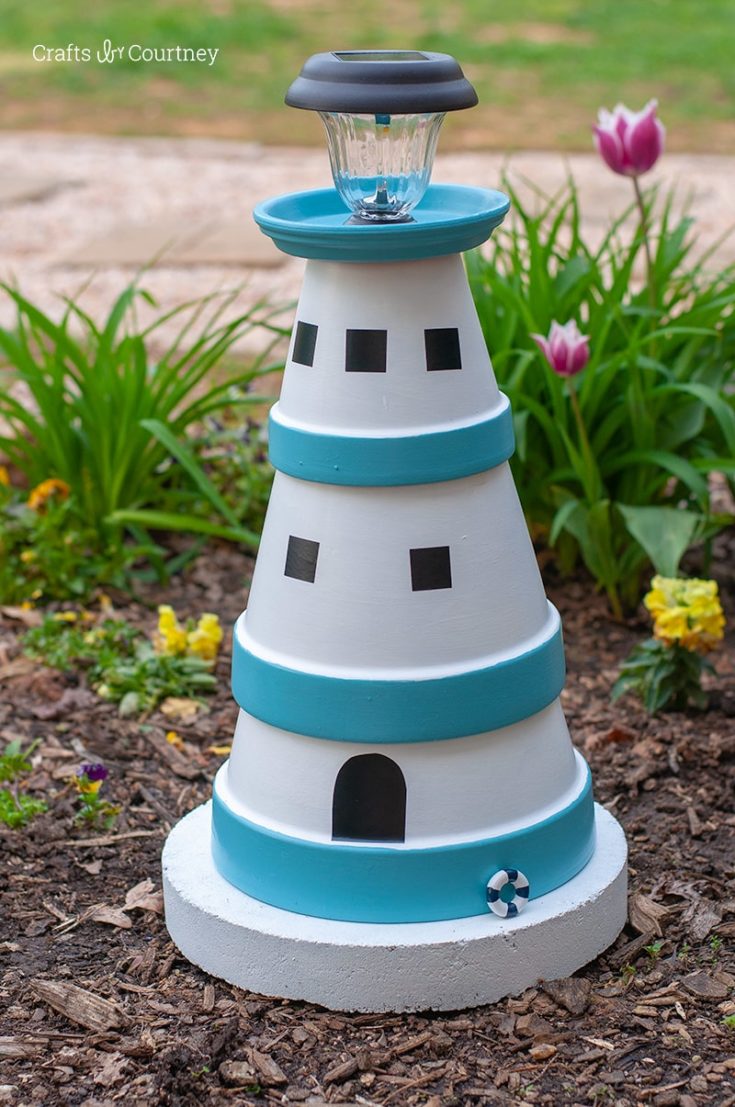
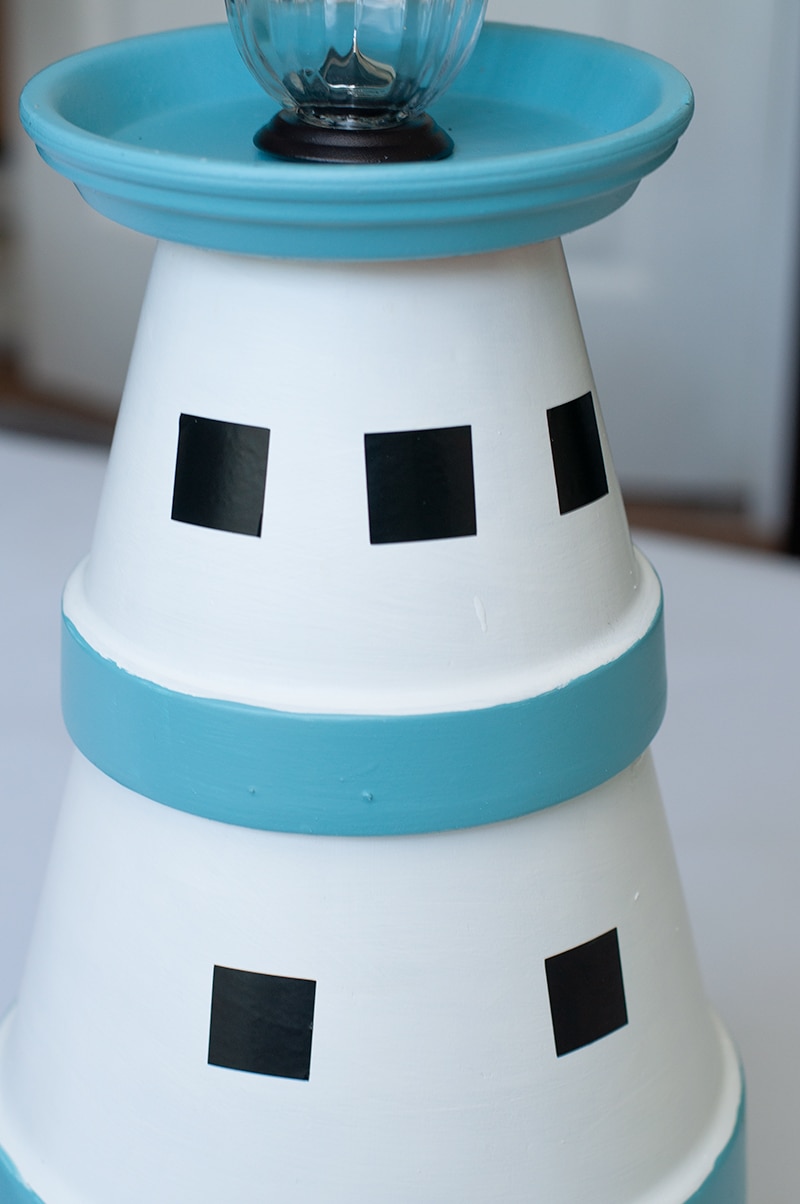
I fell in love with this lighthouse and it’s so simple to make!
This is from the Crafts by Courtney website.
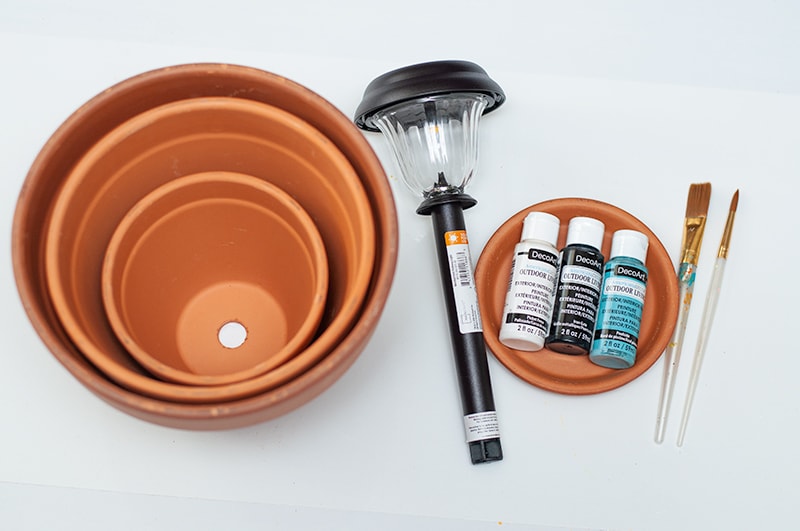
Supplies Needed for Your DIY Lighthouse Project:
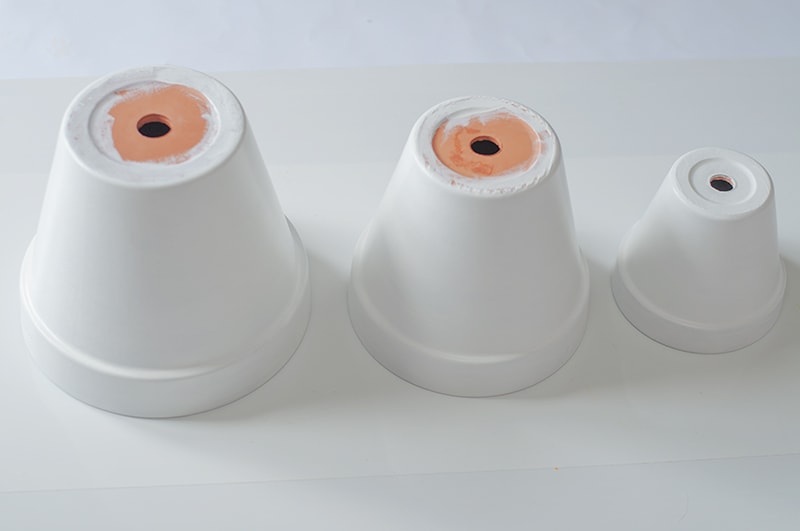
Clay Pots in various sizes
Solar Light
E6000 Glue
Paint Brush
Americana Decor Outdoor Living 2oz – Picket Fence
Americana Decor Outdoor Living 2oz – Poolside
Step 1 – Paint Pots White
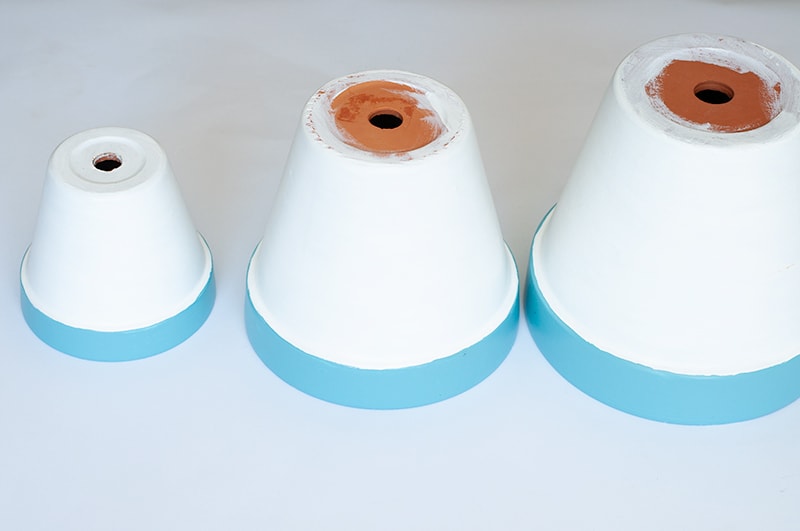
Step 2 – Add Your Blue Accent Color
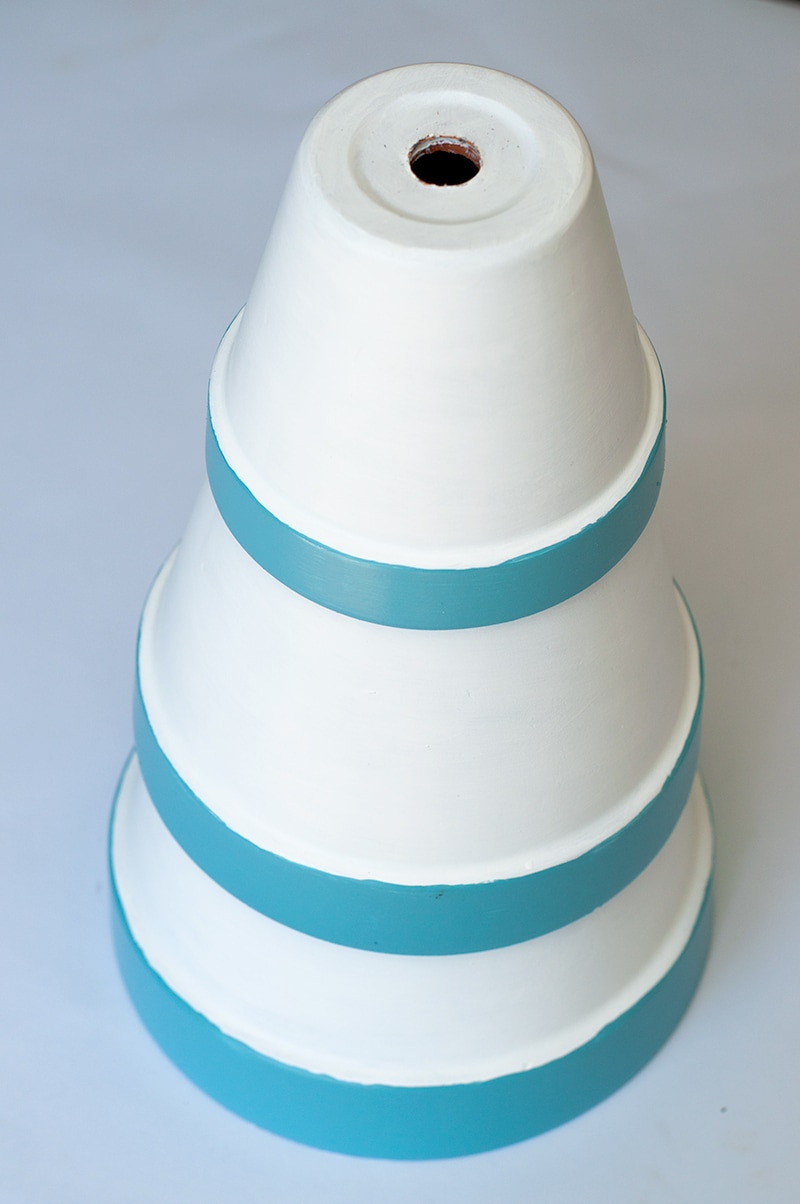
Step 3 – Glue Pots together
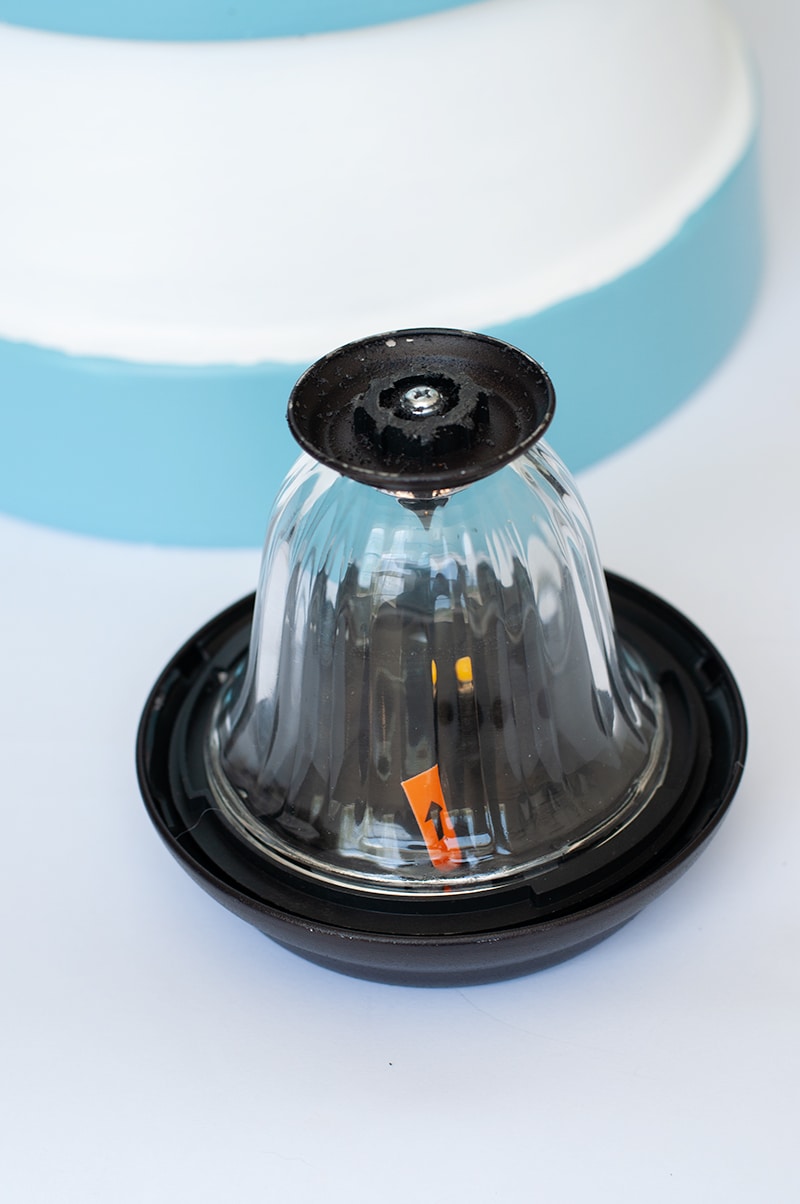
Step 4 – Add your Light
I found a solar light at Wal-Mart to place at the top of the Lighthouse. I used a small hack saw to cut the bottom of the solar light off, so that it would sit flush on the top of the lighthouse. I added a little E6000 glue to this part as well, and let sit overnight.
Step 5 – Add WindowsFor the window I decided to change this step last minute. I was originally going to use the black Iron gate paint. But I cut out my window shape in black vinyl to use as a stencil. Then I decided to just stick with the black vinyl as my window. That vinyl won’t go anywhere.But you can always paint in your window as well. Both options will work.
Finishing Touches
Now let’s take is baby outside and display it!
I’m very excited with how this DIY Lighthouse turned out, I really wanted to keep it simple with the details. But you can get pretty detailed with a project like this as well. I pinned some great ideas on my Pinterest page.
A few people have asked me where I got the base for the lighthouse. The base at the bottom of the lighthouse is a round paver I found at Wal-Mart. I used the outdoor paint to paint that as well.
There’s No House In The World Like This One In Idaho—The Sluice Box
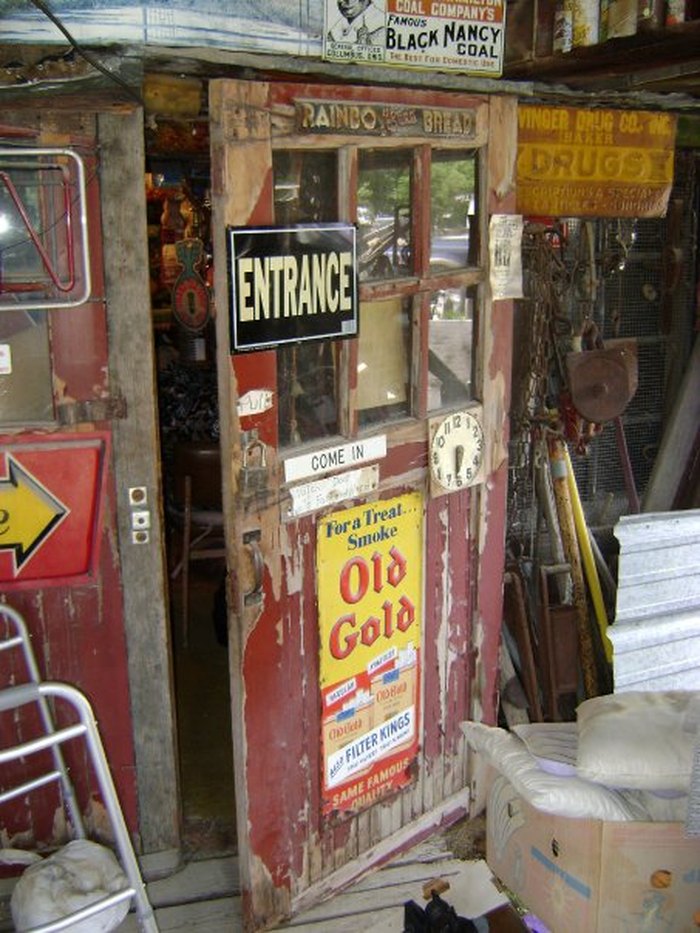
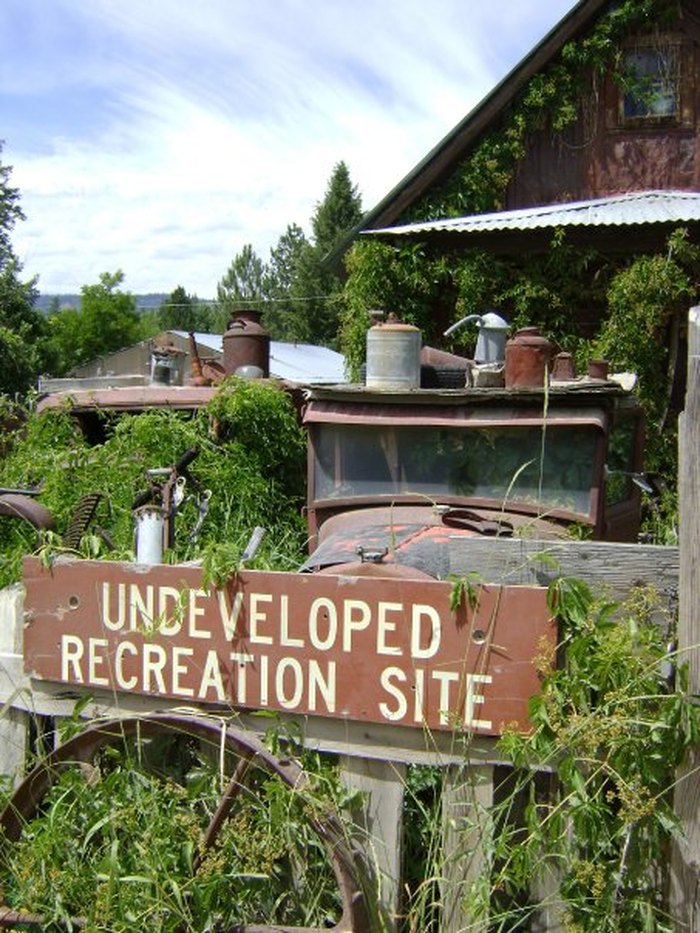
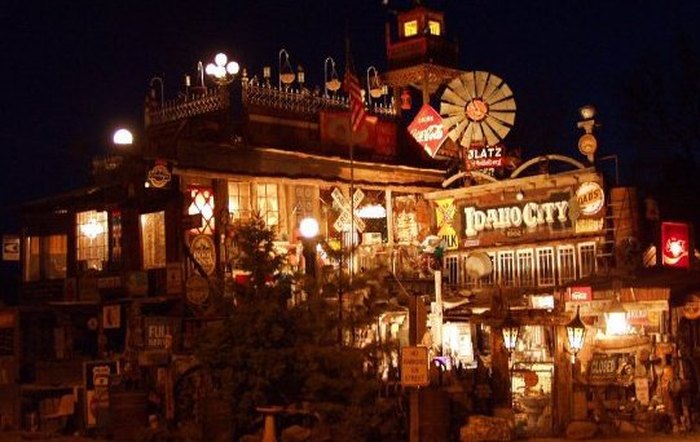
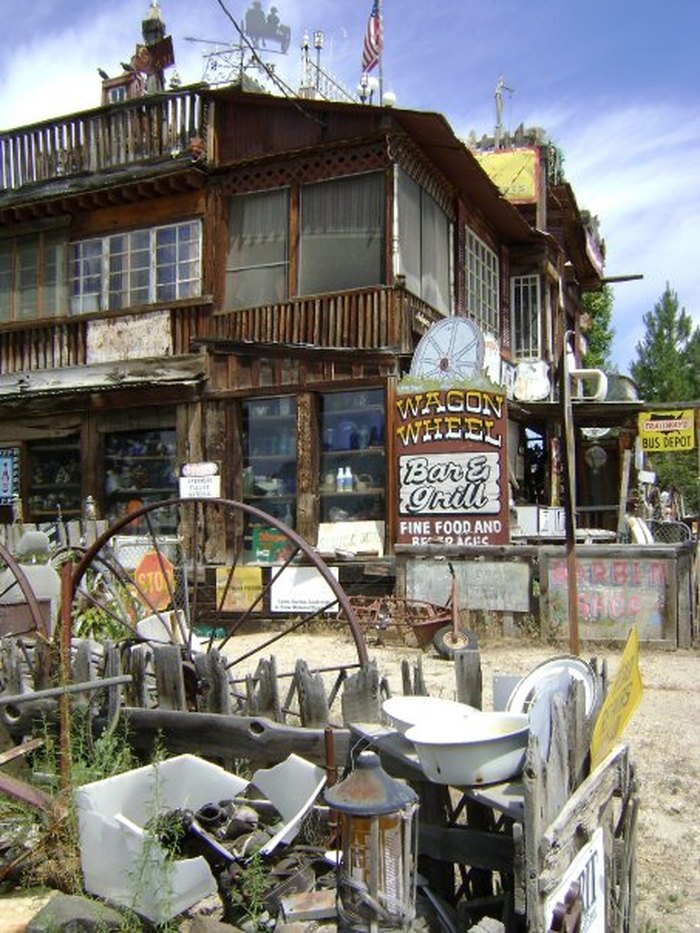
Idaho has dozens of odd, unique, and artistic residential houses, but few are able to be enjoyed or appreciated up close and personal without the term “trespassing” being tossed around. But this radical, eclectic shop/home in Idaho City has been a landmark and tourist favorite for decades, and has a heartwarming story to go with it. Check it out!
Welcome to the Sluice Box.
Where that old saying about “another man’s treasure” is actually the life’s work of one couple with big dreams in small-town Idaho.
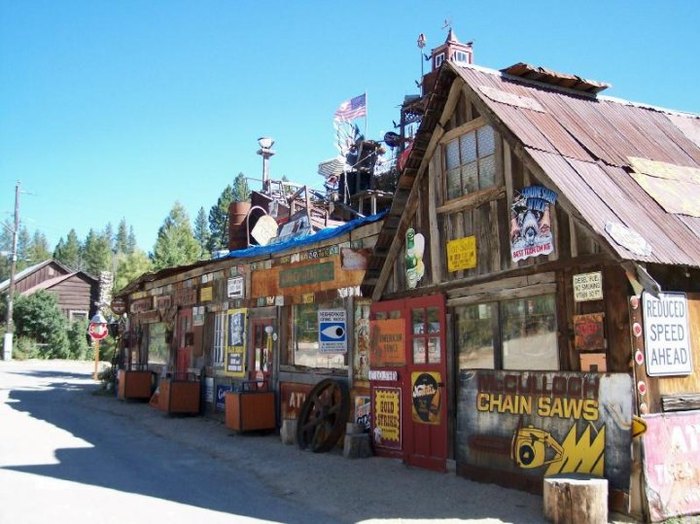
To quote a fellow writer, “It looks as though someone coated a normal two-story house in super glue, then dumped the contents of a well-stocked second-hand store on top of it. And then left it to rust and age for twenty years.”This second-hand and antique shop in Idaho City was hand-built by one man: Larry Carter.
Larry was the master builder and visionary. Wife Ruthie is the antiques expert.
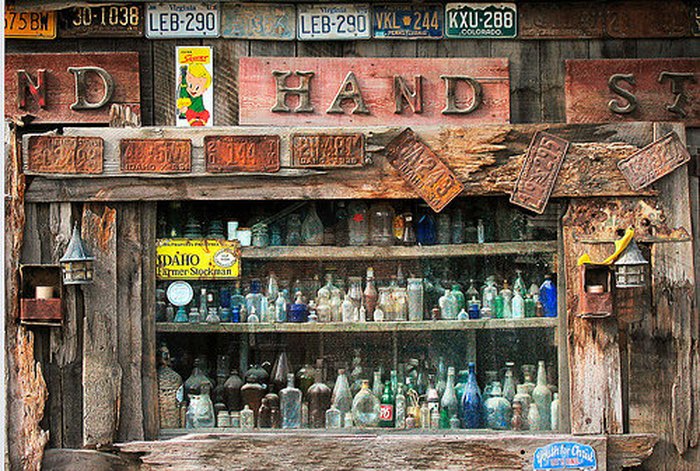
The massive inventory of unique objects was collected partly through travels across the Northwest.
But this eclectic Idaho landmark also has quite the story to tell.
The store originally opened in the 1970s in downtown Idaho City, where it quickly gained popularity as a treasure trove for antique lovers. Ruthie and Larry Carter relocated the shop into a late 1800s building where it stayed until it was caught fire in 1996. From there, despite numerous health concerns, Larry rebuilt the store from the ground up and filled it to the brim with collectibles, trinkets, and funky decor.Windmills, vintage signs, country decor…
And so much more.
The store consists of a maze of rooms and display cases all framed in genuine, reclaimed barn wood. There are custom built-ins, unique photos planted within the barn wood knotholes, and numerous other finds that you won’t see anywhere else. inside there are also hidden rooms and stairways, balconies, screened porches, hallways and at least one ‘official’ bedroom amidst the rooms on top of the unique store below.
There is also a small, overgrown garden nearby where nature is reclaiming Larry’s treasures in stunning feats of beauty, just the way he would have liked it.
Visitors often wonder if the massive shop, with its ever-evolving and winding interior, is haunted. Larry would say, “I hope so.”
Before his passing, Larry built towering eves, curved stairways, false rooms and a wide array of windowed lookouts on top of his masterpiece. As a young man, Larry became interested in tales of ghosts and supernatural stories — and while no reports of hauntings have been recorded, reportedly the tower that crowns the building maintained a permanent “open invitation” to any wandering, otherworldly souls.
Sadly, the store was recently sold in 2014.
But this beautifully rustic homage to one man’s passion remains standing and at last report, will be reopening soon.
One of the wonderful things about Idaho is that our landscape and towns have such phenomenal history, made personal with stories such as this. You can see more photos of this quaint antique shop on the Sluice Box’s Facebook page as well.
UPDATE: I was able to find out that the place has reopened in 2021. They are closed during the week and the winter but open on weekends throughout spring to fall. There have been some changes, but I refuse to go to facebook to see what they are. (There are recent claims that the place is haunted, but Larry never claimed that.) The Lobby Coffee is now inside and sells coffee and pastries.
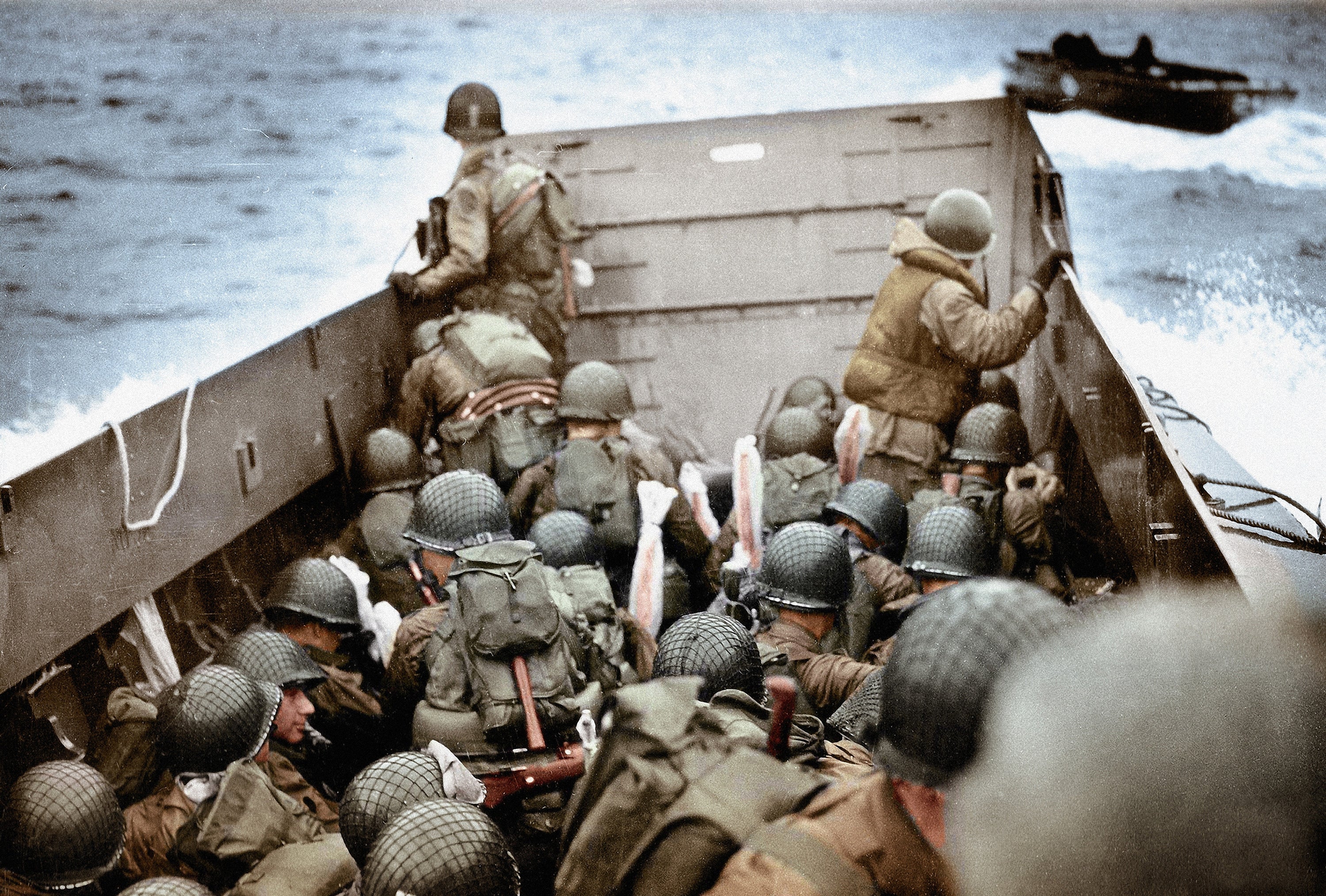
Without the brilliant planning and heroic sacrifices of the D-Day invasion, the Allies may have never defeated the Nazi forces in Europe. On June 6, 1944, more than 156,000 American, British and Canadian troops stormed 50 miles of Normandy’s fiercely defended beaches in northern France in an operation that proved to be a critical turning point in World War II. Below are key facts on the planning and execution of the epic Allied invasion.
D-Day Meaning: The ‘D’ in D-Day doesn’t actually stand for anything.
Unlike V-E Day (“Victory in Europe”) or V-J Day (“Victory over Japan”), the “D” in D-Day isn’t short for “departure” or “decision.” As early as World War I, the U.S. military used the term D-Day to designate the launch date of a mission. One reason was to keep the actual date out of the hands of spies; another was to serve as a placeholder until an actual date was chosen. They also used H-Hour for the specific time of the launch.
The D-Day invasion took years of planning.
Allied leaders Franklin Roosevelt and Winston Churchill knew from the start of the war that a massive invasion of mainland Europe would be critical to relieve pressure from the Soviet army fighting the Nazis in the east. Initially, a plan called “Operation Sledgehammer” called for an Allied invasion of ports in northwest France as early as 1943, but Roosevelt and Churchill decided to invade Northern Africa first and attack Europe’s “soft underbelly” through Italy.
D-Day was the largest amphibious invasion in military history.
According to the D-Day Center, the invasion, officially called “Operation Overlord,” combined the forces of 156,115 U.S., British and Canadian troops, 6,939 ships and landing vessels, and 2,395 aircraft and 867 gliders that delivered airborne troops.
Allied forces carried out a massive deception campaign in advance of D-Day.
The idea behind the ruse was to trick the Nazis into thinking that the invasion would occur at Pas-de-Calais, the closest French coastline to England. The Allies used fake radio transmissions, double agents, and even a “phantom army,” commanded by American General George Patton, to throw Germany off the scent.
A D-Day dress rehearsal was a fiasco.
Two months before D-Day, Allied forces conducted a disastrous dress rehearsal of the Normandy invasion on an evacuated English beach called Slapton Sands. Known as “Exercise Tiger,” 749 U.S. troops lost their lives after a fleet of German E-boats caught wind of the mock invasion and torpedoed American tank landing ships. Survivors described the Exercise Tiger fiasco as more terrifying than the D-Day landing on Omaha Beach.
Germany had fortified France’s coast.
Anticipating an Allied invasion somewhere along the French coast, Adolf Hitler charged Field Marshal Erwin Rommel with fortifying Nazi defenses in France. In 1943, Rommel completed construction of the “Atlantic Wall,” Germany’s 2,400-mile line of bunkers, landmines and beach and water obstacles. It’s estimated that the Nazis planted 4 million landmines along Normandy’s beaches.
The U.S. shipped tons of supplies to the staging area in England.
Since Operation Overlord was launched from England, the U.S. military had to ship 7 million tons of supplies to the staging area, including 450,000 tons of ammunition.
Bad weather delayed the invasion.
Troops and supplies were in place by May, but bad weather delayed the launch date of the invasion. On June 5, General Dwight D. Eisenhower, the Supreme Allied Commander in charge of Operation Overlord, decided that the invasion would happen the next day, in part because the weather was still rough and Nazi planes were grounded. That same day, 1,000 British bombers dropped 5,000 tons of munitions on Nazi gun batteries along the Normandy coast to cripple Germany’s defenses before the imminent invasion.
D-Day was carried out along five sections of beachfront.
Operation Overlord was divided among sections of beachfront along the Normandy coast code named, from West to East: “Utah,” “Omaha,” “Gold,” “Juno” and “Sword.”
Paratroopers launched the operation before dawn .
The D-Day invasion began in the pre-dawn hours of June 6 with thousands of paratroopers landing inland on the Utah and Sword beaches in an attempt to cut off exits and destroy bridges to slow Nazi reinforcements. American paratroopers suffered high casualties at Utah beach, some drowning under heavy equipment in flooded marshland, others shot out of the sky by Nazi snipers. The British and Canadian paratroopers met less resistance at Sword beach and quickly took two key bridges.
More than 156,000 Allied ground troops stormed the beaches. In wave after wave of thousands of landing ships, more than 156,000 Allied infantrymen stormed the five beaches. Facing them were around 50,000 Germans troops. Stormy seas made the landings incredibly difficult, with many regiments coming ashore far from their target destinations. At Omaha Beach, only two of the 29 amphibious tanks even made it to land on their own power (three were later transported to the beach). At Utah Beach, the American troops included 14 Comanche “code-talkers” who relayed critical tactical messages in their Native American tongue
The toughest fighting was on Omaha Beach.
At Omaha Beach, bombing runs had failed to take out heavily fortified Nazi artillery positions. The first waves of American fighters were cut down in droves by German machine gun fire as they scrambled across the mine-riddled beach. But U.S. forces persisted through the day-long slog, pushing forward to a fortified seawall and then up steep bluffs to take out the Nazi artillery posts by nightfall. All told, around 2,400 American troops were killed, wounded or unaccounted for after the fighting at Omaha Beach.
Canadian troops at Juno Beach captured the most territory.
Canadian soldiers also suffered terrible casualties at Juno Beach, battling rough seas before landing on a heavily defended strip of shoreline. Similar to the Americans at Omaha Beach, the first lines of Canadian troops were gunned down en masse by Nazi artillery—estimates put the initial casualty rate at 50 percent—before pushing beyond the beachfront and chasing the Germans inland. In the end, the Canadians at Juno captured more towns and territory than any other battalions in Operation Overlord.
All five beaches were secured by Allied forces by June 11.
Five days after the D-Day invasion, troops immediately began installing two massive temporary harbors that had taken six months to construct back in England. All told, the Allies unloaded approximately 2,500,000 men, 500,000 vehicles and 4,000,000 tons of supplies at the temporary harbors over the remaining course of the war.
The D-Day invasion marked a turning point in the war.
The total Allied losses at Normandy are estimated to be at least 4,413. Total Allied casualties in the Battle of Normandy, which dragged on until August, topped 226,000. But thanks in part to the massive influx of troops and equipment, D-Day marked a decisive turning point in the war. Less than a year later, on May 7, 1945, Germany signed an unconditional surrender.
[Since June is prime bridal season, I brought an article, written in 2021, detailing and explaining 13 wedding traditions.]
In 2021, there are truly no ‘rules’ to weddings—anything and everything goes, as long as it brings you happiness as a couple. That said, there is a reason why time-honored traditions have been mainstays of wedding days for so long: They’re guidelines that so many generations before you have indulged, historically, so it feels kind of like a nice privilege to entertain them at your own wedding celebration, right?
The cool thing about weddings now, though, is that you can pick and choose which customs and conventions you want to embrace or dismiss. Not wearing white, skipping the veil, sneaking a peek at your spouse before the ceremony—it can all be done without repercussions.
Whether you consider yourself superstitious or not, you might still want to take a few of these folklore referrals to heart. Ahead, read up on some of the longest-standing wedding superstitions that go well beyond something old, something new, something borrowed, and something blue.
Getting married on a weekday.
While Saturdays have long been the most popular days to get married for decades, an ancient Celtic poem claims couples should avoid a Saturday wedding at all costs. It reads: “Monday for wealth, Tuesday for health, Wednesday the best day of all, Thursday for losses, Friday for crosses, and Saturday no luck at all.” So if a Saturday nuptials isn’t in the cards, then a weekday wedding is quite alright!
Wearing white.
Wearing white on the day you get married is a dress code that dates back thousands of years and this verse explains why: “Married in white, you will have chosen all right. Married in grey, you will go far away. Married in black, you will wish yourself back. Married in red, you’ll wish yourself dead. Married in blue, you will always be true. Married in pearl, you’ll live in a whirl. Married in green, ashamed to be seen. Married in yellow, ashamed of the fellow. Married in brown, you’ll live out of town. Married in pink, your spirits will sink.”
Wearing something borrowed.
Out of the four “somethings” that brides have been conditioned to carry, “something borrowed” makes the most sense when it comes to luck! The idea here is that in addition to wearing something old and new, representing your pre-married life and your happy one to come, you should also borrow something from a happily married woman (your mom, mother-in-law, sister, grandmother, etc.). It’s thought that wearing something on loan from a long-married missus might just let some of her marital success rub off on you!
Forgoing any pearl accessories.
Speaking of something borrowed, although they’re very common family heirlooms, pearls are one semi-precious gemstone that you might want to pass on if they’re offered. According to several cultural belief systems, pearls embody the look of tears and point to sadness and suffering, so it’s best to keep them away from such an important day. If your partner proposes with a pearl, however, it stands that you can rebalance the karma by giving them a dollar—in essence, by paying for it, the ring is no longer a gift.
Including a sixpence in your shoe.
What most people don’t know about one of the oldest and most iconic wedding proverbs is that it is completed with the phrase “and a sixpence in her shoe.” Dating back to Victorian times, a father would place a sixpence (a coin equivalent to six pennies) in his daughter’s shoe as a token of good luck and prosperity. Nowadays, a penny is usually subbed in for the sixpence from any family member or friend. And if you don’t want to squeeze a coin in your stiletto, consider tying it to your bouquet or ring bearer’s pillow instead.
Adding a veil to your ensemble.
Veils have been part of the bride’s traditional trousseau for centuries. But to ancient Greeks and Romans, the veil was for function rather than fashion. They believed that a bride needed to wear a veil to make her less susceptible to the curses and hexes of jealous witches and evil spirits who wanted to steal her happiness. Once her face was obscured, so too were their vexes.
Crying all the way to the altar.
You’d be hard-pressed to find a bride or groom who doesn’t shed at least a few tears on their wedding day, but that’s actually a good thing. In fact, crying all the tears is a tried-and-true method of making sure you’re happy for the long haul. Once you’ve let the waterworks run, they’ll be as good as gone for the entirety of your marriage.
Saying farewell to your fiancée-ship a little too prematurely.
Using your married name before the actual wedding is kind of taboo ahead of tying the knot. There are a lot of negative, foreboding feelings associated with these anticipatory celebrations (like signing letters with your soon-to-be last name), ultimately suggesting that doing so will prevent the event from taking place altogether. And it doesn’t stop there, folklore also warns against trying on everything you’ll be wearing on your wedding day (dress, veil, shoes, headpieces, jewelry) before the day itself comes. So, if you plan on dressing or suiting up pre-wedding, just remember to leave one or two articles of clothing off.
Crossing paths with a nun or monk on the way to the wedding.
The British backstory goes that if you see a nun or a monk (both of whom notably take vows of chastity and poverty) en route to your wedding, you’ll be blighted with a barren life and dependent on charity. Granted, not every couple envisions a future with children and some prefer simplicity and experiences over money and material things, so this does suppose a pretty antiquated point of view.
Dropping the rings.
There is a timeworn forewarning that should someone drop a ring or ring(s) at the time of the ceremony, that person (regardless of role—bride, groom, officiant, best man, etc.) is next to die. Scary, right? Well, we can pretty much guarantee that there’s no truth to it, but you might just want to double-check how tightly those rings are tied on the ring bearer’s pillow and take your time with the ring swap.
Receiving knives for a wedding gift.
We’re well aware that a sharp set of knives is a common registry item. However, according to a legend that dates back to the Vikings, knives symbolize the cutting or breaking of a relationship. You truly never know what your wedding guests will end up bringing you for the big day, but if you want to hedge your bets on not receiving something like this heartbreak-ridden hardware, maybe just remove it from the registry altogether. Or, send your guests a penny enclosed in their thank you card to switch the script from a gift to a purchase!
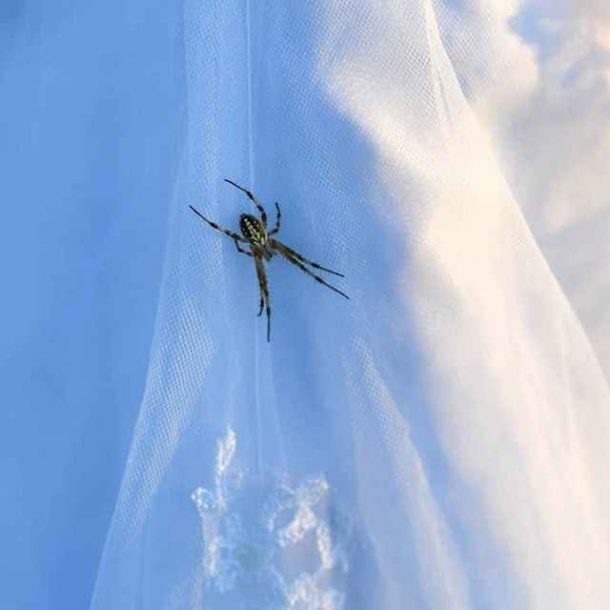
A spider showing up on your attire.
Most people don’t enjoy spotting a spider, but if one shows up on your wedding outfit on the big day, just grin and bear it. English tradition holds that if a spider weaves its way into your wedding day, it’s a terrific and radiant omen; so, come through Charlotte!
Rain on your wedding day.
Rain on your wedding day is something that all couples will stress over, but according to several cultures’ canons, it represents a streak of luck for your special day. If you see dark clouds gathering and raindrops coming down, don’t fret as you’re getting wet: It symbolizes fertility and cleansing, and if ever there were a perfect day to start with a clean slate, it’s your wedding day.
The red panda is known as the “first panda” because it was so named nearly 50 years before the giant panda.
Even though the red panda is classified as a carnivore, its diet is almost exclusively bamboo.
Englishman Major-General Thomas Hardwicke was most likely the first to describe the red panda, but he did not publish his work for several years. In the meantime, Frédéric Cuvier did not wait as long and published the first written description of the red panda in 1825.
Red pandas, like giant pandas, live in Asia’s high forests and are bamboo eaters. However, despite these similarities, red pandas and giant pandas are not related.
Both red pandas and giant pandas have a pseudo-thumb, which is a modified wrist bone.
The name “Firefox” is the red panda’s nickname
The Mozilla Firefox logo is not a fox; it’s actually a red panda. One of the red panda’s nicknames is the red fox.
Red pandas are the only living member of the family Ailuridae.
The red panda is not actually a panda. It’s believed that its name is derived from the Nepalese words “nigalya ponya,” meaning “bamboo eater.”
A red panda eats approximately 200 bamboo shoots and leaves per day, which is about 20 to 30% of their body weight.
Though listed as endangered, the red panda is poached regularly for its pelt and beautiful tail, which is often used on hats for wedding ceremonies in the Yunnan province of China.
A red panda is also known as the lesser panda, the red bear cat, and the red cat bear.
A red panda is a bit larger than a domestic/house cat.
The red panda is the only known non-primate mammal to show a preference for the artificial sweetener aspartame.
Is the red panda a bear? A type of raccoon? Throughout the years, scientists have placed the adorable animal in either the racoon or bear family. They now classify it as the only surviving member of the family Ailuridae.
Scientists estimate that the red panda population will decline by over 10% in the next three generations.
There are fewer than 10,000 mature red pandas left in the world, and only 2,500 left in the wild. Additionally, despite being listed as endangered, their population continues to decline due to habitat loss, poaching, and problems associated with inbreeding.
The scientific name for the red panda is Ailurus fulgens, which means “red shining cat.”
The red panda is also known as the lesser panda, firefox, and red cat-bear.
The red panda is found in five countries: Nepal, India, Bhutan, Myanmar, and China.
Because red panda cubs are very small (3.5 ounces) when they are born, their survival rate is as low as 50%.
Due to their low-calorie diet, red pandas do little more than eat and sleep.
The red panda is considered to be a living fossil.
Red pandas are more closely related to skunks, weasels, and raccoons than they are to giant pandas.
The first known written record of the red panda is found in a 13th-century Zhou (Chou) dynasty scroll. They weren’t known to Europeans until six centuries later.
The red panda was almost named “wha” because it has a loud cry or call that sounds like the word “wha.”
According to one scientist, the red panda is the most beautiful mammal on earth.
Frédéric Cuvier, who published the first Western scientific description of the red panda in 1825, called it “quite the most handsome mammal in existence.”
A red panda named Babu escaped a nature reserve in England and spent four days on the lam. His escapades turned him into a media sensation before his recapture.
A red panda cub weighs just about 3.5 ounces at birth and easily fits in the cupped palm of a hand.
Scientists see red pandas as a critical indicator species for the health of the Himalayan ecosystem.
The character Master Shifu in the movie Kung Fu Panda is a red panda.
Red pandas have escaped from zoos in London, Birmingham, Rotterdam, and the Smithsonian Zoo. The Association of Zoos and Aquariums includes in their care package of information: “beware,” red pandas are escape artists.”
There has been a 40% decrease in the red panda population over the last 50 years.
Red pandas are typically shy and solitary, except when they are mating.
Smart, passionate, and dynamic, Gemini is characterized by the Twins, Castor and Pollux, and is known for having two different sides they can display to the world. Expert communicators, Gemini is the chameleon of the Zodiac, adept at blending into different groups based on the vibe and energy they perceive. While they’re also amazing at showcasing surface traits, the Gemini well runs deep, which is why the Twins are one of the Zodiac’s most emotionally intelligent signs.
Energetic and quick-witted, Gemini never gets stuck in the past and doesn’t ruminate on what might have been. Instead, they move forward with glass-half-full optimism and an ability to always look on the bright side—and land on their feet—in nearly any situation. With a mind that’s constantly racing, even when they’re just quietly hanging out, the Twins never get bored. In fact, Gemini are happy keeping their own company, and can often turn their solitary daydreams into reality.
Gemini signs are in love with love, and they adore the ritual of it all, from those “do they like me?” butterflies to the anticipation of a back-and-forth text volley. Gemini loves dating, and the world loves Gemini. But a Gemini will eventually settle down, because this sign is incredibly loyal and steadfast once they’ve chosen a partner. Let’s be clear, though: Steadfast isn’t a code word for boring. Gemini always love to keep things fresh and are happy to try almost anything in the bedroom. They’re proud of their sexuality and depend on frequent physical check-ins to keep them grounded in their body. To them, sex is a celebration of life, and Gemini loves both sex and life.
Despite their unfair rep for being two-faced, once a Gemini is in your life, they’re loyal for life—but they aren’t afraid to voice their opinion if they feel you’re doing something they disagree with or if they perceive you as not being loyal to them. Always a sign to see all sides of the situation, Gemini may seek input from friends before going to the root of the problem. It’s not gossiping—it’s gathering information.
And even though Gemini is easily the life of the party without trying, the Twins also have a deep emotional side that needs care and feeding. Gemini like time by themselves to read, create, daydream, and come up with other ways of sharing their gifts with the world. When a Gemini can truly tap in and share their gifts, they’re an unstoppable force of energy that can motivate, inspire, and enchant the rest of the Zodiac.
Gemini in Love
Dynamic, intense, and with so many shifting parts to their personalities, Gemini love to date. Indeed, they consider dating a skill. Gemini are great at drawing first dates out of their shells, and they rarely have a “bad” date—because this optimism-infused sign will always find something positive about the person they meet or the conversation they shared.
Gemini Friendship Style
The bad news: Gemini will forget your birthday or flake on a date that you set in the calendar months ago. The good news: It’s not personal, and your Gemini friend will make it up to you. Funny, witty, and talking a mile a minute, a Gemini will keep you laughing, and it’s likely that some of your best memories involve a Gemini.
Gemini Career, Money & Success Traits
Gemini’s greatest career strength: Communication. Inspired by Mercury the messenger, Gemini is an amazing communicator who knows innately how to present ideas for approval. Whether it’s standing in front of a meeting, delivering a killer deck, or writing an amazing article, Gemini is a master wordsmith.
Gemini’s Greatest Gifts
Equipped with almost uncanny emotional intelligence, Gemini can easily read a room and know exactly what other people want to hear from them. They can easily shift their personality depending on mood, going from Friday night life of the party to Monday morning office superstar. Energetic and passionate, Gemini can breathe new life into a same-old routine and excite other people simply by their all-in presence.
Gemini’s Greatest Challenges
That social chameleon rep can sometimes earn Gemini a reputation as two-faced. While a Gemini is all about truth, sometimes a Gemini is more likely to talk to others about a conflict instead of approaching the person who’s actually causing it. The Twins have also been known to stir up gossip just to keep things exciting.
Gemini’s Secret Weapon
Intelligence. Gemini is quick-witted and can read a room or situation in an almost supernatural way. Without saying very many words, a Gemini soon knows who has an agenda, who’s a good ally, and who may need someone to bolster them up. Because of this, Gemini is an amazing friend, leader, and person everyone should be lucky to have in their lives.
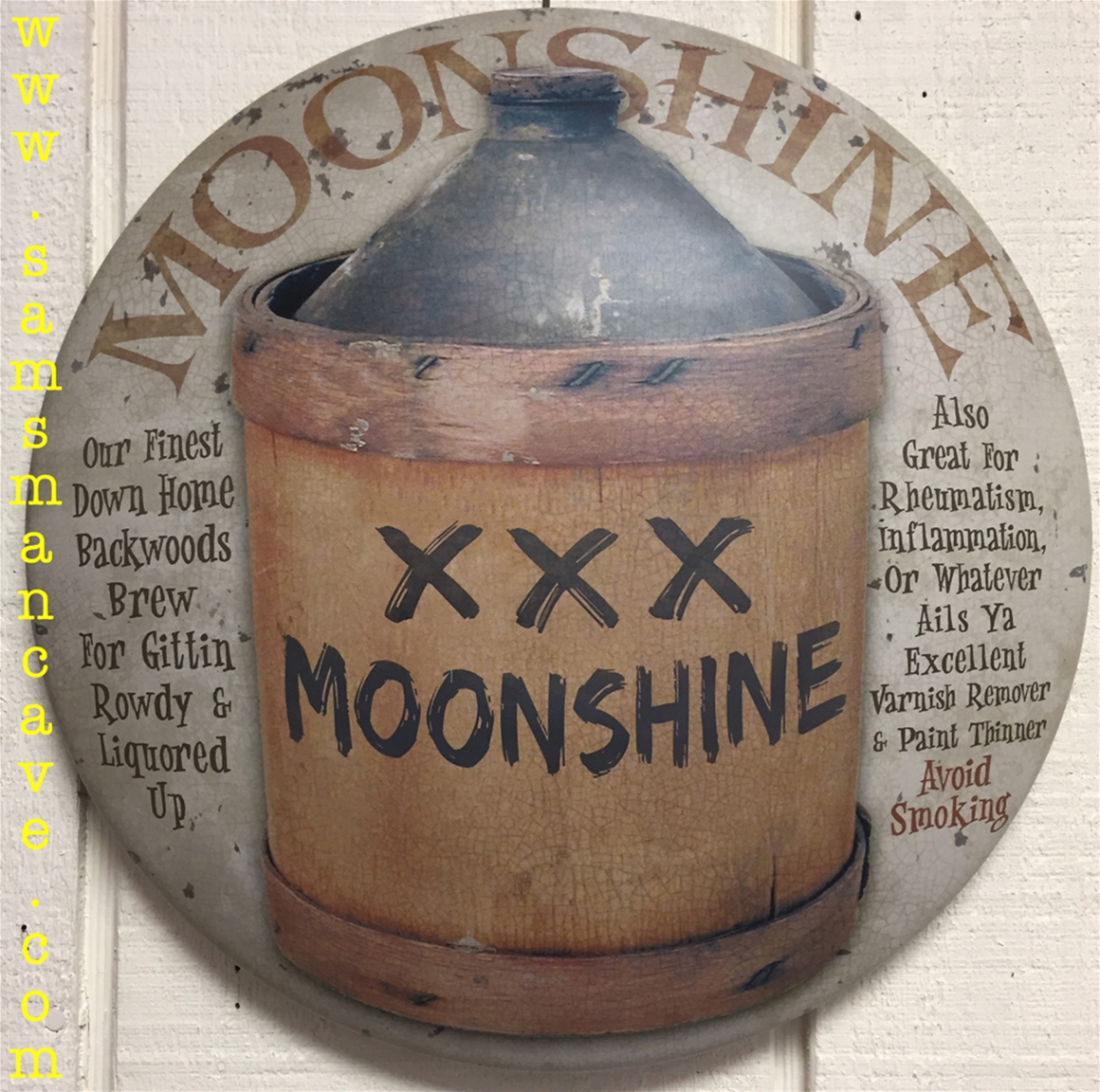
In honor of this momentous occasion, I present a recipe I found in a recipe book called Old Timey Recipes.
Moonshine
“In making “mountain dew” or “white lightning” the first step is to convert the starch of the grain into sugar. (Commercial distillers use malt.) This is done by “sprouting” the corn. Shelled, whole corn is covered with warm water in a container with a hole in the bottom. Place a hot cloth over it. Add warm water from time to time as it drains. Keep in a warm place for about 3 days or until the corn has 2-inch sprouts. Dry it and grind it into a meal. Make mush (or mash) with boiling water. Add rye mash that has been made the same way, if you have it.
Yeast (1/2 pound per 50 gallons of mash) may be added to speed up the fermentation if you have it. Without it, 10 or more days will be required instead of about 4. In either case, it must be kept warm.
When the mash gets through “working” or bubbling up and settles down, it is ready to run. At this stage, the mash has been converted into carbonic acid and alcohol. It is called “wash” or beer and it is sour.
The “cooker” consists of two main parts, mainly the top and the bottom.After the mash is put inside, the top is pasted on with “red dog chop” or some other paste.This is so that if the fire is too hot, the pressure builds up, the top will blow off preventing an explosion which might wreck the still.In the top of the cooker a copper pipe, or “arm” projects over to one side and tapers down from a 4 or 5 inch diameter to the same diameter as the “worm” (one or one and a quarter inch).To make the “worm”, a 20-foot copper pipe is filled with sand, the ends are stopped up, and it is wrapped around a fence post. The sand prevents “kinking” of the pipe.The spiral or coil, called the worm, is then cleaned and attached firmly to the end of the arm in such a way that it is down inside a barrel.The barrel will be kept full of cold, running water.If the water runs in the top and out an opening in the bottom, it can circulate better.
A fire under the cooker causes the spirit to rise in the vapor along with the steam. It goes into the arm and then the worm where the cold water causes condensation. This is collected at the end in a container.
The first run off, or “singlings” is weak and impure and be redistilled to rid it of water and rank oils.
For the second run off, or the “doublings,” the cooker is cleaned out and the singlings, along with some water, is heated and run through again.
The first quart will be far too strong (about 200 proof) and towards the last it will be too weak (about 10 proof). The skill is in the mixing to make it 100 proof.
If a tablespoon of the liquid does not “flash” or burn when thrown on the fire, there is not enough alcohol left to bother running any more.
To test for the right proof, a small glass vial is used. When the small bubbles rise properly after the vial is tilted and when they set half above and half below the top of the liquid, then it is the right proof. The liquor is then filtered through charcoal and is ready for consumption.
There are many ways of making moonshine. This is just one way. For other ways, check with your nearest revenuer.”
Hibiscus tree is an annual or perennial herbaceous plant with trumpet-shaped flowers. This tropical tree grows in full sun or partial shade and does best in moist, well-drained soil. With over 200 species and many more cultivars in the genus, hibiscus flowers can reach nearly 10 inches in diameter at maturity and come in a wide range of colors from white to red, pink, yellow, and orange.
Tropical hibiscus varieties (Hibiscus rosa-sinensis) are perfect if you live in a warm climate or want an impressive houseplant. For those living in cooler parts of North America, opting for a hardy variety or the shrubby rose of Sharon (Hibiscus syriacus), which are both easier to grow and can withstand colder winter temperatures, will be the better choice. Regardless of variety, hibiscus flowers are very attractive to butterflies and hummingbirds.
While all hibiscus have similarities that go beyond appearance, they have some distinct care and growing requirements.
Hibiscus Care
The care you provide your hibiscus will vary depending on whether it is a hardy or tropical variety and whether it is grown indoors or outdoors.
Warning
You can grow most species of hibiscus without worrying about them getting out of control. However, rose of Sharon (Hibiscus syriacus) is classified as an invasive species in much of eastern North America.1
Light
Hibiscus love bright conditions. In northern climes, full sun is often best, but in the intense, dry heat of the south, filtered sunlight is better. If you find that your plant isn’t producing many blooms, move the plant to a sunnier location.
Indoor tropical hibiscus will need a bright spot near a sunny window but keep it away from strong, direct sunlight. If you are transferring your plants outdoors when the warmer weather arrives, gradually acclimate them to the brighter conditions.
Soil
All hibiscus do best in well-drained, fertile, moist, loamy soil. The hardy varieties are wetland natives and are a good choice for sites that are too wet for other plants.
Most hibiscus prefer a slightly acidic soil pH, but the rose of Sharon is tolerant of alkaline conditions. The color of hibiscus flowers can be affected by the soil acidity level.
Mulching around the plant base can help with moisture retention if your location is experiencing dry conditions. For nutrient-poor soil, amending with organic matter will be beneficial.
Water
All hibiscus are thirsty plants that need to be kept moist. Indoor tropical hibiscus benefit from regular watering from spring to early autumn during the growing season. Significantly reduce watering during dormant periods. For container-grown plants, ensure the top inch or so of potting mix dries out fully before watering—saturated soil is also problematic, and make sure containers have adequate drainage holes.
Depending on the conditions, you might need to water your hibiscus daily to help it produce an abundance of blooms.
If your hardy hibiscus are not planted near a pond or in another wet area, water them on a regular basis to keep them moist.
Temperature and Humidity
Rose of Sharon and hardy hibiscus can grow in cool, temperate climates. They thrive in temperatures from 60 to 90 degrees Fahrenheit but can handle temperatures as low as 20 degrees Fahrenheit. When temperatures drop below 30 degrees Fahrenheit and frost is a risk, bring container-grown plants indoors. However, be mindful of their higher humidity requirements—which is why bathrooms are a good location for these plants.
Temperatures below 50 degrees Fahrenheit can kill tropical varieties, so they are best housed in humid locations indoors in regions where this is likely to occur.
Fertilizer
To encourage abundant, healthy blooms with good color, feed plants with a high potassium and high nitrogen fertilizer. Fish emulsion and seaweed extract are organic fertilizers. Feed a half-strength solution just before the start of the bloom period and continue at least once every few weeks until the end of flowering.
Types of Hibiscus
There are hundreds of tropical and hardy hibiscus hybrids and cultivars available. Just a few popular varieties include:
Swamp Hibiscus (Hibiscus coccineus): An unusual, hardy species featuring large pinwheel-like flowers
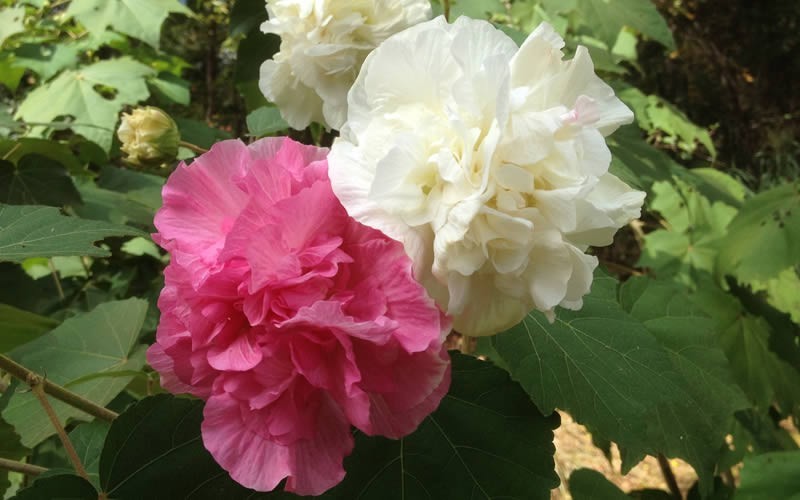
Confederate Rose (Hibiscus mutabilis): This hardy rose mallow has large, showy flowers that open white and then change color.
Hibiscus rosa-sinensis ‘Cajun Cocktail’: A tropical cultivar with striking orange and yellow ruffled blooms, giving each one a one-of-a-kind appearance.
Hibiscus moscheutos ‘Perfect Storm’:A hardy, compact hybrid cultivar that blooms late in the season.
World Otter Day occurs on the last Wednesday of May, which is May 31 this year. Otters are beautiful, playful animals that live in wetlands across the world. Species are declining due to habitat destruction, reduction of prey, roadkill, and illegal trade for fur and as pets.
There are 13 different species, 12 of which are disappearing. Seven of these species are classified as vulnerable and five are endangered. The International Otter Survival Fund founded World Otter Day with two goals in mind. First, to help raise awareness of the dangers that otters face. Second, to educate people on how to protect their habitats.
River Otters
Sea Otters
HISTORY OF WORLD OTTER DAY
World Otter Day had humble beginnings as Otterly Mad Week, a week of events, education, and fun. Then International Otter Awareness Day was founded before becoming the International Otter Survival Day, then World Otter Day, whose singular purpose is to ensure that future generations can enjoy these charming animals.
International Otter Survival Fund began in 1993 to protect and help the different species of otters worldwide. It was inspired by observing otters in their natural habitats. The Fund is one of the world’s leading charities with various projects that protect otters. They have dedicated over 20 years of research to conserving, protecting, and caring for otters and have developed a worldwide program to encourage education on otters.
To date, they have supported projects in 44 countries and helped cubs in 33 countries.
Since 2009, they held workshops across the world in places such as Cambodia, Indonesia, Bangladesh, and China. The workshops provide training in otter field techniques, public awareness programs, law enforcement, and general conservation issues. Some other activities include research, campaigns, training, and otter hospitals.
5 FACTS ABOUT OTTERS
1. Most of them live in Alaska: About 90% of all sea otters live on the coast of Alaska.
Alaska Otters Rebound
2. They have their own tools. Otters use rocks to open clams and carry them around in case they are needed.
3. They are amazing at holding their breath. Sea otters can hold their breath for five minutes and river otters can hold theirs for eight.
4. They have a thick fur. Sea otters lack any blubber, so their thick, dense, water-resistant fur keeps them warm.
5. Their dung tells a story. Scientist believe they may be able to determine the sex, age, and reproductive status of an otter just by studying it’s dung.
WHY WORLD OTTER DAY IS IMPORTANT
Otters are cute. We don’t need too much convincing to spend the day learning about them. They are the cutest, quirky, furry animals.
Conservation is always a plus. World Otter Day focuses on teaching people about the conservation of our planet and our wildlife.
It’s a worthwhile global cause. Otters are found all over the world. They are also celebrated in over 20 different countries.





































:max_bytes(150000):strip_icc():format(webp)/hibiscus-growing-guide-5192541-hero-615db48a744245c49517f7f4bef54d18.JPG)



/grow-storm-hibiscus-rose-mallow-4125795-06-c3f2ae0b2c974f32bdc7aa39e5d79c91.jpg)





 Sew Colorful