
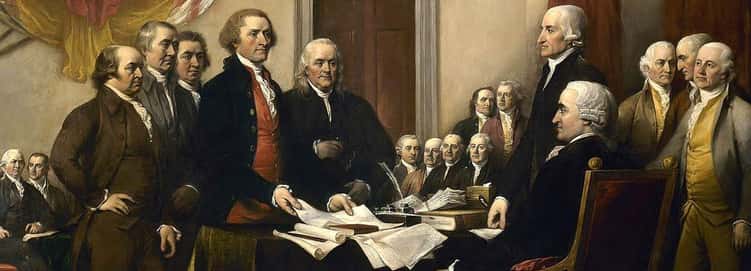
America’s history is a brief yet rich one. Relative to the rest of the world, we are still just a little baby of a country. We often forget that our founding fathers were humans just like the rest of us — they just happened to have lived some 300 odd years before we did, and, you know, wrote the Declaration of Independence. But these American heroes had their flaws and their secrets, too.
These secrets about the founding fathers are both surprising and eye-opening. There are myths about these men that we’ve all gone along believing our whole lives without a second thought. But in some cases, we may have been entirely wrong!

Thomas Jefferson Was A Terrible Public Speaker
The author of the Declaration of Independence and our third president only ever gave two speeches, one at each of his inaugurations. While he was elegant with words on paper, he didn’t like speaking out loud, much less in front of large crowds. The speeches he did give were delivered very quietly, too.
Thomas Jefferson was also addicted to learning. Born April 13 (April 2 on the pre-Gregorian calendar), 1743 at his father’s Shadwell plantation in Virginia, Jefferson was one of 10 children (eight of whom survived to adulthood). While he attended the College of William and Mary, he was said to have studied for 15 hours daily on top of violin practice. The hard work paid off: Jefferson moved into law studies before becoming a lawyer in 1767. Two years later, he became a member of Virginia’s House of Burgesses, the Virginia legislature. His autodidact ways continued throughout his life: Jefferson could speak four languages (English, Italian, French, Latin) and read two more (Greek and Spanish).

John Adams And Jefferson Were Rivals
John Adams and Jefferson were the only two signers of the Declaration to become president, but they also hated each other’s guts. Before Jefferson passed away on July 4, 1826, he had finally made amends with John Adams, the president who preceded him in office and for whom Jefferson served as vice president. The two men, once on the same side, had grown to resent the other’s approach to diplomacy and politics, with Jefferson lamenting Adams’s preference for centralized and meddlesome government—though according to Jefferson, the major issue was the so-called “Midnight Judges,” appointments that Jefferson felt “were from among [his] most ardent political enemies.”
Strangely, Adams passed away the same day as Jefferson, just five hours later. The date, July 4, was also the 50th anniversary of the Declaration of Independence being adopted.

George Washington Didn’t Have Wooden Teeth
This is a fun fact that lots of people like to pull out of their back pocket, but it isn’t even true. George Washington’s teeth were actually made of bone, hippopotamus ivory, human teeth, brass screws, lead, and gold metal wiring. That’s quite the mouthful right there. And his hair was all real but it looks white because he powdered it.
He was a very moral and virtuous man, and he watched carefully everything he did. But he certainly doesn’t fit into our conception of a Christian evangelical or somebody who read his Bible every day. He was not an atheist on the one hand, but on the other hand, he was not a devout Christian. But what about he story of him kneeling in the snow at Valley Forge to pray? “That’s a story that was made up by [early Washington biographer] Parson Weems.” Oh, and Parson Weems, who wrote a myth-filled biography of Washington shortly after he died, made up the cherry tree story. The Mount Vernon Digital Encyclopedia identifies that book, The Life of Washington, as “the point of origin for many long-held myths about Washington.”

Adams Was “Out Of His Senses”
Well, at least according to Benjamin Franklin. And it seems the feeling was mutual. The two were at the French court of Versailles together as ambassadors when Adams wrote that a statue in the court would make a better ambassador than Franklin. Harsh!
Adams thought Franklin uncouth, vulgar, pretentious…and those were his good qualities. Their poor relationship got off to a rocky start in the fall of 1776. Franklin and Adams had to share a room and a bed in Brunswick where Adams and Franklin went to parley with Adm. Lord Richard Howe over a possible end to hostilities. Adams wanted to sleep with the window closed. Franklin wanted it open. Adams thought it would cause him illness. Franklin thought it would cause good health. After much argument, Franklin prevailed.
Adams grew to dislike Franklin more in Paris. Franklin wore plain clothes for effect. Adams disapproved of his garb. Franklin was a particular favorite of French women. Adams could not understand why this was the case. Adams thought Franklin behaved disreputably and immorally. He did not see how Franklin was using his conduct to obtain contacts and access. What Adams could not understand was how Franklin used these idiosyncrasies to advance the nation.
Paul Revere Wasn’t The Only Midnight Rider
A 16-year-old girl named Sybil Ludington rode 40 miles, twice Revere’s distance, when the British took Danbury, CT. She may have even staved off a band of highway robbers on the way. On April 26, 1777, at age 16, Ludington, the daughter of a colonel in the Colonial militia, Henry Ludington, is said to have made an all-night horseback ride 40 miles (64 km) to rally militia forces in neighboring towns after the burning of Danbury, Connecticut by British forces.

Relatively unknown through the 1870s, Ludington became widely recognized around the time of World War II, after historic road markers were placed in locations she was speculated to have visited on her ride. Memorial statues honor her, and books have been written about her. She was honored on a United States Bicentennial postage stamp that was released on March 25, 1975, which depicts her on a horse.

Benedict Arnold Had Help With His Famous Betrayal
Arnold’s wife, Peggy Shippen, was half his age when they met. She’d previously had a fling with a British spy, John André, and introduced her old lover to her new husband. Together, the three of them plotted to give West Point to the British, which would have squashed America’s independence entirely.


Rumors Swirled Around Washington’s Lack Of Children
Many historians have speculated that perhaps George Washington struggled with infertility, as he had no children of his own. Experts say that tuberculosis often causes this extremely common condition in men. Throughout his life, Washington suffered from a laundry list of ailments: diphtheria, tuberculosis, smallpox, dysentery, malaria, quinsy (tonsillitis), carbuncle, pneumonia, and epiglottitis—to name a few.
“Classic studies of soldiers with tuberculous pleurisy during World War II demonstrated that two-thirds developed chronic organ tuberculosis within five years of their initial infection. Infection of the epididymis or testes is seen in 20 percent of these individuals and frequently results in infertility.”

James Madison Used A Secret Code
Madison—like any good politician—was terrified by the idea that someone might intercept one of his private letters. Along with Jefferson and many mutual allies, Madison used complicated encryptions when relaying delicate info. “Having now the use of my cypher,” he informed Jefferson in 1784 after mastering a new system, “I can write without restraint.”
Said to be shy and reserved, Madison apparently had a counterbalance in wife Dolley, who entertained the whole of Washington. At the time, the city was not exactly a hotbed of partying, and her lavish affairs helped endear congressional members to the idea of Madison as president. To date, Madison remains our smallest president at 5 feet, 4 inches and 100 pounds.
Both of James Madison’s vice presidents died in office. George Clinton kicked the bucket in 1812. His short-lived replacement was former Massachusetts governor Elbridge Gerry, who’d redistricted that state to tip the political scales in his favor—a process we now call “Gerrymandering.” Gerry also died in office, and is the only signer of the Declaration of Independence to be buried in Washington, D.C.
He also had a sharp sense of humor. Politics is a pretty serious career, but that didn’t take away Madison’s sense of humor. Among friends, he was known for his quick wit, quippy banter, and well-timed personal anecdotes.

Skeletons Were Buried Under Franklin’s London Home
No, he didn’t murder the people. There was a human anatomy class being run from his basement, which was a very tricky subject at the time. The bones from 15 different bodies were found when, in 1998, work was being done on the historic home.
While all of the Founding Fathers are renowned for pushing the idea of liberty and independent choice, Benjamin Franklin apparently came to the idea a little late. In 1725, when he was just 19 years old, Franklin self-published a pamphlet titled ‘A Dissertation Upon Liberty and Necessity, Pleasure and Pain,’ which argued that humans didn’t actually have free will and weren’t responsible for their behavior. Maturity prevailed, however, and Franklin later burned almost every copy of the booklet he could find.

Ben Franklin’s eccentricity wasn’t limited to that strange philosophy. He once had a plan to rearrange the English alphabet by eliminating the letters C, J, Q, W, X, and Y, declaring them redundant. It didn’t katch on.
If you’re reading this while watching a sunrise, you might have Ben Franklin to thank. A more reasonable Franklin contribution: bifocals, which he invented in order to both see from a distance and read text up close without having to switch lenses.




























 Sew Colorful