Tiger nuts are not nuts, but tubers with a lightly sweet, nutty flavor with nutrients and health benefits. Here’s what you need to know. Despite their name, tiger nuts aren’t actually nuts. These wrinkly little foods are actually tubers like potatoes and yams.
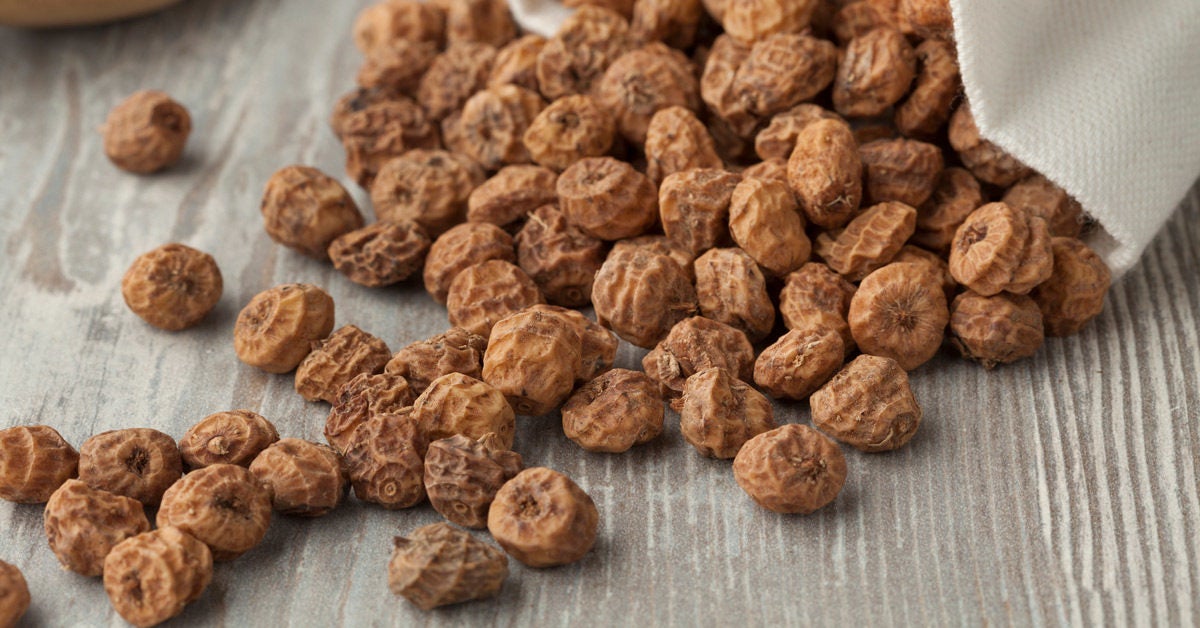
Tiger nuts are also known as yellow nutsedge, chufa, or earth almonds. This grass-like weed is common in Mediterranean and tropical climates around the world. Tiger nuts have a slightly sweet, nutty flavor. They’re “roughly the size of a garbanzo bean (chickpea)” and “wrinkly, almost like a raisin,” says North Carolina-based RDN Sheri Vettel at the Institute for Integrative Nutrition.
These nuts are also a great source of fiber, magnesium, and potassium. “Their texture is like a Brazil nut but has the sweetness of pecans and the earthiness of a sweet potato” adds Mary Gollan, RDN and board member of the Connecticut Academy of Nutrition and Dietetics.
Tiger nuts were one of the first foods grown in ancient Egypt, and people have been eating them for thousands of years. Now the snack is becoming popular as a healthy, plant-based boost for everything from weight loss to heart health, explains Mascha Davis, RDN. However, it’s important to note that the science behind some of the purported benefits is up for debate.
A 2018 market research study revealed that an increased demand for healthy plant-based snacks has fueled the sales of tiger nuts in recent years.
There’s not a lot of research on these interesting tubers, but here’s what our panel of experts say we know right now. (Learn about these fall superfoods.)
Tiger nut nutrition basics
Nuts are known as a great source of plant-based protein. But what about tubers such as tiger nuts?
“Tubers are vegetables that grow underground attached to the root of the plant and are usually high in starch,” says Melissa Kathryn, RD, a certified holistic nutritionist. She points out that tiger nuts are loaded with fiber and a great source of resistant starch—a kind of carbohydrate that is difficult to digest and can actually help feed healthy bacteria in the large intestine. “They also have complex carbs, which provide energy for the body to function,” says Kathryn.
Tiger nuts are starchy like potatoes but have a similar fiber content to almonds. The fat and protein content is lower than typical tree nuts such as almonds, cashews, or hazelnuts.
“They provide a great number of nutrients such as calcium, magnesium, potassium, sodium, phosphorus, zinc, and vitamins E, C, and folic acid,” says Kathyrn. While you might not get enough of these micronutrients from one handful of tiger nuts, eating them regularly could help you get enough of these vitamins and minerals over time.
The health benefits of tiger nuts
Tiger nuts are packed with resistant starch, fiber, and micronutrients, such as magnesium and potassium. In theory, consuming these nutrients should result in better health. However, research on the direct health benefits of tiger nuts is still limited—at least in humans, anyway. Most research on tiger nuts has been animal or cell studies.
KaNisha L. Hall, MD, physician and wellness coach in Houston, says that although the vegan snack has grown in popularity there is little concrete and reproducible data to support that the actual health benefits are greater than placebo. “Based on the fiber content, claims have been made that it improves digestion and glucose levels. The antioxidants are suggested to prevent harm from free radicals and furthermore prevent heart disease and cancer. Some sources have also claimed the food to be an aphrodisiac,” she says. However, Dr. Hall cautions that “credible research has not supported these findings.”
Tiger nuts may ease constipation
Gollan, Kathryn, and Vettel agree that tiger nuts could help make your bowel movements smoother and easier, relieving constipation. Constipation is usually a clear sign that you’re not eating enough fiber. According to Gollan, the combination of fiber and magnesium “keep our bowels regular and happy.” Kathryn adds that tiger nuts are a good source of insoluble fiber in particular, which is known to add bulk to stools and help clean out the intestinal tract.
Tiger nuts may be an aphrodisiac
Historically, people sometimes have eaten tiger nuts to improve sexual performance. But despite claims in the Middle East and parts of Africa that this snack increases men’s sexual arousal, there is no scientific data to support this claim. In one animal study published in BMC Complementary Medicine and Therapies, male rats that received doses of raw tiger nut powder did engage in more frequent sexual activity than rats without tiger nut powder. However, there’s still a lack of evidence when it comes to linking tiger nuts to human libido.
Tiger nuts may help your heart
“Beyond the tiger nuts’ contribution to a healthy gut, they are also high in iron as well as healthy fats, specifically monounsaturated fatty acids,” says Vettel. “These types of fats, also found in healthy foods such as avocado, olive oil, and nuts such as almonds and walnuts, are known to lower cholesterol and promote heart health.” A 2018 study published in the American Journal of Clinical Nutrition also found that plant-based monounsaturated fatty acids are particularly helpful for reducing the risk of heart disease in both men and women.
Tiger nuts could aid weight loss
While tiger nuts will not directly improve your body’s ability to burn fat, they can be a healthy snack for those trying to lose weight. That’s because of their high percentage of insoluble dietary fiber. According to a tiger nut review published in Comprehensive Reviews of Food Science and Food Safety, “The intake of this kind of fiber is linked to a sensation of satiety since the fiber absorbs water and takes up space in the stomach and diminishes the need to consume more food.” So, eating tiger nuts has the potential to help you feel fuller, reducing cravings, and encouraging you to eat fewer calories.
Beware the side effects of too much fiber
When it comes to excess fiber consumption, our experts do caution against adding too many tiger nuts to your diet all at once.
“Tiger nuts are quite high in fiber at 10 grams per 1 ounce serving. For this reason, they should be added to the diet gradually to assess tolerance and reduce the risk of any digestive issues. It’s also important to note that some individuals may have allergies to tiger nuts, including those who are allergic to pollen,” says Vettel.
Gollan adds that getting bloated or gassy after eating tiger nuts is probably an indication that you’re not getting enough daily fiber. “Any food that contains a high amount of fiber may cause bloating and flatulence,” she says. “If you start eating more fiber-rich foods regularly, you will lessen your chance of experiencing these symptoms.”
Tiger nuts are an allergy-friendly snack
Nutritionists agree that tiger nut products offer a variety of options for people who have food allergies, including gluten, dairy, and nuts.
“Tiger nut milk is a good non-dairy alternative and can add a semi-sweet flavor to the products you use it in,” says Gollan.
“Tiger nut flour is also very popular in gluten- and grain-free baking, as the consistency is very similar to other nut flours. This kind of flour is made by roasting the nuts first and then grinding them into a fine powder,” Vettel adds. “They are similar in size and taste to actual nuts, makes them a wonderful option for those with nut allergies, or for those following dietary approaches where nuts aren’t recommended.” For example, these dietary approaches may include an autoimmune dietary protocol or following a low histamine diet.
How to eat tiger nuts
It’s safe to eat raw tiger nuts, though they can also be cooked, baked into desserts, or made into tiger nut milk. You can boost their antioxidant levels by roasting them before eating to improve the absorption of nutrients. You can germinate, or grow them too.
“Keep in mind that they tend to be softer and much easier to chew when they have been soaked or boiled in water,” Davis says. “Soaking or roasting tiger nuts prior to eating can boost their antioxidant levels and improve your body’s ability to absorb the nutrients.”
Gollan says she enjoys tiger nuts roasted in the oven with cinnamon, while Vettel uses tiger nuts as a crunchy topping on yogurt or smoothie bowls. Kathryn adds that they’re a great, easy snack to have on the go whenever hunger pangs strike.
SOURCE: The Healthy
By Leandra Beabout
Medically reviewed by Elisabetta Politi, CDE, MPH, RD
At the surprise party 2 weeks ago for my son, I learned about a new conversation starter: Five Things. The person in the spotlight has to say 5 things that the others probably do not know about them. For family members this can be either hard or hilarious.
I’ll start:
ONE:
I cannot throw a frisbee or hula hoop AT ALL.
TWO:
My favorite jello flavor is strawberry.
THREE:
I believe in ghosts.
FOUR:
I once wrote tips and tricks for the game Candy Crush on a website called Crushing Candies.
FIVE:
I do not own a single pair of shorts or flip flops.
This day in history, July 30, 1975, was the last day Jimmy Hoffa was seen. This article from the Detroit Free Press details the story:
Detroit Free Press:
Jimmy Hoffa, the well-known labor union leader, went missing 45 years ago – on July 30, 1975 in Bloomfield Hills – the mystery behind what happened continues to captivate the public.
Here’s what you need to know about who he was, his disappearance, and new revelations in his case.
Who was Jimmy Hoffa?
Born James Riddle Hoffa on Feb. 14, 1914 in Brazil, Indiana, Hoffa rose to his well-known status in his twenties with the International Brotherhood of Teamsters, of which he later became president. The group was a labor union that represented a mix of professional and blue-collar workers in the private and public sector.
During his tenure, he was convicted of several crimes, including jury tampering, attempted bribery, conspiracy and mail and wire fraud. On July 30, 1975, Hoffa was at a restaurant in Bloomingfield Township. Hoffa called his wife, Josephine, from a pay phone to say that he’d been stood up at a lunch meeting with two mobsters. He was never seen again.
Theories behind his disappearance
Based on his final moments in a call to his wife, many believe Hoffa was killed by the mafia. One major theory that was previously presented to a grand jury was that the Mafia killed Hoffa to prevent him from disclosing mob infiltration of the Teamsters, including its tapping into the union’s pension fund to finance its rackets.
Hoffa had resigned the Teamsters presidency after going to prison. In 1965, a federal jury in Chattanooga, Tenn., convicted Hoffa of conspiring to accept illegal payments from a trucking company and later of trying to funnel a $10,000 bribe to the son of one of the jurors.
Martin Scorsese made an Oscar-nominated film about Hoffa
The film, ‘The Irishman,” directed by Martin Scorsese, was released on Netflix in 2019. The film starring Robert De Niro, Al Pacino and Joe Pesci follows Frank Sheeran (De Niro) and his journey to becoming involved in organized crime and working for Jimmy Hoffa (Pacino). The film was nominated for 10 Academy Awards.
Although the film was a major hit, many have concerns about the accuracy of the film and the portrayal of Hoffa.
Metro Detroit search sites for Hoffa
There are several locations in metro Detroit that people believe could be tied to Hoffa’s disappearance. A few include a north Corktown location where Hoffa had a Teamster 299 site, which is where he began his rise to power in the 1930s. There is also a field in Waterford Township that was searched two months after Hoffa’s disappearance but nothing was found.
In 2004, police took forensic evidence from his home in Oakland County where blood was found on the floorboards but couldn’t be matched to Hoffa.
New revelations in his disappearance
In November, a Hoffa expert, Dan Moldea who wrote ‘”The Hoffa Wars,” said that he believes Hoffa’s body could be at a former New Jersey landfill known as “Brother Moscato’s Dump.” The FBI told the Detroit Free Press back in November that they would be willing to look into this tip if the appropriate evidence guides them that way.
“Absolutely — if we had credible evidence that leads to a location,” said FBI spokeswoman Mara Schneider. “The case has been going on for so long, and there’s so much interest in finding Mr. Hoffa. We would very much like to be able to solve this.”
Today’s offering is another no bake, simple bar recipe…Salted Chocolate & Caramel Pretzel Bars!
Ingredients
12 ounce package semi-sweet chocolate chips, good quality chocolate divided into pieces (I like ghiardelli best for melting)
8 ounces mini pretzel twists, half of a regular 16-ounce bag
11 ounce bags Kraft Caramel Bits, or homemade caramel
sea salt for sprinkling
Instructions
Line a large, rimmed baking sheet with parchment paper.
Melt 8 ounces of the chocolate chips gently in the microwave (on low heat, stirring every 15 seconds) until smooth.
Spread the chocolate evenly over the parchment. Immediately add the pretzel twists over the top (it’s ok if they overlap!) and gently press them into the chocolate.
Add caramel bits to a microwave safe bowl with 2 tablespoons water and melt according to package instructions (on high for 2 minutes). Stir well and drizzle the melted caramel over the top of all of the pretzels.
Melt remaining 4 ounces of chocolate and drizzle over the caramel. Sprinkle with sea salt.
The Golden Pheasant, (Chrysolophus pictus), also known as the ‘Chinese Pheasant’ is one of the more popular species of pheasant which is native to the mountainous forests of Western and Central China. The Golden Pheasant was introduced to the United Kingdom around 100 years ago and there are around 101 – 118 mating pairs in the summer. This hardy, gamebird belongs to the order: Galliformes and is a smaller species of pheasant. The Golden Pheasant along with Lady Amherst Pheasant (Chrysolophus amherstiae), make up the group of ‘Ruffed Pheasants’ named for their ruff which is spread across their face and neck during courtship.
Golden Pheasant Characteristics
Male and female Golden Pheasants look different in appearance. Males measure 90 – 105 centimeters in length with the tail making up two thirds of the total length. Females are slightly smaller measuring 60 – 80 centimeters in length with the tail making up half of the total length. Their wingspan is around 70 centimeters and they weigh around 630 grams.
Male Golden Pheasants can be easily identified by their bright coloring. They have a golden crest tipped with red which extends from the top of their heads, down their necks. They have bright red underparts, dark colored wings and a pale brown, long, barred tail. Their rumps are also golden, upper backs are green and they have bright yellow eyes with a small black pupil. Their face, throat and chin are a rust color and their wattles and orbital skin are yellow. Beak, legs and feet are also yellow.
Female Golden Pheasants are less colorful and duller than males. They have a mottled brown plumage, pale brown face, throat, breast and sides, pale yellow feet and are more slender in appearance.
Golden Pheasant Habitat
Golden pheasants are native to Western China, but they have travelled far and wide and have been introduced over time to other places including the United Kingdom, Canada, the United States. Wild populations can also be found across Central and South America, and much of Western Europe. They can even be found in Australia and New Zealand! The Golden Pheasant’s preferred habitats are dense forests and they can often be seen in places with lots of trees and bushes. While this is their favorite, they can also be found in loose woodlands and sparse undergrowth.
Golden Pheasant Diet
Golden Pheasants mainly feed on the ground on grain, berries, grubs and seeds as well as other kinds of vegetation. They will also eat small insects and invertebrates though when the opportunity arises, and their diet may change seasonally. During winter, they like to stay close to humans and eat wheat leaves and seeds.
Golden Pheasant Behavior
Golden Pheasants are very timid birds and will hide in dark, dense forests and woodlands during the day and roost in very high trees during the night. Golden Pheasants often forage on the ground despite their ability to fly, this may be because they are quite clumsy in flight. However, if they are startled, they are capable of taking off in a sudden fast upward motion with a distinctive wing sound.
Little is known about their behavior in the wild as although the males are very colorful birds, they are difficult to spot. The best time to possibly observe a Golden Pheasant is very early in the morning when they may be seen in clearings.
Vocalizations include a ‘chack chack’ sound. Males have a distinctive metallic call during the breeding season. Also, during the males elaborate courtship display, he will spread his neck feathers over his head and beak, like a cape.
5 Fun Golden Pheasant Facts For Kids
Male golden pheasants like to show off and perform a colorful dance to impress the females during courtship.
They are also known as the Rainbow pheasant because of their vibrant, eye-catching colors.
In China, golden pheasants are seen as a sign of good luck and prosperity. It is said to be an ancient ancestor of the Phoenix and to represent ‘auspiciousness’.
They live much longer in captivity than in the wild, potentially up to 20 years!
Golden pheasants prefer running to flying and spend the majority of their time on the ground.
The harlequin shrimp is a saltwater shrimp species that inhabits coral reefs in the tropical Indian and Pacific Oceans. Its beautiful appearance and selective diet make it a unique creature among shrimp species.
The Harlequin Shrimp is a strikingly colored species of shrimp found in tropical Indo-Pacific coral reefs. It has a distinctive color pattern of red, white, and blue that warns predators that it is toxic. But remember, this shrimp is not toxic.
This colorful shrimp reaches up to 2 inches in length and has enlarged pincer claws. Its colors are aposematic, meaning they act as a warning signal to other animals that it is distasteful or poisonous.
The Harlequin Shrimp feeds primarily on sea stars, using its claws to pry them off coral and flip them over to access their softer underside.
The vivid and highly contrasting colors of the Harlequin Shrimp make it popular in the marine aquarium trade, but it can be difficult to care for properly. Due to its specialized diet, it requires a continuous supply of sea stars, which can be challenging to obtain and keep alive.
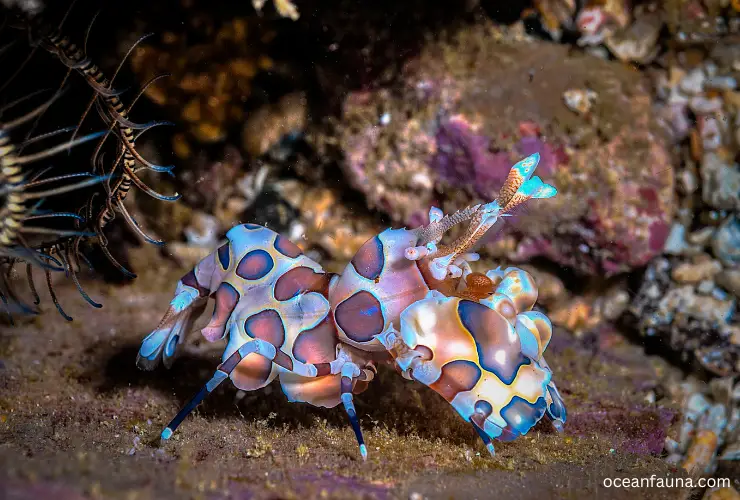
The Harlequin Shrimp is a strikingly colored crustacean found in the Indo-Pacific. It has a white body covered in large light blue spots, giving it a harlequin pattern and its name. The males are slightly smaller than the females.
This shrimp has ten legs. The first pair are modified into large, flattened claws called chelipeds that it uses to capture prey and bring food to its mouth. Its eyes are located on stalks protruding from its head, giving it a wide field of view to spot predators and prey.
The Harlequin Shrimp’s first pair of antennae resemble a flattened leaf. These specialized antennae help the shrimp sense the smell of nearby prey. When it detects prey, the shrimp swiftly attacks using its large chelipeds and feeds on various species of starfish found in coral reefs.
Harlequin shrimp is a picky eater. They have a surprisingly unique diet that consists mainly comprised of echinoderms, particularly starfish. They will also eat a few species of sea urchins, but starfish make up the bulk of their diet. Even the potent toxins found in many starfish do not affect the harlequin shrimp.
To eat a starfish, the harlequin shrimp will flip the starfish onto its back, which disables it. The shrimp then begins eating at the tip of one of the starfish’s arms. It eats its way down the arm all the way to the central disk of the starfish.
The harlequin shrimp uses its claws to peel away the starfish’s spiny exoskeleton to get to the nutrient-rich internal tissues underneath. This peeling behavior and its striking coloration are how the harlequin shrimp got its name – it looks like it is wearing a harlequin costume while eating.
Due to their specialized diet, harlequin shrimp can only be found in areas with abundant starfish populations. They use their powerful claws to capture and subdue starfish, and their digestive systems have evolved to handle the toxins.
Sandra Bullock was born July 26, 1964 and I wanted to look at one of her earlier movies—The Net. Released in 1995, The Net is relevant to today. (Just as Dave and many other movies seem prescient in their releases, so does The Net.) The following is from the IMDb website:
Synopsis
In Washington DC, U.S. Under Secretary of Defense Michael Bergstrom (Ken Howard) commits suicide after being informed that he has tested positive for HIV.
Angela Bennett (Sandra Bullock) is a computer systems analyst in living in Venice, Los Angeles, California who telecommutes to her employment at Cathedral Software based in San Francisco. Her interpersonal relationships are almost completely online and on the phone, with the exception of forgettable interactions with her neighbors and visits to her 60-year-old mother (Diane Baker), who is institutionalized with an early onset type of Alzheimer’s disease and often forgets who Angela is. Angela’s co-worker Dale (Ray McKinnon) sends her a 3.5 inch floppy disk with a backdoor labeled ‘Pi’ that permits access to a commonly used computer security system called “Gatekeeper” sold by Gregg Microsystems, a software company led by CEO Jeff Gregg. Dale and Angela agree to meet, but later that night the navigation system in Dale’s private aircraft malfunctions and it crashes into a tower, killing him.
Angela travels to Cozumel, Mexico for a week-long on vacation, where she meets Jack Devlin (Jeremy Northam), a charming English-accent businessman who charms his way into her life. After seducing Angela, Devlin pays a local mugger to steal her purse as they walk along the beach during an after-dinner stroll. He chases the mugger into the foliage, catches the mugger, and roots through the purse to find the disk before shooting the mugger dead. Devlin takes Angela out on his speedboat to kill her as well after sleeping with her again, but she finds his gun and confronts him. While fleeing with the disk and Devlin’s wallet, Angela’s dinghy collides with rocks, destroying the disk and hospitalizing her. She is unconscious for three days.
When Angela wakes up, she finds that all records of her life have been deleted: She was checked out of her hotel room in Cozumel, her car is no longer at the LAX airport parking lot, and all of her credit cards are invalid. When she arrives home by taxi, Angela discovers that her house is now empty and listed for sale. Moreover, because none of the neighbors remember her, they cannot confirm her identity. Things turn from bad to worse when after contacting the police, Angela’s Social Security number is now assigned to a “Ruth Marx,” for whom Devlin has entered an arrest record by hacking the police computer system. Angela is forced to flee for her life. Once on the streets, she steals a cell phone from the real estate agent in her former house and calls her own desk at Cathedral Software, an impostor (Wendy Gazelle) answers and offers Bennett her old life back in exchange for the disk.
Angela contacts the only other person who knows her by sight, psychiatrist and former lover Alan Champion (Dennis Miller). He checks her into a hotel, offers to contact a friend at the FBI, and arranges to have her mother moved for her safety.
Using her knowledge of the backdoor and a password found in Devlin’s wallet, Angela logs into the Bethesda Naval Hospital’s computers and learns that Under Secretary of Defense Bergstrom, who had opposed Gatekeeper’s use by the federal government, was misdiagnosed. Fellow hacker “Cyberbob” connects ‘Pi’ with the “Praetorians,” a notorious group of cyber-terrorists linked to recent computer failures around the country. Angela and Cyberbob plan to meet, but the unseen Praetorians intercept their online chat and relay it to Devlin who is now relentlessly pursuing her. Angela manages to escape from Devlin… who is now revealed to be a contract killer for the cyber-terrorists, but the Praetorians kill Champion by tampering with pharmacy and hospital computer records for his medication.
Angela is forced to steal a car to flee from Los Angeles, but she is chased and arrested by the California Highway Patrol. While in jail waiting trial for a series of false criminal charges, a man identifying himself as Ben Phillips (Robert Gossette), Champion’s FBI friend bails her from jail. While driving, Angela realizes that “Ben” is an impostor after he makes a slip to her about the Praetorians, and escapes again, killing the impostor with his own gun.
Now wanted for murder and thought to be Ruth Marx, Angela hitchhikes to Cathedral’s office in San Francisco where, she triggers a fire alarm to evacuate the building and now using her impostor’s computer, she connects the cyber-terrorists to Gregg Microsystems and uncovers their scheme: once the Praetorians sabotage an organization’s computer system, Gregg sells Gatekeeper to it and gains unlimited access through the backdoor. Angela downloads another 3.5 inch disk and escapes just as the impostor realizes her presence.
Angela escapes from the building and makes her way to the Moscone Center with Devlin and the Bennett impostor in pursuit. After finding a desktop site to log on, she emails evidence of the backdoor and Gregg’s involvement with the Praetorians to the FBI just before Devlin and the Bennett impostor catch up with her. Angela then tricks Devlin into releasing a virus into Gregg’s mainframe, destroying Gatekeeper and undoing the erasing of her identity.
During a battle on the catwalks of the convention center, in which Devlin accidentally kills the Bennett impostor from Cathedral Software (revealed to be the real Ruth Marx), Angela ambushes Devlin with a fire extinguisher, causing him to fall to his death.
At the end, Angela Bennett regains her identity, home, and life. She then reunites with her mother (who still does not remember her) and goes back to her old solitary life. In a series of news reports, the conspiracy is exposed, with Jeff Gregg being arrested by the FBI.
Hair conditioner is not just for your hair. There are lots of practical ways to use leftover hair conditioner around your home.
Here are some alternative uses for hair conditioner.
Protect Leather Shoes
Dab a rag in some conditioner and work it into your leather shoes. Apply in small amounts at a time and make sure your boots are fully dry when you smart. This will protect your shoes from snow and salt.
Remove Stickers, Bandages, and Temporary Tattoos
To reduce pain or prevent sticker residue, you can use a dab of conditioner to remove a sticker, adhesive bandage, or temporary tattoo.
Cuticle Cream
Rub some conditioner on your cuticles before you push them back or trim them to keep them soft.
Detangler
Mix some water and conditioner in a spray bottle and use it as a detangler or leave-in conditioner.
Reshape and Soften Bristles
If your makeup brushes have become stiff you can work a small amount of conditioner through them after they are washed to reshape and soften them up.
Fabric Softening Dryer Sheets
Instead of buying dryer sheets you can make reusable ones. Pour equal parts conditioner and water in a spray bottle and shake it up. Wet a washcloth with this solution and let it dry. Once it is dry you can put it in your dryer and use it as a dryer sheet.
Unclog a Drain
Squirt some conditioner into your drain and chase it with some hot or boiling water. This can lubricate the clog and help it to slide down.
Shaving Cream
If you’re all out of shaving cream, you can use conditioner in place of it.
Makeup Remover
Take a washcloth with a dab of conditioner and use it to wipe your makeup off if you need some makeup remover in a pinch.
Polish Stainless Steel
Shine your stainless steel and remove fingerprints and smudges by wiping your surfaces down with a clean rag that has a dab of conditioner of it.
Detergent For Delicate Items
Fill a sink with warm water and squirt a bit of hair conditioner into it. Submerge your delicate item in the solution to hand wash items like wool, pantyhose, and underwear.
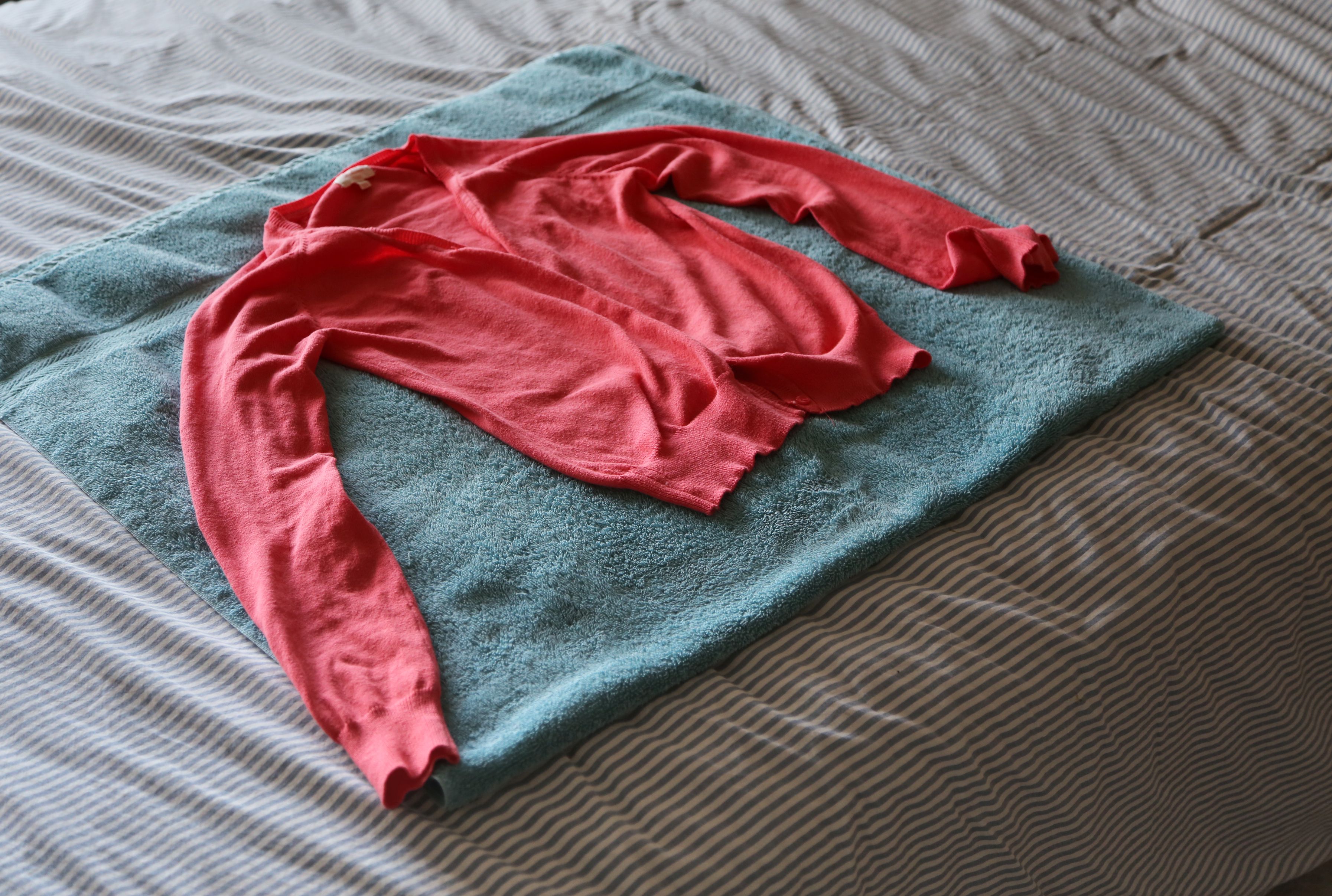
Unshrink a Sweater
Fill a sink with warm water and pour a tablespoon of hair conditioner on it. Submerge your shrunken sweater in this solution and let it soak for several hours. Squeeze out the water, then lay it flat, and stretch it out back to its original size. This only works if your sweater hasn’t been exposed to heat.
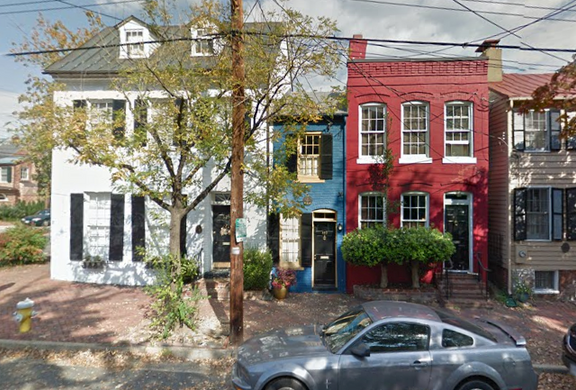
Today’s entry into weird architecture, is The Hollensbury Spite House in Alexandria, Virginia. The house is the blue one in the picture.
From atlasobscura.com:
Works of architecture are often a portal into the headspace of their creators, speaking a unique language of personality, moods, and obsessions. There are few places where this more visually apparent than at Alexandria, Virginia’s squat blue spite house. The two-century-old residence was a delicious poke in the eye to contemporary neighbors and has now become a beloved part of Old Town’s historic fabric.
The man in question here was a local brickmaker and city council member, John Hollensbury. From his nearby home on Queen Street, Hollensbury had a front row seat to a chaotic alley scene of loitering ruffians and dangerous cut through traffic. By 1830 the side of his home was pockmarked from all the collisions with wagons and Hollensbury decided he’d had enough.
In the modern day, the first instinct in a similar situation might be to complain to the police, your neighborhood listserve, or perhaps pursue legal action. Hollensbury had a refreshing streak of self reliance and simply began bricking off the alleyway in question. Two parallel walls and a roof transformed the former byway into a quaint addition to his personal residence. Ripley’s Believe it or Not dubbed it the narrowest house in America.
It’s unclear if any of this was permitted or legal back in 1830. Hollensbury’s seat on the Common Council might have given him the audacity to just build it without asking permission. However, because of the glorious power of Ex Post Facto law, the spite house has been grandfathered into the modern building code, and is presently occupied part of the year. From inside the living room you can still see the spots where wagons smashed against the brick walls and incited the fury of John Hollenbury.
Also from Business Insider:
The Hollensbury Spite House was built in 1830 by John Hollensbury, who owned one of the adjacent homes. The story goes that he was tired of noise from carriages and loiterers in the alley next to his house. To put an end to noise from foot and horse traffic in the alley, he built a house in the middle of it.
“Imagine you hate the neighborhood drunks so you build a house in your alley,” one Instagram user wrote about his recent visit to the Spite House.
Today, the home is a private residence owned by Jack Sammis. Jack purchased the home for $135,000 in 1990, and he and his wife Colleen had been using the home as a pied-à-terre, the New York Times reported in 2008. They did not immediately respond to Insider’s request for comment.
Not surprisingly, the home is compact. They once rented the house to a couple who wanted to see if they could endure living in a ship’s cabin on a cruise around the world, Jack told the New York Times in 2008. The couple decided that they could after staying at the residence.
The two sides of the house are brick and still have grooves from the wagon wheels that would pass through the alley back in the day. It opens up to a walled garden that is 7 feet wide and 12 feet deep.
“I love the idea of it — that something like this can exist. It makes the world a little more magical,” Colleen told the New York Times in 2008.
The Hollensbury Spite House is one of a handful of spite houses around the world
While the Hollensbury Spite House is the most famous spite house in Old Town, it’s not the only one. There are at least three other spite houses built in the neighborhood’s historic alleyways, according to Old Town Home.
Spite houses have also been built across the world, from a London house painted to look like candy canes out of spite for her neighbors to a home in Lebanon reportedly built by a man who wanted to ruin his brother’s seafront views.