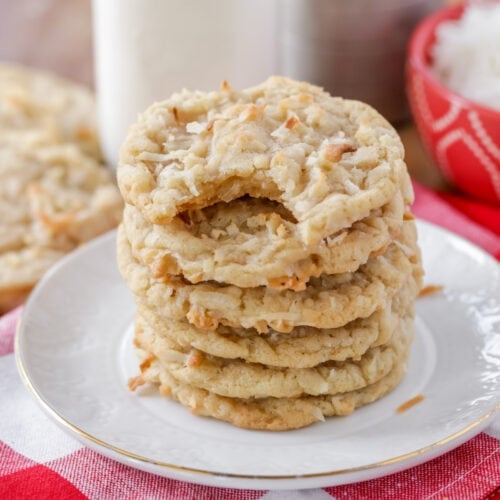
I thought we’d start the New Year off with Champagne Cupcakes!
Ingredients
For the cupcakes:
1 15.25 oz box vanilla or white cake mix
1 cup sparkling wine, such as champagne, prosecco or cava
3 eggs
1/2 cup vegetable oil
For the champagne buttercream:
2 sticks salted butter, softened (1 cup)
4 1/2 cups powdered sugar
2 Tbsp. heavy cream
1/2 tsp. finely grated lemon zest, optional
1/4 cup sparkling wine, such as champagne, prosecco or cava, at room temperature
Gold and white sparkly sprinkles, for garnish
Directions
For the cupcakes: Preheat the oven to 350 degrees. In a large bowl, whisk to combine the cake mix, sparkling wine, eggs and oil. Line 24 muffin cups with paper liners. Fill each with 3-4 tablespoons of batter. Bake for 12-15 minutes. Let cool for 5 minutes in the pans, then transfer the cupcakes to a wire cooling rack to cool completely, about 1 hour.
For the champagne buttercream: In the bowl of a stand mixer, beat the butter on medium speed until creamy, 1-2 minutes. Add the powdered sugar, heavy cream, lemon zest (if using) and prosecco. Mix on low speed just until combined, then increase to medium-high speed and beat for 1-2 minutes, until light and fluffy.
Spread the icing on the cupcakes or transfer it to a piping bag fitted with a large star tip. Pipe the icing around the outer edge of the cupcake, spiraling into the center until the cupcake is completely covered. Top with sprinkles and serve.
When my children were young, on New Year’s Eve we would each make a resolution, and a prediction about what would happen in the New Year and place those in a sealed envelope. At the end of the year, we would open the envelope and see whose prediction came true and who kept up their resolution the longest. The older the kids got, the more savvy they got with their predictions (as in “I will break my resolution first” type of thing…lol) Oh, did I mention the $20 prize for the closest prediction?
May all your troubles last as long as your New Year’s resolutions.
New Year, same me—because I’m already fabulous.
I will try to remember where I left my keys at least once a week.
Master the art of parallel parking (or continue to avoid it).
Develop the ability to remember names, even if it’s just my own.
I will strive to say ‘no’ more often… unless it involves dessert.
I promise to keep up with the latest technology, even if I have to ask my granddaughter for help.
I will strive to eat more greens, even if they’re just the M&M kind.
I promise to stretch regularly, reaching for the snacks on the top shelf counts, right?
I’ll try to remember to take my vitamins, or at least convince myself that gummy bears are a suitable substitute.
I vow to embrace my inner child and jump in puddles whenever it rains – because adulting can be overrated.
Happy New Year’s Eve! I do not drink, but I always find it interesting to see what other people are drinking. I found these unusual cocktails at The Pioneer Woman’s website!
Sugar Cookie Martini
Peppermint Martini
Espresso Martini
Chocolate Martini
Pomegranate Margarita
For recipes for these drinks, please visit The Pioneer Woman’s website!
Have a Happy New Year’s Eve! If you drink, don’t drive!
Wounded Knee, located on the Pine Ridge Indian Reservation in South Dakota, was the site of two conflicts between Native Americans and representatives of the U.S. government, including the U.S. Army and, later, the FBI. An 1890 massacre left some 150 Native Americans dead, in what was the final clash between federal troops and the Sioux tribe. In 1973, members of the American Indian Movement occupied Wounded Knee for 71 days to protest conditions on the reservation.
Ghost Dance and Sitting Bull
Throughout 1890, the U.S. government was worried about the increasing influence at Pine Ridge Indian Reservation of the Ghost Dance spiritual movement, which taught that Native Americans had been defeated and confined to reservations because they had angered the gods by abandoning their traditional customs.
This Day in History: 12/29/1890 – Massacre at Wounded Knee
On this day in 1890, in the final chapter of America’s long Indian wars, the U.S. Cavalry kills 146 Sioux at Wounded Knee on the Pine Ridge reservation in South Dakota. Throughout 1890, the U.S. government worried about the increasing influence at Pine Ridge of the Ghost Dance spiritual movement, which taught that Indians had been defeated and confined to reservations because they had angered the gods by abandoning their traditional customs. Many Sioux believed that if they practiced the Ghost Dance and rejected the ways of the white man, the gods would create the world anew and destroy all non-believers, including non-Indians. On December 15, 1890, reservation police tried to arrest Sitting Bull, the famous Sioux chief, who they mistakenly believed was a Ghost Dancer, and killed him in the process, increasing the tensions at Pine Ridge. On December 29, the U.S. Army’s 7th cavalry surrounded a band of Ghost Dancers under the Sioux Chief Big Foot near Wounded Knee Creek and demanded they surrender their weapons. As that was happening, a fight broke out between an Indian and a U.S. soldier and a shot was fired, although it’s unclear from which side. A brutal massacre followed, in which it’s estimated almost 150 Indians were killed (some historians put this number at twice as high), nearly half of them women and children. The cavalry lost 25 men.
Did you know?
Nearly half of the Sioux killed at the 1890 Wounded Knee massacre were women and children.
Wounded Knee Massacre
The conflict at Wounded Knee was originally referred to as a battle—the Army troops involved were later rewarded with Medals of Honor—but in reality it was a tragic and avoidable massacre. Surrounded by heavily armed troops, it’s unlikely that Big Foot’s band would have intentionally started a fight. Some historians speculate that the soldiers of the 7th Cavalry were deliberately taking revenge for the regiment’s defeat at Little Bighorn in 1876.
Whatever the motives, the massacre ended the Ghost Dance movement and was one of the last major confrontations in the Indian Wars, America’s deadly series of wars against the Plains Indians and other Native Americans.
American Indian Movement
The American Indian Movement (AIM) was founded in 1968 in an effort to stop police harassment of Indians in the Minneapolis area. Borrowing some tactics from the Vietnam war protests of the era, AIM soon gained national notoriety for its flamboyant demonstrations. However, many mainstream Indian leaders denounced the youth-dominated group as too radical.
In 1972, a faction of AIM members led by Dennis Banks and Leonard Peltier sought to close the divide by making alliances with traditional tribal elders on reservations. They had their greatest success on the Pine Ridge Indian Reservation, after a group of young white men murdered a Sioux man named Yellow Thunder.
Although Yellow Thunder’s attackers received only six-year prison sentences, this was widely seen as a victory by the local Sioux accustomed to unfair treatment by the often racist judicial system. AIM’s highly visible publicity campaign on the case was given considerable credit for the verdict, winning the organization a great deal of respect on the reservation.
Wounded Knee Siege
AIM’s growing prestige and influence, however, threatened the conservative Sioux tribal chairman, Dick Wilson. When Wilson learned of a planned AIM protest against his administration at Pine Ridge, he retreated to tribal headquarters where he was under the protection of federal marshals and Bureau of Indian Affairs police.
Rather than confront the police in Pine Ridge, some 200 AIM members and their supporters decided to occupy the symbolically significant hamlet of Wounded Knee, site of the 1890 massacre. Wilson, with the backing of the federal government, responded by besieging Wounded Knee.
During the 71 days of the siege, which began on February 27, 1973, federal officers and AIM members exchanged gunfire almost nightly. Hundreds of arrests were made, and two Native Americans were killed and a federal marshal was permanently paralyzed by a bullet wound.
The leaders of AIM finally surrendered on May 8 after a negotiated settlement was reached. In a subsequent trial, the judge ordered their acquittal because of evidence that the FBI had manipulated key witnesses. AIM emerged victorious and succeeded in shining a national spotlight on the problems of modern Native Americans.
Trouble Continues at Pine Ridge
The troubles at Wounded Knee, however, were not over after the siege. A virtual civil war broke out between the opposing Indian factions on the Pine Ridge reservation, and a series of beatings, shootings and murders left more than 100 Indians dead. When two FBI agents were killed in a 1975 gunfight, the agency raided the reservation and arrested AIM leader Leonard Peltier for the crime.
The FBI crackdown coupled with AIM’s own excesses ended its influence at Pine Ridge. In 1977, Peltier was convicted of killing the two FBI agents and sentenced to life in prison. To this day, Peltier’s supporters continue to maintain his innocence and seek a presidential pardon for him.
And in 2021, members of the U.S. Congress petitioned President Joe Biden to revoke the Medals of Honor soldiers received for their participation in the 1890 Wounded Knee massacre.
I found this article on a site called MyCountry955.com that details the differences between an American Bison and the American Buffalo.
From MyCountry955.com:
Don’t be confused, when in Yellowstone or most places in the North America, you’re not seeing Buffalo you’re seeing the American Bison. There is quite the difference and if you’ll follow along, I will explain it.
When the first explorers made their way west they came in contact with these massive beasts, that roamed the plains in the millions and started hunting until they thinned the herds greatly. Bison were hunted so often, they were almost eliminated in the late 1800’s. In the early 1900’s the US Army brought 21 Bison into Yellowstone and protected them and eventually were able to bring back to a comfortable number like we have now in the park.
Even back as far as those early day’s Bison have been (by some measures) incorrectly called Buffalo. Other than being both big, having horns and being extreme distant cousins in the Bovidae family, the American Bison isn’t even closely related to the Buffalo.
One difference you can see immediately between Bison and Buffalo is the Bison’s large hump on it’s back. This may shock you, but according to NPS.GOV the Bison’s hump is made up of muscles and long vertebrae so they can use their head as a snow plow to get to plants to eat during the winter. That comes in really handy during the Wyoming winters.
Yep! The American Bison is a natural born snow remover!
The Smithsonian’s National Zoo & Conservation Biology Institute points out that “True Buffalo” are actually native to Africa and Asia (Cape Buffalo and Water Buffalo), so living in the warmer climates, they wouldn’t need the type of thick coat of fur that the Bison of North America need during the winter months. You’ll also notice that the Bison has a nice “mountain man” like beard to go along with that big winter coat. Of course the hot summers and to cool down the bison will shed the thick warmth for a lighter/cooler summer coat.
The next difference will come when you’re looking at the horns of the Buffalo and Bison. African Water Buffalo have long, large curved horns, the Cape Buffalo has horns that dip down and look like a mustache coming out of the top of their head and the Bison horns are sharp and shorter than the others.
Historians believe the reason many call the bison, buffalo is a simple play on words. Early explorers called bison by many names and that the French word for beef “boeuf” is where the name originated. Others believe the Bison’s coat resemble a “buff” coat (a popular coat worn in those times) and that’s how they started to be called “Buffalo”. Since that was EARLY in our country’s history, the origins of why they were called Buffalo are a little sketchy, but what we do know is that here in North America…they’re Bison!
I’m fairly certain that you’re not going to get in trouble for calling a bison, buffalo…BUT, just wanted you to be informed when you were in a deep conversation about western U.S. history and so you can school the “Tourons” on your next visit to Yellowstone
Native to the American Southwest, Indian paintbrush (Castilleja spp.) colors a meadow or woodland garden with showy clusters of red-orange leaves (aka bracts) in late spring or early summer. The colorful bracts, which resemble paintbrushes dipped in paint, mask the plant’s actual flowers. These small blossoms are vital for setting seed, of course, but are otherwise unremarkable. Indian paintbrush (also called desert Indian paintbrush) is known to be slightly unpredictable. Some years the foliage will be brilliantly colored, and other years it will be muted. Accept this unpredictability as part of the plant’s charm.
A symbiotic plant, Indian paintbrush grows best when planted where its root system can tap into the root system of a host plant to obtain nutrients. The host plant is rarely harmed by the relationship, and Indian paintbrush thrives. Good host plants include little bluestem (Schizachyrium scoparium), beardtongue (Penstemon), and blue-eyed grass (Sisyrinchium angustifolium).
The leaves and roots of Indian paintbrush can be toxic to humans and livestock.
Where to Plant Indian Paintbrush
Wild Indian paintbrush thrives in sandy soil, sagebrush plains, grassland, and semidesert locations up to 9,500 feet. That’s why it’s best suited for naturalized areas and prairie pockets alongside other native plants rather than manicured gardens.
How and When to Plant Indian Paintbrush
Seeding is the best way to plant Indian paintbrush because container-grown plants are difficult to transplant. Seed Indian paintbrush in late summer in sandy, well-drained soil. Be patient; the seeds may take a few months to germinate; they need a period of cold stratification first. If the seed is pre-stratified, sow it in early spring.
Expect the young biennial plants to unfurl a low-growing rosette of foliage during that first growing season. Colorful bracts appear in spring or early summer of the second growing season, followed by seeds in the fall. The plant will die shortly after setting the seed that will become a new generation of Indian paintbrush.
Types of Indian Paintbrush
Wholeleaf Indian Paintbrush
Wholeleaf Indian paintbrush (Castilleja integra) is one of the larger varieties of Indian paintbrush. It typically stands 6-18 inches tall but can grow to as much as 36 inches. “Whole” in the name refers to the fact that the leaves don’t have the division seen in many Indian paintbrush plants. Zones 4-10
Texas Indian Paintbrush
Texas Indian paintbrush (Castilleja indivisa) is native to Texas, grows 12-18 inches high, and is topped by bright red spikes. A yellow or white variation sometimes occurs. It’s not easy to cultivate, but the spectacular flowers make it worth the effort. Zones 4-8
Scarlet Painted Cup Indian Paintbrush
Indian paintbrush (Castilleja coccinea), also called scarlet painted cup for its attractive spikes, is present primarily in the Eastern states. Like other Indian paintbrushes, it is popular with bees and hummingbirds. Zones 4-9
In December 1900, the keepers of the Flannan Isles Lighthouse off the northwest coast of Scotland mysteriously disappeared — and to this day, no one knows what happened. “A dreadful accident has happened at the Flannans,” reported a ship captain in 1900.
After a lighthouse went dark in the wild islands north of Scotland, a ship traveled to the Flannan Isles to investigate. They discovered that all three lighthouse keepers had vanished The captain added, “On our arrival there this afternoon no sign of life was to be seen on the Island.” What happened to the vanished lighthouse keepers? Was the Flannan Isle mystery an accident, or something darker?
Investigating The Flannan Isle Mystery
Three lighthouse keepers – James Ducat, Thomas Marshall, and William MacArthur – manned the remote outpost on Eilean Mòr, one of the Flannan Isles. Built only a year earlier in 1899, the lighthouse was sturdy and sound.
The men likely disappeared around December 15, 1900, about the time a storm had swept across the North Atlantic. Near the end of December, the ship Hesperus sailed north to investigate under Captain Jim Harvie. On December 26, 1900, The Hesperus docked at the bottom of a steep cliff. Alone, relief lighthouse keeper Joseph Moore climbed the 160 steps up to the lighthouse. When he opened the door, Moore discovered a scene frozen in time. The clock on the wall stood silent. The table was set, waiting for men who would never return. Moore found only one living creature at the lighthouse – a canary who sat quietly in a cage. “I did not take time to search further, for I only too well knew something serious had occurred,” Moore later reported. “I darted out and made for the landing.”
At the Hesperus, Moore reported what he’d found. Two more sailors joined the search for the missing men. But the investigation only deepened the Flannan Isle mystery.
In the lighthouse, the searchers discovered an oilskin, protection against the rough northern weather, meaning one of the lighthouse keepers must have run from the lighthouse during the storm without his rain gear.
On the western side of the isle, the storm’s power left its mark. Iron railings had bent in the wind. A railway track was torn away from the concrete. An enormous boulder had rolled out of place. And a supply box lay smashed on the ground, with its contents spread across the rocky land. But there was no sign of the three vanished men. “Poor fellows, they must been blown over the cliffs or drowned trying to secure a crane or something like that,” declared Captain Harvie in his report to the Northern Lighthouse Board. In his telegram report, the captain also noted, “Nothing appears touched at East landing to show that they were taken from there. On West side it is somewhat different. We had an old box halfway up the railway for holding West landing mooring ropes and tackle, and it has gone.”
Was the west landing where the men died? “Now there is nothing to give us an indication that it was there the poor men lost their lives,” the captain warned. Robert Muirhead, the lighthouse board superintendent, had personally recruited the three missing men. He traveled to the Flannan Isles to conduct his own investigation.
The Official Report And Surrounding Rumors
Muirhead declared that the Flannan Isle mystery was merely an accident. In his official report, Muirhead stated that two men had traveled to the west landing around dinner time on December 15. They hoped to secure ropes and the supply box.
“An extra-large sea had rushed up the face of the rock,” Muirhead speculated, “had gone above them, and coming down with immense force, had swept them completely away.” Wind could not have been the cause, Muirhead reasoned, because the direction of the wind would have pushed the men toward the island rather than out to sea.
The official report did not end speculation. Along the windswept islands of the Hebrides, some blamed a sea serpent for devouring the men. Others claimed the keepers had tried to escape the island only to be swept away. Another theory claimed that a fight had broken out. One of the keepers killed another. While covering up the crime, the survivors were swept out to sea. Or did MacArthur, known for his short temper, kill both men and throw himself off the cliffs?
In the years after their tragic disappearance, the rumors surrounding the lighthouse keepers only intensified. Stories of a logbook containing suspicious entries began to surface. In this supposed logbook, Marshall had written about their despair during the storm, praying for protection before it finally ended on December 15. But if the storm had ended before the men disappeared, it seemed foul play was much more likely than previously thought.
However, no evidence of these logbook entries has ever surfaced. Official reports at the time show the final entry in the lighthouse log being made on December 13, with small notes about the weather being made on the morning of December 15.
The Unsolved Mystery of the Flannan Isles
The bodies of the missing lighthouse keepers were never found. For over 120 years, the mystery has remained unsolved. Whether an accident or something worse, the disappearance was a tragedy. The men left behind families who never learned the truth. Muirhead also found himself reeling after the deaths. “I visited Flannan Islands when the relief was made so lately as 7th December, and have the melancholy recollection that I was the last person to shake hands with them and bid them adieu,” Muirhead recalled.
Did a storm or a large wave kill the missing lighthouse keepers? Or did violence claim their lives? Over a century later, we may never learn the true story.