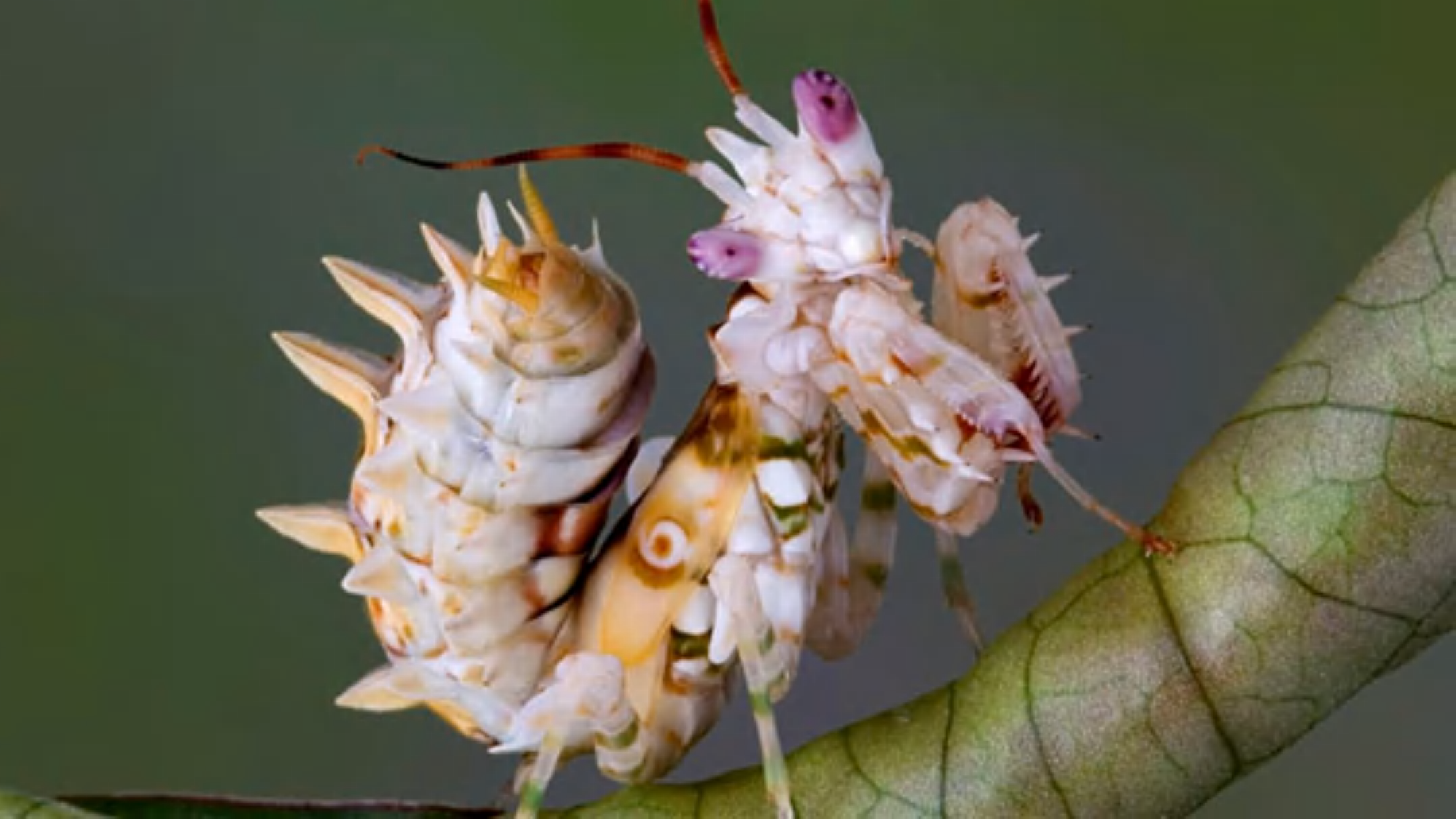
Sure, you’ve heard of the Praying Mantis. But have you met its cousin, Pseudocreobotra wahlbergii, also known as the Spiny Flower Mantis? We stumbled upon its photo during an image search and had to find out more. Here are a few things to know about this beautiful, terrifying-looking insect.
This tiny bug measures between 1 to 2 inches and is native to Southern and Eastern Africa.
Nymphs, like the one shown above, have an upturned abdomen. Adults have a large yellow spiral eyespot on their fore wings.
When they’re first born, nymphs are mostly black and look almost like ants.
Nymphs will molt approximately every two weeks; the time between molts gradually increases as the mantids get closer to adulthood. During molting, a mantis hangs upside down, sometimes shaking, and eventually wiggles out of its skin. It takes seven molts for a female to reach maturity, and six molts for males.
When threatened, the insects raise their fore wings, which makes them look like a much larger creature with big, golden eyes. This is called a deimatic display, and it looks like this:
I wouldn’t want to run into that guy in an alley—would you?
Instead of searching for prey,P. wahlbergii prefers to snatch its meals—usually pollinating insects right from the air.
Females have small spines on the edges of their wing cases; males do not. The male has slightly longer antennae and eight segments on its abdomen (females will have six or seven).
An easy way to tell males from females is to look at the length of their wings: A female’s wings will reach to the end of her abdomen, while a male’s wings will extend past it.
Like other mantis species, the Spiny Flower Mantis is cannibalistic. As usual, it’s the males who have the most to fear; the website MantisKingdom.com recommends feeding the female before putting a male in the cage behind her:
As she is busy with eating, she can’t grab him or throw him off of her. After a while of holding on, the male will bend his abdomen down to connect with hers and mating will commence.
After the deed is done, the site suggests getting the male out of the cage quickly, or else he’ll become a meal.
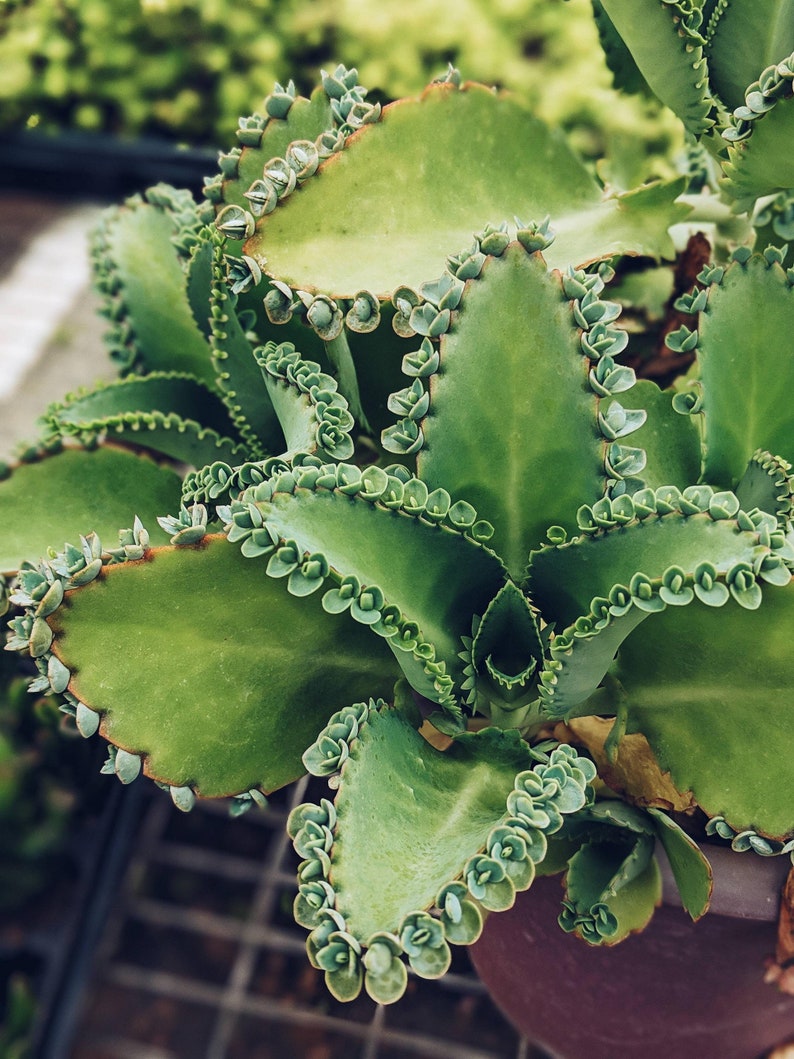
Mother of Thousands (bryophyllum daigremontianum) is a beautiful and interesting house plant, and one of my favorites. If you have one of these plants in your home, you’ll want to know how to care for it, so it thrives for years to come.
Mother of Thousands should be planted in a well draining potting mix, watered infrequently but thoroughly, and kept in bright, indirect sunlight with low humidity at 65 to 75° F. The tiny plantlets that grow along the edges of the leaves will need to be managed as they try to take root wherever they happen to land.
What Is A Mother Of Thousands Plant?
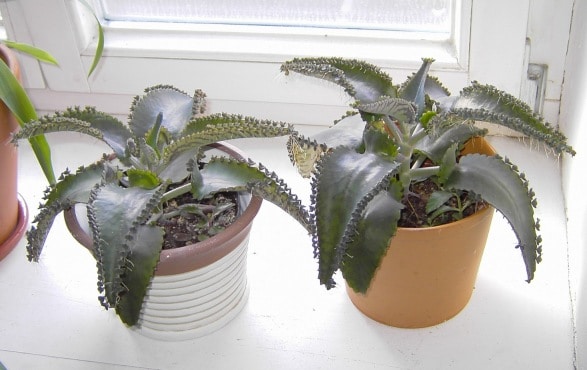
Mother of Thousands is known by numerous other names – Mexican Hat Plant, Alligator Plant, and Devil’s Backbone. A native of Madagascar, the plant is a succulent that grows up from one stem. The large blue-green leaves are pointed and narrow and grow up to 6-inches long and 3-inches wide. The plant itself can grow as tall as 18 to 35-inches if you let it.
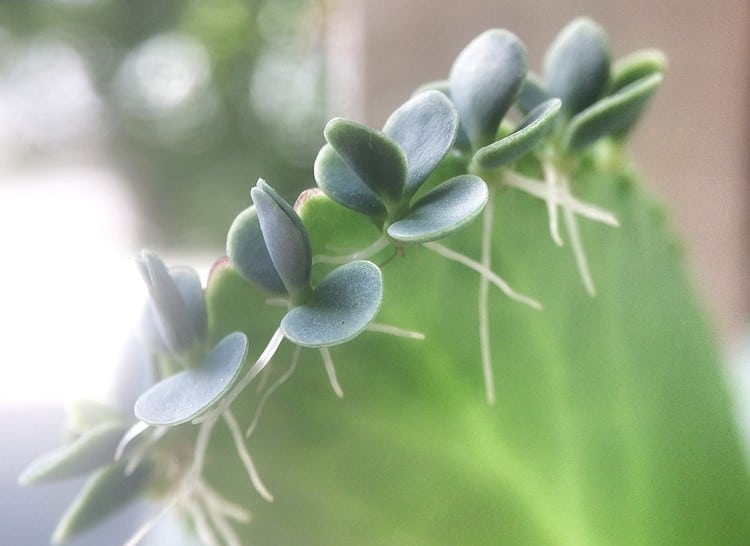
The most unique part of this plant is the tiny plantlets that grow along the edges of the leaves. These little plantlets will drop easily from the main plant, trying to take root wherever they land and find soil appropriate for growth.
For this reason, many gardeners think of the Mother of Thousands as a bit of a problem plant, with the little plantlets doing their best to grow and multiply in all types of soil alongside other plants.
You can easily see how the plant got its most common name – it’s the mother to thousands of other plants! When you’re growing Mother of Thousands indoors, you won’t have to worry too much about it propagating, although you may find that the little plantlets drop into any nearby plant pots where they can take root.
Mother Of Thousands Propagation
With all the little plantlets, your Mother of Thousands is an easy houseplant to propagate. The first thing to do is pick two or three of the plantlets from one of the leaves. If you’re not going to plant them right away, place the plantlets into a plastic bag or seal in plastic wrap. You want to keep them moist until you’re ready to use them.
Take a small terracotta pot and add cactus soil. Don’t worry about finding a deep or big pot – the roots of the plantlets will take some time to grow big enough for a large pot.
Put the plantlets directly onto the soil, making sure they’re at least a ½-inch apart. Spray the soil and the plantlets with water so they’re moist without being saturated. Then cover the pot with plastic wrap so that you’re creating your own little greenhouse.
Place the pot where it gets a lot of sun – then continue to keep the soil and plantlets moist, being careful not to overwater. If you give them too much water, they have a tendency to rot, making them unusable. Mother of Thousands doesn’t like a lot of humidity – this goes for the plantlets as well.
Keep an eye on the plantlets, watching as they start to grow. Adjust the plastic wrap so that it doesn’t crush the plants. You can place a toothpick in the soil and tent over the plastic wrap.
When they’re about an inch tall you can remove the plastic wrap, keeping them in the sun as they continue to grow. If you have a really green thumb, some of these new plants may flower for you, bursting with little pink/purple flowers.
When the plants are big enough you can separate them and plant them in their own pot. Keep in mind that the roots of these new plants are very tender and can be easily damaged. Make a wide cut into the soil when transplanting them to avoid making any cuts into the roots.
Does Mother Of Thousands Flower?
When grown indoors as a house plant, the Mother of Thousands rarely flowers. When grown outside and kept in the garden, Mother of Thousands will flower if the conditions are right. The flowers are pink and tubular in shape, hanging gently over the main stalk of the plant.
They only bloom on plants that are mature and then only in the late fall and early winter if the temperature isn’t too cold. After blooming the plant dies, leaving behind its many plantlets to start sprouting in its place.
Is The Mother Of Thousands Plant Poisonous?
Mother of Thousands is a poisonous plant. The leaves, stem, and tiny plantlets are all toxic and could be fatal to small children and pets. If you have children and pets, be sure to keep the plant well out of reach.
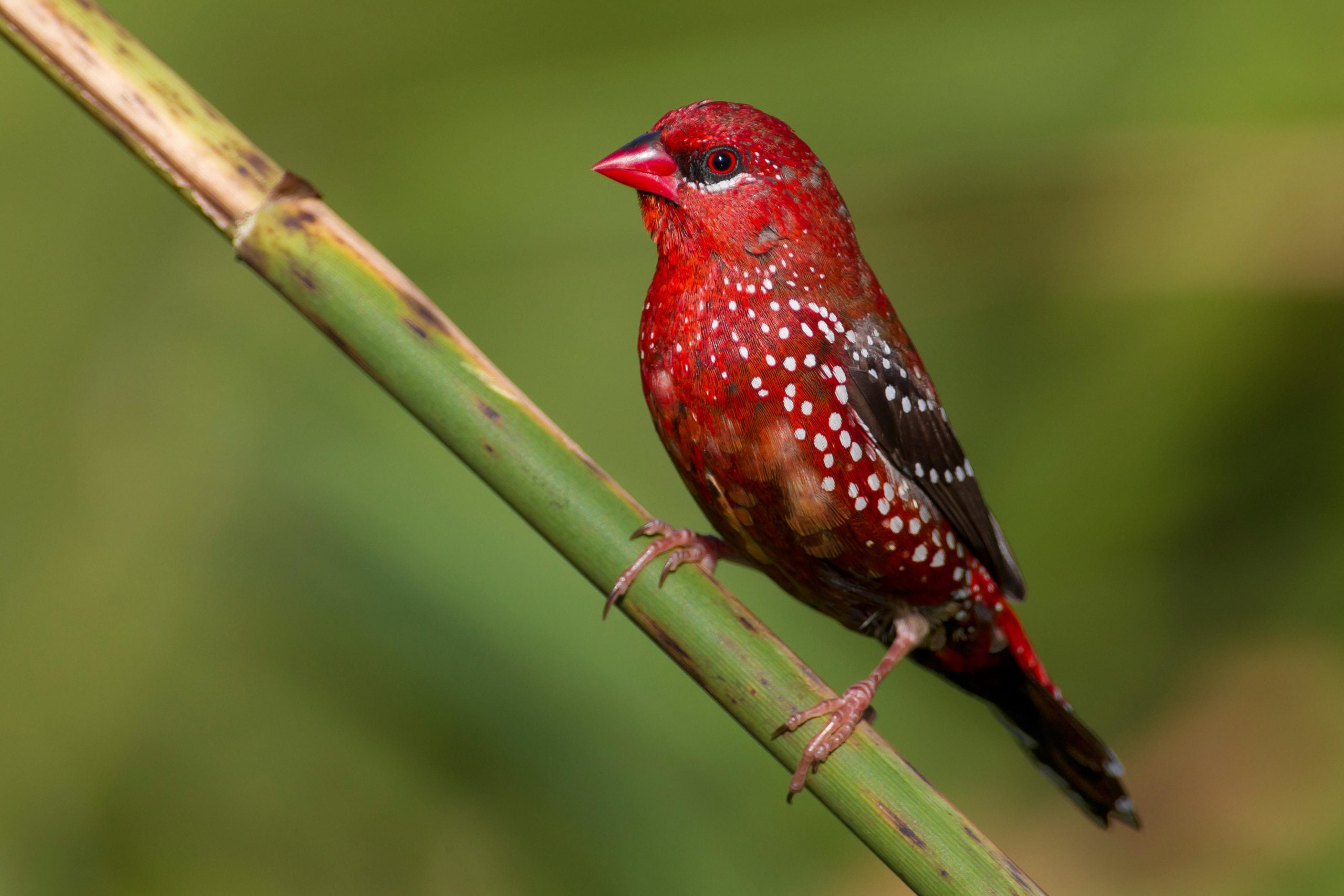
The strawberry finch (Amandava amandava), also known as the red munia or the red avadavat, is a sparrow-sized bird with spectacular bright red plumage speckled with white spots. However, the signature look of the males of the species is only temporary and worn only during the breeding season. Once the breeding season is over, the males take on a plainer and duller look like the female strawberry finches.
Native throughout South and Southeast Asia, these species of finches are most common in the tropical regions of Northwestern and Central India. They are usually found in the flat plains with an abundance of tall grasses. These finches belong to the waxbill group of birds that includes passerines (songbirds). Even though their general physical build is similar to sparrows, the strawberry finches are easily distinguished by their seasonal red beak and the striking vermilion red and white-spotted breeding plumage of the males.
However, there are introduced populations of the strawberry finches that exist in Hawaii, Singapore, Puerto Rico, Portugal, Malaysia, Egypt, Fiji, Brunei, and southern Spain.
The gathering of strawberry finches is called clumping. During this time, they create and maintain bonds by engaging in social preening or grooming.
As part of their pre-mating ritual, the male finch of the breeding pair holds a feather or grass stem in its mouth, keeps its feathers erect, and deeply bows its head in front of the mating partner.
Strawberry Finch Interesting Facts
What type of animal is a strawberry finch?
A strawberry finch is a species of waxbill bird of the family Estrildidae.
Where does a strawberry finch live?
Strawberry finches mostly live in tropical flat plains with crops or tall grasses, preferably with a nearby water source.
What is a strawberry finch’s habitat?
The strawberry finch’s natural habitat and distribution extend throughout South and Southeast Asia from Pakistan to the Malay Peninsula and the adjoining islands. The nominate subspecies (Amandava amandava amandava) is found in Pakistan, India, Nepal, Bangladesh, and Sri Lanka, the Burmese form (Amandava amandava flavidiventris) is also common in Vietnam, Thailand, Indonesia, and China, and the Javan form (Amandava amandava punicea) is found in Cambodia.
How do they reproduce?
Before mating, the male birds try to attract the female finches with a vibrant display of their bright red plumage accompanied by a mating dance comprising bowing, singing, and hopping. The breeding pairs build nests and stick together throughout the breeding season.
The breeding season varies regionally but usually begins in the second half of the rainy season and extends into the following dry months. Female strawberry finches lay a clutch consisting of four to six eggs. The clutch of eggs is incubated by both the parents during the day and by the female of the breeding pair during the night. The eggs are incubated for 11-14 days. After hatching, the young birds take about 20 days to fledge. Both members of a breeding pair are involved in feeding their young.
How do they communicate?
Although not particularly loud, strawberry finches are quite vocal. The male birds have long location calls, but those of the females are softer, shorter, and used less frequently. Both members of a breeding pair use vocalizations during pre-mating ritualistic displays. A shrill call is typical of finches showing aggressive behavior. These birds also give out typical high-pitched calls in times of potential threat to the young. When in the nests, the juveniles learn songs from their father.
What do they eat?
The diet of these finches is quite diverse. They take an omnivorous diet consisting primarily of grass seeds as well as termites, ant larvae, mosquito larvae, caterpillars, and centipedes. They also feed on fruit when available.
Today’s offering is a comfort food dish for those who do not want to make time consuming perogies—Pierogi Casserole!
Ingredients
1 large onion, diced (about 1 1/2 cup)
3 tablespoon butter
1 1/2 teaspoon kosher salt, divided
9 lasagna noodles
1 1/2 cup Small Curd 4% Cottage Cheese
3 cup prepared mashed potatoes
1 egg
1 teaspoon ground black pepper
1 teaspoon onion powder
1 1/2 cup grated cheddar cheese, divided
fresh parsley for garnish
Instructions
Preheat oven to 350°F. Coat a 9×13- inch baking dish with nonstick spray. Set aside.
Heat butter in a skillet over medium heat. Add the diced onions into the melted butter and season with 1/2 teaspoon kosher salt. Cook onions until they are soft and caramelized, stirring frequently. Remove from the heat. Set aside.
Bring a large pot of water to a boil and cook the lasagna noodles according to package directions. Drain.
While the noodles are cooking combine the cottage cheese, mashed potatoes, egg, pepper, onion powder, 1 cup of grated cheese, remaining 1 teaspoon kosher salt, and HALF of the onions. Stir to combine.
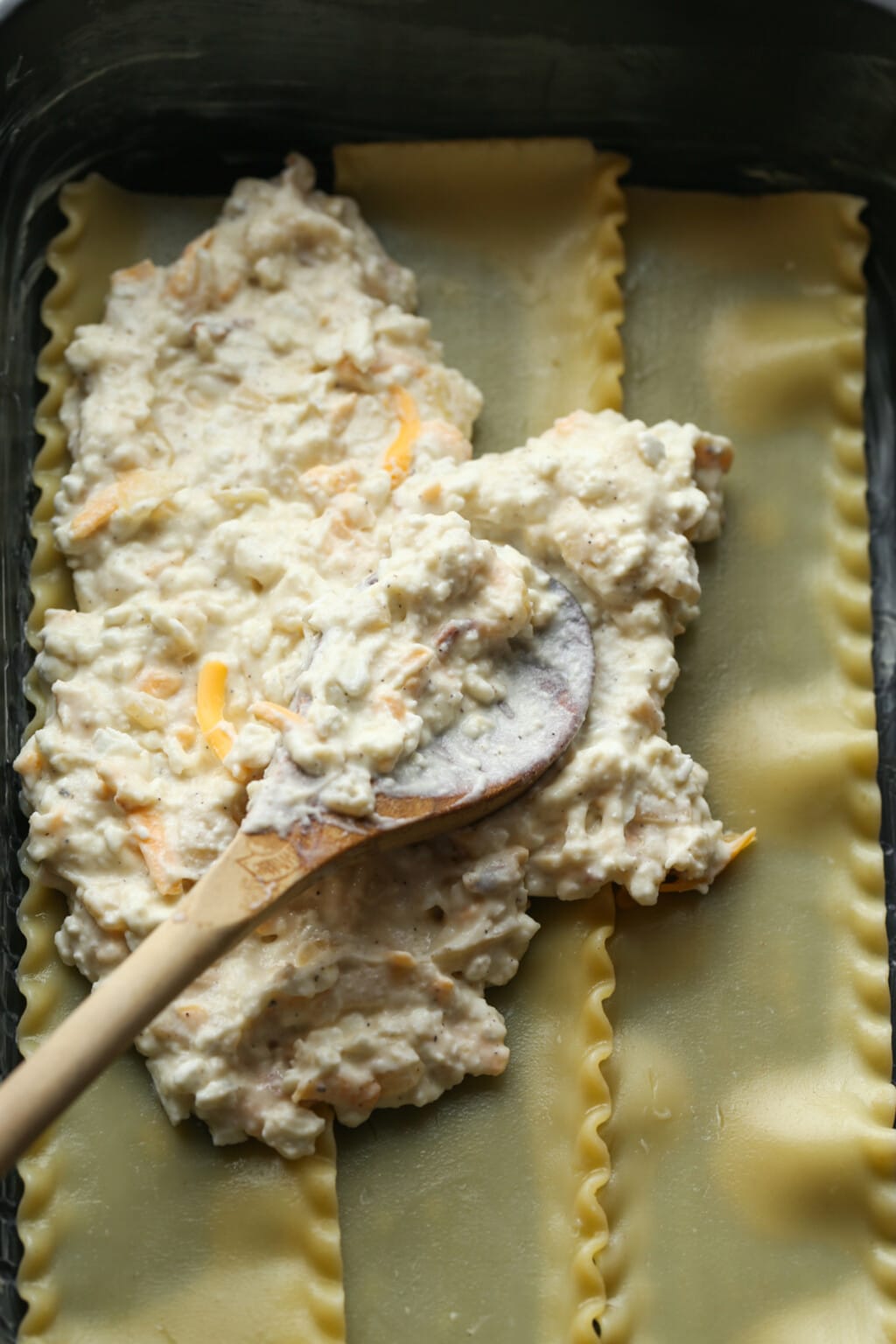
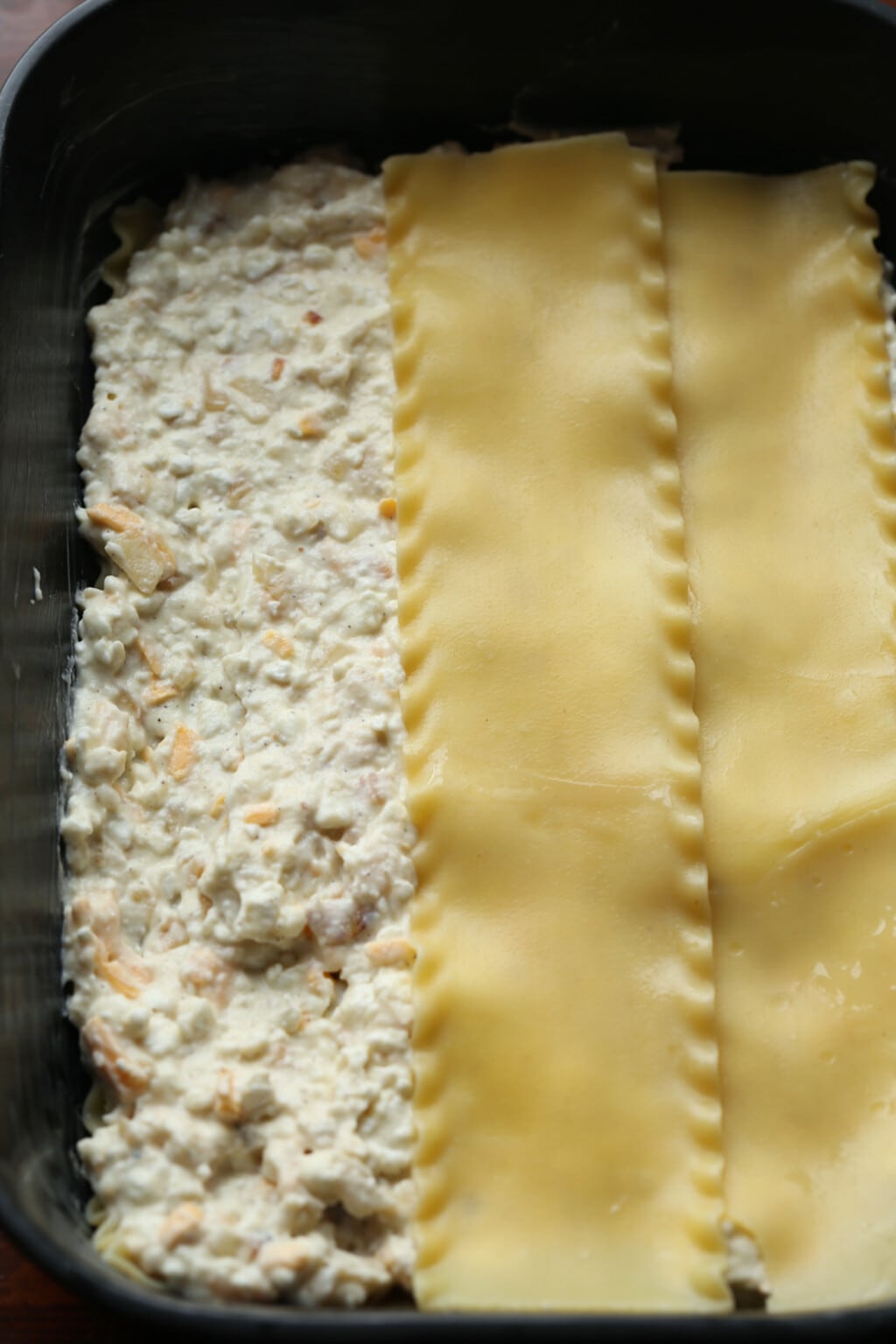
Place 3 noodles into the bottom of the prepared dish. Top with half of the cottage cheese mixture and spread to cover the noodles. Lay 3 more noodles on top of the filling and top that with the remaining filling mixture. Lay the last 3 noodles on top, sprinkle with the reserved onions and remaining 1/2 cup of cheese.
Cover pan with foil and bake for 30 minutes. Remove the foil and broil for 3 minutes.
Allow the casserole to cool for 15-20 minutes. Sprinkle with parsley and serve.
Notes
Store airtight for up to 3 days.
You can use leftover mashed potatoes or store bought prepared mashed potatoes.
You can add bacon, chicken or sausage if you prefer.
They look like a cross between an antelope and a giraffe
Some of the most notable characteristics of the gerenuk are its long, slender neck and thin legs. Gerenuks have also wedge-shaped skulls and shorter noses than many antelope species, lending them a giraffe-like appearance.
Their name means “giraffe-necked”
Gerenuks look so similar to giraffes that they were given the name garanuug, which means “giraffe-necked” in Somali.
They can stand up to find food
Gerenuk diets consist of plant matter from trees, bushes, and other plants. Unique structures in their spine allow them to stand upright on their hind legs to reach food as high as 2 m (about 6 feet) in the air.
Gerenuks never need to drink
These animals get all the moisture that they need from the plants that they consume. Scientists studying gerenuks have observed them for weeks without ever seeing them drink water.
They are surprisingly fast
Gerenuks are prey for lions, cheetahs, hyenas, and other African carnivores. To escape these predators, gerenuks can run up to about 40 miles per hour.
They mark their territory with tar and urine
Male gerenuks secrete a thick, tarry substance from ducts near their eyes. They then wipe this fluid on trunks and branches to alert other males of their territorial boundaries. Male gerenuks also urinate to mark these boundaries. This method only discourages other adult males; female gerenuks and their fawns can move freely through a male’s territory.
Gerenuks have scent glands in unusual places
Many animals use scent to mark their territory. However, unlike most animals, the scent glands of a gerenuk are located behind their knees and inside their hooves. These glands also play a role in reproduction, as they produce pheromones that can help gerenuks attract a mate.
They have a natural defense against thorns
Gerenuks must forage through spiny bushes to find the leaves that make up the bulk of their diet. Their large eyes are vulnerable to scratches or other wounds from sharp thorns. The gerenuk’s long eyelashes protect their delicate eyes from injury as they search for food.
Gerenuks can live up to 13 years in captivity
In nature, gerenuks generally reach about 8 years of age. However, without pressure to find food and avoid predators, captive gerenuks can live much longer than their wild counterparts.
Their mating behaviors are unusual
As gerenuks prepare to mate, the female will raise her nose and pull her ears close to her head. The male will then present his long neck in the hopes that the female will choose to mate with him. Before mating, the male will wipe the female with the scent glands near their eyes and sometimes tap or even kick the female gerenuk in the stomach with his foreleg.
Females live together and males live alone
If you observe a group of gerenuks in the wild, they are almost always adult females and fawns. Male gerenuks leave their maternal groups when they reach sexual maturity. From that point on, they remain solitary, interacting only to defend their territory from other males or breed with females.
Gerenuk pregnancies last about 7 months
Gerenuk breeding happens year-round, and most mothers have only one fawn at a time. Female gerenuks remain pregnant for about 7 months. The newborns are able to stand within minutes after birth.
Hiding is the key to gerenuk fawn survival
Despite their ability to move independently soon after birth, delicate young gerenuks are vulnerable to predators and dangers in the environment. They spend much of their early months hiding in trees, bushes, and piles of leaves and grasses for more than 9 hours a day. Their mothers forage for food while they remain safe. After each nursing period, both mother and fawn move to a new area.
They have a vocabulary of their own
All gerenuks regardless of age or sex communicate with a series of vocalizations. Each sound has a distinct meaning among gerenuks. Loud bleating indicates danger and helps alert other gerenuks. Mothers bleat softly to their young. A whistling noise indicates irritation or annoyance.
I love make overs—this time thrift store makeovers. These transformations are relatively easy and quick to do! Try yard sales or thrift stores—go hunting for what could be instead of what’s there!
Take old lamp shades-remove the shade part-if necessary, paint the metal frames—hang upside down as planters!
Spray paint an old cookie sheet—use contact paper for the flat bottom and turn it into a magnetic memo board!
Turn any old picture into a chalk board with chalk board paint!
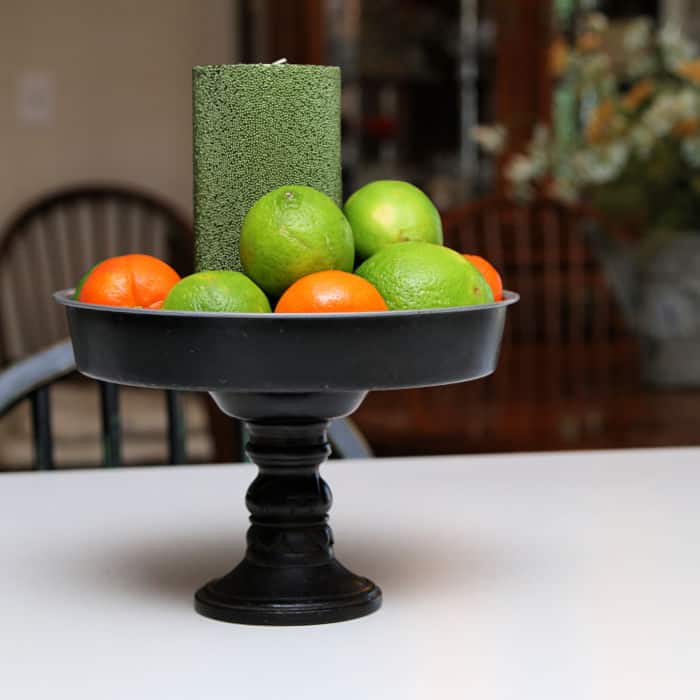
Glue a pie pan to a candle holder and it becomes…a candle holder…LOL
Turn an old diskette holder into a mini greenhouse!
On our recent trip home, we encountered some good stuff, some bad stuff, and some what-the-hell stuff.
First off, there’s some new Trump flags out there (3 just in my little town!) showing President Trump’s face with the phrase—“I’ll be back in 2024!” That’s a good thing!
Another good thing is a new billboard in Williamsport. It has Dolly Parton on it asking us all to “Find the good in everyone. Kindness…pass it on!” Some people can be hard to reckon with, but it did remind me to work to avoid becoming what I despise, so that’s a good thing too! And then there were all the job postings on the semi-trucks that kept passing us. Phone numbers and pleadings for workers: good pay, no cross-country trips, home every night. So, there’s plenty of jobs available and THAT’S a good thing!
But guess what we heard repeatedly on the trip down? Covid cases are on the rise again. I mean, really? If you listen to the entire blurb though, the previous week there were 2 cases and now there are 5! (Could these additional cases be family members? Who else would be taking the dang tests again?) And THIS little gem. A commercial discussing how drugs are being laced with fentanyl and people are accidentally dying. So, rather than closing the border and trying to prevent the crap from entering the country OR cracking down on fentanyl source or sellers, a company has developed fentanyl test strips. Their pitch? “Better safe than sorry”….call and order now! So Big Pharma benefits again? And maybe using the same manufacturer that gave us counterfeit covid test strips?
And then this: I rarely watch traffic when we drive on the highway—people can drive like idiots. But the truckers caught my attention with their job listings on their containers. As I read them, I started to notice something else—other vehicle’s license plates. There were dozens of other states –like CA, FLA, MASS, CO, IND, NJ, NY and I said something to hubby, who laughing said—yeah that’s weird. Other states’ car on our INTERSTATE. OOOOOPS! LOL
Putting that aside, there were other WTH moments. For instance, on our drive down our little dirt road early Friday morning, we saw something orange ahead on the side of the road. Sure enough, when we got there, it was an uneaten, unmolested, orange. In the middle of nowhere…no other garbage around…just sitting there. WTH?
Further along in the trip, we came upon the white cows again. The road splits an enormous pasture and infrequently we see herds of white cows on both sides of the road. The pastures are gated with chutes and sometimes the cows are on one side or the other and sometimes both. The strange part? There are no homes or barns in any direction. In 17 years, I have never seen anyone moving the cows…WTH?
Lastly, I heard this AAA radio ad on the way home Sunday. AAA is offering to assist older people with applying for Medicare. I used to work at AAA (in accounting) and they did have an insurance component for homes and vehicles, but their bread and butter was travel and roadside help. WTH?
I did spend an entire Saturday afternoon listening to Mom read all the recipes in her favorite recipe book to me…lol. But I did bring home some new recipes to try while keeping Mom happy. Win/win.
Who knew that vinegar could do so much? Here are some of the many household uses for vinegar—from cleaning to stain treatment to relieving insect bites. Discover vinegar’s versatility, as well as when NOT to use vinegar.
There’s a cheap, safe, and effective product that has hundreds of uses: vinegar! Let’s explore all the ways vinegar is useful, from the uncommon to the common.
Vinegar in the Garden
Defeating garden weeds: Spray white vinegar directly on plants that you want to kill, especially weeds in cracks in your driveway! Spray on a dry, sunny day. Remember that vinegar will kill plants you want to keep as well, so be careful and try to apply it directly on the leaves of the weed you want to get rid of.
Soothing insect bites: Apply full strength vinegar to mosquito or other insect bites to relieve the itching. (Caution: Do not do this if the affected area is raw.)
Insect repellent: Rub a solution of 1 part apple cider vinegar to 2 parts water on your skin to help repel insects. (For sensitive skins, dilute the vinegar further.)
Keeping cut flowers fresh: To extend the life of flowers in a vase, add a few teaspoons of apple cider vinegar to the water, plus a dash of sugar. The acidic vinegar helps to prevent bacterial growth.
White Vinegar and Cleaning
Vinegar is a common ingredient in countless homemade cleaners and is especially helpful for cleaning household appliances.
Coffeepot: Every month, bring a solution of 1 cup of vinegar and 4 tablespoons of baking soda to a boil in teapots and coffeepots to rid them of mineral deposits. To clean drip coffeemakers, fill the reservoir with white vinegar and run it through a brewing cycle. Rinse thoroughly by brewing two cycles with water before using.
Cutting boards: Use white vinegar to disinfect cutting boards, especially those made of wood.
Stovetop: A solution of vinegar and baking soda will easily remove cooking oil from your stovetop.
Oven: For a clean oven, combine vinegar and baking soda, then scrub.
Microwaves: Pour white vinegar into a bowl of water and microwave it for a few minutes, then wipe out.
Dishwasher: Use as a cheap rinsing agent to get your glasses and plates clean. Also, once a year, pour a cup of white vinegar into an empty dishwasher, then run it for a short cycle to get rid of the lime and soap build-up.
Clogged or smelly sink: Pour 1/4 cup of baking soda down the sink, then add 1 cup of vinegar.
Humidifier: Clean the filter on your humidifier by removing it and soaking it in a pan of white vinegar until all the sediment is off.
Tubs and showers: Saturate a cloth with vinegar and sprinkle with baking soda, and then use it to clean fiberglass tubs and showers. Rinse well and rub dry for a spotless shine.
Tile grout: White vinegar is actually safer than chlorine bleach for cleaning grout and caulking in bathrooms and kitchens. Spray, leave for one hour, and then scrub.
Shower curtain: Use a sponge dampened with vinegar to clean shower curtains.
Toilet bowl: Clean and deodorize your toilet bowl by pouring undiluted white vinegar into it. Let stand for five minutes, then flush. Spray stubborn stains with white vinegar, then scrub vigorously.
Windows: Clean windows with a cloth dipped in a solution of one part white vinegar and 10 parts warm water.
Fridge odors: Rid your refrigerator and freezer of bad odors by cleaning the insides with a solution of equal parts vinegar and water, then wiping dry.
Smoke odors on clothes: To remove smoke odors on clothes, hang them above a steaming bathtub filled with hot water and a cup of white vinegar.
Prevent mildew: Wipe down surfaces with vinegar to clean and prevent mildew.
When NOT to use vinegar:
Do not use vinegar on granite or marble countertops.
Avoid using vinegar where there is unsealed grout.
Do not use vinegar on wood surfaces or hardwood floors (or no-wax vinyl floors).
Never use vinegar on your cell phone or computer screen!
Vinegar and Stain Removal
White vinegar is known as an effective stain remover.
Clothes: Vinegar naturally breaks down uric acid and soapy residue, leaving baby clothes and diapers soft and fresh. Add a cup of vinegar to each load during the rinse cycle. It also gets rid of stinky towel mildew and makes clothes more colorful.
For removing specific stains such as ketchup, tomato sauce, etc., spray a little vinegar directly onto the stain and then launder.
Chewing gum: To remove chewing gum, rub it with full-strength vinegar.
Paint stains: Soak paint stains in hot vinegar to remove them.
Shoes: To remove salt and water stains from leather boots and shoes, rub with a solution of 1 tablespoon white vinegar and 1 cup water. Wipe over the stained area only, and then polish.
Brighten white clothes: Soaking white clothing in vinegar will help bring back their brightness.
Vinegar and Pet Care
Itchy ears: Clean inside of dog and cat ears with a clean washcloth or rag dipped in a white vinegar solution (4 tablespoons water: 1 tablespoon vinegar).
Smelly pets: If your pets get sprayed by a skunk or have other incidents, vinegar can help get rid of the smell!
Vinegar and Car Care
Remove bumper stickers: To remove bumper stickers from car chrome, squirt on vinegar and let it soak in. Next, scrape off the stickers. Decals can be removed similarly.
Keep windows clear: Wipe down windows with diluted vinegar in winter to keep them frost-free. You can also use vinegar spray as a window cleaner.
More Uses for Vinegar!
Sprains: Place a vinegar-soaked brown bag on sprains to ease pain and aid recovery.
Shiny hair: For brunettes, rinsing hair with vinegar after a shampoo makes hair shinier. Use one-tablespoon vinegar to one-cup warm water.
Loosen jar lids: Hold the jar upside down and pour warm vinegar around the neck at the joint between the glass and the top.

































/black-granite-countertops-ideas-57fb717f5f9b586c358525f1.jpg)

:max_bytes(150000):strip_icc()/__opt__aboutcom__coeus__resources__content_migration__mnn__images__2018__07__shutterstock_726710044-183d871ad1684ebfb6f578b2c14feb95.jpg)

 Sew Colorful