
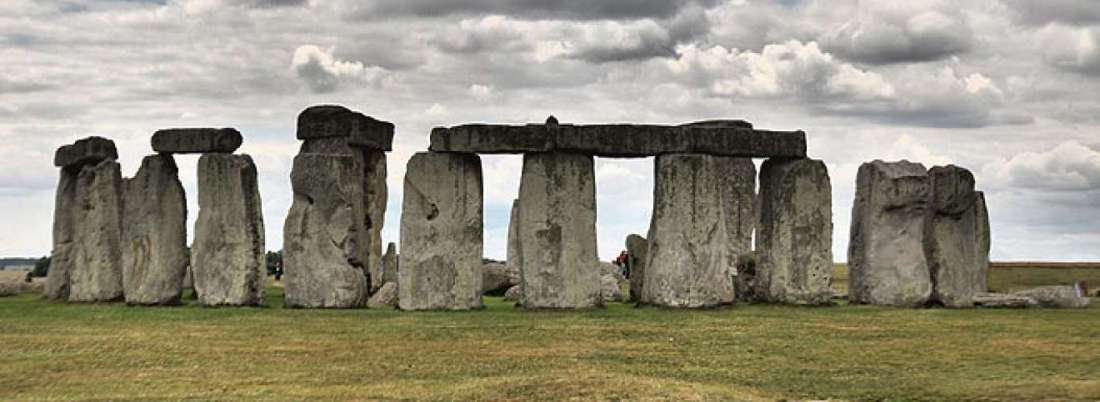
Many, many years of investigation, analysis and speculation has been accomplished thru the ages. We now know how old Stonehenge is, where the stones came from, and how it was constructed, but none of this tells us who built it.

Older theories involving Saxons, Danes, Romans, Phoenicians, and even the Druids are obviously ruled out by the date of the monument. None of these groups was around in the Neolithic or Bronze Age of Britain.
Not surprisingly, much of the ink spilled over Stonehenge in centuries of debate has been concerning its purpose. Early antiquarians tended to see Stonehenge as a “monument,” without any specific use, although they did usually believe that it commemorated a particular event, such as Geoffrey of Monthouth’s theory that it was built in memory of the Bristons slaughtered by the Saxons.
From Aubrey and Stukeley’s time the idea of Stonehenge as a Druid temple dominated the literature, but as the Druids slipped from the scene so did the identification as a temple. The axis of Stonehenge is clearly on the midsummer sunrise/midwinter sunset line, with the sun-rise occurring over the avenue, leading to the conclusion that this was probably the more important astronomical feature.

Professor Gerald Hawkins’ theory of astronomical alignments at Stonehenge
It took an American Astronomer, Dr. Gerald Hawkins of Boston University, to break the silence. He surveyed the possible alignments presented by the monument, then fed the results into a computer to see if they had any astronomical significance. Setting the computer to cross-check the lines against a map of the heavens set at a date of 1500 B.C., he came up with a whole pattern of solar and lunar alignments (but none for the planets or stars) that he decided could not possibly be the result of chance.

Archaeologists today have returned to ideas of Stonehenge as a ceremonial center. The early wooden phase seems to have involved circles of timbers at the middle of the monument, with access tightly controlled by a wooden passageway and fencing. Even the entrances through the ditch had a forest of posts set into them, making it difficult just to walk in.
The later stone circles and horseshoe continue in the same vein, with access restricted by the stones themselves, and visibility of events at the center of the monument obscured for thsoe outside. The avenue seems quite clearly to be a processional way, when its course is followed. This runs in an arc around Stonehenge, going down into a dip.

America’s Stonehenge, Salem, NH
Only after continuing for some time out of sight of the monument does its course begin to climb again, at which point visitors saw the stone circle standing out proud against the skyline. Inside the circular sacred area defined by the bank and ditch they would have seen a crowd of worshippers, and occasional glimpses of those directing ceremonies from the center of the stones.
For those privileged few looking out from the heart of the monument, the high point of the year must have been the moment when the Sun rose over the avenue on midsummer morning. So perhaps it is not too wide of the mark to see Stonehenge as a Sun temple.

Depiction of Druid Ceremony 1815














/fabric-on-bolts-125714058-56a7b9a35f9b58b7d0ed404d.jpg)




























 Sew Colorful