Etymology of Words and Phrases

Someone posted something about etymology and it caught my interest – IIRC, I have Duchess to thank!

I decided to do an open about the subject since I have a book about it. But there is so much more in the book than I can put in one open, I expect I’ll be doing more in the future. If anyone has specific words or phrases they are curious about, let me know and I’ll include it in a future open.

First, the definition of etymology:

– The origin and historical development of a linguistic form as shown by determining its basic elements, earliest known use, and changes in form and meaning, tracing its transmission from one language to another, identifying its cognates in other languages, and reconstructing its ancestral form where possible.

– The branch of linguistics that deals with etymologies.

– That part of philology which treats of the history of words in respect both to form and to meanings, tracing them back toward their origin, and setting forth and explaining the changes they have undergone.

CURSOR

It is a Latin term for “flowing” or “running” that gave rise to the word “cursive” to describe handwriting produced in flowing style. The flow of letters that is produced when a pen is guided by skilled fingers is an impressive art. The name for this efficient and effortless writing style, in this computer age, soon was adapted and bestowed upon the small marker that moves quickly and gracefully across a computer screen. The cursor blinks until it is stimulated into action.

Cursor

TO BOOT

Early computer programmers faced an obstacle: the memories of their computers were wiped clean each time the machines were turned off. To address this problem, the programmers needed to enter a short program called a “bootstrap loader” each time the machine was turned on. When the first desktops first came out, there was a “boot” disc that resided in one drive, while a data disk was in the second drive, where the work was saved. This is the portable laptop I used to take with me on business trips – note the 2 drives side-by-side.

COMPAQ Portable PC

Once this program was read, the computer could then perform more complex functions. The short program gave the machine a “bootstrap” it could then use to perform tasks; without it, the computer was useless. Over time, programmers figured out ways to design software so computers could perform this function automatically, and bootstrap loaders are now part of the basic make-up of any operating system. Pulling oneself up by the “bootstraps” is a means of restarting one’s situation. The expression lives on in the phrase to boot, which today simply means to turn it on, but reflects decades of efforts of computer programmers to make computers easier to use.

CD-ROM

As an abbreviation, this cluster of letters has come to function as a word naming a compact disc crammed with an immense amount of data, graphic material, music, or other sounds. The disc can be read and viewed and printed out, but can’t be altered, making deletion of selected portions impossible. Once the basic nature of this disc is understood, it makes complete sense that the abbreviation stands for “Compact Disc [with] Read-Only Memory.

HANDS DOWN

Plantation owners and merchant princes of colonial America took great interest in horse racing. For many generations major contests were supported largely by the wealthy. After the Civil War, promoters began bidding for attendance by the general public and racing then surged to new popularity and prominence.

Skilled jockeys made an art of timing the final spurt toward the ribbon; sometimes a fellow would be so far ahead of the field that he didn’t have to lift his hands in order to urge his mount forward. Expecting an easy victory, the backer of a horse would boast that his jockey would win hands down. Erupting from racetrack lingo about the turn of the last century, the phrase came to indicate any effortless triumph.

RAISE THE HACKLES

Medieval householders made wide use of flax, whose fibers are so tough they had to be carefully worked with a tool called the hackle. Farmers noticed that angry fowls have a way of raising the feathers on their necks. Disturbed in such a fashion, a bird looked as though someone had rumpled his feathers with a hackle. Hence by 1450, such feathers had taken the name of the combing tool.

Medieval Hackle

Since visible hackles indicated anger, it was natural to say that anything causing an outburst of rage raised the hackles of the offended person.

DERBY

England has few families whose blood is a deeper shade of blue than that of the Stanleys. Descended from an aide of William the Conqueror, this family came into possession of the earldom of Derby in the 15th century. Their name entered common speech because the 12th Earl of a lover of fast horses. With no specific desire for fame, Derby established an annual race for 3 year old horses; first run in 1780, it quickly became the most noted race in England.

American sportsmen who took in the races after the Civil War were impressed by the odd hats some of the English spectators wore. They brought a few of the “Derby hats” back to the US, where a new model was developed. Made of stiff felt with a dome-shaped crown and narrow brim, the derby won the heart of the American male. By the time the first Kentucky Derby was run in 1875, the derby was standard wear for the man of parts. It is merely incidental that the hat also brought a kind of immortality to the distinguished house of Derby.

English Bowler Derby

As a side note…..how did the Kentucky Derby get that name?

“The Kentucky Derby is America’s most celebrated horse race, but its inspiration comes from England.

Col. Meriwether Lewis Clark, founder of Churchill Downs, wanted to model the track’s major races after the English classics. The gold standard for Europe’s three-year-olds is the Derby at Epsom, which also stages the corresponding race for three-year-old fillies, called the Oaks.

Both the Epsom Derby and Oaks are contested at about 1 1/2 miles. And originally so were the Kentucky Derby and Oaks, in the early years since their inception in 1875. Both were eventually shortened, with the Kentucky Derby firmly established at its traditional 1 1/4-mile distance in 1896. The Oaks was subsequently held at distances ranging from 1 1/16 miles to 1 1/4 miles, finally settling at its current trip of 1 1/8 miles in 1982.

But why were the Epsom classics named the Derby and Oaks at their creation in the late 18th century? An aristocratic connection, of course!

The 12th Earl of Derby, Edward Stanley, was instrumental in the development of both. The fillies’ race was established first in 1779, and named after Stanley’s Surrey estate. Fittingly, he won that inaugural Oaks with Bridget.

That prompted the idea to create another classic, open to both colts and fillies, the following year. According to the oft-told tale, the new race’s name hung on the outcome of a coin flip. Was it to be named after the Earl of Derby, or after his friend, Sir Charles Bunbury? Luckily, the toss came up in favor of the Earl, and the first “Derby” was held at Epsom in 1780. Bunbury didn’t go home empty-handed: his Diomed triumphed in that first running.

With the Epsom Derby giving rise to so many spin-offs around the world, racing fans can be grateful for that toss of the coin. The “Kentucky Bunbury” just wouldn’t have the same ring to it.”

https://edge.twinspires.com/racing/why-is-it-named-the-kentucky-derby/

STEALING MY THUNDER

For more than two centuries, the English-speaking world has used the expression “stealing thunder” to mean the appropriation of any effective device or plan that was originated by someone else.

An obscure English dramatis was the father of the phrase. For the production of a play, John Dennis invented a new and more effective way of simulating thunder onstage. His play soon folded but shortly afterward he discovered that his thunder machine was in use for a performance of Macbeth at the same theater.

Dennis was furious!!! “See how the rascals use me?!?” he cried. “They will not let my play run, and yet they steal my thunder.

SHE SELLS SEASHELLS BY THE SEASHORE

Born in 1799, Mary Anning — the dirt-poor woman said to have inspired the tongue-twister “She sells seashells by the seashore” — would spend her entire life uncovering and piecing together the fossils of one never-before-seen monster after another: organisms that had been hidden away for nearly 200 million years in the cliffs up and down England’s southern coastline.

In short, she provided raw material to the scientists — all male — that would be instrumental in forming their evolutionary theories. Stephen Jay Gould later remarked that Anning is “probably the most important unsung (or inadequately sung) collecting force in the history of paleontology” yet Anning’s place in history happened quite by accident.

By birth, Anning never should have become an influential fossil hunter and geologist. She was marginalized not only by her family’s poverty but also by her sex, her regional dialect, and her nearly complete lack of schooling. But she enjoyed one natural advantage: the very good fortune of having been born in exactly the right place at the right time, alongside some of the most geologically unstable coastline in the world; it was — and still is — a place permeated with fossils.

Beach where Anning searched for fossils

After her father died in 1810, young Mary’s family was in dire financial straits. In order to put food on her table, she was forced to run the shore’s gauntlet of high tides and landslides to hunt for curiosities that she could sell to seafaring tourists. If she hadn’t, her family very well could have starved.

Her first discovery, made in 1811 when she was only 12 years old, was of the fossil of an ichthyosaur, a marine reptile about four feet in length with flippers like a dolphin and a chest like a lizard. At first people thought it must be a crocodile. In time, though, the specimen attracted massive crowds to museums in London, where many soon realized the skeleton was of a creature never before seen.

Ichthyosaur Fossil

The strange fossils found along England’s southern shoreline had baffled the locals for as long as anyone could remember. They came in all forms and sizes — including what later were determined to be bivalves, ammonites, belemnites, and brachiopods — and sometimes even the fragments of giant critters never heard of before.

Her discovery of a nearly intact long-necked plesiosaur (Plesiosaurus dolichodeirus) in 1823 was so incredible that even the celebrated French anatomist Georges Cuvier did not believe it could be valid. It was only after British geologist William Conybeare defended Anning’s find — and verified that the neck did indeed boast at least 35 vertebrae — did Cuvier admit he was wrong. Eventually he pronounced Anning’s fossil a major discovery.

Plesiosaur Fossil

As Anning aged, and began working alongside Britain’s clique of male geologists — most of them Anglican clergymen — there were countless attempts to use biblical stories to explain the new knowledge about the natural world that resulted from her fossil discoveries. For example, Anning’s friend and associate William Buckland — the well-known English geologist and first professor of geology at Oxford — believed that the fossils found at high altitudes proved that a great flood had once covered the planet, just like the Flood described in the Bible.

Mary Anning

Anning’s views on the flood and the disparate theories of the male scientists of her era are not known. But in 1833, she was visited by a tourist, the Reverend Henry Rawlins, and his six–year-old son, Frank. Rawlins believed that God created the world within a week, but Anning described to young Frank how the fossils purchased by his father had been found by her at all different levels in the cliffs, explaining that this meant the creatures possibly had been created and had lived at different times. According to Frank’s journals, his father refused to discuss the issue after they left Anning’s home.

One can only imagine how frightening it must have been for Anning to find the fragments of these exotic creatures — with their bat-like wings, snake-like necks, and big, bulging eye sockets — and wonder if perhaps the live versions were not about to fly out of the sky or come up out of the sea to terrorize her.

Anning tried to reconcile what she was unearthing with her belief in God’s omnipotence, a belief she apparently held until her death from breast cancer at the age of 47. Some of her letters to friends suggest that she grew to accept that there had been a progression of living things. A few years before she died, she remarked that — from what she had seen of the fossil world — there is a “connection of analogy between the Creatures of the former and present World.” From most accounts, it seems she continued to believe in God throughout her life, but that she also came to accept that evolution was part of God’s plan. Toward the end of her life, she copied into her journals many poems and passages laced with religious overtones.

At the Natural History Museum in London, as well as a small museum in Lyme Regis, Anning is recognized as having laid the groundwork for the theory of evolution, not to mention nearly two centuries of discoveries in the still evolving worlds of paleontology and geology. Today thousands of people continue to go hunting for fossils along England’s so-called Jurassic coast — a 95-mile stretch of shoreline declared a Unesco World Heritage Site in 2001. And, to this day, real and startling discoveries are still being made, such as the skeleton of a 195-million–year-old Scelidosaurus, the earliest of the armored dinosaurs, in Anning’s hometown of Lyme Regis a few years ago.

Illustration

With over 700 species of dinosaurs already identified and named, reminders of the prehistoric past just keep on surfacing, thrilling paleontologists. But there are plenty of people who are still unsettled by the signs of the completely different world that must have existed on earth before humans arrived — even if they also are able to marvel at the possibilities. It is most likely a feeling that — nearly two centuries ago — Anning would have shared.


Written by: Shelley Emling

Christmas in July? Invention of Christmas Tree Lights

Shall we harken back to 1879, the year of Edison’s light bulb patent? He liked to demonstrate the magic of his new creation and entice investors with it every chance that he got. His bulbs always garnered widespread excitement with plenty of “Oohs” and “Ahhs.” That Christmas was no different, when he decorated his Menlo Park lab with his new lights, bringing spectators from near and far to see the winter magic. Inside or out, nothing adds more of a magical accent to the Holidays than bright, colorful and soothing lights.

Before electric Christmas lights, families would use candles to light up their Christmas trees. This practice was often dangerous and led to many home fires. Edward H. Johnson put the very first string of electric Christmas tree lights together in 1882. Johnson, Edison’s friend and partner in the Edison’s Illumination Company, hand-wired 80 red, white and blue light bulbs and wound them around his Christmas tree. Not only was the tree illuminated with electricity, it also revolved on a base!

The Johnson’s illuminated and revolving tree of the future
Vintage string of Christmas tree lights on display at the Thomas Edison National Historical Park in West Orange, JN

Christmas lights were not mass-produced until 1902, when General Electric, a company founded by Edison in the 1880’s, brought the holiday lights to select consumers. The lights were quite expensive and not available to the mass market until a few decades later. Advertisements that boasted a safer and odorless way to decorate for the holidays stimulated sales for the lights.

Vintage advertisement for Thomas Edison’s Christmas Lights

To this day, a large Christmas tree shines bright in the Thomas Edison’s Glenmont mansion in New Jersey every Holiday Season, which is now decorated by park rangers.

Thomas Edison’s Christmas tree in 2018 vs. circa 1920

Mrs. Edison’s touch was everywhere during the Holidays, with her special Christmas trees set up in the conservatory for her house workers to enjoy. A favorite was the Swedish candle box tree. Many decorations were lovingly placed around the house…and of course a formal printed menu for the big dinner she held every year for family and friends, usually totaling 30 people! That and her husband’s Christmas lights made it all the more memorable.

THE MOON RANG LIKE A BELL

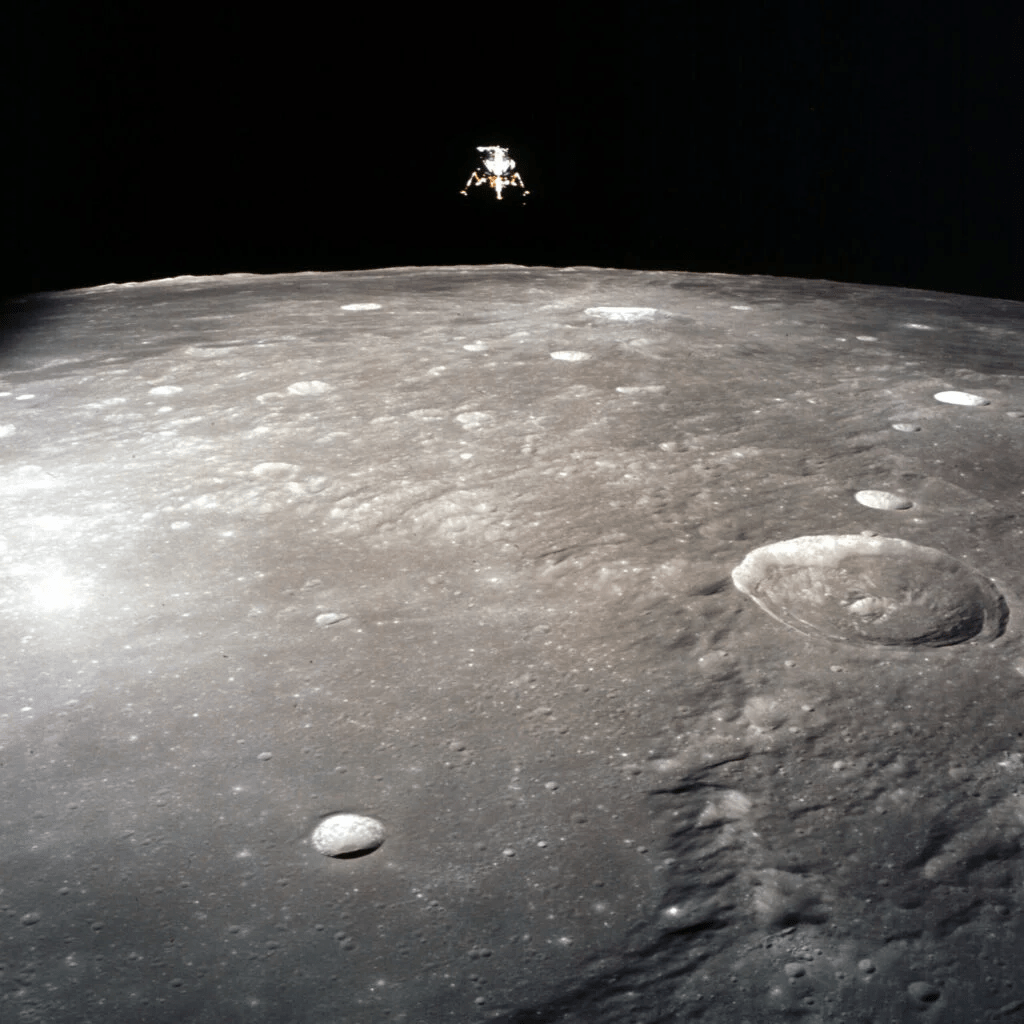
Though the Apollo lunar modules were built for the sole purpose of landing two men on the surface of the Moon, their usefulness didn’t end after ascending from the lunar surface. While on the moon, the astronauts placed seismic censors and NASA used the spent spacecraft for science, directing these modules for controlled crashed into the Moon. These crashes caused moonquakes, and scientists measured the vibrations moving through the Moon and found it rings like a bell.

Astronaut Bean, Apollo 12

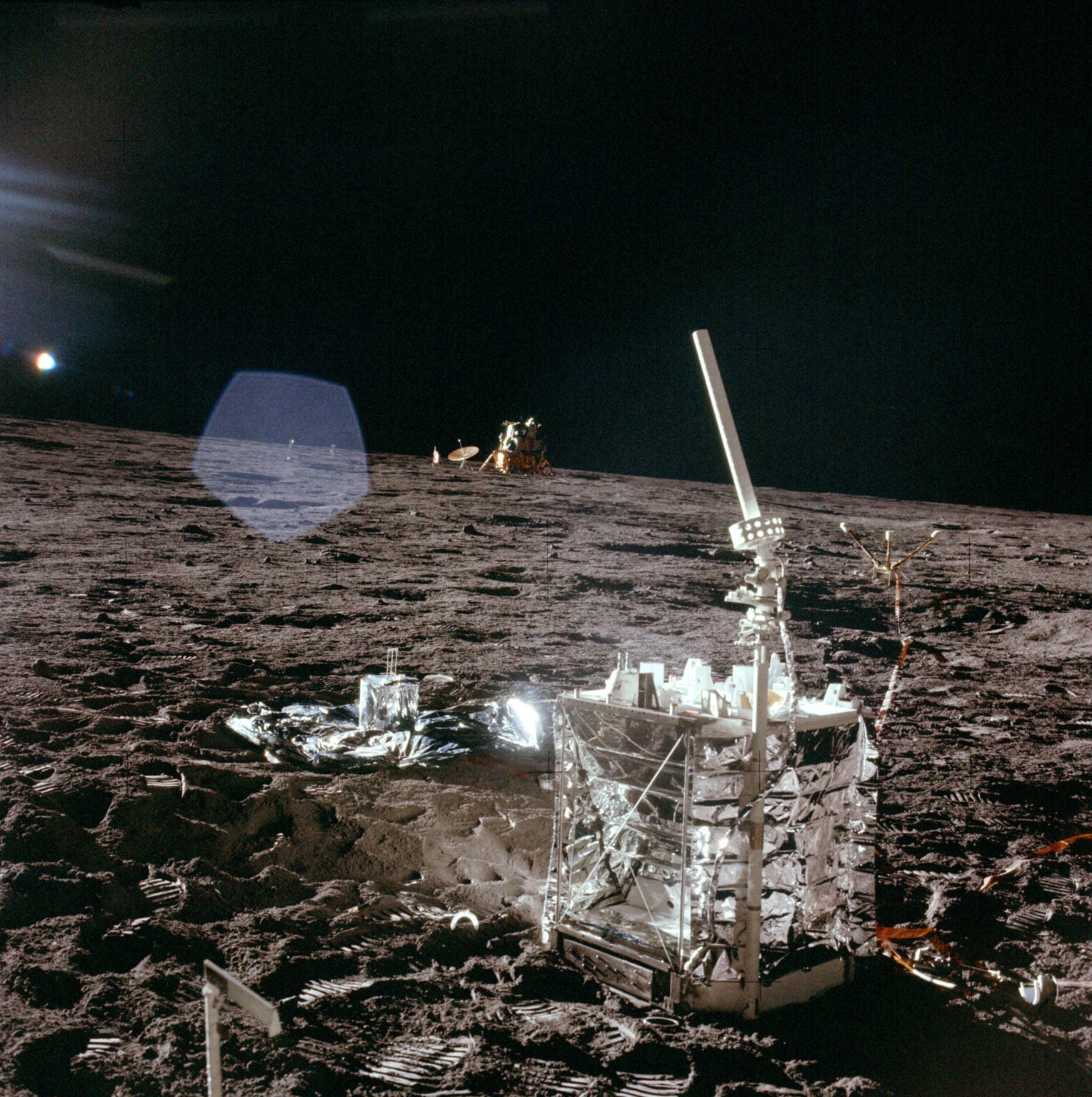
The real goal of the seismic experiments was to figure out the Moon’s internal structure. Measuring how long the reverberations last, how powerful they are, and how big the waves get can reveal what the Moon is made of. Remote seismic stations were instrumental in this investigation, and they were deployed as part of the Apollo Lunar Surface Experiment Packages that astronauts set up on the Moon on Apollos 12, 14, 15, and 16; different versions were deployed on Apollos 11 and 17.

From when they were first set up to when they were remotely shut down in 1977, these ALSEPs recorded all kinds of seismic activity. The data was sent back to receiving stations on Earth where the signal was magnified by 10 million so scientists could interpret the signal.

Apollo 12’s ALSEP on the lunar surface

But something interesting happened on Apollo 12. After Pete Conrad and Al Bean landed at the Ocean of Storms on November 14, 1969, they left the lunar surface 142 hours into the flight. Eight hours later, they were reunited with Dick Gordon in the command module and sent their spent lunar module back to the Moon. It impacted about 40 miles away from the Apollo 12 landing site with the force of one ton of TNT. The resulting shockwave built up and peaked in just eight minutes. Then it took an hour to fully dissipate.

Simulation

Something similar happened on Apollo 13. The S-IVB impacted the Moon 85 miles from Apollo 12’s ALSEP — CMP Jack Swigert joked at the time that it was the only thing on that mission to go right. It hit with the force of 11 and a half tons of TNT. This translated to a seismic impact peaked after seven minute with shockwaves 30 times greater and four times longer than those from Apollo 12’s LM impact.

The vibrations from these two impacts lasted longer than scientists expected, far longer than any equivalent vibrations last on Earth. It was almost as if the Moon was ringing like a bell. This strange result forced scientists to think differently about the Moon and its composition.

The crater left by Apollo 13’s S-IVB impact.

It turns out that these impacts were characteristic of one of four types of moonquakes scientists studied from ALSEP data. Some moonquakes originate deep below the surface because of lunar tides, some are thermal quakes caused by the Sun thawing the frozen surface at the start of a new lunar day, and others are caused by impacting meteors. The fourth kind of moonquake is a shallow moonquake occurring roughly a couple of tens of miles below the surface. The lunar module and S-IVB both produced this kind of vibration, and these are the most violent types of moonquakes.

Between 1972 and 1977, scientists recorded 28 shallow moonquakes registering as high as 5.5 on the Richter scale. On Earth, that will move heavy furniture and crack plaster, but the vibrations usually die down in a matter of minutes.

It all comes down to water. There’s moisture in the materials that makes up our planet, expanding their structure. As energy from an earthquake moves through our planet, that damp material acts like a sponge, absorbing the energy of the waves and ultimately deadening their effects. But the Moon is dry, cool, and rigid, more like a solid rock than a sponge. So even if a moonquake is less intense, there’s nothing to deaden the vibrations. They just go back and forth through the body until the solid stone eventually stops them. The “ringing bell” is the shock waves reverberating through that stone.

STAGECOACH MARY

Would-be mail thieves didn’t stand a chance against Stagecoach Mary. The hard-drinking, quick-shooting mail carrier sported two guns and men’s clothing. Bandits beware: In 1890s Montana, would-be mail thieves didn’t stand a chance against Stagecoach Mary.

As the first African American woman to carry mail, she stood out on the trail—and became a Wild West legend. Rumor had it that she’d fended off an angry pack of wolves with her rifle, had “the temperament of a grizzly bear,” and was not above a gunfight. But how much of Stagecoach Mary’s story is myth?

Stagecoach Mary

Born Mary Fields in around 1832, Fields was born into slavery, and like many other enslaved people, her exact date of birth is not known. Even the place of her birth is questionable, though historians have pinpointed Hickman County, Tennessee as the most likely location. At the time, enslaved people were treated like pieces of a property; their numbers were recorded in record books, their names were not.

Her story becomes clearer after the end of the Civil War, when she was freed. Many formerly enslaved people headed north to friendlier territory. So did Fields, who seems to have gone up the Mississippi River working on riverboats and acting as a servant and laundress for families along the way. She ended up in Ohio, living a life that was well outside the norm—in a convent.

Ursuline Convent of the Sacred Heart

It’s not clear how Fields discovered the Ursuline Convent of the Sacred Heart in Toledo, Ohio. Some accounts say she accompanied a daughter of the Warner family to the convent. Others say she headed there with a family friend who was a nun.

The religious community, which still exists today, was serene and disciplined. There, Fields worked as a groundskeeper. Her gruff style and penchant for cursing raised eyebrows in the quiet convent. When asked how her journey to Toledo was, she reportedly told one of the nuns that she was ready for “a good cigar and a drink.” Historical records show that the nuns complained about her volatile temper and her “difficult” nature.

According to historian Dee Garceau-Hagen, one nun remembered Fields’ wrath when anyone disturbed her lovingly kept grounds, saying “God help anyone who walked on the lawn after Mary had cut it.” Fields also tussled with the nuns over her wages—behavior that would have shocked white women who expected African Americans to be well behaved and subservient.

Mother Amadeus Dunne 1884

Though Fields struggled to adjust to the sheltered life of the convent, she did make a friend: Mother Amadeus Dunne, the convent’s Mother Superior. Known for her fearlessness and charisma, Dunne was called to missionary work by her bishop and headed to Montana where she founded an Ursuline convent there in 1884. There, she assisted Jesuit priests who were starting schools for the Blackfeet Nation. In 1885, Fields got word that the beloved nun was gravely ill, and headed to Montana to help her.

The West suited Fields, who nursed Dunne back to health and began working for her new convent near Cascade, Montana. But though she faithfully served the nuns in the harsh, sparsely populated community, news of her subversive behavior reached the bishop, who raised serious concerns about Fields’ habits of drinking, smoking, shooting guns and wearing men’s clothing. When Fields and the convent’s male janitor pointed guns at one another during an argument, it was the final straw.

Kicked out of the convent, Fields was on her own—and she set about living a life that was shocking by 19th-century standards. She took in laundry and did odd jobs, started businesses and became known for liking hard liquor and gunfights.

Stagecoach Mary

This tough reputation ended up paying off. In 1895, she got a contract from the postal service to become a star route carrier—an independent contractor who carried mail using a stagecoach donated by Mother Amadeus. It suited Fields to a tee. As a star carrier, her job was to protect the mail on her route from thieves and bandits and to deliver mail. She was only the second woman in the United States (and the first African American woman) to serve in that role.

Representative image

“Stagecoach Mary” or “Black Mary,” as she was nicknamed, carried a rifle and a revolver. She met trains with mail, then drove her stagecoach over rocky, rough roads and through snow and inclement weather. And though she intimidated would-be thieves with her height and her tough demeanor, she became beloved by locals, who praised her generosity and her kindness to children.

For eight years, Fields protected and delivered the mail. Eventually age caught up to her and she retired. The community rallied to support her, despite occasional dust-ups with neighbors. Local restaurateurs gave her free meals; saloon regulars chatted with her until bars became forbidden to woman due to a town ordinance. When she died on December 5, 1914, her funeral was one of the largest the town had ever seen.

Notice in Newspaper

Because of scant records and the temptation to create Wild West legends out of ordinary people, many facts about Field’s life are still fuzzy. What is clear is that her real-life persona was extraordinary enough to draw plenty of attention on its own. Mary Fields didn’t need to be a myth to stand out from the crowd—but she didn’t seem to mind her outsized reputation.

Poisoning of the Treaty Oak

Although over a quarter of a century has gone by, the bitter memory of the Treaty Oak’s poisoning still lingers in the minds of many Texans. Few recall, however, the dark motives of the man convicted of the crime.

The Treaty Oak is the lone surviving member of the Council Oaks, a grove where folklore holds that Stephen F. Austin met with Comanche and Tonkawa tribes to negotiate the first boundary treaty of Texas. The 600-year-old live oak is a belove Austin landmark. Before the poisoning, its branches spread some 130-feet wide.

Facebook/Cecilia Minden

John Giedraitis, at that time the arborist for the City of Austin, discovered dead grass under the tree in spring, 1989. After heavy rains caused the poison to penetrate the oak, leaves yellowed and sailed to the ground. Something was terribly wrong. Soon the malevolent cause of the tree’s illness was discovered, a revelation that shocked the Lone Star State.

Texas Heritage Tree Care working on tree

When news of the poisoning spread throughout Austin, residents were outraged. The tree was a treasured part of the region’s history: Before European-Americans settled the land around it, the tree was revered in Tejas, Apache, and Comanche culture. A plaque beneath the site tells the (unsubstantiated) story of Texas settler Stephen F. Austin negotiating a border treaty with Native Americans on that very spot in the 1830s.

2012 timeframe

In an attempt to save the dying tree’s life, the city launched a full-blown recovery campaign. The contaminated soil was replaced with fresh dirt and the damaged roots were treated with sugar. A sprinkler system was installed in Treaty Oak Park to provide the tree a steady supply of revitalizing spring water. Other efforts were less practical: a Dallas-based psychic named Sharon Capehart tried healing the tree by transferring energy into it. (In the process, she allegedly discovered that its spirit had once belonged to an ancient Egyptian woman named Alexandria.) Without any supposed psychic gifts or tree expertise to offer, some Austin citizens responded with good vibes.

Similar to this process undertaken in Auburn

Texans from far and wide arrived to pay their respects to the dying tree. Around its thick trunk, they left notes and gifts, as well as prayers for the tree’s recovery. The experts were unanimous: none of them believed there was any hope for the Treaty Oak. Billionaire Ross Perot sent Austin a blank check. The city would spend $250,000 in an attempt to save the tree, using radical, desperate methods.

As the public processed the shock and grief, the Austin police worked to nab the perpetrator. On June 29, 1989—a few months after the crime had been committed—they arrested their primary suspect: a 45-year-old local named Paul Stedman Cullen. He was convicted on a second-degree criminal mischief charge nearly a year later. His motive?

Cullen poisoned the tree as part of a mystic ritual. “Prosecutors said he used the herbicide in an occult ritual to kill his love for his counselor at a methadone clinic, protect her from another man, and pay back the state for outdoor work he was forced to do while he was in prison,” The New York Times reported in 1990.

Before pouring the Velpar on the oak’s roots, Cullen had placed objects that belonged to his counselor in a circle around the trunk. He told an acquaintance that every time he passed the tree and saw it dying he would “see his love for the counselor dying.” The jury had the option to sentence him to life in prison, but in the end they settled on a sentence of nine years (which he served a third of) and a $1000 fine.

Facebook/Barbara Garner

Witness Cindy Blanco testified that Cullen owned books on witchcraft and that he’d told her he had placed items belonging to the counselor around the oak’s roots before pouring the herbicide. When Cullen drove past the dying tree, Blanco claimed, it was as though he were watching his own unrequited love slowly perishing.

Cullen maintained his innocence and claimed the media was setting him up. His attorney made the case that Cullen had lied to Blanco in an attempt to appear impressive. The defendant faced the stark possibility of a life sentence.

From Austin History Center

The jury faced a difficult decision. They understood that a man’s life is worth more than any tree, even if the man in question is a criminal. Yet at the same time, the jury acknowledged a serious and disturbing crime had been committed and justice must be served. In May 1990, the jury gave Cullen a nine-year sentence and a fine of $1,000. He would serve only three years.

Perhaps prayers are stronger than black magic. In the end, the Treaty Oak survived. Though now a third of its original size, the oak is going strong and managed to produce acorns in 1997 for the first time since the poisoning. The Treaty Oak outlived Cullen, who passed away in 2001 at the age of only 57.

31 Squared

Thirty one years ago, when I was 31 myself, I married the most wonderful man! We had a whirlwind courtship, engaged after just 10 weeks. But I’m getting ahead of myself.

They say true romance never runs smooth, and they are right! The night of the proposal, I had an evening college class. My future husband dropped by just after supper and asked if he could talk with me on the porch. I went out and he said he needed to use the bathroom and would be right out. When he finally came out, he looked really nervous. He began by saying how different we were, how we came at life from different perspectives, and how we were pretty set in our ways.

I was sure he was breaking up with me and began to cry. I told him I needed to get to class and we could break up AFTER my class. He grabbed my arm and whirled me around and said, I want to marry you! I just asked your Dad and he gave me his blessing. Say yes!

UMMMMMM…WHAT???????

I did say yes, and we started to plan a June wedding…we had only met in July, and here we were planning to be married in June! I was beyond happy! But I was also in my final year of college–working full time and raising my son alone. I was BUSY! When I first began evening college, I promised my son I would take him to Florida after I graduated–a promise he reminded me of constantly. And a promise is a promise!

By the time May rolled around, the wedding details were finalized, the vacation I promised my son was booked and I had made significant progress on my wedding gown (did I forget to mention I was also making my own gown? LOL) and I was studying for finals.

I thought I was going to pull this all off! I took my finals…aced them all! I graduated suma cum laude and a Phi Beta Kappa. (One thing crossed off my to-do list!) The day after graduation, my son and I departed for Florida. We spent a fun week in Florida–seeing Disney World, Sea World and everything else on his little list. (Second thing crossed off my list!)

Thankfully this was NOT on his list…lol

The week after we got home from vacation, disaster struck. I got pneumonia. I continued to work and stress about the wedding details, but put finishing the dress on hold. I just didn’t have the strength. At this point, my future husband’s ex-wife decided she HAD to meet me, approve of me and decide whether or not I would be an “appropriate” addition to her daughter’s life. She was met with staunch silence. She then threatened to take my future husband to family court to change the custody agreement if he didn’t agree and he said have your lawyer call mine. After she made that phonecall and found there was nothing she could do to compel me to meet with her, she threatened to come to the church and ruin the wedding. Hubby enlisted additional family members to stand watch at the church and remove her if she showed up.

When our wedding day arrived, the gown was ready, the “guards” were ready and the day was HOT. The bridal cars were being decorated in my family’s driveway, when a limo pulled up. One of my hubby’s groomsmen worked at a rental place, and as a surprise, rented us the limo. Although it was a nice gesture, he had to be the one to drive it–which displaced the entire bridal procession. My brother who was to drive us in my Dad’s new car now had no job. And the bridesmaid who was supposed to be in the same car as the limo bringing groomsman had no one to ride in the car with her. Sigh…but we rolled on anyway.

The wedding itself went off without a hitch…the ex never showed her face. Afterwards we went to the Rose Gardens to take pictures before the reception. After enduring a half hour in the hot June sun posing among the flowers, I was looking forward to an air conditioned ride to the reception hall. The heat in the limo was stifling–and hubby asked the driver to blast the air conditioning in the back. He said…I AM. sigh…the air conditioning was NOT working in the back. I passed out.

I awoke to a large glass of water being thrown (yes, you read that correctly–THROWN) in my face. They drove to my parents’ house, got a large glass of water and threw it in my face. My hair, my make up and my dress were soaked. When I opened my eyes, my hubby and the driver looked pleased with themselves that they got me awake. I was livid. I wanted to go into the house and fix my hair and my make up and try to dry my dress…I was told there wasn’t time. The guests were waiting for us at the reception hall.

I managed to fix my face a little and off we went to the reception. As the bridal party entered the hall, the dj announced their names flawlessly. When he got to ours, he said…please welcome, for the first time…Mr. (hubby) and Patrick Frederick. Sigh…

Happy Anniversary Honey!!!

Natural Childbirth (Part 1)

Please note – everything in this article pertains to a NORMAL, average pregnancy, with NO complications.

In 1980, I was pregnant with my second child and, like the vast majority of people, I trusted my doctor. I had some minor morning sickness and he gave me a prescription for Bendectin, the only approved drug available in the US at that time. The nausea disappeared within a few weeks, so I never took it.

I enjoyed reading the “rags,” like the Enquirer, where I read an article that claimed Bendectin was causing birth defects. My doctor insisted it was quite safe. In 1983, after losing a birth defect lawsuit, the manufacturer pulled it from the shelves. It was never proven that Bendectin caused birth defects. However, here is the bottom line: drugs are NOT good during a normal pregnancy!!! Link to a 1983 NY Times article, if you’re interested.

Stuck at home, by myself, with no vehicle, I worked on my Bengal tiger latch-hook wall hanging and read books about pregnancy and childbirth. I discovered something called “Natural Childbirth.” Our God does NOT make mistakes and, in the normal course of events, nature provides mechanisms to lessen or eliminate what many consider “problems” in labor and delivery.

For example, the requirement to remain flat on your back and not being allowed to get up and walk around – this puts pressure on a major artery and eliminates the effects of normal gravity; the proscription against eating or drinking – this simply makes it easier for the doctors to guard against vomiting and aspiration of fluids; routine enemas – most women will naturally void their bowls during early labor; shaving the pubic hair – again, this is for the convenience of the doctors; an episiotomy – given no other complications (as in my case), the vaginal opening will gradually stretch during labor due to the pressure from above; the claim that drugs do not cross the placental barrier – not true.

In early March, I was one month out from my due date and we went to “Orientation to Labor and Delivery” at Walter-Reed. The Captain giving the class started listing all these drugs you can have during labor, such as getting an epidural, which entails injecting a numbing drug directly into your spinal cord. Yes, this blocks the pain but it also, to a certain extent, removes your ability to push during contractions. She claimed that these drugs did not cross the placental barrier, which I knew for a fact was not true.

Walter Reed Army Medical Center

Well, she did NOT like that! She got all huffy and said, “Well, if you don’t like the way we run things at WR, you can take it up with the General who runs the hospital.” We immediately got up and left the class and were directed to the Public Affairs office, where the Colonel told us they could not FORCE us to do anything we didn’t want – he advised waiting and coming to the hospital at the last minute.

This experience prompted me to search for alternatives and I found a book at the library about Home Birth. Stop and think for a minute – where is THE worst place to be when it comes to germs? That’s right – A HOSPITAL!!!! Your body, and therefore your baby, is already acclimated to the germs within your own home. Yes, when complications arise, chances are not good. However, if you live close to a hospital in case of an emergency….

I was able to find a local group in Arlington called “Family Birth Associates” and we began our journey…….but we had to move fast. Time was running out……stay tuned for the rest of the story…….

Cat Got Your Tongue?

https://craftsstore.art.blog/wp-content/uploads/2022/06/dmyxtyp.jpg

In honor of Caturday, I brought this puzzle/game I found in Games World of Puzzles April 2022 issue.


Cat Got Your Tongue                                                         by Raymond Simon

Each of the 14 clues below can be answered by a word, phrase, name or title containing the word CAT. For example, the clue “Butterfly-to-be” leads to CATEPILLAR, while “Independent oil driller” would be WILDCATTER.  Can you identify all the right answers?

  1. Wealthy campaign contributor
  2. Midafternoon snooze, maybe
  3. Imitator
  4. L. Bean sends them via snail-mail
  5. Fashion show runway
  6. The world’s first female Iron Chef
  7. Excessively fearful person
  8. Subterranean cemeteries
  9. Reveal a secret, slangily
  10. Substance that initiates a chemical reaction
  11. Early version of a missile launcher
  12. Swift boat with twin hulls
  13. Creating a fake persona to lure someone online
  14. Tennessee Williams play featuring Brick and Maggie


So how’d you do? Did you get them all?   PURRRRRRFECT!!

https://www.letuspublish.com/wp-content/uploads/2017/04/Funny-kitten-free-download-hd-wallpaper.jpg