WACO

The Waco Siege began in early 1993, when a government raid on a compound in Axtell, Texas, led to a 51-day standoff between federal agents and members of a millennial Christian sect called the Branch Davidians. The siege ended dramatically on April 19, 1993, when fires consumed the compound, leaving some 75 people dead, including 25 children.

David Koresh

On February 28, 1993, some 80 agents from the U.S. Bureau of Alcohol, Tobacco and Firearms (ATF) raided a religious compound at Mount Carmel, near Waco, Texas, after receiving reports that the Branch Davidians and their leader, David Koresh, were violating federal firearms regulations.

After four ATF agents and six Davidians were killed in the gun battle that followed, a cease-fire was arranged, and nearly 900 law enforcement officials eventually surrounded the compound, including hostage negotiators and rescue teams from the Federal Bureau of Investigation.

Reporters soon arrived on the scene as well, and the 51-day siege that followed would play out on TV screens and in newspaper headlines around the world. Despite some early negotiating successes—the Davidians sent about 2 dozen children out in exchange for food and other supplies—numerous children remained among those inside, many of them Koresh’s children with various women.

Branch Davidians

In the 1930s, a disgruntled member of the Seventh-Day Adventist Church named Victor Houteff had broken away and founded the Davidian movement. After Houteff’s death, Ben Roden led an offshoot of the movement known as the Branch Davidians, who took control of Houteff’s original settlement at Mount Carmel, near Waco, by 1962.

Believing the Bible is literally the word of God, the Branch Davidians looked to it for clues about the end of the world and Christ’s Second Coming, as told in the Book of Revelation.

Roden died in 1978, leaving his wife, Lois, as head prophetess of the sect. In 1981, a 22-year-old convert named Vernon Wayne Howell arrived at Mount Carmel; he became involved with Lois Roden, and after her death clashed with her son, George, over control.

In a gun battle in late 1987, George Roden was shot in the head and chest, and Howell and seven followers went on trial for attempted murder. The seven other men were acquitted, and Howell’s case ended in a mistrial.

By 1990, having asserted control over the Branch Davidians, Howell legally changed his name to David Koresh. (“Koresh” is the Hebrew translation of Cyrus, the ancient Persian king who conquered Babylon and allowed the Jews to return to Israel.)

Koresh and the FBI

In his negotiations with the FBI during the Waco siege, Koresh claimed he was a messianic figure prophesied in the Bible and that God had given him his surname. He threatened violence against those who would attack him and his family, but asserted that the Davidians weren’t planning a mass suicide.

To the Branch Davidians, Koresh was “the Lamb,” the only one (according to the Book of Revelation) worthy of unlocking the Seven Seals and revealing to the world the entirety of the Bible’s teachings. This identification allowed Koresh to justify some of his controversial (even within the sect) practices, including taking various “spiritual wives,” some reportedly as young as 11 years old.

As time wore on, the negotiators and the Hostage Rescue Team, which handled all the tactical maneuvers, disagreed on how to handle the siege. The latter team, frustrated by the slow pace of negotiations, employed aggressive tactics like playing ear-splitting music or crushing the Davidians’ cars—disrupting often-delicate negotiation efforts.

Fire Engulfs Waco Compound

In mid-April, after religious scholars reached out to Koresh through a radio discussion of the teachings of Revelation, Koresh sent a message through his lawyer announcing he had received word from God and was writing his message on the Seven Seals; he would come out with his followers when he was finished.

The FBI, unconvinced, decided to act to end the siege. Though initially reluctant, Attorney General Janet Reno ended up approving a plan to fire CS gas (a form of tear gas) into the Mount Carmel compound to try and force out the Davidians. Just after 6 a.m. on April 19, 1993, FBI agents used two specially equipped tanks to penetrate the compound and deposit some 400 containers of gas inside.

Soon after the attack ended, around 12 pm, several fires simultaneously broke out around the compound, and gunfire was heard inside. Safety concerns prevented firefighters from entering Mount Carmel immediately, and the flames spread quickly and engulfed the property.

Though nine Davidians were able to escape, investigators later found 76 bodies inside the compound, including 25 children. Some of them, including Koresh, had fatal gunshot wounds, suggesting suicide or murder-suicide.

Legacy of the Waco Siege 

From the beginning, the government’s handling of the Waco siege (which played out in the national and international media) was heavily criticized. Reno took responsibility for the botched raid, later admitting there was no evidence of ongoing child abuse within the compound (which had been one of the justifications for ordering the gas attack).

Though the government long maintained that its actions played no role in starting the fires at the Waco compound, in 1999 it was revealed that some of the gas the FBI used was flammable under certain conditions.

Reno subsequently appointed the lawyer and former senator John Danforth to lead an investigation into the siege’s end. In 2000, he concluded that government agents did not start the fires or shoot at the compound.

Despite this conclusion, resentment lingered about the government’s handling of the situation, which partially fueled the growth of homegrown militias in the United States. The Waco siege and the 1992 Ruby Ridge incident in Idaho are often cited by government critics as examples of overreach and intrusion by federal officials.

In April 1995, on the second anniversary of the Waco siege’s end, a militant named Timothy McVeigh used a truck loaded with 4,800 pounds of fuel oil and aluminum nitrate to attack the Alfred P. Murrah Federal Building in Oklahoma City, Oklahoma. With a total of 168 people killed and some 850 wounded, the Oklahoma City bombing was by far the deadliest terrorist attack in the United States to that date.

Source: History.com

The Regulars Are Coming!

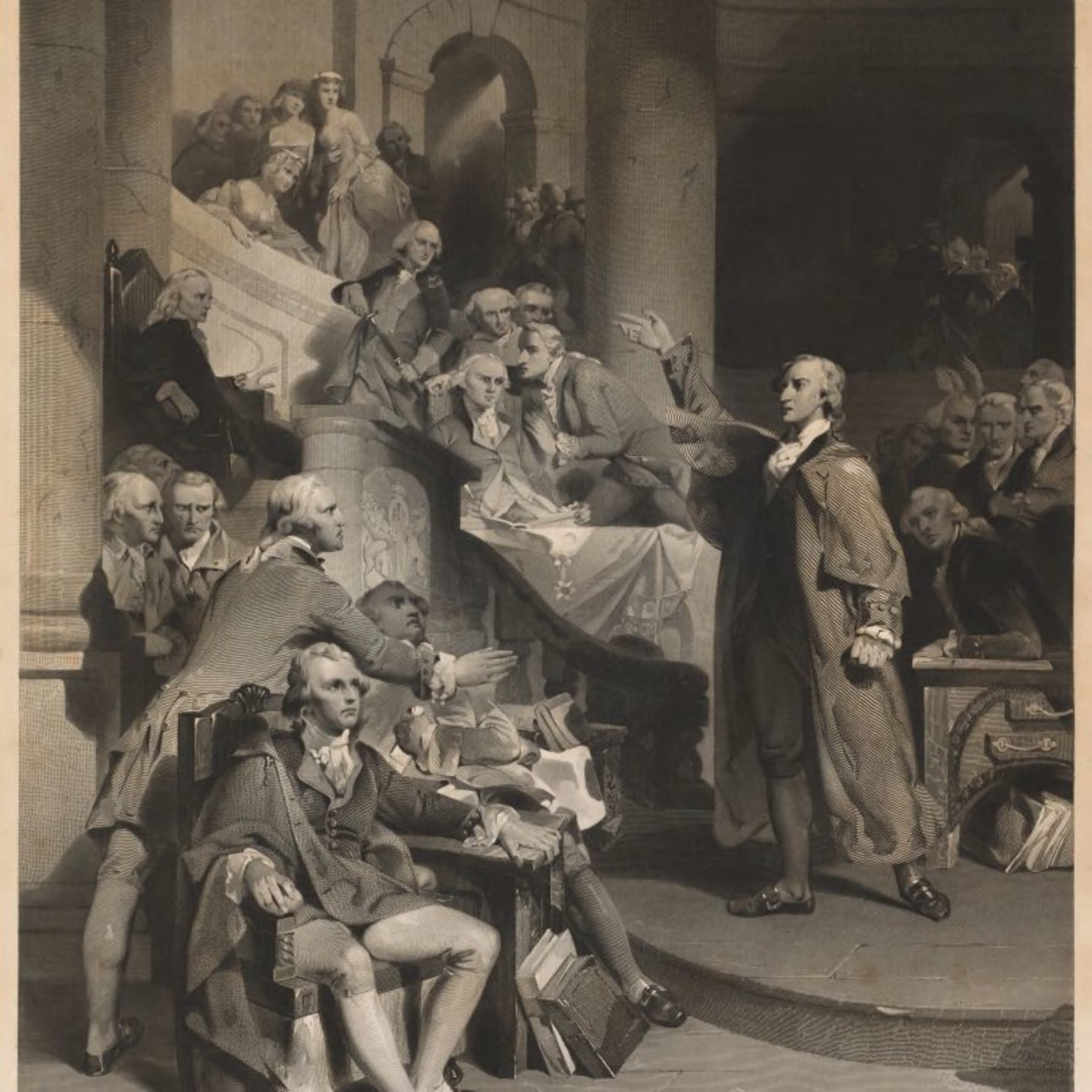
Everyone knows about Paul Revere’s midnight ride, but this patriot did a lot more to help America gain its independence. Here are 11 little-known facts about the Founding Father.

His father was a Huguenot.

Revere’s father, Apollos Rivoire, was a French Huguenot refugee who fled his country as a result of religious persecution. He was born in Riocaud in 1702, but with time he lost most of his connection to France—he could not read or write the language. The Frenchman later changed his name to Paul Revere, “on account that the Bumpkins pronounce it easier.” He married Deborah Hitchbourn, a member of a very old Boston family, and passed the anglicized name, Paul, to his eldest son.

As a teen, Revere worked as a church bell ringer.

When he was around fifteen, Revere would ring the bells at the Eight Bell Church near his home. The young patriot and his friends set up a bell ringers’ association. They drafted a document that detailed the rules and guidelines for membership. Members could only be allowed into the group through a unanimous vote, members could not beg for money, and a moderator was chosen every three months to delegate work and changes within the group. The simple document focused on the fundamentals of public duty, majority vote, and community.

Revere made some interesting items in silver.

Revere’s father came to Boston as an apprentice smith. He worked for a man named John Coney for several years and purchased his freedom for forty pounds. After Revere was born, he apprenticed under his father and learned how to craft things from gold and silver. Some items include a chain for a pet squirrel, an ostrich egg snuffbox, and sword hilts. You can tell an item is made by Revere by his maker’s mark—either his last name in a rectangle, or his initials in cursive.

The silversmith was also a dentist.

When dental surgeon John Baker moved to town, Revere happily studied under him. He learned how to create false teeth out of ivory and insert them using wire. Revere became so confident in his abilities that in 1768, he placed an ad declaring he “can fix [teeth] as well as any surgeon dentist who ever came from London, he fixes them in such a manner that they are not only an ornament but of real use in speaking and eating.”

He made a lot of money. Literally.

During wartime, Revere used his smithing skills to engrave printing plates to print money in Massachusetts. He was also commissioned to design the Continental currency, money used to pay the rebel army. The new bills strangely ranged from one-sixth of a dollar to 80 dollars.

During the war, Revere accidentally engaged in some super early forensics.

After Dr. Joseph Warren was killed at the Battle of Bunker Hill in 1775, he was buried like others in an unmarked grave. Ten months later, the bodies were exhumed and examined. Revere was Warren’s dentist, and recognized him by his teeth: Revere had given Warren a false tooth fastened with wire. This was the first body identification done by teeth in recorded history.

He had a large family.

Revere had two wives, Sarah Orne and Rachel Walker, and he had eight children with each of them. Revere was a doting father who referred to his kids as his “little lambs.” Ten of Revere’s children perished at a young age, but he still managed to acquire 52 grandchildren.

Revere was unfailingly polite and dapper.

The patriot even dressed well on his famous midnight ride. Impressed by his garb, his captors saluted him as one of equal rank (before threatening to shoot him in the head). Even with a gun in hand, the redcoat politely asked, “May I crave your name, sir?”

He was not drunk on his midnight ride.

This urban legend took hold when the media was eager to discredit the Founding Fathers during the tumultuous era surrounding the Vietnam War. One Boston newspaper ran a story in 1968 claiming that Revere drank some rum early into his midnight ride. Revere’s drunken yelling apparently roused the patriots accidentally. While Captain Hall, a patriot stationed in Medford, did own a distillery, there is no evidence suggesting that Revere’s booze-fueled yelling truly occurred. Regardless, the unfounded accusations caught on and are often still suggested as truth.

He wasn’t the only one to go on a midnight ride.

Paul Revere and William Dawes originally planned to carry news of the invasion to Concord, where military supplies were stored, and then warn John Hancock and Samuel Adams, who had been targeted for capture. On the trip there, the duo would ride through Somerville, Medford, and Arlington, warning patriots as they passed through. They ran into Samuel Prescott (who was just leaving a lady friend’s house at one in the morning) in Lexington, and asked him to come along.

Revere was captured about halfway through the ride, but the others managed to escape and keep going. Revere had his horse confiscated but still managed to warn John Hancock and Samuel Adams. The true hero was Prescott, who actually went through with the plan and reached Concord.

So why were the more successful criers left out of the story? One very popular—but incorrect—poem is to blame. Henry Wadsworth Longfellow’s “Paul Revere’s Ride” starts with this very familiar stanza:

Listen, my children, and you shall hear Of the midnight ride of Paul Revere, On the eighteenth of April, in Seventy-Five: Hardly a man is now alive Who remembers that famous day and year.

This poem is filled with intentional inaccuracies. Longfellow did his research, but took many liberties in order to properly convey his message. The poet wanted to create a folk hero by painting a lone man as the midnight rider. In order to do such, he removed the extra players.

We’ve all been misquoting him.

Paul Revere and his fellow patriots never shouted, “The British are coming!” That wouldn’t have made sense, since most colonists were British. The actual warning was “the Regulars are coming out.” This misconception is another result of Longfellow’s creative license—he found the real sentence to be too wordy for his poem.

Source: Mental Floss

Tribute Band…no relation…LOL

Death & Taxes

There are few sure things in life, but 2 are death and taxes. I’m presenting an article from Mental Floss about tax trivia.  I added pictures.

Why does Tax Day typically fall on April 15 (though it’s April 18 in 2022*), and which historical leader taxed beards? Read on for answers to those questions and more in this list, adapted from an episode of The List Show on YouTube. * (in 2023, it’s April 17th)

1. Taxes date back to at least ancient Egypt.

We can trace documented records of taxation all the way back to ancient Egypt, sometime around 3000 to 2800 BCE. Apparently, there was a biennial event called the Following of Horus, when the pharaoh went around collecting taxes in his dual roles as head of state and living incarnation of the god Horus. Taxation is even described in the Bible when Joseph tells the people of Egypt to give a fifth of their crops to Pharaoh.

2. The first taxes implemented in the United States caused a rebellion.

Fans of the Broadway musical Hamilton probably remember the lyric, “Imagine what gon’ happen when you try to tax our whiskey.” What happened was the Whiskey Rebellion, which was largely due to a tax that Alexander Hamilton imposed on—you guessed it—whiskey.

As you might imagine, people were extremely unhappy about it, especially small producers of whiskey, who, because of the way the tax was structured, had to pay nine cents per gallon in taxes, while larger producers were able to get as low as six cents. Violence quickly broke out. Tax officers were assaulted and tarred and feathered for trying to do their jobs, and several people were killed during riots. The rebellion was eventually quashed in 1794, and the whiskey tax remained in effect until 1802, when Thomas Jefferson repealed it.

3. Abraham Lincoln gave us federal income tax.

Abraham Lincoln signed the Revenue Act in 1861, which imposed the first-ever federal income tax. To drum up funds for the Civil War, Lincoln and Congress enacted a modest 3 percent tax on income over $800, which would be roughly $23,000 today. The law was almost instantly replaced with a new revenue act and would be repealed a decade later, but the relief obviously didn’t last: In 1913, the 16th Amendment established the federal income tax system we all know today.

4. Tax Day wasn’t originally on April 15.

When the modern federal income tax was established, lawmakers set March 1 as the looming deadline.

Although they gave no reason for this particular date, it was presumably to give people a couple of months to gather paperwork and crunch numbers after the end of the year. By 1919, the government tacked a couple of more weeks on to help panicked filers, making March 15 the date. That date stood until 1955, after Congress acknowledged that doing your taxes was getting more complicated by the year.

To help accommodate all of those changes and give people adequate time to file, the date was bumped by another month—but the change wasn’t entirely altruistic. The IRS acknowledged that the extra month would help their employees as well, spreading the workload out across another 30 days.

5. We spend a lot of time doing our taxes.

The amount of time we spend doing our taxes every year suggests that the repeated date changes may have been justified. According to the IRS, the average taxpayer spends about 11 hours doing record-keeping, tax planning, form submission, and other super fun tax-related activities. Of course, if you break it down even further, the amount of time changes based on the type of form the filers use. Business filers spend about 20 hours, including 10 hours on record-keeping alone.

6. The average American gets about $3000 back from their tax refund each year.

This amount ebbs and flows a little bit every year based on the economy, fluctuating consumer incomes, and the IRS’s withholding tables, which suggest how much employers should deduct from employee paychecks to account for income tax. It’s worth pointing out that a huge tax refund isn’t necessarily a great goal: It basically means you gave the government an interest-free loan that year.

7. In 1836, the federal government of the United States had a tax surplus of around $30 million.

Congress gave most of that money back to the states, and each state was able to decide how to handle it. Maine decided to give back to the people, which meant that every single resident received a whopping $2. A woman named Salome Sellers used her money to buy a pair of fancy candlesticks. As she told the New York Star Tribune in 1902, when she was about to turn 101 years old, “Many people put their share of the surplus into flimsy finery … but I bought something that would keep to remember those good times by.” Today, those surplus sticks are in a museum.

8. Peter the Great taxed beards.

In 1698, Russia’s Peter the Great introduced a beard tax. After embarking upon what he called a “Grand Embassy” across Europe to observe more about Western cultures and processes, Peter came back with a number of reforms designed to bring Russia up to speed—and one of those reforms impacted facial hair.

The tsar noted that “modern” Western Europeans eschewed beards, and he wanted to emulate the trend within his own borders. If that doesn’t seem strange enough, wait until you hear how he unveiled his new anti-beard beliefs: At a big state reception, the tsar whipped out a massive barber’s razor and proceeded to shave his guests’ beards.

Although Peter was originally against beards entirely, he eventually decided to make money off of his ban by allowing facial hair, but taxing it. Nobility and merchants were charged significantly more than commoners, by the way.

9. A former IRS commissioner went to prison for tax evasion.

In 1952, Joseph Nunan, who was the IRS commissioner from 1944 to 1947, was busted for evading over $90,000 in taxes. Among the transactions that he failed to claim was $1800 in winnings from a wager that Harry Truman would beat Thomas Dewey in the presidential election of 1948. Nunan was sentenced to five years in prison.

10. A famous gangster was ultimately taken down over taxes.

Mob boss Al Capone ran a criminal enterprise and regularly ordered hits on his enemies—but he wasn’t sent to prison for murder. Instead, he was charged with tax evasion and fraud, and was sentenced to 11 years.

11. Willie Nelson made an album to cover his tax debts.

It was called the IRS Tapes, and all proceeds went toward his tax bill.

12. Henry David Thoreau went to jail for failing to pay taxes.

The poet was imprisoned in 1846 for failing to pay a poll tax (a tax levied on every individual, regardless of income). Poll taxes were once typical in much of New England; paying the tax was typically a requisite to be able to vote, so they often functioned as a form of de facto discrimination against poorer citizens. Thoreau’s refusal to pay the poll tax was his way of protesting slavery. Someone paid the tax on Thoreau’s behalf, however, and he was released the next morning.

13. Shelled nuts are sometimes subject to taxes.

In England, shelled nuts are subject to a 20 percent value-added tax.

14. India has an entertainment tax.

Movie tickets are taxed anywhere from 18 to 28 percent depending on the price of the tickets. This is actually an improvement—before the government launched the Goods and Services tax, it was left up to each state to set its own entertainment tax. In Jharkhand, the tax was 110 percent.

15. There’s a cow flatulence tax.

Cow farts (really more like cow burps) are no laughing matter. The methane they produce is contributing to climate change in a big way. To help offset some of these drawbacks, many EU countries are looking at introducing a cow tax to tax producers for cow emissions.

16. England once had a special hat tax.

From 1784 to 1811, British citizens had to pay a tax on their hats. To prove they paid the tax, a stamp was pasted inside the hat. If the hat police caught you wearing a stamp-less hat, you’d be hit with a hefty fine. In 1798, a man named John Collins was caught using a printing press to forge the stamps, which would allow people to skirt the tax. He was sentenced to death.

17. There’s a tax court.

There are always people who get creative with their tax deductions. While most don’t pass muster, the United States Tax Court, a court of law dedicated to tax-related disputes and issues, does occasionally find in favor of some pretty unusual claims. For example, TurboTax tells the story of a professional bodybuilder who successfully claimed his supply of body oil as a professional necessity. (He also tried to claim buffalo meat and vitamin supplements, which they nixed.)

18. New Mexico gives a tax break to all centenarians.

If you live in New Mexico, and have lived there for at least a century, great news: You don’t have to pay state taxes. The Land of Enchantment provides a major tax break to all centenarians. But considering there are only 80,000 100-plus-year-olds in the entire United States, New Mexico isn’t exactly losing out on major money by providing this perk.

19. Even astronauts in space need to file their taxes on time (or ask for an extension).The IRS is a notorious stickler for on-time filing—which no one knows better than Jack Swigert, the command module pilot for Apollo 13, who joined the crew at the last minute. He was mid-mission when he realized that he was going to miss the April 15 tax deadline, so he radioed Houston to request an extension. Although the ground crew laughed at what they presumed was a joke, Swigert was dead serious. According to NASA transcripts, he said, “Hey, listen, it ain’t too funny; things kind of happened real fast down there, and I do need an extension. I didn’t get mine filed, and this is serious.”This sort of thing happens more than you might expect, by the way. In 2005, NASA astronaut Leroy Chiao was commanding the 10th expedition to the International Space Station when Tax Day reared its ugly head. He prevailed upon his sister, an accountant, to file an extension on his behalf, and he got right on it when he returned to Earth on April 24.20. The president of the United States isn’t exempt from taxes.In fact, the POTUS is expected to pay their rightful share, though there are a few nice perks, including a nontaxable travel account worth $100,000 and a nontaxable entertainment account with a $19,000 limit.

21. The IRS updates tax requirements on a regular basis.With the Reform Act of 1986, the IRS started requiring taxpayers to list their dependents’ Social Security numbers for the first time. When citizens were forced to provide this evidence, several million children mysteriously “disappeared” from tax returns.22. Most people file their taxes electronically.As of 2018, only 10 percent of people were still filing paper tax returns. Not only does this mean that those people will wait longer to get any refunds back, it also increases their chances of screwing things up: Paper tax returns are around 40 times more likely to contain mistakes compared to online filing.23. There’s a good chance you can file your taxes for free.If your adjusted gross income is less than $69,000, you’re eligible to use IRS Free File. Seventy percent of filers qualify, which works out to 100 million Americans. If your adjusted gross income is more than $69,000, you can still use Free File. But it’s not going to walk you through the process step-by-step like the other version, so you have to feel pretty comfortable doing your taxes.24. Founding Father Sam Adams was bad at collecting taxes.Adams was elected to Boston’s tax collector post in 1756, but he wasn’t terribly interested in the job. He was prone to overlooking tax debts from people having financial or medical difficulties, which made him a bit like Robin Hood to working-class Bostonians. The problem was, the tax collector was personally liable for uncollected taxes—and by 1765, he owed more than £8,000—equivalent to nearly £1.5 million today. He did end up trying to go after some of the uncollected taxes, but apparently without much success. According to the New England Historical Society, his well-to-do friends ended up covering most of Adams’s debt.25. Vermont once declared war on Germany for tax purposes.In the lead-up to the United States entering World War II, Vermont lawmakers voted to give residents serving in the military a $10-a-month bonus. If the raise was instituted during peacetime, though, everyone would have been hit with a new tax. In order to avoid it, the bonus needed to be issued during a time of armed conflict.War hadn’t officially been declared yet, but President Franklin Roosevelt had issued orders for the U.S. Navy to shoot first if they came across German ships in waters “necessary for our defense.” Vermont lawmakers decided this order was enough for them to basically declare we were at war with Germany in September 1941—three months before the United States did.

This article was originally published in 2021; it has been updated for 2022.

SOURCE: Mental Floss

The Hope Diamond

The History of the Hope DiamondThe Hope Diamond was originally unearthed in the mines of Southwest India along the Kistna River. It was viewed as one of the most unique stones ever pulled from the Golconda mines. So how big is the Hope Diamond? It is believed to have been around 112 carats originally and was placed in the brow of a temple idol.The next time it was mentioned in texts was when it was stolen by a French merchant who then sold it to King Louis XIV in 1642 at a substantial profit. Shortly thereafter the merchant died a wicked death. After the court jeweler cut it down to 67 carats it was named “the Blue Diamond of the Crown.” During the French Revolution in 1792, it was stolen from the royal family after King Louis XVI and Marie Antoinette were beheaded.

In 1812, the Hope Diamond resurfaced in the hands of London diamond merchant Daniel Eliason but only weighed 45.52 carats. It is said that King George IV acquired it but his debts were so enormous when he died that it was sold. A 1839 gem catalog noted that the next known owner was Henry Philip Hope who gave the stone its name. It transferred to several other owners in the succeeding years.

Properties of the Hope Diamond

The Hope Diamond is classified as a type IIb fancy dark grayish-blue stone that contains a strong phosphorescence of reddish-orange. When it is exposed to ultra-violet light in a darkened room then the lights are turned off, the diamond continues to glow like a hot coal. The strange phenomenon simply adds to its mystery.

Colored diamonds, especially blue ones, have electrical properties that are semi-conducting. Unlike other diamonds, blue ones are renowned for their hardness, thermal and optical properties and chemical resistance. Natural diamonds contain defects or impurities. In the Hope Diamond, the impurity is boron, which gives it its unique color.

The Hope Diamond and others in the Aurora Collection underwent intense scrutiny by the Naval Research Laboratory’s Chemistry Division in 2005 in collaboration with NOVA Research. The objective was to identify the similarities and differences between the gems which included the Hope and Blue Heart diamonds among others. It became immediately apparent that all the diamonds studied had phosphorescent bands that centered between 500 and 660nm wavelengths. What they determined was that the phosphorescence in each gem studied could appear pink, aqua, red or orange.

Myths Surrounding the Hope Diamond

Historically, diamonds had myths surrounding them both good and bad as far back in history as 3500 BC when they were first discovered. Here are a few interesting facts that have been recorded over time:

In 3000 BC, the Egyptian hierarchy wore diamonds to represent the sun, courage, truth, and as a symbol of power.

In ancient India, Hindus wore diamonds as a symbol of invincibility and clarity.

The ancient Greeks and Romans believed diamonds were actually the tears of the gods. Plato once wrote that diamonds embodied the celestial spirits of living beings.

In ancient times, the breast plates of Kings were studded with diamonds because it was believed they had magical superpowers. Wearers were seen as invincible, strong and would have good fortune.

Between the 5th and 15th century, diamonds were referred to as “miracle stones” because it was believed they had magical healing powers. Unfortunately, they also discovered that swallowing powdered diamonds resulted in death.

Jewish high priests utilized diamonds to determine guilt or innocence. If the diamond sparkled the individual was considered innocent and if not, they were guilty.

As for the Hope Diamond, its popularity is partially due to the myths surrounding it:

Legend has it that in India the Hope Diamond was originally found embedded in an idol. It was ripped out of the idol by a French merchant and the Hindu priests became so angry they cursed it. A gruesome death was foretold to all who possessed it and anyone that dared touch it. The original thief, for example, was torn apart by wild dogs.

In 1715 King Louis XIV of France bought the Hope Diamond and died of gangrene. Almost all of his children and grandchildren died, so he was succeeded by his five year-old great grandson Louis XV.

In 1792 King Louis XVI and Marie Antoinette were beheaded during the French Revolution. It is said that it was because of the diamond’s curse.

King George IV of England owned the Hope Diamond next and died completely destitute.

It was said that the Titanic sunk in 1912 because the Hope Diamond was aboard.

American Evalyn Walsh-McLean came into possession of the Hope Diamond after which her life was beset by tragedies and debt.

Where Is the Hope Diamond Today?

The Hope Diamond is currently housed in the Smithsonian Museum of Natural History in the Department of Mineral Sciences in Washington D.C. It was donated by Harry Winston in 1958 and receives over 100 million visitors a year. Unlike its previous history, the Smithsonian has always viewed the stone as a sign of good luck.

People often wonder about the value of the Hope Diamond. According to S.H. Zell & Sons Fine Jewelry in New York, New York the value of the gem is $350 million. According to the Smithsonian, however, it is priceless in that it is irreplaceable. However, in 2009 they insured it for $250 million. The thought most gemologists adopt according to Diamond Cutters International is “How can you set a value on the only one of something?”.

Summing Up

The history, curses and myths surrounding the Hope Diamond is actually a parable about the cardinal transgression of greed. The original thief died a horrendous death while later owners, even though unaware of the curse, went through tragedies and forms of suffering as well. It was only when a pure-hearted person, Harry Winston, donated rather than sell the Hope Diamond to the Smithsonian Institution that the curse was broken.

So what is the Hope Diamond? It is one of the greatest treasures in the world that would have an enormous amount to tell us if only it could talk.

Source: The Diamond Authority

Antikythera mechanism: Ancient celestial calculator

A picture taken at the Archaeological Museum in Athens on September 14, 2014 shows a piece of the Antikythera Mechanism, a second-century B.C. device known as the world’s oldest computer which tracked astronomical phenomena and the cycles of the solar system.(Image credit: LOUISA GOULIAMAKI/AFP via Getty Images)

The Antikythera mechanism is an ancient shoebox-sized device that is sometimes called the world’s oldest computer for its ability to perform astronomical calculations. Discovered by sponge divers off the Greek island of Antikythera in 1901, the remains of the mechanism are now preserved in the National Archaeological Museum in Athens. Only 82 fragments, consisting of about one-third of the original mechanism, survive today, It was built around 2,200 years ago.

The mechanism was capable of performing different calculations, and it could help track the motions of the sun, moon and five of the planets; it could even tell when athletic competitions, such as the Olympics, were set to take place, the researchers wrote. Since the discovery of the Antikythera mechanism, scholars have been trying to understand the device. And although they have made considerable progress, many questions remain unanswered. For example, researchers still aren’t sure who made it. The inscriptions on the mechanism are written in Greek.

An engraving illustration of the last hour of Archimedes, the mathematician who died in 212 B.C. or 211 B.C. when the Romans captured Syracuse, Sicily. (Image credit: mikroman6 via Getty Images)

The recovered fragments of the mechanism contained writing and inscriptions, and over the past two decades, scientists have been able to read more of these Greek inscriptions using high-tech imaging methods, such as 3D X-ray scanning. This has enabled them to learn more about how the mechanism worked.

CT scans “revealed inscriptions describing the motions of the sun, moon and all five planets known in antiquity and how they were displayed at the front as an ancient Greek cosmos.” The mechanism used “cycles from Babylonian astronomy, mathematics from Plato’s Academy and ancient Greek astronomical theories.”

More pieces of the Antikythera Mechanism at the Archaeological Museum in Athens.(Image credit: LOUISA GOULIAMAKI/AFP via Getty Images)

Between the front and back of the mechanism were a vast array of gears, designed in such a way that all the dials would depict the correct timing of all the cycles. “Suppose a user of the Antikythera Mechanism wants to check eclipse predictions for a particular month some years ahead. The user winds the mechanism forwards to the desired date, as shown on one of its calendars,” Tony Freeth, a researcher with the Antikythera Mechanism Research Project, wrote in a paper published in 2014 in the journal “PLOS One.”

Though the ship that held the Antikythera mechanism was discovered more than a century ago, the wreck has not been fully excavated. Its location and depth make it hard to excavate. Despite these difficulties a new program of excavation is being carried out by a team of archaeologists and new artifacts continue to be found, shedding light on what the ship, which likely sank around 65 B.C. was like.

Marine archeologists also found a bronze arm from a sculpture in the same shipwreck. Credit: Greek Ministry of Culture

Researchers have noted that many of the artifacts were luxury goods intended for the wealthy. So far, the recent excavations have not uncovered any new remains of the mechanism.

Excavations in 2016 at the Antikythera shipwreck found a nearly intact skull, including the cranial parietal bones. (Image credit: Brett Seymour, EUA/WHOI/ARGO)

Antikythera Mechanism rewrote the history of science

In 2015, Kyriakos Efstathiou, a professor of mechanical engineering at the Aristotle University of Thessaloniki said: “All of our research has shown that our ancestors used their deep knowledge of astronomy and technology to construct such mechanisms, and based only on this conclusion, the history of technology should be re-written because it sets its start many centuries back.”

In 2016, yet another astounding discovery was made when an inscription on the device was revealed—something like a label or a user’s manual for the device. It included a discussion of the colors of eclipses, details used at the time in the making of astrological predictions, including the ability to see exact times of eclipses of the moon and the sun, as well as the correct movements of celestial bodies.

A model of the Antikythera Mechanism was made by Derek De Solla Price. Credit: Public Domain

Inscribed numbers 76, 19 and 223 show maker “was a Pythagorean”

On one side of the device lies a handle that begins the movement of the whole system. By turning the handle and rotating the gauges in the front and rear of the mechanism, the user could set a date that would reveal the astronomical phenomena that would potentially occur around the Earth. Physicist Yiannis Bitsakis has said that today the NASA website can detail all the eclipses of the past and those that are to occur in the future. However, “what we do with computers today, was done with the Antikythera Mechanism about 2000 years ago,” he said.

Making this incredible machine even more impressive is the fact that the movements of the planets are directly linked to specific observation sites around the known world at the time, suggesting that the creator of the Antikythera Mechanism had provided for the use of the machine in more than one location.

Bones found at the Antikythera Mechanism shipwreck site

Greece’s Ministry of Culture issued a statement in late 2019 informing the public that ”bones were collected, which now need to be analyzed, (as well as) olive kernels, and bronze nails from the ship as well as a bronze ring, whose use remains unknown.”

Among the findings which were discovered were sections of the bodies of ancient amphorae, as well as the bases and the necks from the main bodies of the vases. The types of amphorae are identified as those which were typically used on the island of Kos and in Southern Italy in ancient times.

The Greek Ministry noted ”this scientific mission of October 2019 completed the first five-year research program. Based on the results of the latest research, preparations for the new five-year program, starting in May 2020, will begin immediately with the continuation of excavation research in various areas of the wreck, where there are good indications that impressive new findings will come to light.”

“The mission was concluded with great success despite adverse weather conditions and the limited length of time for the rescue research,” the Ministry added.

A video titled “2017 Return to Antikythera Expedition” looks at the delicate and often hazardous work marine archeologists do in recovering ancient gems from the depth of the seas. That expedition, led by the Greek Ephorate of Underwater Antiquities, Lund University, and Woods Hole Oceanographic Institution, was conducted between September 4th to September 20th of that year, and as per previous trips to the wreck, the team did not leave disappointed.

With excellent weather conditions above them, the divers managed to recover an “orphaned” right arm of a bronze statue, pottery shards, nails, lead sheathing fragments, and an odd metal disc, among other artifacts. Prior to that expedition, the Return to Antikythera project team managed to recover glassware, luxury ceramics, anchors, counterweights, tools, and even an ancient skeleton, which is still undergoing DNA analysis.

References:

***https://greekreporter.com/2022/09/15/antikythera-mechanism-secret/

***https://www.livescience.com/antikythera-mechanism


ETYMOLOGY OF WORDS AND PHRASES, PART 13

Curiosity killed the cat is a well-known phrase that is found repeatedly in English literature. The meaning of ‘curiosity killed the cat’ is easy to summarise: don’t go poking your nose into other people’s affairs, and don’t be overly inquisitive about things which don’t concern you, as it will only cause trouble.

The phrase suggests that a cat that went nosing about in something it shouldn’t have came a-cropper and died as a result. However, the phrase began life quite differently. ‘Care killed the cat’ – a phrase with a subtle, but important, different meaning – has a much longer, and older, pedigree. ‘Care killed the cat’ is found as early as 1598, in Ben Jonson’s city comedy, “Every Man in His Humour.” In that play, we find the line: ‘Helter skelter, hang sorrow, care’ll kill a cat, up-tails all, and a louse for the hangman.’

So when did ‘curiosity killed the cat’ take over as the cat-killing expression or phrase of choice – and why? It had certainly come into being by the second half of the nineteenth century: James Allan Mair’s 1873 book, “A handbook of proverbs: English, Scottish, Irish, American, Shakesperean, and scriptural; and family mottoes” lists ‘curiosity killed the cat’ as a familiar phrase, with an ‘I.’ next to it to suggest that the phrase is Irish in origin.

This is perfectly possible, especially as the phrase seems to have really taken off in the United States, where it was perhaps introduced by Irish immigrants in the second half of the nineteenth century. The prolific short-story writer O. Henry, in his 1909 story ‘Schools and Schools,’ wrote: ‘Curiosity can do more things than kill a cat; and if emotions, well recognized as feminine, are inimical to feline life, then jealousy would soon leave the whole world catless.’

Turnabout is fair play is a proverb with its roots in the mid-1700s. A proverb is a short, common saying or phrase that particularly gives advice or shares a universal truth.

Turnabout is fair play is a proverb that means if someone has harmed you, it is permissible to retaliate in kind. Turnabout is fair play is used to justify paying back a real or perceived injury. The phrase turnabout is fair play originated in the mid-1700s in reference to gaming, meaning taking turns assures a fair game.

Today, the term has taken on the connotation of revenge or retaliation, in the sense of two parties taking equal advantage of each other. Occasionally, turnabout is fair play is used in a friendly, teasing manner as an admonishment to keep things fair and equal.

Beggar belief is not a phrase that means the beliefs of beggars. Instead, its true meaning as an idiomatic expression is to be undeserving of being believed or to become unbelievable. People also use the term as a verb meaning to defy belief. The idiom beggar belief comes from the verb to beggar, which means to make poor or impoverished.

In American English, the famous meaning of beggar is a noun that refers to an impoverished person. Some people believe that beggar as a verb was coined by William Shakespeare. He used the term in 1616 in Antony & Cleopatra: ‘For her owne person It beggerd all discription.’

However, it has been around since the early 16th century. Three centuries later, beggar as a verb was combined with belief to mean be unbelievable. The phrase was first found in John Whitley’s “Completion of Prophecy.” He used it in the 19th century to describe the “heathens” who didn’t believe in the Bible.

Catty-corner, kitty-corner, and cater-cornered all derive from the Middle English catre-corner, literally meaning four-cornered. All three forms are used throughout the English-speaking world. They usually mean positioned diagonally across a four-way intersection, but they can work in other contexts relating to one thing being diagonal from another.

Gobsmacked, a British colloquialism, means (1) surprised, (2) dumbfounded, or (3) awestruck. In parts of Britain, gob is slang for mouth, and to be gobsmacked (one word) is to be figuratively smacked in the mouth—that is, struck dumb by something. Gobsmacked is most common in British and Australian speech and writing. It appears occasionally in Canadian and U.S. publications, but it gives the impression that the writer is either British or affecting a British voice.

Another version of this adjective is gobsmacking. Usually things are gobsmacking while people are gobsmacked. The term’s origins are pretty literal. When people are shocked or in awe, they clap or smack their hands to their mouths or gobs. Another related term is a gobstopper, or a jawbreaker in the United States. The candy is round and hard, usually meant to be sucked on instead of chewed, effectively stopping one’s gob from other tasks such as talking.

To have another string in your bow can mean that you have a backup plan in case the current plan fails. This is analogous to an archer carrying an extra bowstring in the event that the first breaks. Alternatively, the phrase may mean to have two strings in one bow that may work together, or to have two methods of acquiring a goal. This would be similar to a bow having two or more strings to increase the force propelling the arrow forward. The arrow would hit the target faster.

A slight variation of this last definition is that by having an extra string in your bow, you have learned a new talent that will help in your career. Or in other words, you have more than one skill to rely on to accomplish your goals. This may refer to an archer having different kinds of strings, some of different materials and strengths.

It should be noted that all of the archer analogies have been used since the sixteenth century and some of them have morphed over time. It is unlikely that each phrase was coined with the explicit analogy in mind. This idiom is mostly found outside of the United States, and it is extremely changeable.

To be at a loose end is to have nothing to do. It is primarily used in British English. In the United States, there is a variant phrase to be at loose ends. This also means to have nothing to do, but it carries the connotation of nervousness, as in the situation of not being able to do anything about a stressful situation. The British phrase suggests only boredom.

The chart shows that the global popularity of the two versions has traded places over time, with the current favorite being ‘at loose ends’. A straight internet search finds ‘at a loose end’ slightly more popular. As with all informal phrases, research is somewhat unreliable about usage since most usage is verbal.

Boggle the mind and mind-boggling are terms that have their roots in the sixteenth century, though their current use only became popular in the 1950s. To boggle the mind means to baffle someone, to astonish or overwhelm someone. The term begins with the word boggle, which dates back to the sixteenth century. At that time, boggle was mostly used to describe the state of a startled horse.

The word boggle is most probably derived from the dialect word bogle, which meant an unseen specter. Presumably, these unseen specters were blamed for startled horses. Today, the word boggle is almost exclusively used in the phrase boggle the mind or the adjective form, mind-boggling. Note that when used as an adjective before a noun, the term is hyphenated. Related terms are boggles the mind, boggled the mind, boggling the mind.

The word cheapskate is a closed compound word made of the words cheap and skate. But it does not refer to affordable skates. The term describes a person who goes beyond frugal living. Cheapskate is a noun that refers to a miserly or stingy person. It’s usually someone who tries to avoid paying their share of expenses or costs. This scornful term describes someone with “short arms and long pockets.”

A cheapskate is not only a cheap person or someone who wants to save money and live debt-free. It’s also someone who does not want to spend money even though it’s necessary. Ebenezer Scrooge from A Christmas Carol is a clear example of a cheapskate. Despite being wealthy, he underpays his employee and hounds debtors relentlessly. He hates Christmas because he associates it with reckless spending.

The origin of cheapskate is not recorded. But it’s worth noting that skate is a slang word for a mean or contemptible person. It might have originated from skite, a Scottish slang with the same definition. Then, in the 20th century, skate and cheapskate became synonymous in the USA and UK. The earliest recorded use of cheapskate can be found in George Ade’s “Artie: A Story of the Streets and Town” (1896):

“Them sporty boys don’t last. They get in with a lot o’ cheap skates and chase around at nights and think they’re the real thing.”

HISTORY OF THE BAR CODE

Every few years, the small town of Troy in Miami County, Ohio celebrates an historic occasion that for a few giddy weeks puts it on the world map of the grocery trade. At the time, National Cash Register, which provided the checkout equipment, was based in Ohio and Troy was also the headquarters of the Hobart Corporation, which developed the weighing and pricing machines for loose items such as meat. It was here, at just after 8 a.m. on June 26, 1974, that the first item marked with the Universal Product Code (UPC) was scanned at the checkout of Troy’s Marsh Supermarket.

It was treated as a ceremonial occasion and involved a little bit of ritual. The night before, a team of Marsh staff had moved in to put bar codes on hundreds of items in the store while National Cash Register installed their scanners and computers. The first “shopper” was Clyde Dawson, who was head of research and development for Marsh Supermarket; the pioneer cashier who “served” him, Sharon Buchanan. Legend has it that Dawson dipped into his shopping basket and pulled out a multi-pack of Wrigley’s Juicy Fruit chewing gum. Dawson explained later that this was not a lucky dip: he chose it because nobody had been sure that a bar code could be printed on something as small as a pack of chewing gum, and Wrigley had found a solution to the problem. Their ample reward was a place in American history.

The first item marked with the Universal Product Code (UPC) was scanned at the checkout of Troy’s Marsh Supermarket. Courtesy of Yale University Press

Joe Woodland said himself it sounded like a fairy tale: he had gotten the inspiration for what became the bar code while sitting on Miami Beach. He drew it with his fingers in the sand. What he was after was a code of some sort that could be printed on groceries and scanned so that supermarket checkout queues would move more quickly and stocktaking would be simplified.

That such a technology was needed was not his idea: it came from a distraught supermarket manager who had pleaded with a dean at Drexel Institute of Technology in Philadelphia to come up with some way of getting shoppers through his store more quickly. The delays and the regular stocktaking were costing him his profits. The dean shrugged him off, but a junior postgraduate, Bernard “Bob” Silver, overheard and was intrigued. He mentioned it to Woodland, who had graduated from Drexel in 1947. Woodland was already an inventor, and he decided to take on the challenge.

So confident was he that he would come up with a solution to the supermarket dilemma, Woodland left graduate school in the winter of 1948 to live in an apartment owned by his grandfather in Miami Beach. He had cashed in some stocks to tide him over. It was in January 1949 that Woodland had his epiphany, though the brilliance of its simplicity and its far-reaching consequences for modern existence were not recognized until many years later.

Joe Woodland (here) and Bernard Silver filed a patent in 1949, which was granted in 1952. Courtesy of Yale University Press

It was Morse Code that gave him the idea. Woodland had learned it when he was in the Boy Scouts. As he was sitting in a beach chair and pondering the checkout dilemma, Morse came into his head: “I remember I was thinking about dots and dashes when I poked my four fingers into the sand and, for whatever reason—I didn’t know—I pulled my hand toward me and I had four lines. I said ‘Golly! Now I have four lines and they could be wide lines and narrow lines, instead of dots and dashes. Now I have a better chance of finding the doggone thing.’ Then, only seconds later, I took my four fingers—they were still in the sand—and I swept them round into a circle.”

The patent illustrates the basic concept of a bull’s-eye-shaped bar code.

Back in Philadelphia, Woodland and Silver decided to see if they could get a working system going with the technology to hand. They first filed a patent in 1949, which was finally granted in 1952. Woodland and Silver had the right idea, but they lacked the minicomputer and, critically, a very bright light with which to “read” the black and white bar code. On July 16, 1960, Hughes Aircraft Company made one of the most sensational announcements in the history of science. One of their research scientists, Theodore Maiman, had made an “atomic radio light brighter than the center of the sun.” Maiman produced for the newsmen his “laser,” an acronym for Light Amplification by Stimulated Emission of Radiation.

Theodore Maiman looks at the ruby used to create the first laser beam. Bettmann/Corbis

A booklet produced in 1966 by the Kroger Company, which ran one of the largest supermarket chains in North America, signed off with a despairing wish for a better future: “Just dreaming a little . . . could an optical scanner read the price and total the sale. . . . Faster service, more productive service is needed desperately. We solicit your help.”

A small research team at the powerful Radio Corporation of America (RCA) was looking at a few new projects, including the possibility of an automatic bank cash machine, which they decided would not go because “the customer would not buy the concept.” Finally, they lighted on the bar code. They soon found the Woodland and Silver patent. Printing the bull’s-eye bar code proved to be one of the greatest difficulties, because any imperfections would make the whole system unworkable.

The first real-life test of RCA’s bull’s-eye bar code was at the Kroger Kenwood Plaza store in Cincinnati. Courtesy of the ID History Museum

On July 3, 1972, the first automated checkstands were installed. More checkstands were installed and a comparison with other Kroger stores told an undeniable and very promising story: the bull’s-eye bar code hit the target, with superior sales figures. But this was just one store in a nationwide grocery and supermarket business worth billions. If the laser and bar code were to revolutionize the checkout counter, they would have to be near universal.

The goal of the Ad Hoc Committee of the Universal Product Identification Code could be stated very simply. The representatives of the grocery trade were charged with finding a way to introduce a Universal Product Code, a bar code of some description that would be common to all goods sold in supermarkets and imprinted by the manufacturers and retailers. The code would carry information about the nature of the product, the company that made it, and so on. In-store computers would “read” this information with scanners and introduce their own variations, which might involve special offers and reductions.

In the end, seven companies, all of them based in the United States, submitted systems to the Symbol Committee, a technical offshoot of the Ad Hoc Committee. International Business Machines (IBM) made a surprise bid. IBM’s George Laurer was handed the specifications for a bar code that had been determined by the Symbol Selection Committee: it had to be small and neat, maximum 1.5 square inches; to save money it had to be printable with existing technology used for standard labels; it had been calculated that only ten digits were needed; the bar code had to be readable from any direction and at speed; there must be fewer than one in 20,000 undetected errors.

Like so many inventions, the UPC was not an immediate success. It was when the mass merchandisers adopted the UPC that it took off, Kmart being the first. In fact, bar code technology was almost made for companies like Walmart, which deal in thousands of goods that need to be catalogued and tracked. The bar code took off in the grocery and retail business in the 1980s, and at the same time began to transform manufacturing. In 2004, Fortune magazine estimated that the bar code was used by 80 to 90 percent of the top 500 companies in the United States.

Test tubes with blood samples are marked with bar codes. AB Still LTD/Science Photo Library/Corbis

Though the inspiration for the bar code was the plea by supermarkets for technology that would speed up the checkout, its greatest value to business and industry is that it has provided hard, statistical evidence for what sells and what does not. It has transformed market research, providing a rich picture of people’s tastes, and it has made production lines more efficient.

Hospital bracelets for newborns and their mothers have bar codes. © Vladimir Godnik/fstop/Corbis

After many years of anonymity, the man whose knowledge of Morse Code inspired the familiar black and white stripes finally got some recognition. In February 1992, President George H.W. Bush was photographed at a national grocery convention looking intently at a supermarket scanner and having a go at swiping a can with a bar code over it. The New York Times correspondent wrote this up as evidence that it was the first time Bush had seen a supermarket checkout. In other words, he was out of touch with everyday American life.

His aides insisted that he was not struck by the novelty of the technology but by the fact that it could read a damaged bar code. Apocryphal or not, the story stuck and was regarded as damaging to Bush. However, as Woodland’s local newspaper put it: “George Bush isn’t one to hold a grudge. No Sir.” A few months after the checkout incident, Bush presented Woodland with a National Medal of Technology.

APRIL FOOLS!!!!

April Fools’ Day—celebrated on April 1 each year—has been celebrated for several centuries by different cultures, though the exact origins remain a mystery. April Fools’ Day traditions include playing hoaxes or practical jokes on others, often yelling “April Fools!” at the end to clue in the subject of the April Fools’ Day prank. The embrace of April Fools’ Day jokes by the media and major brands has ensured the unofficial holiday’s long life.

Some historians speculate that April Fools’ Day dates back to 1582, when France switched from the Julian calendar to the Gregorian calendar, as called for by the Council of Trent in 1563. In the Julian Calendar, as in the Hindu calendar, the new year began with the spring equinox around April 1.

Roman Julian Calendar
Gregorian Calendar

People who were slow to get the news or failed to recognize that the start of the new year had moved to January 1 and continued to celebrate it during the last week of March through April 1 became the butt of jokes and hoaxes and were called “April fools.” These pranks included having paper fish placed on their backs and being referred to as “poisson d’avril” (April fish), said to symbolize a young, easily caught fish and a gullible person.

Hilaria in Ancient Rome

Historians have also linked April Fools’ Day to festivals such as Hilaria (Latin for joyful), which was celebrated in ancient Rome at the end of March by followers of the cult of Cybele. It involved people dressing up in disguises and mocking fellow citizens and even magistrates and was said to be inspired by the Egyptian legend of Isis, Osiris and Seth.

Vernal Equinox and April Fools’

There’s also speculation that April Fools’ Day was tied to the vernal equinox, or first day of spring in the Northern Hemisphere, when Mother Nature fooled people with changing, unpredictable weather.

Gowk Day was a day of wild goose chases, pranks and set ups in Scotland for generations, starting with “hunting the gowk,” in which people were sent on phony errands (gowk is a word for cuckoo bird, a symbol for fool) and followed by Tailie Day, which involved pranks played on people’s derrieres, such as pinning fake tails or “kick me” signs on them.

The Gowk Day custom derives in part from young people being led from wood to wood to track the newly arrived Spring cuckoos, with the “hunt the gowk” always staged too early for the birds to be found. The traditional prank was to ask someone to deliver a sealed message requesting help of some sort.

When the note was opened on delivery, the nature of the errand was revealed. “Dinna laugh, dinna smile, hunt the gowk another mile,” was the message. The daft missions further evolved with reports of people being sent to the butcher for items such as a gill of pigeon milk. It is believed Gowk’s Day was marked in Scotland from at least 1700.

Accounts detail how it was usually the early milk boy or girl who would usher in Gowk month by falsely warning passers by that ‘yer lace is lowse’ or “ye’ve let something fa” More elaborate jokes were perpetrated by the older school children and apprentice boys. In the Western Isles, gowk cakes, made from milk, eggs and fruit, were eaten on April 1.

April Fools’ Day Pranks

In modern times, people have gone to great lengths to create elaborate April Fools’ Day hoaxes. Newspapers, radio and TV stations and websites have participated in the April 1 tradition of reporting outrageous fictional claims that have fooled their audiences.

1856: The Tower of London hosts a lion washing extravaganza

In the days leading up to April 1, 1856, London residents received an official-looking invitation printed on Tower of London stationery and bearing a crimson wax seal. Signed “Herbert de Grassen,” supposedly a “senior warden” at the popular tourist attraction and prison, the leaflet offered admission to “view the annual ceremony of washing the lions” on April 1.

Such an event could have indeed taken place two decades earlier, but the Tower’s famous menagerie—which for 600 years featured bears, leopards, lions and other dangerous beasts—had closed in 1835. Nevertheless, a certain number of would-be spectators showed up for the display, only to learn they’d fallen prey to an April Fools’ hoax.

1957: Spaghetti grows on trees

Leave it to the Brits to concoct one of history’s most memorable April Fools’ Day pranks. On April 1, 1957, the BBC aired a segment in which a Swiss farming family harvested long strands of pasta from their spaghetti trees. In England at that time, spaghetti was still an exotic delicacy with mysterious origins, so many viewers bought the report hook, line and sinker. Some even called in to ask how to grow spaghetti trees of their own. The BBC reportedly suggested, “Place a sprig of spaghetti in a tin of tomato sauce and hope for the best.”

1962: Swedish televisions don pantyhose

On April 1, 1962, a supposed technical expert for Sweden’s one and only television channel made an exciting announcement. By stretching out a pair of nylon stockings and taping it over their screens, he reported, viewers could watch the usual black-and-white broadcast in stunning color. Television owners rushed to implement the astonishingly simple hack, only to be disappointed when the hose did nothing but obscure the picture. Regular color programming would eventually debut in Sweden on April 1, 1970.

1972: The Loch Ness Monster surfaces

Very few April Fools’ Days go by without some Nessie-related hoax, but in 1972 a widely published photograph convinced many that Loch Ness’ elusive dweller had finally made an appearance—sadly, dead rather than alive. It turned out that a prankster from Yorkshire’s Flamingo Park Zoo had dumped the body of a bull elephant seal in the lake. He had only intended to play a joke on his coworkers, but the “news” quickly went viral.

1976: Gravity takes a hiatus

On April 1, 1976, the BBC pulled off yet another of its many April Fools’ Day pranks. Astronomer Sir Patrick Moore told listeners that at 9:47 a.m. that day, the temporary alignment of Pluto and Jupiter would cause a reduction in Earth’s gravity, allowing people to briefly levitate. Sure enough, at 9:48, hundreds of enthralled callers flooded the lines with reports that they had floated in the air.

1992: Richard Nixon makes a comeback

National Public Radio’s “Talk of the Nation” program reported that former-President Richard Nixon had declared his candidacy for the Republican presidential nomination. Accompanying the announcement were audio clips of Nixon delivering his candidacy speech and declaring “I never did anything wrong, and I won’t do it again.”

Harvard professor Laurence Tribe and Newsweek reporter Howard Fineman then came on the air to offer their analysis of Nixon’s decision and its possible impact on the 1992 presidential race. A clip from Torrie Clarke, press secretary of the Bush-Quayle campaign, was also played in which she said, “We are stunned and think it’s an obvious attempt by Nixon to upstage our foreign policy announcement today.”

Listeners reacted emotionally to the announcement, flooding NPR with calls expressing shock and outrage. Only during the second half of the program did host John Hockenberry reveal that the announcement had been an April Fool’s Day joke. Comedian Rich Little had impersonated Nixon’s voice.

1998: Lefties get their own burger

In a full-page advertisement in USA Today, Burger King unveiled a new menu item specifically engineered for southpaws: the Left-Handed Whopper. According to the fast food chain, the burger’s condiments were rotated 180 degrees to better suit the 1.4 million lefties who patronized its restaurants. Thousands of customers requested the new burger, swallowing an April Fools’ Day whopper as they ordered their Whopper.

2000: People Google with their minds

Now famous for its annual hoaxes, Google played its first April Fools’ Day prank in 2000. Visitors to the search engine’s website learned about a new “MentalPlex” technology that supposedly read people’s minds, thereby bypassing the need to type in a query. Google has orchestrated an increasing number of elaborate ruses in the years since, announcing such products and features as Google Nose, Gmail Motion and PigeonRank.

2013: Uncle Sam Wants Kitties

The U.S. Army jumped on the hoax bandwagon in 2013, when it sent out a seemingly official press release announcing the latest additions to the U.S. Armed Forces. Claiming that drafting cats to serve their country would cut down on military spending, officials went on to say that it was time these feckless felines got to work.

As Sgt. 1st Class Tyler Radmall wisely stated, “Not only will the Army have a more cost-effective working animal, but we will be doing our part in getting them off of the streets and finding them employment.” But while Army brass seemed bullish on the idea, they did note that the K-9 units weren’t taking too kindly to the new recruits, resulting in more than a little fighting like cats and dogs.

Of course, I can’t possibly let this day pass without acknowledging the birthday of my sweet girl! Happy Birthday, Heather Brianna!!!

HB at 3 months
HB dearly loved hats of all kinds!
After a night of sleeping on the beach in VA Beach
HB in the Gulf of Mexico
Christmas 2014

The True Origin Story Of Reese’s Peanut Butter Cups

Seriously, is there anything better than the heavenly mix of chocolate and peanut butter? There’s something about Reese’s that’s just right. It doesn’t matter if you’re craving something sweet or something salty, Reese’s has you covered.

The Reese’s Peanut Butter Cup is the third most popular candy in the US (passed only by M&Ms and Hershey’s), and of all those surveyed, an overwhelming 81 percent liked them. (Only 6 percent didn’t, and who are those people?) The data is interesting: for the most part, people can agree that Reese’s are delicious, regardless of what generation they belong to. When someone wonders what millennials and boomers have in common, the answer is, “A love of Reese’s.”

Reese’s had very unlikely beginnings

While you might expect the culinary genius behind Reese’s to be a lifelong candy-maker, that’s not the case at all. The “Reese” that the candy was named for is creator Harry Burnett Reese, and according to the Hershey Archives, he labored away at a long list of jobs before he even came up with the idea of making candy. He was a factory worker, a farmer, and he even managed a fish hatchery, all before becoming a dairy farmer employed by none other than Milton Hershey.

Even then, the road to success wasn’t a straight one. Reese found himself needing to make some extra cash to support his growing family, and in 1919, he met a man at a Harrisburg, Pennsylvania market who gave him a recipe and asked him to make hard candies. It didn’t work — the candies stuck together — so it was back to the drawing board. Reese tried making a candy bar named for his daughter, a coconut caramel bar, and finally, he started making candies with various centers covered in chocolate. Originally, the chocolates came in assorted boxes: centers were cherry, dates, coconut, and, of course, peanuts. Starting to sound familiar? It absolutely should, because it was the foundation of a great idea.

Reese and Hershey were a match made in heaven

According to Business Insider, Reese always used fresh ingredients for the centers of his candies, as well as Hershey’s chocolate. He had started on one of Hershey’s dairy farms in 1917 before he eventually made the jump to working in the chocolate factory. Reese was still working for Hershey when he decided to strike out on his own. He quit his job in 1923, but first, he went to Hershey and asked for his permission not just to quit, but to set up his own candy company. Hershey said yes under the stipulation that all of Reese’s chocolate had to come from the Hershey company.

He agreed, and five years later, a simple suggestion would change the course of the company. A shop owner Reese was visiting on a sales call asked him if he could make something that was peanut butter on the inside and chocolate on the outside. Fortunately, he said he could, and it would go on to become the company’s flagship product.

Here’s why Reese’s only makes peanut butter cups

Reese’s started out making all sorts of candy, so why do we only get peanut butter cups today? Part of the reason is just that they were an outstanding success – when Reese was first trying to figure out how to make his peanut butter cups, he roasted his peanuts to the point where they were on the verge of burning — and that’s what still gives Reese’s peanut butter that oh-so-distinctive, unmistakable taste. Times were tough but sales were strong, and he was able to weather the lean years of the Great Depression.

But then came World War II and with it, food rationing. Sugar was on the top of the list of ingredients that were suddenly in limited supply. Some of his candies simply had to go and in the end, he kept only the peanut butter cup. It was a practical decision that ended up being a very good one since his peanut butter cups required the least amount of sugar to make.

Reese’s had an unusual ad campaign strategy

Ad campaigns can make or break a product, and in the case of Reese’s, their biggest ad campaigns definitely helped raise their profile. While you might think a well-established brand would want to market their longevity, Reese’s did the opposite. They launched a major 1970s campaign by pretending the candy was something new and that most people didn’t even like the idea of chocolate and peanut butter together.

The premise was simple: ads showed two people, one eating chocolate and one eating peanut butter. The people would collide and say, “Hey, you got peanut butter on my chocolate!” and “Hey, you got chocolate on my peanut butter!” They would then suddenly realize the amazing combo.

Reese’s Pieces stuck around because of E.T.

In the 1970s, Hershey launched a new product that they originally called PBs. These candy-coated peanut butter bits were eventually renamed Reese’s Pieces, and you’d think that the name “Reese’s” would have been enough to make them a major hit. At first, they kind of were. The candies had a successful launch, but according to the Hershey Archives, it wasn’t long before sales started tapering off. That’s not something any company wants to see, so when they got a phone call from Universal Studios, it was a big deal.

The phone call was about a movie called E.T., and Universal wanted to let Hershey know that Reese’s Pieces were going to be in the movie. Not surprisingly, the candy company jumped at the chance to help promote the movie. Hershey took a gamble and agreed to give Universal around a million dollars worth of marketing for E.T. without even seeing a script. Remember, in hindsight, we know what a huge hit the movie was, but at the time, Hershey was essentially taking a chance with a hefty wad of cash.

It paid off. Sales of Reese’s Pieces skyrocketed, and supposedly, it only happened because someone else had said “No,” first — and that was M&Ms.

Some Reese’s have a lot more peanut butter than others

Sure, the chocolate is great and all, but it’s Reese’s unique peanut butter that makes them amazing. If you’re in Camp Peanut Butter, you should know that not all Reese’s are created equal — and fortunately, someone’s done the math so you know just what you should splurge on. Redditor Rustid took a handful of various Reese’s candy, scraped out the peanut butter, and weighed it to come up with a definitive chocolate-to-peanut butter ratio rating. The findings are pretty surprising, and include the fact that the Small Heart contains the least amount of peanut butter — just around 19 percent! Yikes!

On the flip side, there’s the egg and the heart, which have a much more generous amount of about 60 percent peanut butter. The pumpkin and the King Size come in just below that with a touch over 50 percent peanut butter. That means all you peanut butter lovers out there should probably keep in it in mind that Valentine’s Day and Easter are the time to stock your year’s stash. What about those that are on the bottom? Minis come in pretty low on the ratio, too, as they’re around 28 percent peanut butter. Now you know, and you can plan accordingly.

If you get a bad Reese’s, they’ll replace it

No one’s perfect, and sometimes, things slip through the cracks. That’s even happened with Reese’s, and there’s a valuable lesson to be learned here — if you get a Reese’s without the peanut butter, definitely reach out to them on social media. In 2018, an Iowa man named Alex Hentges headed over to their Facebook page to post about his peanut-butter-less Reese’s and ask the company what the heck was going on.

They responded, and Today says that at first, they told him they were going to be sending him some coupons to replace his defective Reese’s. When mail showed up a few days later, it was something much more substantial. Hentges received a letter of apology and a massive box containing about 5 pounds of various Reese’s candy. Win!

While they said that they weren’t sure just how that particular cup missed getting its peanut butter, they said: “…The brand had to make things right!” Now that’s just great customer service.

There’s a scientific reason Reese’s taste so good

Reese’s mix of chocolate and peanut butter is nothing short of magical, and it turns out that there’s a scientific principle at work here. According to Penn State University professor of food science Gregory Ziegler (via Mic), it’s something called “dynamic sensory contrast.” What’s going on here is that your taste buds essentially love it when you eat something with completely contrasting textures — like the smoothness of the chocolate and the slightly crunchy peanut butter.

Couple that with another contrasting combination — the sweetness of the chocolate and the saltiness of the peanut butter — and you’ve got a winning team that no one can resist. There’s a catch, though — these contrasting flavors and textures are so good that it makes you sort of forget how much you’re eating. Ever powered your way through half a bag of Minis without realizing it?

It wasn’t you just being a glutton, it was science! Essentially, these contrasting flavors can taste so good it overrides our sense of feeling full. The principle is also called the “ice cream effect,” and it’s why there’s just always room for ice cream even after the biggest of dinners.

If you’ve never used Reese’s in a cocktail, you’re missing out

Sure, we’ve all had Reese’s on their own, and you’ve probably even baked with them, too. But have you had them in a cocktail? No? Why not! First, grab a bottle of vodka and a handful of Reese’s Pieces. Take out just enough vodka that you can pour in those little candy nuggets of deliciousness, replace the top, and let it sit. It might have to hang out on the top shelf for a few days, but it’s worth the wait. The vodka will be infused with all that Reese’s flavor and when it’s done, it’s cocktail time!

It’s the perfect thing to add to a dessert cocktail. Mix with milk, chocolate liqueur, and add a dash of chocolate syrup. Sounds pretty brilliant, right? Pretty much any drink that features those ingredients — or some cream, chocolate vodka, or Irish cream — is made better with the addition of some Reese’s-infused vodka. Better still? Use it to mix up a boozy milkshake, and it’ll be your new go-to treat.

Three Mile Island Accident

The accident in 1979 at the Three Mile Island nuclear power station that was the most serious in the history of the American nuclear power industry. The Three Mile Island power station was named after the island on which it was situated in the Susquehanna River near Harrisburg, Pa. At 4:00 am on March 28, an automatically operated valve in the Unit 2 reactor mistakenly closed, shutting off the water supply to the main feedwater system (the system that transfers heat from the water actually circulating in the reactor core). This caused the reactor core to shut down automatically, but a series of equipment and instrument malfunctions, human errors in operating procedures, and mistaken decisions in the ensuing hours led to a serious loss of water coolant from the reactor core. As a result, the core was partially exposed, and the zirconium cladding of its fuel reacted with the surrounding superheated steam to form a large accumulation of hydrogen gas, some of which escaped from the core into the containment vessel of the reactor building. Very little of this and other radioactive gases actually escaped into the atmosphere, and they did not constitute a threat to the health of the surrounding population. In the following days adequate coolant water circulation in the core was restored.

The accident at Three Mile Island, though minuscule in its health consequences, had widespread and profound effects on the American nuclear power industry. It resulted in the immediate (though temporary) closing of seven operating reactors like those at Three Mile Island. A moratorium on the licensing of all new reactors was also temporarily imposed, and the whole process of approval for new plants by the Nuclear Regulatory Commission was significantly slowed for years after the accident. No new reactors were ordered by utility companies in the United States from 1979 through the mid-1980s. The accident increased public fears about the safety of nuclear reactors and strengthened public opposition to the construction of new plants. The unharmed Unit 1 reactor at Three Mile Island did not resume operation until 1985. The cleanup of Unit 2 continued until 1990; damage to the unit was so severe, however (52 percent of the core melted down), that it remained unusable.

Additional details from the This Day in History website:

At 4 a.m. on March 28, 1979, the worst accident in the history of the U.S. nuclear power industry begins when a pressure valve in the Unit-2 reactor at Three Mile Island fails to close. Cooling water, contaminated with radiation, drained from the open valve into adjoining buildings, and the core began to dangerously overheat.

The Three Mile Island nuclear power plant was built in 1974 on a sandbar on Pennsylvania’s Susquehanna River, just 10 miles downstream from the state capitol in Harrisburg. In 1978, a second state-of-the-art reactor began operating on Three Mile Island, which was lauded for generating affordable and reliable energy in a time of energy crises.

After the cooling water began to drain out of the broken pressure valve on the morning of March 28, 1979, emergency cooling pumps automatically went into operation. Left alone, these safety devices would have prevented the development of a larger crisis. However, human operators in the control room misread confusing and contradictory readings and shut off the emergency water system. The reactor was also shut down, but residual heat from the fission process was still being released. By early morning, the core had heated to over 4,000 degrees, just 1,000 degrees short of meltdown. In the meltdown scenario, the core melts, and deadly radiation drifts across the countryside, fatally sickening a potentially great number of people.

As the plant operators struggled to understand what had happened, the contaminated water was releasing radioactive gases throughout the plant. The radiation levels, though not immediately life-threatening, were dangerous, and the core cooked further as the contaminated water was contained and precautions were taken to protect the operators. Shortly after 8 a.m., word of the accident leaked to the outside world. The plant’s parent company, Metropolitan Edison, downplayed the crisis and claimed that no radiation had been detected off plant grounds, but the same day inspectors detected slightly increased levels of radiation nearby as a result of the contaminated water leak. Pennsylvania Governor Dick Thornburgh considered calling an evacuation.

Finally, at about 8 p.m., plant operators realized they needed to get water moving through the core again and restarted the pumps. The temperature began to drop, and pressure in the reactor was reduced. The reactor had come within less than an hour of a complete meltdown. More than half the core was destroyed or molten, but it had not broken its protective shell, and no radiation was escaping. The crisis was apparently over.

Two days later, however, on March 30, a bubble of highly flammable hydrogen gas was discovered within the reactor building. The bubble of gas was created two days before when exposed core materials reacted with super-heated steam. On March 28, some of this gas had exploded, releasing a small amount of radiation into the atmosphere. At that time, plant operators had not registered the explosion, which sounded like a ventilation door closing. After the radiation leak was discovered on March 30, residents were advised to stay indoors. Experts were uncertain if the hydrogen bubble would create further meltdown or possibly a giant explosion, and as a precaution Governor Thornburgh advised “pregnant women and pre-school age children to leave the area within a five-mile radius of the Three Mile Island facility until further notice.” This led to the panic the governor had hoped to avoid; within days, more than 100,000 people had fled surrounding towns.

On April 1, President Jimmy Carter arrived at Three Mile Island to inspect the plant. Carter, a trained nuclear engineer, had helped dismantle a damaged Canadian nuclear reactor while serving in the U.S. Navy. His visit achieved its aim of calming local residents and the nation. That afternoon, experts agreed that the hydrogen bubble was not in danger of exploding. Slowly, the hydrogen was bled from the system as the reactor cooled.

At the height of the crisis, plant workers were exposed to unhealthy levels of radiation, but no one outside Three Mile Island had their health adversely affected by the accident. Nonetheless, the incident greatly eroded the public’s faith in nuclear power. The unharmed Unit-1 reactor at Three Mile Island, which was shut down during the crisis, did not resume operation until 1985. Cleanup continued on Unit-2 until 1990, but it was too damaged to be rendered usable again.

https://www.history.com/this-day-in-history/nuclear-accident-at-three-mile-island

The Weird Part:

On March 15, 1979, twelve days before the accident, the movie The China Syndrome premiered and was initially met with backlash from the nuclear power industry, claiming it to be “sheer fiction” and a “character assassination of an entire industry”.

In the film, television reporter Kimberly Wells (Jane Fonda) and her cameraman Richard Adams (Michael Douglas) secretly film a major accident at a nuclear power plant while taping a series on nuclear power. At one point in the film, an official tells Jane Fonda’s character that an explosion at the plant “could render an area the size of the state of Pennsylvania permanently uninhabitable”.   After the release of the film, Fonda began lobbying against nuclear power. In an attempt to counter her efforts, Edward Teller, a nuclear physicist and long-time government science adviser best known for contributing to the Teller–Ulam design breakthrough that made hydrogen bombs possible, personally lobbied in favor of nuclear power. Teller suffered a heart attack shortly after the incident and joked that he was the only person whose health was affected.