

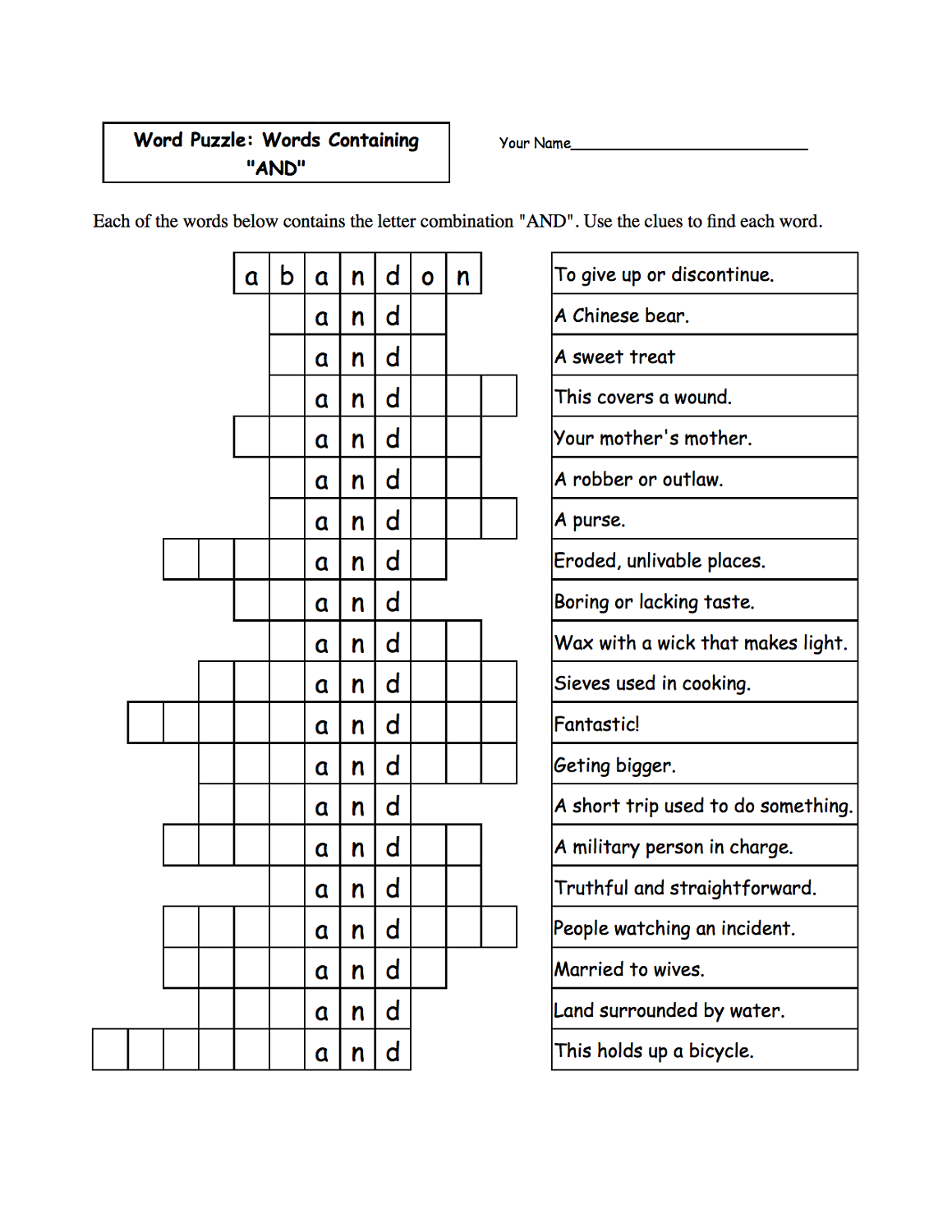
Words that contain “and”. How many can you guess?
Jumble

80’s Word Scramble…these are tough! LOL

Word Picture Puzzles…again some toughies in here!

Movie Scrambles

Words that contain “and”. How many can you guess?
Jumble
80’s Word Scramble…these are tough! LOL
Word Picture Puzzles…again some toughies in here!
Movie Scrambles
Harrison Ford was born today, July 13th, in 1942 and I thought I’d find some fascinating facts from the Indiana Jones franchise.
From Business Insider:
Tom Selleck nearly played Indiana Jones.
It’s hard to imagine anyone other than Harrison Ford donning the fedora and cracking the bullwhip, but the role almost went to Tom Selleck instead. The “Magnum P.I.” and “Friends” star was actually one of the first actors to be offered the role, and even did a screen test alongside “Blade Runner” actor Sean Young as Marion Ravenwood. But as Selleck explained in 2017, CBS wouldn’t let him take the role because he’d already shot the “Magnum P.I.” pilot for the network.
There were around 10,000 snakes in the “Well of Souls” scene.
There are plenty of bugs and reptiles in the whole franchise but the Well of Souls scene is arguably the one that makes many fans squirm because of the thousands of snakes that slither on screen to terrify Indy and Marion Ravenwood (Karen Allen). In a behind-the-scenes featurette, Allen recalled that the original plan was to use “mechanical snakes” but they didn’t look realistic enough. And archival footage shows director Steven Spielberg bringing in numerous snake handlers to fill the set with snakes and glass lizards — which look like snakes.
Harrison Ford even said: “We were working with, I think, around 8, 10,000 snakes.”
The cobra actually spat venom at Harrison Ford.
Although it sounds wild that there were thousands of snakes on the “Raiders” set, the filmmakers didn’t realize how serious the situation could be until one of them actually spat venom at Harrison Ford. Producer Kathleen Kennedy recalled how the cobra reacted to the actor in the scene where Indy comes face-to-face with the snake. Luckily, there was a sheet of glass separating them. She said: “At one point, it hooded and whipped its head off to the side and literally threw venom all over the glass. So that was something that caused everybody to sit up and take notice and recognize that this was not something to play around with.”
Harrison Ford got run over by a plane filming “Raiders of the Lost Ark.”
During the scene where Indy and Marion fight Nazis on the runway, Harrison Ford was actually run over by the plane and tore the ACL ligament in his knee. In a behind-the-scenes documentary, the star recalled: “At a certain point I slipped and fell, and the wheels rode up onto my knee, which resulted in me tearing my anterior cruciate ligament in my left leg in the middle of Tunisia. So rather than submit to any local medical care, we just wrapped it up and put ice on it, and I carried on.”
It wasn’t the only time that Ford got injured on film sets, as he broke his leg years later filming “Star Wars: Episode VII – The Force Awakens,” and hurt his shoulder rehearsing a fight scene for “Indiana Jones and the Dial of Destiny.”
Willie Scott was named after Steven Spielberg’s dog.
While Indiana himself is named after George Lucas’ dog, his “Temple of Doom” love interest, Willie Scott (Kate Capshaw), was named after Steven Spielberg’s Cocker Spaniel. Spielberg explained the name in a behind-the-scenes documentary for the sequel. He said: “Willie was the name of my dog, by the way. ‘Cause, since Indy was named after George’s dog, Indiana, and I had a dog named Willie, and then Short Round was the name of Bill and Gloria’s dog, so Ke was called Short Round. So in that sense, all three characters are named after our house pets.”
Harrison Ford taught Ke Huy Quan how to swim on a day off from filming.
Ke Huy Quan’s career has had a resurgence thanks to “Everything Everywhere All At Once,” but many theatergoers know him for his role as Short Round in “Indiana Jones and the Temple of Doom.” One of the big reasons why his character works so well as comedy relief in the darker movie is because of the believable familial dynamic he has with Indy, and that comes from how Quan and Ford hung out together on set when they weren’t filming. The actor told The New York Times that Ford taught him to swim on a day off while they were in Sri Lanka. Quan said: “We were just hanging out at the swimming pool in Sri Lanka in our hotel, and he says, ‘Ke, do you know how to swim?’ I didn’t, so he says, ‘Come on, I’ll teach you.'”
Kate Capshaw had to be taught how to scream for “Temple of Doom.”
“Temple of Doom” sees nightclub singer Willie Scott get swept along in the adventure after meeting Indy in Shanghai, and because she’s not used to the shenanigans that the archaeologist gets involved in, she’s understandably freaked out by all the action. Kate Capshaw had to be taught how to scream on set, as she explained: “I couldn’t scream, so Steven taught me how to scream. I mean, you know, screaming isn’t as easy as it looks.”
Steven Spielberg cut a scary snake scene for Kate Capshaw.
One of the scenes that didn’t make it off the page in “Temple of Doom” saw a snake descend around Willie Scott, but Kate Capshaw was terrified of the creature while filming in Sri Lanka. Capshaw explained that she was incredibly worried about the scene, and producer Frank Marshall took her to see the snake first to try and ease her into it. Capshaw recalled: “I went over and looked at it, and looking at it, I get tears in my eyes and I’m having a hard time breathing and I’m looking… I can almost work myself up right now. And I went over and I put my hand on the snake, and I lost it.” Spielberg added: “She was shaking and she was all white, and you could see right through her makeup. She had lost all of her color. And I said, ‘I’m not gonna put you through this. Let’s cut it out.’ And I cut the whole scene out of the movie. I think she probably years and years later, married me for that!”
The Nazi uniforms in “The Last Crusade” were apparently genuine.
Costume designer Anthony Powell explained in the “Last Crusade” making-of documentary that the Nazi uniforms worn by the hundreds of extras in the film were genuine. He said: “We had a lot of Nazis in the film. All of those uniforms, I think, were genuine ones that I found in Eastern Europe somewhere. Joanna Johnston worked with me on the two last ‘Indiana Jones’ pictures. I’d give her research pictures and sketches and drawings and things, then she’d go out and find it all.”
2,000 rats were bred for just one sequence in “The Last Crusade.”
“Indiana Jones and the Last Crusade” sees Indy and his father, Dr. Henry Jones Sr. (Sean Connery), hunt for the Holy Grail, and the search takes the hero to Venice with Elsa Schneider (Alison Doody). Unfortunately, when they end up in the catacombs, Schneider is confronted with thousands of rats. It turns out that the crew bred 2,000 of the little critters just for that sequence. In the making-of documentary, Spielberg explained: “In order to have rats that aren’t infected with some virus or disease, you have to basically cultivate them from living births. So our animal handlers gave birth to something like 2,000 living rats. And they were everywhere! The set was half-water, it was like an aqueduct. We had rats walking the very narrow lips of the aqueduct and coming out of holes, rats in poor Alison Doody’s hair.” Thankfully, Ford wasn’t as bothered by all the rats, as he admitted to keeping “black hooded rats” as pets when he was a “nature counselor” as a teenager.
Sean Connery and Harrison Ford filmed a scene together without wearing pants.
Yes, you read that right. Sean Connery and Harrison Ford decided not to wear pants during a conversational scene on the zeppelin in “The Last Crusade.” During the documentary, Connery explained: “The passengers were wearing fur coats and hats, it was supposed to be the wintertime, and I played it without my trousers. Harrison said: ‘You’re not gonna play the scene without your trousers?’ I said, ‘If I don’t, I’ll be stopping all the time because I sweat enormously. I sweat very easily.’ Well, he did the same.” Like father, like son.
Cate Blanchett picked her “Kingdom of the Crystal Skull” haircut by looking at high school yearbooks from the 1950s.
Fast-forward to 2008, and a new “Indiana Jones” movie reared its (crystal) head with “Kingdom of the Crystal Skull.” The film sees the adventurer race against Russian villain Irina Spalko (Cate Blanchett) to find a mythical city in South America. But when it came to Spalko’s intimidating look, Blanchett got inspiration from 1950s high school yearbooks. She explained in the making-of documentary: “I had a look at yearbooks of people’s high school photos in the ’50s, and I found a couple of photos. One of a Russian girl, and one of an American girl with an incredibly short fringe, and I just thought that really emphasized the eyes, so that’s in the end what we went with.”
“Kingdom of the Crystal Skull” carries on the tradition of including a “Star Wars” Easter egg.
When Steven Spielberg and George Lucas made “Raiders of the Lost Ark,” the duo couldn’t resist including a sneaky reference to “Star Wars” on the walls of the Well of Souls scene, with a tile showing R2-D2 and C-3PO. And production designer Guy Hendrix Dyas continued that tradition in the main temple of Akator in the 2008 film’s climax, with R2-D2 and C-3PO being included on a golden tile. He also took it a step further and included the titular alien from Spielberg’s “E.T. the Extra-Terrestrial.”
Shia LaBeouf trained for six weeks to film the bike chase in “Crystal Skull,” but found it hard because Harrison Ford kept moving on the back of it.
Early on in the film, Indy unwittingly meets his long-lost son, Mutt Williams (Shia LaBeouf), and they wind up having to flee Marshall University when the Soviets show up. Stunt coordinator Gary Powell explained that they started off with a “smaller bike” before giving the actor the Harley Davidson, and then they practiced the chase scene for six weeks. But LaBeouf found it hard because Harrison Ford kept moving while sitting on the back of the bike. He said: “The bike was tough, only because when you have somebody moving on the back of a bike. It’s very different than just having someone hold you on the bike. But we’re shooting a movie and Harrison has to animate his character! And we’re on a bike through a lot of it, so a lot of it is the movement. All that stuff was pretty tough.”
SOURCE: BUSINESS INSIDER
Eammon Jacobs

Fact: Only a quarter of the Sahara Desert is sandy
Most of it is covered in gravel, though it also contains mountains and oases. And here’s another geography fact that everyone gets wrong: It isn’t the world’s largest desert. Antarctica is.
Fact: Bananas grow upside down
Or technically, we peel them upside down. Naturally, they grow outward from their stems, but that means their bottoms actually face the sky. As they get bigger, the fruits turn toward the sun, forming that distinctive curve.
Fact: There were active volcanoes on the moon when dinosaurs were alive
Most of the volcanoes probably stopped erupting about a billion years ago, but NASA findings have suggested there might still have been active lava flow 100 million years ago, when dinosaurs were still roaming.
Fact: Dogs sniff good smells with their left nostril

Dogs normally start sniffing with their right nostril, then keep it there if the smell could signal danger, but they’ll shift to the left side for something pleasant, like food or a mating partner.
Fact: Avocados were named after reproductive organs
You’ll never look at avocados the same way again. Indigenous people of Mexico and Central America used the Nahuatl word āhuacatl to mean both “testicles” and “avocado.” The fruits were originally marketed as “alligator pears” in the United States until the current name stuck.
Fact: T. S. Eliot wore green makeup
No one is sure why the poet dusted his face with green powder, though some guess he was just trying to look more interesting.
Fact: The word “fizzle” started as a type of fart
In the 1400s, it meant to “break wind quietly,” according to the English Oxford Living Dictionaries.
Fact: Human noses and ears get bigger as we age

It’s pretty common to see the claim that our nose and ears are the only parts of our body that keep growing as we age, but that’s not exactly true. Our nose and ears stop growing along with the rest of our body, but thanks to the weight of gravity, both parts continue to lengthen over time, according to the Discovery Channel.
Fact: No number before 1,000 contains the letter A
But there are plenty of E’s, I’s, O’s, U’s, and Y’s.
Fact: The # symbol isn’t officially called hashtag or pound
Its technical name is octothorpe. The “octo” means “eight” and refers to its points, though reports disagree on where “thorpe” came from. Some claim it was named after Olympian Jim Thorpe, while others argue it was just a nonsense suffix.
Fact: The French have their own name for a French kiss
Something extra interesting about this kissing fact? The word hasn’t been around for long. In 2014, galocher—meaning to kiss with tongues—was added to the Petit Robert French dictionary.
Fact: You can thank the Greeks for calling Christmas “Xmas”
In Greek, the word for “Christ” starts with the letter Chi, which looks like an X in the Roman alphabet.
Fact: Movie trailers originally played after the movie
They “trailed” the feature film—hence, the name. The first trailer appeared in 1912 and was for a Broadway show, not a movie.
Fact: Mercedes invented a car controlled by a joystick
The joystick in the 1966 Mercedes F200 showcase car controlled speed and direction, replacing both the steering wheel and pedals. The car could also sense which side the driver was sitting in, so someone could control it from the passenger seat.
Fact: H&M actually stands for something

This is one of those interesting facts you’ve probably never thought about before. The clothing retail shop was originally called Hennes—Swedish for “hers”—before acquiring the hunting and fishing equipment brand Mauritz Widforss. Eventually, Hennes & Mauritz was shortened to H&M.
Fact: The U.S. government saved every public tweet from 2006 through 2017
Starting in 2018, the Library of Congress decided to only keep tweets on “a very selective basis,” including elections and those dealing with something of national interest, like public policy.
Fact: Theodore Roosevelt had a pet hyena
Its name was Bill, and it was a present from the Ethiopian emperor. Roosevelt was famous for his many pets, including a one-legged rooster, a badger, a pony, and a small bear.
Fact: The CIA headquarters has its own Starbucks, but baristas don’t write names on the cups
Its receipts say “Store Number 1” instead of “Starbucks,” and its workers need an escort to leave their work posts.
Fact: Giraffe tongues can be 20 inches long

Their dark, bluish-black color is probably to prevent sunburn.
Fact: There’s only one U.S. state capital without a McDonald’s
Montpelier, Vermont, doesn’t have any of those Golden Arches. It also happens to have the smallest population of any state capital, with just 7,500 residents.
Fact: Europeans were scared of eating tomatoes when they were introduced
Scholars think Hernán Cortés brought the seeds in 1519 with the intent of the fruits being used ornamentally in gardens. By the 1700s, aristocrats started eating tomatoes, but they were convinced the fruits were poisonous because people would die after eating them. In reality, the acidity from the tomatoes brought out the lead in their pewter plates, and they actually died of lead poisoning.
Fact: Humans aren’t the only animals that dream
Studies have indicated rats dream about getting to food or running through mazes. Most mammals go through REM sleep, the cycle in which dreams occur, so scientists think there’s a good chance they all dream.
Fact: The inventor of the microwave appliance received only $2 for his discovery
Percy Spencer was working as a researcher for American Appliance Company (now Raytheon) when he noticed that a radar set using electromagnetic waves melted the candy bar in his pocket. He had the idea to make a metal box using microwaves to heat food, but the company was the one to file the patent. That was in 1945, and he received a $2 bonus but never any royalties.
Fact: The Eiffel Tower can grow more than six inches during the summer

The high temperatures make the iron expand.
Fact: Glitter may have originated on a ranch
According to local lore, a man by the name of Henry Ruschmann from Bernardsville, New Jersey, invented glitter by accident in 1934 while working on a cattle ranch. The New York Times reports that in the popular origin story, Ruschmann, a machinist, was trying to find a way to dispose of scrap material by crushing it into tiny pieces. Plastic went in, glitter came out, and the rest is commonly accepted as history.
SOURCE: Reader’s Digest: Elizabeth Yuko

Continuing my No-Bake theme, today’s offering is Watermelon Rice Krispie Treats!

For the Green Rind
5 oz mini marshmallows (half a bag)
2 tbsp butter
2 cups Kellogg’s Rice Krispies Cereal
green food coloring
For the White Rind
5 oz mini marshmallows (half a bag)
2 tbsp butter
2 cups Kellogg’s Rice Krispies Cereal
For the Red Fruit
10 oz mini marshmallows (1 bag)
4 tbsp butter
4 cups Kellogg’s Rice Krispies Cereal
½ cup semi-sweet chocolate chips
Instructions
Spray a 9″ spring form or baking pan with baking spray, or grease with butter.
Make the Green Rind
In a microwave-safe bowl, melt the mini marshmallows and butter until puffy (about 1 minute). Immediately add cereal and a few drops of food coloring. Mix with a buttered spatula or spoon. With your fingers, line the pan with the green cereal so that it is about ½” wide and ¾ of the way up the pan.

Make the White Rind
In a microwave-safe bowl, melt the marshmallows and butter until puffy. Add cereal and mix with a buttered spatula. Press it up next to the green cereal, creating another ring a little wider than the green rind. Fill ¾ of the way up the pan.


Make the Red Fruit
In a larger bowl, melt the mini marshmallows and butter. Add the cereal and red food coloring to desired color. Press the cereal into the center of the pan and, with your hands, press down to pack all three colors together. Place the chocolate chips, flat side up, randomly in the red fruit part of the watermelon. Let harden. Cut into wedges. For wedges on a stick, insert a stick into the wedge while the cereal mixture is still soft.

ENJOY!
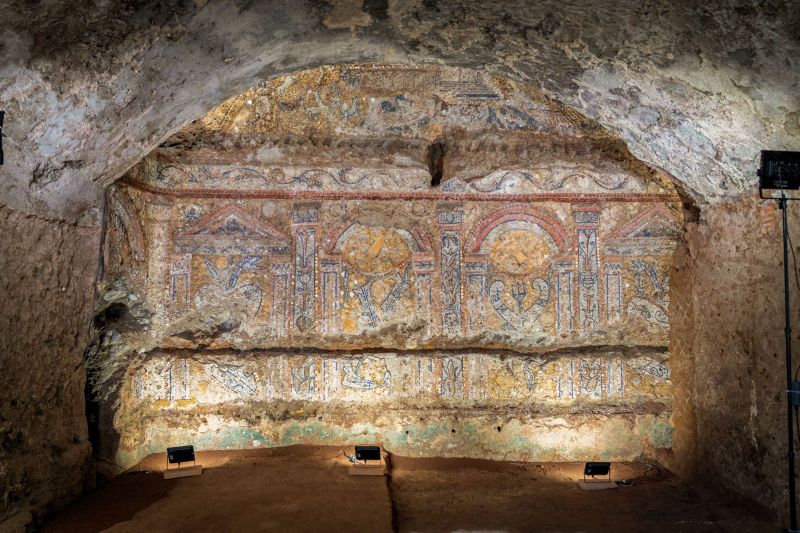
This story was found on CNN.com and it’s about an ancient mosaic found buried under Rome. It’s gorgeous!
From the article:
Rome, Italy CNN —
A five-year dig into the side of Rome’s Palatine Hill yielded treasure last week when archaeologists discovered a deluxe banquet room dating from around the first or second century BC, featuring a sizable, intact and brightly colored wall mosaic.
Estimated to be around 2,300 years old, the work is part of a larger aristocratic mansion, located near the Roman Forum, that has been under excavation since 2018.
Almost five meters long (16.4 ft) and featuring depictions of vines, lotus leaves, tridents, trumpets, helmets and mythological marine creatures, the mosaic scene was painstakingly created using mother of pearl, shells, corals, shards of precious glass and flecks of marble. The piece is framed by polychrome crystals, spongy travertine, and exotic, ancient Egyptian blue tiles.
What makes this discovery “unmatched,” said archaeologist Alfonsina Russo, head of the Colosseum Archaeological Park in charge of the site, is not only the incredible conservation of the mosaic, but its decoration which also features celebratory scenes of naval and land battles likely funded — and won — by an extremely wealthy aristocratic patron who commemorated the victories on their walls.

The intricacy of the mosaic’s depictions of victory have surprised the team working on the project. They show a coastal walled town with lookout towers and loggias — which Russo said could be an ideal or a real-life location — sitting atop a cliff designed with pieces of travertine rock. Scenes of sailing ships with raised sails also feature, alongside depictions of mythical sea monsters swallowing enemy fleets.
Archaeologists are trying to ascertain whether the delicate — and expensive, for the time — coral branches used in the display came from the Mediterranean or the Red Sea (the nearest and most common oceans used by Romans to extract materials). A rare bluish glass paste also featured in the design likely came from the ancient Egyptian city of Alexandria, the team believe.
“This banquet hall, which measures 25 square meters (270 square foot), is just one space within a ‘domus’ (the Latin word for house) spread on several floors,” Russo told CNN in an interview. “In ancient times, when powerful noble families inhabited the Palatine Hill, it was customary to use rich decorative elements as a symbol to show-off opulence and high social rank.”
The chamber, deemed a “jewel” by Russo, was an outdoor banquet hall overlooking a garden, likely used during summer to entertain guests.
Such an elaborate space would also have been used to impress guests with water games, which were very popular amongst nobility at the time. “We have found lead pipes embedded within the decorated walls, built to carry water inside basins or to make fountains spout to create water games,” said Russo.

Marco Rossi, professor of Roman antiquities and head of the mosaic lab at Rome’s Università degli Studi di Roma Tre pointed out that these summer banquet rooms were not only somewhere that hosts and guests would go to relax but also used by the mansion owner as a signifier of their wealth and rank.
“Mosaics are usually found on floors, but this runs across the entire front wall and has been incredibly well-preserved,” said Rossi of the piece. “It’s not been ruined by the weight of debris — as can happen to some mosaics on the ground — and despite being delicate, it hasn’t so much as chipped across the centuries.”
The discovery of an entire wall mosaic is extremely rare, Rossi added, not least because these pieces are more delicate than those for the floor which were designed to be walked upon and withstand pressure.
The location of the grand home has also helped the wall’s preservation, scientists believe. Positioned on the side of Rome’s famous Palatine Hill and subsequently covered over by centuries of mud and earth as the land has moved, the structure and treasures within it have been protected from the air and light by layers of ground.
While this new discovery still has a lot of secrets to reveal — why the property was abandoned and how long ago, for example — Russo believes there is one mystery archaeologists could perhaps solve: The identity of its owner, likely a Roman senator.
“The person was so rich they could afford to import such precious elements from across the empire to decorate this mansion,” Russo said. “We have found nothing so far to shed light on their identity, but we believe more research might enable us to pinpoint the noble family.”
Russo and her team aim to open the space to the public in early January. “We (will) continue to dig the other layers and areas of this evocative place (to try to discover more),” she said. “It is really an incredible display of Roman luxury.”
SOURCE: CNN.COM
By Silvia Marchetti

The peony is a true showstopper, flaunting large, lush blooms with delicate petals that come in an array of colors, including white, pink, red, and even purple. These captivating flowers can grow up to 10 inches in diameter, making them an irresistible sight in any garden. Peonies are also known for their intoxicating fragrance, which varies from soft and sweet to rich and spicy.
Varieties and Colors

Did you know there are over 30 species and thousands of cultivars of peonies? Some of the most popular types include:
Tree peonies — they develop woody stems
Herbaceous peonies — they die back to the ground each winter
There are also intersectional peonies, a hybrid of the two, boasting the best features of both. With so many varieties, there’s a perfect peony for everyone!

Designation in 1957
The peony’s coronation as Indiana’s state flower happened in 1957, thanks to the dedicated efforts of flower enthusiasts and lawmakers. The Indiana General Assembly passed a bill that year, declaring the peony the new state flower, and it’s been a beloved symbol ever since.
Replacement of the Original State Flower
You might be surprised to learn that the peony wasn’t always Indiana’s floral emblem. In fact, the original state flower was the zinnia, which was designated in 1931. But over time, the people of Indiana decided that the peony was a more fitting symbol of their state, leading to the change in 1957. Now, the peony stands proud as Indiana’s official state flower, capturing the hearts of Hoosiers and visitors alike.
The Symbolism of the Peony

It’s not just the peony’s beauty and fragrance that make it so special. This flower also carries deep symbolism that resonates with the people of Indiana. So, let’s explore the rich meanings and connections that have helped the peony become such an enduring symbol of the Hoosier State.
Significance in Indiana’s History and Culture
Throughout history, the peony has been associated with positive qualities like prosperity, honor, and good fortune. In Indiana, these qualities reflect the state’s heritage and the hardworking nature of its people. The peony’s lush blooms are also reminiscent of the fertile lands and agricultural roots of Indiana, which contribute to the state’s identity.
Connection to Indiana’s Values and Identity
The peony’s stunning beauty and resilience echo the spirit of Indiana, a state that cherishes its natural beauty and the strength of its people. As the peony thrives in Indiana’s climate, it serves as a symbol of the state’s ability to overcome challenges and flourish. The flower’s diverse colors and varieties also represent the unity and diversity of Indiana’s communities, making the peony a fitting emblem of the state’s values and identity.

SOURCE: A-Z-ANIMALS.COM
From: theclevelandclinic.org website:
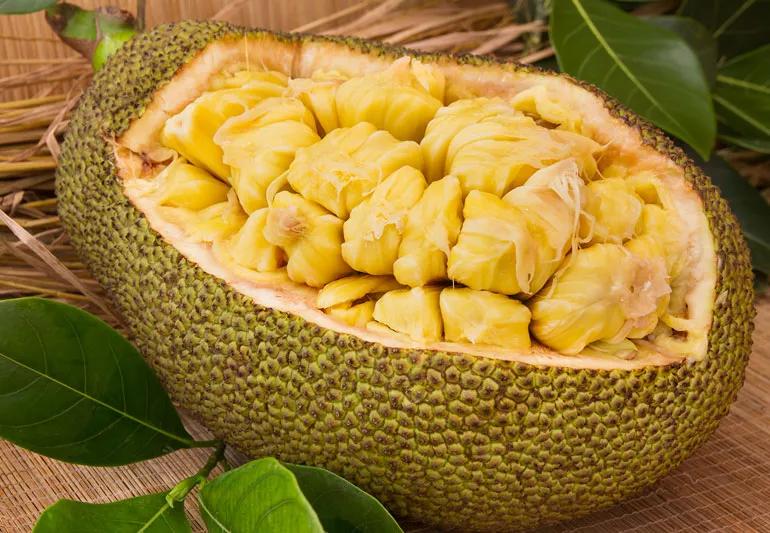
Fruit as a meat substitute? Yep, when it’s jackfruit. This massive tree fruit flips its flavor between sweet and savory, depending on how ripe it is. So, is jackfruit good for you? Yes! Jackfruit benefits include being heart-healthy, fighting inflammation and promoting wound healing. Registered dietitian Gillian Culbertson, RD, explains the health benefits of jackfruit and how to add it to your diet.
What is jackfruit?
The scientific name for jackfruit is Artocarpus heterophyllus. Jackfruit is a tropical tree fruit grown in Asia, Africa and South America. It belongs to the same plant family as figs and mulberries. Under its thick, bumpy green rind is a stringy yellow flesh that you can eat raw or cooked in a variety of dishes. (Its seeds are also edible.) Jackfruit is the largest tree-borne fruit in the world, weighing up to 40 pounds or more. Luckily, you don’t need to throw this massive fruit into your shopping cart. Some health food stores carry peeled and cut jackfruit portions in pouches or cans, ready to cook or eat.

But for some people, jackfruit isn’t safe to eat.
“If you have a latex or birch pollen allergy, avoid jackfruit,” warns Culbertson. “Both of these allergies can have a cross-reaction with jackfruit.” Jackfruit also has a lot of potassium, which can be harmful to people who have chronic kidney disease (CKD) or acute kidney failure. People with these conditions can develop hyperkalemia if they eat high amounts of potassium. Hyperkalemia is a buildup of potassium in the blood that can cause weakness, paralysis and heart attack.
Is jackfruit healthy?
Like many fruits, jackfruit contains some fiber for healthy digestion and very little fat. A 100-gram portion of jackfruit has:
95 calories.
2 grams of protein.
0.6 grams of fat.
3 grams of fiber.
Jackfruit also contains vitamins, minerals and phytochemicals that have health benefits. It’s a good source of:
Vitamin C.
Pyridoxine (vitamin B6).
Niacin (vitamin B3).
Riboflavin (vitamin B2).
Folic acid (vitamin B9).
Calcium.
Magnesium.
Potassium.
Phosphorus.
Jackfruit health benefits
In addition to being a great meat alternative (more on that below!) and full of essential vitamins, there’s a lot more this might fruit can do. Let’s talk about the benefits of jackfruit.
It can be part of a heart-healthy diet

Research shows that eating jackfruit can potentially reduce the risk of heart disease. “The combination of potassium, fiber and antioxidants can benefit heart health,” Culbertson says. Potassium combats the negative effects of sodium on your blood pressure, while fiber contributes to lowering your cholesterol levels.
It may help fight inflammation
Jackfruit is high in vitamin C, which studies show can help prevent inflammation. “Research also shows that jackfruit also contains flavonoids and lignans, plant compounds that may help fight inflammation,” Culbertson notes. All these antioxidants found in jackfruit protect your cells from inflammation and oxidative stress, which can lead to chronic diseases like Type 2 diabetes.
It may help control blood sugar levels
While more research is needed to fully understand this potential benefit, it’s believed that jackfruit can help manage your blood sugar. First, jackfruit has a low glycemic index (GI) score, which means eating it shouldn’t affect your blood glucose levels like other foods with higher scores. Second, a study shows that its leaf may help lower fasting blood sugar levels. Another study shows that jackfruit’s bark may prevent fats and complex carbohydrates from breaking down into sugar. Both pieces of research could be beneficial for managing diabetes.
It may promote wound healing
Research shows that extract from the jackfruit’s leaf may promote wound healing, while other studies show that its anti-inflammatory, antibacterial and antifungal properties can contribute to healthy skin. “Ancient people used jackfruit as medicine,” says Culbertson. “In folk medicine, where jackfruit is grown, people have used it for its antimicrobial and antifungal properties.”
What does jackfruit taste like?
When jackfruit is unripe, it has a neutral flavor that pairs well with savory dishes. You can use unripe jackfruit in vegetarian curry and in place of tofu or chickpeas. But jackfruit’s biggest claim to fame is its ability to imitate barbecue meat. “Jackfruit’s stringy texture makes it a good vegan substitute for pulled pork or chicken,” Culbertson says. “It has under 3 grams of protein per cup, making it much lower in protein than meat. Keep that in mind as you consider the protein sources in your diet.” Look for packages that label jackfruit as “young” or “packed in brine.” These words indicate that it’s unripe and suitable as a meat substitute.
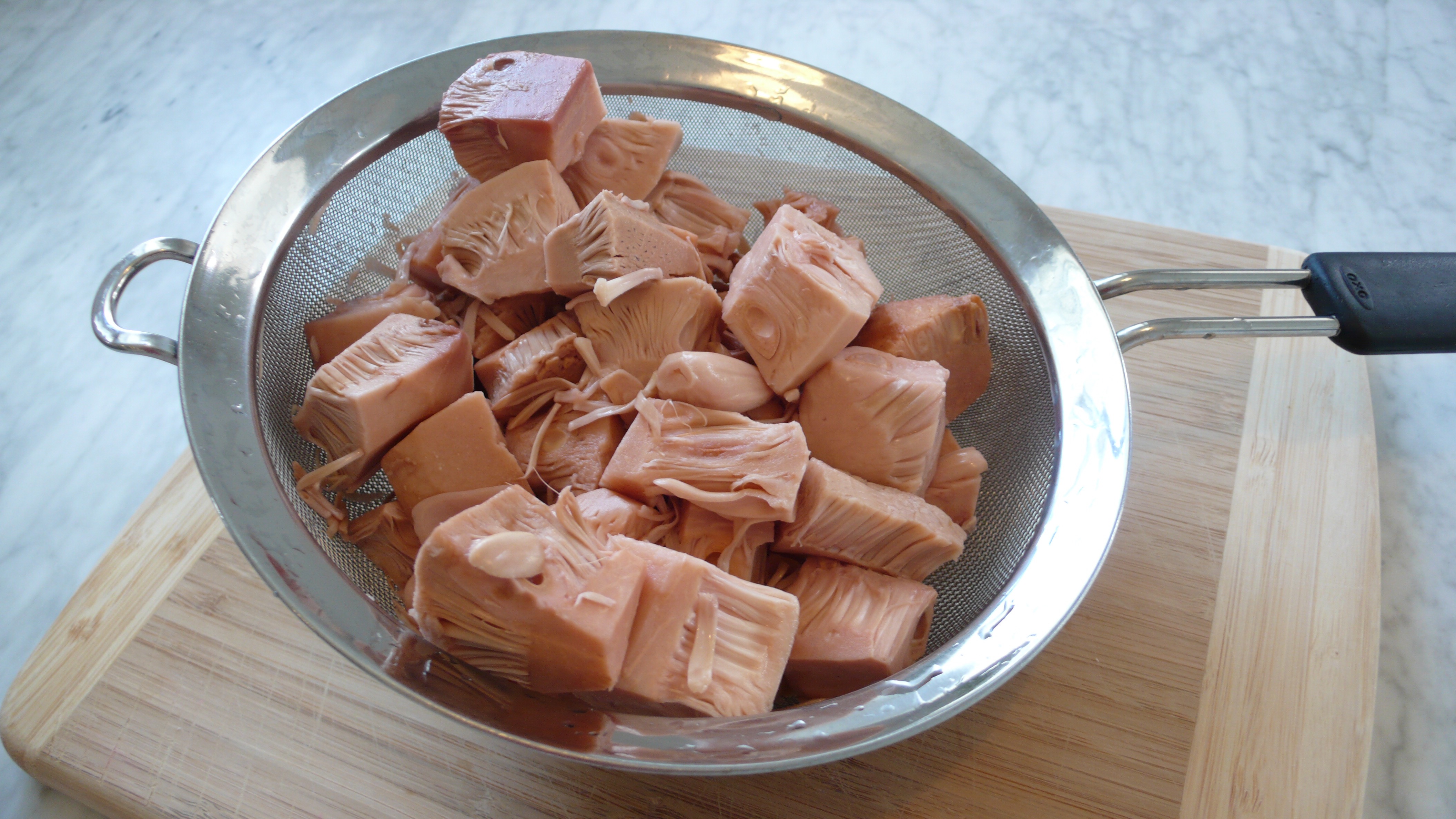
Ripe jackfruit has a sweet, tropical fruit flavor that works well as a snack or added to sweet dishes. When ripe, it tastes like other tropical fruits like bananas, mangos or pineapples. If you’re trying ripe jackfruit, use it like you would any other tropical fruit. Serve it as a healthy dessert or add it to a smoothie. With its abundant vitamins and minerals, jackfruit can be a healthy addition to your diet. Culbertson says, “Many people enjoy jackfruit as a meat substitute, whether they’re vegan or not. Many Americans already tend to eat too much meat, so a healthy meat substitute is always worth a try.”
SOURCE: THECLEVELANDCLINIC.ORG
/https://tf-cmsv2-smithsonianmag-media.s3.amazonaws.com/filer/45/56/45568c7f-f57b-4141-87f8-b1c9dff64bab/053242pv.jpg)
This article, from the Smithsonian, is from November of 2017 and details the “ironic” history of Mar-a-lago.
Within 48 hours after the presidential election last November, the Palm Beach Daily News headlined a question that “many in town” were asking: “Trump’s Mar-a-Lago: Another Winter White House?”
By January, the president-elect had an answer: “Writing my inaugural address at the Winter White House, Mar-a-Lago,” he tweeted from his elite private club, along with a photograph of himself seated behind a large desk, legal pad and pen in hand.
Palm Beach might have been having déjà vu, and not only because President-elect John F. Kennedy wrote his inaugural address at his father’s estate in the town’s North End. The woman who built Mar-a-Lago in the 1920s and presided over it for almost half a century, Marjorie Merriweather Post, had gone to great lengths to turn the mansion into an official wintertime presidential retreat.

But even extreme wealth has its limitations, as my visit to the Post Family Papers suggests. They occupy 57 seldom-seen linear feet at the University of Michigan’s Bentley Historical Library and document the life of one of the most famous and consequential women of the 20th century. The files offer unusual glimpses of the girl who glued labels onto packages of Postum, the coffee substitute that made her family’s fortune, and of the woman who built the General Foods Corporation. Her four husbands, her bountiful philanthropy, her megayacht, her grand balls, her jaw-dropping jewels—all are documented in the archives.
And then there’s a volume bound in still-handsome red leather. A yellowing file card dated “February/March 1976” is taped to the cover: “Original Proposal for Disposition of Mar-a-Lago.”
The mansion dates to the 1920s, when Palm Beach’s wealthiest visitors were forsaking luxury hotels for their own digs, says Debi Murray, chief curator of the Historical Society of Palm Beach County. Post herself explored the site of her future home, on 17 acres of scrub between Lake Worth and the Atlantic. (Mar-a-Lago means “Sea to Lake” in Spanish.) Construction began in 1923 and kept some 600 workers busy, even though, as Murray notes, “Florida entered the Depression earlier than the rest of the country.” The mistress ensured that her workers wouldn’t go hungry.

Even by Palm Beach standards, Mar-a-Lago was grandiose: 58 bedrooms, 33 bathrooms with gold-plated fixtures (easier to clean, Post believed), an 1,800-square-foot living room with 42-foot ceilings. Its 110,000 square feet glinted with gold leaf, Spanish tiles, Italian marble and Venetian silks. All told, Post spent $7 million—somewhere north of $90 million today.
It was finished in 1927. That March, Post and her second husband, Edward F. Hutton, had a few score guests over for dinner before the annual Everglades Costume Ball. The hosts wore costumes evoking the reign of Louis XVI. But there was also noblesse oblige: In 1929, when she hired the Ringling Bros. and Barnum & Bailey Circus to perform for a charity fund-raiser, she invited underprivileged children to attend. In 1944, she offered her grounds to World War II veterans who needed occupational therapy. In 1957, she opened Mar-a-Lago to the International Red Cross Ball, and the gala event has been held there many times since—but not this year. It was one of more than 20 charity events that were relocated from Mar-a-Lago or canceled after the president’s remarks on violent protests in Charlottesville, Virginia, in August.
As the social seasons came and went, however, Palm Beach tastemakers’ tastes changed. The grand houses they built in the 1920s were seen as “white elephants,” Murray says, and were razed in the ’50s and ’60s.
Except that isn’t how Post saw Mar-a-Lago—or Hillwood, her estate in Washington, D.C., or Camp Topridge, her retreat in the Adirondacks. She arranged to donate all three properties to government entities. The state of New York added some of Topridge’s acreage to a forest preserve but sold most of its 68 buildings to a private owner. The Smithsonian Institution, citing maintenance costs, returned Hillwood to the Post Foundation, which now runs it as a museum.

And the original Mar-a-Lago proposal, the one bound in red leather, was to donate it to the state of Florida for a center for advanced scholars, but state officials also balked at the maintenance costs.
By 1968, according to other papers in the archive, Post had turned to Plan B: Mar-a-Lago as winter White House, property of the United States. After she died, in 1973, at age 86, the Post Foundation pursued the idea. But in 1981, the federal government declined, for the same reason the Floridians and the Smithsonian did.
Thus Mar-a-Lago went on the market. Three potential sales collapsed before Donald Trump bought it in 1985, paying a reported $8 million for the estate and its furnishings—a small fraction of the original cost, no matter how you calculate it. And after three decades and the most confounding presidential election in living memory, Marjorie Merriweather Post’s wish for her mansion came true.
SOURCE: SMITHSONIANMAG.COM
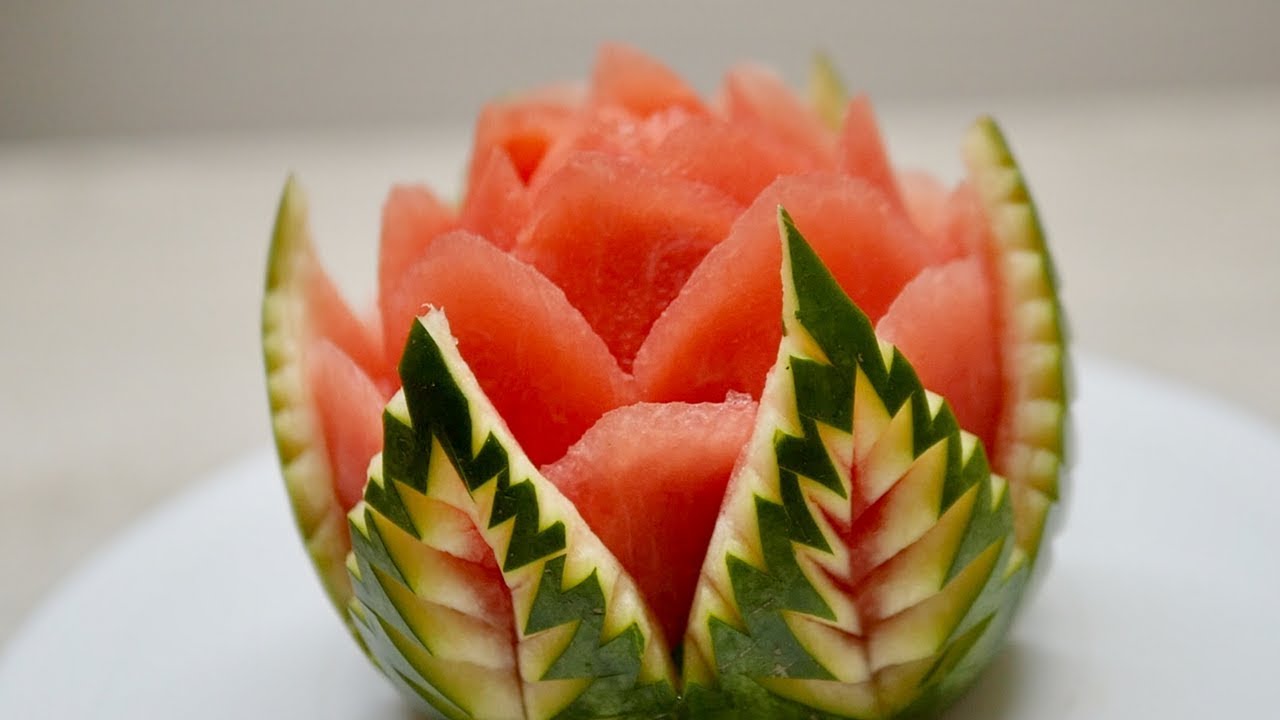
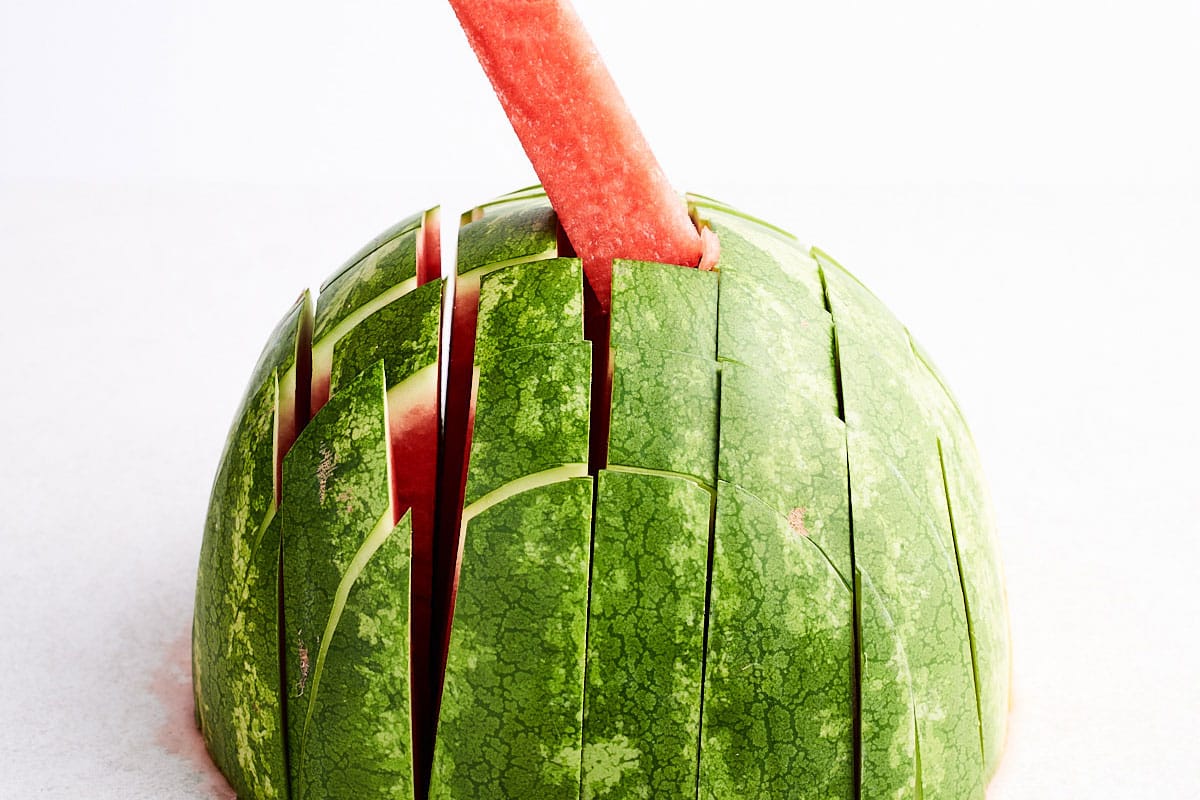
It’s summer and around our house, that means WATERMELON! Now, this article (on liveeatlearn.com) I found for tips and tricks for cutting watermelons will NOT, I repeat, NOT prepare you to make anything close to the picture posted above—but it is so pretty! These are basic tips for cutting basic shapes and getting the most out of your melon.
Instructions
Wedges
Halve: Place the watermelon on a sturdy cutting board. Using a sharp chef’s knife, cut the watermelon in half crosswise.
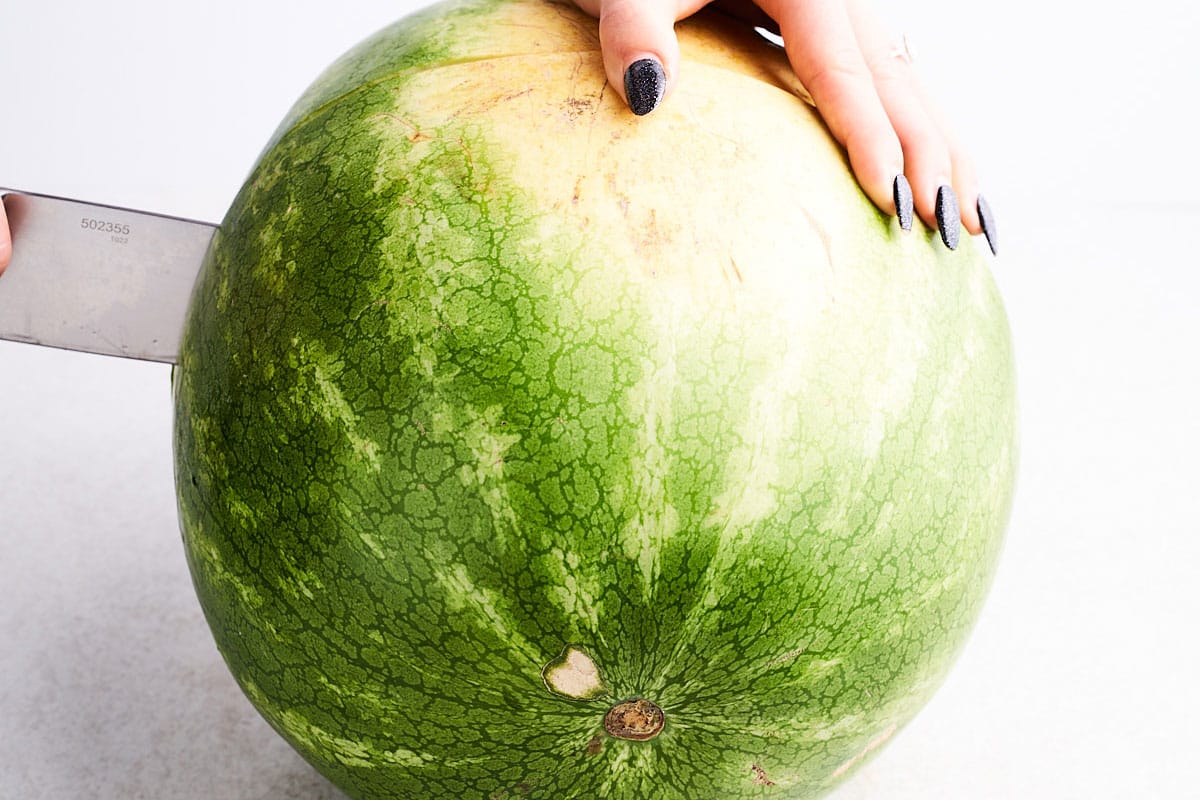
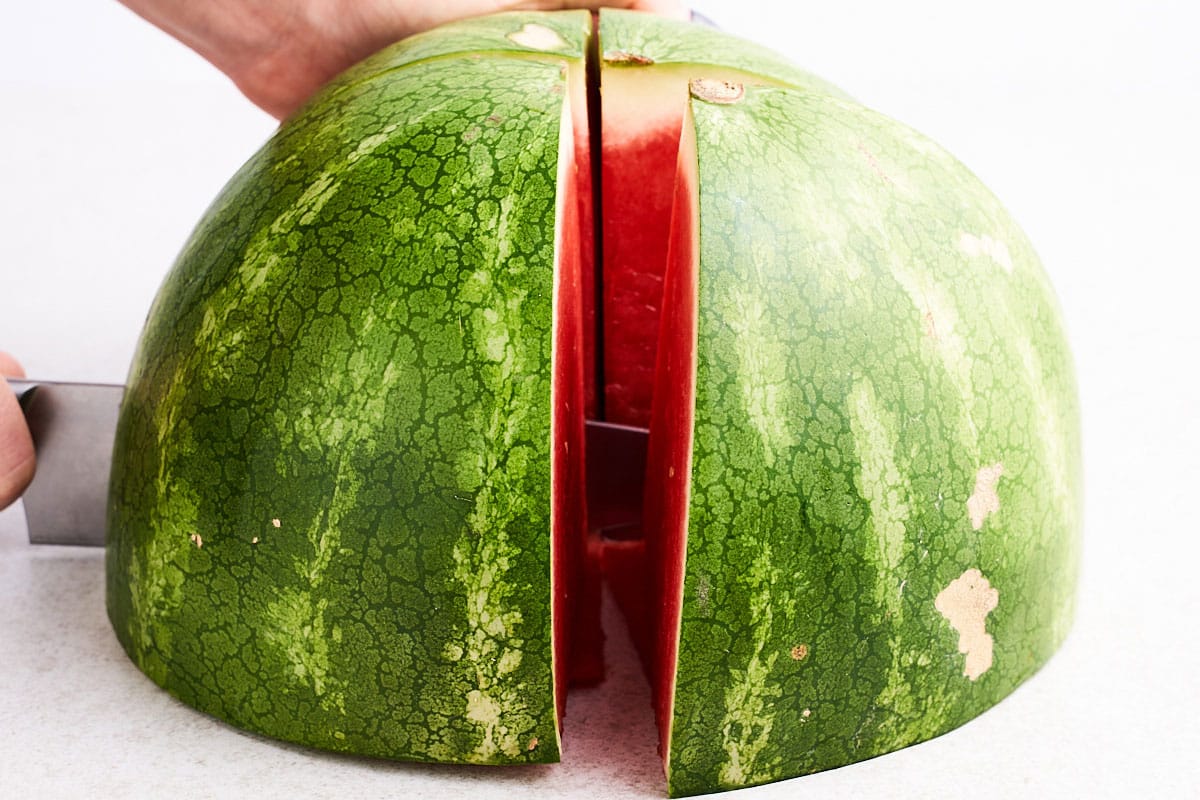
Quarter: Rotate one watermelon half to its flat end and cut it down the middle. Rotate and cut it again down the middle to create four quarters.
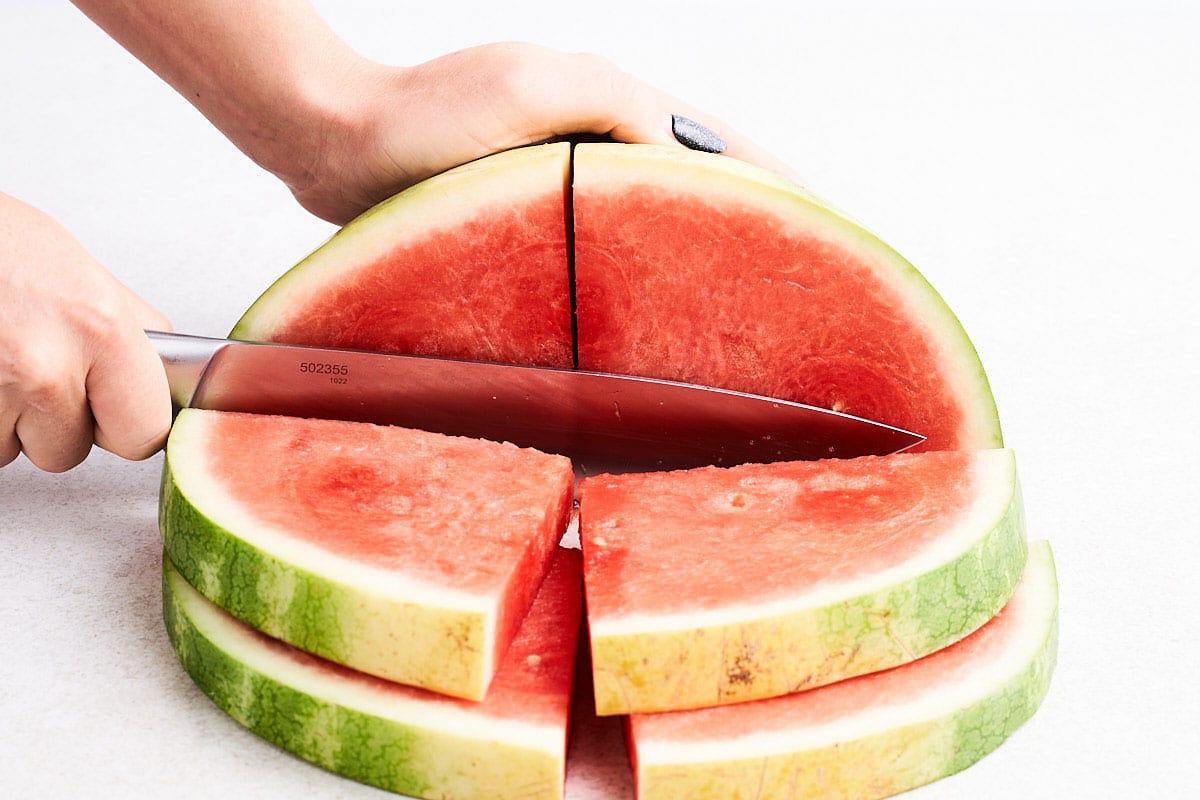
Slice: Set two quarters aside, and lay the other two down. Slice them into 1 or 1 ½-inch slices (or your preferred thickness). Repeat with the remaining quarters.
Sticks
Halve: Slice the watermelon crosswise into two halves. Set one half aside while you work with the other.
Slice: With the cut side facing down, slice 1-inch wide pieces all the way across the half. Rotate it 90 degrees and repeat the slices in the other direction.
Cubes
Remove Peel: First, trim both ends of the watermelon and cut it in half crosswise. Stand one half upright and carefully slice off the rind in strips from top to bottom. Follow the curve of the fruit to minimize wastage. You can come back to remove any white sections in more detail since they can taste bitter.
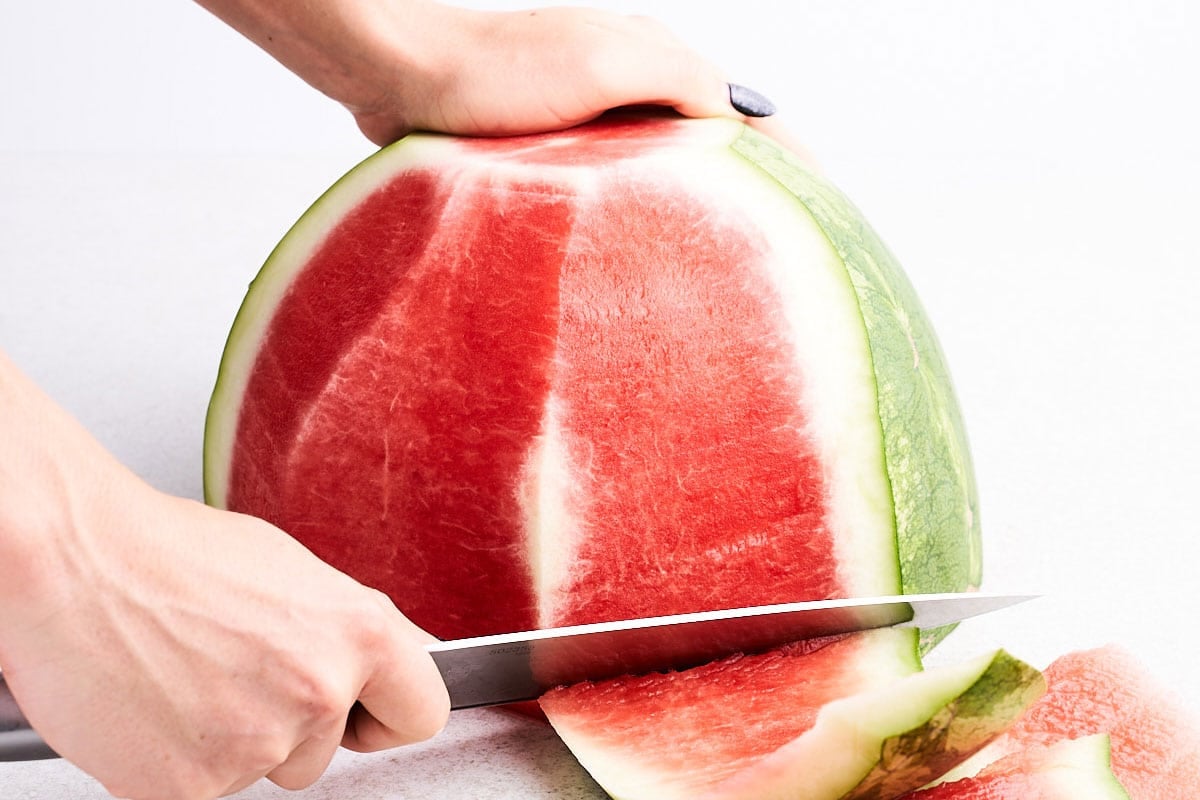
Slice: Once you’ve removed the rind, keep the cut side facing down and make 1-inch slices across the watermelon
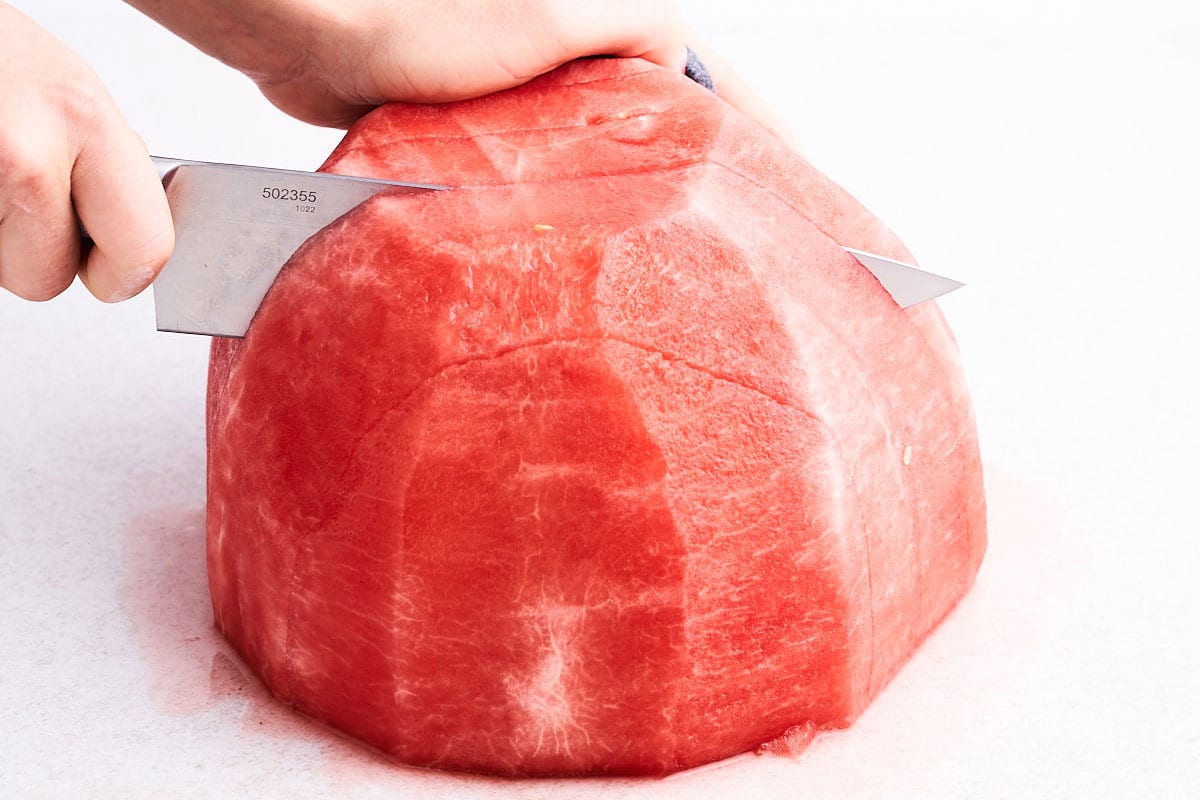
Cube: Lay a few slices down on top of one another and cut them into 1 or 2-inch strips. Rotate the strips 90 degrees and make crosswise cuts to form 1 or 2-inch cubes. Adjust the cube size according to your liking or recipe.
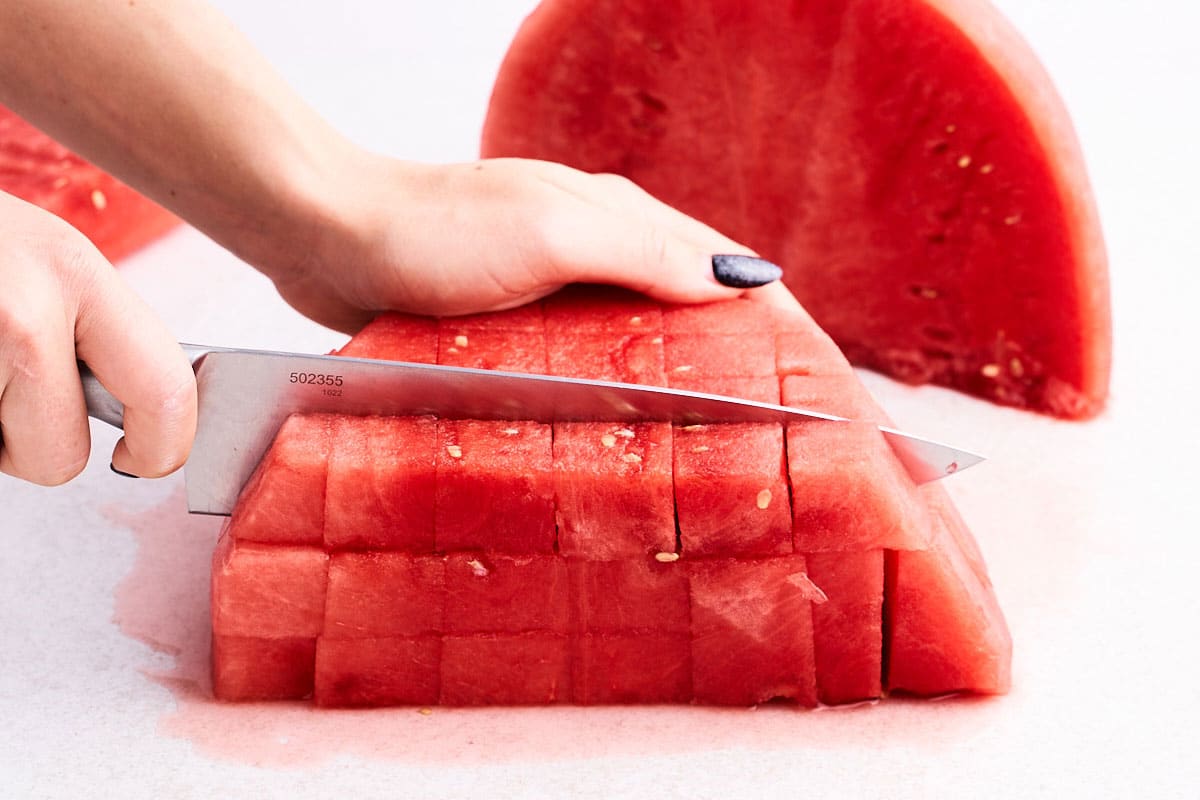
Once you master those tips…can this be far behind?

SOURCE: LIVEEATLEARN.COM

Violet flowers, hailing from the violaceae family, are a fascinating and diverse group of perennials. Famous for their stunning violets, their shades range from deep, sultry purples of the common blue violet (Viola sororia) to the charming tricolor petals of the Viola tricolor.
Violet flowers are versatile and can thrive in a variety of conditions. They can grow under full sun or partial shade, making them a favorite among gardeners across different climates. In Europe, these perennials are a popular choice for both outdoor gardens and as a houseplant due to their adaptability and striking appearance.
The violet flower is a self-pollinating plant, which means it doesn’t rely on insects or wind to propagate. This feature ensures a continuous bloom of flowers from late summer to early autumn. The plant sends out runners, which contribute to its swift spread and swelling population in a garden.

Caring for a violet flower, part of the Violaceae family, requires an understanding of subtle nurturing techniques. These flowers produce delicate petals and lush leaves that resonate vividly in both spring and late summer.
Interestingly, violet flowers are self-pollinating, and some varieties produce runners, swelling their garden presence. However, be cautious of pests such as insects and slugs which could damage the plant.
As a houseplant, violets require careful watering to prevent leaf yellowing, a common sign of overwatering. These characteristic violet flowers are not only visually enchanting but are a source of flavonoids, beneficial for both their beauty and their nutritional value.
Violet flowers grow best in partial shade to full sun. These small plants, often considered perennials, require a delicate balance of light to flourish.
Too much direct sunlight can cause the leaves to scorch, while too little can hinder their growth and flowering. In Europe, they are often found growing in dappled light under trees.

SOURCE: PLANETNATURAL.COM

