






Since yet another state has the white-tailed deer as their State Animal, I found an article about a different type of white-tailed deer—the piebald.
From: eastwesthunt.com:
Among the most often seen and identifiable animals in North America, whitetail deer are among them; some of them stand out because of a startling genetic abnormality called piebaltism. Unlike normal deer, piebald whitetail deer have a marbled or speckled look from their unusual blend of brown and white fur. A genetic mutation influencing pigment causes this unusual tint and occasionally results in physical defects.
Piebald deer have captivated scholars, sportsmen, and nature lovers all around despite their difficulties. Some societies even view them as lucky symbols. Including their genetics, rarity, health issues, and importance in nature, this page covers all you need to know about piebald white-tailed deer.
A piebald whitetail deer is a deer having clearly brown and white fur patches. Piebalds have uneven white patches all over their bodies unlike typical whitetail deer, who have a full brown coat with a white underbelly. A genetic mutation influencing melanin production, the pigment in skin, hair, and eye color causes this disorder.

| Feature | Piebald Deer | Albino Deer |
| Fur Color | Brown and white patches | Completely white |
| Eye Color | Normal (brown or black) | Pink or red |
| Nose Color | Normal (black or brown) | Pink |
| Hoof Color | Normal (black or brown) | Pink or white |
| Pigmentation | Partial pigmentation | No pigmentation at all |
How rare are piebald whitetail deer?
Extreme rare are piebald whitetail deer. Piebaldism is exhibited by less than 2% of all the whitetail deer population. Genetic elements do, however, cause some locations to have a somewhat higher incidence.
Why are they so rare?
Piebald deer are rare mostly since the genetic mutation causing their pigmentation is recessive. This implies:
A fawn must inherit the piebald gene from both parent deer.
Just a tiny fraction of fawns will be born piebald even if both parents carry the trait.
Should just one parent have the gene, the fawn will have normal coloration but may pass the trait on to next generations.
Piebald deer are so scarce in nature and a wonderful sight for those who enjoy wildlife only.
What causes whitetail deer piebaldism?
A hereditary abnormality known as piebaldism causes white fur patches by influencing melanin synthesis. Along with affecting fur pigment, this mutation can cause physical abnormalities.
Physical Exceptions Related to Piebaldism

Many piebald deer are born with other health issues including:
Twisted or shortened legs make mobility harder.
Curved spine (scoliosis) causes postural problems
Affecting feeding and survival, overbite or underbite.
Abnormalities of internal organs cause problems in health.
While not all piebald deer have these problems, the mutation raises their likelihood of physical difficulties.
Piebald Deer’s Significance in Nature and Human Culture
More than just a rare sight in the wild, piebald deer are very important in both natural environments and human civilization.
Native American Folklore: Piebald Deer
Piebald deer are holy animals according to some Native American tribes. They are supposed to provide blessings, protection, and spiritual messages as well as luck. In some customs, killing a piebald deer is thought of as bad luck.
Do Piebald Deer suffer from any survival disadvantages?
Unfortunately, piebald deer’s distinctive color makes them more easily seen by predators including:
Wolves
Coyotes
Bobcats
Humans
Normal brown-colored deer mix in the wild and make it more difficult for predators to find them. But the white patches of piebald deer stand out and raise their vulnerability to attack or hunting.
Identification of a Piebald Whitetail Deer
Look for these characteristics if you search the wild for a piebald deer:
Randomly dispersed white and brown coat patches.
Normal-colored eyes—unlike albino deer, which have pink or red eyes.
Potentially physical anomalies including a bent spine or shortened legs.
A deer with arresting white markings that contrasts with its surroundings.

Should you ever stumble across a piebald deer in the wild, you should count yourself lucky as finding one is unusual and intriguing.
Conclusion
Piebald whitetails deer are among the most fascinating and unusual animals on Earth. Different from other deer, their unusual white-and- brown hue originates from a genetic abnormality. Although they are lovely, they are more easily seen to predators and often have health issues.
Piebald deer are rare, yet they nonetheless draw the interest of academics, hunters, and other wildlife aficionados. Some societies even see them as enigmatic luck symbols. Whether you are lucky enough to come across one in the wild or just find their genes intriguing, these deer remain an amazing example of the diversity present in nature.
SOURCE: EASTWESTHUNT.COM

Today’s entry is a no-bake Cookie Bite recipe!

Ingredients
½ cup salted butter room temperature
½ cup brown sugar, packed
¼ cup granulated sugar
2 teaspoons pure vanilla extract
1 cup all-purpose flour
½ cup mini chocolate chips
Instructions
Start by heat-treating the flour. Add the flour to a microwave-safe bowl and microwave on high for 60 seconds. Stir the flour to distribute the heat and microwave for another 60 seconds. Stir again, and let cool. This step is important to kill any bacteria in the flour and make the cookie dough safe to eat. Alternatively, you can spread the flour on a baking sheet and bake at 350°F for 10 minutes, just be careful it does not become brown.
In a large mixing bowl, use an electric mixer or stand mixer to beat the room-temperature butter, brown sugar, granulated sugar, and vanilla extract on high speed until smooth and fluffy (about 2-3 minutes).
Add the flour to the bowl and mix gently on low speed until the flour is just incorporated into the dough. The dough may be soft (not thick), but that’s okay.
Use a rubber spatula to gently fold the mini chocolate chips into the dough until evenly distributed.
Use a 1-inch cookie scoop to scoop the dough into bite-sized balls. Roll each ball in your hands to give it a smooth, round shape, then place it on a tray lined with parchment paper.
For best results, refrigerate the cookie dough bites for 30-60 minutes so they can firm up. This is optional; you can enjoy the bites right away if you prefer. Enjoy!

These are some of the easiest pies to make! All you need are a graham cracker crust (plain or chocolate), a softened half gallon of ice cream and toppings!
Ingredients
half gallon (2 quarts) favorite ice cream or sorbet
1 (9 inch) pre-made cookie or graham cracker crust
Favorite toppings (chocolate chips, chocolate syrup (or Magic Shell), sprinkles, chopped fruit, candy bars, etc.)
Instructions
Let ice cream thaw until slightly soft and scoop-able. Then gently spread a layer in the pie crust, approximately 1″ thick. Add in a light layer of toppings on top. Then add one more 1″ thick layer of ice cream, and add more toppings on top. Freeze the pie until it is firm again, then slice and serve. (Top with whipped cream if you’d like.)
Ingredient Combination Ideas:
Mint Chocolate Chip:
Mint chocolate-chip ice cream, Oreo crust, chocolate chips, chocolate syrup, chocolate bar shavings
Mocha:
Coffee ice cream, Oreo crust, chocolate syrup, chocolate-covered espresso beans
Strawberry Banana:
Strawberry (or any fruit) ice cream, graham-cracker crust, chopped strawberries and bananas (or other fresh fruits)
Toffee Caramel:
Toffee ice cream, graham-cracker crust, crushed Heath Bar bits, caramel topping, chocolate syrup
Caramel Peach:
Peach or vanilla ice cream, graham-cracker crust, caramel sauce, diced peaches (all the better if caramelized!)
ENJOY!

Today is Belinda Carlisle’s birthday (born in 1958) and this is my favorite song of hers: Mad About You.
Happy Birthday Belinda!

:max_bytes(150000):strip_icc()/screencapture-imgur-gallery-VfNqW-1495849088498-5928d8eb3df78cbe7e2f940f.png)







Today would have been David Crosby’s birthday. He was born in 1941 and died January 18, 2023. This is one of my favorite songs: The Southern Cross.
Got out of town on a boat, going to Southern islands
Sailing a reach before a following sea
She was making for the trades on the outside
And the downhill run to Papeete
Off the wind on this heading lie, the Marquesas
We got eighty feet of the waterline
Nicely making way
In a noisy bar in Avalon, I tried to call you
But on a midnight watch I realized
Why twice you ran away
(I think about)
Think about how many times I have fallen
Spirits are using me, larger voices calling
What heaven brought you and me
Cannot be forgotten (I’ve been around the world)
I have been around the world (Looking)
Looking for that woman-girl
(And I know she knows)
Who knows love can endure
And you know it will
When you see the Southern Cross for the first time
You understand now why you came this way
‘Cause the truth you might be running from is so small
But it’s as big as the promise
The promise of a coming day
So I’m sailing for tomorrow, my dreams are a-dying
And my love is an anchor tied to you
Tied with a silver chain
I have my ship
And all her flags are a-flying
She is all that I have left
And music is her name
(I think about)
Think about how many times I have fallen
Spirits are using me, larger voices calling
What heaven brought you and me
Cannot be forgotten (I’ve been around the world)
I have been around the world (Looking)
Looking for that woman-girl
Who knows love can endure
And you know it will
And you know it will
(Yes)
So we cheated and we lied and we tested
And we never failed to fail
It was the easiest thing to do
You will survive being bested
Somebody fine
Will come along, make me forget about loving you
In the Southern Cross

Today is Steve Martin’s birthday (born in 1945) and he is one of my favorite comedians. Discoverwalks.com had this article about 15 facts about Steve.
From Discoverwalks.com:
Steve Martin was born on August 14, 1945, in Waco, Texas
Steve Martin, born on August 14, 1945, in Waco, Texas, emerged as a comedic force with a career that would redefine the landscape of humor. Raised in a working-class family, Martin’s early years laid the foundation for his journey into entertainment. His birthplace, Waco, Texas, provided the backdrop for the upbringing of a young artist destined for greatness. Little did the world know that this August-born Texan would become a comedy icon, leaving an indelible mark on the world of entertainment.
He started as a writer of The Smothers Brothers Comedy Hour
Embarking on his comedic odyssey, Steve Martin found an early niche as a writer for “The Smothers Brothers Comedy Hour.” This behind-the-scenes role not only honed his craft but also marked the genesis of his ascent in the entertainment industry. The show, known for its irreverent and boundary-pushing humor, served as a fertile ground for Martin’s comedic genius to blossom. As he crafted jokes and skits for the show, little did audiences anticipate the uproarious laughter that would soon emanate from the man who was laying the groundwork for a revolutionary approach to comedy.
He rose to fame in the 1970s
In the dynamic landscape of 1970s comedy, Steve Martin emerged as a luminary with his wild and crazy stand-up routines. His performances, characterized by absurdity and unpredictability, captivated audiences and set him apart from his contemporaries. Martin’s ability to blend physical comedy with sharp wit created a comedic alchemy that resonated with the cultural zeitgeist. As laughter echoed in venues across the nation, Steve Martin solidified his status as a comedic trailblazer, paving the way for a new era in stand-up.
Steve was part of the Grammy-Winning Masterpiece A Wild and Crazy Guy

A Wild and Crazy Guy, a Grammy Award-winning comedy album, stands as a testament to Steve Martin’s comedic brilliance. Released in 1978, the album showcased Martin’s diverse talents, featuring not only his iconic stand-up routines but also musical performances.
The titular track, A Wild and Crazy Guy, became a catchphrase synonymous with Martin’s comedic persona. The album’s success catapulted him into the mainstream, earning accolades for his innovative and daring approach to comedy.
Steve was showcased at the Saturday Night Live and the Comedy Stage
Steve Martin’s impact on the comedy landscape reached new heights as he hosted “Saturday Night Live” multiple times in the show’s early years. His appearances on the iconic sketch comedy show became legendary, solidifying Martin as a master of live performance. His charismatic presence, coupled with impeccable timing, made each hosting stint a memorable event. Saturday Night Live became a platform where Martin’s comedic genius seamlessly blended with the irreverent spirit of the show, creating moments that are etched into the annals of comedic history. These early years on “SNL” not only showcased Martin’s versatility but also marked a pivotal chapter in the evolution of American comedy.
Steve Martin Stared in The Jerk and Planes, Trains and Automobiles
Steve Martin’s comedic brilliance extended to the silver screen with iconic performances in films like The Jerk and Planes, Trains and Automobiles.” “The Jerk,” released in 1979, marked Martin’s debut as a film lead and quickly became a cult classic. His portrayal of the endearing and hapless Navin Johnson showcased his versatility and solidified his status as a film comedy icon. Planes, Trains and Automobiles, a 1987 comedy-drama, further underscored Martin’s ability to seamlessly blend humor with heart, earning acclaim for his memorable chemistry with John Candy.
Steve Martin is an accomplished Banjo Player and Musician
Beyond the realm of comedy, Steve Martin’s artistic talents extend to the realm of music. A skilled banjo player and musician, Martin has showcased his musical prowess in various capacities. His passion for the banjo has led to collaborations with renowned musicians, demonstrating a depth of talent beyond the comedic stage. Martin’s foray into the world of bluegrass music has garnered him respect and admiration, proving that his creative repertoire knows no bounds.
Through the show The Pink Panther, he won an Academy Award
In 2004, Steve Martin achieved an Oscar triumph by winning the Academy Award for Best Animated Short Film for “The Pink Panther.” His foray into the realm of animated filmmaking showcased yet another facet of his artistic versatility. The recognition from the Academy underscored Martin’s ability to excel not only in front of the camera but also as a creative force behind the scenes.
Steve Martin hosted the Academy Awards

Steve Martin’s wit and charm made him a natural choice to host the Academy Awards, a role he undertook with aplomb. Hosting the Oscars three times in the 2000s, Martin brought his signature humor to the prestigious event, leaving audiences in stitches while navigating the delicate balance required for such a high-profile occasion. His hosting gigs added a touch of levity to the glamour of Hollywood’s most celebrated night, making him a beloved figure on the Oscars stage.
He received an Honorary Academy Award in 2010
In 2010, Steve Martin received an Honorary Academy Award, a fitting tribute to his exceptional contributions to the film industry. This prestigious honor recognized Martin not only for his comedic prowess but also for his enduring impact as a multifaceted artist. The award acknowledged a career marked by innovation, excellence, and a dedication to the craft that transcends the boundaries of entertainment. Steve Martin’s legacy in film, as both a performer and a creative force, stands as a testament to his enduring influence in the cinematic landscape.
Steve is a Literary Legacy
Steve Martin’s literary prowess shines through his novels, including “Shopgirl” and “An Object of Beauty.” Released in 2000, “Shopgirl” is a poignant exploration of modern relationships, while “An Object of Beauty” (2010) takes readers into the vibrant art scene of New York City. Martin’s foray into writing showcases a nuanced understanding of human experiences and a literary voice that complements his comedic brilliance.
Steve is an Artistic Connoisseur
Beyond the realms of comedy and literature, Steve Martin is a distinguished art collector and enthusiast. His passion for the visual arts extends to a keen eye for collecting, contributing to the cultural conversation surrounding fine art. Martin’s involvement in the art world reflects a multifaceted artistic sensibility, emphasizing the breadth of his creative interests and his engagement with diverse forms of expression.
He played a Pivotal Role in Disneyland’s Magic Shop
Steve Martin’s influence extends even to the enchanting world of Disneyland. Playing a pivotal role in the development of Disneyland‘s “Magic Shop,” Martin brought his comedic and magical touch to the theme park experience. This contribution showcases his ability to infuse entertainment into unexpected places, leaving an enduring mark on the magical and imaginative atmosphere of Disneyland.
Steve Martin won the Mark Twain Prize for American Humor in 2005
In 2005, the Kennedy Center bestowed upon Steve Martin the prestigious Mark Twain Prize for American Humor. This accolade recognizes individuals who have had a profound impact on American society in ways similar to the great 19th-century humorist Mark Twain. Martin’s humor, characterized by wit and intelligence, earned him this esteemed honor, solidifying his place among the comedic legends who have left an indelible mark on the fabric of American culture.
He did a Dynamic Duo Comedy Tour titled An Evening You Will Forget for the Rest of Your Life
Teaming up with fellow comedian Martin Short, Steve Martin embarked on a hilarious collaboration with the comedy tour titled “An Evening You Will Forget for the Rest of Your Life.” This dynamic duo brought their comedic chemistry to stages across the country, delivering an unforgettable experience for audiences. The tour not only showcased their individual comedic brilliance but also demonstrated the magic that unfolds when two comedic maestros come together, creating an evening that lives on in the memories of those fortunate enough to attend.
:max_bytes(150000):strip_icc()/InStyle-September-Steve-Martin-Short-3-969f939d6538450c8b7313349eace90e.jpg)
In the finale of this exploration into the world of Steve Martin, it becomes abundantly clear that his impact on comedy is not merely a collection of punchlines but a rich tapestry woven with versatility and genius. As we bid farewell to these 15 fascinating facts, we find ourselves standing in awe of a comedic legend whose influence extends far beyond the stage and screen.
Steve Martin’s legacy is not just about laughter; it’s about innovation, fearlessness, and an unyielding dedication to his craft. His ability to navigate the delicate balance between humor and intellect has made him a revered figure, inspiring generations of comedians to come. So here’s to Steve Martin, the maestro of mirth, whose comedic brilliance continues to resonate, proving that a good laugh is not just a momentary escape but a timeless treasure in the grand narrative of life.
SOURCE: DISCOVERWALKS.COM

Today’s entry is an abandoned castle on the Hudson River in New York.

From: allthatsinteresting.com:
Built by an eccentric arms dealer on the isolated Pollepel Island, the Scottish-influenced Bannerman Castle looks like something out of a fairytale — but it has a spooky mythology all its own.
About 60 miles north of New York City, on the supposedly haunted shores of Pollepel Island in the Hudson River, sits the ruins of a 20th-century fortress known as Bannerman Castle. Originally built in the early 1900s as an army surplus arsenal, the castle was abandoned after it was damaged in a series of fires and explosions.

Francis Bannerman, the eccentric weapons tycoon who built the castle, was not your average arms dealer. A first-generation Brooklynite of Scottish descent, he was a pacifist who regarded his vast military collection a tribute to the lost art of weapon making. However, his castle and its grounds would prove to be his greater legacy.
Originally based in Manhattan, Bannerman’s business — and vast supply of flammable black powder — grew so large that the city of New York forced him to move out. His son discovered Pollepel Island while out canoeing on the Hudson, and Bannerman purchased it in 1900 to build a huge arsenal to store his weapons stock.
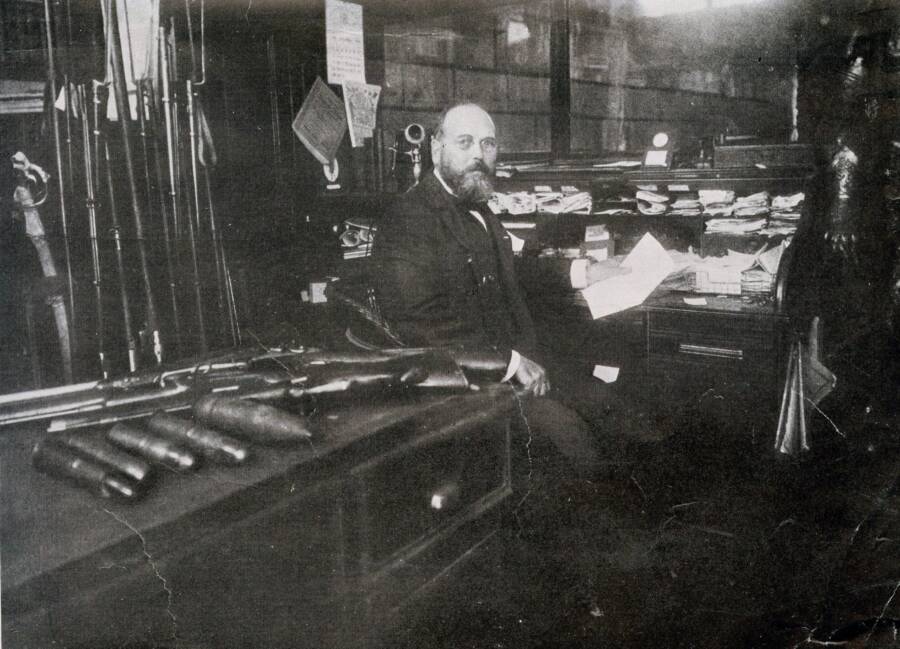
From there, he brought the baronial, Scottish-inspired Bannerman Castle into existence.
The Construction Of Francis Bannerman’s Architectural Oddity
Francis Bannerman was not an architect. That’s what makes the Gaudi-esque character of the castle and its accompanying buildings so astounding. Rather than work with professional architects, Bannerman designed the castle almost entirely by himself, often drawing up plans on the backs of napkins and envelopes to create the estate in the style of a Scottish fortress.
When Bannerman Castle was nearly finished, barges ferried cannons and artillery up the river for storage. But Bannerman and his wife Helen decided to keep building. They designed an additional castle to serve as a family summer residence, complete with lovely gardens, a dock, a moat, and even an outhouse built for two.
The Bannermans landscaped the gardens themselves, importing soil, digging winding pathways around the island, and building the garden walls. Helen Bannerman enhanced the terraces with plants, flowers, and shrubs — some of which are still alive today.

With Scottish, Moorish, and Belgian design influences, the castle was alive with intricate stone and brickwork. Everything was elaborately adorned with thoughtful details. Bannerman even had the name “Bannerman’s Island Arsenal” emblazoned on its façade.
“There is no way to describe something so eccentric,” said Thom Johnson, vice-president of the Bannerman Trust, according to the non-profit Historic Hudson River Towns. “Look at the north view — there’s no right angles on these buildings! Look at all these textures, all that he did with masonry. It’s a piece of sculpture! The style is almost gaudy, but somehow, he manages to pull it off. Bannerman knew exactly what he was doing, and he did it his own way.”
The Haunted History of Pollepel Island
Before Bannerman Castle, Pollepel Island had a spooky history all its own. The portion of the river surrounding the island had a reputation for violent storms and howling winds. According to local Hudson Valley legend, Dutch sailors in the 17th and 18th centuries attributed these storms to a sinister Goblin king who resided on the island.
The sailors named this being the “Heer of Dunderberg” — “Heer” meaning King, “dunder” meaning thunder, and “berg” meaning mountain. The Heer of Dunderberg was said to rule an army of imps, and had the power to summon the violent storms that wreaked havoc on passing ships.

According to believers, during these infamous squalls, you can still hear the captain of the ghost ship The Flying Dutchman barking orders to his crew.
However, it’s possible that this “folk legend” was invented by Washington Irving, author of The Legend of Sleepy Hollow. Irving’s literary success is due in part to his knack for writing tales of lore that sound like they could be true — and he detailed the legend of the Heer of Dunderberg in his 1822 short story “The Storm-Ship.”
Bannerman Castle Falls To Ruin
Unfortunately, Bannerman Castle has seen its share of catastrophe.

In 1918, Frank Bannerman died before the castle was 100 percent complete. Then, in 1920, the arsenal’s powder house exploded, lending credence to New York City’s decision to boot Bannerman from city limits.
“The explosion was heard from Poughkeepsie to Peekskill,” Steve Santangelo, a tour guide at the castle, said to the New York Times. And 6sqft reports that about 200 tons of shells and powder were involved in the blast.
The explosion damaged the castle, shattering the windows and jettisoning part of the tower into the river. The Bannerman family, narrowly escaping death, remained in the residence until about 1930. That’s when the castle began crumbling.

In 1967, the Bannerman family sold the island to New York State; two years later, it’s suspected that an arsonist set the mysterious fire that reduced the castle to ruins.
Eerily, seven years before the blaze, Frank’s grandson Charles had written prophetically: “No one can tell what associations and incidents will involve the island in the future. Time, the elements, and maybe even the goblins of the island will take their toll of some of the turrets and towers, and perhaps eventually the castle itself.”
For years, New York banned visitors from Pollepel Island because it was too dangerous. That didn’t stop people from illegally visiting and photographing the abandoned castle. Poison ivy ran rampant and snakes infested the grounds, but visitors still braved these hazards — and the choppy waters of the Hudson River — for a glimpse of the crumbling historic ruin.

However, this was not the end of Bannerman Castle’s story. In 1992, a Hudson Valley local named Neil Caplan founded the Bannerman Castle Trust, which has raised funds to stabilize the castle ruins, clear overgrown pathways, and revitalize the landscaping.
Today, Bannerman Castle is a haven for enjoying cultural events. Tours of the grounds run from April through October and include the boat ride over to the island. The Bannerman Castle Trust also hosts horror movie nights, theater performances, kayak tours, and farm-to-table dinner events. Last year, in an exclusive dining experience, the Trust even recreated an 11-course, first-class dinner that was served on the Titanic.
Over 100 years after Bannerman Castle was built, the historic Hudson Valley landmark is now closer to a museum than a bomb site. We can only assume that’s what Francis Bannerman would have preferred.
SOURCE: ALLTHATSINTERESTING.COM

Today is Erwin Schroedinger’s birthday (born in 1887 and passed away in 1961). He is famous for his explanation of Quantum mechanics using Schroedinger’s cat. What exactly is it? I found this “simplified” explanation on the culturacolectiva.com website.
From culturacolectiva.com:
Many of us have heard about Schrödinger’s cat, but let’s be honest, either we don’t even know what it is or we know about the theory but we don’t understand anything. Certainly, quantum mechanics is not exactly a piece of cake, so in order for you to have something to talk about at the next party, we leave you with a for dummies so you know it and can show it off to your friends.
What is Schrödinger’s cat?
We are sorry to tell you this cat never actually existed. Although it’s already part of popular culture (yes, they even talked about this cat in an episode of The Big Bang Theory), the Schrödinger’s cat paradox is a thought experiment devised by Austrian physicist Erwin Schrödinger – one of the founders of quantum mechanics – back in 1935.
And what was this mad scientist trying to do? Well, he was trying to talk about a basic principle of quantum mechanics, that branch of physics that some people find exciting, while others flatly hate it. And believe it or not, this is how Erwin felt about quantum physics: he found it so philosophically disturbing that he decided to send it to hell and dedicate himself to biology.
So, what’s the experiment all about?
Now comes the good stuff, so sit up and pay attention to expand the horizons of your intellect (or have your brain explode).
The experiment Erwin devised goes like this: you have to put a cat inside a sealed box. Inside, next to the cat, is a container with hydrogen cyanide (a poisonous gas) threatened by a hammer connected to a radioactive container.
There is a 50% chance that after a period of time (say, one hour) radioactive decay of some atom inside the container will occur which would activate the hammer and break the cyanide container, releasing the poison that would kill the cat.
The other 50% of possibility tells us that this will not happen and therefore the cat is still alive.
Well, Schrödinger’s paradox tells us that we as spectators, on the outside, do not know if inside the box the cat is alive or dead, therefore, without verification, it is alive and dead at the same time.

How?
Yes, think about it, it’s like those times when you are asked if a tree falls in the middle of a forest but no one hears it, does the tree actually sound the thump of the falling tree? And the fact is that the spectator, not seeing inside the box, does not know the result, so the cat is alive and dead, and only the observation is what would change the result.
And this, my friends, is precisely quantum physics, which says that quantum objects can be in two states at the same time.
Two states at once? You don’t say…
This is not just a matter of the cat but is a metaphor to describe the state within this type of mechanics. According to quantum laws, the atom is in an intact and disintegrated state at the same time, which is called quantum superposition*. Only when we look at the particle can we know what state it is in at the moment (like the cat, remember?).
*Quantum superposition: a quantum phenomenon that is a consequence of the dual particle and wave nature of everything.
This action of looking to determine the state (of the atom or the cat, it doesn’t matter, the cat was just an example) is called collapse, and it is that we practically screw up the quantum property it has and it will only be able to materialize in one state (like looking in the box and knowing if it is alive or dead).
But it doesn’t make sense
No, maybe our logic tells us that the cat is going to be alive or dead (there is no other way!) but in the atomic world, the properties of things are governed by laws that are not simple and that is where probability comes in.
For example light. Light, like electrons, has a wave nature, but it also has particle characteristics. But you can’t pick up light with your hands, can you? It stays in two simultaneous states.
Let’s go back to the superposition
The fact of two states at the same time responds to the fact that for an object to have a wavelength, it must extend over some region of space, i.e… it occupies many positions at the same time. omg!
This can lead to other theories such as those of the quantum multiverse. Let’s think: if the cat can be alive or dead but it depends on observation, isn’t it feasible that both possibilities are in fact occurring in parallel but within a multiverse?
More than a cat
Although Schrödinger got fed up with quantum physics and decided it was not worth it, beyond the cat, the physicist formulated one of the most important equations in history: the Schrödinger equation (he was not so original when it came to names).

Here we leave the formula for you to calculate it (Photo: YouTube).
This formula, something like Newton’s second law but for quantum mechanics, contains all the properties and information of any particle. This simple formula is a wave function capable of describing the state of a particle such as energy or position. Because let’s review: if the particle is in two states at the same time, how do you determine anything about it? Unfortunately one of the problems with the equation is that it cannot measure all values simultaneously.
Well, now you know about Schrödinger’s cat and the next time it comes up in the conversation of your educated friends you will be able to explain clearly (or not?) why this cat lives in the collective mind of the whole world.
SOURCE: CULTURACOLECTIVA.COM
 Sew Colorful