The Day the Laughter Died

From: Paul Andrews at lost-in-history.com:

One of the worst train wrecks in U.S. history happened with, of all things, a Circus Train.  It was carrying over 400 performers when another train rear-ended it in the dead the night; and they burst into flames. The horrific tragedy happened to the famous Hagenbeck-Wallace Circus at Dutchman’s Curve near Hammond, Indiana on 22 June 1918.  The circus train was stopped on the tracks for repairs. The circus train wreck killed 89 performers and roustabouts, and injured over 150 more.   How could such a terrible disaster have occurred during the Golden Age of railroads?  

The Hagenbeck-Wallace Circus was the third-largest in the U.S., a Midwestern version of the Barnum & Baily Greatest Show. The H-W Circus had some of the most excellently trained animals, well-known trapeze artists, and spectacular equestrian routines.  By 1918, the company employed around 250 performers – acrobats, trapeze artists, clowns, and wild animal tamers; not to mention all the roustabouts who kept it going.  Circus owner Benjamin Wallace purchased the Carl Hagenbeck Circus in 1907.  In just a decade, the combined circus grew into a million-dollar extravaganza, which even owned its own trains. 

The circus required two, 28-car trains to transport all the tents, performers, animals, and midway across the U.S. The expansion of railroads in the latter half of the 1800’s fueled a Golden Age for circuses, as well as railroads. By 1900, nearly 100 circuses traveled between U.S. towns and cities. Back then, live circuses were an unmatched spectacle of daring, humor, and shear amazement. When the circus came to town, it was an unofficial holiday, schools and stores were closed and even factories shut down.

The Hagenbeck-Wallace Circus Side Show performers

The Hagenbeck-Wallace Circus had just wrapped up 2 successful shows in Michigan City, Indiana.  They were now enroute overnight to Hammond, only 45 miles away. The first train contained the performing animals, tents, midway and most of the circus workers.  The second train carried the performers and the remaining roustabouts. It was standard to send the animals in the first train ahead of the performers. That way, the animals could be unloaded, penned, and fed. This practice saved all the circus animals, but doomed the performers.

The first train made it safely to Hammond that night without incident.  But engineers on the second were forced to stop that train to fix a “hotbox or overheated axle bearings – a serious problem if not addressed. They were able to pull the first cars off on a side track, but five of the rear ones, including 4 sleeper cars, remained on the main track.  This should not have been a problem as the rail line was aware and turned on red warning lights along the tracks.

Around 4 o’clock in the morning on Saturday, June 22, an empty Michigan Central train, led by an experienced railroad engineer, Alonzo Sargent, was rapidly approaching on the tracks behind them.  He and his train were headed to the west coast to pick up U.S. army soldiers for The Great War in Europe (World War I).  Sargent knew he was following 2 circus trains that were going much slower than his empty train.

As the crew worked, and the performers slept, the empty train came barreling towards them.

The engineer blew past several red stop signals AND the frantically waving lanterns of the circus train’s engineers. All his experience and knowledge was for naught as Sargent’s train inexplicably slammed into the back of the stopped circus train at close to 45 mph. The collision was so loud that farmers asleep in the countryside were startled awake.  They dressed and went to see what on earth had occurred.  

When the Michigan Central train rammed into the red caboose of the circus train, it splintered the caboose like kindling.  Then it continued on into the four wooden sleeper cars, filled with sleeping circus performers. The empty troop train’s massive engine and steel Pullman cars tore easily through the 4 wooden cars as well.Dozens were killed instantly.

Henry Miller, the assistant lighting manager, was a survivor thrown from the wreckage with minor injuries. “I was in the last coach, and was asleep when we were hit. I woke to the sound of splintering wood … Then there was another crash, and another, and another … The train buckled on itself.”

To make matters worse, the circus cars were lit inside with kerosene lamps hanging on the walls.  They smashed and exploded, spewing flames across the shattered wood, rapidly igniting the 4 cars.   Wherever the oil splattered, the fire followed.  Some survivors not killed instantly managed to claw their way out of the debris.  Others desperately cried out for help before the hungry fire engulfed them.

All four sleeping cars were completely engulfed in flames in a matter of minutes.

Survivors from the front of the train were knocked out of their berths when their cars jumped the tracks.  They climbed outside into the dark night and saw the rear of the train ablaze.  They ran back to the shouts and screams of their surviving coworkers.  The uninjured survivors risked their own lives trying to rescue their companions trapped in the burning wreckage.  One acrobat, trapped beneath the wooden walls, was pulled out by a clown just as the flames were licking his legs.  But most weren’t so lucky.

Fire engines from both Hammond and Gary, Indiana rushed to the scene.  But delivering enough water to fight the huge fires was next to impossible.  The only supply came from the shallow marshes aside the tracks. Hammond also brought in a wrecking crane to dig people out.  But it couldn’t be used because the fire’s heat was too intense. The survivors could only stand back helplessly and watch the four train cars burn.

The aftermath of the HagenbeckWallace Circus Train Wreck in Hammond, Indiana

By dawn’s pink light, the burning cars were consumed down to blackened metal wheels and smoking heaps of ashes.  The engineer, Alonzo Sargent, and his fireman were uninjured and arrested by local police. Most of the dead were burned beyond recognition. The task of identifying the corpses was hopeless. Some survived the initial crash but succumbed to their injuries at the Hammond and Gary hospitals. Many of the dead were simple circus roustabouts, people who joined the traveling circus doing odd jobs.

The circus kept few records on their roustabouts, most of whom were immigrants.

When reports of the circus train wreck made the newspapers, scenes of unspeakable horror were retold to a shocked country.  89 people were killed and more than 150 injured. Railway investigators believed most victims died within the first minute after the collision.  Among the dead were some famous circus performers – wild animal trainer Millie Jewel, “The Girl Without Fear”; Jennie Todd, an aerialist in the Flying Wards; bareback rider Louise Cottrell; Wild West rider Verna Connor; the strongmen Derickx brothers; and the wife and sons of head clown Joe Coyle.

Five days later, 53 were buried in a mass grave plot.  As luck or fate would have it, the Showman’s League of America, a fraternal order, had purchased an area of Woodlawn Cemetery in Forest Park, IL, for circus performers. When the coffins arrived, more than 1,500 mourners gathered to pay their final respects.   Only 5 of the 53 victims were identified.  Most were marked as “unknown,” or under markers like tent man, smiley clown, or 4 horse driver.

Mass grave for Hagenbeck-Wallace Circus train wreck victims.

The Showman’s League memorialized the mass grave with a statue of a stone elephant, its head and trunk drooping in sorrow. Today, that portion of Woodlawn Cemetery is known as Showman’s Rest.

In the aftermath, families of the deceased struggled with who they should blame. The circus company?  The railway? The engineer?  All of them pointed fingers at the others. Engineer Alonzo Sargent and his fireman Gustave Klauss were criminally charged with manslaughter. Sargent reportedly had fallen asleep and therefore responsible for the crash. In the 1910s, there was no oversight of train conductors.

Sargent had been awake on the job for over 24 hours, driving trains across the Midwest. A few hours before the accident, he’d eaten a heavy supper and taken some medication.  All that, plus driving a train in the dark of night, he dropped into a deep sleep. He had known circus trains were in front of him, but didn’t know one had stopped for repairs. Sargent slept through two warning signals as well as the waving lanterns from the frantic circus train engineers.

At the trial, the jury was dead-locked, and a mistrial declared.

The Indiana prosecutor decided NOT to re-try the case and all of the charges against the two men were dismissed. The Interstate Commerce Commission investigating the accident cited the use of wooden train cars as a contributing factor to the deaths. “We discourage the use of wooden cars on passenger trains and urge the substitution of steel ones. That is all we can do.”

What became of the Hagenbeck-Wallace Circus? Its owner and the surviving performers decided to continue the show, for no other reason than to honor their dead companions.  Despite the physical and psychological toll of the accident, the Hagenbeck-Wallace Circus missed only two performances in its summer schedule.  Thanks to other circuses providing spare equipment and crew, they were able to continue their mid-west tour. The remaining members, and those from circuses from around the country, all pitched in. 

SOURCE: LOST-IN-HISTORY.COM PAUL ANDREWS
MIBURN

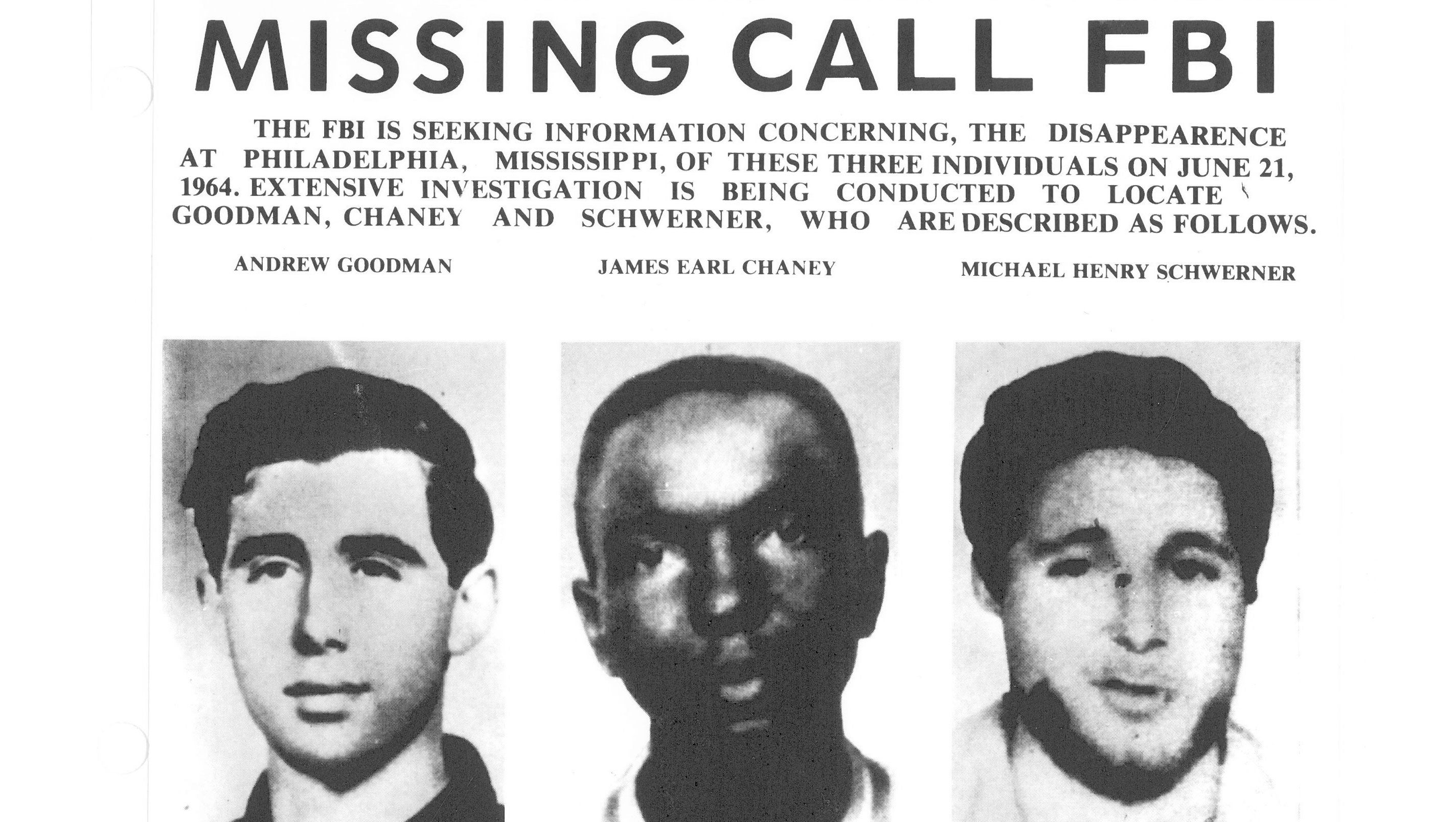
On June 21, 1964, three civil rights workers disappeared.  The following article on the history.com website details the disappearance, the investigation and the discovery of the remains.

From: history.com:

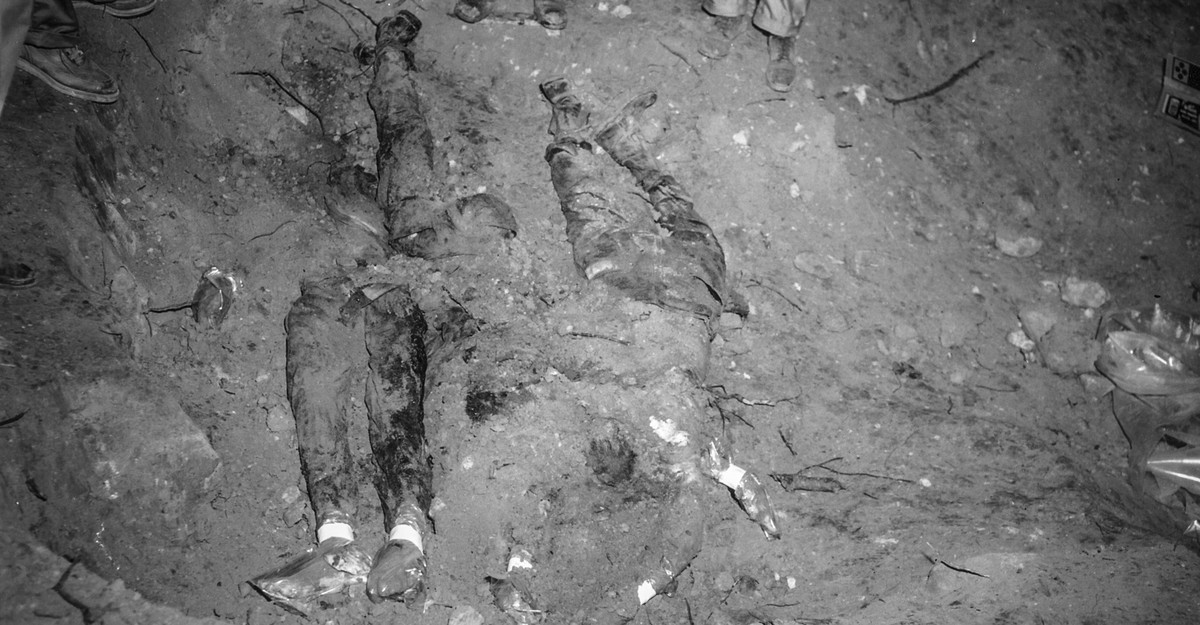
The remains of three civil rights workers whose disappearance on June 21 garnered national attention are found buried in an earthen dam near Philadelphia, Mississippi. Michael Schwerner and Andrew Goodman, both white New Yorkers, had traveled to heavily segregated Mississippi in 1964 to help organize civil rights efforts on behalf of the Congress of Racial Equality (CORE). The third man, James Chaney, was a local African American man who had joined CORE in 1963. The disappearance of the three young men led to a massive FBI investigation that was code-named MIBURN, for “Mississippi Burning.”

Michael Schwerner, who arrived in Mississippi as a CORE field worker in January 1964, aroused the animosity of white supremacists after he organized a successful boycott of a variety store in the city of Meridian and led voting registration efforts for African Americans. In May, Sam Bowers, the Imperial Wizard of the White Knights of the Ku Klux Klan of Mississippi, sent word that the 24-year-old Schwerner, nicknamed “Goatee” and “Jew-Boy” by the KKK, was to be eliminated. On the evening of June 16, two dozen armed Klansmen descended on Mt. Zion Methodist Church, an African American church in Neshoba County that Schwerner had arranged to use as a “Freedom School.” Schwerner was not there at the time, but the Klansmen beat several African Americans present and then torched the church.

On June 20, Schwerner returned from a civil rights training session in Ohio with 21-year-old James Chaney and 20-year-old Andrew Goodman, a new recruit to CORE. The next day—June 21—the three went to investigate the burning of the church in Neshoba. While attempting to drive back to Meridian, they were stopped by Neshoba County Deputy Sheriff Cecil Price just inside the city limits of Philadelphia, the county seat. Price, a member of the KKK who had been looking out for Schwerner or other civil rights workers, threw them in the Neshoba County jail, allegedly under suspicion for church arson. After seven hours in jail, during which the men were not allowed to make a phone call, Price released them on bail. After escorting them out of town, the deputy returned to Philadelphia to drop off an accompanying Philadelphia police officer. As soon as he was alone, he raced down the highway in pursuit of the three civil rights workers. He caught the men just inside county limits and loaded them into his car. Two other cars pulled up filled with Klansmen who had been alerted by Price of the capture of the CORE workers, and the three cars drove down an unmarked dirt road called Rock Cut Road. Schwerner, Goodman and Chaney were shot to death and their bodies buried in an earthen dam a few miles from the Mt. Zion Methodist Church.

The next day, the FBI began an investigation into the disappearance of the civil rights workers. On June 23, the case drew national headlines, and federal agents found the workers’ burned station wagon. Under pressure from Attorney General Robert F. Kennedy, the FBI escalated the investigation, which eventually involved more than 200 FBI agents and scores of federal troops who combed the woods and swamps looking for the bodies. The incident provided the final impetus needed for the 1964 Civil Rights Act to pass Congress on July 2, and eight days later FBI Director J. Edgar Hoover came to Mississippi to open a new Bureau office. Eventually, Delmar Dennis, a Klansman and one of the participants in the murders, was paid $30,000 and offered immunity from prosecution in exchange for information. On August 4, the remains of the three young men were found. The culprits were identified, but the state of Mississippi made no arrests.

Finally, on December 4, nineteen men, including Deputy Price, were indicted by the U.S. Justice Department for violating the civil rights of Schwerner, Goodman, and Chaney (charging the suspects with civil rights violations was the only way to give the federal government jurisdiction in the case). After nearly three years of legal wrangling, in which the U.S. Supreme Court ultimately defended the indictments, the men went on trial in Jackson, Mississippi. The trial was presided over by an ardent segregationist, U.S. District Judge William Cox, but under pressure from federal authorities and fearing impeachment, he took the case seriously. On October 27, 1967, an all-white jury found seven of the men guilty, including Price and KKK Imperial Wizard Bowers. Nine were acquitted, and the jury deadlocked on three others. The mixed verdict was hailed as a major civil rights victory, as no one in Mississippi had ever before been convicted for actions taken against a civil rights worker.

In December, Judge Cox sentenced the men to prison terms ranging from three to 10 years. After sentencing, he said, “They killed one n*****, one Jew, and a white man. I gave them what I thought they deserved.” None of the convicted men served more than six years behind bars.

On June 21, 2005, the forty-first anniversary of the three murders, Edgar Ray Killen, was found guilty of three counts of manslaughter. At eighty years of age and best known as an outspoken white supremacist and part-time Baptist minister, he was sentenced to 60 years in prison. Killen died in 2018.

SOURCE: HISTORY.COM

What Shall We Bake Today?

I found an unusual recipe that I haven’t tried yet, but I plan to! Butterfinger Cake!

Ingredients

yellow cake mix plus ingredients to prepare (1 box)

14 ounces sweetened condensed milk (1 can)

12.25 ounces caramel sauce (1 jar)

8 ounces Cool Whip thawed (or 3 cups homemade)

4 full-size Butterfingers candy bars

Instructions

Preheat the oven and prepare the yellow cake mix according to the package directions for a 9-inch x 13-inch baking dish.

While the cake is baking, mix together caramel sauce and sweetened condensed milk in a medium bowl.

Take the cake out of the oven. While it’s still warm poke holes all over the top with the back of a wooden spoon, skewer, or a fork.

Pour the caramel mixture all over the warm cake and then let it sit on a wire rack until completely cooled. (The cake will soak up the caramel)

Crush up all the Butterfingers and sprinkle 2 of the candy bars evenly over the cake.

*Pro Tip: Put the candy bars in the freezer so they’ll crush better. Then crush the Butterfingers in the wrappers, cut the tops off, and pour them out over the cake.

Frost the cake with the Cool Whip so the entire top is covered.

Sprinkle the top of the cake with the remaining 2 crushed Butterfingers. Store in the fridge until ready to cut into 12 slices and serve.

Enjoy!

Ohio State Mammal: White Tailed Deer

Ohio is another state with the White Tailed Deer as it’s state mammal.  I found this article on the website deeranddeerhunting.com detailing some of the best deer stories!

From: deeranddeerhunting.com

The 7 Funniest Deer Hunting Posts of All Time

– Wednesday December 8, 2021 – Daniel Schmidt

Deer hunting is a time-honored tradition and, for many of us, a 24/7 lifestyle. I’ve had the good fortune of spending the past 27+ years of my life living the dream of getting to think about deer hunting “for a living,” and most of that time has been in serious, reflective thought. My job is to report the facts, foster this wholesome lifestyle and recruit our next generations of hunters. But there are times when we keep it light, as they say, and find humor in some of those things we deal with on the daily.

Here are the 7 best deer hunting memes, clips, posts — there’s a mix — that I’ve seen (and even created) over the past, oh, 15-ish years of this social media madness:

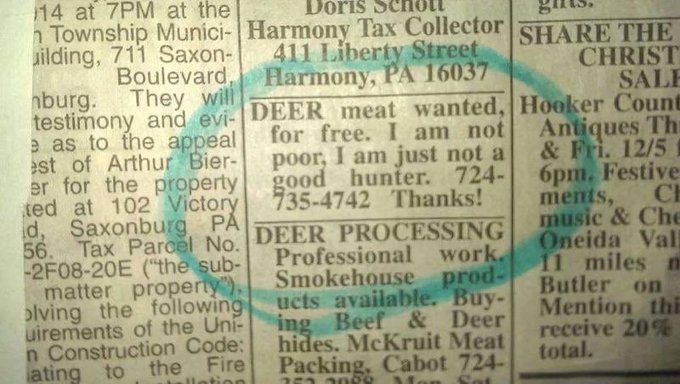
#7 Funniest Deer Hunting Post: “Deer Meat Wanted.”

This one has been floating around for year. I do not know it’s origin other than it was a real-life newspaper classified. It reads: “DEER meat wanted, fo free. I am not poor, I am just not a good hunter. (phone number) Thanks!”   

Hey, at least the person is honest! 

#6 Funniest Deer Hunting Post: “Take Her Somewhere Special.” 

I created this meme last year, but I cannot take credit for the top photo. That image has been used on social media thousands of times for other memes. When I added the photo of the deer mounts, I thought maybe my buddies around here would “get” it. They did, but so did a lot of other folks! This post received thousands of likes and shares, and I’ve even seen others take it, revise it and make it even funnier.

5 Funniest Deer Hunting Post: “Sitting in Your Stand … and You Hear a Twig Break.”

This is another one of my creations. I don’t recall the exact year (I want to say this was either 2011 or 2012), but this was another commonly used image in memes across the Internet. Back in those days, DDH was a tiny subsidiary of a large corporate entity. Our bosses were pressing all of us (hard) to either accept social media (when traditional media was pretty much opposed to it) or find new employment. I dove headfirst into building our Facebook page (which became the company’s largest social footprint). This one came to me one day when I saw the baby’s excited face and said, “Hey, that’s me EVERY time I think I hear a deer!” My coworkers laughed out loud (they knew it was true), and a meme was born.

#4 Funniest Deer Hunting Post: “Deer Hides in Barrel.”

No clue who was responsible for this one, but it makes me laugh out loud to this day. Pure genius. Who HASN’T run across a deer-hide donation barrel in their day? Heck, we used to have them at every gas station, grocery store parking lot and even some churches here in Wisconsin. The guys who saw the humor in this — and then pulled off the perfect photo shoot — get a gold star for this one!

#3 Funniest Deer Hunting Post: “Clueless Shed Hunter.”

I vividly recall when this photo was first circulating on Facebook. As much as you would think that it was created to be a joke, it WASN’T! The guy truly thought he had been tracking the same buck for years. The first comment was something like, “Um … who wants to tell him?” That literally made me spit coffee all over my laptop that morning.

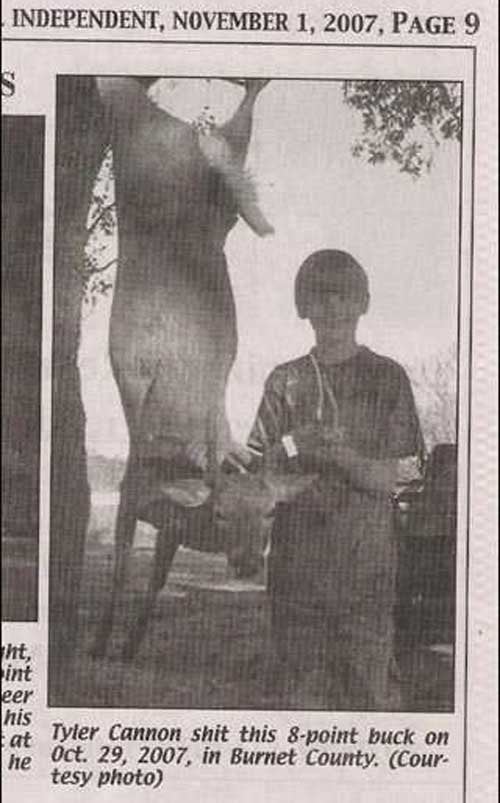
#2 Funniest Deer Hunting Post: “The Painful Bowel Movement.”

Poor Tyler. He’s in his mid-20s now, but he will forever be known as the kid that pooped a hefty 8-pointer. That copy editor surely was reprimanded after that newspaper hit the streets.

And, finally, the best of all-time:

#1  Funniest Deer Hunting Post: “Move the Deer Crossing Signs!”

I’m just going to take a wild guess that Tim Abbot knows a little more about deer behavior today than he did when he sat down and hammered out this letter to the editor years ago. Please … someone track him down and confirm that he does. Because I’m quite certain there’s a whole new crop of ill-informed city folks who probably think the same thing today!

SOURCE: DEERANDDEERHUNTING.COM

American Curl Cat

From: SPRUCEPETS.COM:

Thanks to their fluffy, curled-back ears, American Curls are one of the most easily identifiable cat breeds today. As their coats can come in a wide variety of colors and patterns, and their hair can be either short or long, it’s the unique ears of American Curls that make them stand out among other cat breeds. Today, their backwards-curled ears are a desirable trait among breeders, but they were originally the product of a natural (and harmless) genetic mutation first identified in the United States during the 1980s.

But it’s not only their curled ears that make these cats so special. Sometimes nicknamed the “Peter Pan cat,” these felines retain kitten-like natures into adulthood, and love to play, investigate, climb, and keep a close eye on their owners. They are very affectionate and easily accept children and other pets, making them an ideal family cat.

Breed Overview

Personality: Playful, friendly, affectionate, inquisitive, and easy going

Weight: Males weigh between 7 and 10 pounds, while females weigh less than 8 pounds.

Length: 18 to 20 inches

Coat Length: Short haired or long haired

Coat Colors: Any possible feline color, including black, white, gray, brown, cream, or red

Coat Patterns: Any possible feline pattern, including solid, bi-color, tabby, tortoiseshell, tuxedo, and calico

Eye Color: Any possible feline color, including amber, aqua, blue, copper, green, gold, hazel, odd-eyed, orange, yellow

Life expectancy: Typically 10 to 18 years

Hypoallergenic: No

Origin: United States

American Curl Characteristics

American Curls are friendly, affectionate, and active cats that are often said to have a somewhat “doglike” attachment to their owners. They like to gently poke and prod their humans with their paws and will often follow their favorite family members from room to room around the house. They are exceptionally intelligent cats as well. Some have been known to figure out how to flick light switches on and off, and many learn how to open and close doors and cupboards.

They typically retain a kitten-like playfulness throughout their entire lives and love to play with toys, climb and explore furniture and cat trees, investigate anything new brought into the home, and even play fetch. However, once playtime is over, your American Curl is likely to cuddle up on your lap, give you some affectionate head bumps, and spend some time in peaceful companionship.

It’s important to note, however, that American Curls don’t like to be left alone for too long—so you might have to consider whether your schedule can accommodate several hours of attention and playtime each day.

These friendly felines aren’t too large when fully grown, although they are somewhat muscular for their small-to-medium size. They generally reach maturity by one to two years of age. American Curls aren’t especially talkative cats, tending towards quiet trills rather than loud meows. A sociable cat, most American Curls take readily to children and other pets in the home, especially if they offer extra opportunities for play and fun.

Appearance

Surprisingly, American Curls are not born with their most distinctive feature. Kittens are born with typical straight ears. However, within the first couple of days, the ears roll up into tight little buds. At around six weeks of age, the kitten’s ears slowly begin to unfurl, reaching full curvature by the time the kitten is four months old. The breed standards call for an ear curl that is between 90 and 180 degrees at full maturity.

American Curls are not especially large cats, with males being no more than 10 pounds and females less than 8 pounds as adults. They are a moderately muscled cat with a well-proportioned body. The coat can be long-haired or short-haired, but either way, there is not much undercoat, meaning these cats don’t shed as much as some other breeds. However, they are not hypoallergenic.

When it comes to color, anything goes. American Curls can be any color or coat pattern that occurs naturally in felines. That means your cat can be calico, solid black, red tabby, “tuxedo,” solid gray, tortoiseshell, or any other combination of colors and patterns. The same is true of eye color; if it occurs naturally in felines, it is acceptable in an American Curl.

The skin on an American Curl’s nose and paw pads should complement the color of its fur, but there is no one required color.

SOURCE: SPRUCEPETS.COM

What Shall We Make Today?

In honor of National Fudge Day, I am bringing my favorite Chocolate Peanut Butter Fudge recipe.  I learned this one in 8th grade and am still making this delicious fudge!

2/3 cup evaporated milk (I use skim milk)

1 2/3 cups sugar

1 cup semi-sweet chocolate chips

1 cup miniature marshmallows

1/2 cup creamy peanut butter

1 teaspoon vanilla extract

Instructions

Combine the milk, and sugar in a saucepan.  Heat until boiling, then stirring constantly, cook for 5 minutes.  Remove from the heat and stir in the chocolate chips, marshmallows and the peanut butter, stirring until smooth.  Add vanilla.

Lightly grease a 10-inch square pan or line with parchment. Pour the fudge into the pan and spread with a spatula. Chill in the refrigerator until firm. Slice into 1-inch pieces and store in an airtight container in the refrigerator. Enjoy!

Notes

This fudge can be made ahead of time and then kept in the freezer for several months. Thaw in the refrigerator when ready to serve.

Happy Flag Day!

Happy Birthday President Trump!

NOTE: I didn’t make the President’s birthday the headline for this open because we tend to get trolls trying to post negative comments then.  And I didn’t bring any biographical information either because of the leftist spin on most of the articles I found. 

The Toolman

Today is Tim Allen’s birthday (born in 1953), so I brought this article from usmagazine.com detailing some interesting and perhaps unknown facts about The Toolman!

From usmagazine:

Whether you remember him as Tim “The Toolman” Taylor from Home Improvement or as the voice of Buzz Lightyear from the Toy Story franchise, Tim Allen has certainly left his mark in pop culture.

Now, as he’s gearing up to say goodbye to his Mike Baxter character on Last Man Standing after nine seasons, the 67-year-old actor exclusively opened up to Us Weekly with 25 things you might not know about him. Read on to learn more about Allen, including what his favorite Home Improvement episode is, his go-to hobbies and more.

1. The book Zen and the Art of Motorcycle Maintenance [by Robert M. Pirsig] changed my life. I love motorcycles.

2. Women were a strong influence in my life when I was growing up.

3. I am one of nine kids.

4. I worked at a sporting goods store when I was younger.

5. Matthew McConaughey used to be my neighbor. He [was] a great [one].

6. I have the original Tool Time set from Home Improvement in my garage.

7. I like Spam — there I said it.

8. I love reading about different religions.

9. One of my favorite Home Improvement scripts [took place] up in the International Space Station.

10. I talk a lot at the screen [while] watching movies and commercials on TV.

11. I like to make friends with spiders.

12. When I appear on a talk show, I rearrange the furniture in my dressing room.

13. I’ve met the real Santa Claus. He was a consultant on my [Santa Clause] films.

14. I would eat the same meal every day.

15. I would wear the same clothes every day.

16. I think I have lived many lifetimes.

17. [The] best advice I’ve ever received was: “A grateful heart has no room for resentment.”

18. I like studying quantum physics.

  1. If I weren’t a comedian, I would be a designer.
  2. My favorite part of school was shop class.
  3. Richard Pryor made me choose comedy. His stuff made me laugh ’til I was almost sick.
  4. My favorite fast food is White Castle and Chick-fil-A.

23. I love the mountains in Colorado. I was born in Denver.

24. I always wanted to be a semi truck driver or a bulldozer operator.

25. The Sound of Music is one of my top 10 [favorite] movies.

SOURCE:USMAGAZINE.COM

Happy Birthday Tim!