
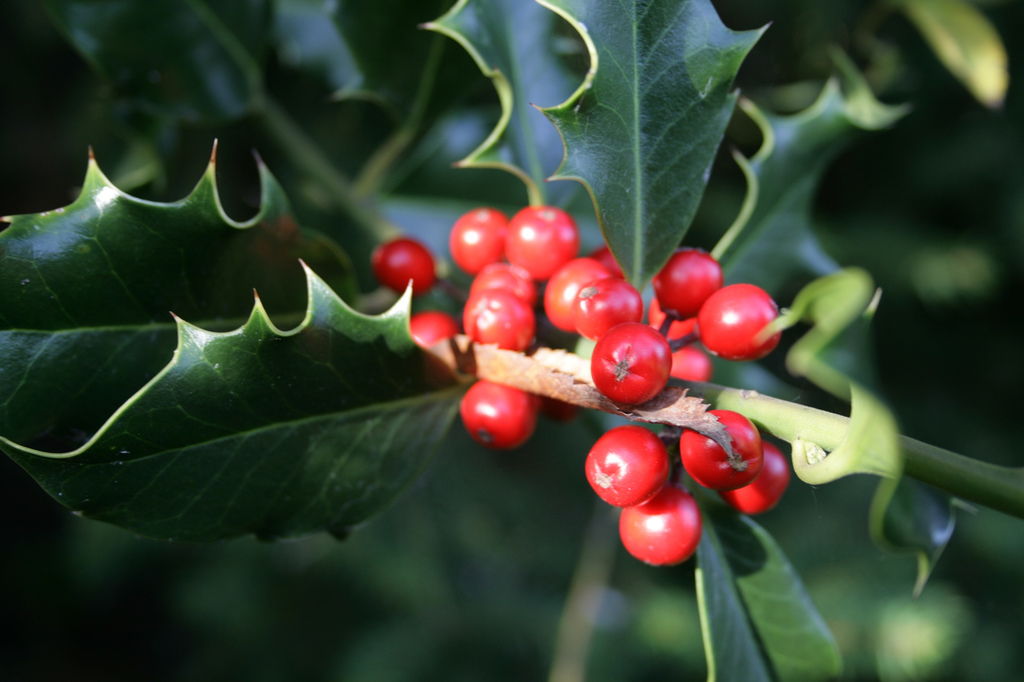
The American Holly is considered one of the most popular trees in the world. Due to extensive cultivation of the American Holly by nurseryman and gardeners alike, there are currently over 1000 different cultivars, with more being patented every year (Holly Society of America).
The tree is ridiculously tough. The American Holly is widely known as the hardiest broadleaf evergreen. Native specimens found throughout the Appalachian Mountains have been found to withstand temperatures of -10°F, while cultivated varieties have been naturalized in Ohio down to -20°F. The tree is also not picky in terms of soil requirements. American Holly will grow in nearly all soils. This fact is evident given that its native range extends from Massachusetts to Florida to Texas. American Hollies grow on mountain tops, in river valleys, on flood plains, and along coastlines. This range of habitats and conditions means the American Holly does not take great risks in its habit of growth. The tree has a slow to medium growth rate.
The tree also reproduces the “old fashioned way;” male and female flowers are produced on separate plants (dioecious reproduction). A male pollenizer must be nearby in order to produce the beautiful red berries we are all familiar with on female trees.
Throughout history, the appeal of bright red berries and lustrous evergreen leaves drove the popularity of the English Holly. From the Roman and Druid winter solstice traditions to the eventual European Christian traditions, the symbolism and colorful nature of the evergreen holly in the dead of winter was constant. It is little wonder that when the European colonists landed in the New World, they brought their love of holly among their many traditions.
Prior to their arrival, American Holly leaves had been used by Native Americans to make tea to treat cough, and berries had been used to make buttons. But Europeans brought demand for American Holly to a whole new level. They recognized American Holly as an obvious substitute for their English holly (Ilex aquifolium) holiday traditions, and decorative and landscape usage soon exploded. Today the popularity of the American Holly is as strong as ever.
 Sew Colorful
Clint Eastwood and his Norton Commando on the set of “Kelly’s Heroes“
Running before the dust storm
Never park your classic under a pine tree
Might not be so cuddly when it grows up
LikeLiked by 1 person
Good night, Pat! Hope your banana run went well.
LikeLiked by 1 person
Good Night Filly!
it poured–the streams are high here, but we made it thru.
LikeLiked by 1 person
Good Night All!
LikeLike