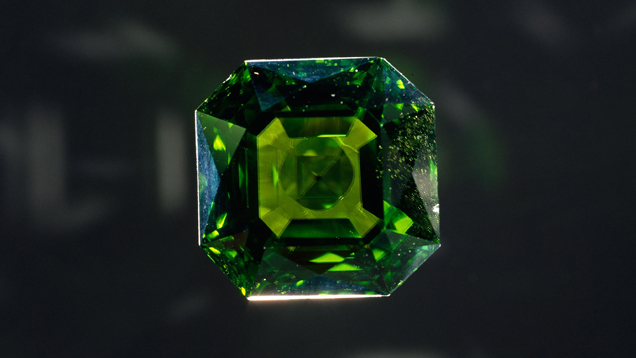
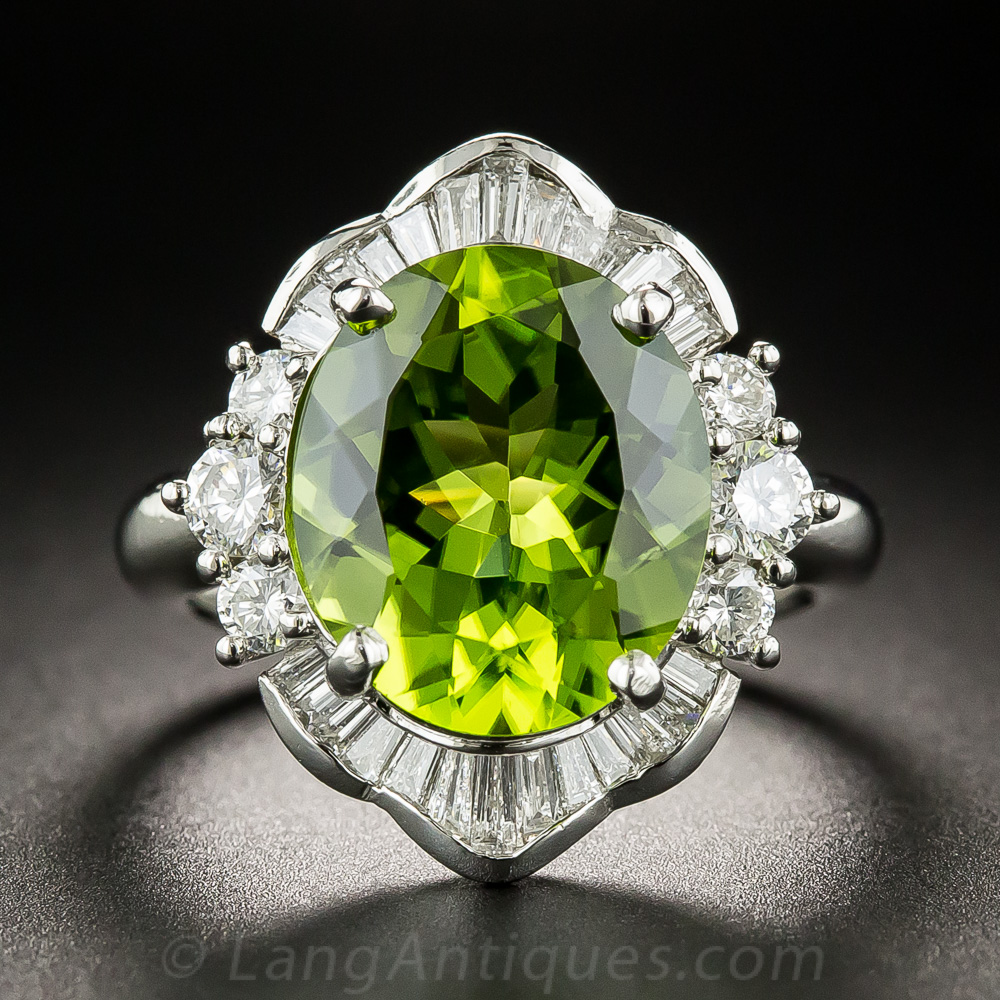
Peridot has always been associated with light. In fact, the Egyptians called it the “gem of the sun.” Some believed that it protected its owner from “terrors of the night,” especially when it was set in gold. Others strung the gems on donkey hair and tied them around their left arms to ward off evil spirits.
The word peridot comes from the Arabic “faridat,” which means “gem.” Most peridot formed deep inside the earth and was delivered to the surface by volcanoes. Some also came to earth in meteorites, but this extraterrestrial peridot is extremely rare, and not likely to be seen in a retail jewelry store.
Early records indicate that the ancient Egyptians mined a beautiful green gem on an island in the Red Sea called Topazios, now known as St. John’s Island or Zabargad. Legend has it that the island was infested with snakes, making mining unpleasant until an enterprising pharaoh drove them into the sea. From the earliest times, people confused this stone—now known to be peridot—with other gems. It was one of many labeled as “topaz.”
Some historians believe that Cleopatra’s famous emerald collection might actually have been peridot. People in medieval times continued to confuse peridot with emerald. For centuries, people believed the fabulous 200-ct. gems adorning the shrine of the Three Holy Kings in Germany’s Cologne Cathedral were emeralds. They are, in fact, peridots.
Today is National Middle Child Day and because I’m a middle child (older sibling was the favorite, younger sibling is the anointed one and I am the spare) I thought I’d explore what webmd says about Middle-Child Syndrome. (I’ve added comments where appropriate because, after all, I have experience in this area…lol)
Let’s begin, shall we?
What to Know About Middle-Child Syndrome
If a couple has two children and a third on the way, will the birth of their third child affect the personality of the second-born? Some psychologists think so. Here’s what to know about “middle-child syndrome.”
What Is Middle-Child Syndrome?
Many experts who study personality believe that your family’s birth order plays a role in your development. They see “middle-child syndrome” as the idea that if you’re neither the oldest child nor the youngest, you get less attention from your parents and feel “caught in the middle”.
As a result, you may take on certain personality traits that are different from those of your older and younger siblings.
Can Birth Order Affect Personality?
Middle-child syndrome is part of the psychology behind birth order. Birth order ranges from firstborn, or oldest; to second-born, third-born, and so forth; to youngest, sometimes called the last born. Though many experts think birth order is important to personality and family structure, not everyone is on board. [Okay, do they pay these people to write about this? REALLY? I can figure out birth order…1,2,3]
A psychology pioneer named Alfred Adler introduced the idea that birth order affects the development of a child. He believed that how many siblings a child has can affect the child’s potential.
Adler thought that even though children grew up in the same household, their personalities wouldn’t be the same. He said that each child should be looked at as an individual and that each child would differ based on their order of succession. [Succession? Is this a family or a royal family?]
Still, middle-child syndrome isn’t recognized as an official condition. Many researchers have disagreed with Adler’s theories.
Even researchers who believe in that middle-child syndrome have trouble applying it to all middle children. For example, they find that there may be a relationship between birth order and being outgoing. But it is more likely to be true for males than for females.
Characteristics of a Middle Child
Do you, or does someone you know, have middle-child syndrome? Think about whether you know any middle children with these personality traits:
Rebellious. They’re also less religious than their siblings and parents. Still, they’re less likely to act out against their parents. [Middle child here—I am the most religious of all the siblings.]
Sociable. They’re good at being mediators and want fairness in situations. They’re also trustworthy friends and work well as team members. [Okay, they got one right.]
Not as family-oriented as their siblings. They may have a stronger sense of not belonging than their siblings do. So, even though many can be great when working in groups, some middle children can struggle when working with others. [Covering all the bases I see…LOL]
Feeling overshadowed. They come to believe that their parents don’t care about them. Looking back as adults, they express a negative view of childhood. [When you’re not the favorite or the anointed one, you do the math.]
Mobile. They’re often the first sibling to move out of the house. They’re also more likely to move the farthest away. This stems from their feeling misunderstood by their families. [I did move the farthest away– to get away from the drama.]
Not perfectionists. Still, they tend to take up something that an older sibling isn’t so great at. For example, if the older sibling is a scholar, the second-born may focus on athletics. [None of us was athletic, but I am the only one to graduate summa cum laude –or at all—from college.]
Outstanding Qualities of Middle Children
Despite how you may see yourself as the middle child, you will learn how to act, make friends, and come into your own by watching your siblings or peers. But it seems that your status also can drive you to excel. This may come from feeling second-best compared with your older or younger siblings.
Some well-known middle children have been or continue to be great negotiators, trailblazers, and fighters for justice. Among them are Nelson Mandela, Martin Luther King Jr., Susan B. Anthony, Charles Darwin, Madonna, Bill Gates, and Nabisco CEO Michael Gerstner. These middle children used their personality traits to help them gain success. [CRAP…Bill Gates?]
As a middle child, you may not be a perfectionist, but you may be more open to taking risks and to new ideas. In studies, 85% of middle children showed such openness, compared with 50% of firstborns.
You may be more skilled at persuasiveness and debate. You probably can see more than one side of an argument, which makes you empathetic. Some middle children claim that their success is due in part to their ability to compromise.
If middle-child syndrome is real, it might be the middle child’s sense of their own uniqueness that has led to many discoveries, important theories, and social movements.
SOURCE: webmd
[Pat’s Note: Too many ifs, maybes, and mights in there for me to take seriously. And the whole “succession” thing takes sibling rivalry to a whole other level. We are who we are in my opinion, but then I’m not profiting from my opinions either…lol]
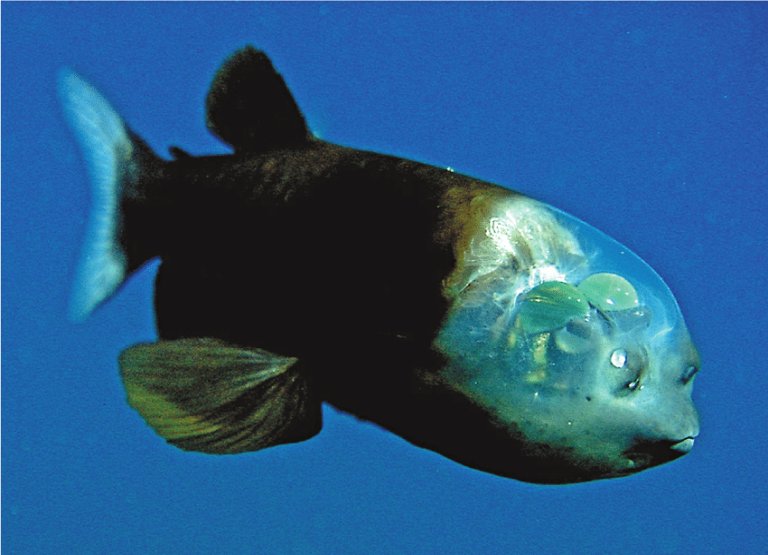
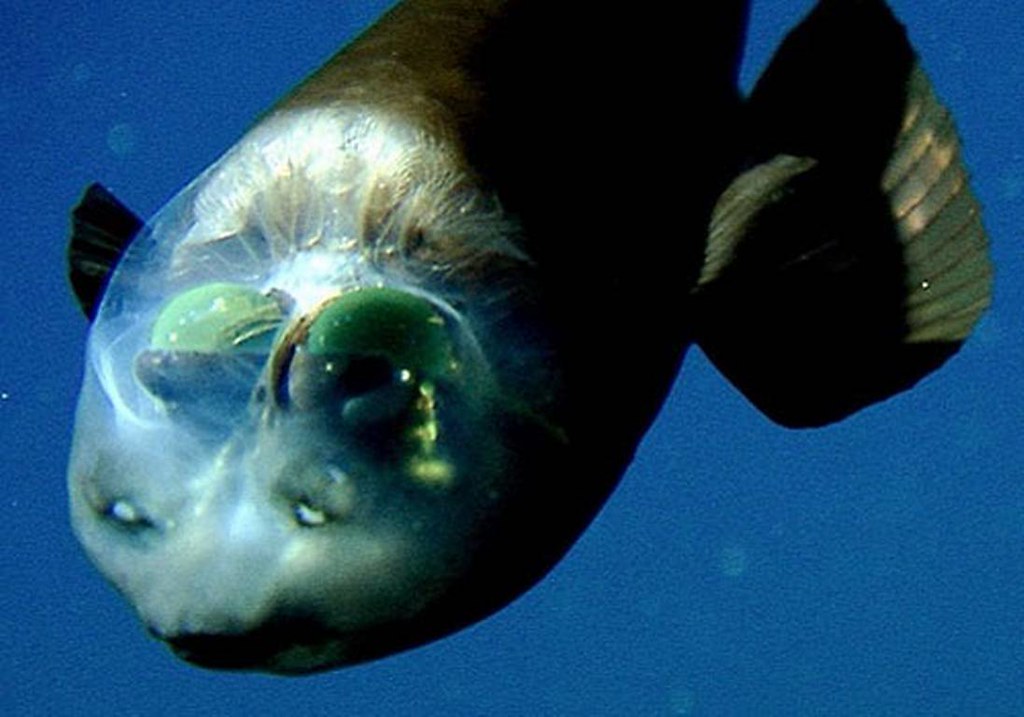
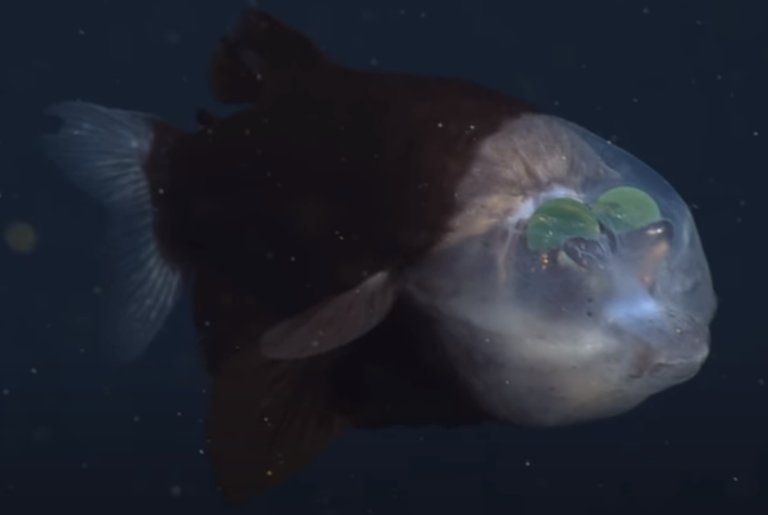
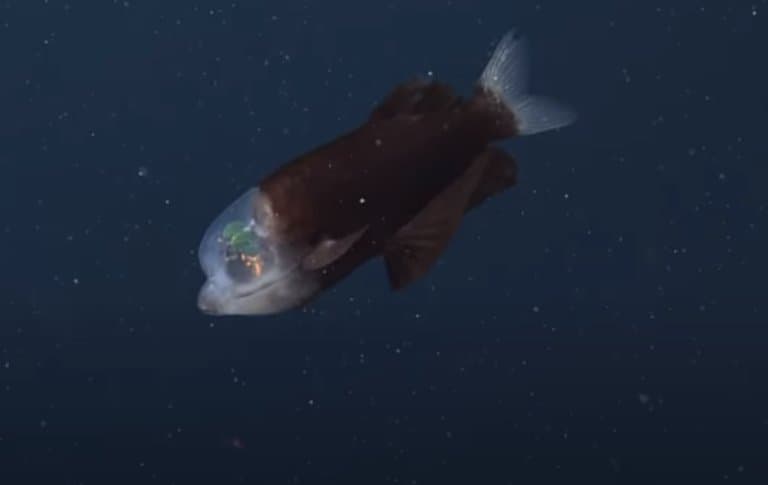
The barreleye (Macropinna microstoma) is a small deep-sea fish with a dome-shaped transparent head that contains glowing green eyes.
This family of fish has been found in the Bering Sea and off the coast of Baja California, but there have only been a handful of sightings. There is still much to learn about these fascinating organisms.
Named for the shape of its eyes, the barreleye’s eyes are contained within its see-through headpiece.
Barreleyes can refer to any fish in the family ‘Opisthoproctidae’, who all have barrel-shaped heads, with tubular eyes. There are 9 genera in the family and over 20 species.
Macropinna is a genus of Opisthoproctidae, which contains one species, Macropinna microstoma.
During the small number of times these fish have been found, they are seen moving slowly through the dark waters—patrolling for signs of prey above them. Living thousands of feet below the surface, little is known about their natural predators and their reproductive patterns. Due to a lack of data and research, the IUCN has yet to classify them. Their absolute numbers are also unknown. Even so, it is important to remember that our actions on the ocean surface can have lasting impacts on the deep sea and its animals.
They have transparent heads that are fluid-filled
Their alien-like heads are made up of a transparent shield and fluid that protects the fish’s eyes. Through the transparent dome, you can see their eyes, brain and nerve endings in their head! This shield is extremely fragile and has often been reported to be damaged in research when the animal is brought up from the deep.
Their eyes can rotate
Two green glowing orbs can be seen within the transparent head. Normally, these eyes point upwards to capture as much light as possible, but barreleyes are capable of rotating these eyes forward when searching for prey.
They have ‘nostrils’
The two dark spots above the fish’s mouth were originally mistaken for eyes. They are actually olfactory organs that are the equivalent of nostrils.
The barreleye fish was recently discovered
The barreleye was first described in 1939. Due to it inhabiting such deep depths, it has been difficult for marine biologists to thoroughly study it since then.
They have very narrow mouths
Barreleye’s have small pointed mouths that have to be precisely directed towards its prey. This is one of the reasons why its eyes are capable of rotating forwards—so that it can plan coordinated strikes.
Their eyes are tubular
Many deep-sea animals possess tubular eyes that help them capture light. These types of eyes are generally located dorsally on the animal, are cylindrical, and have an accessory retina. The green globes seen in barreleyes are large lenses that help to focus light onto their retinas which contain a high density of rod cells.
Barreleyes are colorblind
Their eyes do not possess and cone cells which are used for the perception of color. Where they live, it is so dark that these fish are solely focused on recognizing brightness and differentiating light that is coming from above or from potential prey.
Their fins allow them to hover
Barreleye fins are large and flat which allow them to essentially remain motionless underwater. Using exact movements, these fins steer them around as the barreleye looks upwards.
They might steal food from others
At the deep-sea depths that barreleyes inhabit, siphonophores—a group of jellyfish—are also found. They can grow to over 10 meters long and catch prey in their stinging tentacles. It has been suggested that barreleyes sneakily consume organisms that have been entangled within the arms of siphonophores. Their see-through shield protects their eyes from being damaged by any stinging appendages.
They live in the twilight zone
Barreleyes live in the ocean twilight zone—the layer of water that is 650 to 3300 feet below the surface. It surrounds our planet and is deep enough that it lies just beyond the reaches of sunlight.
Their digestive systems are quite large
Based on preliminary findings, it has been found that barreleyes have lengthy digestive systems capable of breaking down various types of prey.
We know little about their reproduction
Barreleyes are believed to reproduce by pelagic spawning, a process in which eggs and sperm are released into the water. Following fertilization, the eggs are carried along by currents.
Barreleyes are extremely elusive and rare
These mysterious creatures are rarely sighted. In fact, in approximately 5600 dives, researchers with the Monterey Bay Aquarium have only spotted these fish nine times.
Today’s offering is not a baked cookie at all! It does require a couple of minutes cooking on the stove, but that’s it…no baking! From the Pioneer Woman’s website…No-Bake Chocolate Oatmeal Cookies.
No-Bake Chocolate Oatmeal Cookies
Ingredients
2 cups firmly packed light brown sugar
1 stick butter
1/2 cup whole milk
2 tbsp. unsweetened cocoa powder
2 1/2 cups old-fashioned oats (quick oats works too!)
1/2 cup sweetened flaked coconut, plus more for garnish*
1/2 cup creamy peanut butter
1/2 cup chocolate-hazelnut spread (such as Nutella)**
1 tbsp. vanilla extract
1 tsp. salt
*Not a fan of coconut? Stir in half a cup of chopped pecans, pistachios, or cashews for a nice nutty crunch.
**If you don’t have Nutella on hand, you can add more peanut butter.
Directions
Line two rimmed baking sheets with parchment or wax paper, and set aside.
Bring the sugar, butter, milk, and cocoa powder to a rolling boil in a medium saucepan over medium-high heat. Let boil for 1 to 2 minutes, stirring often, until mixture measures 230° on an instant read thermometer. Remove from the heat.
Stir in the oats, coconut, peanut butter, chocolate-hazelnut spread, vanilla, and salt until everything is combined.
Working quickly before the mixture sets up, drop tablespoons of the mixture onto the prepared pans, flattening slightly, if you like. Immediately sprinkle with more coconut; press gently to help the coconut stick to the cookies. Let stand at room temperature until firm, about 30 minutes. Store in an airtight container in a cool, dry place for up to 1 week—if they last that long!
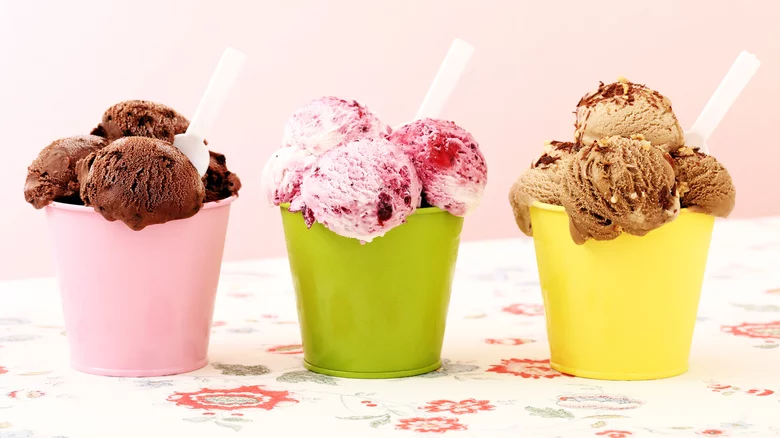
Today’s post concludes the 20 strangest ice cream flavors I ever heard of!
Honey Jalapeño Pickle
Pickle-lovers and pregnant people everywhere can rejoice because Sweet Action Ice Cream in Denver, Colorado, made the flavor mash-up just for you. In collaboration with The Real Dill pickle company based out of Denver, the brands made a Honey Jalapeño Pickle ice cream loaded with honey, jalapeño peppers, and pickles. It’s sweet, savory, and spicy all in one. As was made abundantly clear by the anchors at local news station 9NEWS who tried the flavor, this ice cream is not for the faint of heart.
What’s more, it might leave you with some acid reflux after you eat it, but if you’re into spicy and salty, it’s totally worth it. Pickle ice cream might not sound great, but these two brands clearly are experts in both their respective cuisines. If you were going to try them out together, it only seems fitting that it would be this thoughtfully-crafted sundae rather than trying to create your own version at home.
Garlic
Garlic is one of those ingredients that makes everything taste better, but loves to linger on your breath or your fingers if you chop up a bunch of it. The stinky ingredient is a staple at The Stinking Rose, a restaurant in San Francisco known for making everything with garlic. The brand’s motto is that they “season their garlic with food,” which translates to their dessert offerings. The star of the final course is Gilroy’s Famous Garlic Ice Cream topped with chocolate sauce, their nod to the garlic capital of the world, Gilroy, California.
It is another flavor that will almost certainly leave you with savory stinky breath after, but it’s also another shockingly delicious combination that you might have not expected. It doesn’t feature an overpowering amount of garlic, but it is enough in the mix so that the taste is present throughout. Garlic lovers must put the restaurant on their bucket list and it’d be a shame to make the trip and not try this one-of-a-kind frozen treat. “Stay away if you have a child’s taste buds,” one customer joked in a Yelp review about the frozen treat.
Flamin’ Hot Cheetos
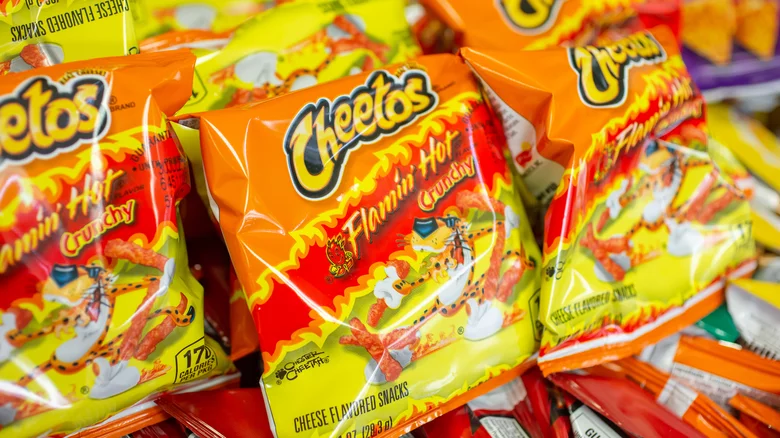
Loblolly Creamery in Little Rock, Arkansas, took one of the internet’s favorite snack foods and turned it into ice cream. To create Flamin’ Hot Cheetos ice cream, Loblolly takes their sweet cream base and mixes in Flamin’ Hot Cheeto powder for that signature kick. The brand even whipped up some Hot Cheetos cones and sprinkles to make this treat even more Instagram-worthy. it’s not always on the menu so it’s a must-order whenever the brand decides to whip up a batch. (Many of Loblolly Creamery’s other flavors — like Strawberry Buttermilk or Little Rocket Pop Sorbet — are solid options as well if Cheetos aren’t your thing.) Luckily, it won’t be as hot as the Cold Sweat flavor, but it still has quite the kick for a treat that’s typically supposed to cool you down. Next time, maybe the brand will try to add a kick of acid by making a flavor based on Flamin’ Hot Cheetos Limon if they’re feeling wild.
Oyster
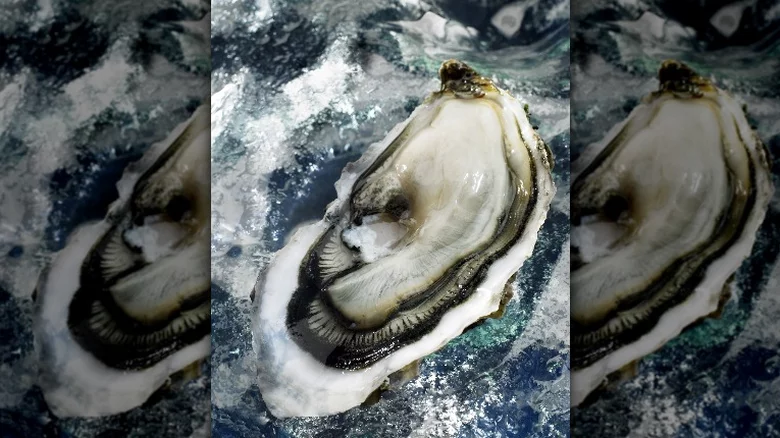
Namjatown is a destination in Tokyo for foodies and beyond. It’s an indoor theme park that’s anything but ordinary, and the largest in the entire country of Japan. Alongside some unusual attractions, there are two food-themes areas of the park: Namja Gyoza Stadium, where you can get all sorts of dumplings, and Dessert Alley, which features some of the wildest ice cream flavors known to man, per Go Tokyo. One of the notable flavors is oyster gelato, which uses the mollusk to create a briny, frosty treat. As SoraNews24 wrote in their review, “While the smell is milder than you might expect, there is still a definite shellfish scent due to the chunks of actual oyster mixed into it.”
It’s interesting to see how the flavor was captured in some seemingly nondescript churned ice cream, so it’s worth the stop if you’re so inclined to see what it tastes like. If not, it’s still fun to walk through the dessert section and look in awe at all of the wacky flavors that you truly won’t find anywhere else.
Crawfish
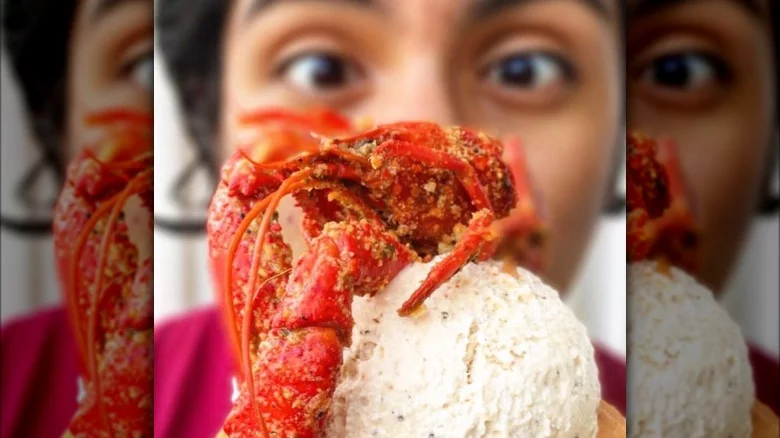
If you’re based in the U.S. and have a hankering for some seafood-inspired ice cream, Red Circle Ice Cream in Houston might have just what you need. The brand is known for their over-the-top dessert creations including monster milkshakes, bubble waffles, donuts, and churros alongside their ice cream offerings. Sometimes, for a limited time only, Red Circle likes to serve up a real Southern treat: crawfish ice cream. This isn’t just regular old ice cream with a crawfish on top for dramatic effect. The flavor of the little crustacean is present throughout the cone. It’s bursting with flavors of butter, garlic, and cajun spice that’s ubiquitous with eating cajun crawfish, just with a total sugary twist.
It’s worth purchasing just to freak your friends out on social media with pictures of a cone with eyes, but die-hard fans also claim it’s a sleeper hit. Again, it’s not going to be everyone’s bag — and that’s okay. As Nickey Ngo of Red Circle Ice Cream acknowledged when she stopped by local affiliate FOX26 with a pint, the flavor is beyond bold.
Nacho Nacho
If you’ve ever eaten a plate of nachos and though “Wow, I wish I could be experiencing all of these flavors on an ice cream cone,” Rococo Artisan Ice Cream has you covered. The brand’s Nacho Nacho ice cream is everything you love about the appetizer in one. It features tortilla chips, nacho cheese, spicy tomato jam, chopped black olives, and candied jalapeños. The flavor was the result of a nationwide contest submission where a customer was inspired by a meal where they ate nachos at a local Mexican restaurant in Kennebunkport, Maine, and then got dessert at Rococo’s after.
Originally, the flavor was named Luke’s Nachos Grande, as the person who submitted the idea named it after their son. Luckily, if you’re intrigued by this flavor but aren’t in New England, Rococo’s ships pints nationwide for you to enjoy the original flavor wherever you are.
Beef tongue
Namjatown in Tokyo has such strange ice cream flavors that it landed two spots on the list. Sure, the menu (via Appetite for Japan) features more approachable flavors like vanilla and rum raisin. However, the list also features flavors like shark fin noodle ice cream, crab-flavored ice cream, and grilled eggplant. One of the oddest on the list that only the bravest eaters would dare to order is beef tongue ice cream. A scoop is supposed to channel the flavor of not just beef, but the gelatinous tongue cut that isn’t as common in the U.S. as steak or hamburgers. Regardless of the absurdity, a trip to Namjatown should include an order of some of the most ridiculous scoops on the menu. Whether or not that includes the beef tongue flavor or something more simple like orange sherbet is totally up to personal preference, but the former is a flavor you probably won’t find literally anywhere else, especially not on your neighborhood ice cream truck. Yellowfin tuna ceviche with basil and avocado ice cream
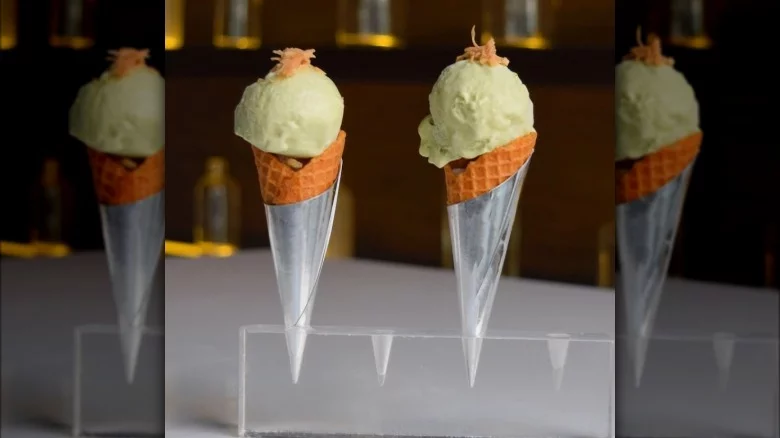
One of the fanciest ice cream creations on the list comes from SoBou NOLA, a Creole saloon in New Orleans with one-of-a-kind plates. This ice cream dish actually is served as an appetizer rather than a dessert. It starts with an ice cream cone which is filled with yellowfin tuna and pineapple ceviche. Then, a scoop of basil and avocado ice cream goes on top. It’s an explosion of flavors that also serves as a visual feast and is the unlikely mashup of ice cream and raw fish that you didn’t know you needed. “You can’t go into just any restaurant and get mini cones with tuna and avocado ice cream,” chef Juan Carlos Gonzalez, who created the dish, said to Nation’s Restaurant News. The best part is that this starter dish is only the beginning of your meal at SoBou, which is quite the way to set the tone for a meal.
Famous Idaho Ice Cream Potato
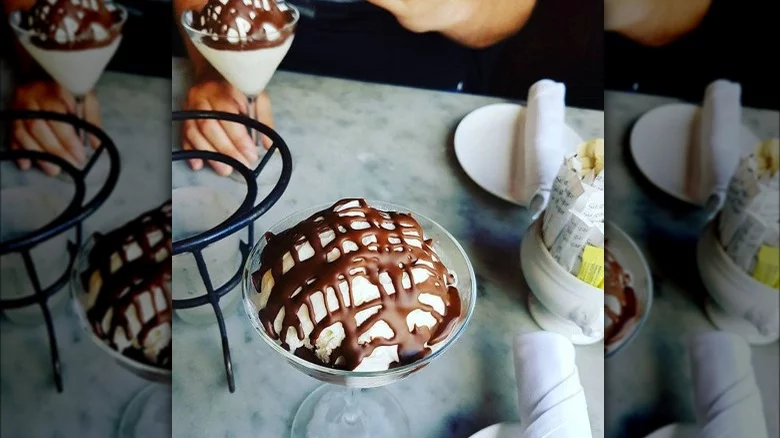
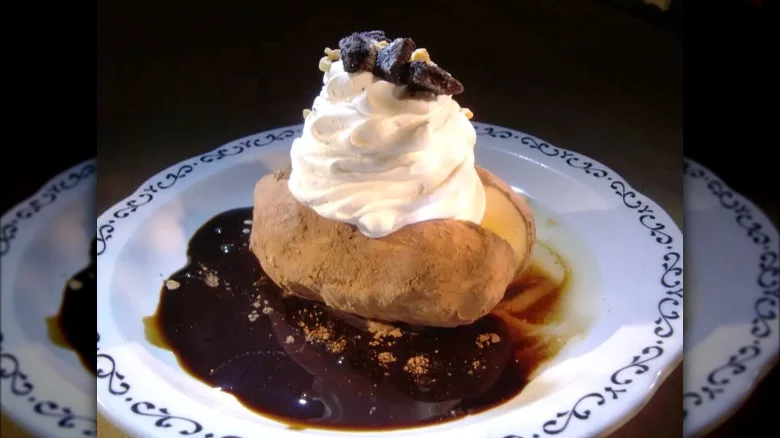
If you find yourself in Idaho with time to kill, the only appropriate way to spend it is to speed through the Westside Drive-In and eat the Famous Idaho Ice Cream Potato. It’s a treat that will only set you back $5 and will give you a lifetime of bragging rights. Don’t worry, this dish is all about deceiving the eyes. It looks like a real baked potato, but the base of the dish is actually a scoop of vanilla ice cream covered in cocoa powder to give it the look of tater skin. It is topped with whipped cream “sour cream” and “dirt” made out of Oreos, nuts, and chocolate. Westside Drive-In has been an Idaho institution since the ’50s and chef Lou Aaron has apparently spent 40 years tweaking the recipe and perfecting the potato-inspired dessert. The Instagram photos alone make it worth the few bucks, but on top of that? You get to enjoy the establishment’s authentic ’50s dining experience.
Spicy Peanut Butter Curry Coconut
Sebastian Joe’s Ice Cream in Minneapolis, Minnesota, is one of those shops meant for foodies to walk in and be in awe. The ice cream makers understand the importance of balancing flavors and expanding the customer’s ideas of what ice cream can be. One must-try is the brand’s limited-edition Spicy Peanut Butter Curry Coconut ice cream. It’s sweet, tropical, nutty, spicy, and aromatic, essentially checking all of the boxes and touching almost every flavor that your tastebuds can recognize. It almost sounds like a dish you might eat at a restaurant that serves Indian or Thai food, but it is a frozen treat created in Middle America. Sebastian Joe’s also serves up their scoops in wild cones, shakes, sundaes, and ice cream sandwiches, so you can really get creative with this spicy flavor — or any of the other unique pints they’ve got at the shop.
SOURCE: mashed.com
So…what’s the verdict? Wanna try any of these??? Plain Jane here will stick with vanilla…or if I’m feeling adventurous, a TWIST!
Who doesn’t like ice cream? Especially on a hot August day! Well, mashed.com has a list of 20 of the strangest ice cream flavors ever! Today’s post brings you the first ten…tomorrow the other ten. These are BIZARRE in my opinion, but I’d love to hear if there’s ANY that you would try!
Everything Bagel
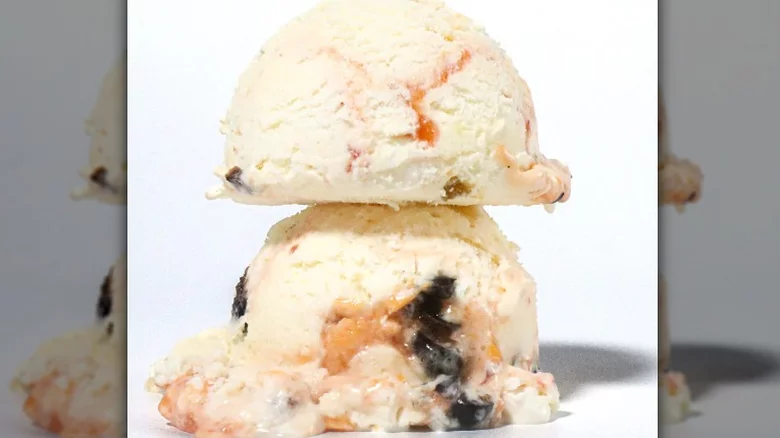
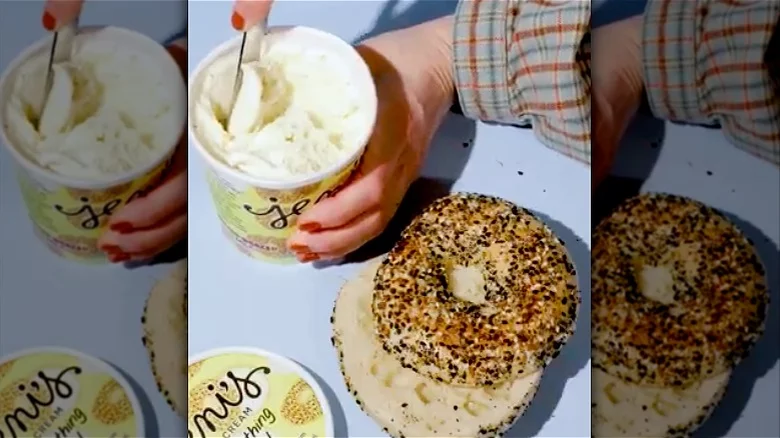
Jeni’s Splendid Ice Cream from Ohio essentially broke the internet when they first debuted their pint of Everything Bagel ice cream. Jeni’s starts with a cream cheese ice cream base that’s a tangy staple in some of the other brand’s flavors. Things get truly unhinged from there. The ice cream then includes a swirl of what Jeni’s refers to as “everything gravel.” Basically, it’s a savory strudel featuring sesame seeds, poppy seeds, and garlic and onion bits. It’s the ingredient really responsible for reinforcing the bagel flavor and the pleasant savory element to offset the sweet. Without the cream cheese base, this might be one of those flavors you try one scoop of and move on from. However, Jeni’s somehow made this a flavor that you’ll weirdly find yourself wanting to return to. If anyone can do it, it’s the ice cream crafters at Jeni’s, so don’t question their genius.
Foie Gras
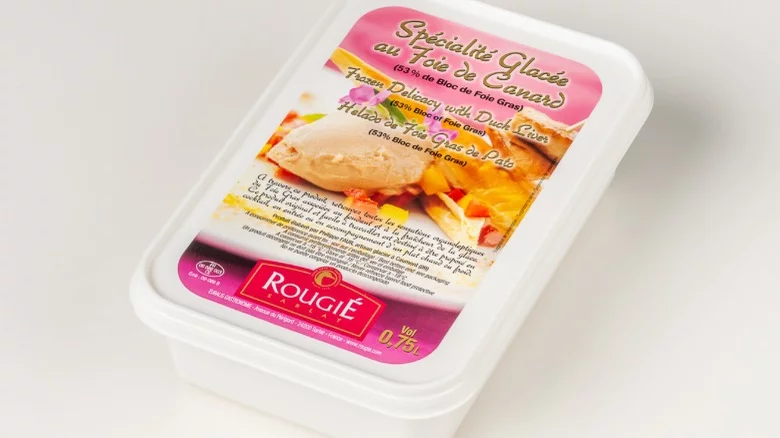
Philippe Faur is a French ice cream manufacturing company that has a list of flavors that reads like a generic index of a food encyclopedia. The brand literally seems to make any and every flavor they can come up with, whether customers asked for it or not. Their savory flavors roster, for example, includes ice cream bases rooted in flavors like caviar, mustard, truffle, and more.
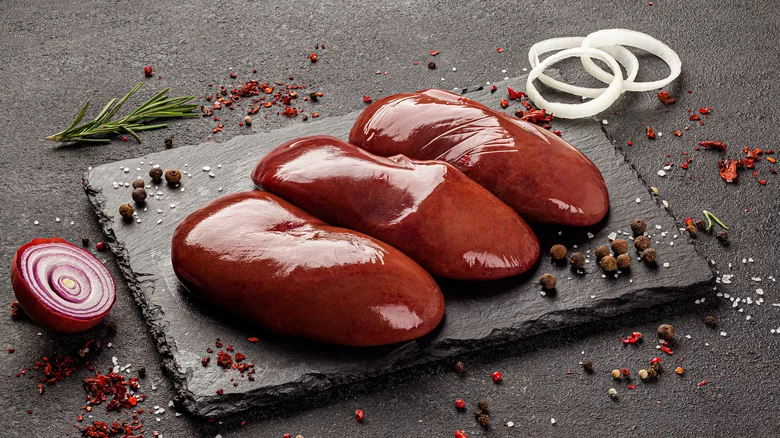
Hands-down the most unusual flavor on the list is foie gras, which is pâté made by the liver of gavage-fattened ducks or geese. It’s a controversial dish that’s a delicacy in France and beyond, but it’s truly hard to imagine how the flavor would translate as a dessert. It would make sense to use foie gras ice cream as the topper of an appetizer at a fancy restaurant to add texture and depth. However, it’s hard to imagine that anyone digs into a pint of this with a spoon to soothe their sorrows after a break-up considering the flavor is quite an acquired taste.
Deviled Egg Custard with Smoked Black Tea
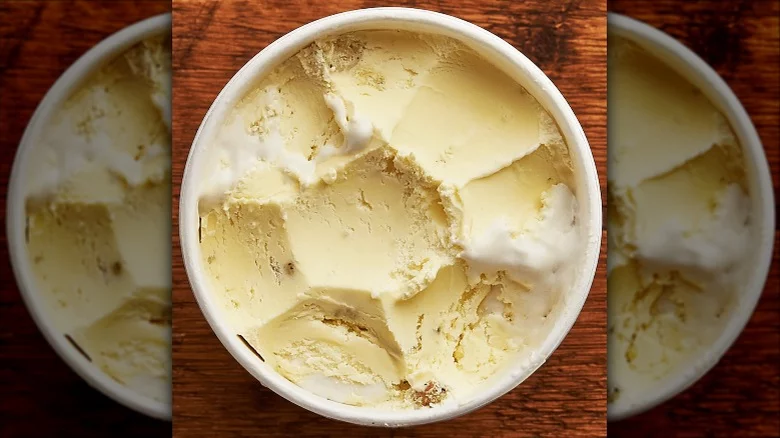
Salt & Straw Ice Cream is a popular ice cream chain with most of its locations on the West Coast, and an ever-rotating menu of strange and never-before-seen flavors. For summer 2022, the brand debuted a truly inventive flavor with the Deviled Egg Custard with Smoked Black Tea ice cream. The flavor features egg yolk custard mixed with Kala Namak, a black salt from the Himalayan Mountains, and smoked tea-infused shortbread. It’s topped off with a balsamic egg white marshmallow fluff which reinforces the “deviled” egg flavor.
It’s an ice cream for foodies, not necessarily picky eaters. Keep an open mind and prepare to be pleasantly surprised by the explosions going on in this pint. Every bite reveals a different layer of intensity. If you find yourself in Oregon, California, Washington, or parts of Florida, it might be worth it to make an ice cream road trip for this flavor and dozens of others.
Wasabi
Wasabi is best known for being the bright-green condiment served alongside sushi that is spicy enough to clear out your sinuses. The entire ingredient is like the antithesis of ice cream, but il Laboratorio del Gelato in the Greater New York City area took it as a challenge. The company creates so many gelato flavors that use simple ingredients perfectly executed, like mascarpone cheese or pink peppercorn.
The same goes for the company’s smooth and creamy wasabi gelato that has a slight kick. The folks at il Laboratorio del Gelato take the Japanese root that’s grated into a green paste and slightly infuse it with their base ice cream blend. The company compares the flavor to horseradish or hot mustard, but it’s pretty distinct all on its own. Again, it’s simple yet so innovative and wasabi is probably not a flavor you’re likely to see be made into a Ben & Jerry’s pint anytime soon.
Coffee Garlic Herb Almond Chip
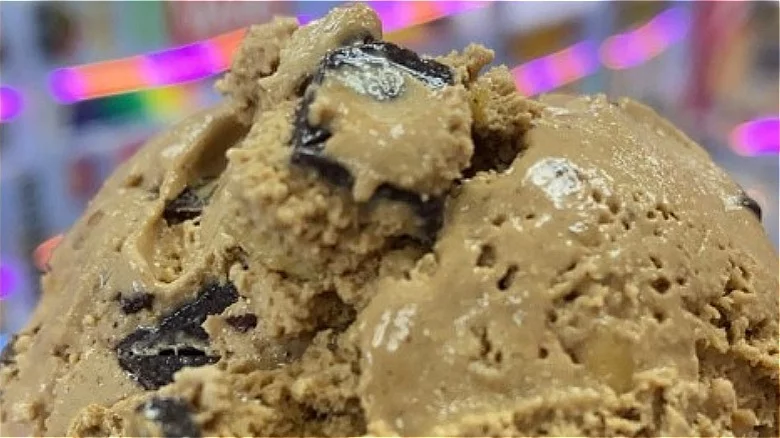
Okay, so we know that coffee and chocolate ice cream is a pretty standard flavor in the U.S. and beyond. You want to add almond chips to it? That sounds like a great combination as well. But Max and Mina’s awe-inspiring ice cream shop in Queens, New York, decided to take it a step further by creating a flavor called Coffee Garlic Herb Almond Chip.
Max and Mina’s is a famous shop that should be on every ice cream lover’s bucket list, whether they are experimental with their orders or not. However, this flavor that united bitter coffee with sweet chocolate and herbaceous garlic is another combination that has to be tasted to understand fully. It’s probably not the best scoop to order on date night though, because it’s probably one of the few ice creams on the planet that will leave you with garlic breath after the fact.
Mountain Dew and Doritos
Sparky’s Homemade Ice Cream in Columbia, Missouri, should be a stop for anyone looking to pursue as many weird ice cream flavors they can get their hands on. Sparky’s is notorious for their concoctions; as Columbia Missourian notes, they may be best known for the time they thought to use the carcasses of cicada bugs in an ice cream. Cicada likely won’t be making a reappearance on their menu anytime soon (probably for the best), but Sparky’s will never stop making ice cream that’s as intriguing as it sometimes is off-putting.
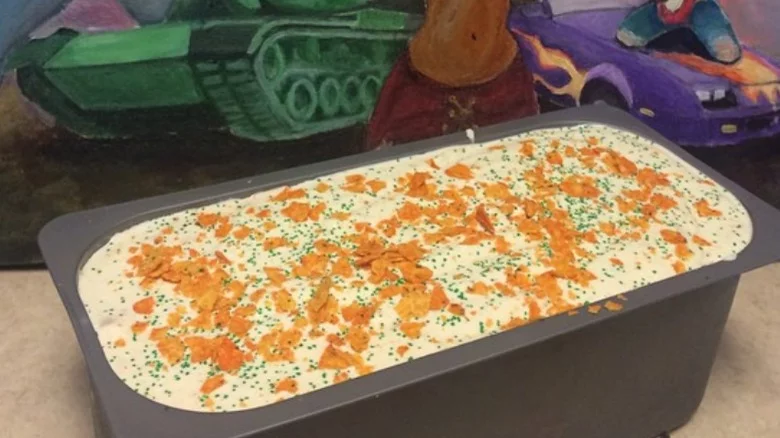
One time the folks at the scoop shop decided to take the classic gaming snack duo of Mountain Dew and Doritos and blend them together in one ice cream. The photo on the company’s Instagram page shows that the finished product looks like what you might doodle up if someone asked you to draw Mountain Dew and Doritos ice cream — topped with green sprinkles and Dorito crumbles. It’s not for everyone, but definitely a flavor to take at least one bite of just to say that you did.
Margherita pizza
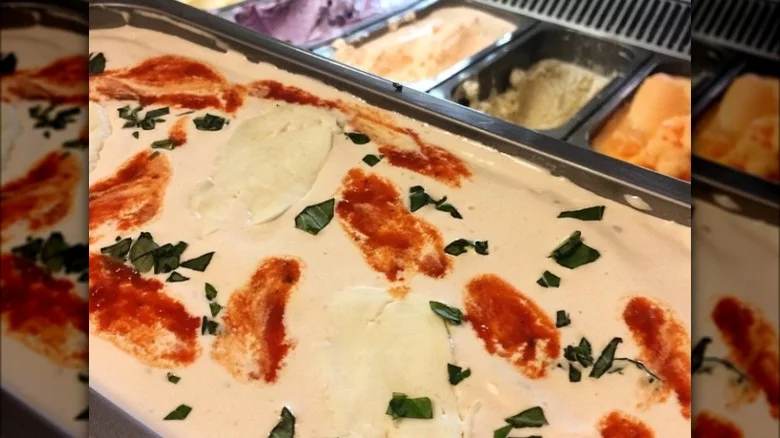
Sparky’s didn’t stop at junk food snack-inspired ice cream. It’s worth following the shop’s Instagram page whether or not you’re in the Columbia area just to see what creations they come up with. You may stumble upon flavors like Margherita pizza, which is packed with tomato sauce, mozzarella cheese, and basil. Yes, we are still talking about ice cream. Sure, tomato and basil sorbet has been done and tried before, and it’s still pretty special. But this ice cream is literally the dessert version of the iconic pizza pie.
It’s pretty genius that someone even thought of this flavor combination in the first place, let alone that the shop executed the idea and sold it to daring customers. It’s likely that this is one of those flavors you try once and never return to again, but it’s definitely a flavor to brag about having that likely no one else you encounter will have also tried before.
Kraft Macaroni & Cheese
Van Leeuwen Ice Cream did the unthinkable when they unveiled ice cream pints inspired by flavors of Kraft Macaroni & Cheese. The ingredients are relatively simple — it’s literally ice cream with Kraft cheese powder sauce mixed into it. It’s another option that’s an acquired taste and there’s a chance you won’t put it in your regular rotation, but it’s fun for the novelty of it. Who knows, sweet and salty combinations are always the sleeper hits.
Van Leeuwen’s Kraft Macaroni & Cheese pint could be a good way for someone to indulge their junk food cravings for both ice cream and cheesy snacks at the same time. If not, it’s still a fun pint to purchase one time and try for the fun of it. u/KingKonah wrote in the ice cream subReddit page that the combination of flavors is so weird that it works. “It’s dairy on top of dairy and neither takes away from the other,” they shared.
Cold Sweat
At Sunni Sky’s Homemade Ice Cream, they have a flavor that’s so out of this world, you have to sign a waiver to even order it. The ice cream is loaded with different peppers and hot sauce for a cool treat that will have you chugging water after just one lick. It’s a buzz-worthy treat that has the bravest ice cream aficionados traveling to Angier, North Carolina, and has been featured on the Food Network and the Travel Channel. Sunni Sky’s makes another spicy flavor called Exit Wound that also requires a waiver, but you would have to be extremely daring to attempt to sample both scoops at the shop (and sign two waivers in order to do so).
Some reviews on Yelp compared the flavor of Cold Sweat ice cream to a spicy Indian pickle. “Managed to eat 3 small pinches. True to its name, it was super spicy,” one Yelp review reads. Sunni Sky’s sells more than 100 flavors at their shop, so there are plenty of options to eat after to cool down your tongue after a bite of cold sweat.
Sesame gelato with miso caramel, cookies, and ramen
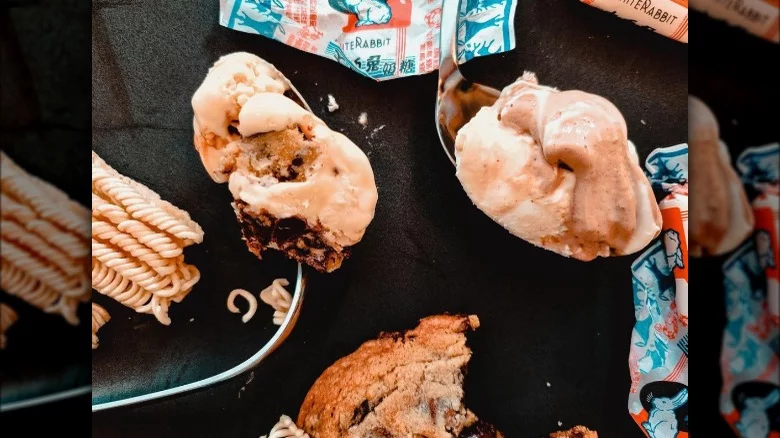
Chicago’s Black Dog Gelato is a must for those obsessed with ice cream. In fact, even if you’re far away from the Windy City, the shop offers a pint club so you can sample all of the innovative flavors they have to offer. Black Dog Gelato is always featuring a rotating list of flavors from goat cheese cashew caramel to sesame cookie dough. One of the most eye-catching flavors they’ve experimented with is a sesame-based gelato with swirls of miso caramel, cookie chunks, and caramelized ramen noodles.
That’s right, those hard little squiggly noodles get the artisan treatment in this pint that turns the pantry staple into something that resembles a sugary crouton with its satisfying crunch. It’s not a staple on the Black Dog’s shop menu, but it’s a must-order if you happen to be at the right place at the right time when this treat is available.
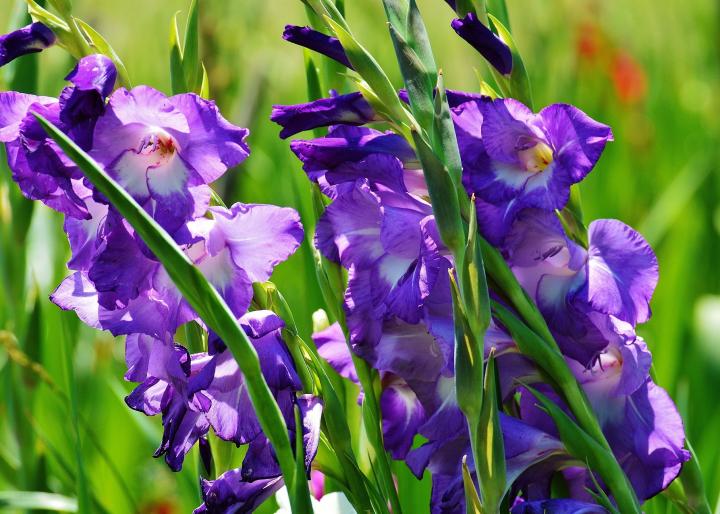
The gladiolus is a classic perennial known for its tall flower spikes and large, colorful blooms! A great cutting flower, the gladiolus looks spectacular in summer bouquets. Here’s how to grow gladioli in your garden.
About Gladiolus
Part of the iris family (Iridaceae) and commonly known as “glads,” these lovely flowering plants are available in a multitude of colors and sizes—from the smaller hybrids that fit perfectly in containers to the large-flowered Grandiflora hybrids, which send out huge spikes of blooms in a range of colors.
The most common gladioli typically reach between 2 and 5 feet in height, sporting flowers that also range in size—from “miniature” blooms less than 3 inches in diameter to “giant” flowers greater than 5 inches across! The taller varieties, which need to be staked, are often placed in the back of a garden to nicely complement shorter plants.
Gladiolus Winter Hardiness
The accepted hardiness zone for the classic Grandiflora gladioli (your typical garden glad) is zone 8, but it’s well known that by covering the corms with a good mulch, you can keep them alive in zones 6 and 7 and sometimes even zones 5 for certain varieties such as “Nanus Hybrids.” In colder zones, most gladioli corms should be dug up in the fall, stored, and replanted the following spring
Planting
For the best blooms, plant glads in full sun (6 to 8 hours of sunlight per day) in well-drained soil that’s moderately fertile. They will not do well in heavy, soggy soil. Mix compost (humus) into your soil to improve its consistency and fertility.
When to Plant Gladiolus
Start planting gladiolus corms in the spring, once the danger of frost has passed and the soil has warmed to at least 55°F (13°C).
From your last frost date to early summer, plant another round of corms every 10 days or so. This will result in continuous blooms through early fall!
Depending on the variety, it takes between 60 and 90 days from the time glads are planted for the corms to root, grow, and bloom.
How to Plant Gladiolus
Ready your garden by using a garden fork or tiller to loosen the soil to about 12 to 15 inches deep. After loosening the soil, mix in a 2- to 4-inch layer of compost or aged manure.
To ensure large-sized blooms, plant corms that are 1¼ inch or larger in diameter.
Set the corm in the hole about 4 inches deep with the pointed end facing up. Cover with soil and press firmly.
Space the corms 6 to 8 inches apart.
If you grow gladioli primarily for cut flowers, plant them in rows. It’s easier to tend the plants and to harvest the flowers.
If planted with other flowers in borders or annual beds, plant the corms in groups of 7 or more for the best effect.
Water the corms thoroughly at planting.
If you’re planting tall varieties, be sure to stake them at planting time. Be careful not to damage the corms with the stakes.
Growing
How to Grow Gladiolus
Put a 2- to 4-inch layer of mulch around your gladioli to keep your soil moist and help prevent weeds.
If you get less than 1 inch of rain a week, water your plants regularly throughout the summer. Otherwise, water them moderately when in growth to keep the soil moist.
Remove the faded/dead flowers to ensure continuous blooms. Once all the flowers on a stalk are gone, cut the stalk off at about 2 to 3 inches above the soil.
Be sure to leave the plant intact so it can mature and grow the corms for the next season.
Winter Protection for Gladiolus
If you live in USDA Hardiness Zone 8 or warmer, put down a layer of hay or straw for winter protection. Gladiolus can remain in the ground through winter, provided a hard freeze (28°F or colder) isn’t common in your area.
In colder regions (Zone 7 or colder), dig up gladioli corms once the foliage has faded after the first fall frost. A light frost will kill the foliage, but not the rest of plant. Be sure to dig up the gladiolus corms before a hard freeze (28°F), or the plants could be fatally damaged.
All that said, many gardeners who live in the “border” zones 6 and 7 have tried leaving their glads in the ground and found that they survived; this is a judgement call and based on your microclimate, your variety of gladiolus, and climate shifts.
Digging Up and Storing Gladioli Corms
To dig up the gladioli corms for winter storage, follow these tips:
Use a spade and dig up the entire plant, grasping the top to pull it out of the soil. Avoid bruising or injuring corms while digging. Shake off all loose soil (do not wash them off) and discard damaged corms. Cut the stalk down to 1 to 2 inches above the corm. Save the small cormels separately if you so desire. These will bloom in 2 to 3 years if you replant them each spring.
Allow the corms to dry in the sun for 1 or 2 days if the weather agrees. Sift out excess soil and place corms in wooden flats or trays. Cure in a warm and airy location for 2 weeks at a temperature of 80 to 85°F (27 to 29°C). Remove and throw away the oldest bottom corms (from the base of the new one).
Don’t remove the husks on the corms.
Dust the corms with a fungicide (“bulb dust”) to avoid disease problems. Place dust and bulbs in a paper bag and shake vigorously.
Store the corms in paper or cloth bags, pantyhose, or old onion sacks. Stack or hang the containers so air can move among them. Store the corms at 35 to 45°F (2 to 7°C) in low humidity. A cool basement is quite suitable. Do not allow corms to freeze.
Replant these corms in the spring for another year of beautiful blooms.
Varieties
Gladioli come in a variety of sizes and colors, with the most popular being part of the follow hybrid groups:
Grandiflora Hybrids: These are the classic gladioli that produce a plentiful amount of large (5- to 6-inch) blooms in a range of colors. The plants produce flower stalks that reach up to 4 feet in height and are winter hardy to Zone 7.
Dwarf Grandiflora Hybrids: These miniature glads are a great choice for containers and cutting gardens, as their flowers are about half the size of Grandifloras and their shorter stalks don’t typically require staking. They are also winter hardy to Zone 7. Glamini gladioli are included in this group; they are pest resistant and will bloom in full sun or partial shade.
Nanus Hybrids: Hardy to Zone 5, these smaller gladioli look a lot like Grandifloras, but do not produce as many flowers. They tend to grow no larger than about 2 feet in height, which makes them perfect for containers or small spaces.
Some specific gladiolus varieties of note include:
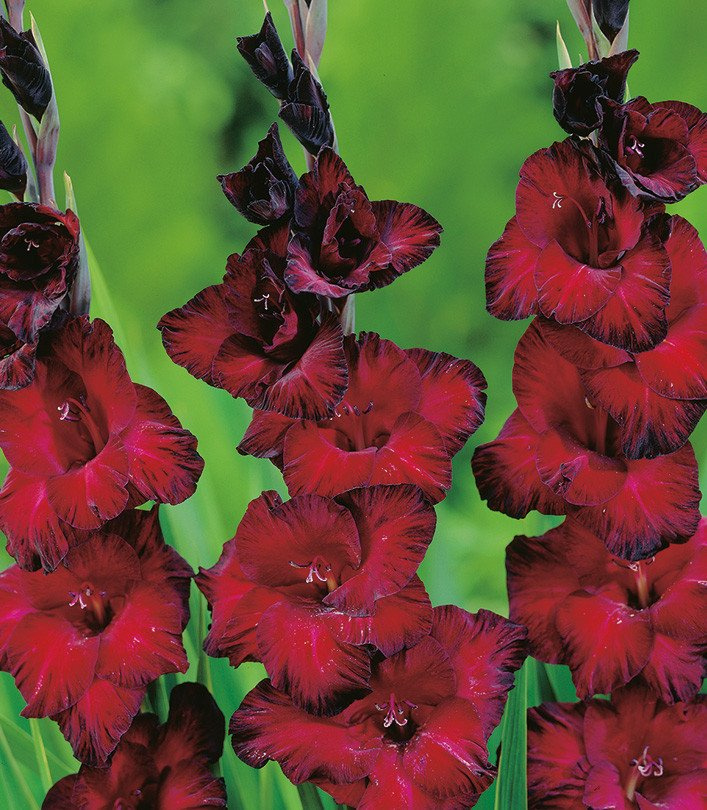
‘Black Star’, which has deep purple-red blooms
‘Candyman’, for its beautiful, deep pink flowers
‘Costa’, which sports ruffled flowers in blue-purple
‘Dream’s End’, which makes a good background plant because its flower spike is up to 3 feet tall (and it has pretty light orange flowers with large yellow centers)
‘Fun Time’, which has yellow flowers edged with red
‘Green Time’, for its unusual lime-green flowers
‘Prins Claus’, which has white flowers with splashes of pink on its petals
‘Priscilla’, which produces off-white flowers with yellow center and a pink edge
Harvesting
To cut glads for bouquets, follow these tips:
Cut the flower stalks early in the morning or at night, not during the heat of day.
Use a sharp knife and bring a bucket of lukewarm water to the flower bed; cut diagonally through the stalks and place in the bucket.
Cut stalks with only one or two open flowers. The rest of the buds will open after you put them in a vase. Leave at least four leaves on the plant in the ground if you want to re-use the corms.
Place the bucket with the flowers in a cool dark place for a few hours before arranging them in a vase.
Remove lower fading flowers and cut about 1 inch off the bottom of each flower stalk every few days.
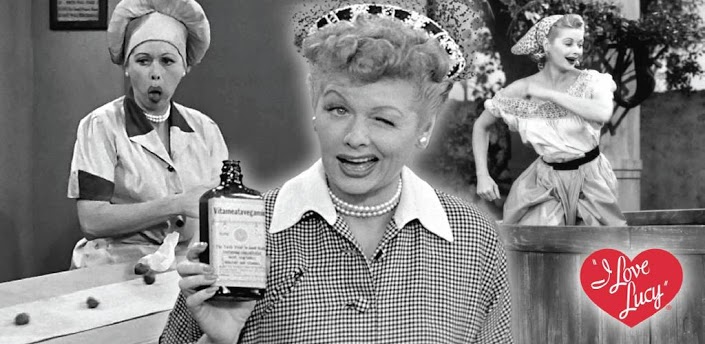
In honor of Lucille Ball’s birthday, I present an article containing fascinating facts about the lovely comedienne.
From the sheknows website, by author Allison Koerner October 14, 2017:
Ball was revolutionary in more ways than one, especially when it came to transforming the entertainment industry for women. As she once said, “I am not funny… What I am is brave.” We couldn’t have said it better ourselves.
She showed that women can be funny. She showed that women can be the lead of their own show and their own lives. She showed that goofiness is attractive. She showed that one woman can do wonders for other women. Ball absolutely deserves all of the recognition.
Obviously, fans of the show know the Lucy Ricardo they’ve seen and continue to watch on the small screen, but do they know the real Lucille Ball? If not, it’s time to get to know her even better.
She was the first woman to run a major production company
According to the New York Daily News, after Ball and Desi Arnaz divorced in 1960, she bought out Arnaz’s shares of Desilu for $2.5 million, making her the first female CEO of a major production company. Per the outlet, she later sold her Desilu shares to Paramount Studios for $17 million. Then, in 1967, Ball founded Lucille Ball Productions, according to Turner Classic Movie network.
She didn’t win that many awards
Even though she scored 13 Emmy nominations between I Love Lucy and The Lucy Show, she only took home a total of four Emmys. As for the Golden Globes, she was nominated six times, but never for I Love Lucy. Rather, she was recognized for The Facts of Life, The Lucy Show, Yours, Mine and Ours, Here’s Lucy and Mame. In 1979, she was honored with the Cecil B. DeMille Award.
She did win this award
In 1977, with Nancy Malone, Eleanor Perry and Norma Zarky, Ball was one of the first recipients of the Women in Film Crystal Award. According to the official website, Women in Film is all about “promoting equal opportunities for women, encouraging creative projects by women, and expanding and enhancing portrayals of women in all forms of global media.”
Her father died from typhoid fever
According to an excerpt from Stefan Kanfer’s 2003 book titled Ball of Fire (via The New York Times), Ball’s father died from typhoid fever in 1915 at only 28 — and it rightfully stayed with her the rest of her life. “Lucille retained only fleeting memories of that day, all of them traumatic,” Kanfer writes. “A picture fell from the wall; a bird flew in the window and became trapped inside the house. From that time forward she suffered from a bird phobia. Even as an adult, she refused to stay in any hotel room that displayed framed pictures of birds or had wallpaper with an avian theme.”
Her life completely changed at 16
As revealed in her memoir, Love Lucy (via Huffington Post), in 1927, her grandfather bought her brother, Freddy, a gun for his birthday. While her grandfather was teaching Freddy and his “little girlfriend” Johanna how to use the gun, Ball said, it went off and hit their 8-year-old next door neighbor, Warner Erickson. The bullet severed his spinal cord. The Erickson family filed a lawsuit, and as Ball wrote, “They took our house, the furnishings that [Ball’s mother] DeDe had bought so laboriously on time, week after week, the insurance — everything. My grandfather never worked again. The heart went out of him. It ruined Celoron for us; it destroyed our life together there.”
She wasn’t always “Lucille Ball”
Remember how Lucy Ricardo sometimes went by Lucille McGillicuddy (her maiden name)? Well, Ball once used the name Diane Belmont, according to The Los Angeles Times. “I always loved the name Diane and I was driving past the Belmont race track, and the names seemed to fit together,” she said.
She’s connected to the Salem Witchcraft Trials
According to NPR, Ball was a descendant of those accused as witches during the Salem Witchcraft Trials of 1692. “A lot of celebrated Americans, it has been determined, were descended from the accused witches, including Walt Disney, Clara Barton and Lucille Ball,” the outlet reports.
She defied ageism
When I Love Lucy first began in 1951, Ball was 40. As it unfortunately still is, that was a big deal back in the day, especially since it’s known that a woman over 40 in Hollywood has a harder time finding work compared to younger women and also men.
She fought for TV’s first interracial couple
Did you know that Ball and Arnaz made TV history as the first interracial couple? Ball also had to fight to keep Arnaz as her TV husband.
Kathleen Brady, author of Lucille: The Life of Lucille Ball, told NPR in February 2014 that CBS didn’t want Arnaz, especially since the network was unsure about his accent and Cuban heritage. “CBS and its sponsor, Philip Morris cigarettes, were adamantly opposed to this,” Brady said. “They said that the American public would not accept Desi as the husband of a red-blooded American girl.” However, Ball defended Arnaz, and according to Brady, she told CBS that they’d have to either cast them both or neither of them.
She wasn’t a natural redhead
Believe it or not, but Ball wasn’t always a redhead. According to Good Housekeeping, her natural hair color was brown and she dyed her hair for her role in Du Barry Was a Lady.
As revealed by I Love Lucy‘s hairstylist, Irma Kusely, it wasn’t easy finding the right tint of red, either. “A lot of people think of it as red — it’s not red at all,” she said in an interview for EmmyTVLegends.org. “She met a very wealthy sheikh and he had heard about her problem [getting the right coloring]. He said he would send her a lifetime supply of henna, which he did! [We kept it] in my garage, locked away in a safe.”
She almost drowned stomping grapes
The I Love Lucy episode, titled “Lucy’s Italian Movie,” is one of the most popular and favorite episodes ever. Well, according to a 2004 letter to the editor at The New York Times, the grape-stomping scene didn’t go as planned. “That was a real-life Italian grape stomper who was Lucy’s vat partner and who almost drowned the real-life Lucille Ball by pushing her down into the grapes and grape juice and fighting with her during the filming of that episode,” reads the letter, signed by Dennis Sprick.
Her pregnancy made history
It’s known that I Love Lucy wasn’t allowed to use the word “pregnant” after both Ball and her character got pregnant. As reported by The Hollywood Reporter, she also made headlines by becoming the first pregnant woman to play a pregnant woman on TV.
She’s basically responsible for Star Trek
It’s hard to imagine television without Star Trek, but that almost became a reality before Ball stepped in, according to Entertainment Weekly. “If it were not for Lucy, there would be no Star Trek today,” former studio executive Ed Holly told Desilu historian Coyne Steven Sanders (via EW).
CBS passed on Star Trek, but Ball apparently overruled the board of directors to make sure the pilot was produced, even after it was taken to NBC. The network ended up rejecting the first pilot. However, the Peacock network ordered a second pilot, with William Shatner as Captain Kirk, and this particular pilot was funded by Lucy, as she once again ignored her board. Star Trek ended up making the 1966 fall TV schedule.
She was registered with the Communist Party
As reported by The Los Angeles Times in 1953, Ball was once connected to the Communist Party. Apparently, it was a “short association” in 1936, but her family was investigated by the House Un-American Activities Committee. Ball explained her connection by saying the only reason she registered as a Communist was to please her grandfather, Fred Hunt, a Socialist.
She never needed a TV husband
Starring in The Lucy Show made Ball one of the first women to play a woman without a husband. She could easily lead a show without any men by her side.
She lied about her age after marrying Desi
For those unaware, Ball was six years older than Arnaz, which was reportedly frowned upon back in the day. According to Us Weekly, they decided to handle the situation by lying about their ages. “When Desi Arnaz and Ball (who was almost six years his senior) tied the knot in 1940, it was socially unacceptable for an older woman to marry a younger man,” the outlet reported in August 2011. “To avoid controversy, they both listed 1914 as their birthdate.”
She wasn’t afraid to take risks
In a 1980 interview with People, Ball showed just how fearless she was when it came to her career. “I guess after about six months out here in the ’30s I realized there was a place for me,” she said of Hollywood. “Eddie Cantor and Sam Goldwyn found that a lot of the really beautiful girls didn’t want to do some of the things I did — put on mud packs and scream and run around and fall into pools. I said I’d love to do the scene with the crocodile. He didn’t have teeth, but he could sure gum you to death. I didn’t mind getting messed up. That’s how I got into physical comedy.”
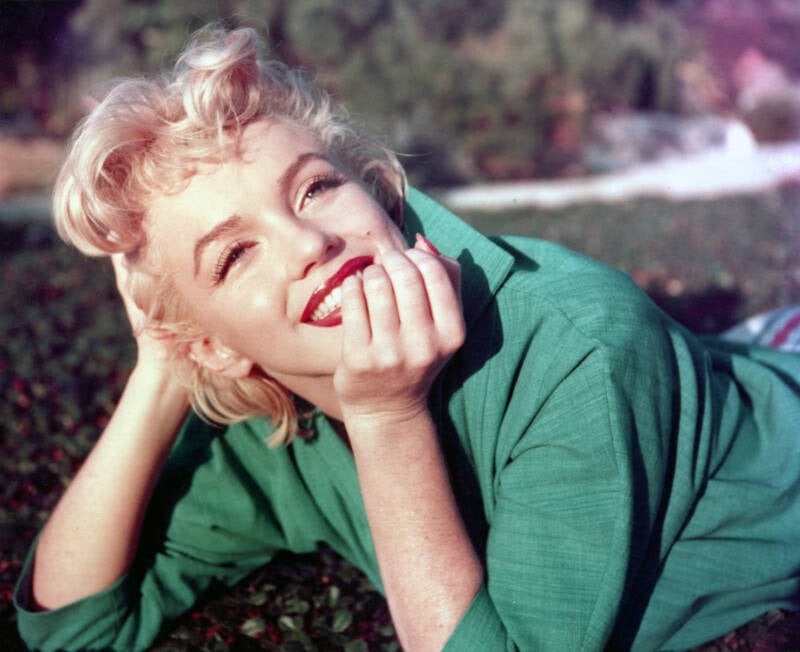
Today is the anniversary of Marilyn Monroe’s death and I found this article about her on the All That’s Interesting website.
By Kaleena Fraga
Published June 21, 2022
Updated August 4, 2022
From her troubled childhood to her famous films to her mysterious death, discover some of the most fascinating facts about Marilyn Monroe.
Marilyn Monroe is arguably one of the most recognizable Americans who ever lived. Almost everyone is familiar with her face, her silhouette, and, of course, the iconic photo of the star holding her white skirt over a New York City subway grate. But who was Marilyn Monroe?
These 22 facts about Marilyn Monroe include some of the most fascinating details about the beloved movie star, from her most famous films to her three marriages to her tragic — and mysterious — death in 1962.
Who Is Marilyn Monroe?
Marilyn Monroe was an American actress, singer, model, and sex symbol who starred in a number of films during the 1950s and 1960s. She charmed audiences with her beauty, intriguing quotes, and sensuality.
When Was Marilyn Monroe Born?
Marilyn Monroe was born on June 1, 1926, in Los Angeles, California, to a single mother named Gladys Pearl Baker. Monroe never knew her father (who DNA testing suggests was Charles Stanley Gifford and not Martin Edward Mortensen, the man listed on Monroe’s birth certificate).
Monroe spent her early life oblivious that she had two half-siblings, whom her mother’s first husband had taken to Kentucky. Though Monroe’s half-brother Robert Kermit Baker died before she could meet him, she later established a close relationship with her half-sister, Berniece Baker Miracle.
Until then, Monroe had a shaky family life. Her mother suffered from paranoid schizophrenia, and so the future movie star spent most of her childhood bouncing between relatives and foster homes.
What Was Marilyn Monroe’s Real Name?
Marilyn Monroe was born Norma Jeane Mortenson and later baptized as Norma Jeane Baker. Her name changed again when she married her first husband James Dougherty and took his surname. But Hollywood producers eventually convinced her to change the entire thing.
According to TIME, studio executive Ben Lyon thought that there were too many ways to say “Dougherty.” He suggested Marilyn as a first name, after the Ziegfeld Follies star Marilyn Miller, and Monroe eventually decided to use her mother’s maiden name as her last name.
What Size Was Marilyn Monroe?
According to the Marilyn Monroe Collection — the largest collection of the star’s memorabilia in the world — the Blue Book Modeling Agency listed her measurements as 36-24-34 and her size as 12 in 1945.
In today’s clothing sizes, that’d likely equate to a 6 or an 8. However, it’s worth noting that many modern brands vary widely in their sizing, so she could have picked different sizes depending on which brand she was wearing. It’s also worth noting that Monroe’s weight fluctuated throughout her life, so that could’ve affected what size she’d take as well.
How Tall Was Marilyn Monroe?
Marilyn Monroe was approximately five feet and six inches tall.
How Much Did Marilyn Monroe Weigh?
Most official documents list Marilyn Monroe as weighing between 117 and 120 pounds throughout her life. However, her weight was known to fluctuate and there were a few moments in the late 1950s when she appeared visibly heavier, with some guessing that she weighed up to 140 pounds at one point.
How Many Movies Did Marilyn Monroe Appear In?
Including bit parts, Marilyn Monroe appeared in about 30 films throughout her entire career as an actress. Some of Monroe’s best-known movies include Gentlemen Prefer Blondes (1953), Niagara (1953), The Seven Year Itch (1955), Some Like It Hot (1959), and The Misfits (1961).
But Monroe’s personal life was often watched just as much as her film roles.
Who Was Marilyn Monroe Married To?
During her life, Marilyn Monroe married three times. She wed her first husband, James Dougherty, in 1942 at the age of 16. They divorced in 1946 because Dougherty was unsupportive of Monroe’s movie star ambitions.
“My marriage didn’t make me sad, but it didn’t make me happy either,” Monroe once explained, according to the New York Daily News. “My husband and I hardly spoke to each other. This wasn’t because we were angry. We had nothing to say. I was dying of boredom.”
In 1954, Monroe married retired New York Yankees baseball star Joe DiMaggio. However, DiMaggio struggled with Monroe’s busy schedule and sex symbol status. The couple fought often, and at times, DiMaggio was physically abusive toward her. The two divorced after nine months.
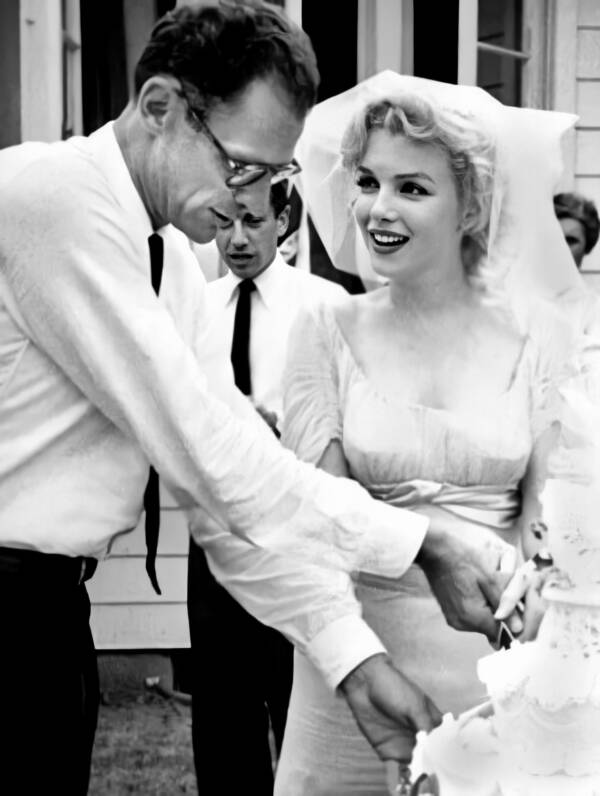
She married for the third time in 1956, to playwright Arthur Miller. But this marriage didn’t last, either, and the two divorced in 1961.
Why Did Marilyn Monroe Marry Arthur Miller?
Of all Marilyn Monroe’s marriages, her third to Arthur Miller strikes some as the most surprising. After all, Monroe and Miller — a movie star and a playwright, respectively — came from totally different worlds. But the two had a deep, emotional connection that spanned several years. According to Biography, Monroe once said, “This is the first time I’ve been really in love.”
However, the two clashed, especially while filming The Misfits, based on a story that Miller wrote. After they divorced in 1961, Monroe mused: “I wasn’t sweet all through. He should love the monster, too. But maybe I’m too demanding. Maybe there’s no man who could put up with all of me. I put Arthur through a lot, I know. But he also put me through a lot.”
Did Marilyn Monroe Have Children?
Marilyn Monroe did not have any children. She did, however, have an ectopic pregnancy and at least two miscarriages while married to Miller.
Did Marilyn Monroe Have An Affair With JFK?
Though the exact nature of Marilyn Monroe’s relationship with President John F. Kennedy is unknown — and only knowable to Monroe and Kennedy — historians generally agree that the two had at least one intimate encounter.
According to TIME, Monroe and Kennedy met four times between October 1961 and August 1962, and likely slept together on March 24, 1962.
In May of that same year, Monroe famously — and sensuously — sang “Happy Birthday” to the president during a rally at Madison Square Garden. Afterward, Kennedy quipped: “I can now retire from politics after having had ‘Happy Birthday’ sung to me in such a sweet, wholesome way.”
Was Marilyn Monroe Hard To Work With?
Toward the end of her life, Marilyn Monroe was reportedly difficult to work with. According to Variety, the production of Some Like It Hot was “troubled.” Monroe was frequently late to set — if she came at all — and frequently flubbed her lines, requiring retakes. Her co-star Tony Curtis even claimed that filming a romantic scene with her was like “kissing Hitler.”
Similarly, Monroe’s personal struggles hindered the making of what would have been her last film, Something’s Got to Give. Monroe was eventually fired from the project for “spectacular absenteeism” in June 1962.
Despite all the trouble on set, the movie star was subsequently rehired. But before filming could continue, she abruptly died.
When Did Marilyn Monroe Die?
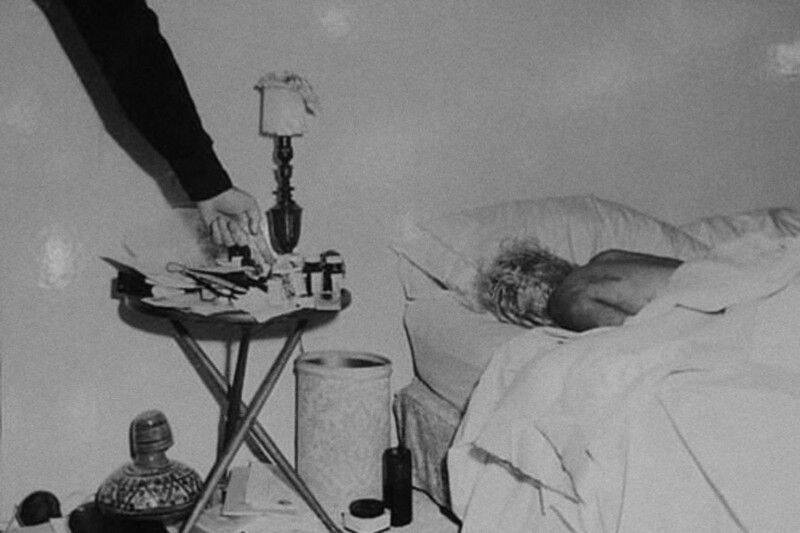
Marilyn Monroe died on August 4, 1962, mere months after she’d stunned the world by singing “Happy Birthday” to President Kennedy.
Where Did Marilyn Monroe Die?
Marilyn Monroe died at 12305 5th Helena Drive in Los Angeles, California, the home she’d moved into just six months prior.
How Old Was Marilyn Monroe When She Died?
Marilyn Monroe was 36 years old when she died suddenly in August 1962.
What Were Marilyn Monroe’s Last Words?
As far as anyone knows, Marilyn Monroe spoke her last words to Peter Lawford, an English-born actor who was also John F. Kennedy’s brother-in-law, in a phone conversation just hours before she was found dead.
“Say goodbye to Pat [Lawford’s wife], say goodbye to Jack [John F. Kennedy], and say goodbye to yourself, because you’re a nice guy,” the movie star allegedly said before hanging up the phone for the last time.
How Did Marilyn Monroe Die?
According to Marilyn Monroe’s autopsy report, the movie star died of “acute barbiturate poisoning” due to “ingestion of overdose.”
The medical examiner told reporters, “It is my conclusion that the death of Marilyn Monroe was caused by a self-administered overdose of sedative drugs and that the mode of death is probable suicide.”
She had such high levels of Nembutal and chloral hydrate in her system that the coroner suggested she’d taken the pills “in one gulp or in a few gulps over a minute or so.” But not everyone buys this story.
Was Marilyn Monroe Murdered?
Despite the coroner’s report — and another investigation in 1982 that concluded she either killed herself or accidentally overdosed — rumors that Marilyn Monroe was murdered have lingered ever since her 1962 death.
Questions have been raised about why there were no traces of pills found in Monroe’s stomach and why there was a bruise on her lower body, leading some to believe that a fatal injection was administered by a third party.
Some have claimed that Monroe’s romantic entanglements with both John F. Kennedy and his brother, Robert, led the two to plot her demise. Proponents of this theory have speculated that Monroe perhaps knew too much — or that the brothers killed her to avoid any embarrassing disclosures. But investigations into Monroe’s death have turned up no concrete evidence that the movie star was purposefully killed by anyone.
Murdering the star, investigators found in 1982, would have required “a massive, in-place conspiracy.” But they “uncovered no credible evidence supporting a murder theory.” Still, many people remain suspicious.
Did Marilyn Monroe Commit Suicide?
Another dicey question is whether or not Marilyn Monroe intended to die by suicide. A “psychological autopsy” at the time of Monroe’s death found that she was probably suicidal during her final days on Earth.
It noted that: “Miss Monroe had often expressed wishes to give up, to withdraw, and even to die,” and that she had previously attempted suicide.
But many people close to Monroe couldn’t believe that she would take her own life. For one thing, Monroe had apparently recently reconciled with her second husband, Joe DiMaggio. While the two had not made plans to wed again, they were on far better terms than they were during their marriage.
“It could have been an accident, because I had just talked to her a short time before,” her half-sister, Berniece Baker Miracle noted in a rare interview. “She told me what she had planned to do, she had just bought a new house and she was working on the curtains of the windows. She had so many things to look forward to and she was so happy.”
A friend of Monroe’s, James Bacon, agreed. “She wasn’t the least bit depressed,” he said. “She was talking about going to Mexico.”
In the end, it’s unclear whether or not the star meant to overdose on drugs on that fateful night. In 1982, District Attorney John Van de Kamp explained: “Based on the evidence available to us, it appears that her death could have been a suicide or a result of an accidental drug overdose.”
Where Is Marilyn Monroe Buried?
Marilyn Monroe is buried in Crypt Number 24 at the Corridor of Memories at Westwood Village Memorial Park Cemetery in Los Angeles, California. According to Atlas Obscura, DiMaggio had red roses delivered to her grave three times a week for 20 years as a tribute to the star.
What Was Marilyn Monroe’s Net Worth?
By the time Marilyn Monroe died, she had a net worth of about $800,000 — or $7 million today. According to Netflix, the actress left money to her half-sister, her niece, her mother, her acting coach, and her therapist.
How Old Would Marilyn Monroe Be Today?
If Marilyn Monroe were still alive today — 2022 — she would be 96 years old.
Leo, the fifth sign in the zodiac, belongs to those born between the dates of July 23rd and August 22nd.
Leo Traits
Bold, intelligent, warm, and courageous, fire sign Leo is a natural leader of the Zodiac, ready to blaze a trail, vanquish injustice, and make a name for themselves along the way. Blessed with high self-esteem, Lions know that they possess enviable traits—and they’re proud of them. They don’t believe in false modesty and will be the first to praise themselves for a job well done. But Leo isn’t self-aggrandizing or unwilling to roll up those sleeves and do the work: this sign knows that in order to be respected and admired, he or she needs to put in the effort worthy of a leader.
But it’s not all hard work for Lions. Intense and energetic, Leos thrive on social interactions and have no problem making friends—although pinning them down to spend time with you is another story. Leos put themselves first, and will turn down a plan that doesn’t fit with their agenda or idea of fun. This trait has gained them an unfair reputation for arrogance. But on the flip side, when a Lion chooses to spend time with you, it’s genuinely because he or she wants to.
Leo signs are passionate in all pursuits, including relationships, and take it upon themselves to be the best partner you’ve ever had. They love grand gestures, and they want to show the world how attentive and caring they can be. They also can’t resist flashiness and often buy their partner the biggest and best presents. Leo is an adventurer, seeking to balance an intense life of social obligations and travel with plenty of downtime to relax and luxuriate. Work and outward appearances matter to this sign, and they’re willing to do whatever it takes to gain a job title or workplace status, even if it means temporarily sacrificing their precious leisure time.
Benevolent with their time and attention, Leos are never cliquey, always showing friendliness and politeness to everyone. While almost everyone else is entranced by the Leonine personality, Leos are their own harshest critic and consider each day a challenge to be the best, brightest, and boldest Lion they can be.
Leo’s Love Style
Passionate, intense, and fiery, Leo loves hard. For Leos, love itself—whether falling in love, thinking about love, making love—is one of their favorite things in the world. A busy Lion will always make sure that there’s plenty of time for passion in his or her life.
Leo Friendship Style
“Friends” is one of Leo’s favorite words, and Lions are known for collecting friends—but not in a transactional way. Leo genuinely adores other people, and innately gets that the more people you know, the easier life can be. Leos easily hand out their phone number, are quick to follow or DM on Instagram, and will invite you to their happy hour five minutes after meeting you.
Leo Career, Money & Success Traits
Leo’s greatest career strength: Passion. Leos bring fiery intensity to everything they do, including work, and when they believe in what they’re doing, there’s no stopping them.
Leo’s Greatest Gifts
A natural leader, Leo’s very presence inspires others to be the best they can be. But with great power comes great responsibility. Leos love the pull of the limelight, and they’re occasionally swayed by what other people want (or expect) them to do. Although this sign has a loud inner voice, learning to listen to it—especially if it’s guiding them toward an unpopular move—is a lifelong lesson that will only make proud Lions stronger and more resilient.
Leo’s Greatest Challenges
Lions are well known for their loud roar. But learning to quiet down and listen is essential for Leo signs to reach their peak power—especially when they’re hearing a voice that doesn’t match their confidence and certainty. And while this sign thrives on their split-second decision-making and reaction skills, they might sometimes benefit from taking a few seconds, minutes, or even days before making their opinion known on a subject. Researching all sides, doing due diligence, and learning from other people’s experiences are all essential for a Leo to be as strong a leader as possible.
Leo’s Secret Weapon
A giving nature. Most people assume that Lions are all about themselves. But appearances are deceiving. A Leo’s secret weapon is his or her boundless capacity for love, affection, and generosity.
Famous Leos
(Pat’s Note: there are a LOT of famous Leos—but there’s also a lot of infamous ones—Obama and Meeghan Markle for example.)




































 Sew Colorful