The coffee is made, the cinnamon buns are in the oven and the gifts are open! Maybe you got exactly what you wanted, but maybe not. Whatever the case, your gifts have to be better than the awful ones I found below.
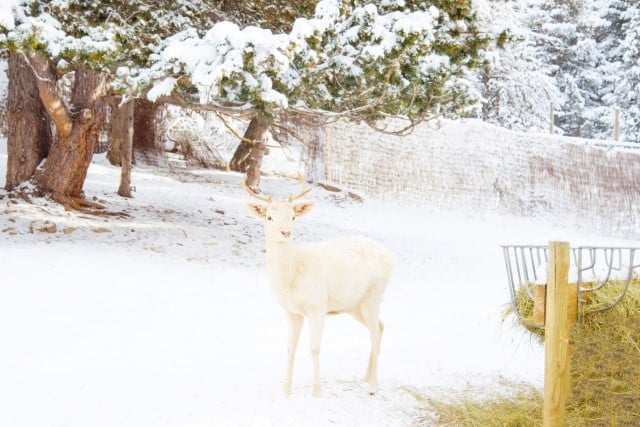
Even some of the most ardent deer enthusiasts and hunters have never heard of the Seneca white deer herd. This unique group of deer boasts a beautiful white coat that makes it notable throughout the world. Keep reading to learn everything you need to know about this mysterious herd.
The History of the Seneca White Deer Herd
The Seneca white deer herd’s history stretches back to 1941. Humans were inadvertently instrumental in the creation of this unique group of deer.
In 1941, New York’s Seneca Army Depot in Seneca County enclosed 10,600 acres to create a compound where since then, we’ve seen this herd’s development.
A fence positioned around the compound trapped in a deer population, keeping it separate from other deer in the area. This fence stretched 24 miles, and it was high enough that the deer inside the compound weren’t able to jump over. While the compound’s number of deer was small at the beginning, it has obviously grown exponentially since then.
Some of the original deer on the compound carried recessive genes that create all-white coats. As inbreeding became common in this deer population, white coats became common. The white coat genes got stronger and stronger as time passed.
Some people believe the Seneca white deer herd is made up of albino deer, but this isn’t true. Leucism, not albinism, causes the white coat that is so common in this herd, and the white deer in the Seneca herd are actually leucistic deer.
The Seneca White Deer Herd is a Leucistic Deer Herd
The gene for leucism means that the deer’s fur doesn’t have any pigmentation. While deer usually have a coat in a shade of brown, deer with leucism lack the pigmentation to create that kind of coat.
That is why their coats are completely white. While leucism is a recessive gene, constant inbreeding in the Seneca white deer herd over several decades has made this herd mostly white-coated.
Are Seneca White Deer Always Completely White?
While deer with leucism, such as the ones in the Seneca white deer herd, are usually completely white, there can be some variations. For example, a leucistic deer may be only primarily white, with other markings. Even completely white leucistic deer still have a black nose.
Leucism vs Albinism
One difference between a leucistic deer and an albino deer is that the albino deer has pink eyes. Leucistic deer like the ones in the Seneca white deer herd, on the other hand, have brown eyes like any other deer. Albinism is much rarer than leucism.
Overall, deer with leucism are healthier than albino deer. That is why leucistic deer tend to enjoy longer lives than deer with the albino trait. One major disadvantage of any kind of white deer, however, is their difficulty with camouflaging themselves and hiding from predators in the wild. Of course, this herd is protected, so they don’t have this challenge – a fact which may help to explain how the deer became more and more white over time.
Other Facts About the Seneca White Deer Herd
The fact the deer herd on the former Seneca Army Depot had become overwhelmingly white-coated was first noticed in the 1950s. That was when the United States Army decided to keep this deer herd intact and protected.
It was in 2000 that this property ceased being an army depot. It was transformed into Seneca White Deer, Inc., which is a conversation park devoted to the herd. The property also holds a Cold War Museum. Without question, the Seneca white deer herd preserve is a unique wildlife park with a fascinating heritage.
How is the Seneca White Deer Herd Doing Today?
The Seneca white deer herd is still thriving. However, the White Deer Tour program officially ended in 2019. The Seneca White Deer, Inc., organization and Hobart and William Smith Colleges’ Finger Lakes Institute have established a special scholarship fund in honor of the herd and its preservation.
This herd is found in New York State towns called Varick and Romulus. They’re in the Finger Lakes Region. The preserve spans an impressive 3,000 acres. Its deer herd is the largest herd of deer with visible leucism on the planet.
Are There Health Problems Associated with White-Coated Deer?
Remember that leucism is a recessive trait. Like many other such traits, it only becomes prevalent when there is inbreeding. And inbreeding, in turn, is linked to many potential health problems. That is why a deer with leucism is more likely to have certain health problems than a deer without this condition. Some problems commonly linked to leucism in animals include birth defects, such as a cleft palate and cross eyes.
Myths and Legends About White-Coated Deer
The recessive leucism gene exists in deer all over the world, so leucistic white deer do pop up in populations outside of the Seneca herd.
That is why we see the symbolism of white deer in myths and cultures around the globe.
For example, there are white-coated deer in Asian, European, and Native American stories. We see white deer treated as magical creatures in European mythology.
Are White Deer an Endangered Species?
No, white deer aren’t an endangered species of deer. They aren’t actually a species separate from regular deer. White deer are the same species as the other deer in your area, but they have either leucism or albinism.
Its preferred habitat is open savannas or grasslands in sub-Saharan areas. It hunts in these open areas, using its long legs to strike prey and stomp them to death. It is famous for eating snakes, but it also hunts insects and small mammals. They mate for life and one pair inhabits and defends a territory of up to 50km. Pairs lay eggs in a nest of their own making at the top of Acacia trees. They live 10-15 years in the wild and up to 19 in captivity. They are classed as endangered, with their numbers rapidly decreasing due to habitat loss.
Interesting Secretary Bird Facts
No one is quite sure where it got its name.
There are a few different theories, including that it was named by Dutch Settlers because of its resemblance to 19th Century Lawyers’ Secretaries. Another theory suggests that the name is a corruption of an originally Arabic word, meaning “hunter bird”.
Its scientific name means “the archer of snakes”.
This is because secretary birds love to hunt snakes. They use their large wingspan to distract the snake, while their scaley legs prevent snake bites.
They rarely fly.
They move around on foot most of the time, only taking to the air to reach their nests or for courtship displays.
They have a wingspan of 2m.
This is huge! They use their wings while hunting to distract their prey, and also during mating rituals.
They are one of just two birds of prey that hunt on the ground.
The only other birds that hunt on the ground are caracaras.
Secretary birds have one of the strongest (and fastest) kicks in the animal kingdom.
They can kick with a force 5-6 times their body weight. It happens fast too, in 15 milliseconds the foot can go from still to making contact.
They have been seen hunting juvenile big cat.
They’ve been spotted using their stomping hunting technique to kill juvenile cheetahs, and also baby gazelles.
They hunt in pair.
Monogamous pairs, and sometimes familiar groups, will hunt together.
Secretary birds mate for life.
Once paired up, they will stay together for life. They even use the same nest year after year.
They have elaborate mating display.
Even though they mate for life, they still perform their elaborate mating displays. They will perform “pendulum flights”, swooping up and down again. And on the ground, they dance together.
Secretary birds have large territories.
Pairs of secretary birds will inhabit, and defend, areas of up to 50 km2. However, many can be spotted together around important resources, such as watering holes.
They make their nests on the top of thorny trees.
This is almost always in an acacia tree. The nests are large, platform-like and often softened with grass and dung.
They lay 2-3 blue-green eggs.
These eggs are a few inches long and hatch after 45 days of incubation.
Sadly, the secretary bird is endangered.
This is because their grassland habitats are cleared and used for cattle.
On December 21, 1988, Pan Am Flight 103 from London to New York explodes in midair over Lockerbie, Scotland, killing all 243 passengers and 16 crew members aboard, as well as 11 Lockerbie residents on the ground. A bomb hidden inside an audio cassette player detonated in the cargo area when the plane was at an altitude of 31,000 feet. The disaster, which became the subject of Britain’s largest criminal investigation, was believed to be an attack against the United States. One hundred eighty-nine of the victims were American.
Islamic terrorists were accused of planting the bomb on the plane while it was at the airport in Frankfurt, Germany. Authorities suspected the attack was in retaliation for either the 1986 U.S. air strikes against Libya, in which leader Muammar al-Qaddafi’s young daughter was killed along with dozens of other people, or a 1988 incident, in which the U.S. mistakenly shot down an Iran Air commercial flight over the Persian Gulf, killing 290 people.
Sixteen days before the explosion over Lockerbie, the U.S. embassy in Helsinki, Finland, received a call warning that a bomb would be placed on a Pan Am flight out of Frankfurt. There is controversy over how seriously the U.S. took the threat and whether travelers should have been alerted, but officials later said that the connection between the call and the bomb was coincidental.
In 1991, following a joint investigation by the British authorities and the F.B.I., Libyan intelligence agents Abdel Basset Ali al-Megrahi and Lamen Khalifa Fhimah were indicted for murder; however, Libya refused to hand over the suspects to the U.S. Finally, in 1999, in an effort to ease United Nations sanctions against his country, Qaddafi agreed to turn over the two men to Scotland for trial in the Netherlands using Scottish law and prosecutors. In early 2001, al-Megrahi was convicted and sentenced to life in prison and Fhimah was acquitted. Over the U.S. government’s objections, Al-Megrahi was freed and returned to Libya in August 2009 after doctors determined that he had only months to live. In December 2020, reports surfaced that the U.S. Justice Department would unseal criminal charges against another suspect in the bombing, Abu Agila Mohammad Mas’ud.
In 2003, Libya accepted responsibility for the bombing, but didn’t express remorse. The U.N. and U.S. lifted sanctions against Libya and Libya agreed to pay each victim’s family approximately $8 million in restitution. In 2004, Libya’s prime minister said that the deal was the “price for peace,” implying that his country only took responsibility to get the sanctions lifted, a statement that infuriated the victims’ families. Pan Am Airlines, which went bankrupt three years after the bombing, sued Libya and later received a $30 million settlement.
In December 2022, the U.S. Justice Department announced Abu Agila Mohammad Mas’ud was arrested by the FBI for his suspected role in the bombing.
Turquoise is a popular gemstone that has long been prized in many cultures. It’s said to bring luck, peace, and protection, and it’s also one of the birthstones associated with December.
Turquoise stones have many meanings that go above and beyond the beauty of the blue color they provide.
What Is Turquoise?
Turquoise is an opaque stone that ranges from blue to green in color. The most valuable turquoise stones generally have a more smooth, solid color, while many stones have brown veins throughout. It has a calming, soothing, protective energy that can be beneficial for various feng shui applications. The word turquoise comes from a French word meaning “Turkish,” likely because the stone was introduced to Medieval Europe by Turkish sources. Turquoise has a Mohs scale ranking of 5 to 6, which means it has a fair to good hardness rating.
Properties of Turquoise
There is not one rare or best turquoise stone. But there are many rare types of turquoise with unusual colors. There are rare specimens of turquoise with blue-violet colorations and highly valuable transparent or translucent turquoise crystals that come from Virginia, for example.
Here are more common properties of turquoise stones:
Color: Blue, green
Chakra: Throat, third eye
Number: Vibrates to 1
Planet: Jupiter, Venus, Neptune
Zodiac: Scorpio, Sagittarius, Pisces, Rabbit
Bagua areas: Zhen, Qian
Elements: Wood, metal
Origin: Afghanistan, Arabian Peninsula, China, Egypt, France, Iran, Mexico, Peru, Poland, Russia, Tibet, United States
Spiritual Meaning of Turquoise
What does turquoise mean spiritually? The stone has a calming, grounding energy that makes it a great stone for when you are feeling overwhelmed, or to aid in meditation. It is said to connect heaven and earth and help you connect to the spiritual world. Turquoise can strengthen your connection to intuition, and it is also helpful for protection and purification.
Put on your thinking caps! It’s time for Tuesday Trivia: ChristmasVersion!
Question: Which popular Christmas beverage is also called “milk punch?” Answer: Eggnog
Question: What did the other reindeer not let Rudolph do because of his shiny red nose? Answer: Join in any reindeer games
Question: How many ghosts show up in A Christmas Carol? Answer: Four
Question: Where was baby Jesus born? Answer: In Bethlehem
Question: The movie Miracle on 34th Street is based on a real-life department store. What is it? Answer: Macy’s
Question: What are the two other most popular names for Santa Claus? Answer: Kris Kringle and Saint Nick
Question: Elvis isn’t going to have a white Christmas he’s going to have a…. Answer: Blue Christmas
Question: What do people traditionally put on top of a Christmas tree? Answer: An angel
Question: In Home Alone, where are the McCallisters going on vacation when they leave Kevin behind? Answer: Paris
Question: In the classic Christmas movie, How The Grinch Stole Christmas, the Grinch was described with three words. What are they? Answer: Stink, stank, stunk
Question: In which modern-day country was St. Nicholas born in? Answer: Turkey (originally Patara, a city in the ancient district of Lycia, in Asia Minor)
Question: In the movie It’s A Wonderful Life, what happened every time a bell rang? Answer: An angel got his wings
Question: What words follow “Silent Night” in the song? Answer: Holy night
Question: Which Hollywood actor played six different roles in The Polar Express? Answer: Tom Hanks
Question: In Charles Dickens’ A Christmas Carol, what was the first name of Scrooge? Answer: Ebenezer
Question: Which country did eggnog come from? Answer: England
Question: Which real-life person is Santa Claus based on? Answer: The Christian bishop St. Nicholas
Question: What did Frosty The Snowman do when a magic hat was placed on his head? Answer: He began to dance around
Question: What is Ralphie’s little brother’s name in the movie A Christmas Story? Answer: Randy
Question: Which Christmas song contains the lyric “Everyone dancing merrily in the new old-fashioned way?” Answer: “Rocking Around The Christmas Tree”
Question: What are you supposed to do when you find yourself under the mistletoe? Answer: Kiss
Question: Which one of Santa’s reindeer has the same name as another holiday mascot? Answer: Cupid
Question: Which country started the tradition of putting up a Christmas tree? Answer: Germany
Question: In the song “Winter Wonderland,” what do we call the snowman? Answer: Parson Brown
Question: In the movie Elf, what was the first rule of The Code of Elves? Answer: Treat every day like Christmas
Question: What’s the name of the main villain in The Nightmare Before Christmas? Answer: Oogie Boogie
Question: According to the song, what did my true love give to me on the eighth day of Christmas? Answer: Eight maids a milking
Question: What was the highest-grossing Christmas movie of all time? Answer: Home Alone
Question: Whose eyes are all aglow in “The Christmas Song?” Answer: Tiny tots
Question: What was the real name of the character Tim Allen plays in The Santa Clause? Answer: Scott Calvin
Question: How many gifts in total were given in “The Twelve Days of Christmas” song? Answer: 364
Question: Which fairy tale was the first gingerbread houses inspired by? Answer: Hansel and Gretel
Question: In the movie A Christmas Story, what was the name of the neighbors whose dog ate the Christmas turkey? Answer: The Bumpuses
Question: How do you say “Merry Christmas” in Spanish? Answer: Feliz Navidad
Question: Where did the word and idea “Christmukkah” come from? Answer: The O.C.
Question: What is the name of the last ghost that visits Scrooge in A Christmas Carol? Answer: The Ghost of Christmas Yet To Come
Question: Visions of which food danced in children’s heads as they slept in the poem “‘Twas The Night Before Christmas?” Answer: Sugar plums
Question: What gift did the Little Drummer Boy give to the newborn Christ? Answer: He played a song for him on his drums
Question: What is the best-selling Christmas song ever? Answer: “White Christmas” by Bing Crosby
Question: Who wrote, “Christmas doesn’t come from a store, maybe Christmas perhaps means a little bit more?” Answer: Dr. Seuss
Question: Three of Santa’s reindeer’s names begin with the letter “D.” What are those names? Answer: Dancer, Dasher, and Donner
Question: What was Frosty the Snowman’s nose made out? Answer: A button
Question: What is the name of George Bailey’s guardian angel in It’s A Wonderful Life? Answer: Clarence Odbody
Question: In the 1964 movie Rudolph the Red-Nosed Reindeer, what was the name of Rudolph’s elf friend? Answer: Hermey
Question: What popular Christmas song was actually written for Thanksgiving? Answer: “Jingle Bells”
Question: What was the first company that used Santa Claus in advertising? Answer: Coca-Cola
Question: In “The Christmas Song,” who did the narrator see kissing Santa Claus under the mistletoe? Answer: Mommy
Question: In the movie Elf, how does Buddy get to the North Pole? Answer: He hides in Santa’s sack
Question: Where did there arise such a clatter? Answer: On the lawn
Question: What are Christmas trees also called? Answer: Yule-Tree
Every state harbors unpleasant secrets—here are 50 of the strangest ones from around the country, and why we may never learn the real truth.
Montana: The Vortex and House of Mystery
Just 13 miles from Glacier National Park you can pass through a portal in which the laws of nature are set aside: A gravitational anomaly forces trees to grow sideways and makes people appear as much as six inches shorter. A shack in the Vortex—called the House of Mystery—is the home to bizarre phenomenon: A marble rolled on an incline will travel upward, and a rope hanging from the ceiling falls in a curve.
Nebraska: The Lucky 15
{{I remember Filly had this in an open.}}
On March 1, 1950, the 15 members of the Beatrice’s West Side Baptist Church choir were supposed to meet for practice. All of the 15 were known for their timeliness, but on this day, they were all running late—every single one of them. The reasons varied, but not a single one was present when a natural gas leak caused the complete destruction of the church. Even Snopes can’t discount the mystery here: Why and how were every single one of the 15 spared a grisly death?
Nevada: Who murdered Tupac Shakur?
In 1996, hip-hop star Tupac Shakur was killed in Las Vegas during a drive-by shooting. “The story…begins with a failed attempt on his life two years earlier,” according to History, which Shakur blamed on producer Sean “Puff Daddy” Combs and rival rapper, Christopher Wallace (“Notorious B.I.G.”). Wallace was murdered six months later in Los Angeles; no arrest has ever been made in either case.
New Hampshire: The disappearance of Rachel Garden
In 1980, 15-year-old Rachel Garden bought a pack of cigarettes at a market in Newton and was never seen again. The friend whom Rachel told her family she was going to be spending the night with denied having plans with Rachel that night. A witness claimed to have seen Rachel talking to three young men outside the market, but none of the men were ever charged. In fact, no one has ever been charged, and there are no suspects. Nearly 40 years later, the case appears to be hopelessly cold.
New Jersey: The phantom sniper
In 1927, Camden was terrorized by what’s been described as phantom- or ghost-sniper. Bus and car windows were shattered and even a policeman was struck, but no bullets or casings were ever found and no one ever saw an actual sniper. One witness reported hearing a man’s laughter. But no one else saw or heard a thing. The attacks suddenly stopped in 1928. To this day, no one knows why they began or what they really were.
New Mexico: What was really going on in Roswell?
It all started in the summer of 1947 when a Roswell rancher found mysterious debris in his sheep pasture. The Air Force claimed the debris belonged to a crashed weather balloon, but the citizens of Roswell didn’t buy it. They believed it came from a UFO. Fifty years later, the military revealed that the debris came from a top-secret atomic project. So it probably wasn’t a UFO—but what was it? And why has the U.S. government come up with at least two different stories about it?
New York: Who was the Leatherman?
During the second half of the 1800s, a leather-clad hermit wandered around Westchester and Putnam Counties, never speaking, and unlike other wanderers of that time period, not looking for work. He was, however, happy to accept a meal and returned once a year—on the same day—to the homes that were generous to him. He was known to sleep in caves; his body was discovered in 1889 in a cave on the Dell family farm in Briarcliff. To this day, no one’s sure who he was or why he wandered.
North Carolina: The shadow of the bear
Going bear-hunting has its own unique meaning in Cashiers: During the autumn months, when the sun is shining, the shadow of a bear is visible on Whiteside Mountain just before sunset. Romantic Asheville suggests you “shoot” this unexplained phenomenon with your camera.
North Dakota: Eugene Butler’s crawl space
Niagara, about 40 miles west of Grand Forks, was founded in 1882 and has never been a big town. In fact, today, it has less than 100 residents. But back in the early 1900s, there were at least six more people there than anyone knew about at the time. In 1915, the bodies of six people who’d been bludgeoned to death were discovered in the crawl space of a house that had once belonged to the reclusive Eugene Butler. He died in 1911, several years after being committed to a mental hospital. Their identities remain a mystery to this day.
Ohio: The Circleville letters
In 1976, residents of Circleville began receiving harassing letters, taunting and threatening them with tidbits about their personal lives. After the murder of one resident and the attempted murder of another, police arrested Paul Freshour, but while he was in prison, the letters continued. Six months after Freshour’s release, television’s Unsolved Mysteries aired a segment—only to receive its own short letter: “Forget Circleville, Ohio… if you come to Ohio, you el sickos will pay. The Circleville Writer.” The identity of the letter writer remains unknown.
Oklahoma: The Jamison Family
In 2014, Bobby and Sherilynn Jamison drove out to look at a property in Red Oak they were interested in purchasing. Their truck was discovered days later, along with their wallets, IDs, phones, $32,000 in cash, and their dog. Their remains, along with their young daughter’s, were discovered by hunters a month later. No cause of death could be determined, and no one knows what happened to them, although theories abound, including that the family faked their deaths and joined the witness protection program, and the family’s supposed involvement with cults and/or witchcraft.
Oregon: The mysterious shrieks of Forest Grove
The small town of Forest Grove is generally a quiet town, but in 2016, the quiet was shattered by reports of an otherworldly shrieking sound that seemed to emanate from nowhere and everywhere all at the same time. Some managed to record the screeching sound, which has been described as being like that of a train careening wildly on metal tracks—except there’s no train nearby. The shrieks ceased soon after, and no one has ever been able to figure out what caused them or where they might have been coming from.
Pennsylvania: Boy in the box
In 1957, the body of a young boy was discovered in a cardboard box in the woods outside Philadelphia. Authorities failed to identify him, and no one came forward looking for a boy that fit his description. The crime scene yielded no clues, but in 1960, a psychic led the police to a foster home where the boy might have lived. But a definitive connection between the boy and the foster home couldn’t be made, and the case remains cold all these years later.
Rhode Island: Where is Adam Emery?
In 1993, Adam Emery disappeared just hours after being convicted of murdering 20-year-old Jason Bass in a road rage incident. (Emery was out on bail pending formal sentencing.) Police found his car abandoned on Newport Bridge. Less than a year later, his wife’s remains were found in Narragansett Bay. Some believe Adam and his wife jumped to their deaths from that bridge, but the FBI still considers Emery one of America’s most wanted criminals.
South Carolina: The Lizard Man
Starting in the summer of 1988, Browntown residents began seeing what’s now referred to as the “Lizard Man,” a seven-foot-tall creature with red eyes and incredible, superhuman strength. The first sighting involved a car being “mauled” by the creature. “To this day, the mystery hasn’t been solved,” reports the Smithsonian, and there have been sightings as recently as 2015.
South Dakota: The strange fate of Tom Keuter
In 1994, Tina Marcotte called a friend to say she had a flat tire but that her coworker, Tom Kueter, was going to help her out. Tina was never seen or heard from again, and when Tom was questioned by police, he disputed that he’d been in touch with Tina on that day. The next day, Tom was found dead: He had been run over by his own forklift. Was it an accident? Suicide? Homicide? And what happened to Tina Marcotte?
Tennessee: The Craigmiles Mausoleum
In 1871, Nina Craigmiles was killed at the age of seven when the buggy she was riding in was hit by a train. Her family had a mausoleum built for her (and future deceased members of the Craigmiles family) of fine white Italian marble. Shortly after Nina was placed there, red streaks and splotches began to appear in the marble. Efforts to clean the marble failed, and each time a family member’s body was placed in the mausoleum, more red stains appeared. There’s no scientific explanation for the stains; some believe they are Nina’s tears.
Texas: The girl behind the Amber Alerts
Amber Hagerman was a nine-year-old Arlington Girl Scout when she was kidnapped while riding her bike on January 13, 1996. A witness quickly told the police he’d seen a girl being forced into a black van. Despite a massive search, Amber was never seen alive again. Her body was found five days later about four miles from where she had been taken. Her killer has never been found, but her abduction led to the invention of “Amber Alerts.”
Utah: Jean Baptiste’s great escape
Jean Baptiste was a notorious grave robber in Utah. When his grave-pillaging came to light in the late 1800s, Baptiste was banished to a remote island in the Great Salt Lake (the equivalent of solitary confinement). Three weeks later, he was gone. What little evidence authorities could find indicated that he might have built a raft in order to escape. But he was never seen or heard from again.
Vermont: The Bennington Triangle
The Bennington Triangle refers to an area of Vermont surrounding Glastenbury Mountain where several people have disappeared without a trace. These include a trail guide who vanished in 1945 while leading a hunting party, college student Paula Jean Weldon, who disappeared the following year from a hiking trail, and James Tedford, who seemingly vanished from a bus headed for Bennington. Since the disappearances were clustered in the 1940s, there’s speculation of a serial killer. But others believe paranormal forces are at work.
Virginia: The Old House Woods
In the quaint seaside town of Diggs, Virginia’s “Old House Woods” was once a popular hiding place for soldiers and pirates, so naturally, it’s become a hotspot for paranormal activity, including sightings of a ghostly woman and accounts of skeletons dressed in armor wandering the woods. People have reported finding themselves filled with dread while walking in the forest. Horses are known to become spooked for no apparent reason. Even paranormal investigators are creeped out, often unable to continue their investigations.
Washington: How Jason Padgett became a math genius
In 2002, Jason Padgett, a furniture salesman, jock, and self-described “partier” from Tacoma, was savagely attacked by two men outside a bar, leaving him with a severe concussion. When he recovered, he had acquired the ability to “visualize complex mathematical objects and physics concepts intuitively,” according to Live Science. Padgett is now one of 15 to 25 cases of so-called “acquired savant syndrome”—people who developed abilities after suffering a head injury.
West Virginia: The Octopus mystery
Danny Casolaro was a freelance writer who came to Martinsburg, West Virginia in 1991 to meet with a source about a story he code-named “the Octopus,” which involved high-ranking government officials and an international cabal. Casolaro was found dead in his hotel room. Authorities labeled it a suicide, but Casolaro’s family believe he was murdered.
Wisconsin: The demon bunkbed in the Tallman house
In 1987, the Tallman family brought a secondhand bunk bed to their home in Horicon. For the next nine months, the family was haunted by what appeared to be poltergeists—clock radios turning on by themselves, a paintbrush that dipped itself in paint—and worse, including the children becoming ill despite no previous health problems and an unexplained fire. The hauntings ceased only when the Tallman family destroyed the bunk bed.
Wyoming: Devil’s Tower
Various Native American tribes view the Devil’s Tower National Monument as a sacred site and have their own origination stories about the massive stone structure. And science fiction fans may recall that the mythology of the structure played an important role in the film, Close Encounters of the Third Kind. Geologically speaking, it’s made of volcanic material and is connected in some way to an existing or previously-existing volcano. But precisely how it came to exist continues to confound scientists.
Every state harbors unpleasant secrets—here are 50 of the strangest ones from around the country, and why we may never learn the real truth.
Alabama: The Brasher-Dye Disappearance
The Dye brothers, Billy Howard and Robert, disappeared in 1956 along with their cousin, Dan Brasher. They were last seen leaving a relative’s house in rural Jefferson County in a 1947 green Ford, but no one even noticed they were missing because they were known to be heavy drinkers and often disappeared for days while sleeping off a binge. When a missing person’s report was filed, investigators’ questions were met with silence or tall tales—for example, of a bulldozer burying a car under a highway. The case remains unsolved.
Alaska: The Investor murders
In 1982, an $850,000 fishing boat named the Investor was seen burning off of the coast of Craig. Inside, eight bodies were found (the owner, his pregnant wife, their two daughters, and four crewmen) They’d been shot to death and left to burn. One possible suspect was tried, but he’s been acquitted due to a lack of hard evidence. Authorities still haven’t determined a motive. The case is Alaska’s biggest and most famous unsolved mystery.
Arizona: Searching for Robert Fisher
Robert William Fisher (born 1961) is one of the FBI’s ten most wanted fugitives. He’s wanted for the murder of his wife and two kids and for blowing up the house in which they lived in Scottsdale on April 10, 2001. Fisher, the only suspect in the case, disappeared the night of the fire and hasn’t been seen since. It’s possible he committed suicide, but equally possible he’s living under an assumed identity. The FBI is offering a $100,000 reward for information leading to his arrest.
Arkansas: The Gurdon Light
Ever since the 1930s, a floating light appears above the railroad tracks near Gurdon sometime in late October. It’s not in dispute whether the light appears because thousands of people have seen it. What remains a mystery is what causes the light. Some believe it’s the ghost of William McClain, a railroad worker murdered in 1931, according to the Encyclopedia of Arkansas. Others believe it’s a natural phenomenon caused by swamp gas or rock quartz beneath the land. It was featured on television’s Unsolved Mysteries in 1994 and remains unsolved to this day.
California: Did anyone survive the “Escape From Alcatraz”?
The supposedly escape-proof prison named for Alcatraz Island in San Francisco Bay claimed the lives of 33 prisoners who attempted to flee. But not necessarily John Anglin, Clarence Anglin, and Frank Morris: In 1962, they escaped from their cells through holes they’d drilled in the wall of their cell. Unfortunately, that’s where the story ends. “What happened next remains a mystery,” reads a portion of an FBI history of the investigation, according to NBC News. The case was closed in 1979, but people (including the families of the escapees) still wonder.
Colorado: The Black Forest haunting
Within weeks of moving into their home in the Black Forest area of Colorado Springs, “all hell broke loose” for the Lee family, according to Our Community Now. There were flashing lights, footsteps, orchestra music, strange smells, and even sightings of ghostly faces. The Lee family lives there to this day, still reporting the same phenomena. No one can explain what it is, although a Hopi shaman who was called in to consult claims the house is located on a “rip in the space-time continuum,” where spirits can move freely between worlds.
Connecticut: The shallow graves beneath New Haven Green
In 2012, Hurricane Sandy caused a tree to fall on New Haven Green. Tangled in the roots was a human skull, dating back around 200 years. An archeological dig followed, yielding more body fragments, as well as coffin nails. It’s suspected more than 5,000 bodies are buried under the Green and that they may have been “dragged out in the middle of the night, wrapped in a sheet, and buried in shallow, unmarked graves.” Some theorize the people died during a terrible epidemic—though no one’s sure of what.
Delaware: The inexplicable murder of Jane Marie Prichard
Jane Marie Prichard was conducting botany experiments in Blackbird State Forest in September 1986 when she was shot to death; campers stumbled across her body later. Many hunters were in the forest that day, but investigators quickly ruled out an accidental shooting, according to Delaware Online. What they couldn’t figure out and still haven’t, is why someone wanted Prichard dead, and who might have killed her. The case remains cold to this day.
Florida: The spontaneous combustion of Mary Reeser
In July of 1951, authorities found the body of 67-year-old Mary Reeser in her St. Petersburg apartment. Or more accurately, the pile of mostly ash that once was Mary Reeser’s body (part of her lower leg and some of her spine remained). Apparently, her body had been almost entirely cremated, which is mind-boggling when you consider that cremation requires three hours of burning in a 3,000-degree fire. Even more bizarre—only Reeser’s body had burned: The rest of her apartment was intact, even a pile of newspapers beside her body.
Georgia: The Bleeding House
One night in 1987, Minnie Winston saw blood on the floor of her Atlanta house. Terrified, she ran to find her husband. He was fine, but there was more blood… everywhere. On the walls, oozing from the floor, seeping up from under kitchen appliances. She and her husband called the police, who found no evidence of a break-in. What they were able to surmise was that the blood had come from a living human. No one has ever figured out where or whom the blood came from.
Hawaii: What happened to Lisa Au
More than 35 years ago, 19-year-old Lisa Au disappeared without a trace, her car abandoned along a highway in Kailua. Her body turned up ten days later, naked and decomposing. The coroner couldn’t determine the cause of death, but police consider the case a homicide—perhaps Hawaii’s most notorious since the police believe that Lisa may have been abducted by someone posing as a police officer.
Idaho: Strange mutilations
The towns of Jerome and Bliss have been plagued by bizarre mutilations since the 1970s—human, cattle, and deer (genitals removed, the bodies drained entirely of blood, and no discernable footprints or other forensic evidence left at the scene). The official explanation by law enforcement is “cult killings,” but no arrest has ever been made, and no cult has ever been identified.
Illinois: The Mad Gasser of Mattoon
During the 1940s, law enforcement received more than two dozen cases of “gassings,” in which the victims reported paralysis, coughing, nausea, and vomiting after smelling a strange, noxious odor in their homes. No physical evidence was ever found, however, and the victims always survived. Some believe the “attacks” were a case of mass hysteria. Others believe the “Mad Gasser” actually existed or that the “attacks” were really the result of paranormal activity. The truth may or may not be “out there.”
Indiana: The mysterious fire poltergeist
In 1941, a farmer in Odon had breakfast with his family and then headed out to his barn to begin his chores. Then he noticed smoke coming out of an upstairs window in his house. He ran back, and with the help of the volunteer fire department put out the fire in an upstairs bedroom—only to have another fire break out in another room. All day long, as soon as they put out one fire, another would start elsewhere in the house—28 in all. Believing his house to be haunted by poltergeists, the farmer tore it down and built a new one. The cause of the fires has never been determined.
Iowa: The boy with no appetite
In Cedar Falls, there lives a boy who never gets hungry or thirsty. It all started in 2013, when the boy, Landon Jones, who’d been completely fine up until then, came down with a bacterial infection in his left lung. Ever since then, he’s never felt hunger or thirst. He only eats and drinks because he is reminded to do so. No one knows what caused this affliction.
Kansas: The baffling disappearance of Randy Leach
In 1988, Randy Leach, a teenager from Leavenworth County, disappeared from a high school party and has never been found. What makes the case stranger is there’d been rumors of satanic cult activity in the county in the days before Randy’s disappearance, and the party site had been cleaned meticulously before investigators arrived; soon after, it burned to the ground. Most people who’ve cooperated in the investigation have turned up dead, and county officials decline to pursue further leads. There are theories about what really happened that night, but we may never know the truth.
Kentucky: The meat shower
Not a meteor shower—a meat shower. One day in 1876 over a farm in Kentucky, the sky rained down chunks of meat of indeterminate origin (was it bear? mutton? No one knew). The only explanation anyone has ever been able to offer is that the meat was the prey of vultures, who had gorged themselves and then vomited while flying overhead.
Louisiana: The Unknowable Marie Laveau
Marie Laveau lived in New Orleans at the turn of the 19th century, and charmed, titillated, and unnerved the community with her practice of voodoo. Laveau told fortunes and created potions and charms on request. She held spiritual ceremonies that led people to become possessed; she also could magically heal the sick. However, stories of her feats have been passed along from one generation of voodoo practitioners to the next, making it impossible to know the truth behind the tales.
Maine: What happened to Sarah Ware?
In 1898, the brutally beaten body of 52-year-old Sarah Ware was discovered in a wooded area of Bucksport. She’d been missing for two weeks. Her killer is believed to have been a neighbor, but when the blood-stained hammer believed to be the murder weapon disappeared, the neighbor was acquitted. The case still haunts the town to this day, not just because the case was never solved, but also because the circumstances of her burial are so strange: her head and body are buried separately, with no gravestone.
Maryland: House of horrors
In 2017, a Bethesda house fire revealed a disturbing find: The body of a man in the basement. Further investigation revealed a mysterious network of tunnels below the foundation of the house that extended all the way to the street. The house owner, Daniel Beckwitt, has since been charged with the death of Askia Khafra (the body in the basement); investigators allege that Beckwitt hired Khafra to dig the tunnels but put him in danger due to the unsafe work environment. But the purpose of the tunnels and Beckwitt’s motives remain a mystery.
Massachusetts: The Black Flash of Provincetown
From 1939 to 1945, the people of Provincetown were terrorized by a being they called the “Black Flash.” The figure first appeared to a group of children—tall, dressed in black, and growling ominously. In 1945, a group of policemen actually reported seeing the figure leap a 10-foot fence. About a month later, a man threw boiling water at the figure, sending it screaming into the night. It was never seen again.
Michigan: What exactly is the Paulding Light?
In 1966, a group of teens reported having seen a mysterious light above a valley in Paulding. Scientific explanations such as swamp gas have been rejected in favor of the more popular paranormal theory that the light is from the lantern belonging to local brakeman who was killed while attempting to stop an oncoming train. Michigan Tech students believe it’s a phenomenon created by headlights from a nearby road, but the mystery remains officially unsolved.
Minnesota: The frozen girl, defrosted
In 1981, Jean Hillard’s car went off the road near Langby, and the next day, her frozen body was discovered, her eyes wide open, her flesh frozen so solid that doctors couldn’t pierce it with a hypodermic needle. Her body temperature was too low to register on a thermometer. But when Hillard thawed, she was very much alive and made a full recovery.
Mississippi: Phantom Barber of Pascagoula
In 1942, Pascagoula was plagued by a series of peculiar home invasions: “The intruder took locks of hair from each of the people whose homes he broke into,” according to Southern Living. Although one man became a suspect, he was never formally charged and passed a lie-detector test; no one has ever figured out who the Phantom Barber really was or why he did what he did.
Missouri: How Robert Rayford contracted AIDS
In 1969, 16-year-old Robert Rayford was hospitalized in St. Louis for extreme, unintended weight loss and a host of infections. The doctors had no answers, and Rayford died. A few years later, HIV, the virus that causes AIDS was discovered in this country; subsequently, medical testing of Rayford’s blood revealed that he had the virus. Somehow, Rayford, who’d never been out of the country and never had a transfusion, had died of AIDS nearly a decade before it was discovered.
Every year I attempt one new cookie. If the family likes it, I add it to the holiday cookie list. This year I wanted to try Rolo Turtles. (At this point, I have not tried them yet, as hubby and I have been sick, but I am going to when I feel better.)
ROLO TURTLES
1/2 cup butter, softened to room temperature
1/2 cup granulated sugar
1/2 cup packed brown sugar
1 large egg
1 teaspoon vanilla extract
1 1/4 cups all-purpose flour
6 tablespoons unsweetened cocoa powder
1/2 teaspoon baking soda
1/4 teaspoon salt
24 Rolo chocolate candies, unwrapped
For rolling:
1 tablespoon granulated sugar
1/4 cup crushed pecans
Instructions
Preheat oven to 375ºF. Line two baking sheets with parchment paper.
In a large bowl, using a hand-held mixer or a stand mixer with paddle attachment, cream together the butter, granulated sugar, and brown sugar until combined. Beat in the egg and vanilla until smooth.
In a separate bowl, combine the flour, cocoa powder, baking soda, and salt.
Add the dry ingredients to the wet ingredients and slowly mix until combined.
Measure about 1 tablespoon of dough and wrap around a Rolo candy into a ball shape. Repeat with remaining dough and Rolo candies.
In a small bowl, combine the granulated sugar and crushed pecans. (I used coarsely chopped pecans and no added sugar.) Roll each dough ball in the mixture until coated on all sides. Place dough balls on the prepared baking sheets.
Bake for 8-10 minutes until set and slightly cracked. Allow cookies to cool on the tray for 5 minutes, then transfer to a wire rack to cool slightly before serving.


























:max_bytes(150000):strip_icc():format(webp)/turquoise-meaning-purity-and-happiness-1274380-2-1504aa7dfb854c219b106b2c8848646f.jpg)













 Sew Colorful