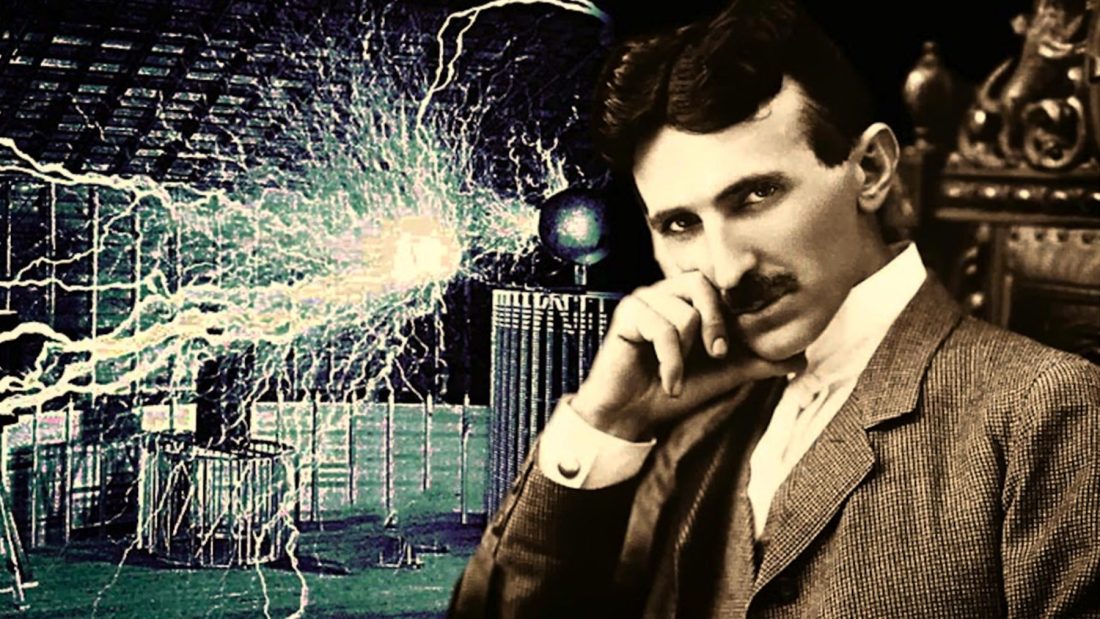
In 1895 Tesla’s New York lab burned, destroying years’ worth of notes and equipment. Tesla relocated to Colorado Springs for two years, returning to New York in 1900. He secured backing from financier J.P. Morgan and began building a global communications network centered on a giant tower at Wardenclyffe, on Long Island. But funds ran out and Morgan balked at Tesla’s grandiose schemes.
Tesla lived his last decades in a New York hotel, working on new inventions even as his energy and mental health faded. His obsession with the number three and fastidious washing were dismissed as the eccentricities of genius. He spent his final years feeding—and, he claimed, communicating with—the city’s pigeons. Tesla died in his room on January 7, 1943. Later that year the U.S. Supreme Court voided four of Marconi’s key patents, belatedly acknowledging Tesla’s innovations in radio.
Patent After Nikola Tesla was found dead in January 1943 in his hotel room in New York City, representatives of the U.S. government’s Office of Alien Property seized many documents relating to the brilliant and prolific 86-year-old inventor’s work
What happened to Tesla’s files from there, as well as what exactly was in those files, remains shrouded in mystery—and ripe for conspiracy theories. Three weeks after the Serbian-American inventor’s death, an electrical engineer from the Massachusetts Institute of Technology (MIT) was tasked with evaluating his papers to determine whether they contained “any ideas of significant value.”
Dr. John Trump
According to the declassified files, Dr. John G. Trump reported that his analysis showed Tesla’s efforts to be “primarily of a speculative, philosophical and promotional character” and said the papers did “not include new sound, workable principles or methods for realizing such results.” The scientist’s name undoubtedly rings a bell, as John G. Trump was the uncle of the 45th U.S. president, Donald J. Trump. The younger brother of Trump’s father, Fred, he helped design X-ray machines that greatly helped cancer patients and worked on radar research for the Allies during World War II.
Tesla, Trump, Trump
At the time, the FBI pointed to Dr. Trump’s report as evidence that Tesla’s vaunted “Death Ray” particle beam weapon didn’t exist, outside of rumors and speculation. But in fact, the U.S. government itself was split in its response to Tesla’s technology. Marc Seifer, author of the biography Wizard: The Life & Times of Nikola Tesla, says a group of military personnel at Wright Patterson Air Force Base in Dayton, Ohio, including Brigadier General L.C. Craigee, had a very different opinion of Tesla’s ideas.
Wizard: The Life & Times of Nokola Tesla
“Craigee was the first person to ever fly a jet plane for the military, so he was like the John Glenn of the day,” Seifer says. “He said, ‘there’s something to this—the particle beam weapon is real.’ So you have two different groups, one group dismissing Tesla’s invention, and another group saying there’s really something to it.”
Then there’s the nagging question of the missing files. When Tesla died, his estate was to go to his nephew, Sava Kosanovic, who at the time was the Yugoslav ambassador to the U.S. According to the recently declassified documents, some in the FBI feared Kosanovic was trying to wrest control of Tesla’s technology in order to “make such information available to the enemy,” and even considered arresting him to prevent this.
Yugoslavan Ambassador Sava N. Kosanovic
In 1952, after a U.S. court declared Kosanovic the rightful heir to his uncle’s estate, Tesla’s files and other materials were sent to Belgrade, Serbia, where they now reside in the Nikola Tesla Museum there. But while the FBI originally recorded some 80 trunks among Tesla’s effects, only 60 arrived in Belgrade, Seifer says. “Maybe they packed the 80 into 60, but there is the possibility that…the government did keep the missing trunks.”
Despite John G. Trump’s dismissive assessment of Tesla’s ideas immediately after his death, the military did try and incorporate particle-beam weaponry in the decades following World War II, Seifer says. Notably, the inspiration of the “Death Ray” fueled Ronald Reagan’s Strategic Defense Initiative, or “Star Wars” program, in the 1980s. If the government is still using Tesla’s ideas to power its technology, Seifer explains, that could explain why some files related to the inventor still remain classified
Although some of his more sensitive innovations may still be hidden, Tesla’s legacy is alive and well, both in the devices we use every day, and the technologies that will undoubtedly play a role in our future. “Tesla is the inventor of wireless technology. He’s the inventor of the ability to create an unlimited number of wireless channels,” Seifer says of the inventor’s lasting impact. “So radio guidance systems, encryption, remote control robots—it’s all based on Tesla’s technology.”
Serbian-American engineer and physicist Nikola Tesla (1856-1943) invented the first alternating current (AC) motor and developed AC generation and transmission technology. Though he was famous and respected, he was never able to translate his copious inventions into long-term financial success—unlike his early employer and chief rival, Thomas Edison.
Nikola Tesla
Nikola Tesla was born in 1856 in Smiljan, Croatia, then part of the Austro-Hungarian Empire. His father was a priest in the Serbian Orthodox church and his mother managed the family’s farm. In 1863 Tesla’s brother Daniel was killed in a riding accident. The shock of the loss unsettled the 7-year-old Tesla, who reported seeing visions.
Young Tesla in the lab
In 1870, Tesla moved to Karlovac (Carlstadt) and stayed with his Aunt and Col. “Old War Horse” Brankovic. He attended “Higher Real Gymnasium” where teacher Martin Sekulic taught him math and physics and had a decided influence over him. Tesla graduated Gimnazije Karlovac a year early.
House where Tesla lived in Karlovac
Did you know? During the 1890s Mark Twain struck up a friendship with inventor Nikola Tesla. Twain often visited him in his lab, where in 1894 Tesla photographed the great American writer in one of the first pictures ever lit by phosphorescent light.
Tesla and Twain
Tesla studied math and physics at the Technical University of Graz and philosophy at the University of Prague. In 1882, while on a walk, he came up with the idea for a brushless AC motor, making the first sketches of its rotating electromagnets in the sand of the path. Later that year he moved to Paris and got a job repairing direct current (DC) power plants with the Continental Edison Company. Two years later he immigrated to the United States.
Nikola Tesla and Thomas Edison
Tesla arrived in New York in 1884 and was hired as an engineer at Thomas Edison’s Manhattan headquarters. He worked there for a year, impressing Edison with his diligence and ingenuity. At one point Edison told Tesla he would pay $50,000 for an improved design for his DC dynamos. After months of experimentation, Tesla presented a solution and asked for the money. Edison demurred, saying, “Tesla, you don’t understand our American humor.” Tesla quit soon after.
Nikola Tesla and Westinghouse
After an unsuccessful attempt to start his own Tesla Electric Light Company and a stint digging ditches for $2 a day, Tesla found backers to support his research into alternating current. In 1887 and 1888 he was granted more than 30 patents for his inventions and invited to address the American Institute of Electrical Engineers on his work.
His lecture caught the attention of George Westinghouse, the inventor who had launched the first AC power system near Boston and was Edison’s major competitor in the “Battle of the Currents.” Westinghouse hired Tesla, licensed the patents for his AC motor and gave him his own lab. In 1890 Edison arranged for a convicted New York murderer to be put to death in an AC-powered electric chair—a stunt designed to show how dangerous the Westinghouse standard could be.
Edison’s Electric Chair
Buoyed by Westinghouse’s royalties, Tesla struck out on his own again. But Westinghouse was soon forced by his backers to renegotiate their contract, with Tesla relinquishing his royalty rights. In the 1890s Tesla invented electric oscillators, meters, improved lights and the high-voltage transformer known as the Tesla coil.
Early Tesla Coil
He also experimented with X-rays, gave short-range demonstrations of radio communication two years before Guglielmo Marconi and piloted a radio-controlled boat around a pool in Madison Square Garden. Together, Tesla and Westinghouse lit the 1893 World’s Columbian Exposition in Chicago and partnered with General Electric to install AC generators at Niagara Falls, creating the first modern power station.
World Otter Day occurs on the last Wednesday of May, which is May 31 this year. Otters are beautiful, playful animals that live in wetlands across the world. Species are declining due to habitat destruction, reduction of prey, roadkill, and illegal trade for fur and as pets.
There are 13 different species, 12 of which are disappearing. Seven of these species are classified as vulnerable and five are endangered. The International Otter Survival Fund founded World Otter Day with two goals in mind. First, to help raise awareness of the dangers that otters face. Second, to educate people on how to protect their habitats.
River Otters
Sea Otters
HISTORY OF WORLD OTTER DAY
World Otter Day had humble beginnings as Otterly Mad Week, a week of events, education, and fun. Then International Otter Awareness Day was founded before becoming the International Otter Survival Day, then World Otter Day, whose singular purpose is to ensure that future generations can enjoy these charming animals.
International Otter Survival Fund began in 1993 to protect and help the different species of otters worldwide. It was inspired by observing otters in their natural habitats. The Fund is one of the world’s leading charities with various projects that protect otters. They have dedicated over 20 years of research to conserving, protecting, and caring for otters and have developed a worldwide program to encourage education on otters.
To date, they have supported projects in 44 countries and helped cubs in 33 countries.
Since 2009, they held workshops across the world in places such as Cambodia, Indonesia, Bangladesh, and China. The workshops provide training in otter field techniques, public awareness programs, law enforcement, and general conservation issues. Some other activities include research, campaigns, training, and otter hospitals.
5 FACTS ABOUT OTTERS
1. Most of them live in Alaska: About 90% of all sea otters live on the coast of Alaska.
Alaska Otters Rebound
2. They have their own tools. Otters use rocks to open clams and carry them around in case they are needed.
3. They are amazing at holding their breath. Sea otters can hold their breath for five minutes and river otters can hold theirs for eight.
4. They have a thick fur. Sea otters lack any blubber, so their thick, dense, water-resistant fur keeps them warm.
5. Their dung tells a story. Scientist believe they may be able to determine the sex, age, and reproductive status of an otter just by studying it’s dung.
WHY WORLD OTTER DAY IS IMPORTANT
Otters are cute. We don’t need too much convincing to spend the day learning about them. They are the cutest, quirky, furry animals.
Conservation is always a plus. World Otter Day focuses on teaching people about the conservation of our planet and our wildlife.
It’s a worthwhile global cause. Otters are found all over the world. They are also celebrated in over 20 different countries.
There have been many misconceptions, fallacies, falsehoods, and media inaccuracies about the beginnings of ‘420’, and even about The Waldos. Rogues and fogged burnouts turn up across the internet claiming they started ‘420’, fictionally making up dates that precede The Waldos’ creation date with their revisionist history. Unfortunately, as things grow in popularity, sometimes people “crawl out of the woodwork” to claim they were part of it.
The Waldos, from left, Mark Gravitch, Larry Schwartz, Dave Reddix, Steve Capper and Jeffrey Noel by the statue of Louis Pasteur at San Rafael High School in San Rafael, California in 2018. (Photo: Associated Press/Eric Risberg)
The Waldos are the only ones with multiple pieces of physical-evidence proof of the very earliest usage of the term ‘420’. In fact, The Waldos are the only ones in the world with any proof at all. The Waldos story/proof of ‘420’ origination has been investigated, and verified, by numerous credible journalistic news organizations. The Waldos are the real creators of the term 420.
This photo shows dried cannabidiol (CBD) flower buds on February 16, 2022 in Paris. April 20 or “4/20” is the event in the calendar that stoners look forward to every year, becoming a celebration of cannabis culture.
Meet The Waldos
“In the fall of ’71, Waldo Steve was given a treasure map to a patch of weed on the Point Reyes Peninsula. The map was given to him by a friend whose brother was in the U.S. Coast Guard and was growing cannabis. The coastguardsman was paranoid he would get busted so he granted permission to harvest. The Waldos™ all agreed to meet at 4:20 p.m. at the statue of chemist Louis Pasteur on the campus of San Rafael High. They met, got high, and drove out to search for the patch.
In the ensuing school days the Waldos would use the term ‘420 Louie™’ to remind each other of their after school quest. They eventually dropped the ‘Louie’ part and just said ‘420’ to refer to cannabis. Originally ‘420’ was nothing more than the Waldos’ secret slang–their own private joke–however, it was picked up by others and spread from generation to generation, city to city, country to country, across decades, and throughout all media around the globe. The Waldos have published multiple pieces of “evidence” to give credence to their theory, including letters from college and the original “420” flag from the 1970s.
Point Reyes Forest
Spreading the Word
Initially “420” began as private joke for their own meetups, but the phrase supposedly caught traction via the group’s connection with the rock band ‘The Grateful Dead,’ also based in Marin County Hills at that time, only blocks away from the high school the Waldos attended. One of the Waldos, Mark Gravitch, had a father who managed real estate for the band, while the brother of Dave Reddix (another Waldos member) managed a Grateful Dead side-band and was close friends with Grateful Dead bassist Phil Lesh.
Grateful Dead
The Grateful Dead practiced at a rehearsal hall in San Rafael, California and the Waldos used to hang out there at watch, Reddix said. His older brother Patrick spread the “420” phrase with the band through Lesh. “And me, too, because I was hanging out with Lesh and his band [as a roadie] when they were doing a summer tour my brother was managing,” Reddix added.
Capper added: “We’d go with [Gravitch’s] dad, who was a hip dad from the ’60s. There was a place called Winterland and we’d always be backstage running around or onstage and, of course, we’re using those phrases. “When somebody passes a joint or something, ‘Hey, 420.’ So it started spreading through that community.”
“Winterland Auditorium stage in 1976”
Capper said Marin County was “ground zero” for the California counterculture, which saw hippies smoke weed as a form of protest against government policies, such as the Vietnam War. Later, banners calling from 4:20 p.m. meetings on 4/20 were found circulating at gatherings ahead of Grateful Dead concerts.
Today, 4/20 can mean a whole host of different things to weed smokers, as well as the industry. Hundreds of sellers show off their marijuana products at 4/20 rallies each year. For example, the aptly-named California town Weed hosts its own 4/20 festival:
“The City of Weed, California, Threw Huge Blowout to Celebrate 420
Published April 21, 2022, by Chris Moore
“What better place to celebrate the year’s biggest cannabis holiday than a town named Weed? Yesterday, a tiny Northern California city called Weed hosted its fourth annual festival to celebrate 4/20, the official cannabis holiday. The event was held by La Florista Cannabis dispensary, which just happens to be the only weed shop in Weed. Organizers shut down a block of the city’s Main St. for a blowout featuring bands, a DJ, a taco truck, and – you guessed it – legal cannabis. The dispensary offered special “swag bags” for customers, plus promos on flower, pre-rolls, vape carts, edibles, and pretty much every other product they sell.
With all the hype surrounding California’s fabled cannabis industry, one might speculate that the town of Weed might have adopted this name just to cash in. But the town’s unique name actually comes from its founder, a pioneer named Abner Weed. In 1897, Weed bought a 280-acre lumber mill in the area that eventually became the current City of Weed.
Weed was initially quite reluctant to embrace its cannabis namesake. Residents and elected officials initially resisted attempts to capitalize on the town’s potential for pot tourism but did agree to allow La Florista to open in 2018. Since then, Weed has slowly been warming up to weed. Last January, the city council voted to impose a 3% local cannabis sales tax, which city officials predicted would bring them about $100,000 a year.”
Watch a marijuana documentary….Learn more about the history of cannabis and the controversies surrounding it today by watching a marijuana documentary, such as “Grass is Greener, High Country: The Future of Weed,” “The Culture High” and “The Legend of 420.”
Those are all movies that require payment. This one, however, is surprisingly honest, even tho it came via PBS. The FDA (i.e., HHS) consciously CHOSE to block ALL study on the efficacies of MJ for health purposes simply by refusing to take it off the list of dangerous drugs to free up research $$$. They want to control ALL of it!!!! Bayer/Monsanto has been locking up the medical MJ business for a very long time!!!
Try some cannabis recipes
Try a recipe or two from “The Official High Times Cannabis Cookbook,” which features more than 50 tasty recipes to get you high.
Listen to a marijuana podcast
Learn more about the ins and outs of the cannabis industry on ‘The Adam Dunn Show,’ ‘Brave New Weed’ and ‘Cannabis Cultivation and Science Podcast.’
Video of the effects of CBD on Parkinsons and Epilepsy:
Parkinson’s Sufferer Shows The Incredible Effect Marijuana Has On His Tremors
A Little Girl With Epilepsy Tries Cannabis Oil
Toddler’s seizures treated with medical marijuana
“20 Medical Studies That Show Cannabis Can Be A Potential Cure for Cancer”
EXCERPT: “Let’s take a look at the science behind cannabis and cancer. Although cannabis has been proven to be an effective treatment for a wide range of ailments, this article will focus mainly on its effects on cancer.
Cannabinoids, which refer to any of a group of related compounds that include cannabinol and the active constituents of cannabis, may very well be one of the best disease- and cancer-fighting treatments out there. They activate cannabinoid receptors in the body, and the body itself produces compounds called endocannabinoids that play a role in many processes within the body that help to create a healthy environment.
Cannabinoids are also involved in immune system generation and re-generation. The body regenerates best when it’s saturated with phyto-cannabinoids.”
This disappeared and I had to use the Wayback Machine:
A picture taken at the Archaeological Museum in Athens on September 14, 2014 shows a piece of the Antikythera Mechanism, a second-century B.C. device known as the world’s oldest computer which tracked astronomical phenomena and the cycles of the solar system.(Image credit: LOUISA GOULIAMAKI/AFP via Getty Images)
The Antikythera mechanism is an ancient shoebox-sized device that is sometimes called the world’s oldest computer for its ability to perform astronomical calculations. Discovered by sponge divers off the Greek island of Antikythera in 1901, the remains of the mechanism are now preserved in the National Archaeological Museum in Athens. Only 82 fragments, consisting of about one-third of the original mechanism, survive today, It was built around 2,200 years ago.
The mechanism was capable of performing different calculations, and it could help track the motions of the sun, moon and five of the planets; it could even tell when athletic competitions, such as the Olympics, were set to take place, the researchers wrote. Since the discovery of the Antikythera mechanism, scholars have been trying to understand the device. And although they have made considerable progress, many questions remain unanswered. For example, researchers still aren’t sure who made it. The inscriptions on the mechanism are written in Greek.
An engraving illustration of the last hour of Archimedes, the mathematician who died in 212 B.C. or 211 B.C. when the Romans captured Syracuse, Sicily. (Image credit: mikroman6 via Getty Images)
The recovered fragments of the mechanism contained writing and inscriptions, and over the past two decades, scientists have been able to read more of these Greek inscriptions using high-tech imaging methods, such as 3D X-ray scanning. This has enabled them to learn more about how the mechanism worked.
CT scans “revealed inscriptions describing the motions of the sun, moon and all five planets known in antiquity and how they were displayed at the front as an ancient Greek cosmos.” The mechanism used “cycles from Babylonian astronomy, mathematics from Plato’s Academy and ancient Greek astronomical theories.”
More pieces of the Antikythera Mechanism at the Archaeological Museum in Athens.(Image credit: LOUISA GOULIAMAKI/AFP via Getty Images)
Between the front and back of the mechanism were a vast array of gears, designed in such a way that all the dials would depict the correct timing of all the cycles. “Suppose a user of the Antikythera Mechanism wants to check eclipse predictions for a particular month some years ahead. The user winds the mechanism forwards to the desired date, as shown on one of its calendars,” Tony Freeth, a researcher with the Antikythera Mechanism Research Project, wrote in a paper published in 2014 in the journal “PLOS One.”
Though the ship that held the Antikythera mechanism was discovered more than a century ago, the wreck has not been fully excavated. Its location and depth make it hard to excavate. Despite these difficulties a new program of excavation is being carried out by a team of archaeologists and new artifacts continue to be found, shedding light on what the ship, which likely sank around 65 B.C. was like.
Marine archeologists also found a bronze arm from a sculpture in the same shipwreck. Credit: Greek Ministry of Culture
Researchers have noted that many of the artifacts were luxury goods intended for the wealthy. So far, the recent excavations have not uncovered any new remains of the mechanism.
Excavations in 2016 at the Antikythera shipwreck found a nearly intact skull, including the cranial parietal bones. (Image credit: Brett Seymour, EUA/WHOI/ARGO)
Antikythera Mechanism rewrote the history of science
In 2015, Kyriakos Efstathiou, a professor of mechanical engineering at the Aristotle University of Thessaloniki said: “All of our research has shown that our ancestors used their deep knowledge of astronomy and technology to construct such mechanisms, and based only on this conclusion, the history of technology should be re-written because it sets its start many centuries back.”
In 2016, yet another astounding discovery was made when an inscription on the device was revealed—something like a label or a user’s manual for the device. It included a discussion of the colors of eclipses, details used at the time in the making of astrological predictions, including the ability to see exact times of eclipses of the moon and the sun, as well as the correct movements of celestial bodies.
A model of the Antikythera Mechanism was made by Derek De Solla Price. Credit: Public Domain
Inscribed numbers 76, 19 and 223 show maker “was a Pythagorean”
On one side of the device lies a handle that begins the movement of the whole system. By turning the handle and rotating the gauges in the front and rear of the mechanism, the user could set a date that would reveal the astronomical phenomena that would potentially occur around the Earth. Physicist Yiannis Bitsakis has said that today the NASA website can detail all the eclipses of the past and those that are to occur in the future. However, “what we do with computers today, was done with the Antikythera Mechanism about 2000 years ago,” he said.
Making this incredible machine even more impressive is the fact that the movements of the planets are directly linked to specific observation sites around the known world at the time, suggesting that the creator of the Antikythera Mechanism had provided for the use of the machine in more than one location.
Bones found at the Antikythera Mechanism shipwreck site
Greece’s Ministry of Culture issued a statement in late 2019 informing the public that ”bones were collected, which now need to be analyzed, (as well as) olive kernels, and bronze nails from the ship as well as a bronze ring, whose use remains unknown.”
Among the findings which were discovered were sections of the bodies of ancient amphorae, as well as the bases and the necks from the main bodies of the vases. The types of amphorae are identified as those which were typically used on the island of Kos and in Southern Italy in ancient times.
The Greek Ministry noted ”this scientific mission of October 2019 completed the first five-year research program. Based on the results of the latest research, preparations for the new five-year program, starting in May 2020, will begin immediately with the continuation of excavation research in various areas of the wreck, where there are good indications that impressive new findings will come to light.”
“The mission was concluded with great success despite adverse weather conditions and the limited length of time for the rescue research,” the Ministry added.
A video titled “2017 Return to Antikythera Expedition” looks at the delicate and often hazardous work marine archeologists do in recovering ancient gems from the depth of the seas. That expedition, led by the Greek Ephorate of Underwater Antiquities, Lund University, and Woods Hole Oceanographic Institution, was conducted between September 4th to September 20th of that year, and as per previous trips to the wreck, the team did not leave disappointed.
With excellent weather conditions above them, the divers managed to recover an “orphaned” right arm of a bronze statue, pottery shards, nails, lead sheathing fragments, and an odd metal disc, among other artifacts. Prior to that expedition, the Return to Antikythera project team managed to recover glassware, luxury ceramics, anchors, counterweights, tools, and even an ancient skeleton, which is still undergoing DNA analysis.
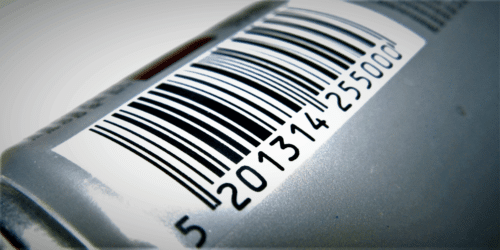
Every few years, the small town of Troy in Miami County, Ohio celebrates an historic occasion that for a few giddy weeks puts it on the world map of the grocery trade. At the time, National Cash Register, which provided the checkout equipment, was based in Ohio and Troy was also the headquarters of the Hobart Corporation, which developed the weighing and pricing machines for loose items such as meat. It was here, at just after 8 a.m. on June 26, 1974, that the first item marked with the Universal Product Code (UPC) was scanned at the checkout of Troy’s Marsh Supermarket.
It was treated as a ceremonial occasion and involved a little bit of ritual. The night before, a team of Marsh staff had moved in to put bar codes on hundreds of items in the store while National Cash Register installed their scanners and computers. The first “shopper” was Clyde Dawson, who was head of research and development for Marsh Supermarket; the pioneer cashier who “served” him, Sharon Buchanan. Legend has it that Dawson dipped into his shopping basket and pulled out a multi-pack of Wrigley’s Juicy Fruit chewing gum. Dawson explained later that this was not a lucky dip: he chose it because nobody had been sure that a bar code could be printed on something as small as a pack of chewing gum, and Wrigley had found a solution to the problem. Their ample reward was a place in American history.
The first item marked with the Universal Product Code (UPC) was scanned at the checkout of Troy’s Marsh Supermarket. Courtesy of Yale University Press
Joe Woodland said himself it sounded like a fairy tale: he had gotten the inspiration for what became the bar code while sitting on Miami Beach. He drew it with his fingers in the sand. What he was after was a code of some sort that could be printed on groceries and scanned so that supermarket checkout queues would move more quickly and stocktaking would be simplified.
That such a technology was needed was not his idea: it came from a distraught supermarket manager who had pleaded with a dean at Drexel Institute of Technology in Philadelphia to come up with some way of getting shoppers through his store more quickly. The delays and the regular stocktaking were costing him his profits. The dean shrugged him off, but a junior postgraduate, Bernard “Bob” Silver, overheard and was intrigued. He mentioned it to Woodland, who had graduated from Drexel in 1947. Woodland was already an inventor, and he decided to take on the challenge.
So confident was he that he would come up with a solution to the supermarket dilemma, Woodland left graduate school in the winter of 1948 to live in an apartment owned by his grandfather in Miami Beach. He had cashed in some stocks to tide him over. It was in January 1949 that Woodland had his epiphany, though the brilliance of its simplicity and its far-reaching consequences for modern existence were not recognized until many years later.
Joe Woodland (here) and Bernard Silver filed a patent in 1949, which was granted in 1952. Courtesy of Yale University Press
It was Morse Code that gave him the idea. Woodland had learned it when he was in the Boy Scouts. As he was sitting in a beach chair and pondering the checkout dilemma, Morse came into his head: “I remember I was thinking about dots and dashes when I poked my four fingers into the sand and, for whatever reason—I didn’t know—I pulled my hand toward me and I had four lines. I said ‘Golly! Now I have four lines and they could be wide lines and narrow lines, instead of dots and dashes. Now I have a better chance of finding the doggone thing.’ Then, only seconds later, I took my four fingers—they were still in the sand—and I swept them round into a circle.”
The patent illustrates the basic concept of a bull’s-eye-shaped bar code.
Back in Philadelphia, Woodland and Silver decided to see if they could get a working system going with the technology to hand. They first filed a patent in 1949, which was finally granted in 1952. Woodland and Silver had the right idea, but they lacked the minicomputer and, critically, a very bright light with which to “read” the black and white bar code. On July 16, 1960, Hughes Aircraft Company made one of the most sensational announcements in the history of science. One of their research scientists, Theodore Maiman, had made an “atomic radio light brighter than the center of the sun.” Maiman produced for the newsmen his “laser,” an acronym for Light Amplification by Stimulated Emission of Radiation.
Theodore Maiman looks at the ruby used to create the first laser beam. Bettmann/Corbis
A booklet produced in 1966 by the Kroger Company, which ran one of the largest supermarket chains in North America, signed off with a despairing wish for a better future: “Just dreaming a little . . . could an optical scanner read the price and total the sale. . . . Faster service, more productive service is needed desperately. We solicit your help.”
A small research team at the powerful Radio Corporation of America (RCA) was looking at a few new projects, including the possibility of an automatic bank cash machine, which they decided would not go because “the customer would not buy the concept.” Finally, they lighted on the bar code. They soon found the Woodland and Silver patent. Printing the bull’s-eye bar code proved to be one of the greatest difficulties, because any imperfections would make the whole system unworkable.
The first real-life test of RCA’s bull’s-eye bar code was at the Kroger Kenwood Plaza store in Cincinnati. Courtesy of the ID History Museum
On July 3, 1972, the first automated checkstands were installed. More checkstands were installed and a comparison with other Kroger stores told an undeniable and very promising story: the bull’s-eye bar code hit the target, with superior sales figures. But this was just one store in a nationwide grocery and supermarket business worth billions. If the laser and bar code were to revolutionize the checkout counter, they would have to be near universal.
The goal of the Ad Hoc Committee of the Universal Product Identification Code could be stated very simply. The representatives of the grocery trade were charged with finding a way to introduce a Universal Product Code, a bar code of some description that would be common to all goods sold in supermarkets and imprinted by the manufacturers and retailers. The code would carry information about the nature of the product, the company that made it, and so on. In-store computers would “read” this information with scanners and introduce their own variations, which might involve special offers and reductions.
In the end, seven companies, all of them based in the United States, submitted systems to the Symbol Committee, a technical offshoot of the Ad Hoc Committee. International Business Machines (IBM) made a surprise bid. IBM’s George Laurer was handed the specifications for a bar code that had been determined by the Symbol Selection Committee: it had to be small and neat, maximum 1.5 square inches; to save money it had to be printable with existing technology used for standard labels; it had been calculated that only ten digits were needed; the bar code had to be readable from any direction and at speed; there must be fewer than one in 20,000 undetected errors.
Like so many inventions, the UPC was not an immediate success. It was when the mass merchandisers adopted the UPC that it took off, Kmart being the first. In fact, bar code technology was almost made for companies like Walmart, which deal in thousands of goods that need to be catalogued and tracked. The bar code took off in the grocery and retail business in the 1980s, and at the same time began to transform manufacturing. In 2004, Fortune magazine estimated that the bar code was used by 80 to 90 percent of the top 500 companies in the United States.
Test tubes with blood samples are marked with bar codes. AB Still LTD/Science Photo Library/Corbis
Though the inspiration for the bar code was the plea by supermarkets for technology that would speed up the checkout, its greatest value to business and industry is that it has provided hard, statistical evidence for what sells and what does not. It has transformed market research, providing a rich picture of people’s tastes, and it has made production lines more efficient.
After many years of anonymity, the man whose knowledge of Morse Code inspired the familiar black and white stripes finally got some recognition. In February 1992, President George H.W. Bush was photographed at a national grocery convention looking intently at a supermarket scanner and having a go at swiping a can with a bar code over it. The New York Times correspondent wrote this up as evidence that it was the first time Bush had seen a supermarket checkout. In other words, he was out of touch with everyday American life.
His aides insisted that he was not struck by the novelty of the technology but by the fact that it could read a damaged bar code. Apocryphal or not, the story stuck and was regarded as damaging to Bush. However, as Woodland’s local newspaper put it: “George Bush isn’t one to hold a grudge. No Sir.” A few months after the checkout incident, Bush presented Woodland with a National Medal of Technology.
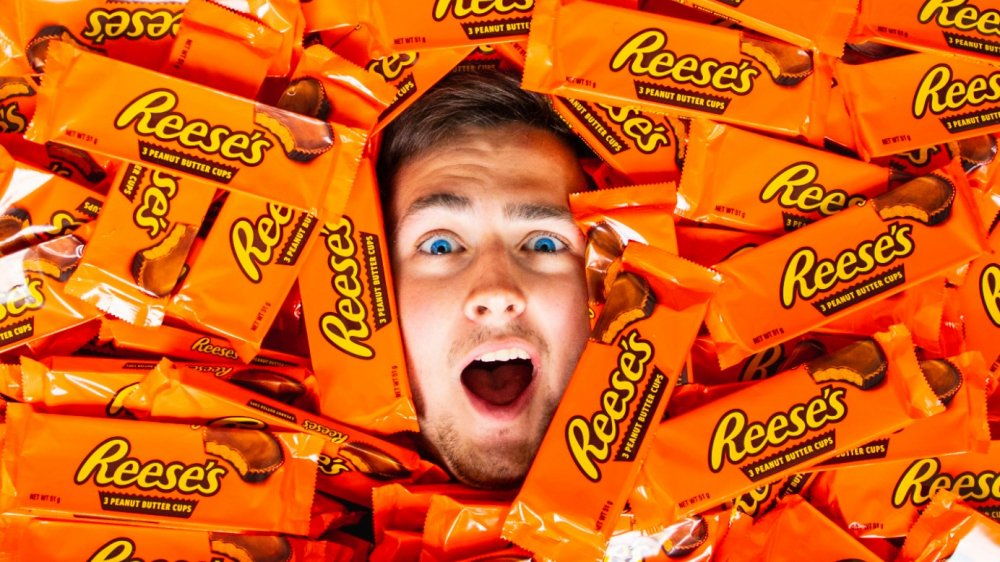
Seriously, is there anything better than the heavenly mix of chocolate and peanut butter? There’s something about Reese’s that’s just right. It doesn’t matter if you’re craving something sweet or something salty, Reese’s has you covered.
The Reese’s Peanut Butter Cup is the third most popular candy in the US (passed only by M&Ms and Hershey’s), and of all those surveyed, an overwhelming 81 percent liked them. (Only 6 percent didn’t, and who are those people?) The data is interesting: for the most part, people can agree that Reese’s are delicious, regardless of what generation they belong to. When someone wonders what millennials and boomers have in common, the answer is, “A love of Reese’s.”
Reese’s had very unlikely beginnings
While you might expect the culinary genius behind Reese’s to be a lifelong candy-maker, that’s not the case at all. The “Reese” that the candy was named for is creator Harry Burnett Reese, and according to the Hershey Archives, he labored away at a long list of jobs before he even came up with the idea of making candy. He was a factory worker, a farmer, and he even managed a fish hatchery, all before becoming a dairy farmer employed by none other than Milton Hershey.
Even then, the road to success wasn’t a straight one. Reese found himself needing to make some extra cash to support his growing family, and in 1919, he met a man at a Harrisburg, Pennsylvania market who gave him a recipe and asked him to make hard candies. It didn’t work — the candies stuck together — so it was back to the drawing board. Reese tried making a candy bar named for his daughter, a coconut caramel bar, and finally, he started making candies with various centers covered in chocolate. Originally, the chocolates came in assorted boxes: centers were cherry, dates, coconut, and, of course, peanuts. Starting to sound familiar? It absolutely should, because it was the foundation of a great idea.
Reese and Hershey were a match made in heaven
According to Business Insider, Reese always used fresh ingredients for the centers of his candies, as well as Hershey’s chocolate. He had started on one of Hershey’s dairy farms in 1917 before he eventually made the jump to working in the chocolate factory. Reese was still working for Hershey when he decided to strike out on his own. He quit his job in 1923, but first, he went to Hershey and asked for his permission not just to quit, but to set up his own candy company. Hershey said yes under the stipulation that all of Reese’s chocolate had to come from the Hershey company.
He agreed, and five years later, a simple suggestion would change the course of the company. A shop owner Reese was visiting on a sales call asked him if he could make something that was peanut butter on the inside and chocolate on the outside. Fortunately, he said he could, and it would go on to become the company’s flagship product.
Here’s why Reese’s only makes peanut butter cups
Reese’s started out making all sorts of candy, so why do we only get peanut butter cups today? Part of the reason is just that they were an outstanding success – when Reese was first trying to figure out how to make his peanut butter cups, he roasted his peanuts to the point where they were on the verge of burning — and that’s what still gives Reese’s peanut butter that oh-so-distinctive, unmistakable taste. Times were tough but sales were strong, and he was able to weather the lean years of the Great Depression.
But then came World War II and with it, food rationing. Sugar was on the top of the list of ingredients that were suddenly in limited supply. Some of his candies simply had to go and in the end, he kept only the peanut butter cup. It was a practical decision that ended up being a very good one since his peanut butter cups required the least amount of sugar to make.
Reese’s had an unusual ad campaign strategy
Ad campaigns can make or break a product, and in the case of Reese’s, their biggest ad campaigns definitely helped raise their profile. While you might think a well-established brand would want to market their longevity, Reese’s did the opposite. They launched a major 1970s campaign by pretending the candy was something new and that most people didn’t even like the idea of chocolate and peanut butter together.
The premise was simple: ads showed two people, one eating chocolate and one eating peanut butter. The people would collide and say, “Hey, you got peanut butter on my chocolate!” and “Hey, you got chocolate on my peanut butter!” They would then suddenly realize the amazing combo.
Reese’s Pieces stuck around because of E.T.
In the 1970s, Hershey launched a new product that they originally called PBs. These candy-coated peanut butter bits were eventually renamed Reese’s Pieces, and you’d think that the name “Reese’s” would have been enough to make them a major hit. At first, they kind of were. The candies had a successful launch, but according to the Hershey Archives, it wasn’t long before sales started tapering off. That’s not something any company wants to see, so when they got a phone call from Universal Studios, it was a big deal.
The phone call was about a movie called E.T., and Universal wanted to let Hershey know that Reese’s Pieces were going to be in the movie. Not surprisingly, the candy company jumped at the chance to help promote the movie. Hershey took a gamble and agreed to give Universal around a million dollars worth of marketing for E.T. without even seeing a script. Remember, in hindsight, we know what a huge hit the movie was, but at the time, Hershey was essentially taking a chance with a hefty wad of cash.
It paid off. Sales of Reese’s Pieces skyrocketed, and supposedly, it only happened because someone else had said “No,” first — and that was M&Ms.
Some Reese’s have a lot more peanut butter than others
Sure, the chocolate is great and all, but it’s Reese’s unique peanut butter that makes them amazing. If you’re in Camp Peanut Butter, you should know that not all Reese’s are created equal — and fortunately, someone’s done the math so you know just what you should splurge on. Redditor Rustid took a handful of various Reese’s candy, scraped out the peanut butter, and weighed it to come up with a definitive chocolate-to-peanut butter ratio rating. The findings are pretty surprising, and include the fact that the Small Heart contains the least amount of peanut butter — just around 19 percent! Yikes!
On the flip side, there’s the egg and the heart, which have a much more generous amount of about 60 percent peanut butter. The pumpkin and the King Size come in just below that with a touch over 50 percent peanut butter. That means all you peanut butter lovers out there should probably keep in it in mind that Valentine’s Day and Easter are the time to stock your year’s stash. What about those that are on the bottom? Minis come in pretty low on the ratio, too, as they’re around 28 percent peanut butter. Now you know, and you can plan accordingly.
If you get a bad Reese’s, they’ll replace it
No one’s perfect, and sometimes, things slip through the cracks. That’s even happened with Reese’s, and there’s a valuable lesson to be learned here — if you get a Reese’s without the peanut butter, definitely reach out to them on social media. In 2018, an Iowa man named Alex Hentges headed over to their Facebook page to post about his peanut-butter-less Reese’s and ask the company what the heck was going on.
They responded, and Today says that at first, they told him they were going to be sending him some coupons to replace his defective Reese’s. When mail showed up a few days later, it was something much more substantial. Hentges received a letter of apology and a massive box containing about 5 pounds of various Reese’s candy. Win!
While they said that they weren’t sure just how that particular cup missed getting its peanut butter, they said: “…The brand had to make things right!” Now that’s just great customer service.
There’s a scientific reason Reese’s taste so good
Reese’s mix of chocolate and peanut butter is nothing short of magical, and it turns out that there’s a scientific principle at work here. According to Penn State University professor of food science Gregory Ziegler (via Mic), it’s something called “dynamic sensory contrast.” What’s going on here is that your taste buds essentially love it when you eat something with completely contrasting textures — like the smoothness of the chocolate and the slightly crunchy peanut butter.
Couple that with another contrasting combination — the sweetness of the chocolate and the saltiness of the peanut butter — and you’ve got a winning team that no one can resist. There’s a catch, though — these contrasting flavors and textures are so good that it makes you sort of forget how much you’re eating. Ever powered your way through half a bag of Minis without realizing it?
It wasn’t you just being a glutton, it was science! Essentially, these contrasting flavors can taste so good it overrides our sense of feeling full. The principle is also called the “ice cream effect,” and it’s why there’s just always room for ice cream even after the biggest of dinners.
If you’ve never used Reese’s in a cocktail, you’re missing out
Sure, we’ve all had Reese’s on their own, and you’ve probably even baked with them, too. But have you had them in a cocktail? No? Why not! First, grab a bottle of vodka and a handful of Reese’s Pieces. Take out just enough vodka that you can pour in those little candy nuggets of deliciousness, replace the top, and let it sit. It might have to hang out on the top shelf for a few days, but it’s worth the wait. The vodka will be infused with all that Reese’s flavor and when it’s done, it’s cocktail time!
It’s the perfect thing to add to a dessert cocktail. Mix with milk, chocolate liqueur, and add a dash of chocolate syrup. Sounds pretty brilliant, right? Pretty much any drink that features those ingredients — or some cream, chocolate vodka, or Irish cream — is made better with the addition of some Reese’s-infused vodka. Better still? Use it to mix up a boozy milkshake, and it’ll be your new go-to treat.
The Victorian era was one of science and innovation. Cameras, cars, electricity and evolution were heralded in under the reign of Queen Victoria. In the world of Chemistry, Dalton and Faraday were making discoveries in atomic theory and electricity. One of the most famous chemists of this era was William Henry Perkin.
In 1856, an 18-year-old William Perkin, Hofmann’s assistant at the Royal College of Chemistry, was tasked to create a chemical synthesis of quinine. Quinine is found in tonic water and used as an anti-malarial. Perkin made several attempts at the synthesis over the Easter vacation in his home laboratory, using coal tar as a source of aniline. Oxidizing the aniline with potassium dichromate gave a black sludge which didn’t contain aniline: it contained something far more exciting. Perkin noticed whilst cleaning out a flask with ethanol that a purple solution had formed – an observation which led to Perkin becoming one of the most celebrated chemists of the Victorian era.
William Henry Perkin
The purple substance – initially named aniline purple – was one of the world’s first synthetic dyes: mauveine. Mauveine’s significance as a dye is its elusive colour. Throughout history, purple clothes have been worn almost exclusively by the richest in society due to the expense of creating purple dyes. Phoenician dye, known as ‘Purple of the Ancients’, is a famous example made from predatory sea snails.
Perkin was encouraged by his family to test the purple substance for colouring clothes. A sample was sent to Messrs Pullar of Perth who gave their approval. Finding success, he quickly patented the method. He set up a factory with his brother, funded by his father. In doing so, he brought purple to the Victorian mass market.
Purple became the height of fashion in Paris and London in the late 1850s to early 1860s, and the frenzy over mauve became known as ‘mauveine measles’. Even Queen Victoria was not exempt from the excitement, appearing in 1862 at the International Exhibition wearing a silk dress colored by mauveine. Wife of Napoleon III, Empress Eugenie wore mauveine-dyed dresses to stat functions.
Piece of silk dyed by Sir William Henry Perkin in 1860
But within this story there lurks a curious mystery. Closer inspection of Perkin’s synthesis method reveals that he may have been hiding something. There are eight bottles of mauvine alleged to have been made by Perkin left in the whole world, spread across six museums in four cities: London, Manchester, Bradford and New York. Museum-stored mauveine was tested in the 1990s and is rich in two main components – the chromophores of mauveine known as mauveine A and mauveine B.
Dr. John Plater at the University of Aberdeen repeated Perkin’s synthesis as it was written in the original patent, and here’s where the curiosity begins. The synthesis produces not two chromophores of mauveine, but four: A, B, B2 and C.
John Plater obtained his BSc in Chemistry from Loughborough University in 1986 and his PhD in heterocyclic synthesis from Imperial College of Science, Technology and Medicine in 1989. He was awarded his DSc from The University of Aberdeen in 2009 where he is currently Senior Lecturer.
Did Perkin miss something out when he patented his method? Or are the samples in these museums not genuine Perkin’s mauveine? To solve this mystery, Dr. Plater began investigating the synthesis of mauveine. Perkin’s starting material was aniline extracted from coal tar, and later made commercially from coal-tar, which would also have contained two impurities, ortho- and para-toluidine, which have a similar chemical structure to aniline.
A bottle of original William Henry Perkin (WHP) mauveine from the WHP factory in Greenford.
Dr. Plater’s attempts to make mauveine from different combinations of aniline and toluidines were always unsuccessful – he never managed to create a product with only the A and B chromophores. Every synthesis created four chromophores of mauveine. Removing the B2 and C chromophores was also impossible.
In the search for more information, Dr. Plater was given access to analyze three samples of Perkin’s mauveine. These samples were stored in museums: one in Manchester, Bradford, and the other in Sudbury, the London borough where Perkin built both his family home and his factory. One sample is accompanied with a letter, addressed to Prof Henry Armstrong Fellow of the Royal Society, from William Henry Perkin’s son, Frederick Mollwo Perkin. The ‘Mollwo’ letter, as it is now known, provides evidence that the museum-stored mauveine samples are from Perkin’s factory.
An example of a Victorian mauveine dyed silk dress, Science Museum London.
Dr Plater used liquid chromatography-mass spectrometry (LC-MS) to identify the chromophores present in these mauveine samples. In LC-MS, liquid chromatography is used to separate compounds by running them along a long column filled with reverse phase silica gel. The different chromophores reach the end of the column at different times. Mass spectrometry can then be used to identify the structure of each chromophore from its molecular mass and the way it fragments. This revealed that the Bradford and Sudbury mauveines, like the Manchester mauveine, are highly rich in mauveine A and B.
Museum-stored mauveines match each other in their compositions, and the Mollwo letter provides evidence that the samples originate from Perkin. However, the synthesis described by Perkin doesn’t produce mauveine with the correct composition. Dr. Plater deduces from this that Perkin actually used a different synthesis method from the one he said he used.
Perkin’s mauve was used to colour 6d postage stamps from 1867-1880.
A final clue in this mystery comes from six pence stamps. Victorian postage stamps printed using mauveine dyes are available to purchase online. Dr. Plater analyzed the mauveine in 15 six pence stamps using LC-MS. Each stamp had a slightly different composition, generally of all four chromophores. A fluctuating composition of mauveine provides further evidence that the method for synthesizing mauveine changed over time. Dr. Plater believes that his method is actually more similar than the method in Perkins patent to the method actually used by Perkin.
Purple became the height of fashion in Paris and London in the late 1850s to early 1860s, and the frenzy over mauve became known as ‘mauveine measles’.
One question remains: why would Perkin patent one method for making mauveine, but use another? An answer may be to do with the yield of product. Dr. Plater notes that mauveine is actually very difficult to make. The yields are low – about 1 per cent. The method proposed by Dr. Plater increases the yield to about five per cent. Perkin discovered this synthesis by accident, but clearly understood the chemistry well enough to understand the need for research and development.
But there may be another answer to this question. In a lecture in 1896, Perkin revealed his concerns about his competition: other manufacturers of mauveine were using copper chloride as an oxidizing agent in place of Perkin’s potassium dichromate. Dr. Plater has strong evidence now that Perkin never revealed his true method. Perkin may well have done this intentionally: as the demand for synthetic dyes grew, Perkin wanted to avoid his competition getting hold of his secrets.
Perkin was the first person to mass produce a synthetic dye, but this research uncovers a new aspect to Perkin’s achievements. Analysis of mauveine stored in museums, Victorian stamps, and Perkin’s original patent provides evidence that Perkin iterated and improved his method of making his dye, making him one of the first chemists to realize the value of research and development. Because Perkin never revealed his true method, we may never know how he did it – but with Dr. Plater’s research we are one step closer to the truth.
It took a war, famine, and poultry to develop the technological breakthrough responsible for saving thousands of premature infants. The Franco-Prussian war in 1870-1871, along with a concomitant famine, had contributed to a significant population decline in France. To increase the growth rate, the French needed to start having more babies, as quickly as possible. But one obstetrician realized that if he could find a way to reduce infant mortality, then the population growth rate problem could be solved far sooner.
Dr. Etienne Stephane Tarnier
That French obstetrician was Dr. Étienne Stéphane Tarnier, who, having observed the benefits of warming chambers for poultry at the Paris Zoo, had similar chambers constructed for premature infants under his care. These warm air incubators, introduced at L’Hôpital Paris Maternité in 1880, were the first of their kind. Dr. Pierre Budin began publishing reports of the successes of these incubators in 1888. His incubators had solved the deadly problem of thermoregulation that many premature babies faced.
Dr. Budin wanted to share his innovation with the world, but few in the stubborn medical establishment would listen. Many doctors viewed the practice as pseudo-scientific and outside the realm of standard care. But Dr. Budin was convinced that the Tarnier incubators would save so many lives that he enlisted the help of an associate, Dr. Martin Couney, in exhibiting the new incubators at the World Exposition in Berlin in 1896.
Dr. Pierre Budin
Apparently blessed with skills in showmanship as well as medicine, Dr. Couney took the assignment perhaps a step farther than what Dr. Budin has originally anticipated; Couney asked the Berlin Charity Hospital to borrow some premature babies for this experiment, and they granted his request, thinking that the children had little chance of survival anyway. When he managed to hire a cadre of nurses to fully demonstrate the capabilities of the incubators, he was ready to take the show on the road.
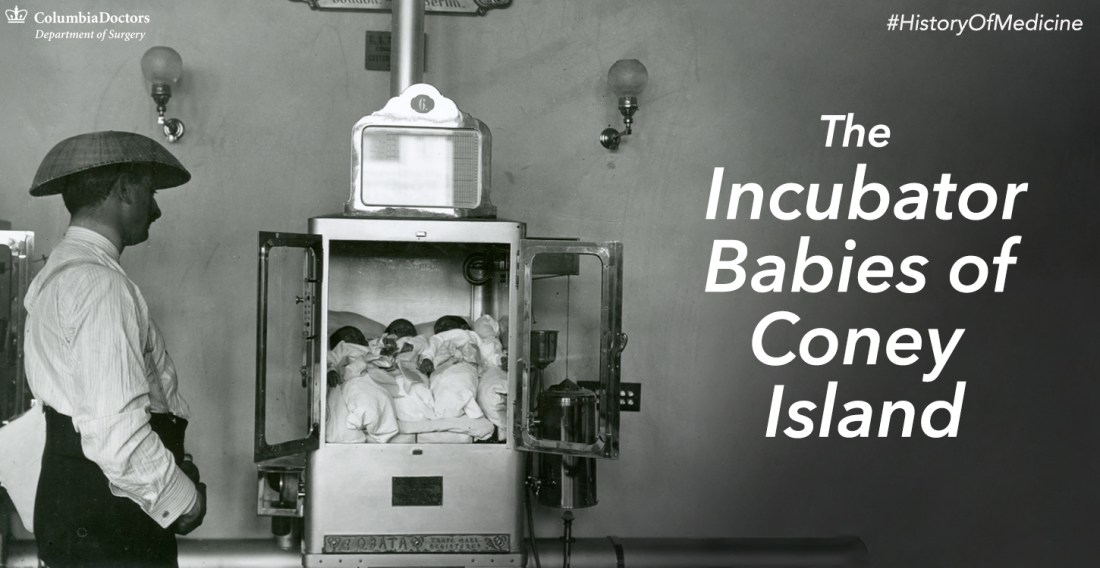
Nestled between exhibits of the Congo Village and the Tyrolean Yodelers, “Couney’s Kinderbrutanstalt,” or ‘Child Hatchery,’ became a wild success. Remarkably, all six babies in the Tarnier incubators survived. From there, Couney took his entourage to the United States where he went on to share his show at virtually every large exhibition and at the World’s Fair. He ultimately settled at New York City’s Coney Island amusement park and connected parents eager to save the lives of their premature newborns with circus sideshow visitors willing to pay 25¢ to view the uncannily tiny babies. It was an odd connection indeed, but a brilliant one that kept the warming glow of the incubator lights on for over 40 years, and saved thousands of babies in the process.
Modern Incubator
The babies were premature infants kept alive in incubators pioneered by Dr. Martin Couney. The medical establishment had rejected his incubators, but Couney didn’t give up on his aims. Each summer for 40 years, he funded his work by displaying the babies and charging admission — 25 cents to see the show.
In turn, parents didn’t have to pay for the medical care, and many children survived who never would’ve had a chance otherwise. Lucille Horn was one of them. Born in 1920, she, too, ended up in an incubator on Coney Island. “My father said I was so tiny, he could hold me in his hand,” she tells her own daughter, Barbara, on a visit with StoryCorps in Long Island, N.Y. “I think I was only about 2 pounds, and I couldn’t live on my own. I was too weak to survive.”
She’d been born a twin, but her twin died at birth. And the hospital didn’t show much hope for her, either: The staff said they didn’t have a place for her; they told her father that there wasn’t a chance in hell that she’d live. “They didn’t have any help for me at all,” Horn says. “It was just: You die because you didn’t belong in the world.”
But her father refused to accept that for a final answer. He grabbed a blanket to wrap her in, hailed a taxicab and took her to Coney Island — and to Dr. Couney’s infant exhibit.
(Dr. Martin Couney holds Beth Allen, one of his incubator babies, at Luna Park in Coney Island. This photo was taken in 1941. Courtesy of Beth Allen)
“How do you feel knowing that people paid to see you?” her daughter asks. “It’s strange, but as long as they saw me and I was alive, it was all right,” Horn says. “I think it was definitely more of a freak show. Something that they ordinarily did not see.”
Horn’s healing was on display for paying customers for quite a while. It was only after six months that she finally left the incubators.
Years later, Horn decided to return to see the babies — this time as a visitor. When she stopped in, Couney happened to be there, and she took the opportunity to introduce herself.
“And there was a man standing in front of one of the incubators looking at his baby,” Horn says, “and Dr. Couney went over to him and he tapped him on the shoulder.”
“Look at this young lady,” Couney told the man then. “She’s one of our babies. And that’s how your baby’s gonna grow up.” After all, Horn was just one of thousands of premature infants that Couney cared for and exhibited at world fairs, exhibits and amusement parks from 1896 until the 1940s. He died in 1950, shortly after incubators like his were introduced to most hospitals.
At the time, Couney’s efforts were still largely unknown — but there is at least one person who will never forget him. “You know,” she says, “there weren’t many doctors then that would have done anything for me. Ninety-four years later, here I am, all in one piece. And I’m thankful to be here.”
Lucille Horn and her daughter Barbara on a recent visit to StoryCorps in Long Beach, NY (StoryCorps)
“Every word carries a secret inside itself; it’s called etymology. It is the DNA of a word.” — Mary Ruefle,”Madness, Rack & Honey”
“Etymology” derives from the Greek wordetumos, meaning “true.” The practice of etymology is uncovering the truth by tracing the root of a word. If you’re interested in language, it can be quite exhilarating. Like being a linguistic detective. There will be few pictures in this one so settle down….this will take you a few minutes!!!
1. Disaster
“anything that befalls of ruinous or distressing nature; any unfortunate event,” especially a sudden or great misfortune, 1590s,
from French désastre (1560s),
from Italian disastro, literally “ill-starred,” from dis-,
from Latin astrum,
from Greek astron “star”.
The origin of the word points to unfavorable events being blamed on certain planet positions. Destiny is written in the stars – in some conceptions of fate in mythology, the universe is fixed and inevitable.
2. Muscle
A far cry from World’s Strongest Man, the origin of the word ‘muscle’ is perhaps the most surprising.
“contractible animal tissue consisting of bundles of fibers,”
late 14c., “a muscle of the body,”
from Latin musculus “a muscle,” literally “a little mouse.
Rather than relating to strength and brawn as we understand it, ‘muscle’ is derived from the appearance of a muscle under the skin. Particularly biceps, which were thought both in Latin and in Greek to resemble a mouse running beneath the skin.
3. Nice
Perhaps you’ve been told by an English teacher in the past to avoid using the word ‘nice’. This is because the word is so commonly used in our language that it’s not highly descriptive or imaginative. Many English teachers consider it a cop-out. Yet its origins are far more interesting than the word appears.
late 13c., “foolish, ignorant, frivolous, senseless,”
from Old French nice (12c.) “careless, clumsy; weak; poor, needy; simple, stupid, silly, foolish,”
from Latin nescius “ignorant, unaware,” literally “not-knowing,”
4. Cloud
Old English clud “mass of rock, hill,” related to clod.
The modern sense “rain-cloud, mass of evaporated water visible and suspended in the sky” is a metaphoric extension that begins to appear c. 1300 in southern texts, based on the similarity of cumulus clouds and rock masses.
The usual Old English word for “cloud” was weolcan (see welkin).
In Middle English, skie also originally meant “cloud.”
The last entry for cloud in the original rock mass sense in Middle English Compendium is from c. 1475.
The origins of the word ‘cloud’ are surprising. You wouldn’t automatically associate their wispy appearance with the solidity of rocks. The etymology explains that it refers to the mass it accumulates and thus appearing similar to earth formations.
5. Oxymoron
This is a great example of the word being an example of itself.
in rhetoric, “a figure conjoining words or terms apparently contradictory so as to give point to the statement or expression,”
1650s, from Greek oxymōron, noun use of neuter of oxymōros (adj.) “pointedly foolish,”
from oxys “sharp, pointed” (from PIE root *ak- “be sharp, rise (out) to a point, pierce”) + mōros “stupid” (see moron).
Now, it’s used more broadly to denote a contradiction in terms. Originally, though, it was a clash of terms around sharpness and dullness.
6. Quarantine
The origins of ‘quarantine’ may interest you.
1660s, “period a ship suspected of carrying disease is kept in isolation,”
from Italian quaranta giorni, literally “space of forty days,”
from quaranta “forty,” from Latin quadraginta “forty,” which is related to quattuor “four” (from PIE root *kwetwer- “four”). So called from the Venetian policy (first enforced in 1377) of keeping ships from plague-stricken countries waiting off its port for 40 days to assure that no latent cases were aboard. Also see lazaretto.
The extended sense of “any period of forced isolation” is from the 1670s.
Earlier in English the word meant “period of 40 days in which a widow has the right to remain in her dead husband’s house” (1520s), and, as quarentyne (15c.), “desert in which Christ fasted for 40 days,” from Latin quadraginta “forty.”
We understand ‘quarantine’ as a period of isolation to prevent the spread of an illness, but the background on this is very interesting. The root of the word is more specific to the period of time elapsed.
7. Tragedy
Without the word ‘tragedy’, we wouldn’t have one of the greatest songs by the Bee Gees. But there is also an interesting word history to be grateful for.
late 14c., “play or other serious literary work with an unhappy ending,”
from Old French tragedie (14c.), from Latin tragedia “a tragedy,”
from Greek tragodia “a dramatic poem or play in formal language and having an unhappy resolution,”
apparently literally “goat song,” from tragos “goat, buck” + ōidē “song” (see ode), probably on model of rhapsodos (see rhapsody).
Although the specificity of the goat connection is debated, the connection to goats, in general, is accepted. There are a few different possibilities as to why. The etymology includes the literal translation “goat song”. Tragedy as we know it has its roots in ancient Greece, where it’s thought people dressed as goats and satyrs in plays. There are other theories surrounding goat sacrifices. Either way, who knew goats were involved at all?
8. Surprise
What would a list of surprising etymology be without the word ‘surprise’ itself?
also formerly surprize, late 14c.,
“unexpected attack or capture,” from Old French surprise “a taking unawares” (13c.),
from noun use of past participle of Old French sorprendre “to overtake, seize, invade” (12c.),
Meaning “something unexpected” first recorded 1590s, that of “feeling of astonishment caused by something unexpected” is c. 1600.
Meaning “fancy dish” is attested from 1708.
When you think of the word ‘surprise’ today, you might think of smiling faces. In history, though, it had a much more violent origin. The word is rooted in an invasion in having the element of surprise as an advantage. It is also interesting that it has root words meaning “grasp”. This can also be related to words like “comprehend”.
9. Comrade
It is interesting how the word ‘comrade’ is considered a non-neutral term. Whether it’s a veteran recalling time spent with his old army comrades, or used among the political left. Its origins point to it being more widely applicable.
1590s, “one who shares the same room,” hence “a close companion,”
from French camarade (16c.),
from Spanish camarada “chamber mate,” or Italian camerata “a partner,”
from Latin camera “vaulted room, chamber” (see camera).
In Spanish, a collective noun referring to one’s company.
In 17c., sometimes jocularly misspelled comrogue.
Used from 1884 by socialists and communists as a prefix to a surname to avoid “Mister” and other such titles.
Also related: Comradely; comradeship.
With this considered, you could call any of your cohabitants “comrade”. And it’s perfectly acceptable to use it for your partner, no matter what your politics are.
10. Clue
To end where we started, with the spirit of investigation, let’s have a look at the word ‘clue’.
“anything that guides or directs in an intricate case,” 1590s, a special use of a revised spelling of clew “a ball of thread or yarn” (q.v.).
The word, which is native Germanic, in Middle English was clewe, also cleue; some words were borrowed from Old French and Middle but these later were reformed, and this process was extended to native words (hue, true, clue) which had ended in a vowel and -w.
The spelling clue is first attested mid-15c.
The sense shift is originally in reference to the clew of thread given by Ariadne to Theseus to use as a guide out of the Labyrinth in Greek mythology. The purely figurative sense of “that which points the way,” without regard to labyrinths, is from 1620s.
As something which a bewildered person does not have, by 1948.
The word origins rooted in old stories like this are the most fascinating. A clue could be any object now. But, once upon a time, it was explicitly a ball of yarn a character used to find his way.
























 Sew Colorful