ETYMOLOGY OF WORDS AND PHRASES – PART 8

Continuing my etymology series, today I am focusing only on some common phrases. If you have any phrases you are curious about, hit me up and I’ll see what I can find for you. Enjoy!!!

A bird in the hand is worth two in the bush

This proverb, like many others, warns against taking risks. It suggests that you should keep what you have and not risk losing it by going after more. The allusion may be to falconry where a bird in the hand (the falcon) was a valuable asset and certainly worth more than two in the bush (the prey).

This proverbial saying is first found in English in John Capgrave’s “The Life of St Katharine of Alexandria, 1450”: “It is more sekyr [certain] a byrd in your fest, Than to haue three in the sky a‐boue.”

John Heywood’s 1546 glossary “A Dialogue conteinyng the nomber in effect of all the Prouerbes in the Englishe tongue” also includes a variant of the proverb: Better one byrde in hande than ten in the wood. The 7th century Aramaic “Story of Ahikar” has text that modern translations render as “Better is a sparrow held tight in the hand than a thousand birds flying about in the air.”

Cat got your tongue?

The origin of the phrase ‘has the cat got your tongue?’ isn’t known. What is certain is that it isn’t derived as a reference to the cat o’ nine tails or people’s tongues being fed to cats in ancient Egypt. Both of these have been suggested and there’s no shred of evidence to support either of them.

‘Cat got your tongue?’ is the shortened form of the query ‘Has the cat got your tongue?’ and it is the short form that is more often used. It is somewhat archaic now but was in common use until the 1960/70s. It was directed at anyone who was quiet when they were expected to speak, and often to children who were being suspiciously unobtrusive.

There’s no derivation that involves any actual cat or celebrated incident of feline theft. Like the blackbird that ‘pecked off his nose’, the phrase is just an example of the light-hearted imagery that is, or was, directed at children.

The expression sounds as though it might be old but isn’t especially so. There are no instances of it in print until the mid 19th century. The early examples of the expression in print all come from the USA, which reinforces the falsity of the Egyptian or Royal Navy origins.

Hell’s bells

The exclamation ‘Hell’s bells’ has been used in both the UK and the USA since at least the mid-19th century. The earliest example of it in print that can be found is from the weekly London sporting newspaper “The Era,” February 1840. The rather fanciful story concerned a character who had stolen his friend’s partridges and replaced them with pigeons, claiming them to be ptarmigan.

There’s no reason to look for any special meaning of Hell’s bells – it doesn’t refer to diabolical campanology – the ‘bells’ are added just for the rhyme. It is an uncommon phrase in that, as well as being an example of reduplication, it is also a minced oath. Adding ‘bells’ was simply a way of uttering the oath ‘Hell’ and making it sound acceptable in polite company.

The expression is often extended by other evocative but meaningless additions. In the UK this is often ‘Hell’s bells and buckets of blood’ and, in the USA, ‘Hells bells and little fishes’ or ‘Hells bells and a bunch of parsley’. There are many other variants, in fact almost anything can be added to ‘Hell’s bells…’ as there’s no requirement for the addition to make sense.

Hold a candle

The expression ‘can’t hold a candle to’ refers to someone who compares badly to an known authority – to be unfit even to hold a subordinate position. Apprentices used to be expected to hold the candle so that more experienced workmen were able to see what they were doing. Someone unable even to do that would be of low status indeed.

Sir Edward Dering used a similar phrase ‘to hold the candle’ in his “The fower cardinal-vertues of a Carmelite fryar,” 1641: “Though I be not worthy to hold the candle to Aristotle.”

‘To hold a candle’ is first recorded in 1883 in William Norris’s “No New Thing:” “Edith is pretty, very pretty; but she can’t hold a candle to Nellie.”

Raise Cain

Cain was the first murderer according to scriptural accounts in the Bible – Genesis 4 and in the Qur’an – 5:27-32.

The biblical account, from the King James’ Version, tells of how Cain and Abel, the two sons of Adam and Eve, bring offerings to God, but only Abel’s is accepted. Cain kills Abel in anger and is cursed by God.

The transitive verb ‘to raise’ has been used since at least the 14th century to mean ‘to conjure up; to cause a spirit to appear by means of incantations’. Geoffrey Chaucer made use of that meaning in “The Canon’s Yeoman’s Tale,” circa 1395:

I haue yow told ynowe To reyse a feend al looke he neuere so rowe.

In Modern English – [I have told you enough already to raise a fiend, look he never so savage.]

If you make trouble you are raising, that is, conjuring up, the accursed spirit of Cain. This is similar to several phrases that allude to calling-up or ‘raising’ the Devil. There’s ‘raise the Devil’ of course and also ‘raise hob’ and ‘raise hell’.

The phrase is American and is first found there in the late 19th century; for example, this little pun on the word ‘raised’ from the St. Louis’ “Daily Pennant,” May 1840: “Why have we every reason to believe that Adam and Eve were both rowdies? Because they both raised Cain.”

A picture is worth a thousand words

This phrase emerged in the USA in the early part of the 20th century. Its introduction is widely attributed to Frederick R. Barnard, who published a piece commending the effectiveness of graphics in advertising with the title “One look is worth a thousand words”, in “Printer’s Ink,” December 1921. Barnard claimed the phrase’s source to be oriental by adding “so said a famous Japanese philosopher, and he was right.”

Printer’s Ink printed another form of the phrase in March 1927, this time suggesting a Chinese origin: “Chinese proverb. One picture is worth ten thousand words.”

The arbitrary escalation from ‘one thousand’ to ‘ten thousand’ and the switching from Japan to China as the source leads us to smell a rat with this derivation. In fact, Barnard didn’t introduce the phrase – his only contribution was the incorrect suggestion that the country of origin was Japan or China. This has led to another popular belief about the phrase that it was coined by Confucius. It might fit the Chinese-sounding ‘Confucius he say’ style, but the Chinese derivation was pure invention.

A similar idea was seen very widely in the USA from the early 20th century, in adverts for “Doan’s Backache Kidney Pills,” which included a picture of a man holding his back and the text “Every picture tells a story.”

Neither of the above led directly to ‘a picture is worth a thousand words’. Who it was that married ‘worth ten thousand words’ with ‘picture’ isn’t known, but we do know that the phrase is American in origin. It began to be used quite frequently in the US press from around the 1920s onward. The earliest example found is from the text of an instructional talk given by the newspaper editor Arthur Brisbane to the “Syracuse Advertising Men’s Club,” in March 1911:

“Use a picture. It’s worth a thousand words.”

Etymology of Words and Phrases, Part 6

TURN A BLIND EYE – The phrase “turn a blind eye”—often used to refer to a willful refusal to acknowledge a particular reality—dates back to a legendary chapter in the career of the British naval hero Horatio Nelson. During 1801’s Battle of Copenhagen, Nelson’s ships were pitted against a large Danish-Norwegian fleet. When his more conservative superior officer flagged for him to withdraw, the one-eyed Nelson supposedly brought his telescope to his bad eye and blithely proclaimed, “I really do not see the signal.” He went on to score a decisive victory. Some historians have since dismissed Nelson’s famous quip as merely a battlefield myth, but the phrase “turn a blind eye” persists to this day.

Admiral Horatio Nelson

WHITE ELEPHANT – White elephants were once considered highly sacred creatures in Thailand—the animal even graced the national flag until 1917—but they were also wielded as a subtle form of punishment. According to legend, if an underling or rival angered a Siamese king, the royal might present the unfortunate man with the gift of a white elephant. While ostensibly a reward, the creatures were tremendously expensive to feed and house, and caring for one often drove the recipient into financial ruin. Whether any specific rulers actually bestowed such a passive-aggressive gift is uncertain, but the term has since come to refer to any burdensome possession—pachyderm or otherwise.

CROCODILE TEARS – Modern English speakers use the phrase “crocodile tears” to describe a display of superficial or false sorrow, but the saying actually derives from a medieval belief that crocodiles shed tears of sadness while they killed and consumed their prey. The myth dates back as far as the 14th century and comes from a book called “The Travels of Sir John Mandeville.” Wildly popular upon its release, the tome recounts a brave knight’s adventures during his supposed travels through Asia. Among its many fabrications, the book includes a description of crocodiles that notes, “These serpents sley men, and eate them weeping, and they have no tongue.” While factually inaccurate, Mandeville’s account of weeping reptiles later found its way into the works of Shakespeare, and “crocodile tears” became an idiom as early as the 16th century.

DIEHARD – While it typically refers to someone with a strong dedication to a particular set of beliefs, the term “diehard” originally had a series of much more literal meanings. In its earliest incarnation in the 1700s, the expression described condemned men who struggled the longest when they were executed by hanging. The phrase later became even more popular after 1811’s Battle of Albuera during the Napoleonic Wars. In the midst of the fight, a wounded British officer named William Inglis supposedly urged his unit forward by bellowing “Stand your ground and die hard … make the enemy pay dear for each of us!” Inglis’ 57th Regiment suffered 75 percent casualties during the battle, and went on to earn the nickname “the Die Hards.”

57th Regiment

RESTING ON YOUR LAURELS: The idea of resting on your laurels dates back to leaders and athletic stars of ancient Greece. In Hellenic times, laurel leaves were closely tied to Apollo, the god of music, prophecy and poetry. Apollo was usually depicted with a crown of laurel leaves, and the plant eventually became a symbol of status and achievement. Victorious athletes at the ancient Pythian Games received wreaths made of laurel branches, and the Romans later adopted the practice and presented wreaths to generals who won important battles. Venerable Greeks and Romans, or “laureates,” were thus able to “rest on their laurels” by basking in the glory of past achievements. Only later did the phrase take on a negative connotation, and since the 1800s it has been used for those who are overly satisfied with past triumphs.

READ THE RIOT ACT – These days, angry parents might threaten to “read the riot act” to their unruly children. But in 18th-century England, the Riot Act was a very real document, and it was often recited aloud to angry mobs. Instituted in 1715, the Riot Act gave the British government the authority to label any group of more than 12 people a threat to the peace. In these circumstances, a public official would read a small portion of the Riot Act and order the people to “disperse themselves, and peaceably depart to their habitations.” Anyone that remained after one hour was subject to arrest or removal by force. The law was later put to the test in 1819 during the infamous Peterloo Massacre, in which a cavalry unit attacked a large group of protestors after they appeared to ignore a reading of the Riot Act.

1819 Peterloo Massacre

PAINT THE TOWN RED – The phrase “paint the town red” most likely owes its origin to one legendary night of drunkenness. In 1837, the Marquis of Waterford—a known lush and mischief maker—led a group of friends on a night of drinking through the English town of Melton Mowbray. The bender culminated in vandalism after Waterford and his fellow revelers knocked over flowerpots, pulled knockers off of doors and broke the windows of some of the town’s buildings. To top it all off, the mob literally painted a tollgate, the doors of several homes and a swan statue with red paint. The marquis and his pranksters later compensated Melton for the damages, but their drunken escapade is likely the reason that “paint the town red” became shorthand for a wild night out. Still yet another theory suggests the phrase was actually born out of the brothels of the American West, and referred to men behaving as though their whole town were a red-light district.

BY AND LARGE – Many everyday phrases are nautical in origin— “taken aback,” “loose cannon” and “high and dry” all originated at sea—but perhaps the most surprising example is the common saying “by and large.” As far back as the 16th century, the word “large” was used to mean that a ship was sailing with the wind at its back. Meanwhile, the much less desirable “by,” or “full and by,” meant the vessel was traveling into the wind. Thus, for mariners, “by and large” referred to trawling the seas in any and all directions relative to the wind. Today, sailors and landlubbers alike now use the phrase as a synonym for “all things considered” or “for the most part.”

16th Century Spanish Galleon

THE THIRD DEGREE – There are several tales about the origin of “the third degree,” a saying commonly used for long or arduous interrogations. One theory argues the phrase relates to the various degrees of murder in the criminal code; yet another credits it to Thomas F. Byrnes, a 19th-century New York City policeman who used the pun “Third Degree Byrnes” when describing his hardnosed questioning style. In truth, the saying is most likely derived from the Freemasons, a centuries-old fraternal organization whose members undergo rigorous questioning and examinations before becoming “third degree” members, or “master masons.

Thomas F. Byrnes
You will need to enlarge this to see details.
This one doesn’t provide any detail but the overall picture should give you an idea.

SPILL THE BEANS –

One explanation dates back to ancient Greece when people would use beans to vote anonymously. White beans were used for positive votes, and for negative votes, black beans or other dark-colored beans were used. These votes were cast in secret, so if someone knocked over the beans in the jar—whether by accident or intentionally—they “spilled the beans” and revealed the results of the votes prematurely. Eventually, in modern times, the phrase “spill the beans” came to mean “upset a previously stable situation by talking out of turn.”

DIME A DOZEN – After the dime was made in 1796, people started advertising goods for “a dime a dozen.” This meant you were getting a good deal on products, such as a dozen eggs. Over time, the idiom evolved to mean the opposite. Instead of something being a good deal, it became a phrase to describe something that’s not valuable and easily available. The first known use of it in this context is believed to have occurred in 1930. From there, people picked up on the phrase’s new meaning and started using it in that context.

Etymology, Part 3: Common Sayings

TAKES THE CAKE: The phrase “takes the cake” comes from the cake walks that were popular in the late 19th century. Couples would strut around gracefully and well-attired, and the couple with the best walk would win a cake as a prize. Interestingly, cake walk was soon used to describe something that could be done very easily, and it’s very possible that from there we get the phrase “piece of cake.”

PARTING SHOT: A parting shot, which is a final insult tossed out at the end of a fight when you assume it’s over, was originally a Parthian shot. The Parthians, who lived in an ancient kingdom called Parthia, had a strategy whereby they would pretend to retreat, then their archers would fire shots from horseback. Parthian sounds enough like parting, and, coupled with the fact that not a lot of people knew who the Parthians were, the phrase was changed to parting shot.

DEAD AS A DOORNAIL: One could certainly argue that a doornail was never alive, but when a doornail is dead, it has actually been hammered through a door, with the protruding end hammered and flattened into the door so that it can never come loose or be removed or used again. The phrase “dead as a doornail” has actually been around since the 14th century, about as long as the word doornail has officially been in the English language.

DOWN TO BRASS TACKS: “There are many theories about what “down to brass tacks” means, including that brass tacks is rhyming slang for hard facts. But it’s very likely that the brass tacks being mentioned here are actual brass tacks. Merchants used to keep tacks nailed into their counters to use as guides for measuring things, so to get down to brass tacks would be you were finally done deciding what you wanted and were ready to cut some fabric and do some actual business.

IT’S GREEK TO ME: “The phrase “it’s Greek to me” is often attributed to Shakespeare, but it’s been around since well before his time. An earlier version of the phrase can be found written in Medieval Latin translations, saying “Graecum est; non potest legi,” or “it’s Greek. Cannot be read.”

SMART ALEC: “You may have presumed the Alec in “smart Alec” was just a name that sounded good preceded by the word smart, but that’s not necessarily the case. Professor Gerald Cohen suggested in his book”Studies in Slang” that the original smart Alec was Alexander Hoag, a professional thief who lived and robbed in New York City in the 1840s. Hoag was a very clever criminal who worked with his wife and two other policemen to pickpocket and rob people. He was eventually busted when he decided to stop paying the cops.

HEARD IT THRU THE GRAPEVINE: “The grapevine people hear things through is a grapevine telegraph, which was the nickname given to the means of spreading information during the Civil War as a kind of wink at an actual telegraph. The grapevine telegraph is just a person-to-person exchange of information, and much like when you play a game of telephone, it’s best to presume that the information you receive has gone through a few permutations since it was first shared.

CAT’S OUT OF THE BAG: “Farmers used to stick little suckling pigs in bags to take them to market. But if a farmer was trying to rip somebody off, they would put a cat in the bag instead. So, if the cat got out of the bag, everybody was onto their ruse, which is how we use the phrase today, just not quite so literally. (We hope.)

OUT OF WACK: “Today, “out of whack” means not quite right, but it took a long time to get there. Whack appeared in the 18th century as a word that meant to strike a blow when used as a verb. The noun whack was the blow that was whacked on something. But whack also grew to mean portion or share, especially as loot that was being split by criminals. From there, whack grew to mean an agreement, as in the agreed share of loot, but it also meant in good order. If something was behaving as it was intended to, it was “in fine whack.” Eventually the opposite fell into common usage, and something that wasn’t in good shape was “out of whack.”

KIBOSH: “Evidence of kibosh dates the word to only a few years before Charles Dickens used it in an 1836 sketch, but despite kibosh being relatively young in English its source is elusive. Another hypothesis pointed to Irish caidhp bhais, literally, coif (or cap) of death, explained as headgear a judge put on when pronouncing a death sentence, or as a covering pulled over the face of a corpse when a coffin was closed. Today, “to put the kibosh on something” is to shut it down.

BETWEEN A ROCK AND A HARD PLACE: “Some people think that the phrase “between a rock and a hard place” is a kind of sloppy reference to Odysseus. But in 1921, the phrase became a popular means of describing when miners had to choose between dangerous work for little or no money or definite poverty during the Great Bankers’ Panic of 1907.

GOT UP ON THE WRONG SIDE OF THE BED: “The generally accepted origin of the phrases “get up on the wrong side of the bed” and wake up on the wrong side of the bed is ancient Rome, where superstition was rampant. Ancient philosophers equated the right side of anything as the positive side, and the left side of anything as the sinister or negative side. The story says that Romans always exited the bed on the right side in order to start the day in contact with positive forces. If one rose on the left side of the bed, he started the day in contact with negative forces.

MAD AS A HATTER: “The expression is linked to the hat-making industry and mercury poisoning. In the 18th and 19th centuries, industrial workers used a toxic substance, mercury nitrate, as part of the process of turning the fur of small animals, such as rabbits, into felt for hats. Workplace safety standards often were lax and prolonged exposure to mercury caused employees to develop a variety of physical and mental ailments, including tremors (dubbed “hatter’s shakes”), speech problems, emotional instability and hallucinations.

WHAT IS THE REAL STORY BEHIND THE LAS VEGAS CARNAGE?

There are many theories out there about what was really behind the shooting at the Mandalay Bay in Las Vegas on October 1, 2017. Regardless of the motivation, it was horrific for those at the festival, with many an odd coincidence cropping up day after day after day. We all know SOMETHING isn’t right about this – there are just far too many oddities and we know what that means!

Aftermath

I am going to completely ignore the accepted “story” that has been bandied about by the media and focus instead on the connections to the Saudi regime, with connections to the Killary Show and the Muslim-in-Chief. IMO, Paddock was a CIA/FBI patsy/player who was used for this shitshow, whether knowingly or not – who can say? Waaay too much shady shit in HIS background!

Let’s lay out the players here and provide the backstory…..we all know the Saud Family is very incestuous, devious and convoluted. The current King Salman has 13 children from 3 different marriages. The current Crown Prince is one of his sons from his 3rd marriage, Mohammed Bin Salman.

Mohammed Bin Salman

Another critical player in this cat-and-mouse game is Alwaleed bin Talal, a billionaire businessman who is the Grandson of King Saud. He has ties to the DNC, Clinton, Podesta, and Obama. He also co-owned (with Bill Gates) The Four Seasons at Mandalay Bay in Las Vegas, which occupies the top five floors of Mandalay Bay from 35 to 39 (Paddock was on 32), as well as shares in Twitter and other high-tech silicon valley companies. He is just one of many, many “family” members who have designs on the Crown but he is more deeply and directly involved in US politics than most. He funded Obama’s stint at Harvard……

Prince Alaweed

Flash back to the May 2017 meeting….the Globe…..you see, SA was in a bind – they underestimated the amounts of natural gas the US was able to produce via fracking….they had vastly underestimated the amount of total shale reserves in North America. They had no idea that so much of this stuff exists and thought maybe they could ride it out if the reserves would dry up in a decade or so. But nope. We have enough shale to supply us for at least 50 years. Hmmm… big problem.

So, if you’re King Salman, what do you do? Well, there’s only one thing you can do. Give up the reliance on oil production and try to use existing wealth to stay wealthy; to modernize trade to include more than just exports of oil. They would need to build an entire industrial country from scratch and, to do that, he needed the help of the USA. which is where President Trump comes in.

MBS and POTUS

It was a business meeting – King Salman asked Trump for help. Trump was more than willing to give it (like listing the oil companies on the NYSE) but his help would come with a price: Liberalization and the stop of illegal funding; no more contributions to American politics; no more supplying funds to terrorists or splinter groups. King Salman took the deal and, all of a sudden, women were allowed to drive, ISIS was retreating and Syrian rebels suddenly ran out of ammunition.

Sword Dance – very rare honor!


Not all the royals in KSA are into this, of course, so they started plotting against King Salmon. Who was occupying that whole floor in the Mandalay Bay that night? The whole floor was reserved for that week and no one would do that unless they were Saudi royalty. Many believe, as I do, that it was Crown Prince Mohammad – it wasn’t King Salman because he was in Russia at the time. These pictures were taken in a nearby casino that is connected to the Mandalay Bay while the shooting was on-going.

Is that MBS???


At Mandalay Bay

The plan was to take out the crown prince, then kill King Salman — with the King and the Crown Prince both dead, Deputy Crown Prince, Muqrin, is next in line. Posing as terrorists who wanted to buy the guns for some terrorist attack, they either duped the CIA/FBI to supply the guns to the death squad via Paddock, or they were in on it. The plan is to climb the stairs right after the deal and kill the VIP in the floors above them, which is why the weapons cache was located on the 32nd floor.

Paddock’s Room
Paddock’s Room

Somehow, the word leaked, and the royalty in the floors above were notified of the assassination plot – the prince was e-vac’d out. This accounts for all the helicopter flight reports that can be found on the net, as well as the gun fire from black-dressed figures that was on video taking place on runways.

EXCERPT: “In a bombshell audio recording from the night of the Las Vegas shooting, an air traffic control dispatcher can be heard telling one pilot that it might not be a good idea to land because there are “active shooters on the runway.”

Co-founder of “The New Right,” Mike Tokes, obtained the recording and has dispensed it on Twitter.

Listen for yourself. The specific statement comes just after the 2:00 mark. [NF: I didn’t try to find the Tweet – I expect it has been removed by now]

‘Air traffic control tapes on the night of the Las Vegas shooting:

“There’s active shooters on the runway. They’re on the airport property” pic.twitter.com/HZf3LBeAgk”

—Michael Coudrey (@MichaelCoudrey) October 29, 2017′

“Shutting down might not be a good idea, there’s active shooters on the runway,” he declared. “The 19s are closed, we are in the process of trying to round them up, they are on the airport property.”

We know from audio analysis that there were at least two different ranges of shots that were fired. Mike Adams provided an excellent analysis of the audio from video footage that has been obtained and made several points of reference to where the shots of a second shooter may have originated. However, not one of the places the Adams pointed to as a possibility was the airport.”

Now, let’s fast forward to one month later. We know a missile was intercepted by the Saudi military on November 3 or 4th, which was probably the final effort by the anti- King Salman group to kill him. OR, it was staged to give King Salman the excuse to round everyone up in retaliation of the assassination attempt. We know that MASSIVE raids and the rounding of Saudi princes took place on the 5th. And who was killed at that time? The son of Muqrin, Mansour, who died in a chopper crash.

“SAUDI ROYALTY ARRESTS ROCK CLINTON-OBAMA REGIME

In a shocking development Saturday, the Saudi Arabian government arrested prominent billionaire Waleed bin Talal, a member of the royal Saudi family with deep ties to Barack Obama and Hillary Clinton. Arrests were carried out by Crown Prince Mohammed bin Salman’s recently-formed anti-corruption committee and included bin Talal, ten senior princes, and dozens of ministers for corruption and money laundering charges.

Bin Talal, a primary shareholder of Citigroup, News Corp., and Twitter, was arrested along with dozens of other princes and ministers on Saturday. Bin Talal’s arrest was part of a massive sweep of Saudi elites charged with corruption and money laundering by a newly formed anti-corruption committee headed by Crown Prince Mohammed bin Salman. Meanwhile, Royal princes’ private planes have been grounded.”

https://www.dailymail.co.uk/news/article-4949534/Stephen-Paddock-bought-mystery-rifle-going-Vegas.html

Even more oddities follow…..

EXCERPT: “A staggering eight survivors, eyewitnesses and a legal attorney representing key players in the Las Vegas shooting have died in suspicious circumstances. Others are missing. What are the odds on eight people dying, the majority of them very young, in such a short space of time?

The odds would be astronomical. The fact is all of those eight people, every single one of them, had one thing in common, other than being there during the shooting, or having inside information. They all had information on the attack that contradicts the official narrative….” Here are just a few of them:

Dennis and Lorraine Carver

The most recent eyewitnesses to die were Dennis and Lorraine Carver, a married couple from California. Their car suddenly veered off the road outside their home and crashed into a gate, exploding into a fireball on impact, killing both of them instantly. A spokesman for the local fire authority said it took fire fighters over one hour to extinguish the blaze.

Suspicions surrounding the real nature of their death was raised when, one week after the fatal crash, the couple’s eldest daughter, Brooke Carver, received an item carrying memories of her 52-year-old father through the post. During the confusion of the shooting, he had lost his phone that was full of photos and videos from the night of the attack. His phone had somehow ended up in the FBI’s possession, but a Las Vegas agent promised to ship the phone back to him.

“When we turned it on, all his photos and messages were still there,” Brooke said. The question is why did the FBI take three weeks to return the phone? As has been widely reported, the phones and laptops of eyewitnesses were confiscated and wiped by the FBI, so why was Mr. Carver’s phone returned seemingly intact?

Brooke Carver says “all his photos and messages were still there,” but how would she know if anything had been deleted? She wouldn’t have seen what was on her father’s phone before the FBI had it. Could the Carver’s have captured something they shouldn’t have? Perhaps unknowingly?

Danny Contreras

In the same week the Carvers died, Danny Contreras, an eyewitness Las Vegas shooting survivor who publicly claimed there were multiple shooters involved in the attack, was been found dead in an empty house in Las Vegas with multiple gunshot wounds.

His body was found in a vacant home in the northeastern valley after a neighbor heard a man groaning inside the building and called 911. Police say Contreras was dead when they arrived at the 5800 block of East Carey Avenue, near North Nellis Boulevard. Mr. Contreras tweeted the day after the attacks saying he was “lucky to be alive” after he was “chased by two gunmen.” His social media post from his Twitter account, which has since been suspended by Twitter, that was shared several times said:

Kymberley Suchomel

Kymberley Suchomel went public with claims of witnessing multiple gunmen, and was determined to prove the mainstream narrative is wrong. She even announced plans to set up a survivor’s group to shine a light on the truth about what happened in Las Vegas, and expose the lies.

According to Kimberley, the Las Vegas shooting was carried out by multiple gunmen who were chasing people down in the crowd and shooting them. Her post on Facebook quickly went viral as it confirmed what many had already suspected: The mainstream media “official” narrative that Stephen Paddock was a “lone wolf” gunman was false.

Less than one week after she gave this account, Kymberley was found dead at her house in Apple Valley, California.

This was a multi-faceted, multi-level operation with wide-ranging, global ramifications, IMO. In the following video, you can see the muzzle flashes coming from a chopper.

Shooting Location: Panorama Tower
4525 Dean Martin Dr
Las Vegas, NV 89103


COUNT DRACULA

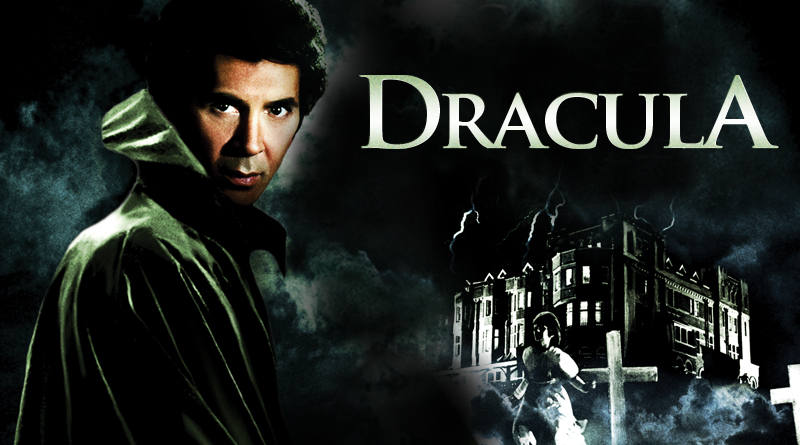
Almost everyone is familiar with the movie image of Dracula, the smooth but sinister Transylvania count, elegantly dressed in evening clothes and a cape, who throws his disguise aside to reveal fearsome fangs that strike for the neck of his innocent victim. The vampire Count Dracula is the supreme creation of Irish writer Bram Stoker, now a century old yet showing no signs of losing his popularity.

Bram Stoker

But Stoker did not dream up his Dracula entirely from nothing, for historians have fixed on a plausible and horrific original for Dracula himself and there are many well-attested accounts of vampirism in modern and ancient times. Vampires are certainly not a product of the 17th century, as belief in the undead preying on the living has been extremely widespread, both in time and geography. The ancient Babylonian bloodsuckers were known as Ekimmu and according to Jewish tradition, the first woman on earth actually became a vampire, Lilith – before the creation of Eve.

Vampire Princess (depiction)

They are known in folklore and legends from Africa, East Asia, Australasia, the Near East, the Americas and, of course, Europe. In Romania, from whence the probable original model for Dracula arose, according to folk tradition: “…there was once a time when vampires were as common as blades of grass, or berries in a pail, and they never kept still, but wandered round at night among the people.”

Vampires are real enough, at least in terms of ancient communities’ beliefs, but what about Dracula himself? Remarkably, there are good grounds for believing that Bram Stoker based him on a real character, Vlad the Impaler, the ruler of Wallachia in modern Romania in the mid-15th century AD.

Vlad The Impaler

Vlad bore a family Christian name, his father also being a Vlad, while “the Impaler” was a nickname he earned from his horrific behavior. He was born in Transylvania in 1431, becoming the heir to the neighboring princedom of Wallachia in 1437, after his father expelled the previous ruler. When the Ottoman Empire was completing it’s takeover of Greece, Wallachia became a strategic border state; the Turkish sultan took as hostages the young Vlad and his brother Radu in 1442 to ensure Wallachian loyalty.

Regardless, the Wallachians undertook a series of campaigns against the Turks, with some success, until the older Vlad was put to death after falling out with his allies, the Hungarians. The younger Vlad escaped captivity and embarked on a long campaign to regain his father’s throne, now occupied by a distant relative. His efforts finally bore fruit in 1456 with the assassination of his rival, and he became the Prince of Wallachia. Vlad’s subjects were soon to find out that their new ruler intended to crush any lingering opposition. He called a meeting of nobles and after testing them, and their making it abundantly clear how little they thought of the various Princes and Kings, he had his armed guards seize all 500 hundred, leading them outside, where they were impaled on sharpened stakes, along with their wives and servants, and left to rot.

Bran Castle

Vlad’s cruelty became famous, as he turned against Transylvania, land of his birth, because of its economic control of Wallachia. He led a series of raids on the major towns from 1457 to 1460, massacring vast numbers of men, women, and children, with torture being followed up by slow impaling. Moreover, Vlad showed every sign of enjoying these horrors. According to a German pamphlet printed in 1499, he was perfectly at home sitting down to watch the death throes of his victims at the town of Brassoc: “All those whom he had taken captive, men and women, young and old, children, he had impaled on the hill by the chapel, and all around the hill, and under them he proceeded to eat at table and enjoyed himself in that way.”

Prince of Wallachia

But, appalling though the deeds of Vlad the Impaler undoubtedly were, where does the Dracula connection come in? Vlad was the son of Vlad Dracul. The Dracul part was a nickname with a double meaning – “dragon” and “devil.” The official version was probably “dragon,” since the elder Vlad had been invested with the Order of the Dragon in 1431. Thereafter, Vlad Dracul minted coins with a dragon symbol and flew a flag bearing a dragon. The alternative meaning of his name, “devil,” was not unwelcome, for his rule was based on fear.

Dracula means “son of Dracul,” and Vlad the Impaler actually signed himself “Dracula” on official documents. Perhaps he relished the idea of being known as the son of the devil. This may have been uppermost in the mind of the court poet Michel Beheim in 1463, when he composed an epic entitled “Story of a Bloodthirsty Madman Called Dracula of Wallachia.” Technically, he WAS a vampire, for he reportedly dipped his bread in the blood of his victims at his macabre feasts of the dying.

As in all of history, all tyrants come to an end eventually. After many years of fighting the Turks and overwhelming them with his wholesale slaughter, they left Vlad’s brother Radu behind when they retreated. Radu soon gained support among the aristocracy, who could not forgive Vlad’s massacres of their fellow nobles, while Vlad’s army faded away once the threat of the Turks had been lifted.

Vlad the Impaler’s Poenari Fortress

Vlad escaped to Hungary, where he was captured, tried on false charges, and confined for 12 years until Radu’s death, when Vlad agreed to subject himself to Hungarian control, converted to Catholicism and married a Hungarian princess. He regained his throne in 1476 but, in a final battle against an army of Wallachian nobles supported by the Turks, he was himself impaled by a lance. The Turks cut off his head and delivered it to the sultan, where it was put on display as proof that their deadly foe was finally vanquished.

Snagov Monastery (where Vlad’s headless corpse is alleged to be buried)

Vampires definitely existed in the strongly held beliefs of past people concerning the dead. Dracula was not a vampire in the folklore tradition, but he was certainly bloodthirsty in more ways than one!!!

Source: Ancient Mysteries

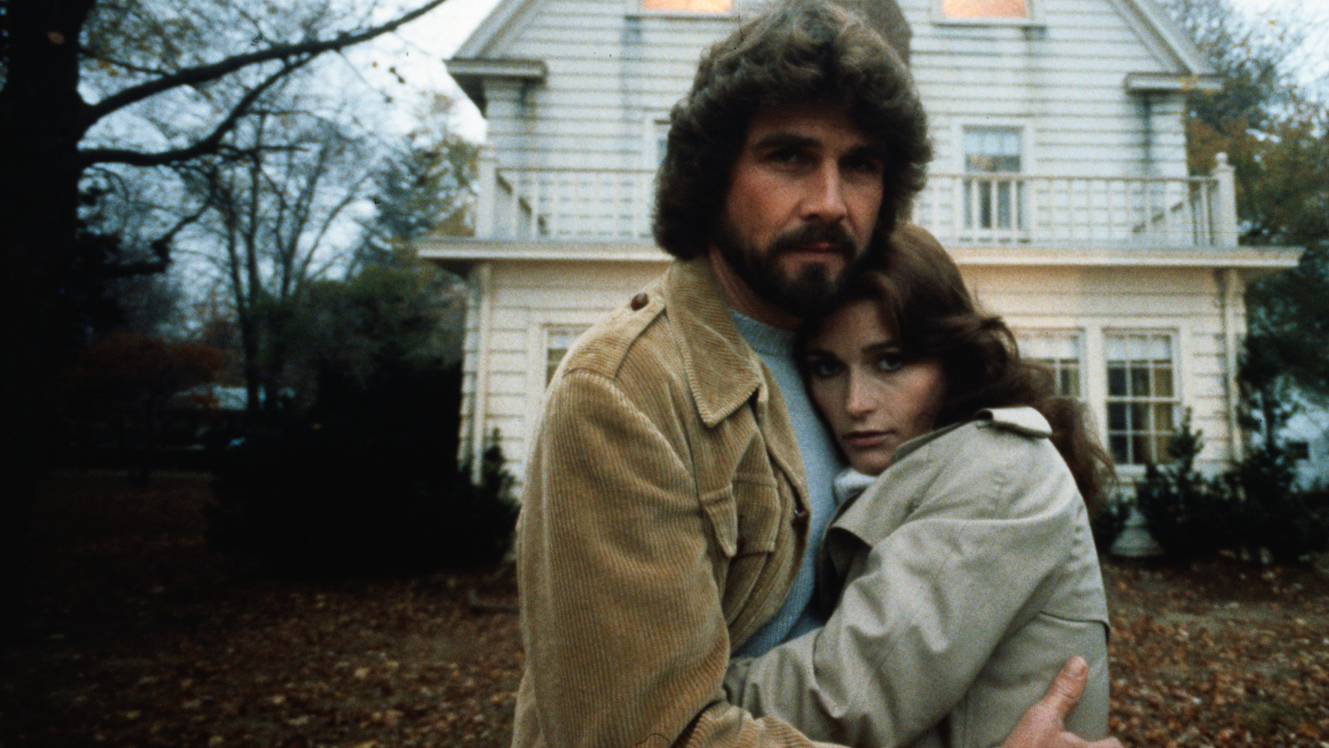
Amityville: The House, the Horror and the Hoax

Thirty miles outside of New York City, nestled in the Long Island town of Amityville, stands the house forever linked to the Amityville Horror phenomenon. On November 13, 1974, the estate was the scene of mass murder. It was the middle of the night, when 23-year-old Ronald DeFeo Jr. killed six of his relatives with a .35 caliber rifle while they were asleep: parents Louise and Ronald DeFeo Sr., siblings 18-year-old Dawn, 13-year-old Allison, 12-year-old Marc, and nine-year-old John Matthew.

Though he confessed to his deeds, DeFeo’s defense would later attempt to enter an insanity plea. DeFeo claimed he was guided by malevolent voices in his head and couldn’t control his behavior.  It was this claim, and the murders themselves, that spawned the notion that 112 Ocean Avenue itself was haunted — and that the DeFeo family as a whole were victims of the house. However, a look at DeFeo Jr.’s life provides an alternative reading of the events.

With an abusive father and passive mother, the boy’s troubled childhood led to substance abuse as an adult. He not only lashed out at his father but once even threatened him with a gun. The parents hoped letting him live at home and with a weekly stipend would help. DeFeo Jr. barely held a job.

On the day in question, DeFeo Jr. left work and went to a bar. He kept calling his home to no avail and complained to patrons about it. He eventually left, only to return at 6:30 a.m. — when he yelled, “You got to help me! I think my mother and father are shot!”

Authorities found all six family members dead in their beds, shot with a rifle at around 3:15 a.m., and positioned on their stomachs. There was no sign of struggle, nor that they were drugged. No local reports of gunshots were logged, with only the DeFeo dog barking away.

DeFeo Jr. changed his alibi several times, from claiming he was at the bar during the time of the murders to mob hitman Louis Falini killing his family while forcing DeFeo Jr. to watch. He eventually confessed that he gunned his own family down, and stood trial on Oct. 14, 1975.

Though attorney William Weber tried to enter an insanity plea, the prosecution argued DeFeo Jr. was a mere drug addict who was well aware of what he was doing that night. He was convicted on six counts of second-degree murder and sentenced to six concurrent sentences of 25 years to life.

But it wasn’t until after the Lutz family moved into the house in December of 1975 that the purported haunting of the Amityville Horror house allegedly set in. George and Kathy Lutz believed their purchase of the 4,000-square-foot house at $80,000 was a steal — but moved out 28 days later after terrifying incidents allegedly forced them to flee.

From green slime purportedly oozing from the walls and eyes peering into the house from outside to foul odors and Kathy allegedly levitating in bed, it was a rather disquieting month. George claimed he woke up at 3:15 a.m. each night — the exact time of death of the DeFeo family members.

Jay Anson’s 1977 book The Amityville Horror was based on these reported events and served as the foundation for the 1979 film of the same name, which was remade in 2005. The book became a bestseller, while the film grew into a classic — and legions of horror aficionados flocked to town.

The Lutz family claimed they experienced supernatural activity.  George Lutz had a history of dabbling in the occult, so they asked a priest came to bless the house. The priest allegedly heard a voice scream “Get out!”.  He told the Lutzes to never sleep in that particular room in the house.  Other paranormal activity they experienced: a nearby garage door opening and closing; an invisible spirit knocking a knife down in the kitchen; a pig-like creature with red eyes staring down at George and his son Daniel from a window; George waking up to wife Kathy levitating off their bed; sons Daniel and Christopher also levitating together in their beds.

Anson’s book used 45 hours of the family’s recorded interviews as a basis. And one of the three Lutz children, Christopher Quaratino, confirmed that the hauntings happened. However, he also said that the events were exaggerated by his stepfather, George Lutz. After telling their story, George and Kathy took a lie detector test to prove their innocence. They passed; but the couple was bogged down in legal and financial issues, which prompted skeptics to believe they had the motive to create a fantastical story to sell to the public.

The Lutz’s former lawyer William Weber — who fell out with them over money issues — came out in 1979, claiming the three of them came up with the horror story “over many bottles of wine.”   Son Daniel, who lives a quiet life in Queens, New York as a stonemason, claims the house ruined his life and that he continues to have nightmares to this day.

Murderer Ron, who’s still alive and serving six 25-year-life sentences at a New York correctional facility, claimed he heard voices urging him to kill his family. He has since changed his story multiple times.

Ultimately, the house remains just that — a house. It has changed hands for decades, with nothing but price fluctuations and a change in address serving as notable incidents. But even after the Amityville Horror house’s address changed, the public fascination never let up. To this day, countless people still yearn to get inside the Amityville Horror house just to get a taste of its supposed terrors.

Will Wonders Never Cease

Tucked away in the rolling hills of Potter County is one of the oddest natural wonders in Pennsylvania: The Coudersport Ice Mine.  The mine is located on a hillside, shielded from the sun and wind. Ice begins to form in April and continues to build up as the weather warms. Then, starting in September, the ice begins to melt, with only a residual amount remaining during the winter months.

The Coudersport Ice Mine is actually an ice cave located in Sweden Township, Pennsylvania. Ice appears in various shapes and forms, often as huge icicles measuring from 1 to 3 feet (0.91 m) in thickness, and from 15 to 25 feet in length; the ice is generally clear and sparkling. Discovered in 1894, the cave is about 40 feet deep, about 8 feet wide, and 10 feet long. The cave was open to the public for many decades but closed in 1990. New Ownership and renovations have led to the reopening of the mine to the general public.

The discovery of the mine was not a complete accident.  A farm owner in the area, John Dodd, had heard umpteen stories about a Native American seen carrying silver ore out of a mysterious cave on a mountainside in Sweden Valley, just east of Coudersport. Dozens of prospectors had thoroughly searched the mountain and came away empty handed. So, in the summer of 1894, with curiosity finally getting the best of him, Dodd set out to give it a try.

He asked a farm-hand, Billy O’Neil, for help. He knew Billy was handy with a divining rod and immediately Billy went searching. The divining rod, Billy said, “told him” where to find the vein of silver ore. He began to dig.  On a sweltering 90-degree day, Billy’s shovel hit something hard.

Only it wasn’t silver. It was ice!  He eventually uncovered a shaft of ice, some 30 feet deep, 10 feet long and 8 feet wide. Inside, they found not only large pieces of ice, but also human remains, a petrified fish, and fossils. While the search failed to yield the much-fabled silver, it resulted in one of the most fascinating finds in Pennsylvania history.

With winter approaching, Dodd returned to the hole in the ground and was amazed to see ice melting and warm air coming from the shaft. Winter passed. Returning to the mountain in late spring, Dodd was dumbfounded to see ice reforming. As summer progressed, it seemed the hotter the weather, the thicker the ice in the shaft!

Ice in summer. Gone in winter. How does this happen?

The mountainside consists of loose rock. Air currents travel through the mountain rocks and the mine shaft. Cold air is drawn in during the winter, forcing out the warmer air, which was drawn in during summer and the ice melts. In the spring, warmer air enters the mountain forcing the colder air out and ice forms. The cycle continues.

As years went by and word of the discovery got out, the science community took notice. In the meantime, the Ice Mine was on its way to becoming a prime tourist attraction. It’s reported that scientists from the National Geographic Society arrived at the Mine in the mid-1930s. One of them dubbed it “the eighth wonder of the world.” Despite initial skepticism, they departed Potter County saying the Ice Mine was indeed “a modern miracle”, giving credence to the “eighth wonder” label. Today, some 80 years later, The Ice Mine’s fascination continues among scientists and scholars.

The Fear Frequency

Have you ever wondered what a ghost sounds like? Engineer Vic Tandy may already know. In the early 1980s, Tandy was working in a laboratory designing medical equipment. Word began to spread among the staff that the labs might be haunted, something Tandy put down to the constant wheeze of life-support machines operating in the building.

Vic Tandy

One evening he was working on his own in the lab when he began to feel distinctly uncomfortable, breaking into a cold sweat as the hairs on the back of his neck stood on end. He was convinced that he was being watched. Then, out of the corner of his eye, Tandy noticed an ominous grey shape drifting slowly into view, but when he turned around to face it, it was gone. Terrified, he went straight home.

Generic pic

The next day Tandy, a keen fencer, noticed that a foil blade clamped in a vice was vibrating up and down very fast. He found that the vibrations were caused by a standing sound wave that was bouncing between the end walls of the laboratory and reached a peak of intensity in the center of the room. He calculated that the frequency of the standing wave was about 19hz (cycles per second) and soon discovered that it was produced by a newly installed extractor fan. When the fan was turned off, the sound wave disappeared.

Generic fencing blade

The key here is frequency: 19hz is in the range known as infrasound, below the range of human hearing, which begins at 20hz. Tandy learned that low frequencies in this region can affect humans and animals in several ways, causing discomfort, dizziness, blurred vision (by vibrating your eyeballs), hyperventilation and fear, possibly leading to panic attacks.

1980’s era sound spectrum analyzer

Tandy went on to recreate his experience, and with the assistance of Dr. Tony Lawrence, he was able to publish his findings in the Journal of the Society for Psychical Research. Their research led them to conclude that infrasound at or around a frequency of 19 Hz, has a range of physiological effects, including feelings of fear and shivering. Though this had been known for many years, Tandy and Lawrence were the first people to link it to ghostly sightings. Tandy also appeared in the “Ghosts on the London Underground” documentary.

In 2001 Tandy was asked to investigate the cellar of Coventry’s Tourist Information Centre and in 2004 he was part of a research group looking for paranormal activity in Warwick Castle. In both cases he found high levels of infrasound present. Tandy also conducted large-scaled experiments including one experiment on 750 participants at London’s Royal Festival Hall.

Coventry, Warwickshire, England

A more recent investigation took place in an allegedly haunted 14th-century pub cellar in Coventry, where people have reported terrifying experiences for many years, including seeing a spectral grey lady. Here Tandy also uncovered a 19hz standing wave, adding further evidential weight to his theory. The following is a generic pic from the web – I don’t know which pub he examined.

Built around 1583, The Golden Cross claims to be the oldest pub in the city and one of the longest-established alcohol-serving venues in England. There’s been a lot of bumps in the night over the years and reports of strange activity in the kitchen area. It is thought that the kitchen stands where there were once cells keeping prisoners locked away. There have also been sightings of shadowy figures appearing in the pub and it has received a Most Haunted Location award.

In an interesting parallel, researchers have recorded that, prior to an attack, a tiger’s roar contains frequencies of about 18hz, which might disorientate and paralyze their intended victim. Is this the sound of fear itself?

https://www.theguardian.com/science/2003/oct/16/science.farout

A Ship Lost in the Desert

In 1610, King Philip of Spain ordered the construction of three ships to be built in Acapulco. They were to be used for the harvesting of pearls along the Pacific coast of Mexico. These vessels, of a type named caravels, would be smaller and more maneuverable than the 200-ton galleons that had transported the first conquistadors from Cuba to Veracruz. The caravels would have a shallow draft, square sails, and 13 rows of oars on each side, which would allow them to navigate easily in shallow water, regardless of wind direction.

The ships were completed in 1612 and they immediately set sail under the command of captains Alvarez de Cordone, Pedro de Rosales, and Juan de Iturbe. Between them they had 40 experienced pearl divers who were slaves brought over from the Portuguese colony of Sierra Leone in West Africa.

It was no accident that the ships were heading north. Nearly 80 years earlier, Hernán Cortés had sailed up to the tip of Baja and found that Bahia de La Paz was loaded with oysters that produced perfectly shaped pearls. At the time, pearls were in great demand and were even more valuable than gold. But the Spanish were unable to establish a permanent settlement in La Paz because of the large numbers of hostile natives and a lack of fresh food and water.

So, the ships led by Captain Cordone passed La Paz but traded for pearls at other coastal villages along the coast of Baja. However, at one village things went awry. When Cordone promised to trade a basket of clothing for a basket of pearls, the native chief was surprised to find his basket filled with worm-eaten cloth. The chief had expected clothing like that worn by the officers. The angered chief shot Cordone in the chest with an arrow. While he wasn’t killed, the captain was forced to return to Acapulco for medical treatment. He ordered his two fellow captains to sail their ships further up the Sea of Cortez.

At present-day Mulege, the men hit the jackpot. A big storm had washed thousands of oysters up onto the beach and men quickly filled their baskets. But upon their departure, Captain Rosales’s caravel struck a reef and began to take on water. Captain Iturbe brought his ship alongside the sinking vessel and moved its cargo and crew into his own.

Now Iturbe had a decision to make: return to Acapulco early or continue north and load up with even more pearls? He chose the latter. For a week he sailed farther north until his ship entered a large estuary. Gradually the route narrowed and then opened up into what he described as a great “inland sea.” This would have been the ancient Lake Cahuilla, today’s much smaller Salton Sea. The captain sailed along the eastern edge of the inland sea and continued up the Colorado River nearly 100 miles to the site of modern day Blythe (where Interstate 10 crosses the Colorado).

Salton Sea today

It was here that Iturbe decided to turn around. He sailed back down the river and across the great inland sea. But in the weeks since their arrival the water level had fallen tremendously. A miles-long continuous ring of sand bars blocked their exit. They were trapped and Iturbe and his men circled around the inland sea for three days until their ship ran aground. The crew gathered as much of their cargo as they could carry and then they abandoned the ship.

Most of them survived the long and miserable walk back to the Spanish settlement of Guaymas, and a few months later they were transported back to Acapulco on a Spanish galleon. However, their ship and the majority of its cargo of pearls were to remain forever stuck on the edge of the great inland sea, covered by sand dunes.

Throughout the years, particularly during the Gold Rush years, numerous sightings were made of the rotting remains of a ship out in the barren Colorado Desert region, but no one has recovered any of the buried cargo.

In June of 2009, the San Diego Reader published a story entitled “Stay Away from Pinto Canyon.” The story was about a trek 2 friends made to a remote canyon in order to photograph petroglyphs — prehistoric rock paintings. The petroglyphs were not what they expected. There were no wooly mammoths or saber-toothed cats. Instead they found a crude collection of stick figures, next to what looked like a large sailing vessel with square sails and oars protruding from it.

petroglyph supposedly showing Spanish ship

The article and the pictures intrigued an exhibit designer from The Maritime Museum who then secured permission from the federal government to view the petroglyphs personally. He concluded that there was no definitive proof, but they could be representing the failed Spanish expedition–and any one of the three doomed ships.

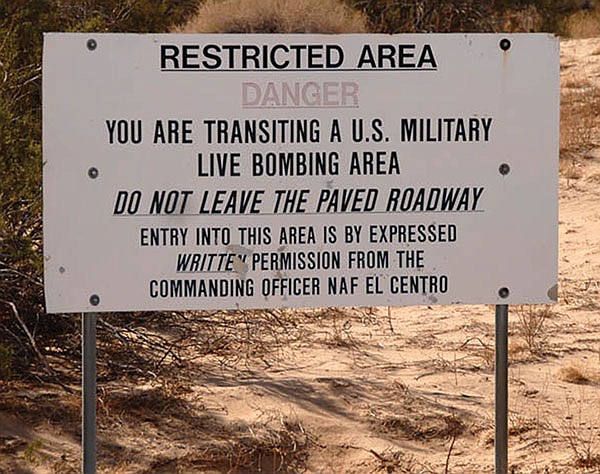
So it’s just as likely that the petroglyph represents Juan de Iturbe’s doomed pearl ship, which ran aground just six miles from Pinto Canyon. Most of the people who’ve seen the remains of Iturbe’s ship were riding in off-road vehicles, and one of them, Imperial Valley resident Ed Barff, provided a precise location. He says the caravel lies three hundred feet southeast of the eastern-most edge of the Superstition Mountains. Much of that area is designated for off-road vehicle use. But the ship’s remains are located in a section reserved as a bombing range under the jurisdiction of Naval Air Facility El Centro.

Does anyone else wonder why the federal government always seems to be in the picture whenever lost treasure is being hunted?

Pots of Gold

During the autumn of 1864 it was clear the Confederacy was losing the Civil War. Some of the Southern leaders hoping to save what was left of the Confederate Treasury decided to move some of it from Richmond, Virginia to North Carolina. They summoned Captain JW Duchase to Richmond and gave him specific orders–orders he was only to open upon arrival in Greensboro, North Carolina. When Duchase left Richmond, the train on which he traveled carried several boxcars with soldiers and arms, a cannon and 2 flatcars filled with thousands of iron cooking pots–each filled to the brim with gold coins, their lids tightly fastened with wire.

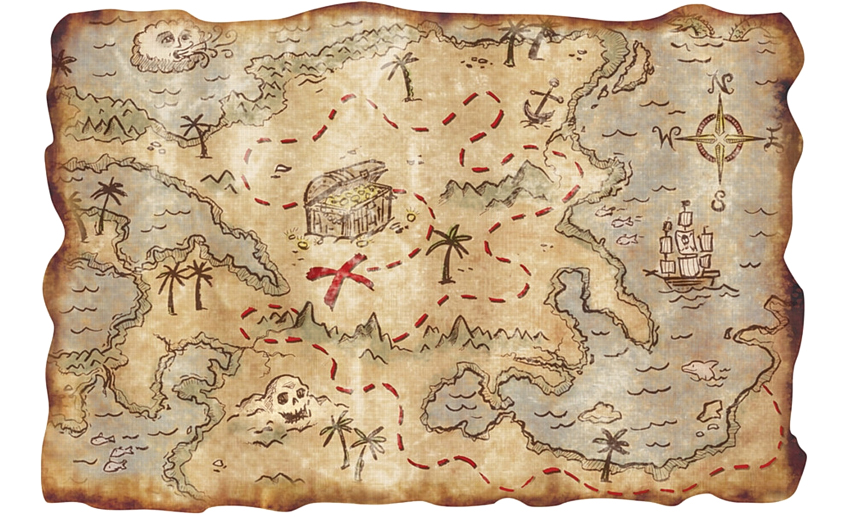
Upon arrival in Greensboro, Duchase read his orders. He was instructed to bury the pots along the train track, 100 paces out, and to plot the burial places as nearly as possible. Following his orders, Duchase’s men buried the pots in groups of three, over 16 miles from McLeansville to a town called Company Shops (now known as Burlington).

His mission completed, Duchase and his men were to take the train back to Richmond, not only to report on the locations of the buried iron pots, but also to help defend Richmond from the advancing Union forces. But the returning train was derailed by Union saboteurs. Most of Duchase’s company was captured–only he and a Lieutenant escaped– but in the escape, he lost the only written plot map. Weeks later he was captured and sent to prison, where he remained until after the war.

NOT Duchase’s map

Duchase then traveled to Mexico, where he built a successful life, and never returned to the U.S. His personal journals, which contained specific details of buried pots where given to P.H. Black. Black was from Greensboro, NC, and met with Duchase in Mexico, returning to the United States with his journals. When Black died in the 1930s, Duchase’s journals were missing from his possessions.

Where are the journals?

In the late 1880’s, the town of Burlington was growing rapidly. Farmers responded to the growing demand for food by turning thousands of acres of land along the railroad tracks to farmland. In the spring of 1910, a farmer was plowing next to the railroad tracks and broke his plow on something buried in the soil. He hit an old rusted pot, with the lid wired shut and filled with gold coins. Two more were found later, totaling three pots of $20 gold pieces, for this very lucky man.

The legend never says if he found more pots on his property. However, in the mid 1990’s a treasure hunter claims to have found 12 pots in four different locations. Still, if there were thousands of pots, and the number claimed to have been found is less than 20, that means there could be hundreds of pots of gold, just waiting to be found…in the 16 mile stretch from McLeansville to Burlington…100 paces from the railroad tracks.