History of Playing Cards

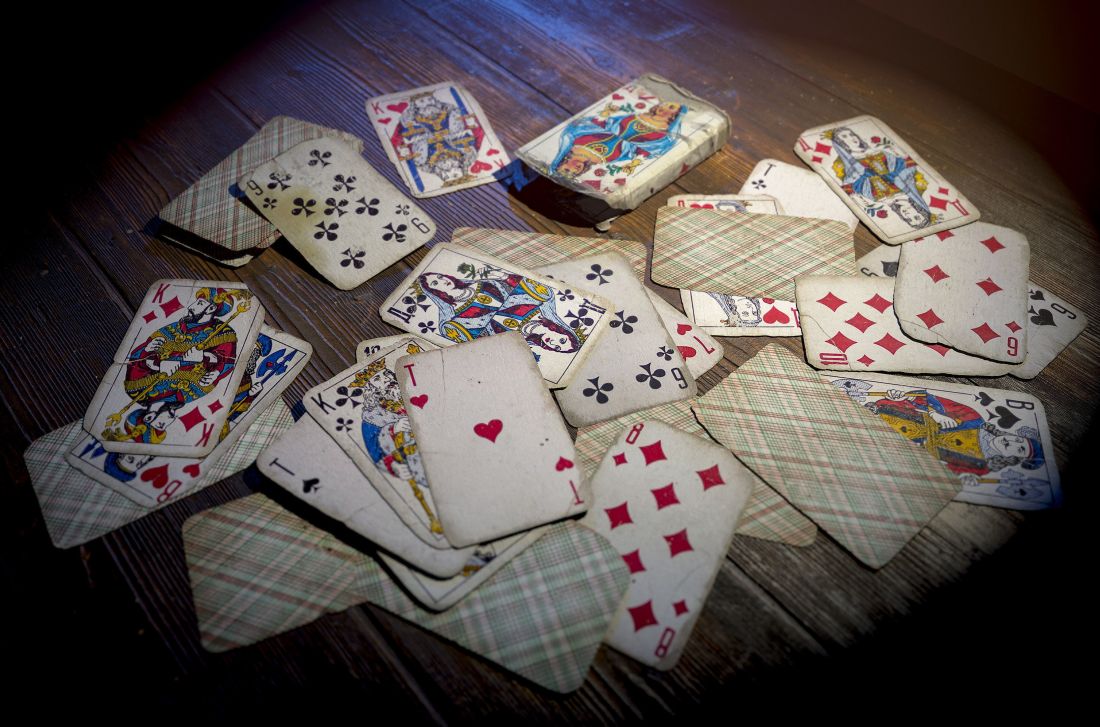
When playing cards first arrived in Europe toward the end of the 14th century AD, they caused quite a furor. In 1377, the town council of Florence complained that the playing of “a certain game called naibbe has recently been introduced into these parts,” and by a vote of 98 to 25 decided to prohibit it. In the same year cards reached Paris, where new city regulations cracked down on working-class cardplayers but apparently left nobel devotees alone.

European Playing Cards

The following year, in the Bavarian city of Regensburg, the council tried to limit card games to small stakes. By 1387, cards had arrived in the Spanish kingdom of Castile, where the government tried to ban them.

The killjoys were fighting a losting battle, however, for even at this early stage, cards began to acquire royal patrons. In 1379, the prince of Brabant, in Belgium, bought a highly decorated pack of cards, while in 1392 the mad French king Charles VI received three packs of cards painted by artist Jacquemin Gringonneur “for his amusement during the intervals in his sad illness.”

Charles VI/Gringonneur Cards

Playing cards soon led to the emergence of cardsharps, and the mother of all card swindles is recorded in the Parisian court annals for 1408. Two dubious characters lured a traveling merchant into an inn with talk of a good currency deal. One of them then produced a pack of cards from his pocket and demonstrated an amusing game of guessing the identity of a card while seeing only its back. The astute merchant soon noticed that one of the cards had a slight but distinctive mark on the reverse, so he happily joined in when the betting started. When the marked card turned up, the trader put his shirt on it, only to find that the front of the card was not the same, as it had been switched for another.

The French also made one great contribution to the development of playing cards by inventing, around 1480 AD, the names and shapes of the four suits (spades, hearts, diamonds, and clubs) we still use today. These simple geometric shapes did much to encourage card playing. By the end of the 15th century, playing card manufacture was a major industry, and even Johannes Gutenberg, often claimed to be the inventor of movable type, became involved.

Johannes Gutenberg Card

He developed some of the mechanical methods of production and, at a time when his finances were in desperate straits, he used drawings that his artists had prepared for his famous Bible to decorate the back of a deck of playing cards.

From this point the history of Western playing cards is clear. But who brought them to Europe in the first place? The subject is swathed in mystery, and it has at different times been claimed that they were introduced by Marco Polo (1254-1324), the Crusaders, or the Gypsies. The most exotic theories credit the Gypsies with the invention of cards (as a means of divination), and it has therefore been argued that their origins lie in India or even Egypt. The truth is that playing cards are a Chinese invention, but the problem has been that little is known of their transmission from China to the West.

Ancient Chinese Playing Cards

Playing cards had been invented in China by at least the 9th century AD when, according to tradition, a princess and her relatives played the “leaf game,” or cards. Women were certainly important in the development of card games, for one apparently wrote the world’s first book on the subject (now lost), later in that century.

By the 11th century, cards were printed with woodcut blocks, and in the early Ming dynasty (1369-1644 AD) famous artists were employed to design card backs with portraits of characters from favorite novels, such as The Water Margin. Chinese cards were much smaller than ours (about 2 inches long and 1 inch wide) and were printed on fairly thick paper, which made them hard-wearing but difficult to shuffle. Chinese “money cards” had four suits: cash, strings (of cash), myriads (of strings) and tens (of myriads), with the numbers 2 thru 9 in the first three and 1 thru 9 in the fourth.

Ancient Woodcut Playing Cards

The Chinese of yesteryear were enthusiastic cardplayers and gamblers, as they are today. Ming Dynasty books on cards praised them as superior to all other amusements, for they “were convenient to carry, could stimulate thinking and could be played by a group of four without annoying conversation, and without the difficulties which accompanied playing chess or meditation.” Also, “cards could be played in almost any circumstances without restrictions of time, place, weather, or qualification of partners.”

But this still leaves us without a link to Europe, for early Western cards don’t resemble Chinese ones and have different suits. The missing link appears to be the Islamic world, despite the fact that card playing was frowned on by Muslim clerics.

In 1938, Professor L.A. Mayer came across a pack of 52 cards while searching through the collections of the famous Topkapi Museum, in Istanbul, Turkey. They had been made in Egypt about 1400 AD, using designs that closely resemble those of early Italian cards.

Second card from left: The Seven of Swords (equivalent to Seven of Clubs)

Third card from left: the Malik of Cups (equivalent to the King of Hearts)

The Arabic inscriptions on the court cards make clear the origin of the word naibbe for cards (used by the Florence council); they are called the Malik (King), Na’ib Malik (Governor), and Na’ib Thani (Deputy Governor). They are in 4 suits – swords, polo sticks, cups, and coins (equivalent to modern clubs, spades, hearts and diamonds).

The only significant difference between these and early Italian cards is that the Egyptian ones are, like the Chinese, long and thin. Even this difficulty seems to have been overcome by the find of a single card with an Arabic inscription made around 1200 AD; its dimensions are like those of Italian cards, which are still slightly narrower than those made today in the rest of Europe.

There can now be little doubt that the Arabs were the intermediaries for the widespread transmission of one of ancient China’s most popular inventions.

Source: Ancient Inventions
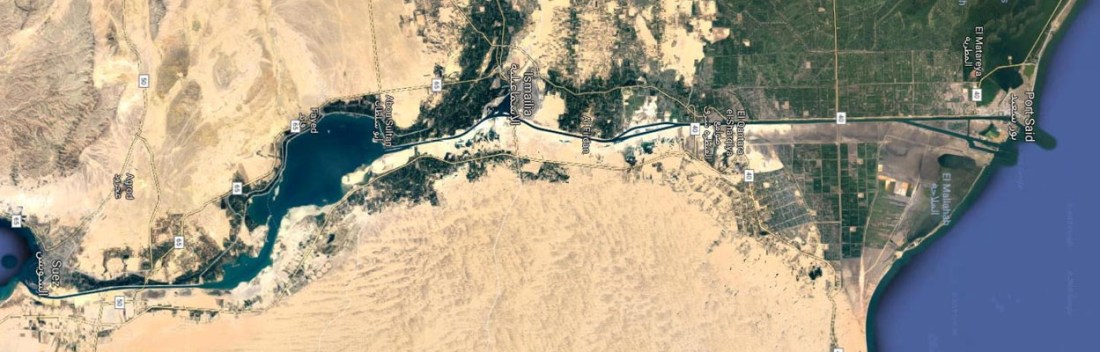
THE FIRST SUEZ CANAL

In 1869, the Suez Canal was finished under Ferdinand de Lesseps’s leadership. The French had wanted a shipping route from the Mediterranean to the Red Sea for a long time. A shortcut from Marseilles to the Orient would give France a fine advantage over England. As early as 1800 Napoleon had surveyors looking at routes.

Napoleon was told that the Red Sea was 30 feet higher than the Mediterranean. Dig a canal, his surveyors said, and the Red Sea will hemorrhage into the Mediterranean. It’ll sweep away the Nile Delta. The survey was grossly in error, of course. French scientists tried to point out that sea level couldn’t possibly differ that much at two points only eighty miles apart.

But the damage was done; the moment had passed; only the idea wasn’t dead. It re-emerged in both England and France after Napoleon was gone. Lesseps finally dug his Suez Canal so it wandered northward from the Red Sea, following two lakes, to a mid-point. Then he dug in a straight line to the Mediterranean.

That southern leg of the Lesseps canal actually followed a vastly older canal. Napoleon had been a latecomer to the canal idea. In 500 BC, the Persian conqueror of Egypt, Darius, had begun a canal along that same route. He meant his canal to swing west at the mid-point and link with the Nile near Cairo. But Darius’s experts, like Napoleon’s, decided the Red Sea was higher than the Mediterranean. They too thought a canal would result in disaster.

Ferdinand de Lesseps

So Darius didn’t finish his canal. But the Ptolemies who followed Darius did finish it. By 250 BC, a substantial canal linked the Red Sea and the Mediterranean. It was fifty yards wide and it served ocean-going vessels. Cleopatra probably rode that canal in her royal barge, a few years before the birth of Christ.

Here the plot thickens even further: For Darius had built on the route of an earlier canal, begun in 600 BC. And that canal followed the route of an even older canal that served shipping around 1500 BC. Temple carvings show the Queen of Egypt setting out for Africa on that canal. And, as Egyptian history blends into myth, 4000 or so years in the past, it tells of still other canals.

Cleopatra’s Barge

But the Suez Canal we remember is the one built only 140 years ago by Lesseps. The crowning irony is that the French honored Lesseps so highly for his work that they gave him the job of digging a Panama Canal. But that was another matter entirely. The Panama Canal had to penetrate jungles, cross mountains, and span great fields of mud. Twenty thousand workers died, and Lesseps returned to France in failure.

Celebration of Opening of Suez Canal


GEORGIA GUIDESTONES

On one of the highest hilltops in Elbert County, Georgia stands a huge granite monument. Engraved in eight different languages on the four giant stones that support the common capstone are 10 Guides, or commandments. That monument is alternately referred to as The Georgia Guidestones, or the American Stonehenge. Though relatively unknown to most people, it is an important link to the Occult Hierarchy that dominates the world in which we live.

The origin of that strange monument is shrouded in mystery because no one knows the true identity of the man, or men, who commissioned its construction. All that is known for certain is that in June 1979, a well-dressed, articulate stranger visited the office of the Elberton Granite Finishing Company and announced that he wanted to build an edifice to transmit a message to mankind. He identified himself as R. C. Christian, but it soon became apparent that was not his real name.

He said that he represented a group of men who wanted to offer direction to humanity, but to date, almost two decades later, no one knows who R. C. Christian really was, or the names of those he represented. Several things are apparent. The messages engraved on the Georgia Guidestones deal with four major fields:

(1) Governance and the establishment of a world government,

(2) Population and reproduction control,

(3) The environment and man’s relationship to nature, and

(4) Spirituality.

A book written by the man who called himself R.C. Christian explained that the monument he commissioned had been erected in recognition of Thomas Paine and the occult philosophy he espoused. Indeed, the Georgia Guidestones are used for occult ceremonies and mystic celebrations to this very day.

THE MESSAGE OF THE GEORGIA GUIDESTONES

1. Maintain humanity under 500,000,000 in perpetual balance with nature.
2. Guide reproduction wisely – improving fitness and diversity.
3. Unite humanity with a living new language.
4. Rule passion – faith – tradition – and all things with tempered reason.
5. Protect people and nations with fair laws and just courts.
6. Let all nations rule internally resolving external disputes in a world court.
7. Avoid petty laws and useless officials.
8. Balance personal rights with social duties.
9. Prize truth – beauty – love – seeking harmony with the infinite.
10. Be not a cancer on the earth – Leave room for nature – Leave room for nature.

Limiting the population of the earth to 500 million will require the extermination of nine-tenths of the world’s people. The American Stonehenge’s reference to establishing a world court foreshadows the current move to create an International Criminal Court and a world government. The Guidestones’ emphasis on preserving nature anticipates the environmental movement of the 1990s, and the reference to “seeking harmony with the infinite” reflects the current effort to replace Judeo-Christian beliefs with a new spirituality.

The message of the American Stonehenge also foreshadowed the current drive for Sustainable Development. Any time you hear the phrase “Sustainable Development” used, you should substitute the term “socialism” to be able to understand what is intended. What is the true significance of the American Stonehenge, and why is its covert message important? Because it confirms the fact that there was a covert group intent on:

(1) Dramatically reducing the population of the world;
(2) Promoting environmentalism;
(3) Establishing a world government; and
(4) Promoting a new spirituality.

Certainly the group that commissioned the Georgia Guidestones is one of many similar groups working together toward a New World Order, a new world economic system, and a new world spirituality. Behind those groups, however, are dark spiritual forces. Without understanding the nature of those dark forces it is impossible to understand the unfolding of world events.

A recent addition to the monument – a block on which is inscribed 2014 – was placed inside an indent between the English and the Spanish slab. While apparently trivial, this block nevertheless proves that the Guidestones is still updated by its sponsors and that its message is, more than ever, relevant in 2014.

Why is 2014 inscribed on that block? Will an event lead to the fruition of one of the Guidestones’ commandments in 2014? Considering the fact that the first commandment is about maintaining the world population under 500 million, this is somewhat disturbing.

The fact that most Americans have never heard of the Georgia Guidestones or their message to humanity reflects the degree of control that exists today over what the American people think. We ignore that message at our peril.

The hole was drilled in the Center Stone so that the North Star could be visualized through it at any moment. This was one of several requirements stipulated by R.C.Christian for the building of the American Stonehenge and reflects his obsession with the alignment of the stars, the sun, and the moon. Occultists often worship the alignment and movement of heavenly bodies as part of their religious ceremonies.

THE MAN FROM THE ICE

Not every couple on vacation comes across a dead body, let alone a deep-frozen one. But this is precisely what happened on Thursday, September 19, 1991 in the Tyrolean Alps by Helmut and Erika Simon. They had just crossed the Hauslabjoch Pass, which would bring them down to Italy, when they noticed a body protruding from the ice. Reporting their find to the nearest mountain center, they proceeded on their trip, little knowing what would follow.

Tyrol Alps Stock Photo

The manager of the center notified both the Italian and Austrian police, as well as the mountain rescue chief for the area. The following day the Austrian police arrived at the Pass and began chiseling out the body, which lay in a natural hollow covered by the remains of a glacier. A suggestion that it was a man who had disappeared in 1941 was belied by the collection of ancient-looking objects found with the body, including skin clothing and an axe, apparently with an iron blade.

Stock Photo

Of course, wide speculation abounded from local mountaineers to experts in local folk-culture. Early estimates claimed the body’s age ranged from 500 to 3K years. The body was finally released from the ice on September 23 and sent to the Institute of Forensic Medicine in Innsbruck, Austria. The corpse turned out to be of a man over 40 who had apparently died of exposure. Konrad Spindler, Professor of Archaeology at Innsbruck, believed the axe had a bronze rather than an iron blade, and speculated that the body was at least 4K years old.

Initial radio carbon tests on grass samples found with the body suggested an even earlier date – somewhere between 2,600 BC and 2,900 BC. Excavations at the site revealed an amazing repertoire of equipment carried by a prehistoric man going about his business: a pair of grass-lined leather shoes; a fur hood; a patchwork jacket made of deer fur; fur leggings; a leather apron; a woven-grass cloak; a thong with a stone pendant; a goat-fur rucksack; a net; a beaker made of birch bark; a bow; a copper axe with wooden handle; a fur quiver stuffed with 12 wooden arrow shafts; two arrows complete with flint arrowheads and an arrow repair kit; flint and bone tools; and a calf’s-leather pouch containing a fire-making kit.

Artifacts found with Otzi

It soon became clear that the iceman, dubbed “Otzi” by the press, was one of the greatest archaeological finds of the century. This brought about an undignified row between Italy and Austria as to ownership of Otzi’s body. Once the archaeological importance of the find had been appreciated, the press on both sides of the Alps trumpeted a battle of words over the frozen corpse.

It is difficult to determine border lines through the snowy terrain of the Alps but it was agreed, after a new survey specially commissioned to solve the problem, that the body was found just within the Italian side of the border. Eventually the authorities of the North Tyrol (Austrian) and South Tyrol (Italian) came to an agreement that Otzi could remain in Innsbruck until the scientific studies were completed.

Wild theories abounded, including one woman who claimed it was her husband’s body, who went missing in the 1970’s; and then there was a Viennese gay magazine that started a rumor that Otzi was the world’s oldest known passive homosexual, while his skin clothing surely revealed him to be a “leather queen.” The claim was also made that Otzi’s penis was missing. When Otzi’s genitals were examined in April 1993, his penis proved to be there after all, shrunk to about 5 centimeters – quite a creditable length after 5K years of deep-freezing.

These stories are, no doubt, only the small beginnings of a popular publishing industry on the iceman that will come to rival that on Tutankhmanu. The speculations of academics themselves have sometimes lacked restraint, even turning at times to the bizarre. With this kind of speculation coming from the academic world, it may only be a matter of time before a book is published claiming that Otzi was an alien who landed on the Alps in a spaceship!!!!

MAGIC LANTERNS

The magic lantern, or zoetrope, is little known today but it amazed and delighted audiences in Victorian drawing rooms. It also led, in the 20th century, to the invention of the slide projector and the cinema. In its final form, the zoetrope was a cylinder-shaped canopy of thin material suspended over a lamp. Vanes placed at the top caught the hot air rising from the lamp and made the cylinder rotate slowly.

On the sides of the canopy were thin panes of paper on which were painted pictures. As the cylinder revolved around the lamp, the light shone through the succession of pictures to give the illusion that the painted figures were moving — exactly the same principle as that behind modern motion pictures.

From Athanasius Kirchner’s “An Magna Lucis et Umbrae” of 1671

In 1868 Mr. W.B. Carpenter, the vice president of the Royal Society of London, stated with some confidence that the magic lantern had been invented by Michael Faraday, the famous pioneer of electricity as recently as 1836. He was certainly wrong, as one John Bate had already written about the zoetrope early in the 17th century. However, even Bate was merely describing a device long known elsewhere.

The principal of using heat to make small figures rotate is extremely ancient. In the Near East it goes back to Heron of Alexandria, who invented a toy with moving dancers in the 1st century AD. The Chinese version is even older, and far more advanced, as it involved the projection of images.

In 121 BC, a magician named Shao Ong staged a sort of seance for the Emperor Han Wu-ti, using moving images projected onto a screen. An earlier emperor, Han Gaozu, had a lamp in his possession in 207 BC that, when lit, showed the sparkling scales of turning dragons.

Around 180 AD the inventor Ting Huan created a “nine-storied hill censer,” which was apparently an extremely complicated multiple magic lantern. On it were strange birds and unusual animals, which turned around as the lamp burned.

By the 12th century AD, the most common form of zoetrope was the “horse-riding” or the “horse-pacing” lamp. After the lamp was lit a succession of prancing horses was projected onto the walls, moving as if they were alive. More sophisticated examples probably used lenses to produce stronger images. This was the type of magic lantern seen by early European visitors, and is undoubtedly provided the inspiration for the Jesuit priest of the China Mission Martin Martini (1614-1661). Martini presented the first lantern slides in Europe at Louvain, Belgium, in 1654, soon followed by other European scientists fascinated by the properties of light.

The Mexican Ball Game

Much speculation has gone into discovering the origins of American football. Perhaps this was where the game originated…..in the 1st millenium B.C.? From “Ancient Inventions:”

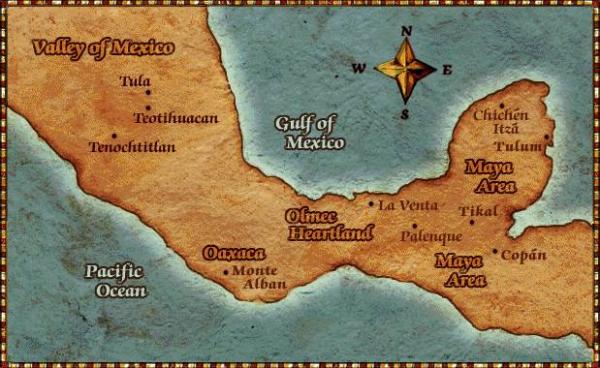
“The most extraordinary sport of the ancient world was without doubt the sacred ball game of Central America and the southern United States. It was first played in about 1000 B.C. by the Olmecs, who lived along the Bay of Mexico, and by all the later great civilizations of the region.

From its very start, it was played by the most important members of society. The colossal Olmec heads — carved from basalt brought down from mountains 50 miles away and weighing up to 44 tons — show Olmec rulers wearing head coverings. A plausible explanation is that these are protective helmets (like those of modern football players) worn by the Olmecs when playing their sacred ball game.

Olmec Heads

The earliest ball courts were simple basins with earthen retaining walls, but by 1000 A.D., they had become far more elaborate. At Chichen Itza the parallel walls were 283 feet long, 100 feet apart and 27 feet high. In Aztec times, ball courts were shaped like a capital “I,” with temples at both ends and banks of seating along the sides. In the middle of the walls, which were usually 12 feet high, were set stone or wooden rings. The ball was a solid rubber sphere about 6 inches in diameter.

Detail from the 15th century Codex Magliabecciano, showing the Mexican ball game about to start. The rings, here shown outside the court, actually projected into it at right angles to the side walls.

To protect themselves against injuries from the heavy ball, the noble players (and a sprinkling of professionals) wore protective helmets, wide belts of hard wood and leather, hip pads, knee pads, and a single glove.

Representation of Protective Gear

After the ball was thrown into play, players had to pass it to their teammates using their hips, elbows, or legs, without letting it run into the other side’s end of the court, for this counted as a point against them. The excited crowd would bet on the outcome: according to a Spanish chronicler they would wager “gold, turquoises, slaves, rich mantles, even cornfields and houses.”

Star players were able to hit the ball up through the ring on the side of the court, thereby winning the game. The victorious side had the right to grab the clothes and jewelry of any spectators who couldn’t get away fast enough. That the game also had a religious significance is shown by the fact that omens were read from the movements of the ball and the nature of the victory.

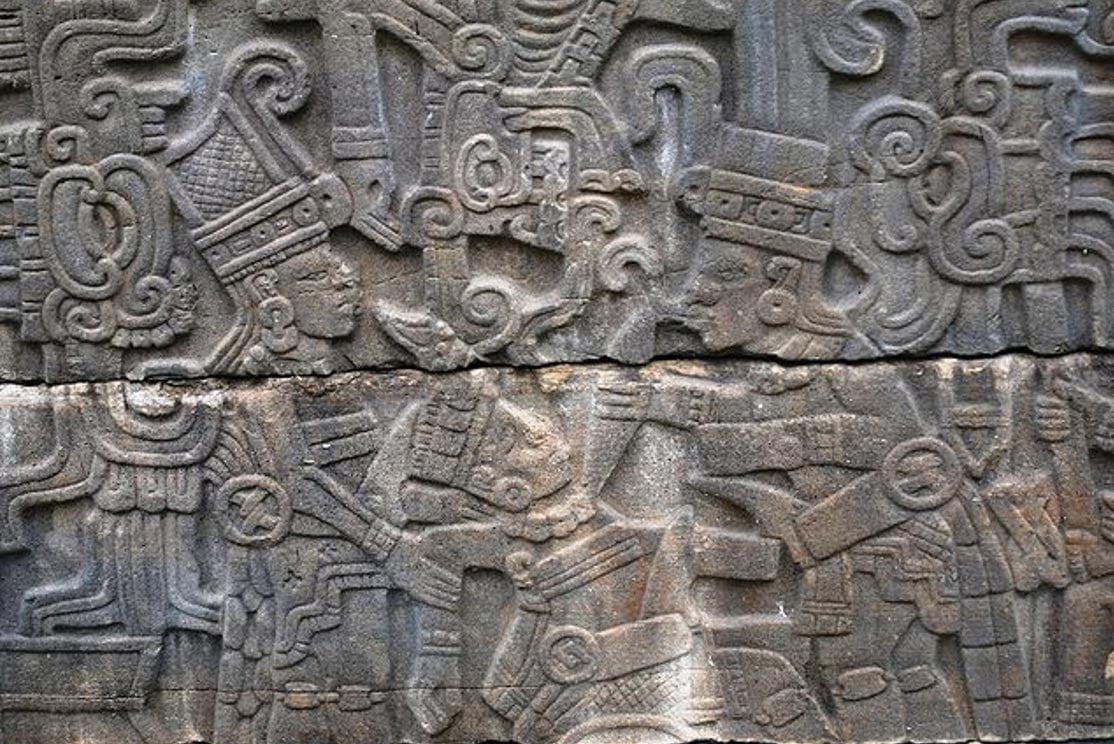
Pre-Columbian art often depicts acts of decapitation as authors such as Christopher L. Moserhave pointed out. The practice is also known from the ball court game that was commonly played by all the Mesoamerican cultures prior to the arrival of the Spanish, from the Olmecs to the Aztecs. The game began to feature sacrificial elements when the Maya took it over from the Toltecs. Archaeologists had mostly dismissed these depictions as figurative, but recent evidence, including the discovery of a collection of decapitated human heads, has provided physical proof of its existence among Pre-Columbian cultures.

https://www.ancient-origins.net/news-history-archaeology/decapitation-discovery-reveals-gruesome-practices-ancient-incas-003116

That the losing team may have paid the ultimate price for defeat is suggested by the sculptural reliefs found next to many ball courts, which show a ball player being decapitated as a sacrifice to the gods.

COMMON LAW VS. CORPORATE LAW

We have all now seen with our own eyes how our elected officials hide their shenanigans from the People. A clear example is the obscure hurricane bill passed under the public’s radar in 2015 that also conferred freedom from liability to Big Pharma (Glenn Beck). I gathered the following information via the Patriots For America blog back in 2014. This is going to be a long one, guys! Sorry – I tried to cut it down but….

I mentioned to Pat about there being an official process to revoke one’s United States citizenship, regain one’s own individual Sovereignty, and become strictly a State citizen. The process is very lengthy and complicated, of course – the instruction packet from SEDM (Sovereignty Education and Defense Ministry, a Christian-based group) is 17 pages long. You can only read it on-line if you are a member of the site (https://sedm.org/) but it was posted at PFA years ago, and I printed it out.

Two pictures from that document: – first page:

Last page:

Rechayahu Ben Harvey in 2014:

“There was a coup d’etat that occurred in 1871 in the United States. Both Senate and House of Republicans abandoned the de jure Constitution and seats of Congress for the United States of America, and joined the municipal corporate UNITED STATES, INC., giving the People the impression that their Country and Government had not made any major changes. It has been masquerading as the de jure “Nation” and “Country,” of United States of America to the American people and the world for over 150 years.”

UNITED STATES LLC – How the ACT of 1871 changed the US from a CONSTITUTIONAL REPUBLIC to a CORPORATION

https://ugetube.com/watch/united-states-llc-how-the-act-of-1871-changed-the-us-from-a-constitutional-republic-to-a-corparation_gtNiNtYYIHEcryE.html

“The Republic can be restored by returning to Common Law, but you must be ready to Constitutionally enforce it with Article I, Section 8, Clause 15. If not, back down and continue to be Sheeple for the next 150 years, for you have let all peaceful means slip away while you complain, petition, and seek assistance from traitors in the de facto Congress.

The people have been made submissive or dumbed down, and don’t recognize the authority that they have, that was given to them, in this founding document by the Founding Fathers–an authority no other country in the world has: 1776 Declaration of Independence.”

So, what is Article I, Section 8, Clause 15???

Article I, Section 8, Clause 15:

[The Congress shall have Power . . . ] “…to provide for calling forth the Militia to execute the Laws of the Union, suppress Insurrections and repel Invasions; . . .

The states as well as Congress may prescribe penalties for failure to obey the President’s call of the militia. They also have a concurrent power to aid the National Government by calls under their own authority, and in emergencies may use the militia to put down armed insurrection.1 The Federal Government may call out the militia in case of civil war; its authority to suppress rebellion is found in the power to suppress insurrection and to carry on war.2 The act of February 28, 1795,3 which delegated to the President the power to call out the militia, was held constitutional.4 A militiaman who refused to obey such a call was not employed in the service of the United States so as to be subject to the article of war, but was liable to be tried for disobedience of the act of 1795.5″

https://constitution.congress.gov/browse/essay/artI-S8-C15-1/ALDE_00001077/

As with all legislation, this Act alone caused a cascade of secondary ramifications that have just gotten more convoluted, incomprehensible and corrupt with every year that passes.

Ben Harvey: “Even the most powerful and the most despotic government cannot hold a society together by sheer force; to that extent, there was a limited truth to the old belief that governments are produced by consent. Whatever corruption and tyranny that is being thrown at The People by this de facto government, it is with the People’s consent.”

The following was written in 2007 by Augustus Blackstone, Attorney, Spokane, WA:

1. The only remaining access to common (constitutional) law under original jurisdiction lies with the Admiralty Courts under “Savings to Suitors” through Rule 9(h). The political maggots had to leave this escape hatch, else they could legitimately be charged with treason.

2. Suits in Admiralty are under the exclusive original jurisdiction of the (Article 111) district courts of the United States of America….which is not the same thing as Article 1 (administrative) or Article IV (territorial) “United States District Courts”.

3. At present, there are only 13 judges vested with original jurisdiction Article 111 judicial authority and who are properly bound by original jurisdiction Article VI oath. They are the judges of the Court of International Trade and they have the authority to sit the bench in any case in any court anywhere in the United States of America. (The CIT is located in New York.)

4. Any case (state or federal) can be re-opened and/or removed to the Admiralty as a Libel in Review, Counterclaim, and Injunction under (common law remedies) “Savings to Suitors.” An original action in Admiralty can be brought in much the same way.

5. The Admiralty courts have exclusive jurisdiction of the property in Maritime Law. The State courts can have concurrent jurisdiction only over the personage of the parties. The entire subject of insurance (of any kind, including SSA) falls within the Maritime aspect of Contract (common) Law. Hence, the phrase “law of the contract.” Today, Maritime insurance touches every part of an average American’s life. Even the nation’s currency is Maritime insured.

6. Trust entities (“strawman,” etc.) are treated as corporation entities because they are artificial creatures without inherent conscience or sentient volition of their own. Corporation entities are treated in the Admiralty as “vessels” (for similar reasons). For Maritime insurance (contract) purposes, each “vessel” must not only have a hull (body) number, but each “vessel” must also be “personified” with a name (usually all caps spelling).

7. What most people think of as federal, state, and local “government” today is, in truth, nothing more than a bunch of affiliated (Maritime insured) corporation entities (“vessels”). Each entity (Justice Dept., Judicial Dept., Treasury Dept., United States, State of ______, IRS, SSA, FBI, etc.) has its own Federal Employer Identification Number (FEIN), which number cannot be obtained without certification of corporation “vessel” character/status (Form SS-4).

8. The most compelling evidence of proof of the corporation status, which can be obtained via public disclosure request (FOIA), is written verification of the FEIN assigned to a particular “government” agency/department.

9. The officers and crew of these corporation vessels, whether elected, appointed or hired, are nothing more than corporation “public policy” employees (without Public Law authority) and are, therefore, subject to removal/employment termination for any malfeasance, misfeasance or non-feasance, including false personification (of a Public Law officer).

10. The most compelling evidence of proof of the (corporation) “employee” status of any of today’s so-called “civil servants,” is written verification of their individual membership account in the (state) Public Employee’s Retirement System (PERS) or the Federal Employee’s Retirement System (FERS). You won’t be able to get any account balances or other more personal information, but verification of the existence or non-existence of the account is not “exempt” from disclosure under FOIA.

11. With this sort of evidence in hand, the issue (in court) then becomes: by what lawful authority do (or did) you, a mere employee of a mere corporation, exercise legitimate Public Law power to my detriment?

12. The procedures in Admiralty courts are not so dissimilar from those of other courts. It is mainly understanding the actual body of law being applied to the case without confusing it with what you think it ought to be. The de jure government of our nation is, for the most part, dormant. And it’s Offices are, for the most part, vacant. The de facto “government” and it’s employees can be brought to task only in the Admiralty courts (under Contract Law).

13. Admiralty jurisdiction has another aspect which, for various valid reasons, directly corresponds to Law Martial. It is that aspect (in a corrupted ‘quasi’ or

‘colorable’ form) which is currently in use by the federal corporation “vessels” most people tend to think of as federal, state and local “government.” There is a distinction to be made between a “criminal action” (Public Law exercise of the collective power of the People) and a “penal code violation” (exercise of federal corporation “public policy” authority). A Public Law crime requires an actual victim (corpus delicti). A federal corporation “(Public) policy” offense only requires an infraction violation of the corporation’s penal code. The easiest way to make the distinction between the two is: the punishment for a (real) crime makes no provision for amercement (bribe). The penalty for a federal corporation’s penal code violation typically includes time in the “vessel’s” brig/stockade or a “fine,” or both. Thus, the Maritime insurance/Contract Law becomes apparent.

14. It is a fundamental precept of English/American jurisprudence that “justice shall be administered without purchase.” In other words, “justice” is not for sale or hire. That is why those who advocate (practice law) on behalf of incompetent person, e.g., the insane, infants, etc., must do so pro bono and be appointed by the court on a case-by-case basis (which is how practitioners lawfully acquire the character/status of “officer of the court.”

15. That is also why those who advocate (practice law) for hire on behalf of a corporation entity must do so under “license” issued by and under the official Seal of the State(s)….which an attorney’s BAR card is not. The BAR card carries no more legal significance than a AAA membership card….which is not a “license” (to drive) issued by and under the official Seal of the State(s). The State BARs, without federal corporation “vessels” styled as “LEGISLATIVE ASSEMBLY OF _______” and/or “JUDICIAL DEPARTMENT.”

16. The BAR number assigned to each member is (or can be referred to as) a mixed war Letter of Marque (document) number, by which they are seemingly authorized to make inland raids and seizures (in the capacity of privateers) upon “enemies” of the (corporation) “state.” (Ref. the Trading With The Enemy Act).

17. When in the Admiralty courts, one must use the proper terms to properly identify the parties and their actions. The Maritime insured federal corporation vessel styled as “(insert TITLE/NAME)” operates inland under U.S. tax registry number (insert FEIN). The officers and crew thereof are Maritime insured “employees.” Get the idea?

The foregoing has very little directly to do with restoring and maintaining one’s individual sovereign character/status. It does, however, help one to understand the true nature of the game (and its rules) in which we find ourselves, and the remedies available.

Yours in Liberty

/s/ – Gus