
Andrew Jackson’s 1400-pound block of cheese

Despite a humble beginning, Andrew Jackson grew to become a legend. Born in the backwoods of South Carolina, he attended school only sporadically as a boy. By the age of 14, he had been predeceased by both of his parents and his brothers and fought in the American Revolutionary War (during which time he contracted, and survived, smallpox). He was known for his fiery temper and propensity for fighting.

Still, he managed to pull himself up by the bootstraps to become a wealthy lawyer, celebrated general, influential politician and, eventually, President of the United States of America. And, at some point, he was gifted a really, really big wheel of cheese.

Andrew Jackson’s early life

Andrew Jackson was born on March 15, 1767, in the Waxhaws region of the Carolinas. The exact location of his birth is unknown, and both states have claimed him as a native son, though he always said he was from South Carolina. The son of Irish immigrants, his father died before he was born, and his mother and both of his brothers died during the American Revolution. As a result, Jackson would hold a life-long grudge against the British.

Career and political achievements

Despite very little formal education as a child, Jackson started reading law books as a teenager and, in 1787, earned admission to the North Carolina bar. He soon moved to the region that would become Tennessee and began working as a prosecuting attorney. Later, he opened a private practice.

Jackson did quite well in his business and earned enough to build a mansion, the Hermitage (still standing in Nashville today), and to buy slaves. In 1796, he became the first man elected to the U.S. House of Representatives from Tennessee and was later elected to Senate in 1797. Only a year later, he was elected judge of Tennessee’s superior county and later chosen to head the state’s militia.

The Hermitage. The plantation was owned by Andrew Jackson, the seventh President of the United States, from 1804 until his death at the Hermitage in 1845. It also serves as his final resting place.

During the War of 1812, he held the role of general and twice led the Americans to victory. Later, he ordered an invasion of Florida and, defeating the Spanish, claimed the land for the United States. Though his actions were controversial, they ultimately sped up the U.S. acquisition of the land.

Due to his popularity, many suggested that he run for president. Though he initially protested, supporters managed to get him a nomination. In a five-way race, Jackson neatly won the popular vote, but no candidate received the majority of electoral votes. The House of Representatives was charged with deciding between the three leading candidates: Jackson, John Quincy Adams and Secretary of the Treasury William H. Crawford. Adams won.

President Andrew Jackson

Four years later, Andrew Jackson won the election, despite an unusually large number of personal attacks. He was the first president not from Massachusetts or Virginia, and people either loved him or hated him–there was no middle ground.

The newly minted president made it clear that he was in charge, and almost immediately he made a decision that would mar his reputation for centuries to come: he suggested moving Native American tribes in the United States to the west of the Mississippi. The forced removal wasn’t completed until two years after he left office, but the great loss of life is largely attributed to his ignoring the corrupt actions of government officials.

On the upside, Jackson’s penny-pinching ways, along with increased revenue, enabled him to pay off the national debt in 1835 and keep the nation debt free for the remainder of his term. This is the only time in the history of the United States that the federal government was debt free.

Andrew Jackson

In October 1840, the city of New Orleans held a silver jubilee celebrating the twenty-fifth anniversary of the American victory over the British in the Battle of New Orleans. This portrait of Andrew Jackson, the aging hero of that battle, was based on a larger oil painting created during the jubilee. Later, to the chagrin of many, Jackson vetoed the re-charter of the Bank of the United States (who was aligned with the opposing party). Despite the unpopularity of this move, he easily won reelection with more than 56 percent of the popular vote.

The big block of cheese

On New Year’s Day 1836, Andrew Jackson received a giant block of cheese. It wasn’t as much a gift as it was a testament to the great state of New York.

Dairy farmer Colonel Thomas S. Meacham of Sandy Creek, NY, came up with the idea in 1835. He believed that creating a gargantuan wheel of cheese from all the local cows, and then shipping it to the president, would help prove New York’s success as a center of farming and industry. Though his efforts were perhaps misguided, he certainly did garner a lot of attention.

According to legend, the finished product was a wheel of cheddar four feet in diameter, two feet thick, and nearly 1400 pounds. It was wrapped in a giant belt that, according to a story in the New Hampshire Sentinel, presented a “fine bust of the President, surrounded by a chain of twenty-four States united and linked together.”

After touring the northeast, the cheese was loaded onto a schooner and set sail for Washington D.C. It was accompanied by five other giant cheeses (though only about half the size) intended for Vice President Martin Van Buren, William Marcy, Daniel Webster, the U.S. Congress, and the legislature of the State of New York.

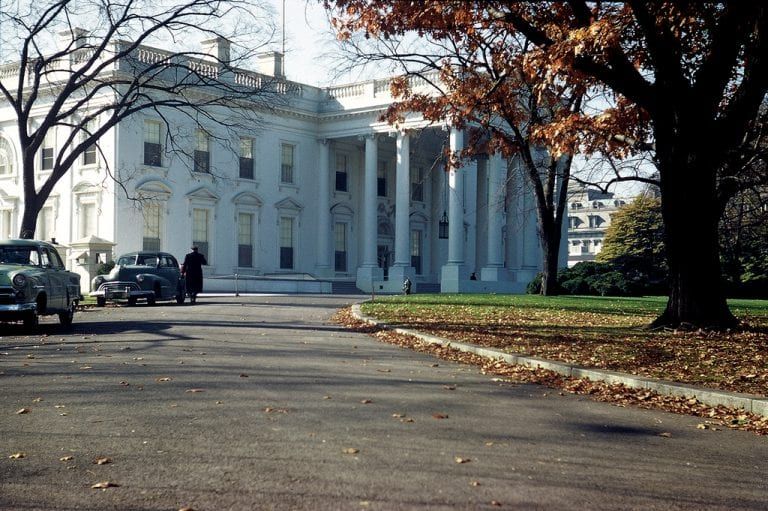
Upon its arrival at Pennsylvania Avenue, the president simply did not know what to do with it. He gave away as much as he could, and undoubtedly ate his own fair share, but by all accounts, it was left to age sitting on a floor in the middle of the White House.

A giant cheese party

What do you do when you have more cheese than you can possibly eat on your own? You throw a party. And that’s exactly what Andrew Jackson did. Nearing the end of his second term, the president decided that he didn’t really want to pack up a giant cheese and take it with him. Instead, he would make the two-year-old pile of cheese the center point of his last public reception.

Jackson’s cheese in the East Room of the White house

10,000 visitors showed up and devoured the stinky wheel in under two hours. According to Benjamin Perley Poore in his 1886 book Perley’s Reminiscences of Sixty Years in the National Metropolis, “For hours did a crowd of men, women and boys hack at the cheese, many taking large hunks of it away with them. When they commenced, the cheese weighed one thousand four hundred pounds, and only a small piece was saved for the President’s use. The air was redolent with cheese, the carpet was slippery with cheese, and nothing else was talked about at Washington that day.”

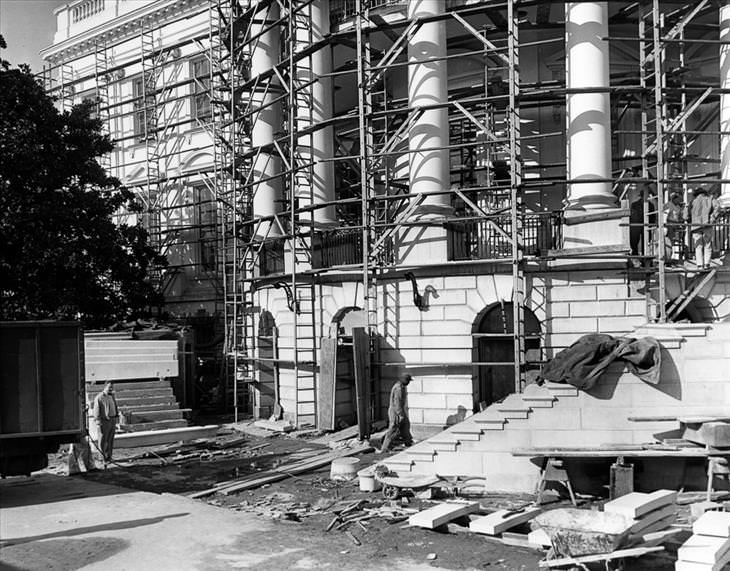
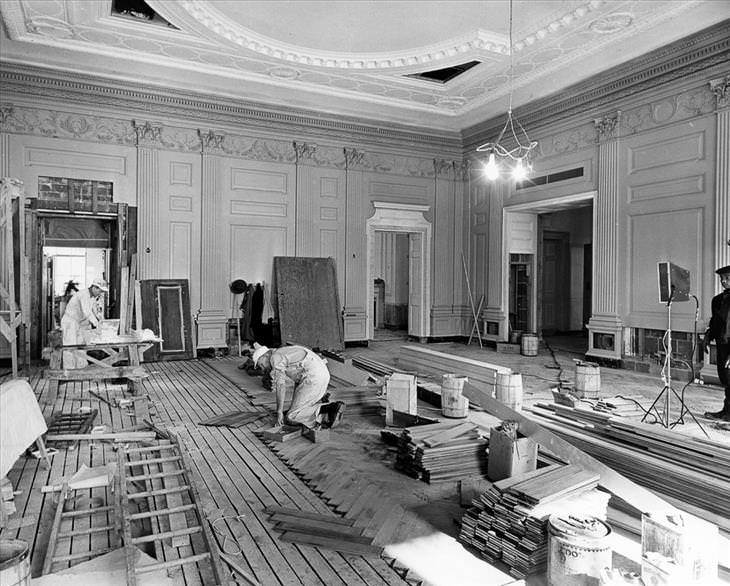
Unfortunately, even though the cheese was gone, its odor was not. Jackson’s successor, Martin Van Buren, reportedly had to air out the carpet, remove the curtains, and paint and white-wash the walls in the room where the cheese had resided.

Source: https://lulz.com/andrew-jackson-1400-pound-block-of-cheese/

Genghis Khan’s Bizarre Burial: Hidden Graves

There’s an ancient legend that Mongolian Ruler Genghis Khan desired that no one ever know the location of his grave, so he sent an army of men to murder anyone who came in contact with the funeral procession.

The Mausoleum of Genghis Khan is an ornate blue and white octagonal hall. It’s a top-rated tourist attraction outside of Ordos City in Inner Mongolia, which is an autonomous region landlocked inside of China. As many as 8,000 tourists visit each day to pay tribute to Genghis Khan. The main hall of the mausoleum contains a cenotaph – that’s a fancy word for a burial monument that contains no body. That’s because for 794 years, no one has ever figured out where Genghis Khan was buried.

The Mongolian ruler Genghis Khan was born sometime around 1162 near the Burkhan Khaldun mountain in Mongolia. He was the founder and the first Khan – which is a title meaning emperor of the Mongol Empire. His legacy is being an absolutely brutal conquerer.

His armies conquered hundreds of cities and murdered millions of people. In doing so, he created the largest contiguous land Empire in the history of the world – a mass of land equal to around the size of the continent of Africa. Genghis Khan’s Mongol Empire stretched as far West as modern day Poland and as far South as what is now Egypt. While he is remembered for ruthlessness and violence, he was once remembered for spreading culture, science and technology to many parts of the world. His empire was ethnically and racially diverse. He is considered the most successful military conquerer of all time.

The last conquest of Genghis Khan was Yinchuan, the capital of the Western Xia province of China. The Mongols conquered the city and slaughtered it’s entire population in 1227. It’s believed that it was during that battle that Genghis Khan died. No one is certain how he died. Theories range from being killed in battle to falling off his horse to dying from wounds he sustained while hunting – which is a theory that was spread by explorer Marco Polo. A legend that was circulated later was that he was killed by a Western Xia Princess that he had abducted.

The army that the Khan had amassed when he died was more than 129,000 men. So why is it that one of the most famous humans to have walked the Earth has an unknown burial site? The simple answer is he wanted it that way.

Quite a few famous people from history have lost, unmarked or unknown graves. Take Mozart. When Mozart was buried, he was buried in a common grave. He wasn’t ultra wealthy and he wasn’t aristocracy, and as such, his grave was subject to excavation after a period of ten years after his death. This was the practice in Vienna at the time as there wasn’t enough room in the cemeteries. After a period of 10 years, the remains were gathered and added together with other interments to consolidate space. Because of this, over the years, the actual remains of Mozart were lost.

Alexander the Great’s current tomb is unknown. After he was entombed, his grave was repeatedly raided and looted. It was moved, but since then sea levels have changed, earthquakes have changed the land, and entire cities have been built over what was once ancient Alexandria.

Alexander the Great Sarcophagus

Atilla the Hun, Cleopatra – many rulers from history have graves that are now lost. But looking at the burials of people closer to our time might help us to understand why some would want their gravesites to be hidden.

The grave of John Belushi became a place for people to party. The family didn’t like this, nor did the cemetery, so he was moved to a quiet hillside cemetery. The family says that his grave marker there doesn’t actually mark the site of his grave, which has been kept a secret. [Who knows if he is actually buried at either of these sites!]

Nobody knows the location of the gravesite of Steve Jobs. He was a very private person and his family made sure that the location of his gravesite at Alta Mesa Cemetery in Palo Alto has been kept a secret. People wishing to pay respects can sign the guest book at the front lobby of the cemetery.

Going back in time to the 13th century, Genghis Khan had been explicit in the years previous to his death about how he wanted to be buried. He left very detailed instructions about what was to be done to ensure his wish was granted – that no one would ever know where he was buried. This was a tradition in his tribe.

Much of this is legend and very difficult to prove. The sources that are commonly pointed to are that of Marco Polo who journeyed across Asia at the time of the Mongolian Empire, and the Altan Tobchi, which is a 17th century chronicle of Mongolian customs.

The funeral procession was carried out by an army of 800 soldiers. Those soldiers murdered anyone who they encountered on the procession, as well as everyone who attended Genghis Khan’s funeral. They reached the likely site of his burial near the Burkhan Khaldun mountain and Onon River, buried him, and were then killed by a separate group of soldiers who came in at that point. A thousand horses were led to trample the ground of the entire region to obscure any trace of the burial. Additional legends even go so far as to suggest the Mongols redirected the flow of the Onon River to cover the region where Khan was buried.

This is how important it was to Genghis Khan for his burial place to remain a secret. I mean, after you’ve killed as many as 40 million people establish your empire, what are a few thousand more? There have been countless expeditions through the years to locate the body of Genghis Khan. None have been successful. Partly, this is due to the fact that Mongolians don’t want him to be found – they tend to respect the tradition and wishes of the ruler. Some superstitions claim that if the burial is ever discovered, the world will end.

This is probably linked to the fact that in 1941, the tomb of 14th Century Mongolian ruler Tamarlane was opened by Soviet Archaeologists and soon after, Nazis invaded The Soviet Union.

It’s been made even more difficult for researchers to find the site because the region around Burkhan Khaldun mountain has been made into a UNESCO World Heritage Site and as such is off limits for any sort of excavation or research.

Mongolia Badaam Festival

For Mongolians, they’re happy he’s never going to be found. In Mongolia, Genghis Khan is their most celebrated figure. He’s immortalized with statues and monuments throughout the nation and his face appears on their money. The rest of the world may see him as a vicious murderer and conquerer, but for Mongolians, he’s the ruler that united the East and West. He established what would become the Silk Road to enable trade and commerce for future generations. And for that, they want to continue to respect his final wishes.

1000 Tögrög Note Of Mongolia

The Cecil (Suicide) Hotel (Part 2)

Considering all of the deaths and suicides that have taken place at the Cecil Hotel, might there be a horrific history from the 1700’s giving rise to phantoms and ghosts or auras, if you will? People seem to be attracted to certain “spots” around the world, saying things such as “I don’t like the energy coming off of that place” or “there is something dark that draws me here.” Most people use that metaphorically but might there actually be something to it? Hmmm….there is blood in that soil!

The Tongva are an indigenous people of California from the Los Angeles Basin and the Southern Channel Islands, an area covering approximately 4,000 square miles. In the pre-colonial era, the people lived in as many as 100 villages and primarily identified by their village name. The name Tongva is the most widely circulated name and gained popularity in the late 20th century. Others choose to identify as Kizh and disagree over use of the term Tongva.

Southern CA Native American Tribal Territories

On October 7, 1542, an exploratory expedition led by Spanish explorer Juan Cabrillo reached Santa Catalina in the Channel Islands, where his ships were greeted by Tongva in a canoe. The following day, Cabrillo and his men, the first Europeans known to have interacted with the Gabrieleño people, entered a large bay on the mainland, which they named “Baya de los Fumos” (“Bay of Smokes”) on account of the many smoke fires they saw there. This is commonly believed to be San Pedro Bay, near present-day San Pedro.

Present day San Pedro Bay

The Gaspar de Portola expedition in 1769 was the first contact by land to reach Tongva territory, marking the beginning of Spanish colonization. Franciscan padre Junipero Serra accompanied Portola. Within two years of the expedition, Serra had founded four missions, including Mission San Gabriel, founded in 1771 and rebuilt in 1774, and Mission San Fernando, founded in 1797. The people enslaved at San Gabriel were referred to as Gabrieleños, while those enslaved at San Fernando were referred to as Fernandeños.

Painting of Mission San Gabriel by Ferdinand Deppe (1832) showing a Gavrieleno kiiy thatched with tule, a giant species of sedge grass.

There is much evidence of Tongva resistance to the mission system. Many individuals returned to their village at time of death. Many converts retained their traditional practices in both domestic and spiritual contexts, despite the attempts by the padres and missionaries to control them. Traditional foods were incorporated into the mission diet and lithic and shell bead production and use persisted. More overt strategies of resistance such as refusal to enter the system, work slowdowns, abortion and infanticide of children resulting from rape, and fugitivism were also prevalent. Five major uprisings were recorded at Mission San Gabriel alone.

It is estimated that nearly 6,000 Tongva lie buried on the grounds of Mission San Gabriel from the mission period.

Two late-eighteenth century rebellions against the mission system were led by Nicolás José, who was an early convert who had two social identities: “publicly participating in Catholic sacraments at the mission but privately committed to traditional dances, celebrations, and rituals.” He participated in a failed attempt to kill the mission’s priests in 1779 and organized eight foothill villages in a revolt in October 1785 with Toypurina, who further organized the villages, which “demonstrated a previously undocumented level of regional political unification both within and well beyond the mission.” However, divided loyalties among the natives contributed to the failure of the 1785 attempt as well as mission soldiers being alerted of the attempt by converts or neophytes.

Toypurina, José and two other leaders of the rebellion, Chief Tomasajaquichi of Juvit village and a man named Alijivit, from nearby village of Jajamovit, were put on trial for the 1785 rebellion. At his trial, José stated that he participated because the ban at the mission on dances and ceremony instituted by the missionaries, and enforced by the governor of California in 1782, was intolerable as they prevented their mourning ceremonies.

Felipe de Neve y Padilla (1724–1784) was a Spanish soldier who served as the 4th Governor of the Californias, from 1777 to 1782. Neve is considered one of the founders of Los Angeles and was instrumental in the foundation of San Jose and Santa Barbara.

Statue of Felipe de Neve, Spanish colonial Governor of Las Californias, in the Los Angeles Plaza. The inscription reads: “Felipe de Neve (1728-84). Governor of California 1775-82. In 1781, on orders from King Carlos III of Spain, Felipe de Neve selected a site near the River Porciuncula and laid out the town of El Pueblo de La Reina de Los Angeles, one of two pueblos he founded in Alta California.

In June 1788, nearly three years later, their sentences arrived from Mexico City, Nicolás José was banned from San Gabriel and sentenced to six years of hard labor in irons at the most distant penitentiary in the region. Toypurina was banished from Mission San Gabriel and sent to the most distant Spanish mission.

Resistance to Spanish rule demonstrated how the Spanish Crown’s claims to California were both insecure and contested. By the 1800s, San Gabriel was the richest in the entire colonial mission system, supplying cattle, sheep, goats, hogs, horses, mules, and other supplies for settlers and settlements throughout Alta California. The mission functioned as a slave plantation.

Felipe de Neve Library, Los Angeles

Some might wonder…..could there be a Tongva burial ground on the site of the Cecil Hotel? Could it be the ghosts of the earliest settlers of that land returning? A sense of despair that somehow seeps in while people are sleeping? Who can say? Do YOU believe in ghosts?

The Cecil (Suicide) Hotel

Nestled within the busy streets of downtown Los Angeles lies one of the most infamous buildings in horror lore: the Cecil Hotel. Since opening its doors in 1927, the Cecil Hotel has been plagued with unfortunate and mysterious circumstances that have given it a perhaps unparalleled reputation for the macabre. At least 16 different murders, suicides, and unexplained paranormal events have taken place at the hotel — and it’s even served as the temporary home of some of America’s most notorious serial killers.

The original sign on the side of Los Angeles’ Cecil Hotel

The Grand Opening Of The Cecil Hotel

The Cecil Hotel was built in 1924 by hotelier William Banks Hanner. It was supposed to be a destination hotel for international businessmen and social elites. Hanner spent $1 million on the 700-room Beaux Arts-style hotel, complete with a marble lobby, stained-glass windows, palm trees, and an opulent staircase.

The marble lobby of the Cecil Hotel, which opened in 1927

But Hanner would come to regret his investment. Just two years after the Cecil Hotel opened, the world was thrown into the Great Depression — and Los Angeles was not immune to the economic collapse. Soon enough, the area surrounding the Cecil Hotel would be dubbed “Skid Row” and become home to thousands of homeless people.

The once beautiful hotel soon gained a reputation as a meeting place for junkies, runaways, and criminals. Worse yet, the Cecil Hotel ultimately earned a reputation for violence and death.

Suicide And Homicide At “The Most Haunted Hotel In Los Angeles”

In the 1930s alone, the Cecil Hotel was home to at least six reported suicides. A few residents ingested poison, while others shot themselves, slit their own throats, or jumped out their bedroom windows.

In 1934, for example, Army Sergeant Louis D. Borden slashed his throat with a razor. Less than four years later, Roy Thompson of the Marine Corps jumped from atop the Cecil Hotel and was found on the skylight of a neighboring building. The next few decades only saw more violent deaths.

In September 1944, 19-year-old Dorothy Jean Purcell awoke in the middle of the night with stomach pains while she was staying at the Cecil with Ben Levine, 38. She went to the bathroom so as not to disturb a sleeping Levine, and — to her complete shock — gave birth to a baby boy. She had no idea she had been pregnant.

A newspaper clip about Dorothy Jean Purcell, who threw her newborn baby out of her hotel bathroom window

Mistakenly thinking her newborn was dead, Purcell threw her live baby out the window and onto the roof of the building next door. At her trial, she was found not guilty of murder by reason of insanity and she was admitted to a hospital for psychiatric treatment.

In 1962, 65-year-old George Giannini was walking by the Cecil with his hands in his pockets when he was struck to death by a falling woman. Pauline Otton, 27, jumped from her ninth-floor window after an argument with her estranged husband, Dewey. Her fall killed both her and Giannini instantly.

Outside Los Angeles’ Cecil Hotel

Police initially thought the two had committed suicide together but reconsidered when they found Giannini was still wearing shoes. If he had jumped, his shoes would have fallen off mid-flight. In light of the suicides, mishaps, and murders, Angelinos promptly dubbed the Cecil “the most haunted hotel in Los Angeles.”

A Serial Killer’s Paradise

While tragic calamities and suicide have contributed heavily to the hotel’s body count, the Cecil Hotel has also served as a temporary home for some of the grisliest murderers in American history. In the mid-1980s, Richard Ramirez — murderer of 13 people and better known as the “Night Stalker” — lived in a room on the top floor of the hotel during much of his horrific killing spree.

After killing someone, he would throw his bloody clothes into the Cecil Hotel’s dumpster and saunter into the hotel lobby either completely naked or only in underwear — “none of which would have raised an eyebrow,” writes journalist Josh Dean, “since the Cecil in the 1980s… ‘was total, unmitigated chaos.’” At the time, Ramirez was able to stay there for a mere $14 per night. And with corpses of junkies reportedly often found in the alleys near the hotel and sometimes even in the hallways, Ramirez’s blood-soaked lifestyle surely raised nary an eyebrow at the Cecil.

Richard Ramirez was ultimately convicted of 13 counts of murder, five attempted murders, and 11 sexual assaults

While some episodes of violence in and around the Cecil Hotel are attributable to known serial killers, some murders have remained unsolved. Such stories of violence are not simply a thing of the past. One of the most mysterious deaths ever to take place at the Cecil Hotel happened as recently as 2013.

Elisa Lam

In 2013, Canadian college student Elisa Lam was found dead inside the water tank on the roof of the hotel three weeks after she had gone missing. Her naked corpse was found after hotel guests had complained of bad water pressure and a “funny taste” to the water. Though authorities ruled her death as an accidental drowning, critics believed otherwise.

Before her death, surveillance cameras caught Lam acting strangely in an elevator, at times appearing to yell at someone out of view, as well as apparently attempting to hide from someone while pressing multiple elevator buttons and waving her arms erratically.

After the video surfaced publicly, many people began to believe that the rumors of the hotel being haunted might be true.

Horror aficionados began drawing parallels between the Black Dahlia murder and Lam’s disappearance, pointing out that both women were in their twenties, traveling alone from L.A. to San Diego, last seen at the Cecil Hotel, and were missing for several days before their bodies were found.

Thin though these connections may sound, the hotel has nevertheless developed a reputation for horror that defines its legacy to this day.

After a brief stint as the Stay On Main Hotel and Hostel, the hotel closed. It underwent a $100 million renovation and was turned into $900 to $1,200-a-month “micro apartments.”

https://allthatsinteresting.com/cecil-hotel-los-angeles

—————-

On December 14, 2021, Cecil Hotel Apartments opened. The 600 units range between 160 and 175 square feet and the common areas include bathrooms and kitchens, which is similar to the hotel’s earlier days. It also offers guarded entry and case management services on-site.

The rooms are exclusively available to rent by low-income Los Angelenos who earn between 30% and 60% of the area’s median income of $24,850 annually. With rent ranging between $900 and $1,200 a month, tenants can use Section 8 housing vouchers to help pay. Three months after it reopened, the building was boarded up against unwanted visitors and discreetly serves its visitors.

Might there be another reason for all the deaths, spawned much further back in history? Stay tuned for part 2 of The Cecil Hotel…..

The Legendary Tayos Caves of Ecuador

The Tayos caves of Ecuador are a legendary vast natural underground network of caves spanning many kilometres, very little of which has been officially explored. The Tayos caves (Cueva de los Tayos) reached worldwide attention in 1973 when Erich von Däniken released his bestselling and controversial book ‘The Gold of the Gods’, in which he claimed that piles of gold, unusual sculptures, and a library of metal tablets had been found in a series of artificial tunnels within the caves. Tayos was also mentioned as the location of Father Crespi’s collection of mysterious golden artifacts, given to him by the indigenous people of Ecuador. Ancient Origins recently carried out the first of a series of expeditions to the caves to explore just what lies within this enigmatic subterranean world. Here are some of the never-before-seen photographs of the caves.

Hidden Entrance
Taos Caves
Rock Formations in Tayos Caves
Walking thru a small alley in Tayos Caves

Rapelling down a Tayos Cave

Legendary Metal Library in Tayos Caves

The elusive Metal Library in the Tayos Caves

Library of Metal Books

Map of massive Caves of Tayos
Father Crespi plays a big part in this story because the local tribes’ people liked him and gave him artifacts as gifts. They gave him so many artifacts throughout his 60 years of being a missionary in Ecuador, that he displayed them and opened a local museum for all to see.

Neil Armstrong the astronaut and treasure hunting? That’s correct. Neil heard about Father’s Crespi‘s collection and he traveled down to see them. It wasn’t long until people came to the realization that points to one fact; these artifacts must have come from a nearby area, and the local tribes know of their whereabouts.

People started to research and even though the village people were closed-mouthed of the location of more artifacts and where they came from, people learned of a great mystery. The local tribespeople knew of an ancient site that they deemed spiritual and secret. People started to learn that these modern day village people knew of a great underground city that they have been protecting for hundreds, maybe thousands of years.

After further inquiring, people learned that the local people were not as friendly about this story and inquiries as they thought. These village people gave the gifts to Father Crepsi out of love and respect but these local tribes didn’t want outsiders to learn about the ancient site.

Neil Armstrong and his large group of professionals and military men did learn that there was a massive cave system not far away.

Could this be the site where Father Crepsi’s artifacts came from? After a large man-scaled hunt, Neil Armstrong’s group did in fact find a cave system. In this cave system, they did find man-made structures, carved tunnels, rooms, and more. It was an exciting find. Newspapers and magazines wrote about the discoveries and the world thought that the collection of artifacts from this lost civilization would be found. The hunt wasn’t unsuccessful but Neil and his group didn’t find the lost treasure that they were hoping to find.

Neil Armstron in the Tayos Caves

Ancient Roman Villa Discovered Near Pompeii

(Header image: Mosaic uncovered at the Domus Aventino apartment block development. Source: Domus Aventino)

Rome is a place where many archaeological treasures and remains continue to be found. The latest discovery is a luxury villa with many remarkable artifacts and spectacular mosaics. This luxury Roman villa is providing us with new insights into how the elite in Rome lived up to 2000 years ago.

The villa — dubbed ‘Domus Aventino’ — is located at the foot of the Aventine Hill. A region of the city occupied by the regular citizenry (or ‘plebeians’) during the Roman republic, the area became home to the wealthy patricians in the time of the empire, when the villa would have been built. It was located close to the Circus Maximus, as well as a port on the River Tiber

From the discoveries made at this site, we can certainly say that the Roman elite lived in opulence. The domus was found at the foot of the famous Aventine Hill in central Rome in 2015. Originally, this hill was inhabited by poor people, but by the reign of Agustus was where the Roman elite, including senators, made their home, and it’s “not far from the Circus Maximus,” reports Wanted in Rome.


The Aventine Hill, where the Roman luxury villa was discovered in 2015, as seen from the Palatine Hill in central Rome. (Walter T Crane /Public Domain)

Ancient Luxury Roman Villa Found In The Heart of Modern Rome

The Roman luxury villa was uncovered, completely by chance, during the earthquake proofing of a 1950s building in central Rome. Archaeologists found a large villa that had been occupied for several generations at the foot of a modern condominium. Their work continued even while a new 180-apartment development rose-up around the archaeological site.

Forbes reports that “The dig revealed six different strata of historical remains, ranging from 8th century BC to 3rd century AD.” This time period stretches from the birth of Rome to the peak of Imperial Roman Power. Among the most important finds were the remains of an 8th century BC stone tower. The Daily Mail reports that “Excavations also revealed a defensive wall from the time of the Roman republic (509–27 BC).” These findings are helping researchers to better understand the topography of Rome in ancient times.

Remains of the upper-class Roman luxury villa unearthed by archaeologists in central Rome. (Domus Aventino)

Ancient Roman Villa: A Lavish Home Full Of Treasures

The ancient Roman villa, which would have been known as a domus, was once a sumptuous residence that included many artifacts and wonderful mosaics in its series of rooms. Based on this evidence, “archaeologists believe that the domus belonged to a ‘person of power’,” reports Wanted in Rome. The owners may have been members of the senatorial order because the villa was so luxurious. Daniela Porro, an archaeologist and official who works for the Italian capital, told Forbes that the family who lived here were “probably linked to the imperial family.”

Rome: An Archaeological Jewel At Every Level

Since its discovery in 2015, the archaeologists have unearthed a treasure trove of artifacts in this Roman luxury villa. Among the finds were a hammer, lamps, needles, hairpins, and lacquered bowls decorated with figures from Greek mythology. Also found was a vessel that contained garum fish sauce, which was a delicacy extremely popular with the Roman elite. These finds show that the Roman elite had a very high standard of living.

Though the remains of some great frescoes were also found in the villa, its mosaics are considered to be especially spectacular. The mosaic sections were laid down over a period of two hundred years, beginning in first century AD. The Daily Telegraph quoted Mr. Porro as saying that “Rome never ceases to surprise us. It’s an archaeological jewel.”


The frescoes and mosaics discovered in the ancient Roman villa are considered to be among the finest ever found. (Domus Aventino)

Spectacular Mosaics In The Luxury Villa Tell Us A Lot

The mosaics unearthed in the Roman luxury villa were made in the style known as “black and white” because they are almost entirely made from black and white stone cubes. They consist of thousands of tiny cube-shaped stones that are known as tesserae. Black and white mosaics were popular from the 1st century AD onward and have been found all over Italy and beyond. One of the villa’s black and white mosaics has a small section depicting a colorful green parrot. Another one shows a grapevine growing out of a pot.

One of the surface artworks found in the villa was very unusual. It consisted of a series of figure of eight patterns. Robert Narducci, who took part in the villa excavation process is quoted by the Daily Mail as stating that “We’ve not seen it before,” in reference to the figure of eight pattern. At least one of the black and white mosaics contains a Latin inscription. These mosaics would not have been laid down solely for decorative purposes: they were intended to express the splendor and power of the owner of the villa and his family to the wider community.

The Ancient Roman Luxury Villa Is Now An Underground Museum

The elite Roman luxury villa and its artworks have recently been turned into a subterranean museum. To reach the museum, visitors have to enter the newly built apartment complex and go down a staircase. Anselmo De Titta, a senior director with the company that owns the new apartment building told the Daily Mail that “It’s quite a challenge to allow access to the site while protecting the privacy of the condominium’s residents.”

Entrance to Villa

Video projections have been added to the museum’s attractions to enhance the experience. “The walls of the space now enclosing the villa are illuminated with video projections of a Roman senator and his wife walking amid marble busts and ornate furnishings,” according to the Daily Mail. Initially, the villa and its mosaics will be opened two days a month, but if they prove popular, the opening hours will be extended.

https://www.ancient-origins.net/news-history-archaeology/luxury-roman-villa-0014369

The Shelby Light Bulb

Dangling from the ceiling of a California firehouse is a bulb that’s burned for 989,000 hours – nearly 113 years. Since its first installation in 1901, it has rarely been turned off, has outlived every firefighter from the era, and has been proclaimed the “Eternal Light” by General Electric experts and physicists around the world.

Tracing the origins of the bulb — known as the Centennial Light — raises questions as to whether it is a miracle of physics, or a sign that new bulbs are weaker. Its longevity still remains a mystery.

A Brief History of the Light Bulb

Thomas Edison worked on improving carbon filaments. By 1880, through the utilization of a higher vacuum and the development of an entire integrated system of electric lighting, he improved his bulb’s life to 1,200 hours and began producing the invention at a rate of 130,000 bulbs per year.

In the midst of this innovation, the man who would build the world’s longest-lasting light bulb was born.

The Shelby Electric Company

Adolphe Chaillet

Adolphe Chaillet was bred to make exceptional light bulbs. Born in 1867, Chaillet was constantly exposed to the burgeoning light industry in Paris, France. By age 11, he began accompanying his father, a Swedish immigrant and owner of a small light bulb company, to work. He learned quickly, garnered an interest in physics, and went on to graduate from both German and French science academies. In 1896, after spending some time designing filaments at a large German energy company, Chaillet moved to the United States.

Chaillet briefly worked for General Electric, then, riding on his prestige as a genius electrician, secured $100,000 (about $2.75 million in 2014 dollars) from investors and opened his own light bulb factory, Shelby Electric Company. While his advancements in filament technology were well-known, Chaillet still had to prove to the American public that his bulbs were the brightest and longest-lasting. In a risky maneuver, he staged a “forced life” test before the public: The leading light bulbs on the market were placed side-by-side with his, and burned at a gradually increased voltage. An 1897 volume of Western Electrician recounts what happened next:

Chaillet’s original patent:

“Lamp after lamp of various makes burned out and exploded until the laboratory was lighted alone by the Shelby lamp — not one of the Shelby lamps having been visibly injured by the extreme severity of this conclusive test.”

Shelby claimed that its bulbs lasted 30% longer and burned 20% brighter than any other lamp in the world. The company experienced explosive success: According to Western Electrician, they had “received so many orders by the first of March [1897], that it was necessary to begin running nights and to increase the size of the factory.” By the end of the year, output doubled from 2,000 to 4,000 lamps per day, and “the difference in favor of Shelby lamps was so apparent that no doubt was left in the minds of even the most skeptical.”

Over the next decade, Shelby continued to roll out new products, but as the light bulb market expanded and new technologies emerged (tungsten filaments), the company found itself unable to make the massive monetary investment required to compete. In 1914, they were bought out by General Electric and Shelby bulbs were discontinued.

The Centennial Light

Seventy-five years later, in 1972, a fire marshall in Livermore, California informed a local paper of an oddity: A naked, Shelby light bulb hanging from the ceiling of his station had been burning continuously for decades. The bulb had long been a legend in the firehouse, but nobody knew for certain how long it had been burning, or where it came from. Mike Dunstan, a young reporter with the Tri-Valley Herald, began to investigate — and what he found was truly spectacular.

Tracing the bulb’s origins through dozens of oral narratives and written histories, Dunstan determined it had been purchased by Dennis Bernal of the Livermore Power and Water Co. (the city’s first power company) sometime in the late 1890s, then donated to the city’s fire department in 1901, when Bernal sold the company. As only 3% of American homes were lit by electricity at the time, the Shelby bulb was a hot commodity.

In its early life, the bulb, known as the “Centennial Light,” was moved around several times: It hung in a hose cart for a few months, then, after a brief stint in a garage and City Hall, it was secured at Livermore’s fire station. “It was left on 24 hours-a-day to break up the darkness so the volunteers could find their way,” then-Fire Chief Jack Baird told Dunstan. “It’s part of another era in the city’s past [and] it’s served its purpose well.”

Though Baird acknowledged that it had once been turned off for “about a week when President Roosevelt’s WPA people remodeled the fire house back in the 30s,” Guinness World Records confirmed that the hand-blown 30-watt bulb, at 71 years old, was “the oldest burning bulb in the world.” A slew of press followed, which saw it featured in Ripley’s Believe it or Not, and on major news networks.

Aside from the 1930s fire house remodel, the bulb has only lost power a few times — most notably in 1976, when it was moved to Livermore’s new Station #6. Accompanied by a “full police and fire truck escort,” the bulb arrived with a large crowd eager to see it regain power, but, as recalled by Deputy Fire Chief Tom Brandall, “there was a little scare:”

“We got to new location and the city electrician installed the light bulb and made connection. It took about 22-23 min, and [the bulb] didn’t come back on. The crowd gasped. The city electrician grabbed the switch and jiggled it; it went on!”

Once settled, the bulb was placed under video surveillance to ensure it was alive at all hours; in subsequent years, a live “Bulb Cam” was put online. At one point, the bulb’s groupies (9,000 followers on FB) received another scare when it lost light.

At first it was suspected that the light had finally met its demise, but after nine and half hours, it was discovered that the bulb’s uninterrupted power supply had failed; once the power supply was bypassed, the bulb’s light returned. The 113-year-old bulb had outlived its power supply, just as it had outlived three surveillance cameras.

Today, the bulb still shines, though, as one retired fire volunteer once said, “it don’t give much light” (only about 4 watts). Owning a frail piece of history comes with great responsibility: Livermore firefighters treat the little bulb like a porcelain doll. “Nobody wants that darn bulb to go out on their watch,” once said former fire chief Stewart Gary. “If that thing goes out while I’m still chief it will be a career’s worth of bad luck.”

“They Don’t Make ‘Em Like They Used To”

Everyone from Mythbusters to NPR has speculated on the reasons for the Shelby bulb’s longevity. The answer, in short, is that it remains a mystery – Chaillet’s patent left much of his process unexplained.

In 2007, Annapolis physics professor Debora M. Katz purchased an old Shelby bulb of the same vintage and make as the Centennial Light and conducted a series of experiments on it to determine its differentiation from modern bulbs. She reported her findings:

“I found the width of the filament. I compared it to the width of a modern bulb’s filament. It turns out that a modern bulb’s filament is a coil, of about 0.08 mm diameter, made up of a coiled wire about 0.01 mm thick. I didn’t know that until I looked under a microscope. The width of the Shelby bulb’s 100-year-old filament is about the same as the width of the coiled modern bulb’s filament, 0.08 mm.”

The Lightbulb Cartel

Light bulb companies like Shelby once prided themselves on longevity – so much so, that the durability of their products was the central focus of marketing campaigns. But by the mid-1920s, business attitudes began to shift, and a new rhetoric prevailed: “A product that refuses to wear out is a tragedy of business.” This line of thought, termed “planned obsolescence,” endorsed intentionally shortening a product’s lifespan to entice swifter replacement.

In 1924, Osram, Philips, General Electric, and other major electric companies met and formed the Phoebus Cartel under the public guise that they were cooperating to standardize light bulbs. Instead, they purportedly began to engage in planned obsolescence. To achieve this the companies agreed to limit the life expectancy of light bulbs at 1,000 hours, less than Edison’s bulbs had achieved (1,200 hrs) decades before; any company that produced a bulb exceeding 1,000 hours in life would be fined.

Until disbanding during World War II, the cartel supposedly halted research, preventing the advancement of the longer-lasting light bulb for nearly twenty years.

Whether or not planned obsolescence is still on the agenda of light bulb manufacturers today is highly debatable, and there exists no definitive proof. In any case, incandescent bulbs are being phased out worldwide: Since Brazil and Venezuela began the trend in 2005, many countries have followed suit (European Union, Switzerland, and Australia in 2009; Argentina and Russia in 2012; the United States, Canada, Mexico, Malaysia, and South Korea in 2014).

As more efficient technologies have surfaced (halogen, LED, compact fluorescent lights, magnetic induction lights), the old filament-based bulbs have become a relic of the past. But perched up in the white ceiling of Livermore’s Station #6, the granddaddy of old-school bulbs is as relevant as ever, and refuses to bite the dust.

Source document written in 2014.

History of St. Paul’s Lutheran Church

I was unable to find a picture by itself of the current church/school but you can see it in the opening picture in this video. Overhead view of the current church, with the school I attended on the right; I was baptized in this church in 1953 and was confirmed in April 1967. The entire wing on the left and the parking lot was added after I left the area.

In the year 1865, a group of members of the Evangelical Lutheran St. Paul congregation at Ixonia, WI gathered together with the desire to raise their cildren near a church and school. This caused them to consider emigration. Pastor Hoeckendorf, the minister of this congregation, at that time had relatives who lived near West Point, NE. So they got the idea to send scouts into this area. They wanted some trustworthy people to check everything out right there on location.

The info in this post was taken from this booklet.

They entrusted this important matter to “Father” Braasch, “Father” Wagner, and John Gensmer. These men departed for NE and, since the area surrounding West Point was already more or less settled and the whole group couldn’t possibly also settle there, they ventured further north over the wild plains of Nebraska until they came to the area which is now Norfolk.

They found that the land was fertile, the water drinkable, and wood was also found on the North Fork and the Elkhorn rivers. Very pleased with their finding, they joyfully returned to Ixonia and delivered the good news.

Pic from internet

On May 23, 1866, it was time for the old pioneers to leave their homes and strike out toward their new destination. It was a difficult time since many heartrending goodbyes were required – parents to their children, children to their parents, brothers and sisters parted, relatives and friends shook hands for the last time. The long journey was made in “prairie schooners” pulled by horses and oxen. In 3 caravans, 53 wagons moved through the uncultivated terrain, accompanied by cattle and sheep. Along the way, they encountered great difficulties, such as crossing rivers without bridges and maneuvering through swamps. Some days they had to stop to wash clothes and bake bread and on Sundays, they observed regular church services, which were led by Father Braasch, the leader of the whole train.

Around the 12th of July 1866, the members of the new German Settlement arrived in close proximity to the present-day Norfolk. After the land was measured and raffled off, everybody moved onto their allotted properties from 17-20 July.

Note: You may need to enlarge the pic to see – on the left just over half-way down, you will see the name “William Duhring.” (My brother inherited the farm and now his children have inherited it from him – Chris gets the land in order to keep it in the Deering name, ‘Nette gets the house.) That was my birth grandfather, Arnold Deering’s Father (Grandpa changed the spelling of his last name in order to appear less German, probably due to WWII, I expect). If you look up further towards the center, close to the river, you will see the name “Martin Raasch,” my adopted great-great-grandfather.

I’m not sure when this picture was taken – clearly not in 2007 – but these were the 4 remaining founders still alive at that time. August Raasch, my adopted great-grandfather, was the first postmaster in Norfolk. He was wounded at Gettysburg and carried shrapnel in his back until he died; in later years, he was basically an invalid but with 12 children (mostly boys), he had plenty of help on the farm.

Of course, it took time to build homes and barns so, in the meantime, they either built one-room log cabins or sod houses.

The first services of this new settlement took place in a shed on the North Fork of the Elkhorn River. Shrubs and branches covered the roof to provide shade and the dirt floor was covered with hay. For the rest of that first summer, they held church services in this shed. I don’t know when the first real church, a log building 24 X 30, was built – there was no altar or chancel and the benches consisted of boards which were laid on wooden blocks. Occasionally the boards would fall over when the people rose during the service. This church was used until the year 1878; in 1876, the congregation had bought 12 acres from Pastor Hoekendorf for $120.

The first parsonage was built in 1878 and at the April meeting that year, the congregation decided to build a new church. The new one would be 36 X 50 and cost approximately $1,405. The number of school children increased significantly so the congregation found it necessary to hire a regular teacher and build a school house. Since they already had a teacher, a house for him was also required, which was constructed in 1884.

Although the church building was finished, the interior was bare – no chancel, altar, benches or organ. Father Braasch made the initial contribution when he paid for an altar and chancel for the church, providing an example for the wealthy people among the members. The congregation bought the benches and, in 1884, they acquired a pipe organ (the organ still remains in the current church, as you will see in the interior picture). Since the church did not have enough seating for the attendants and the school also needed another classroom, the congregation voted unamimously to build a new church. During a meeting on January 21, 1907, the decision was made to build a brick building.

Architect Stitt created the plans and specifications for the beautiful building, which was designed in the gothic style of the 13th century. The cost of the building and interior came to about $24K. The cornerstone was laid in August of 1907 and the dedication took place on May 3, 1908. The old church was remodeled to serve for school functions and weekly catechism.

In July 1916, it had been 50 years since the founding fathers of our congregation arrived on these grassy plains. Since the congregation did not want to let this day pass without an expression of gratitude to God, they decided to celebrate their 50th anniversary on July 16, 1916. For this event, they had the interior of the church painted – the finished work is a credit to the master, Mr. Art Reiman of Milwaukee, and is a perfect work of art.

At the end of the 1st row is my birth grandmother, Marie Deering (she loved Hitler, btw); in the 2nd row, you will see my grandfather, Arnold, as well as Ernest Raasch, my adopted grandfather.
Esther Raasch was my adopted grandmother – Ernest died around the time I was born. He was a Nebraska State Senator. My birth mother lived with them for a period of time while she was in HS – she and my adopted Mom were close friends.

17TH AMENDMENT WAS A HUGE MISTAKE

Since it was ratified in 1913, we have been losing states’ rights over time and it is getting faster. Today we see the abuses of the federal government destroying the powers of the state at an alarming rate.

The 17th Amendment must go if we are ever to rein in the abuses of the federal government. The good news is that we do not need a Constitutional amendment to do that. Here’s why…

Article V of the US Constitution spells out the process for amending the Constitution. The last line of Article V seems prophetic in that it spells out that the 17th Amendment could not happen unless 100% of the states agreed. That line reads, “and that no State, without its Consent, shall be deprived of its equal Suffrage in the Senate.”

What this clearly means is that no State (as an entity – that is why it is capitalized) can have its representation in Congress taken from it without consent. Taking that representation away from the state as an entity and placing it with the people of that state clearly takes away any representation in the US Senate for the states. Therefore, it was not passed by all states so some (a total of 12) did not consent.

Some might argue that the 36 that did ratify it would be bound by it. This would violate equal representation, therefore could not stand.

As with all governments, it becomes necessary, from time to time, to reacquaint ourselves with its basic mechanics of operation. The Founding Fathers gave posterity a written constitution to aid in this process. When there are doubts as to its meaning, one must study its original intent to discern proper application, for “the intent of the Lawgiver is the Law.”

Current events in this nation have provoked citizens and scholars to perform this assessment — to “retrace our steps” — in yet another area: the principle of federalism. Simply defined, federalism is ‘a system that combines States retaining sovereignty within a certain sphere with a central body possessing sovereignty within another sphere, and a third sphere where concurrent jurisdiction (exists].’

After years of silence on the matter, a resurgence of interest in federalism became evident. President Reagan’s “New Federalism,” “The Federalist Society,” and a report on federalism issued by the Domestic Policy Council were just some of the manifestations of this increasing concern.

The reason for the current interest is that America is reaping the fruit of centralized government. Contrary to the Founding Fathers’ original vision of separate spheres of jurisdiction between the people, the states, and national government, our current system is now dominated by the national government.

The United States Constitution, as drafted by the Founding Fathers, clearly enumerated the limited powers of the national government. All other powers were reserved to the states or the people. The 10th Amendment affirms this noting: ‘The powers not delegated to the United States by the Constitution, nor prohibited by it to the States, are reserved to the States respectively, or to the people.’

The separate spheres of jurisdiction of the national and state governments have gradually been eroded. The national government has increasingly usurped the reserved power of both the people and the states. It has been documented that:’States, once the hub of political activity and the very source of our political tradition, have been reduced — in significant part — to administrative units of the national government ….’

As a result of this erosion process, both the national government and the state governments are crippled in their effectiveness. The national government, having taken on too much power, is unable to properly administer all the areas it has arrogated unto itself. On the other hand, the state governments are impotent in legislating and executing the will of the people because they are subject to unpredictable subjugation by the national government.

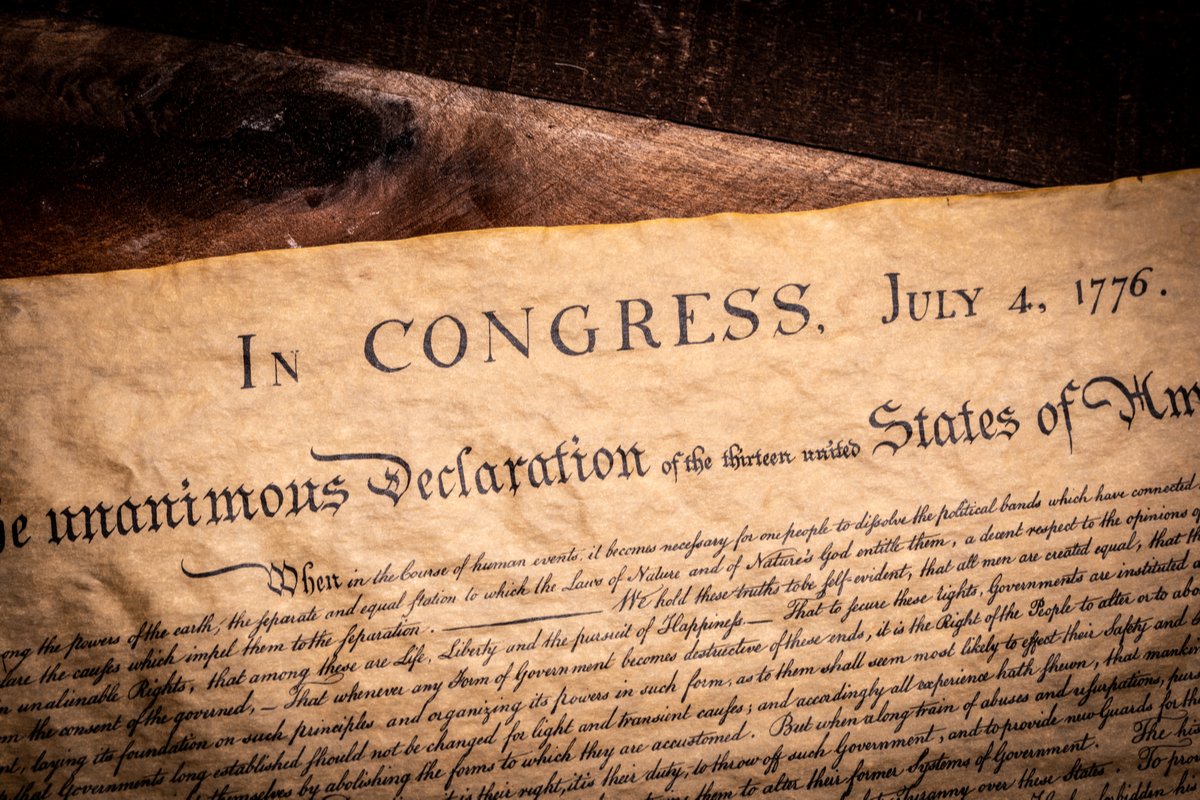
Our founding document, the Declaration of Independence, proclaims as self evident the proposition that “all men are … endowed by their Creator with certain unalienable rights,” and that “to secure these rights, governments are instituted among men.” When state governments so instituted become impotent, then it is their right and duty to reacquire the appropriate power in order to fulfill the purpose for which they were originally established.

History of the Bath Tub

Search the web, and you’re sure to read that America’s first bathtub was installed in 1842—December 20, to be exact. It would be nice if such a mercurial vessel had so neat a beginning—even H.L. Mencken, the newspaperman who concocted this hoax as an uplifting wartime news story, would agree. What is true is that no accessory embodies the metamorphosis of bathing equipment (from moveable furniture to plumbed-in-place fixtures) or helps define the use and look of a bathroom in any era as much as the bathtub.

Antebellum Scrubs

Before indoor plumbing, bathtubs—like chamber pots and washbowls—were moveable accessories: large but relatively light containers that bathers pulled out of storage for temporary use. The typical mid-19th-century bathtub was a product of the tinsmith’s craft, a shell of sheet copper or zinc.

“Late 1800’s Zinc and Cast Iron Bath Tub With Oak Trim”

In progressive houses equipped with early water-heating devices, a large bathtub might be site-made of sheet lead and anchored in a coffin-like wooden box.

Later, there were ingenious (though ultimately impractical) hideaway alternatives, like the portable canvas tub (similar to a pot-bellied cot), or the Mosely folding bath tub—an armoire-like contraption with a hinged door that pulled down like a Murphy bed to reveal a bathing saucer.

The Mosely Folding Bath Tub pulled down like a Murphy bed.

However, for decades, the bathtub most Americans knew best was the one available in a 1909 hardware catalog: a tinware plunge bath with wood-covered bottom painted in Japan green (a type of pre-1940 enamel paint).

As running water became more common in the latter 19th century, bathtubs became more prevalent and less portable. Though copper was still used for wood-enclosed tubs as late as the 1910s, it more commonly appeared as a liner for steel-cased tubs, rimmed in oak or cherry, that stood on bronzed iron legs.

This wood-encased period galvanized tin tub is in Astoria, Oregon’s 1885 Flavel House museum.

Cast iron—the all-purpose material of the Victorian era—had been poured into sinks and lavatories since the late 1850s, and by 1867 the famous J.L. Mott Iron Works was finding a ferrous niche in the bathtub market as well.

However, the big catch with all of these conveniences was corrosion. Copper and zinc discolored readily around water and soap, and the seams of sheet metal were hard to keep clean at all. Iron and steel, of course, rusted eventually, even under the most meticulous coat of paint.

Glaze Crusades

A china-like glaze seemed to be the ideal, obvious solution, but producing a vitreous skin on an object the scale of a tub was not so simple. Though cast iron sinks were porcelain enameled, iron bathtubs were a far more complex shape, and when filled with hot water, they could expand more than the coating, risking delamination.

In the 1850s, British artisans cracked the tub-coating code by taking a different tack: all-ceramic tubs with a glazed surface. Because the tubs were both fragile and heavy, they were iffy for export, but the idea found a market on English shores, and by the 1890s, solid porcelain tubs were being fired up by manufacturers like Trenton Potteries.

An ordinary-style tub—sloped at the head, flat and plumbed at the foot—was the most common, and affordable, early porcelain model.

The solid porcelain tub scratched many itches. Besides satisfying the need for a seamless, smooth, washable surface that wouldn’t rust, it provided a continuous, roll-over edge around the perimeter of the basin. Indeed, one of the subtle attractions of the porcelain tub was its sensuous, smooth curves and zaftig proportions. Whether it stood on bulbous ceramic legs or muscular sides that ran to the floor (thereby eliminating unsanitary hidden spaces), the porcelain tub was a study in robust modeling. Ads from the 1910s asked, “Why shouldn’t the bathtub be part of the architecture of the house?”

Seemingly the ultra-modern bathing, solid porcelain had its downside. For one thing, such tubs were dauntingly heavy and equally pricey. In 1909, prices ran from $180 for a 4 1/2′-long model to $255 for a massive 6 1/2-footer—this at a time when a steel-cased footed tub could be had for around $25. Plus, some bathers felt the pottery mass absorbed too much heat from the water, making it expensive to use.

High-Tech Tubs

Drawbacks aside, the solid porcelain tub remained the Cadillac of the bath industry into the 1920s and the hallmark of a high-end bathroom. Indeed, before 1910, bathrooms in and of themselves were often status symbols. In an era when houses with running water and waste piping were new and modern, a single bathroom with lavatory, flushing toilet, and fixed tub was a sign of progressive thinking and an essential step in the march toward better hygiene. What’s more, the bathrooms of the wealthy were not so much places of daily cleanup and dressing, but therapeutic laboratories akin to personal spas. The shower we now associate with a daily spritz was frequently a stand-alone cage of multiple sprays designed for skin or kidney stimulation, while tubs were dispersed around the room for soaking one or more parts of the body.

Roman tubs with nearly vertical, sloping round ends were thought to look more balanced and elegant in bathrooms, and usually came with faucets mounted on a long side.

As multiple-fixture, high-tech bathrooms started to evaporate after World War I (along with the large houses that made them possible), the new paradigm for up-to-date ablution became the porcelain-enameled, cast-iron, footed tub—the ubiquitous clawfoot type still at work for thousands of bathers today.

The Cast-Iron Tub

The J.L. Mott Iron Works was among the first to solve the porcelain-on-iron puzzle in the late 1880s with better techniques for preparing the iron and firing the coating, and when production improvements reduced costs in the 1920s, the cast-iron tub soon took over the bathroom. The typical tub style was the ordinary, a round-bottomed trough with a sloping head and a vertical foot holding water inlets and outlets. The other common style was the Roman, with flat sides and bottom, and identical (nearly vertical) sloping, rounded ends.

Antique Cast Iron Tub

Fancy, upscale lavatories could include both a sitz (at left) and foot bath (at right) to complement the bathtub and state-of-the-art ribcage shower, per a 1912 Standard Sanitary catalog.

The Built-In Tub

For a new century increasingly on the alert for germs, the only thing better than a tiled-in recess tub was one shipped this way straight from the factory. Casting one-piece tubs with a rim that extended down to the floor in an apron wasn’t easy, but by 1911, the Kohler Company, followed swiftly by its competitors, introduced the built-in tub—still a bathroom standard today. Made with one enclosed side (or one side and an end), the built-in tub was not only efficient in its own right, but as a 5′-long model that spanned the walls of the typical 5′ square bathroom, it became the cornerstone of the modern, functional Jazz Age bathroom trinity: wall-hung lavatory, water closet, and tub-and-shower combo.

Color Craze

Like Henry Ford, who promised auto buyers any color they wanted so long as it was black, sanitary ware manufacturers were at first color-blind to anything but white. White was not only the color of sanitation, making it easy to spot grime and therefore clean, it was also the optimal color to produce reliably from item to item.

Just like with the auto industry, however, all that began to change in the late 1920s. Once the bathroom reached a plateau as an efficient, hygienic cleansing hospital, it began to be viewed as a vehicle for design and household beauty, and around 1929, color came into the bathroom in a big way.

This inviting bathroom suite, featuring tan vitrolite walls and colorful Spring Green fixtures—including a separate, petite dental sink—appeared in a 1939 Kohler brochure.

Pigmenting the vitreous finish in fixtures—at first in light pastels, then in deeper hues like royal blue, Ming green, and Chinese red—brought color to the bathroom in solid swaths far more dramatic and permanent than any paint or tile.

Always key bathroom players by dint of their sheer size and function, bathtubs became ever more pivotal when they moved away from white. As color put a design spin on fixtures in the 1930s and ’40s, they began to look—once again—like furniture, with lavatories resembling tables and toilets approximating chairs. In this light, tubs might stand in for beds, especially when detailed with the rectangular outlines popular in the Art Moderne era and in velvety colors of rich maroon or black. It was a long way from the tin tub that had been hauled out of a closet only a generation or two before.