On May 3, 1937, the Hindenburg left Frankfurt, Germany, for a journey across the Atlantic to Lakehurst’s Navy Air Base. Stretching 804 feet from stern to bow, it carried 36 passengers and crew of 61. While attempting to moor at Lakehurst, the airship suddenly burst into flames, probably after a spark ignited its hydrogen core. Rapidly falling 200 feet to the ground, the hull of the airship incinerated within seconds. Thirteen passengers, 21 crewmen, and 1 civilian member of the ground crew lost their lives, and most of the survivors suffered substantial injuries.
Survivors of the Hindenburg disaster far outnumbered the victims.
Anyone who has seen the graphic newsreel video of the Hindenburg plunging to earth in flames may be amazed to know that of the 97 passengers and crew on board, 62 survived. The disaster’s 36 deaths included 13 passengers, 22 crew members and one worker on the ground. Many survivors jumped out of the zeppelin’s windows and ran away as fast as they could.
The Hindenburg disaster wasn’t history’s deadliest airship accident.
Thanks to the iconic film footage and the emotional eyewitness account of radio reporter Herbert Morrison (who uttered the famous words “Oh, the humanity!”), the Hindenburg disaster is the most famous airship accident in history. However, the deadliest incident occurred when the helium-filled USS Akron, a U.S. Navy airship, crashed off the coast of New Jersey in a severe storm on April 4, 1933. Seventy-three men were killed, and only three survived. The 1930 crash of the British military airship R101, which claimed 48 lives, was also deadlier.
The Hindenburg disaster wasn’t broadcast live on radio.
Morrison was on the scene to record the arrival of the Hindenburg for WLS in Chicago, but he wasn’t broadcasting live. His wrenching account would be heard in Chicago later that night, and it was broadcast nationwide the following day. His audio report was synched up with separate newsreel videos in subsequent coverage of the Hindenburg disaster.
U.S. law prevented the Hindenburg from using helium instead of hydrogen, which is flammable.
After the crash of the hydrogen-filled R101, in which most of the crew died in the subsequent fire rather than the impact itself, Hindenburg designer Hugo Eckener sought to use helium, a non-flammable lifting gas. However, the United States, which had a monopoly on the world supply of helium and feared that other countries might use the gas for military purposes, banned its export, and the Hindenburg was reengineered. After the Hindenburg disaster, American public opinion favored the export of helium to Germany for its next great zeppelin, the LZ 130, and the law was amended to allow helium export for nonmilitary use. After the German annexation of Austria in 1938, however, Secretary of Interior Harold Ickes refused to ink the final contract.
The Hindenburg had a smokers’ lounge.
Despite being filled with 7 million cubic feet of highly combustible hydrogen gas, the Hindenburg featured a smoking room. Passengers were unable to bring matches and personal lighters aboard the zeppelin, but they could buy cigarettes and Cuban cigars on board and light up in a room pressurized to prevent any hydrogen from entering. A steward admitted passengers and crew through a double-door airlock into the smokers’ lounge, which had a single electric lighter, and made sure no one left with a lit cigarette or pipe.
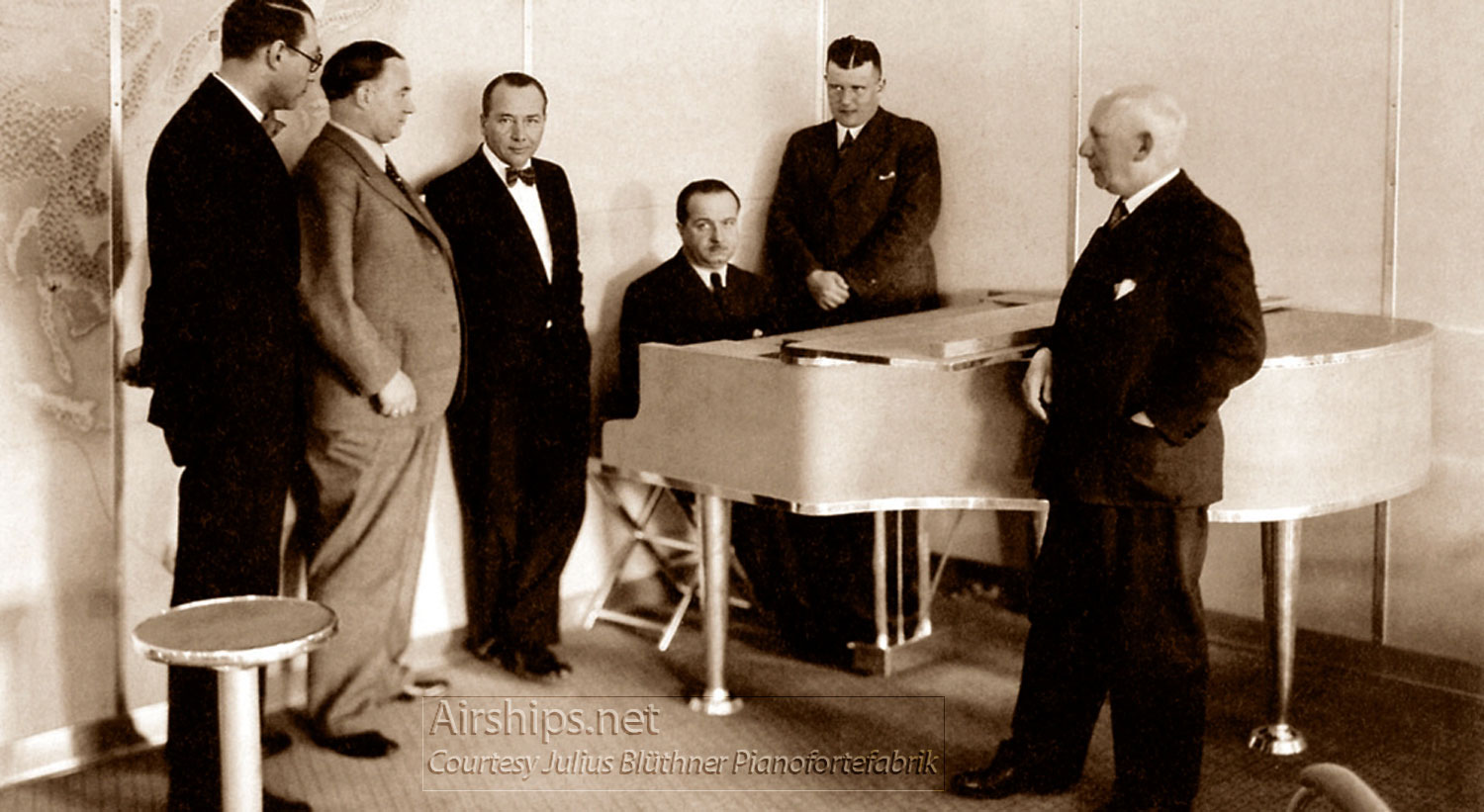
A specially designed lightweight piano was made for the Hindenburg.
The Hindenburg’s owners, seeking to outfit their airborne luxury liner, tasked the renowned piano making firm of Julius Blüthner with building a special lightweight baby grand piano to meet the airship’s strict weight standards. The piano, which was made mostly of aluminum alloy and covered in yellow pigskin, weighed less than 400 pounds. It was only used during the Hindenburg’s first flying season, so it wasn’t aboard the ill-fated voyage.
The Hindenburg first took flight on a Nazi propaganda mission.
Although the Hindenburg was in development before the Third Reich came to power, members of the Nazi regime viewed it as a symbol of German might. Nazi propaganda minister Joseph Goebbels ordered the Hindenburg to make its first public flight in March 1936 as part of a joint 4,100-mile aerial tour of Germany with the Graf Zeppelin to rally support for a referendum ratifying the reoccupation of the Rhineland. For four days, the airships blared patriotic tunes and pro-Hitler announcements from specially mounted loudspeakers, and small parachutes with propaganda leaflets and swastika flags were dropped on German cities. (The referendum, approved by 98.8 percent of Germans, was hardly a squeaker.) Later in 1936 the Hindenburg, sporting Olympic rings on its side and pulling a large Olympic flag behind it, played a starring role at the opening of the Summer Games in Berlin. The airship, which had swastikas emblazoned on its tail fins, was such a symbol of Nazi power that it was subjected to constant bomb threats—including some before its final flight, which led to suspicions of sabotage in the disaster.
Dozens of letters carried aboard the Hindenburg were ultimately delivered.
Zeppelins pioneered airmail service across the Atlantic, and the Hindenburg carried approximately 17,000 pieces of correspondence on its final voyage. Amazingly, 176 pieces stored in a protective container survived the crash and were postmarked four days after the disaster. The pieces, charred but still readable, are among the world’s most valuable philatelic artifacts.
Goebbels wanted to name the Hindenburg for Adolf Hitler.
Eckener, no fan of the Third Reich, named the airship for the late German president Paul von Hindenburg and refused Goebbels’ request to name it after Hitler. The Führer, never enthralled by the great airships in the first place, was ultimately glad that the zeppelin that crashed in a fireball didn’t bear his name.
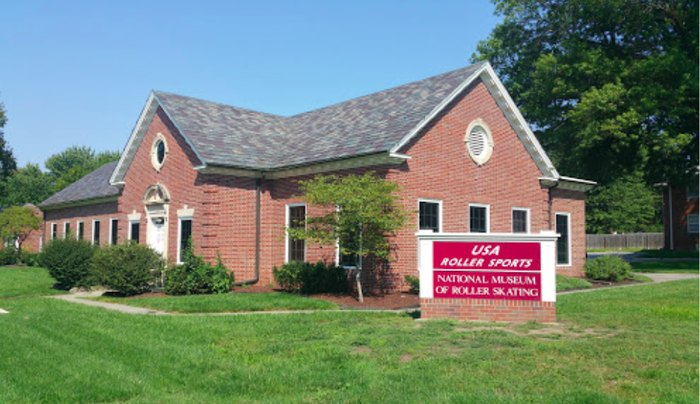
Since 1980, Lincoln, Nebraska has been the home of a one-of-a-kind museum that most people aren’t even aware of. The National Museum of Roller Skating sits in an unassuming little brick building that it shares with the headquarters of USA Roller Sports, the national governing body of roller sports. The next time you’re in the area, don’t pass by this hidden gem; step inside and get to know a fascinating part of American history.
The people behind the National Museum of Roller Skating believe that everyone should know about this delightful activity and its long history. What comes to mind when you think of roller skating? If you’re of a certain age, you probably picture couples gliding hand-in-hand around a hardwood floor as live music floats through the air from the on-site organist.
Younger people may picture a similar scene, but with a DJ and colorful flashing lights in place of a live organist. No matter what your personal experience is with roller skating, chances are you’ve got some positive associations with the activity.
Those fond memories – and much more – are all on display in this unique museum. The exhibits trace the history of roller skating back through the generations, all the way to the early 19th century.
When you visit, you’ll see some early versions of roller skates, beginning with the most primitive pieces of wood with wheels attached.
Some of the crowd-favorite exhibits are the rare and unusual types of roller skates. Would you ever try to race around the rink in these cowboy-boot skates?
Other exhibits tell little-known stories of roller skating as a sport, a hobby, and an all-around cultural phenomenon.
The museum houses the world’s largest collection of roller skating items, making it a must-visit for anyone who has ever felt a rush of excitement as they laced up a pair of skates.
The museum also contains the National Roller Skating Archives, a collection of publications and other information on all aspects of roller skating’s history.
Roller skating is explored here as a sport and an art form, as a diplomatic tool, and a unifying experience that just about everyone can enjoy. See old costumes and uniforms and read all about the surprising ways in which roller skating has influenced the world.
Whether your interest lies in leisurely rolls around the rink, dominating in a roller derby league, or even competitive speed-skating, you’ll find fascinating information at the museum about this underrated all-American activity.
Address: National Museum of Roller Skating, 4730 South St, Lincoln, NE 68506, USA
America’s history is a brief yet rich one. Relative to the rest of the world, we are still just a little baby of a country. We often forget that our founding fathers were humans just like the rest of us — they just happened to have lived some 300 odd years before we did, and, you know, wrote the Declaration of Independence. But these American heroes had their flaws and their secrets, too.
These secrets about the founding fathers are both surprising and eye-opening. There are myths about these men that we’ve all gone along believing our whole lives without a second thought. But in some cases, we may have been entirely wrong!
Thomas Jefferson
Thomas Jefferson Was A Terrible Public Speaker
The author of the Declaration of Independence and our third president only ever gave two speeches, one at each of his inaugurations. While he was elegant with words on paper, he didn’t like speaking out loud, much less in front of large crowds. The speeches he did give were delivered very quietly, too.
Thomas Jefferson was also addicted to learning. Born April 13 (April 2 on the pre-Gregorian calendar), 1743 at his father’s Shadwell plantation in Virginia, Jefferson was one of 10 children (eight of whom survived to adulthood). While he attended the College of William and Mary, he was said to have studied for 15 hours daily on top of violin practice. The hard work paid off: Jefferson moved into law studies before becoming a lawyer in 1767. Two years later, he became a member of Virginia’s House of Burgesses, the Virginia legislature. His autodidact ways continued throughout his life: Jefferson could speak four languages (English, Italian, French, Latin) and read two more (Greek and Spanish).
John Adams
John Adams And Jefferson Were Rivals
John Adams and Jefferson were the only two signers of the Declaration to become president, but they also hated each other’s guts. Before Jefferson passed away on July 4, 1826, he had finally made amends with John Adams, the president who preceded him in office and for whom Jefferson served as vice president. The two men, once on the same side, had grown to resent the other’s approach to diplomacy and politics, with Jefferson lamenting Adams’s preference for centralized and meddlesome government—though according to Jefferson, the major issue was the so-called “Midnight Judges,” appointments that Jefferson felt “were from among [his] most ardent political enemies.”
Strangely, Adams passed away the same day as Jefferson, just five hours later. The date, July 4, was also the 50th anniversary of the Declaration of Independence being adopted.
George Washington
George Washington Didn’t Have Wooden Teeth
This is a fun fact that lots of people like to pull out of their back pocket, but it isn’t even true. George Washington’s teeth were actually made of bone, hippopotamus ivory, human teeth, brass screws, lead, and gold metal wiring. That’s quite the mouthful right there. And his hair was all real but it looks white because he powdered it.
He was a very moral and virtuous man, and he watched carefully everything he did. But he certainly doesn’t fit into our conception of a Christian evangelical or somebody who read his Bible every day. He was not an atheist on the one hand, but on the other hand, he was not a devout Christian. But what about he story of him kneeling in the snow at Valley Forge to pray? “That’s a story that was made up by [early Washington biographer] Parson Weems.” Oh, and Parson Weems, who wrote a myth-filled biography of Washington shortly after he died, made up the cherry tree story. The Mount Vernon Digital Encyclopedia identifies that book, The Life of Washington, as “the point of origin for many long-held myths about Washington.”
Benjamin Franklin
Adams Was “Out Of His Senses”
Well, at least according to Benjamin Franklin. And it seems the feeling was mutual. The two were at the French court of Versailles together as ambassadors when Adams wrote that a statue in the court would make a better ambassador than Franklin. Harsh!
Adams thought Franklin uncouth, vulgar, pretentious…and those were his good qualities. Their poor relationship got off to a rocky start in the fall of 1776. Franklin and Adams had to share a room and a bed in Brunswick where Adams and Franklin went to parley with Adm. Lord Richard Howe over a possible end to hostilities. Adams wanted to sleep with the window closed. Franklin wanted it open. Adams thought it would cause him illness. Franklin thought it would cause good health. After much argument, Franklin prevailed.
Adams grew to dislike Franklin more in Paris. Franklin wore plain clothes for effect. Adams disapproved of his garb. Franklin was a particular favorite of French women. Adams could not understand why this was the case. Adams thought Franklin behaved disreputably and immorally. He did not see how Franklin was using his conduct to obtain contacts and access. What Adams could not understand was how Franklin used these idiosyncrasies to advance the nation.
Paul Revere Wasn’t The Only Midnight Rider
A 16-year-old girl named Sybil Ludington rode 40 miles, twice Revere’s distance, when the British took Danbury, CT. She may have even staved off a band of highway robbers on the way. On April 26, 1777, at age 16, Ludington, the daughter of a colonel in the Colonial militia, Henry Ludington, is said to have made an all-night horseback ride 40 miles (64 km) to rally militia forces in neighboring towns after the burning of Danbury, Connecticut by British forces.
Relatively unknown through the 1870s, Ludington became widely recognized around the time of World War II, after historic road markers were placed in locations she was speculated to have visited on her ride. Memorial statues honor her, and books have been written about her. She was honored on a United States Bicentennial postage stamp that was released on March 25, 1975, which depicts her on a horse.
Peggy Shippen
Benedict Arnold Had Help With His Famous Betrayal
Arnold’s wife, Peggy Shippen, was half his age when they met. She’d previously had a fling with a British spy, John André, and introduced her old lover to her new husband. Together, the three of them plotted to give West Point to the British, which would have squashed America’s independence entirely.
Benedict Arnold
Rumors Swirled Around Washington’s Lack Of Children
Many historians have speculated that perhaps George Washington struggled with infertility, as he had no children of his own. Experts say that tuberculosis often causes this extremely common condition in men. Throughout his life, Washington suffered from a laundry list of ailments: diphtheria, tuberculosis, smallpox, dysentery, malaria, quinsy (tonsillitis), carbuncle, pneumonia, and epiglottitis—to name a few.
“Classic studies of soldiers with tuberculous pleurisy during World War II demonstrated that two-thirds developed chronic organ tuberculosis within five years of their initial infection. Infection of the epididymis or testes is seen in 20 percent of these individuals and frequently results in infertility.”
James Madison
James Madison Used A Secret Code
Madison—like any good politician—was terrified by the idea that someone might intercept one of his private letters. Along with Jefferson and many mutual allies, Madison used complicated encryptions when relaying delicate info. “Having now the use of my cypher,” he informed Jefferson in 1784 after mastering a new system, “I can write without restraint.”
Said to be shy and reserved, Madison apparently had a counterbalance in wife Dolley, who entertained the whole of Washington. At the time, the city was not exactly a hotbed of partying, and her lavish affairs helped endear congressional members to the idea of Madison as president. To date, Madison remains our smallest president at 5 feet, 4 inches and 100 pounds.
Both of James Madison’s vice presidents died in office. George Clinton kicked the bucket in 1812. His short-lived replacement was former Massachusetts governor Elbridge Gerry, who’d redistricted that state to tip the political scales in his favor—a process we now call “Gerrymandering.” Gerry also died in office, and is the only signer of the Declaration of Independence to be buried in Washington, D.C.
He also had a sharp sense of humor. Politics is a pretty serious career, but that didn’t take away Madison’s sense of humor. Among friends, he was known for his quick wit, quippy banter, and well-timed personal anecdotes.
Franklin House
Skeletons Were Buried Under Franklin’s London Home
No, he didn’t murder the people. There was a human anatomy class being run from his basement, which was a very tricky subject at the time. The bones from 15 different bodies were found when, in 1998, work was being done on the historic home.
While all of the Founding Fathers are renowned for pushing the idea of liberty and independent choice, Benjamin Franklin apparently came to the idea a little late. In 1725, when he was just 19 years old, Franklin self-published a pamphlet titled ‘A Dissertation Upon Liberty and Necessity, Pleasure and Pain,’ which argued that humans didn’t actually have free will and weren’t responsible for their behavior. Maturity prevailed, however, and Franklin later burned almost every copy of the booklet he could find.
Ben Franklin’s eccentricity wasn’t limited to that strange philosophy. He once had a plan to rearrange the English alphabet by eliminating the letters C, J, Q, W, X, and Y, declaring them redundant. It didn’t katch on.
If you’re reading this while watching a sunrise, you might have Ben Franklin to thank. A more reasonable Franklin contribution: bifocals, which he invented in order to both see from a distance and read text up close without having to switch lenses.
Melania Trump, née Melania Knauss, {original name Melanija Knavs}, was born April 26, 1970, in Novo Mesto, Yugoslavia [now in Slovenia]. She grew up in Sevnica, Yugoslavia, where her father sold cars and her mother worked in the textile industry. She attended the Secondary School of Design and Photography in Ljubljana, the capital of Slovenia. She then studied Architecture and Design at the University of Ljubljana for one year before leaving to pursue a modeling career. She found success, first in Slovenia and later—under the name Melania Knauss—in Milan and Paris. In 1996 she was brought to New York by Paolo Zampolli’s modeling agency. In the course of her career, she appeared on the covers of several magazines, and in 2000 she modeled for Sports Illustrated’s popular swimsuit edition. Melania is fluent in Slovene and English, and also speaks Italian, French, German and Serbo-Croatian.
Knauss first met Donald Trump in 1998 at a fashion industry party in New York City. He was then married to Marla Maples, whom he was to divorce in 1999. After a long courtship, Trump and Knauss were married on January 22, 2005, at his estate in Palm Beach, Florida. It was his third marriage and her first. In 2006 Melania gave birth to Barron William Trump, her first child and Donald’s fifth. In that year she also became a U.S. citizen. During this time, Melania continued her career. In addition to occasionally modeling, she marketed a line of jewelry sold by the QVC company and developed a line of caviar-based skin care products. Melania strongly believes in women equality and stands for it.
In 2015 Donald announced that he was entering the U.S. presidential race. When he made immigration a central issue, the details of Melania’s own immigration history were scrutinized, including allegations that she worked in the United States before acquiring the appropriate visa. Although Melania did not take a prominent role in the campaign, she spoke at the Republican National Convention in July 2016. Her speech initially drew praise but was later revealed to contain sentences and phrases similar to those spoken by Michelle Obama eight years previously. A speechwriter apologized for the seeming plagiarism.
Melania subsequently maintained a low profile until several weeks before the election, when she defended her husband after a series of women accused him of sexual assault and harassment. On November 8, 2016, Donald was elected president of the United States, defeating Hillary Clinton; he took office on January 20, 2017.
Melania initially made few appearances as first lady, and she did not move into the White House until June, after her son finished the school year. In 2018 she launched the Be Best initiative, which focused on children. Its main objectives included ending cyberbullying. In May 2018 she underwent an embolization procedure for a benign kidney condition. During her husband’s reelection campaign in 2020, Melania took a limited role, though she spoke at the Republican National Convention in August. Two months later both she and the president tested positive for COVID-19, but both recovered.
The Controversies
The Photos
When Donald announced his intentions to make a 2016 presidential bid for the White House, the normally private Melania was pushed into the national spotlight along with her past modeling work, some of which was considered racy. One of the first controversial images that began circulating online was her 2000 British GQ spread that had her lying naked on a fur blanket.
Not long after, more controversy followed. On July 30, 2016, the New York Post published nude photos of a then 25-year-old Melania, including one in which she lay in bed with another woman. Many of the photos were published for a men’s French magazine that is no longer in circulation.
Discussing the nude photos, Donald told The Post, “Melania was one of the most successful models and she did many photo shoots, including for covers and major magazines. This was a picture taken for a European magazine prior to my knowing Melania. In Europe, pictures like this are very fashionable and common.”
The Speech
While Donald Trump was campaigning for the 2016 presidential elections, Melania Trump gave a speech on July 18, 2016, at the Republican National Convention. The speech became controversial after it was found to be partly similar to Michelle Obama’s speech given at the Democratic National Convention in 2008. According to the Biography website, a staff writer took responsibility for the mistake:
Shortly thereafter, Melania staff writer Meredith McIver took responsibility for the gaffe, claiming she accidentally included part of Obama’s speech in Melania’s talking points. McIver issued the following statement explaining what transpired:
“In working with Melania on her recent first lady speech, we discussed many people who inspired her and messages she wanted to share with the American people. A person she has always liked is Michelle Obama. Over the phone, she read me some passages from Mrs. Obama’s speech as examples. I wrote them down and later included some of the phrasing in the draft that ultimately became the final speech.”
The LanguagesMelania Trump is a multi-linguist with good command over Slovene, English, German, French, Italian, and Serbo-Croatian. {Britannica}According to Stephanie Winston Wolkoff (“Melania and Me”) and Mary Jordan (“The Art of her Deal”), nobody has ever heard her speak anything but English and Slovenian, except for “Bonjour” and a few such basic expressions. {Imdb}
The Degree
She was embroiled in a controversy regarding her degree in architecture and design from the University of Ljubljana. This alleged false claim was mentioned on her official website. After this was highlighted by the media, it was removed.
Imdb made a larger issue with the claim:
On July 29, 2016, USA Today reported that Melania Trump’s personal website was taken offline. Previously, Melania’s bio-statement stated there that she received a “degree in design and architecture at University in Slovenia.” However, a biographer questioned the veracity of that claim by suggesting that Melania never completed her studies. At http://www.archive.org, the WayBack Machine has preserved a 2012 snapshot of Melania’s website, where she printed the now-disputed statement.
The Books
An early attempt to use the first lady platform for public good generated attention for the wrong reasons: In September, Melania sent a package of Dr. Seuss books to one deserving school in each state as part of National Read-a-Book Day. However, the gift was spurned by a Massachusetts elementary school librarian, who decried both the selection of her school and the choice of Dr. Seuss as a “tired and worn ambassador for children’s literature.”
The Unnamed Family Friend Revealing Secrets
The following month, the secretive first lady was profiled in Vanity Fair. According to the article, it was Melania who pushed a waffling Donald into announcing his candidacy for president, knowing that he would regret the missed opportunity if he didn’t. On the flip side, she supposedly never expected to find herself in the White House. “This isn’t something she wanted and it isn’t something he ever thought he’d win,” said one longtime friend of the couple. “She didn’t want this come hell or high water. I don’t think she thought it was going to happen.”
(I cannot believe she “pushed” him into something she didn’t want and never thought he would win.)
Personal Quotes
[on the accusations against her husband] I believe my husband. This was all organized by the opposition. Did they ever check the background of these women? They don’t have any facts. (…) That never happened. [Oct.2016]
My husband is real. He’s raw. He tells it like it is. [Oct.2016]
Don’t feel sorry for me. I can handle everything. [Oct.2016]
[about the attacks on her husband] The opposition doesn’t want to talk about WikiLeaks and the Emails and Benghazi and all the rest of the stuff – they don’t want to talk about it. So, they said: ‘Let’s do something to hurt his campaign’. [Oct.2016]
[defending her husband’s attacks on the Clintons] They’re asking for it. They started it. They started from the beginning of the campaign, putting my pictures from the modeling days [into the newspapers]. That was my modeling days and I’m proud of what I did. I worked very hard. [Oct.2016]
[on the media bias against Donald Trump] When did we hear or read any great stories about my husband – or about me? The true stuff. The facts. The real stuff. We never read the New York Times. They are bashing, bashing, bashing. [Oct.2016]
Sources: Biography, Brittanica, Imdb
In my opinion, Melania has only gotten more beautiful as time has passed. Her look is softer somehow and she is by far the most gorgeous First Lady we’ve ever had.
In the center of Sante Fe, NM stands a former Roman Catholic Church, known as the Loretto chapel, that was constructed in the popular Gothic Revival style by French architect Antoine Mouly. To Bishop Jean-Baptiste Lamy’s dismay, Mouly didn’t live to see the chapel completed. The renowned architect passed away when the chapel was nearly done, leaving the chapel unfinished.
Despite the beauty and craftsmanship of the chapel, it lacked a critical component, a staircase. As the story goes, the chapel was completed in 1878, but there was no way to get to the choir loft, which is 20 feet off the ground. The Sisters believed this to be a test of faith and set out to find a new carpenter to finish the work promptly.
Legend of the Loretto Chapel Staircase Miracle
According to legend, which has since been made into a movie called “The Staircase” (1998), the nuns didn’t want the staircase to be big because it would take up too much space, so they went to get advice from the local carpenters.
Unfortunately, they met with many carpenters, none of whom could provide a solution that worked for the Sisters. Some said it couldn’t be done, while others quoted an outrageous price. The only option was to use a ladder, which was deemed inappropriate due to the sister’s attire.
In 1880, the Sisters started praying to the patron saint of carpenters, St. Joseph. They asked for a solution to their dilemma and prayed for over a week. According to the historical account, on the 9th day, a man arrived on his mule with some tools. He revealed to the Sisters that he was a carpenter by trade, and they eagerly invited him in.
This carpenter was unlike any who had come before him, and shortly after viewing the problem, he admitted that putting a staircase in was possible, even ones that wouldn’t take up too much space or be an eyesore.
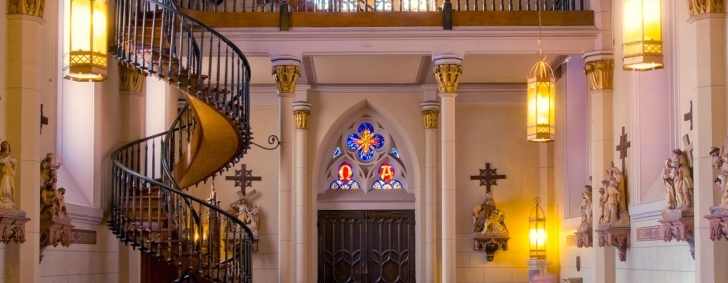
But he asked to be alone in the chapel for three months and, with only simple tools including a saw, T-square, and a hammer, he built the ‘miraculous’ staircase. It is a spiral staircase making two complete 360 degrees rotations but without using a central pole and without using any nails, only wooden pegs.
The bannister of the staircase is perfectly curved, a remarkable accomplishment considering the basic tools that were used. The shape of the helix is not a stable weight-supporting structure, and without the middle column it shouldn’t be able to withstand the weight of people using the staircase.
When the man finished the staircase, he left without asking for a cent. The nuns tried to find him but they could not. They did not know who he was or where he got the wood. Ten years later the railing was added to the staircase by Phillip August Heasch for safety reasons.
The order decided to honor the carpenter’s deed with a banquet, but when it was time to feast, they could not find him. He had disappeared without a trace; he did not identify himself during his time there or ask for payment. Because his identity remains a secret, the Sisters believed him to be St. Joseph, answering their prayers. The number of steps is of religious significance because it was Jesus’ age during his crucifixion. This realization only further convinced the Sisters and fueled the story that St. Joseph had come to their rescue.
With the staircase finished, the chapel was finally complete, but the mystery of its construction was impossible to ignore, and many pondered how the carpenter accomplished the job. The manager of the privately owned chapel (1991-2006), Richard Lindsley, took a piece of wood from the staircase and sent it for analysis. When the results came back, they showed that it was spruce, but of an unknown subspecies. This specific wood was very strong with dense and square molecules – which is something that you usually find in trees that grow very slowly in very cold places like Alaska.
However, there was no such wood in the area and no local trees grow in the Alpine tundra in the surrounding area. The closest place that he would find this density in trees was in Alaska, but of course back then transport was not the same as it is now and wood was not transported over such long distances.
Were the Stairs Created by a Man from a French Secret Society?
Santa Fe New Mexican offers an alternative explanation for the amazing staircase. It’s said that when historian Mary J. Straw Cook researched the stairs for a book she was writing, she “found information in an 1881 nun’s daybook that a man named Rochas was paid for wood.” Francois-Jean Rochas, an alleged “member of a French secret society of highly skilled craftsmen and artisans called the Compagnons, which had existed since the Middle Ages” has been named as the skilled woodworker who apparently “came to the U.S. with the purpose of building the staircase with wood shipped from France.”
When a group of stair-building professionals convened at the Loretto Chapel a few years ago to see the staircase they were shocked at the beauty, design, and engineering of the stairs. A couple of their comments on the workmanship after analyzing the stairs are:
“We all like to think we create creative stair designs and nice curved staircases, but to think how they did it that long ago and still attain the same quality is breathtaking” and
Later, Cook found a newspaper article mentioning Mr. Rochas and that he was a skilled woodworker who built the staircase. Rochas was a member of a secret French society of skilled artisans known as the Compagnons and had come to the U.S. to design the Santa Fe staircase specifically; the wood came from France.
Even with all the advances in technology and engineering, no one can determine how the staircase was built. The stairs are a beautiful and mysterious element of the Loretto Chapel, regardless of the facts around its construction.
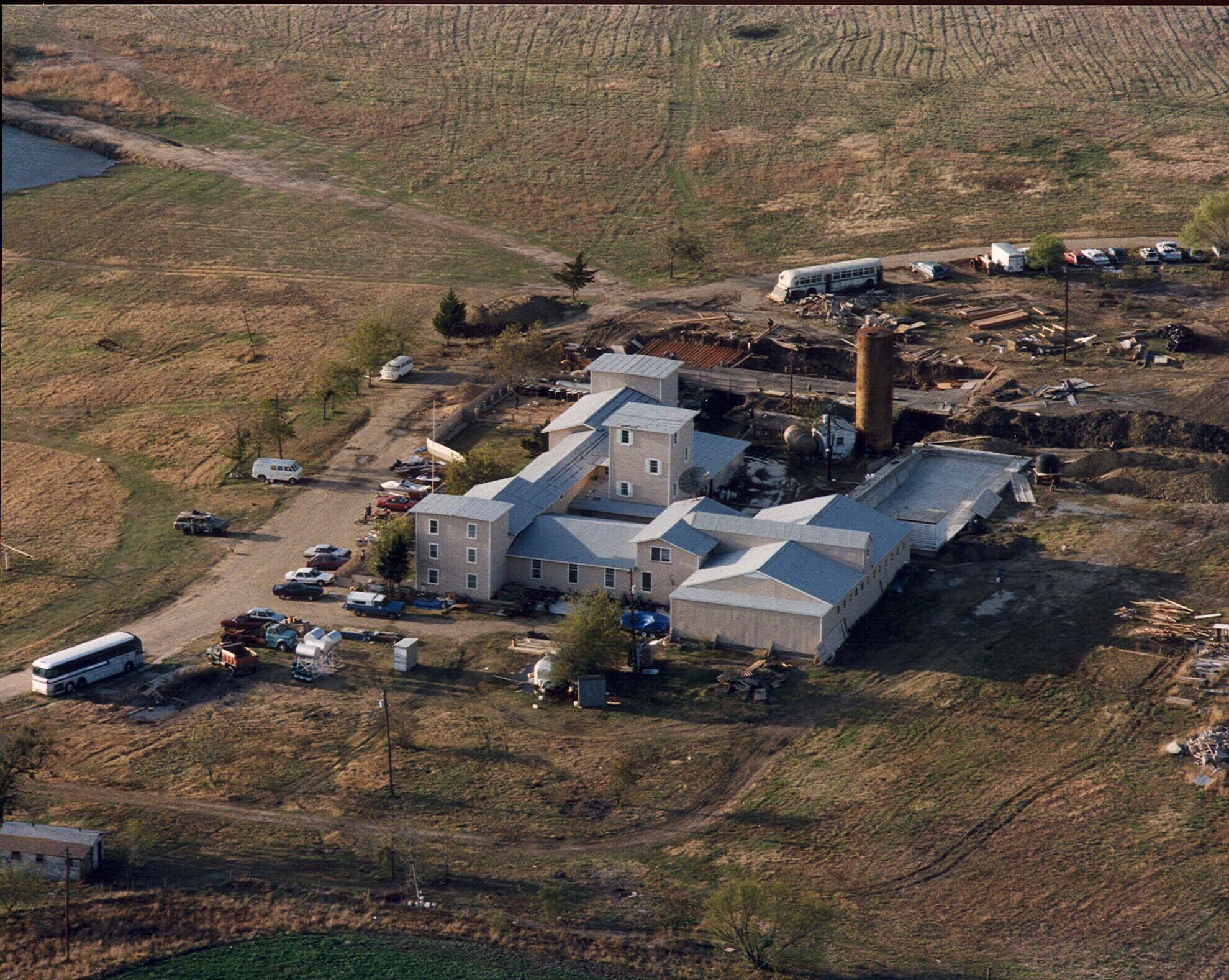
The Waco Siege began in early 1993, when a government raid on a compound in Axtell, Texas, led to a 51-day standoff between federal agents and members of a millennial Christian sect called the Branch Davidians. The siege ended dramatically on April 19, 1993, when fires consumed the compound, leaving some 75 people dead, including 25 children.
David Koresh
On February 28, 1993, some 80 agents from the U.S. Bureau of Alcohol, Tobacco and Firearms (ATF) raided a religious compound at Mount Carmel, near Waco, Texas, after receiving reports that the Branch Davidians and their leader, David Koresh, were violating federal firearms regulations.
After four ATF agents and six Davidians were killed in the gun battle that followed, a cease-fire was arranged, and nearly 900 law enforcement officials eventually surrounded the compound, including hostage negotiators and rescue teams from the Federal Bureau of Investigation.
Reporters soon arrived on the scene as well, and the 51-day siege that followed would play out on TV screens and in newspaper headlines around the world. Despite some early negotiating successes—the Davidians sent about 2 dozen children out in exchange for food and other supplies—numerous children remained among those inside, many of them Koresh’s children with various women.
Branch Davidians
In the 1930s, a disgruntled member of the Seventh-Day Adventist Church named Victor Houteff had broken away and founded the Davidian movement. After Houteff’s death, Ben Roden led an offshoot of the movement known as the Branch Davidians, who took control of Houteff’s original settlement at Mount Carmel, near Waco, by 1962.
Believing the Bible is literally the word of God, the Branch Davidians looked to it for clues about the end of the world and Christ’s Second Coming, as told in the Book of Revelation.
Roden died in 1978, leaving his wife, Lois, as head prophetess of the sect. In 1981, a 22-year-old convert named Vernon Wayne Howell arrived at Mount Carmel; he became involved with Lois Roden, and after her death clashed with her son, George, over control.
In a gun battle in late 1987, George Roden was shot in the head and chest, and Howell and seven followers went on trial for attempted murder. The seven other men were acquitted, and Howell’s case ended in a mistrial.
By 1990, having asserted control over the Branch Davidians, Howell legally changed his name to David Koresh. (“Koresh” is the Hebrew translation of Cyrus, the ancient Persian king who conquered Babylon and allowed the Jews to return to Israel.)
Koresh and the FBI
In his negotiations with the FBI during the Waco siege, Koresh claimed he was a messianic figure prophesied in the Bible and that God had given him his surname. He threatened violence against those who would attack him and his family, but asserted that the Davidians weren’t planning a mass suicide.
To the Branch Davidians, Koresh was “the Lamb,” the only one (according to the Book of Revelation) worthy of unlocking the Seven Seals and revealing to the world the entirety of the Bible’s teachings. This identification allowed Koresh to justify some of his controversial (even within the sect) practices, including taking various “spiritual wives,” some reportedly as young as 11 years old.
As time wore on, the negotiators and the Hostage Rescue Team, which handled all the tactical maneuvers, disagreed on how to handle the siege. The latter team, frustrated by the slow pace of negotiations, employed aggressive tactics like playing ear-splitting music or crushing the Davidians’ cars—disrupting often-delicate negotiation efforts.
Fire Engulfs Waco Compound
In mid-April, after religious scholars reached out to Koresh through a radio discussion of the teachings of Revelation, Koresh sent a message through his lawyer announcing he had received word from God and was writing his message on the Seven Seals; he would come out with his followers when he was finished.
The FBI, unconvinced, decided to act to end the siege. Though initially reluctant, Attorney General Janet Reno ended up approving a plan to fire CS gas (a form of tear gas) into the Mount Carmel compound to try and force out the Davidians. Just after 6 a.m. on April 19, 1993, FBI agents used two specially equipped tanks to penetrate the compound and deposit some 400 containers of gas inside.
Soon after the attack ended, around 12 pm, several fires simultaneously broke out around the compound, and gunfire was heard inside. Safety concerns prevented firefighters from entering Mount Carmel immediately, and the flames spread quickly and engulfed the property.
Though nine Davidians were able to escape, investigators later found 76 bodies inside the compound, including 25 children. Some of them, including Koresh, had fatal gunshot wounds, suggesting suicide or murder-suicide.
Legacy of the Waco Siege
From the beginning, the government’s handling of the Waco siege (which played out in the national and international media) was heavily criticized. Reno took responsibility for the botched raid, later admitting there was no evidence of ongoing child abuse within the compound (which had been one of the justifications for ordering the gas attack).
Though the government long maintained that its actions played no role in starting the fires at the Waco compound, in 1999 it was revealed that some of the gas the FBI used was flammable under certain conditions.
Reno subsequently appointed the lawyer and former senator John Danforth to lead an investigation into the siege’s end. In 2000, he concluded that government agents did not start the fires or shoot at the compound.
Despite this conclusion, resentment lingered about the government’s handling of the situation, which partially fueled the growth of homegrown militias in the United States. The Waco siege and the 1992 Ruby Ridge incident in Idaho are often cited by government critics as examples of overreach and intrusion by federal officials.
In April 1995, on the second anniversary of the Waco siege’s end, a militant named Timothy McVeigh used a truck loaded with 4,800 pounds of fuel oil and aluminum nitrate to attack the Alfred P. Murrah Federal Building in Oklahoma City, Oklahoma. With a total of 168 people killed and some 850 wounded, the Oklahoma City bombing was by far the deadliest terrorist attack in the United States to that date.
Everyone knows about Paul Revere’s midnight ride, but this patriot did a lot more to help America gain its independence. Here are 11 little-known facts about the Founding Father.
His father was a Huguenot.
Revere’s father, Apollos Rivoire, was a French Huguenot refugee who fled his country as a result of religious persecution. He was born in Riocaud in 1702, but with time he lost most of his connection to France—he could not read or write the language. The Frenchman later changed his name to Paul Revere, “on account that the Bumpkins pronounce it easier.” He married Deborah Hitchbourn, a member of a very old Boston family, and passed the anglicized name, Paul, to his eldest son.
As a teen, Revere worked as a church bell ringer.
When he was around fifteen, Revere would ring the bells at the Eight Bell Church near his home. The young patriot and his friends set up a bell ringers’ association. They drafted a document that detailed the rules and guidelines for membership. Members could only be allowed into the group through a unanimous vote, members could not beg for money, and a moderator was chosen every three months to delegate work and changes within the group. The simple document focused on the fundamentals of public duty, majority vote, and community.
Revere made some interesting items in silver.
Revere’s father came to Boston as an apprentice smith. He worked for a man named John Coney for several years and purchased his freedom for forty pounds. After Revere was born, he apprenticed under his father and learned how to craft things from gold and silver. Some items include a chain for a pet squirrel, an ostrich egg snuffbox, and sword hilts. You can tell an item is made by Revere by his maker’s mark—either his last name in a rectangle, or his initials in cursive.
The silversmith was also a dentist.
When dental surgeon John Baker moved to town, Revere happily studied under him. He learned how to create false teeth out of ivory and insert them using wire. Revere became so confident in his abilities that in 1768, he placed an ad declaring he “can fix [teeth] as well as any surgeon dentist who ever came from London, he fixes them in such a manner that they are not only an ornament but of real use in speaking and eating.”
He made a lot of money. Literally.
During wartime, Revere used his smithing skills to engrave printing plates to print money in Massachusetts. He was also commissioned to design the Continental currency, money used to pay the rebel army. The new bills strangely ranged from one-sixth of a dollar to 80 dollars.
During the war, Revere accidentally engaged in some super early forensics.
After Dr. Joseph Warren was killed at the Battle of Bunker Hill in 1775, he was buried like others in an unmarked grave. Ten months later, the bodies were exhumed and examined. Revere was Warren’s dentist, and recognized him by his teeth: Revere had given Warren a false tooth fastened with wire. This was the first body identification done by teeth in recorded history.
He had a large family.
Revere had two wives, Sarah Orne and Rachel Walker, and he had eight children with each of them. Revere was a doting father who referred to his kids as his “little lambs.” Ten of Revere’s children perished at a young age, but he still managed to acquire 52 grandchildren.
Revere was unfailingly polite and dapper.
The patriot even dressed well on his famous midnight ride. Impressed by his garb, his captors saluted him as one of equal rank (before threatening to shoot him in the head). Even with a gun in hand, the redcoat politely asked, “May I crave your name, sir?”
He was not drunk on his midnight ride.
This urban legend took hold when the media was eager to discredit the Founding Fathers during the tumultuous era surrounding the Vietnam War. One Boston newspaper ran a story in 1968 claiming that Revere drank some rum early into his midnight ride. Revere’s drunken yelling apparently roused the patriots accidentally. While Captain Hall, a patriot stationed in Medford, did own a distillery, there is no evidence suggesting that Revere’s booze-fueled yelling truly occurred. Regardless, the unfounded accusations caught on and are often still suggested as truth.
He wasn’t the only one to go on a midnight ride.
Paul Revere and William Dawes originally planned to carry news of the invasion to Concord, where military supplies were stored, and then warn John Hancock and Samuel Adams, who had been targeted for capture. On the trip there, the duo would ride through Somerville, Medford, and Arlington, warning patriots as they passed through. They ran into Samuel Prescott (who was just leaving a lady friend’s house at one in the morning) in Lexington, and asked him to come along.
Revere was captured about halfway through the ride, but the others managed to escape and keep going. Revere had his horse confiscated but still managed to warn John Hancock and Samuel Adams. The true hero was Prescott, who actually went through with the plan and reached Concord.
So why were the more successful criers left out of the story? One very popular—but incorrect—poem is to blame. Henry Wadsworth Longfellow’s “Paul Revere’s Ride” starts with this very familiar stanza:
Listen, my children, and you shall hear Of the midnight ride of Paul Revere, On the eighteenth of April, in Seventy-Five: Hardly a man is now alive Who remembers that famous day and year.
This poem is filled with intentional inaccuracies. Longfellow did his research, but took many liberties in order to properly convey his message. The poet wanted to create a folk hero by painting a lone man as the midnight rider. In order to do such, he removed the extra players.
We’ve all been misquoting him.
Paul Revere and his fellow patriots never shouted, “The British are coming!” That wouldn’t have made sense, since most colonists were British. The actual warning was “the Regulars are coming out.” This misconception is another result of Longfellow’s creative license—he found the real sentence to be too wordy for his poem.
There are few sure things in life, but 2 are death and taxes. I’m presenting an article from Mental Floss about tax trivia. I added pictures.
Why does Tax Day typically fall on April 15 (though it’s April 18 in 2022*), and which historical leader taxed beards? Read on for answers to those questions and more in this list, adapted from an episode of The List Show on YouTube. * (in 2023, it’s April 17th)
1. Taxes date back to at least ancient Egypt.
We can trace documented records of taxation all the way back to ancient Egypt, sometime around 3000 to 2800 BCE. Apparently, there was a biennial event called the Following of Horus, when the pharaoh went around collecting taxes in his dual roles as head of state and living incarnation of the god Horus. Taxation is even described in the Bible when Joseph tells the people of Egypt to give a fifth of their crops to Pharaoh.
2. The first taxes implemented in the United States caused a rebellion.
Fans of the Broadway musical Hamilton probably remember the lyric, “Imagine what gon’ happen when you try to tax our whiskey.” What happened was the Whiskey Rebellion, which was largely due to a tax that Alexander Hamilton imposed on—you guessed it—whiskey.
As you might imagine, people were extremely unhappy about it, especially small producers of whiskey, who, because of the way the tax was structured, had to pay nine cents per gallon in taxes, while larger producers were able to get as low as six cents. Violence quickly broke out. Tax officers were assaulted and tarred and feathered for trying to do their jobs, and several people were killed during riots. The rebellion was eventually quashed in 1794, and the whiskey tax remained in effect until 1802, when Thomas Jefferson repealed it.
3. Abraham Lincoln gave us federal income tax.
Abraham Lincoln signed the Revenue Act in 1861, which imposed the first-ever federal income tax. To drum up funds for the Civil War, Lincoln and Congress enacted a modest 3 percent tax on income over $800, which would be roughly $23,000 today. The law was almost instantly replaced with a new revenue act and would be repealed a decade later, but the relief obviously didn’t last: In 1913, the 16th Amendment established the federal income tax system we all know today.
4. Tax Day wasn’t originally on April 15.
When the modern federal income tax was established, lawmakers set March 1 as the looming deadline.
Although they gave no reason for this particular date, it was presumably to give people a couple of months to gather paperwork and crunch numbers after the end of the year. By 1919, the government tacked a couple of more weeks on to help panicked filers, making March 15 the date. That date stood until 1955, after Congress acknowledged that doing your taxes was getting more complicated by the year.
To help accommodate all of those changes and give people adequate time to file, the date was bumped by another month—but the change wasn’t entirely altruistic. The IRS acknowledged that the extra month would help their employees as well, spreading the workload out across another 30 days.
5. We spend a lot of time doing our taxes.
The amount of time we spend doing our taxes every year suggests that the repeated date changes may have been justified. According to the IRS, the average taxpayer spends about 11 hours doing record-keeping, tax planning, form submission, and other super fun tax-related activities. Of course, if you break it down even further, the amount of time changes based on the type of form the filers use. Business filers spend about 20 hours, including 10 hours on record-keeping alone.
6. The average American gets about $3000 back from their tax refund each year.
This amount ebbs and flows a little bit every year based on the economy, fluctuating consumer incomes, and the IRS’s withholding tables, which suggest how much employers should deduct from employee paychecks to account for income tax. It’s worth pointing out that a huge tax refund isn’t necessarily a great goal: It basically means you gave the government an interest-free loan that year.
7. In 1836, the federal government of the United States had a tax surplus of around $30 million.
Congress gave most of that money back to the states, and each state was able to decide how to handle it. Maine decided to give back to the people, which meant that every single resident received a whopping $2. A woman named Salome Sellers used her money to buy a pair of fancy candlesticks. As she told the New York Star Tribune in 1902, when she was about to turn 101 years old, “Many people put their share of the surplus into flimsy finery … but I bought something that would keep to remember those good times by.” Today, those surplus sticks are in a museum.
8. Peter the Great taxed beards.
In 1698, Russia’s Peter the Great introduced a beard tax. After embarking upon what he called a “Grand Embassy” across Europe to observe more about Western cultures and processes, Peter came back with a number of reforms designed to bring Russia up to speed—and one of those reforms impacted facial hair.
The tsar noted that “modern” Western Europeans eschewed beards, and he wanted to emulate the trend within his own borders. If that doesn’t seem strange enough, wait until you hear how he unveiled his new anti-beard beliefs: At a big state reception, the tsar whipped out a massive barber’s razor and proceeded to shave his guests’ beards.
Although Peter was originally against beards entirely, he eventually decided to make money off of his ban by allowing facial hair, but taxing it. Nobility and merchants were charged significantly more than commoners, by the way.
9. A former IRS commissioner went to prison for tax evasion.
In 1952, Joseph Nunan, who was the IRS commissioner from 1944 to 1947, was busted for evading over $90,000 in taxes. Among the transactions that he failed to claim was $1800 in winnings from a wager that Harry Truman would beat Thomas Dewey in the presidential election of 1948. Nunan was sentenced to five years in prison.
10. A famous gangster was ultimately taken down over taxes.
Mob boss Al Capone ran a criminal enterprise and regularly ordered hits on his enemies—but he wasn’t sent to prison for murder. Instead, he was charged with tax evasion and fraud, and was sentenced to 11 years.
11. Willie Nelson made an album to cover his tax debts.
It was called the IRS Tapes, and all proceeds went toward his tax bill.
12. Henry David Thoreau went to jail for failing to pay taxes.
The poet was imprisoned in 1846 for failing to pay a poll tax (a tax levied on every individual, regardless of income). Poll taxes were once typical in much of New England; paying the tax was typically a requisite to be able to vote, so they often functioned as a form of de facto discrimination against poorer citizens. Thoreau’s refusal to pay the poll tax was his way of protesting slavery. Someone paid the tax on Thoreau’s behalf, however, and he was released the next morning.
13. Shelled nuts are sometimes subject to taxes.
In England, shelled nuts are subject to a 20 percent value-added tax.
14. India has an entertainment tax.
Movie tickets are taxed anywhere from 18 to 28 percent depending on the price of the tickets. This is actually an improvement—before the government launched the Goods and Services tax, it was left up to each state to set its own entertainment tax. In Jharkhand, the tax was 110 percent.
15. There’s a cow flatulence tax.
Cow farts (really more like cow burps) are no laughing matter. The methane they produce is contributing to climate change in a big way. To help offset some of these drawbacks, many EU countries are looking at introducing a cow tax to tax producers for cow emissions.
16. England once had a special hat tax.
From 1784 to 1811, British citizens had to pay a tax on their hats. To prove they paid the tax, a stamp was pasted inside the hat. If the hat police caught you wearing a stamp-less hat, you’d be hit with a hefty fine. In 1798, a man named John Collins was caught using a printing press to forge the stamps, which would allow people to skirt the tax. He was sentenced to death.
17. There’s a tax court.
There are always people who get creative with their tax deductions. While most don’t pass muster, the United States Tax Court, a court of law dedicated to tax-related disputes and issues, does occasionally find in favor of some pretty unusual claims. For example, TurboTax tells the story of a professional bodybuilder who successfully claimed his supply of body oil as a professional necessity. (He also tried to claim buffalo meat and vitamin supplements, which they nixed.)
18. New Mexico gives a tax break to all centenarians.
If you live in New Mexico, and have lived there for at least a century, great news: You don’t have to pay state taxes. The Land of Enchantment provides a major tax break to all centenarians. But considering there are only 80,000 100-plus-year-olds in the entire United States, New Mexico isn’t exactly losing out on major money by providing this perk.
19. Even astronauts in space need to file their taxes on time (or ask for an extension).The IRS is a notorious stickler for on-time filing—which no one knows better than Jack Swigert, the command module pilot for Apollo 13, who joined the crew at the last minute. He was mid-mission when he realized that he was going to miss the April 15 tax deadline, so he radioed Houston to request an extension. Although the ground crew laughed at what they presumed was a joke, Swigert was dead serious. According to NASA transcripts, he said, “Hey, listen, it ain’t too funny; things kind of happened real fast down there, and I do need an extension. I didn’t get mine filed, and this is serious.”This sort of thing happens more than you might expect, by the way. In 2005, NASA astronaut Leroy Chiao was commanding the 10th expedition to the International Space Station when Tax Day reared its ugly head. He prevailed upon his sister, an accountant, to file an extension on his behalf, and he got right on it when he returned to Earth on April 24.20. The president of the United States isn’t exempt from taxes.In fact, the POTUS is expected to pay their rightful share, though there are a few nice perks, including a nontaxable travel account worth $100,000 and a nontaxable entertainment account with a $19,000 limit.
21. The IRS updates tax requirements on a regular basis.With the Reform Act of 1986, the IRS started requiring taxpayers to list their dependents’ Social Security numbers for the first time. When citizens were forced to provide this evidence, several million children mysteriously “disappeared” from tax returns.22. Most people file their taxes electronically.As of 2018, only 10 percent of people were still filing paper tax returns. Not only does this mean that those people will wait longer to get any refunds back, it also increases their chances of screwing things up: Paper tax returns are around 40 times more likely to contain mistakes compared to online filing.23. There’s a good chance you can file your taxes for free.If your adjusted gross income is less than $69,000, you’re eligible to use IRS Free File. Seventy percent of filers qualify, which works out to 100 million Americans. If your adjusted gross income is more than $69,000, you can still use Free File. But it’s not going to walk you through the process step-by-step like the other version, so you have to feel pretty comfortable doing your taxes.24. Founding Father Sam Adams was bad at collecting taxes.Adams was elected to Boston’s tax collector post in 1756, but he wasn’t terribly interested in the job. He was prone to overlooking tax debts from people having financial or medical difficulties, which made him a bit like Robin Hood to working-class Bostonians. The problem was, the tax collector was personally liable for uncollected taxes—and by 1765, he owed more than £8,000—equivalent to nearly £1.5 million today. He did end up trying to go after some of the uncollected taxes, but apparently without much success. According to the New England Historical Society, his well-to-do friends ended up covering most of Adams’s debt.25. Vermont once declared war on Germany for tax purposes.In the lead-up to the United States entering World War II, Vermont lawmakers voted to give residents serving in the military a $10-a-month bonus. If the raise was instituted during peacetime, though, everyone would have been hit with a new tax. In order to avoid it, the bonus needed to be issued during a time of armed conflict.War hadn’t officially been declared yet, but President Franklin Roosevelt had issued orders for the U.S. Navy to shoot first if they came across German ships in waters “necessary for our defense.” Vermont lawmakers decided this order was enough for them to basically declare we were at war with Germany in September 1941—three months before the United States did.
This article was originally published in 2021; it has been updated for 2022.
The History of the Hope DiamondThe Hope Diamond was originally unearthed in the mines of Southwest India along the Kistna River. It was viewed as one of the most unique stones ever pulled from the Golconda mines. So how big is the Hope Diamond? It is believed to have been around 112 carats originally and was placed in the brow of a temple idol.The next time it was mentioned in texts was when it was stolen by a French merchant who then sold it to King Louis XIV in 1642 at a substantial profit. Shortly thereafter the merchant died a wicked death. After the court jeweler cut it down to 67 carats it was named “the Blue Diamond of the Crown.” During the French Revolution in 1792, it was stolen from the royal family after King Louis XVI and Marie Antoinette were beheaded.
In 1812, the Hope Diamond resurfaced in the hands of London diamond merchant Daniel Eliason but only weighed 45.52 carats. It is said that King George IV acquired it but his debts were so enormous when he died that it was sold. A 1839 gem catalog noted that the next known owner was Henry Philip Hope who gave the stone its name. It transferred to several other owners in the succeeding years.
Properties of the Hope Diamond
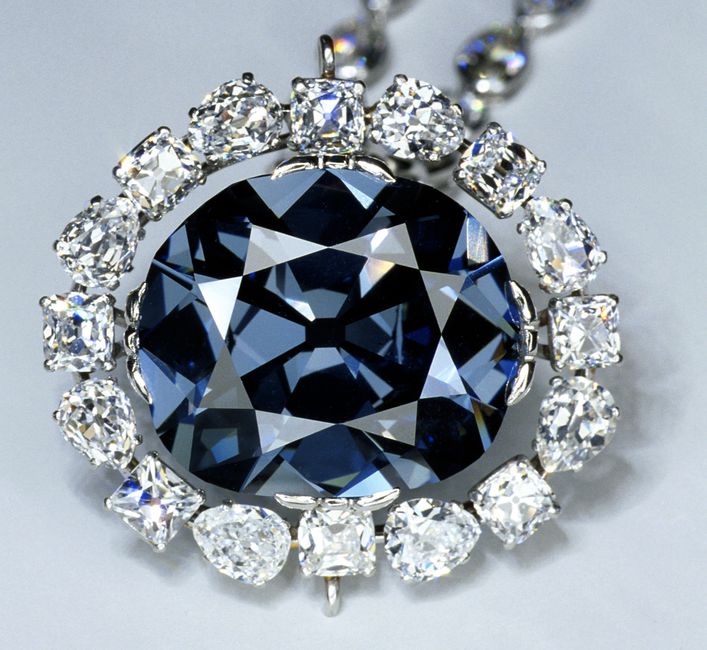
The Hope Diamond is classified as a type IIb fancy dark grayish-blue stone that contains a strong phosphorescence of reddish-orange. When it is exposed to ultra-violet light in a darkened room then the lights are turned off, the diamond continues to glow like a hot coal. The strange phenomenon simply adds to its mystery.
Colored diamonds, especially blue ones, have electrical properties that are semi-conducting. Unlike other diamonds, blue ones are renowned for their hardness, thermal and optical properties and chemical resistance. Natural diamonds contain defects or impurities. In the Hope Diamond, the impurity is boron, which gives it its unique color.
The Hope Diamond and others in the Aurora Collection underwent intense scrutiny by the Naval Research Laboratory’s Chemistry Division in 2005 in collaboration with NOVA Research. The objective was to identify the similarities and differences between the gems which included the Hope and Blue Heart diamonds among others. It became immediately apparent that all the diamonds studied had phosphorescent bands that centered between 500 and 660nm wavelengths. What they determined was that the phosphorescence in each gem studied could appear pink, aqua, red or orange.
Myths Surrounding the Hope Diamond
Historically, diamonds had myths surrounding them both good and bad as far back in history as 3500 BC when they were first discovered. Here are a few interesting facts that have been recorded over time:
In 3000 BC, the Egyptian hierarchy wore diamonds to represent the sun, courage, truth, and as a symbol of power.
In ancient India, Hindus wore diamonds as a symbol of invincibility and clarity.
The ancient Greeks and Romans believed diamonds were actually the tears of the gods. Plato once wrote that diamonds embodied the celestial spirits of living beings.
In ancient times, the breast plates of Kings were studded with diamonds because it was believed they had magical superpowers. Wearers were seen as invincible, strong and would have good fortune.
Between the 5th and 15th century, diamonds were referred to as “miracle stones” because it was believed they had magical healing powers. Unfortunately, they also discovered that swallowing powdered diamonds resulted in death.
Jewish high priests utilized diamonds to determine guilt or innocence. If the diamond sparkled the individual was considered innocent and if not, they were guilty.
As for the Hope Diamond, its popularity is partially due to the myths surrounding it:
Legend has it that in India the Hope Diamond was originally found embedded in an idol. It was ripped out of the idol by a French merchant and the Hindu priests became so angry they cursed it. A gruesome death was foretold to all who possessed it and anyone that dared touch it. The original thief, for example, was torn apart by wild dogs.
In 1715 King Louis XIV of France bought the Hope Diamond and died of gangrene. Almost all of his children and grandchildren died, so he was succeeded by his five year-old great grandson Louis XV.
In 1792 King Louis XVI and Marie Antoinette were beheaded during the French Revolution. It is said that it was because of the diamond’s curse.
King George IV of England owned the Hope Diamond next and died completely destitute.
It was said that the Titanic sunk in 1912 because the Hope Diamond was aboard.
American Evalyn Walsh-McLean came into possession of the Hope Diamond after which her life was beset by tragedies and debt.
Where Is the Hope Diamond Today?
The Hope Diamond is currently housed in the Smithsonian Museum of Natural History in the Department of Mineral Sciences in Washington D.C. It was donated by Harry Winston in 1958 and receives over 100 million visitors a year. Unlike its previous history, the Smithsonian has always viewed the stone as a sign of good luck.
People often wonder about the value of the Hope Diamond. According to S.H. Zell & Sons Fine Jewelry in New York, New York the value of the gem is $350 million. According to the Smithsonian, however, it is priceless in that it is irreplaceable. However, in 2009 they insured it for $250 million. The thought most gemologists adopt according to Diamond Cutters International is “How can you set a value on the only one of something?”.
Summing Up
The history, curses and myths surrounding the Hope Diamond is actually a parable about the cardinal transgression of greed. The original thief died a horrendous death while later owners, even though unaware of the curse, went through tragedies and forms of suffering as well. It was only when a pure-hearted person, Harry Winston, donated rather than sell the Hope Diamond to the Smithsonian Institution that the curse was broken.
So what is the Hope Diamond? It is one of the greatest treasures in the world that would have an enormous amount to tell us if only it could talk.
A picture taken at the Archaeological Museum in Athens on September 14, 2014 shows a piece of the Antikythera Mechanism, a second-century B.C. device known as the world’s oldest computer which tracked astronomical phenomena and the cycles of the solar system.(Image credit: LOUISA GOULIAMAKI/AFP via Getty Images)
The Antikythera mechanism is an ancient shoebox-sized device that is sometimes called the world’s oldest computer for its ability to perform astronomical calculations. Discovered by sponge divers off the Greek island of Antikythera in 1901, the remains of the mechanism are now preserved in the National Archaeological Museum in Athens. Only 82 fragments, consisting of about one-third of the original mechanism, survive today, It was built around 2,200 years ago.
The mechanism was capable of performing different calculations, and it could help track the motions of the sun, moon and five of the planets; it could even tell when athletic competitions, such as the Olympics, were set to take place, the researchers wrote. Since the discovery of the Antikythera mechanism, scholars have been trying to understand the device. And although they have made considerable progress, many questions remain unanswered. For example, researchers still aren’t sure who made it. The inscriptions on the mechanism are written in Greek.
An engraving illustration of the last hour of Archimedes, the mathematician who died in 212 B.C. or 211 B.C. when the Romans captured Syracuse, Sicily. (Image credit: mikroman6 via Getty Images)
The recovered fragments of the mechanism contained writing and inscriptions, and over the past two decades, scientists have been able to read more of these Greek inscriptions using high-tech imaging methods, such as 3D X-ray scanning. This has enabled them to learn more about how the mechanism worked.
CT scans “revealed inscriptions describing the motions of the sun, moon and all five planets known in antiquity and how they were displayed at the front as an ancient Greek cosmos.” The mechanism used “cycles from Babylonian astronomy, mathematics from Plato’s Academy and ancient Greek astronomical theories.”
More pieces of the Antikythera Mechanism at the Archaeological Museum in Athens.(Image credit: LOUISA GOULIAMAKI/AFP via Getty Images)
Between the front and back of the mechanism were a vast array of gears, designed in such a way that all the dials would depict the correct timing of all the cycles. “Suppose a user of the Antikythera Mechanism wants to check eclipse predictions for a particular month some years ahead. The user winds the mechanism forwards to the desired date, as shown on one of its calendars,” Tony Freeth, a researcher with the Antikythera Mechanism Research Project, wrote in a paper published in 2014 in the journal “PLOS One.”
Though the ship that held the Antikythera mechanism was discovered more than a century ago, the wreck has not been fully excavated. Its location and depth make it hard to excavate. Despite these difficulties a new program of excavation is being carried out by a team of archaeologists and new artifacts continue to be found, shedding light on what the ship, which likely sank around 65 B.C. was like.
Marine archeologists also found a bronze arm from a sculpture in the same shipwreck. Credit: Greek Ministry of Culture
Researchers have noted that many of the artifacts were luxury goods intended for the wealthy. So far, the recent excavations have not uncovered any new remains of the mechanism.
Excavations in 2016 at the Antikythera shipwreck found a nearly intact skull, including the cranial parietal bones. (Image credit: Brett Seymour, EUA/WHOI/ARGO)
Antikythera Mechanism rewrote the history of science
In 2015, Kyriakos Efstathiou, a professor of mechanical engineering at the Aristotle University of Thessaloniki said: “All of our research has shown that our ancestors used their deep knowledge of astronomy and technology to construct such mechanisms, and based only on this conclusion, the history of technology should be re-written because it sets its start many centuries back.”
In 2016, yet another astounding discovery was made when an inscription on the device was revealed—something like a label or a user’s manual for the device. It included a discussion of the colors of eclipses, details used at the time in the making of astrological predictions, including the ability to see exact times of eclipses of the moon and the sun, as well as the correct movements of celestial bodies.
A model of the Antikythera Mechanism was made by Derek De Solla Price. Credit: Public Domain
Inscribed numbers 76, 19 and 223 show maker “was a Pythagorean”
On one side of the device lies a handle that begins the movement of the whole system. By turning the handle and rotating the gauges in the front and rear of the mechanism, the user could set a date that would reveal the astronomical phenomena that would potentially occur around the Earth. Physicist Yiannis Bitsakis has said that today the NASA website can detail all the eclipses of the past and those that are to occur in the future. However, “what we do with computers today, was done with the Antikythera Mechanism about 2000 years ago,” he said.
Making this incredible machine even more impressive is the fact that the movements of the planets are directly linked to specific observation sites around the known world at the time, suggesting that the creator of the Antikythera Mechanism had provided for the use of the machine in more than one location.
Bones found at the Antikythera Mechanism shipwreck site
Greece’s Ministry of Culture issued a statement in late 2019 informing the public that ”bones were collected, which now need to be analyzed, (as well as) olive kernels, and bronze nails from the ship as well as a bronze ring, whose use remains unknown.”
Among the findings which were discovered were sections of the bodies of ancient amphorae, as well as the bases and the necks from the main bodies of the vases. The types of amphorae are identified as those which were typically used on the island of Kos and in Southern Italy in ancient times.
The Greek Ministry noted ”this scientific mission of October 2019 completed the first five-year research program. Based on the results of the latest research, preparations for the new five-year program, starting in May 2020, will begin immediately with the continuation of excavation research in various areas of the wreck, where there are good indications that impressive new findings will come to light.”
“The mission was concluded with great success despite adverse weather conditions and the limited length of time for the rescue research,” the Ministry added.
A video titled “2017 Return to Antikythera Expedition” looks at the delicate and often hazardous work marine archeologists do in recovering ancient gems from the depth of the seas. That expedition, led by the Greek Ephorate of Underwater Antiquities, Lund University, and Woods Hole Oceanographic Institution, was conducted between September 4th to September 20th of that year, and as per previous trips to the wreck, the team did not leave disappointed.
With excellent weather conditions above them, the divers managed to recover an “orphaned” right arm of a bronze statue, pottery shards, nails, lead sheathing fragments, and an odd metal disc, among other artifacts. Prior to that expedition, the Return to Antikythera project team managed to recover glassware, luxury ceramics, anchors, counterweights, tools, and even an ancient skeleton, which is still undergoing DNA analysis.









:no_upscale()/cdn.vox-cdn.com/uploads/chorus_asset/file/6966527/Screen_Shot_2016-08-19_at_2.46.14_PM.0.png)



























 Sew Colorful