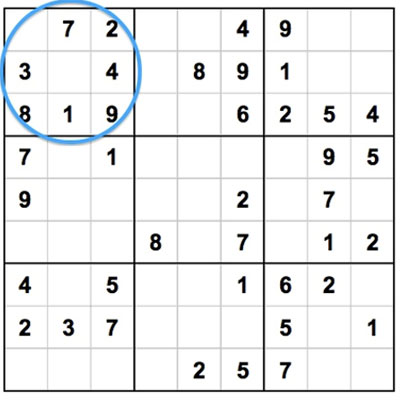
Sudoku is played on a grid of 9 x 9 spaces. Within the rows and columns are 9 “squares” (made up of 3 x 3 spaces). Each row, column and square (9 spaces each) needs to be filled out with the numbers 1-9, without repeating any numbers within the row, column or square. Does it sound complicated? As you can see from the image above of an actual Sudoku grid, each Sudoku grid comes with a few spaces already filled in; the more spaces filled in, the easier the game – the more difficult Sudoku puzzles have very few spaces that are already filled in.
In the above puzzle, the upper left square (circled in blue), already has 7 out of the 9 spaces filled in. The only numbers missing from the square are 5 and 6. By seeing which numbers are missing from each square, row, or column, we can use process of elimination and deductive reasoning to decide which numbers need to go in each blank space.
We know we need to add a 5 and a 6 to be able to complete the square, but based on the neighboring rows and squares we cannot clearly deduce which number to add in which space. This means that we should ignore the upper left square for now, and try to fill in spaces in some other areas of the grid instead.
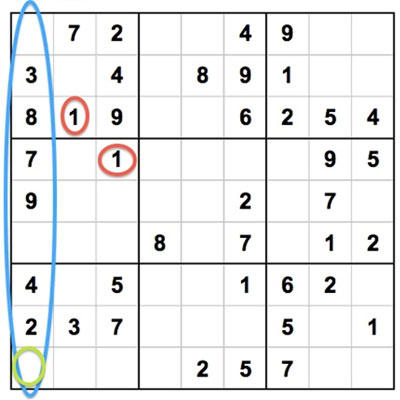
One way to figure out which numbers can go in each space is to use “process of elimination” by checking to see which other numbers are already included within each square – since there can be no duplication of numbers 1-9 within each square (or row or column). Looking at the same puzzle below, we can use the process of elimination to determine where another number should go. In the far left-hand vertical column (circled in Blue) the 1, 5 and 6 missing.
In this case, we can quickly notice that there are already number 1s in the top left and center left squares of the grid (with number 1s circled in red). This means that there is only one space remaining in the far left column where a 1 could possibly go – circled in green. This is how the process of elimination works in Sudoku – you find out which spaces are available, which numbers are missing – and then deduce, based on the position of those numbers within the grid, which numbers fit into each space.
Sudoku rules are relatively uncomplicated – but the game is infinitely varied, with millions of possible number combinations and a wide range of levels of difficulty. But it’s all based on the simple principles of using numbers 1-9, filling in the blank spaces based on deductive reasoning, and never repeating any numbers within each square, row or column.
There is no guessing in sudoku…reasoning and logic are key…and there’s NO MATH required…LOL.
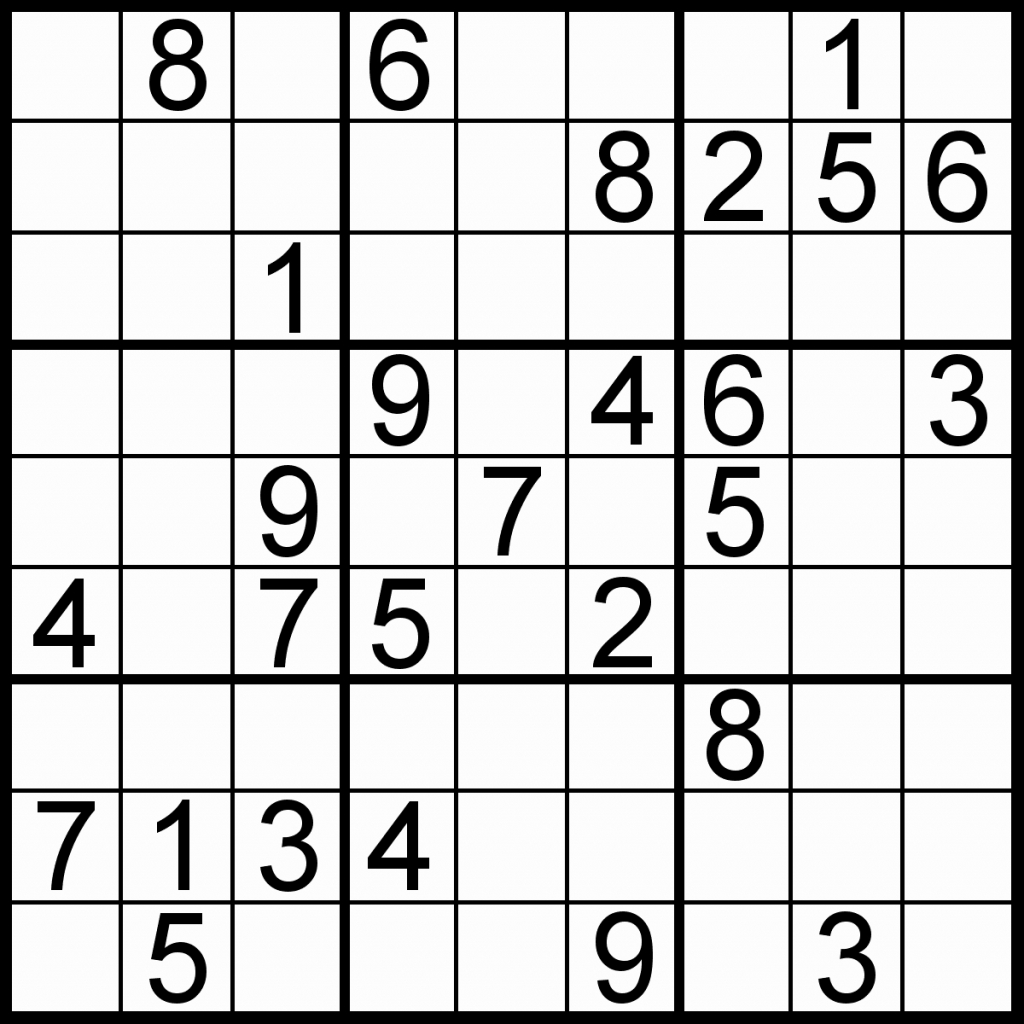
Pat’s Apology: the above sample puzzle requires a little more than basic skills to complete but most puzzles i found on line were like this. (I liked the circles and details in the explanations to help you see exactly what they were talking about.) I have included a puzzle below which requires ONLY the most basic process of elimination skills to solve and I will post the answer if anyone requests it.
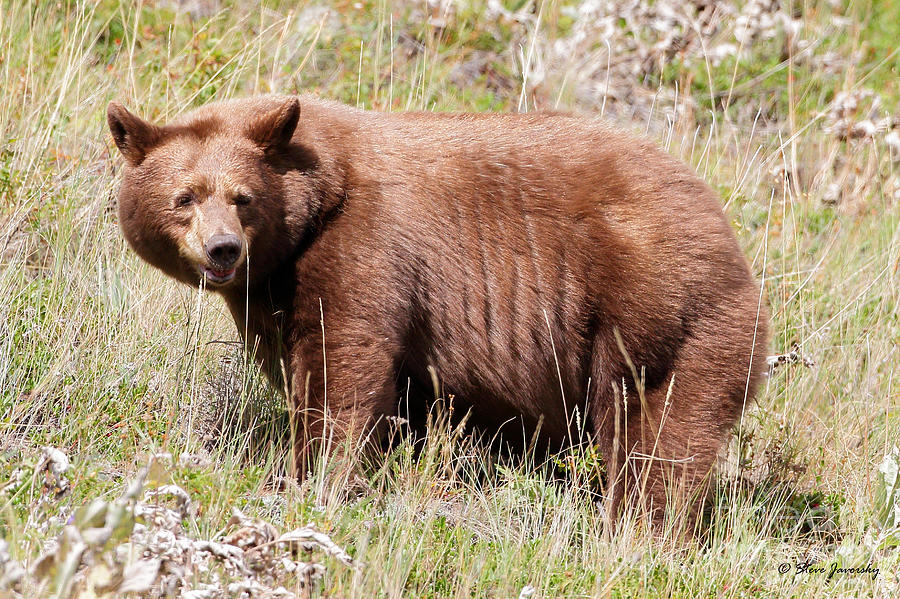
This is the time of the year we normally see the first black bears of the season. The forest is reviving itself after the long, snowy winter and everything is finally green again. The air is filled with the sweet, sweet smell of blossoming honeysuckle bushes…and the woods surrounding the house are filled with them. And that sweet smell will be tempting the bears to leave the higher ground and come visit our house.
honeysuckle
From the PA Game Commission’s website:
Ursus americanus is the black bear’s scientific name; it means “American bear.” Although three species of bears inhabit North America, only the black bear is found in Pennsylvania. A population estimate in 2015 showed approximately 20,000 bears living in the commonwealth. Black bears appear heavy, but are surprisingly agile; they can run up to 35 miles per hour, climb trees and swim well. They may live up to 25 years in the wild.
Black bears are intelligent and curious. Studies show that bears can see colors, recognize human forms, and notice even the slightest movement. Bears usually rely on their acute sense of smell and, to a lesser degree, hearing, to locate food and danger. Despite their common name, black bears are not always black. They may be cinnamon or, even rarer, blond. Many bears have a white blaze or “V” on their chest.
Adults usually weigh around 200 pounds, with males being heavier than females, often more than twice as much. Some weigh up to 600 or more pounds and rare individuals up to 900. Males are called boars; females, sows. Black bears measure about three feet high when on all fours or about five to seven feet tall when standing upright.
In Pennsylvania, bears mate primarily from early June to mid-July. Males are very aggressive towards each other at this time. Sows give birth in January to litters of one to five. The newborn cubs are blind, toothless, and covered with short, fine hair that seems to inadequately cover their pink skin. Cubs begin nursing immediately after birth, and are groomed and cared for daily by the sow. Nurtured with the sow’s rich milk, they grow from as light as 10 ounces at birth to as much as 10 pounds by the time they leave the den in early April. Males do not help rear young.
Most cubs stay with the sow for a little more than a year. They watch her every move and learn by imitating her. Cubs are playful, regularly romping and wrestling with their littermates. The sows are very protective of cubs, sending them up trees if danger threatens. Adult males occasionally kill cubs. The family group disbands when the cubs are about a year and a half old and the sow is again ready to breed.
We saw a lot more bears when we were first building our home. I believe the new smells and sounds piqued their curiosity. They’ve balanced precariously on the rim of our burn barrel–butt in the air–reaching down inside the barrel to nab any edible bit left there. They’ve ruined our hummingbird feeders (lesson learned there–we take them in nightly now) and even left muddy prints on the logs on the side of our home.
But they are such fun to watch, safely inside the house. Hopefully we won’t have to wait too much longer this year!
In honor of the upcoming Memorial Day holiday, I’m posting some rather easy and quick picnic desserts.
No Bake Cheesecake Flag Cake
The base for this dessert is a no-bake Jello Cheesecake (mix in a box). Prepare according to directions. Then you add raspberries and blackberries to complete the flag look.
Red, White and Blue Trifle
In a large glass compote, layer either store bought pound cake or angel food cake chunks with whipped cream, blueberries and strawberries.
Patriotic Chocolate Cake
Your favorite brand of chocolate cake mix, some whipped cream and fruit (strawberries, raspberries, blueberries and blackberries) will make this memorable dessert a breeze.
Memorial Day Pizza
Brownie mix makes a wonderful crust for this holiday pizza! Prepare brownie mix as directed and bake in a round pan. Top with either vanilla or cream cheese frosting, add fruit and mint leaves and you’re done!
Strawberry Poppers
This dessert is an easy, pick up and go dessert. Cleaned strawberries are sliced diagonally twice (but not apart) and then whipped cream is inserted using a star tipped pastry bag and a blueberry is placed on top.
There you have it! Easy to prepare, spectacular to see and delicious to eat recipes for your Memorial Day picnic!
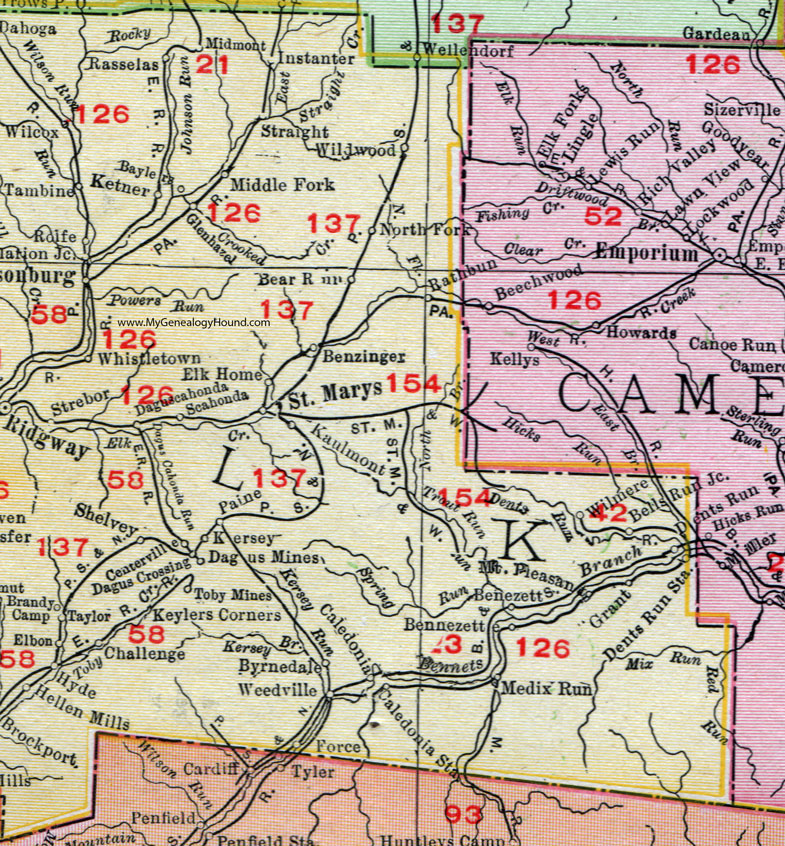
Treasure hunters claim there is gold in the hills of Pennsylvania, but is that fact or fiction? I am talking about the legend of Dent’s Run, an area in Western PA which had been under scrutiny from the FBI because treasure hunters claimed to found the place where a Union payroll of gold bars has been hiding since the Civil War era.
From the Courier Express:
In 1863, a Union wagon train left Wheeling, W.V. with 52 bars of gold, each weighing 50 lb., which were meant to pay Union soldiers. The wagon train was to travel northeast through Pennsylvania to Ridgway and then head southeast to Harrisburg. It made it to St. Marys and that was the last time it was seen. The wagons and dead soldiers were found later — but not the gold.
stock photo Civil War reenactment
In 2012, Finders Keepers said it found the gold, but federal law kept them from digging for it.
According to current market value, the gold bars would be worth more than $55 million. But Burke isn’t sure that if the search is successful that all of them will be found there.
You see, Finders Keepers aren’t the only ones who have been looking for the legendary Civil War era gold haul. Jim Burke, a historian has too.
“I’ve looked for the gold and have had a private investigator from Washington, D.C. go through our archives (at the historical society),” Burke said in a phone interview Wednesday afternoon.
He said the story of the gold is multi-layered — some of it rooted in legend and other elements in documented fact.
According to the story Burke has pieced together over many years, three men came out of the gold train alive.
The person who was leading it, Lt. Castleton is said to have come down with typhoid fever and in his delusion, divulged the secret of what the wagon train was carrying somewhere around its last stop in St. Marys.
Other characters on the trip were a man known as O’Rourke, who was a ruthless character, as well as a man known as Conners. There are 10 said to have been in the train in total and not all of them have been accounted for.
Legend has it that Conners and two other unnamed men walked out before the wagon train met its storied end. Legend has it that Conners said that end was “over Thunder Mountain near Hicks Run.” All three went into the Civil War, but only Conners survived. He is said to have gotten drunk on numerous occasions on his return from war and would tell others in the bar — “I know where there’s gold back in the hills of Pennsylvania.” Ultimately, he died while building roads in California.
Another part of the story Burke found in searching for the gold is that when a company was surveying the Elk and Cameron county lines when Cameron branched out on its own, seven skeletons were found in the hollow of Bell Draft, near the tributary of Hicks Run.
At that time (circa the late 1800s-early 1900s), the Pinkerton Detective Agency came to the area and lore has it that 3.5 gold bars were found. After some of the detectives left the agency, they were said to have spent the rest of their lives in the area looking for the rest of the gold.
Pinkerton Detective Agency
Moving forward, to the 1990s, Burke said a man named Jack Schall, who currently lives in North Carolina, came to the region to do studies on elevation marker accuracy for the government. During his stint in the region, he is said to have met a man in a St. Marys drinking establishment, who said he kept a bar of gold under his bed. According to Burke, Shaw claims the man showed him the gold bar, which he took out of a canvas basket. After this, Shaw started to travel around the county lecturing about the lost gold.
Burke said at one point his partner in the search went to a “soothesayer” in New York state.
“He didn’t tell her what he was looking for. She went into a trance and said you’re looking for gold buried in Pennsylvania,” Burke recounted, adding that she also said she heard the voice of a man, whose description fit that of Lt. Castleton, saying, “I’m stuffed down in the hole. I can’t get out. There’s a bobcat licking my face.”
While Burke, in his retelling, often paused in uncertainty about the factuality of what he knows, he said that if it is true, he doubts the FBI will find what it’s looking for.
“Let’s suppose the Pinkertons found 3.5 gold bars. That tells me there was a division of gold,” Burke said. “If they do find a box of gold on the hill (in Dents Run) it was hidden by somebody, but it’s not the whole batch.”
When asked if he thought the search would be successful, Burke said frankly, “I hope it’s not. But, it might not be the end of the story if they do. And the first thing I’d ask then is how many bars did you find. I think somebody left with some of that gold.”
And if this site doesn’t pan out, Burke has one in mind, saying only that he has found a weathered rock with an important marking scribbled on it which has yielded some notable artifacts nearby.
The Courier Express article ends before the results of the FBI investigation were finished and released. Since then, the FBI, who conducted their search and diggings out of the public eye, claim they have excavated the site and have found nothing. Believable? Perhaps, but the entire story has some serious flaws.
This excerpt is from an interesting site called The Pennsylvania Rambler and this is from a post on February 16, 2020:
The treasure has divided people like no other legend within the borders of Pennsylvania. People have argued and debated the legend, with each bringing their evidence to the table to defend their side of the argument. I admit at one time, I was taken in by the legend and I too wanted to seek out and discover the fortune in gold. However, the story which first captivated me years ago is now an amusing piece of my past as I watch and read how people continue to scour the woods of Elk and Cameron Counties for a treasure that does not exist.
Yes, you read that last line correctly – in my opinion, the treasure that the FBI was accused of going in at night, digging up and stealing away with does not exist. Now I’ve read countless message boards and articles about the treasure and I find it strange that people are so committed in their belief that this treasure exists that they are willing to spend a small fortune on the continual search for it.
So why don’t I believe it exists? Allow me to present my evidence.
1). The most obvious answer is – I’m almost as old as the legend of the Lost Treasure of Dent’s Run. This piece of evidence is the biggest problem with the legend of the lost treasure. The oldest record of this tale is from a 1973 issue of Treasure Magazine. The article, written by a Sandra Gardner – who may or may not have actually existed – was the first telling of the tale that I can find. Since then it has appeared in numerous guide books and regional histories and with each retelling, the story gets more details added. The story fails to appear in Beers’ History of the Counties of McKean, Elk, Cameron and Potter, Pennsylvania (1890) and while this history is definitely missing some pieces, if the event had happened, I cannot imagine it would have been omitted from the history. In fact, the first time the story appears as an “official” part of Cameron County’s history is in the History of Cameron County, Pennsylvania (1991).
Note: I have found mention of the legend being as old as 1965, but the story that is recorded in that message board is the same as Gardner’s version. The article posted there had nothing with it to state where they obtained the story from, so at this point I’m still going with the oldest version being from 1973.
2) The characters mentioned do not exist. I’ve contacted so many U.S. Civil War historians to seek out Lieutenant Castleton and Sergeant Mike O’Rouke that most of them have me on a block list. There’s no solid proof anywhere that the two men existed. One version of the story states the unit assigned to transport the treasure was from either Indiana or Illinois, but again no state records there show the two men being a part of any regiment.
As far as Conners, the citizen guide who supposedly led the group through the mountains of central Pennsylvania, he remains a mystery. Recently I read that there was a man named Conners who was killed near Benezette, but – as far as I can tell – that Conners had nothing to do with the Civil War or the lost gold.
Note: In a recent conversation with a friend, we were discussing the lost treasure and he made an interesting suggestion about the name Castleton. In the Benezette Valley is the community of Castle Garden and maybe the writer used the community name to give Lieutenant Castleton his name. “Castle Garden to Castle Town to Castleton.” He also suggested Conners might have been a corruption of Connelly, an outlaw shot in the Benezette Valley in 1820. I can’t say this is correct, but it is an interesting theory that might hold some truth in it.
3) The route taken. This is one of the biggest problems I have with this legend. It makes absolutely no sense and the more I have looked into this route, the less sense it makes. They leave Wheeling, go to Pittsburgh, drive north along the Clarion River before arriving at Emporium. Then they go overland to St. Marys to Driftwood, where they planned on floating it down stream. First, if you’re in Wheeling, put it on a train, go to Pittsburgh and then to Altoona, to Harrisburg. A lot faster. Second, if the Bucktail Regiment could not float rafts down the West Branch, then why a couple years later would the U.S. Army think they could float a couple million dollars worth of gold down it?
The argument to this point is usually “The Battle of Gettysburg was going on at that time.” The fabled group left Wheeling in June. That’s a whole month before Gettysburg. The nearest major battle would have been the Second Battle of Winchester in early June, but even so, there would have been enough time to put the treasure on a train and send it to Washington, D.C. by rail.
4) The “Henry Shoemaker Theory.” No, I’m not accusing him of making this story up, although he would have if he would have thought about it. To be honest, I never thought I’d use Henry Shoemaker and his writings to defend my beliefs. The “Henry Shoemaker Theory” is the treasure probably does not exist, because he did not write about it. Although many of the stories that Shoemaker wrote were from his own imagination, or moved folktales from other parts of the world and set them in the wilderness of Pennsylvania, he did take a number of regional stories and retell them. Shoemaker seemed fascinated about lost treasures and focused a lot on another treasure in the region, the silver bars hidden north of here near the small community of Gardeau. I cannot help but believe, if the Lost Treasure of Dents Run existed, Shoemaker would have written about it because he had set a number of his stories within the Sinnemahoning Region. Note: more about the lost treasure of Gardeau can be found here: Blackbeard’s Treasure.
Two other questions arise in regards to the Legend of the Lost Treasure that I feel need to be addressed.
1) Were human bones found? The point most treasure hunters make is that human remains were found, along with other Civil War relics, proving there was a massacre. I have not found any reliable source pre-1973 to prove that human remains were found while either surveying the county line or while widening any of the roads. However, with there being numerous family cemeteries in the region, it is possible a forgotten cemetery was discovered and is the source of the story of human remains being found.
2) Where did it happen if it did happen? The lost treasure was supposedly buried along Dents Run or nearby Hicks Run. However, that has not prevented newer versions of the story – which are claimed to be the “correct” version – from changing to location. The treasure has been reported to have been buried near Caledonia, under a “concrete slab at the top of Winslow Hill” and in Driftwood itself. I personally love the Driftwood version because it states the reason the Bucktail Monument was moved from the center of Route 555 was because the state recovered the lost gold buried beneath the monument.
Bucktail Vista
If I’m correct in my belief the Lost Treasure of Dents Run does not exist, then the question must be asked: “Where did the story originate? My personal belief is the legend is a corruption of Shoemaker’s story about Blackbeard’s Silver Bars. Both have a lost treasure being transported overland by wagon and are set in the Sinnemahoning Valley. Mix into the story some elements of truth – the Bucktail Regiment came out of this region and a short distance south was the fight between army deserters and U.S. troops. Add into this mixture of history the similar stories of lost Union or Confederate gold and silver existing in other parts of the state and in the mountains of Appalachia and there is a story that becomes a part of regional lore that has just enough “fact” in it to make people believe it is true.
Note: Strangely, most of the stories about lost Civil War treasure first appear in the late 1960s and early 1970s.I’m not sure why these stories all seemingly appear roughly at the same time and – in my mind – there has to be a connection to why these stories suddenly became a part of American culture, but I have not been able to make any type of relevant connection to their origins.
Final Thoughts
I always thought it would be exciting to go on a treasure hunt, but it seems legends cloud the actual facts and it’s difficult to know if there are indeed undiscovered treasures still buried deep beneath the ground. Did the FBI uncover $54 Million in gold bars and whisk it away under cover of darkness? Hard to say, but with the current state of the FBI, it would not be surprising at all.
I came across this list the other day: The funniest Town Name in Each State by mentalfloss.com The list was posted in 2017, so hopefully the towns are still there!
1. ALABAMA // SCREAMER
2. ALASKA // UNALASKA
3. ARIZONA // WHY
4. ARKANSAS // SMACKOVER
5. CALIFORNIA // ROUGH AND READY
6. COLORADO // NO NAME
7. CONNECTICUT // HAZARDVILLE
8. DELAWARE // CORNER KETCH
9. FLORIDA // TWO EGG
10. GEORGIA // CLIMAX
11. HAWAII // VOLCANO
12. IDAHO // SLICKPOO
13. ILLINOIS // SANDWICH
14. INDIANA // SANTA CLAUS
15. IOWA // WHAT CHEER
16. KANSAS // GAS
17. KENTUCKY // BUGTUSSLE
18. LOUISIANA // UNEEDUS
19. MAINE // BURNT PORCUPINE
20. MARYLAND // BORING
21. MASSACHUSETTS // BELCHERTOWN
22. MICHIGAN // HELL
23. MINNESOTA // NIMROD
24. MISSISSIPPI // HOT COFFEE
25. MISSOURI // TIGHTWAD
26. MONTANA // PRAY
27. NEBRASKA // MAGNET
28. NEVADA // JIGGS
29. NEW HAMPSHIRE // SANDWICH
30. NEW JERSEY // LOVELADIES
31. NEW MEXICO // CANDY KITCHEN
32. NEW YORK // NEVERSINK
33. NORTH CAROLINA // WHYNOT
34. NORTH DAKOTA // CANNON BALL
35. OHIO // KNOCKEMSTIFF
36. OKLAHOMA // GENE AUTRY
37. OREGON // ZIGZAG
38. PENNSYLVANIA // INTERCOURSE
39. RHODE ISLAND // WOONSOCKET
40. SOUTH CAROLINA // KETCHUPTOWN
41. SOUTH DAKOTA // MUD BUTTE
42. TENNESSEE // DIFFICULT
43. TEXAS // DING DONG
44. UTAH // MEXICAN HAT
45. VERMONT // SATANS KINGDOM
46. VIRGINIA // BUMPASS
47. WASHINGTON // HUMPTULIPS
48. WEST VIRGINIA // LICK FORK
49. WISCONSIN // BOSSTOWN
50. WYOMING // CHUGWATER
Pat’s Note: I have been to Intercourse, PA…it’s not far from Blue Ball…have we got a sense of humor in PA or what?
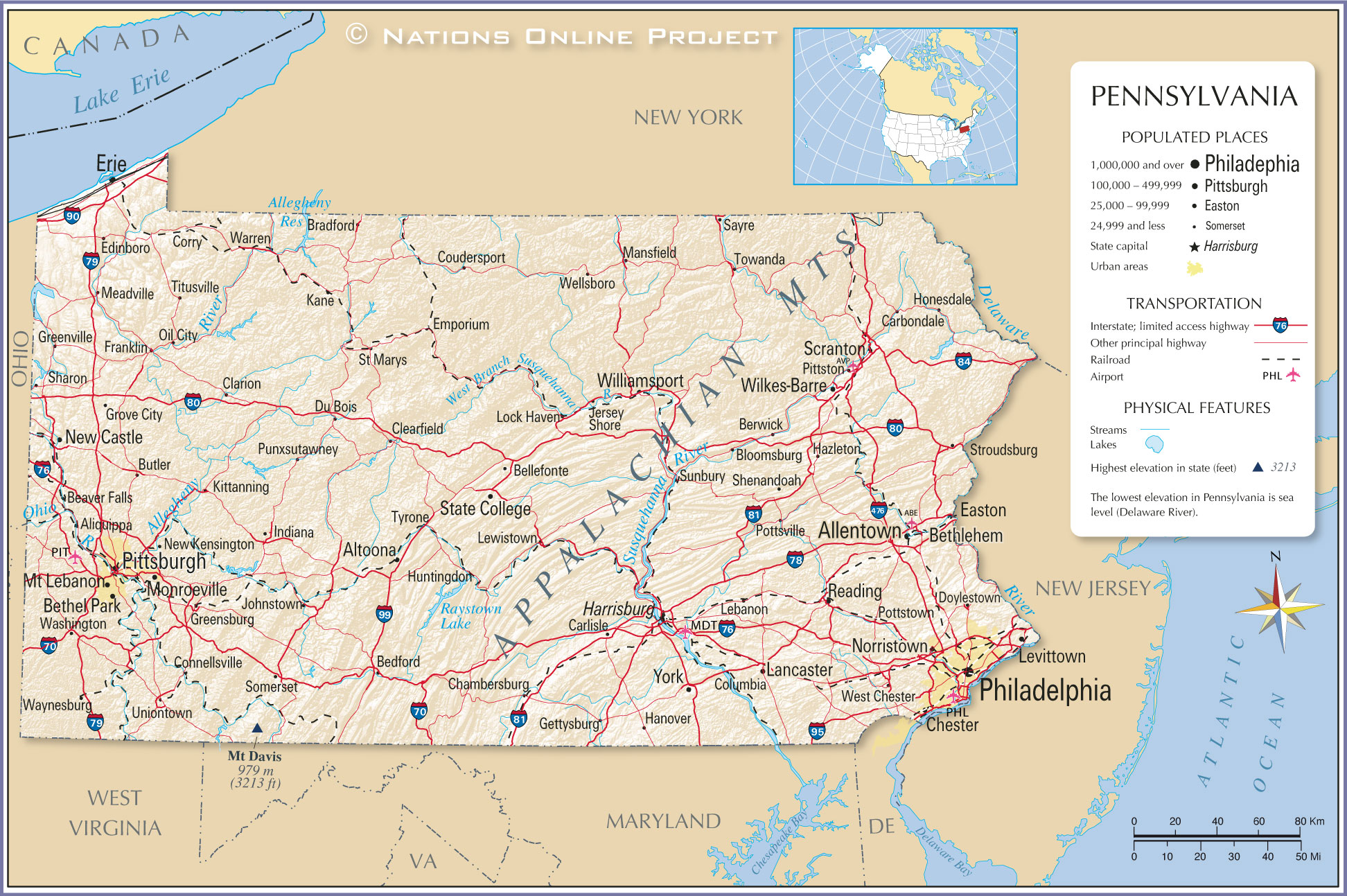
Eerie Pennsylvania is not about Lake Erie, or the town or the county either. Instead it refers to the WEIRD stuff found IN Pennsylvania. And trust me, there’s some weird stuff! ( I’m saving the creepy, spooky stuff for October though!)
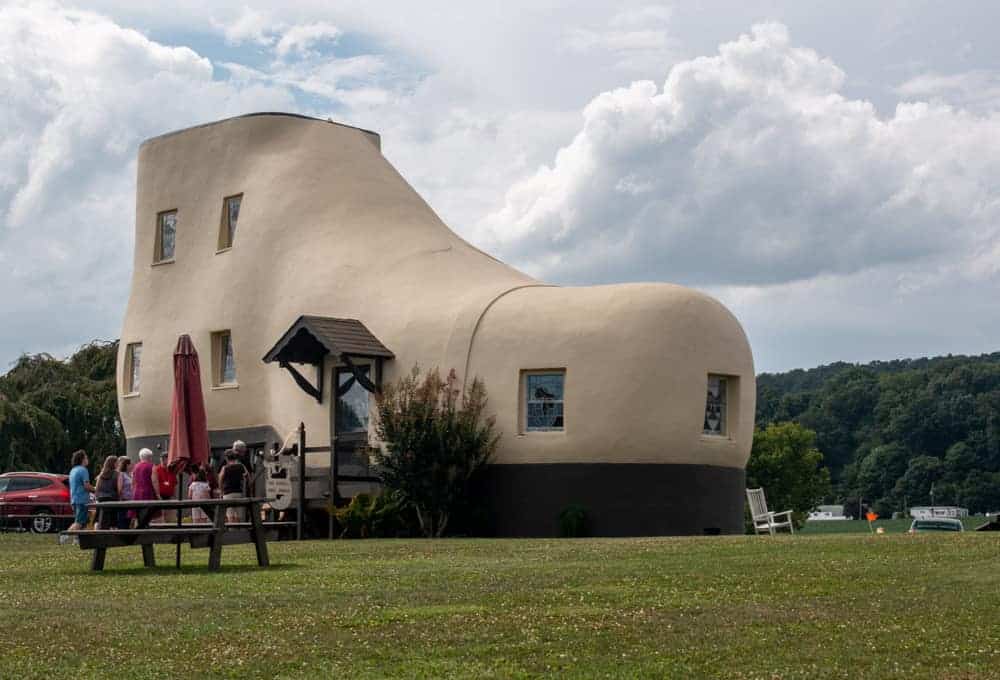
The Haines Shoe House in York
The giant Haines Shoe House
Without a doubt, one of the strangest and most popular roadside attractions in PA has to be the Haines Shoe House. Located along Route 30 east of York, the Shoe House has been drawing curious stares since it was completed in 1949. The Shoe House was built as an advertisement for a local shoe company and never served as more than a temporary residence. Today, it is open for tours, which offer the chance to learn more about this amazing oddity.
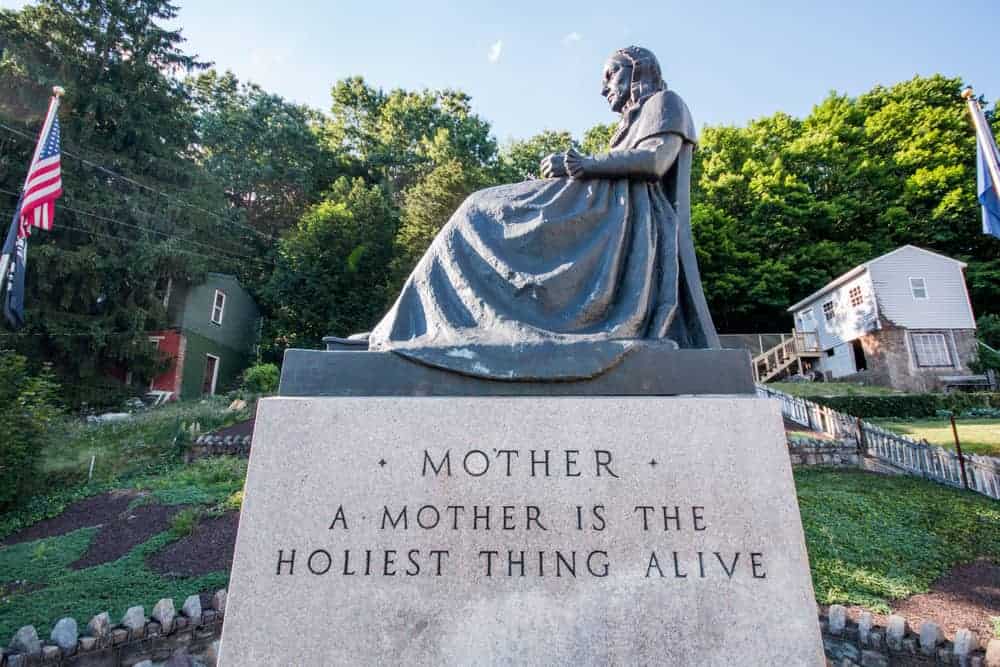
Whistler’s Mother Statue in Ashland
Enchanting, isn’t she?
Located in Ashland, PA, which is better known as the gateway to Centralia and the home of the Pioneer Coal Mining Tour, the Whistler’s Mother Statue is well worth a quick stop. Known officially as the Mother’s Memorial, it was designed to appear like like 1871 painting “Arrangement in Grey and Black: Portrait of the Painter’s Mother” by artist James McNeil Whistler. The statue was completed in 1938 by the Ashland Boys Association to honor the mothers of the world. The statue is very stark and appears rather humorless and severe, which is quite different from how we typically picture mothers today. The phrase “A mother is the holiest living thing” appears on the statue. It claims to be the only statue dedicated to all mothers in the country.
Flying Saucer in Mars
With a name like Mars, you gotta have a flying saucer somewhere in town!
A miniature flying saucer might seem out of place in western Pennsylvania, but when the town’s name is Mars, it almost seems logical. That’s right, in a small park in the center of Mars, Pennsylvania, is a small UFO statue. The flying saucer stands three feet tall and is six feet around. But what it lacks in imposing height or intergalactic history, it certainly makes up for in humorous curiosity. While visiting the town, take a few minutes to walk around and notice some of the humorous Mars stores, such as “Mars Travel” or “Mars National Bank.” The Flying Saucer in Mars, Pennsylvania, is located at 100 Pittsburgh St., Mars, PA 16046.
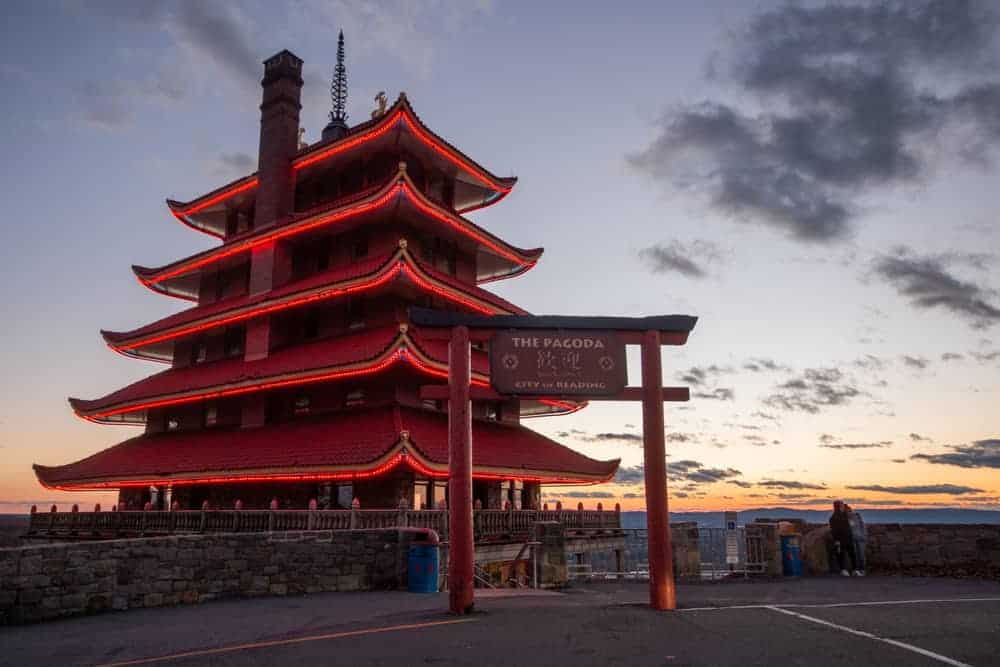
The Reading Pagoda in Reading
The Reading Pagoda is a beautiful and odd spot in eastern PA. Located high atop a hillside above Reading, Pennsylvania is a curious sight. The Reading Pagoda is a Japanese-style pagoda that was built at the beginning of the 20th century and was planned to be one part of a resort that would site on the top of Mount Penn. However, the rest of the resort never came to be. While the Reading Pagoda can be seen from throughout the valley below, you can also drive right up to it and enjoy breathtaking views of the surrounding area. Visiting in the evening offers the chance to see this amazing spot lit up at night.
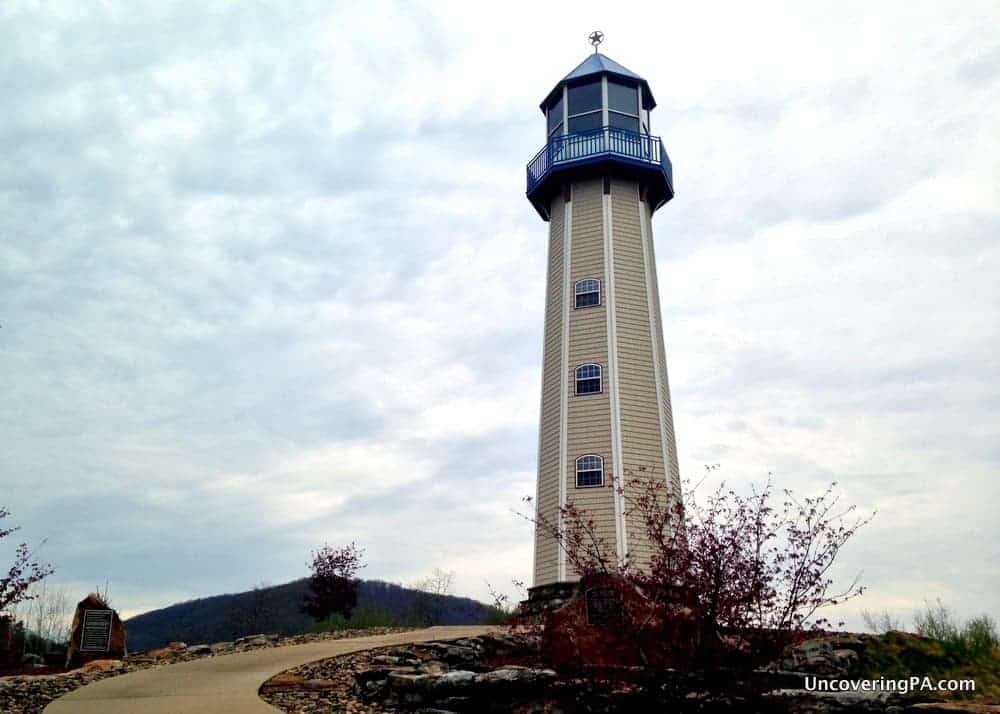
Sherman Memorial Lighthouse in Tionesta
Towering above the small borough of Tionesta, in the middle of Forest County, rises the Sherman Memorial Lighthouse which serves absolutely no significant purpose. In fact, the lighthouse is located roughly 60 miles from the closest navigable body of water, Lake Erie. The 75-foot tall lighthouse was completed in 2004 and was built by local Jack Sherman as a memorial to his family and to hold his large collection of miniature lighthouses.
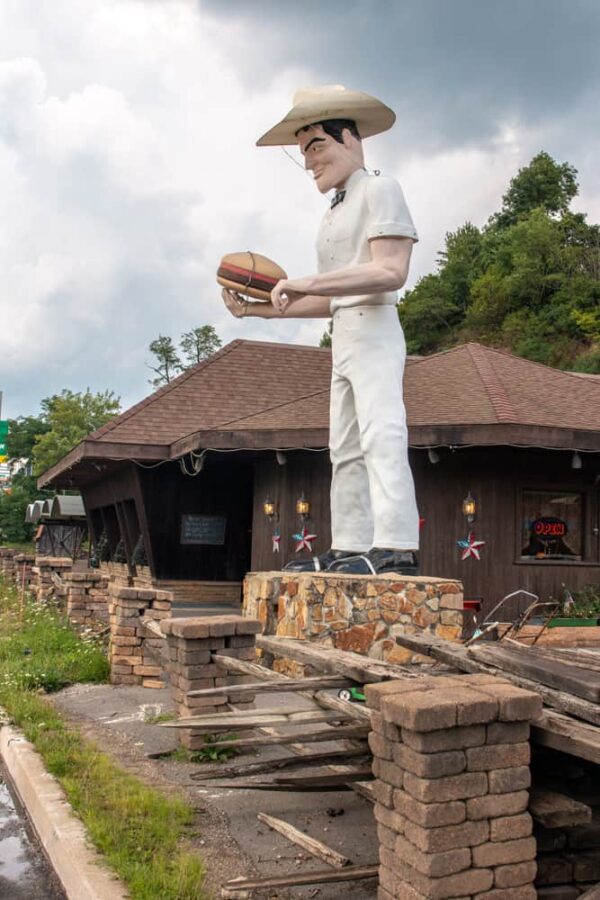
The Giant Cowboy
If you are driving along Route 422 just east of Kittanning, you can’t miss another roadside oddity in Pennsylvania: the Giant Cowboy. Located outside of the Cadet Restaurant since 1962, this 30-foot cowboy known as Sam welcomes guests with a giant hamburger in his right hand. Interestingly, Sam was one of many characters made from the same mold in the 1960s. The first was a Paul Bunyan statue that was placed in Flagstaff, Arizona. The statues would be commonly seen outside of car shops holding a muffler and became known as a “Muffler Man.” The Giant Cowboy can be found outside the Cadet Restaurant at the following address: 13514 US-422, Kittanning, PA 16201.
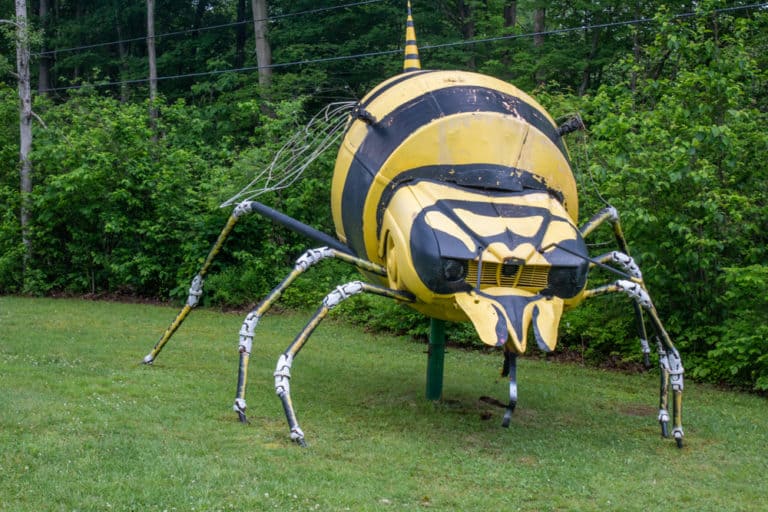
Schaefer’s Auto Art
Schaefer’s Auto Art is located a few minutes south of downtown Erie and is the work of local artist Richard Schaefer. Schaefer uses old cars to create interesting sculptures that are well worth taking the time to see. In the front yard of his house, visitors can see everything from a giant bumblebee to a rocket and a two-headed dinosaur. Visitors are welcome to park and walk amongst these strange, but quite awesome creations. Schaefer’s Auto Art is located at 3705 Hershey Rd, Erie, PA 16506.
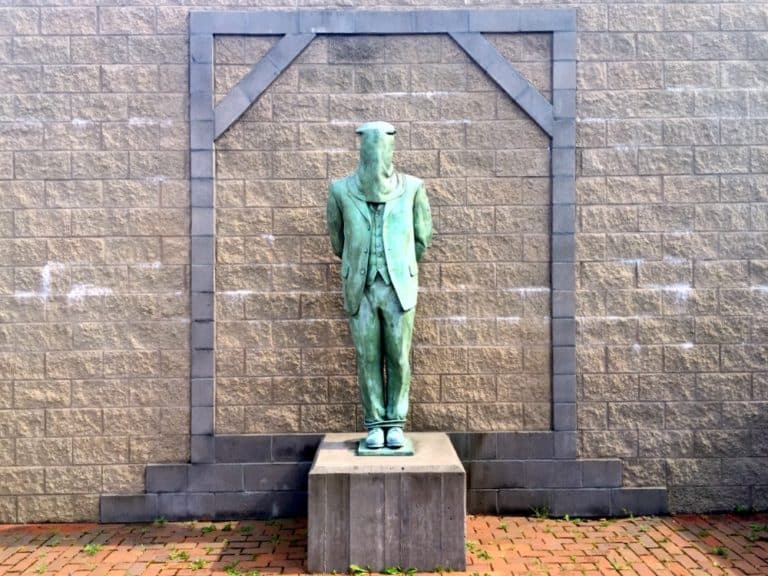
The Statue of a Hooded Man on the Gallows
The Statue of a Hooded Man on the Gallows is located in the heart of Mahanoy City and pays tribute to the Molly Maguires. The Molly Maguires were comprised of Irish immigrants that worked in the anthracite coal mines in northeastern PA. In the 1870s, there are labor issues in the mines that threatened to upend the systems that had been created. Whether the Molly Maguires were a real secret society or more of a boogeyman, at least 20 miners were hung in Schuylkill County between 1877 and 1879 for crimes associated with the group. This statue, which is somewhat hidden behind a stone wall (presumably because of the subject matter), is a sad reminder of this history. The statue can be seen at 212 W Centre St, Mahanoy City, PA 17948.
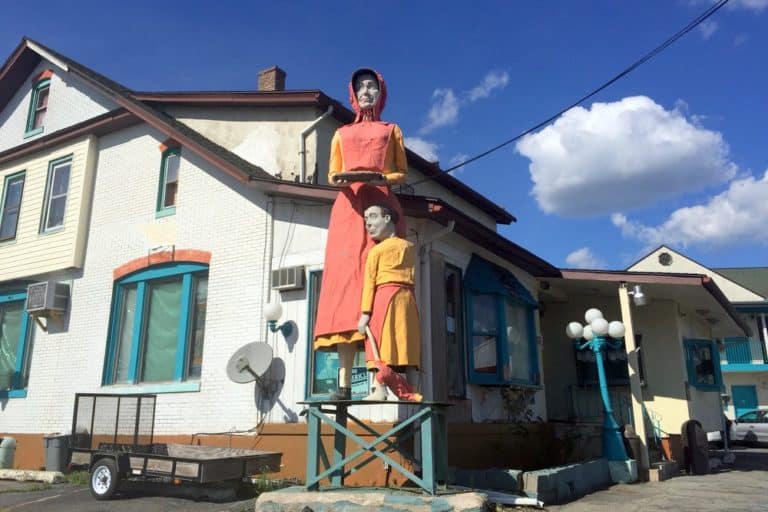
The Pioneer Woman and Child Statue
Without a doubt, the Pioneer Woman and Child Statue in Frackville is one of the strangest roadside oddities in Pennsylvania. Located just off of I-81 in Frackville, the statue consists of a 15-foot tall mom in pioneer clothing being clutched by her daughter. While the subject is certainly nice, the actual statue is somewhat disturbing. The large mom is clutching a pie and has a rather odd look on her face. No matter how strange she is, however, it’s nothing compared to her daughter. Standing about half as tall as the mother statue, the daughter is clutching her mother’s leg and holding a giant decapitated doll. The strangest part, however, is the daughter’s head, which would be more appropriate looking on the statue of a middle-aged man. This is simply an odd statue that seems totally out of place in the middle of Pennsylvania’s coal country.The Pioneer Woman and Child Statue stands next to the closed Granny’s Restaurant at 115 W Coal St, Frackville, PA 17931.
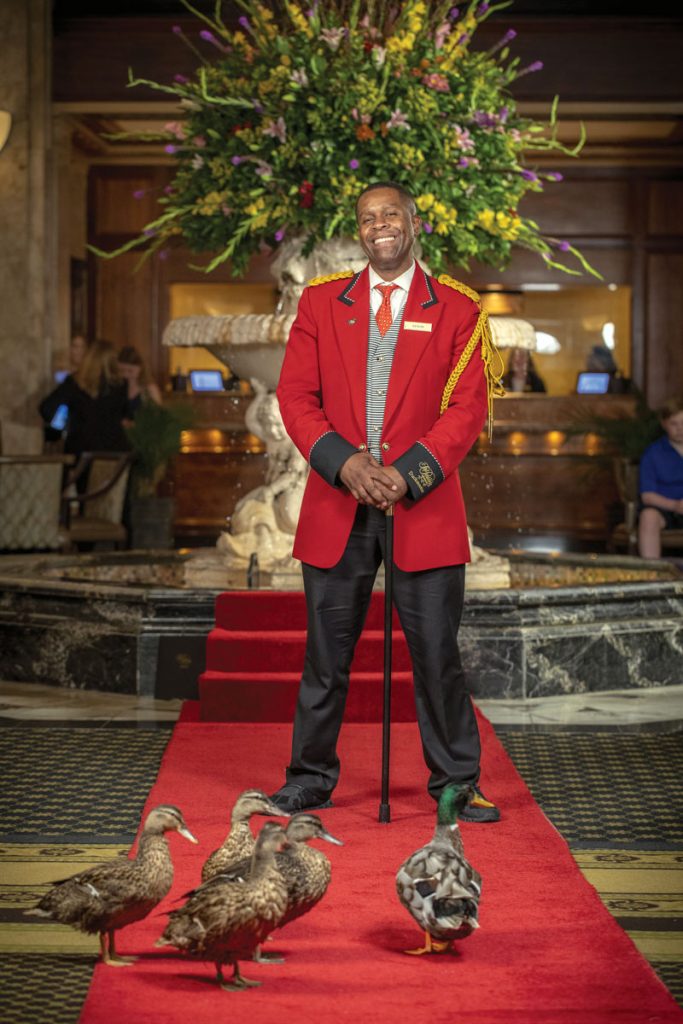
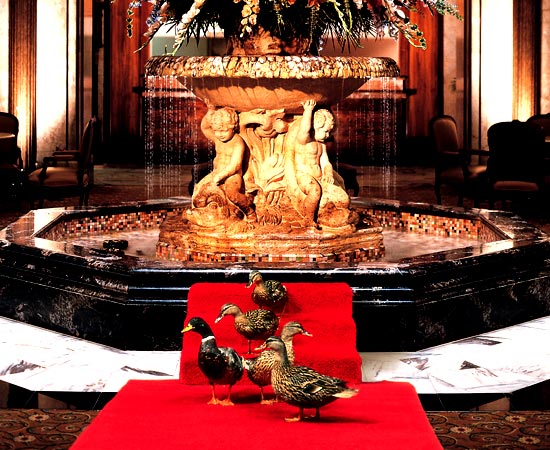
Every day at 11am, the five Peabody Hotel ducks leave their “Royal Duck Palace” on the hotel’s roof and waddle to the elevator. They ride the elevator 12 floors down to the lobby where they walk single file down a red carpet lined with adoring guests. Then they hop into the fountain where they will stay until 5 pm when the whole process occurs in reverse.
The tradition began back in the 1930s when Frank Shutt, General Manager of The Peabody, in Memphis, and a friend, Chip Barwick, returned from a weekend hunting trip to Arkansas. The men had a little too much Tennessee sippin’ whiskey, and thought it would be funny to place some of their live duck decoys (it was legal then for hunters to use live decoys) in the beautiful Peabody fountain. Three small English call ducks were selected as “guinea pigs,” and the reaction was nothing short of enthusiastic.
In 1940, Bellman Edward Pembroke, a former circus animal trainer, offered to help with delivering the ducks to the fountain each day and taught them the now-famous Peabody Duck March. Mr. Pembroke became Peabody Duckmaster, serving in that capacity for 50 years until his retirement in 1991.
Kenon Walker, a current duckmaster, describes his duties and activities:
“Every three months, we rotate our ducks and release the current group to live on a nearby farm. The first marches of the new team happen in front of everybody. I try to line the red carpet with people all the way from the elevator to the fountain so they form a human tunnel; otherwise, I get a lot of cardio. I’ve literally had to chase ducks into the gift shop, behind the bar, and out to the valet stand. After about two weeks, they get accustomed to it.”
“The $200,000 marble Royal Duck Palace on the hotel’s rooftop has a glass wall that gives the mallards gorgeous downtown views. They even have their own miniature Peabody Hotel replica to crawl inside for a nap. On weekends, the hotel sets up a bar next to the Palace so guests can sip cocktails and watch the ducks at sunset.”
the Royal Duck Palace on the roof
“I feed the ducks scratch grains from a silver platter twice a day. The hotel has a French restaurant, but we don’t serve any duck in the hotel. Ours might be the only French restaurant in the world that does not have duck on the menu.”
From The Peabody’s own website: 10 Fun Duck Facts
1. Ducks were not the first residents of The Peabody’s lobby fountain. Rumor has it that turtles and baby alligators each briefly graced the fountain in the 1920s.
2. The Peabody Ducks are five North American mallards – one drake (male) with a white collar and green head and four hens (females) with less colorful plumage.
3. Duck is not served anywhere at The Peabody and has not been seen on the hotel’s menus since its 1981 reopening, quite possibly making Chez Philippe the only French restaurant in the world that does not offer duck.
4. The Peabody Ducks do not have individual names. However, the very first team of ducks were Peabody, Gayoso and Chisca – named for the three hotels owned by the Memphis Hotel Company in 1933.
5. When off-duty, the ducks live in their Royal Duck Palace on the hotel’s rooftop. The $200,000 structure is made of marble and glass and features its very own fountain with a bronze duck spitting water. It also includes a small house – a replica of the hotel – where the ducks can nest with a soft, grassy”front yard.”
6. The Peabody Marching Ducks have appeared on “The Tonight Show with Johnny Carson,” “Sesame Street” when Bert and Ernie celebrated Rubber Ducky Day, “The Oprah Winfrey Show” and in People magazine and the Sports Illustrated Swimsuit issue.
7. The Peabody Ducks have been a question on the TV game show “Jeopardy” and in the board game Trivial Pursuit.
8. Original Duckmaster Edward Pembroke held the position for 50 years.
9. Raised by a local farmer and a friend of the hotel, each team of Peabody Ducks lives at the hotel for only three months before retiring from their duty and returning to the farm, where they are free to live as wild ducks. With a return to the great outdoors in mind, the hotel recognizes its resident waterfowl as wild animals and does not domesticate them or treat them like pets.
10. The Peabody Ducks are mentioned in the 1999 Jimmy Buffet song “Math Sucks” in a line that says “quackin’ like those Peabody ducks.”
***I will be away for a few days and Filly will be in and out. See you soon!***
Open THIS box and remove the turnovers from the package and bake as directed. (These cannot be improved upon without much fanfare and mess! I know, I’ve tried!)
Step 3
When the turnovers have finished baking and are cooling, prepare a simple drizzle icing. I use powdered sugar (start with a cup and experiment) and a teaspoon of water at a time–mixing well before adding more water. (If you use too much water, the icing will just run off the turnovers and be wasted.) If the icing does get too runny, add a little more powdered sugar. When you get the consistency you desire, drizzle it over the turnovers. Enjoy!
Variations:
“Work smarter, not harder.”
Scrooge McDuck
BON APPETIT!!
***I will be away for a few days and Filly will be in and out. See you soon!***
Octopuses are marine creatures that have an excellent sense of touch, powerful, beak-like jaws and venomous saliva. Their suckers have receptors that enable an octopus to taste what it is touching. They are predators, and they typically kill their prey by dropping down on them and enclosing it with their arms. The prey is then pulled into their beaks and broken up. An octopus’s beak resembles a parrot’s beak.
Octopus beak
An octopus has three hearts, two of which pumps blood to the gills and the third heart circulates blood to rest of the body. Their blood is actually blue, mainly because of the presence of hemocyanin – a copper-based protein in its blood cells instead of an iron based system like we have. An octopus can squeeze itself into ridiculously small cracks and crevices because it has a soft body and lacks an internal skeleton.
The size of octopuses usually vary, normally ranging from 12 to 36 inches in length. According to National Geographic, the giant Pacific octopuses, which are found throughout the Pacific Ocean, weigh between 50 kg to 272 kg and measure over 30 feet long.
Octopuses are known to be masters of disguise in which they can easily change colors in 3-tenths of a second. It is one of their distinct features as it eludes predators easily. This talent is so impressive that they can instantly change colors accurately to that of their surroundings–including texture–hiding in plain sight to help catch prey off guard.
PEEK-A-BOO
Because they have such a large brain, octopuses are a highly intelligent marine species. They also have a well-developed central nervous system and 500 million neurons found in their arms, allowing for touch, taste, and gripping its prey. 75% of the octopus’ neurons are located on its arms and each arm can do something on its own at the same time. When one of their arms is severed, it will actually regenerate itself.
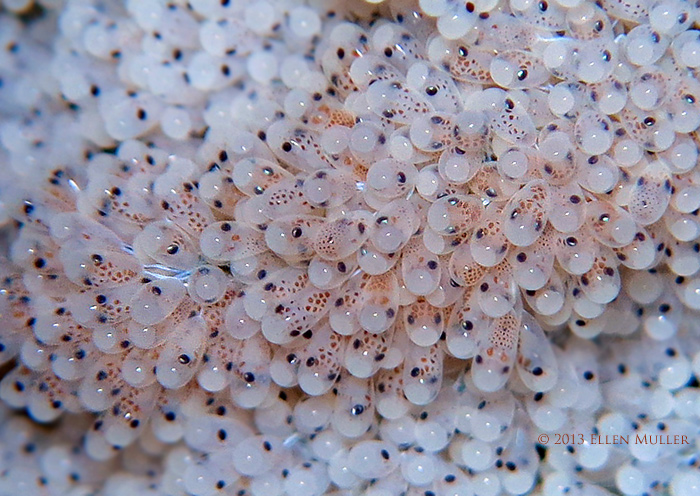
Octopuses have a very short life span. Some species live only for six months; however the giant octopus can live as long as five or six years. According to some research, octopuses mate and then die in a few months. They are an egg-laying species, and a female octopus can lay 200,000 to 400,000 eggs at a time and will guard the eggs without eating until they hatch. The female octopuses die through cellular suicide soon after the eggs are hatched.
Octopus eggs
When an octopus is relatively hungry, everything is on the menu, and they will even eat their fellow octopus. Furthermore, scientists and researchers have also witnessed female octopuses eating their mating partner once breeding is done. However, male octopuses have learned how to avoid getting killed once copulation is done– including mating within arm’s reach to avoid getting eaten by the larger female and sometimes sacrificing one of its limbs just to get away as it will just soon regenerate.
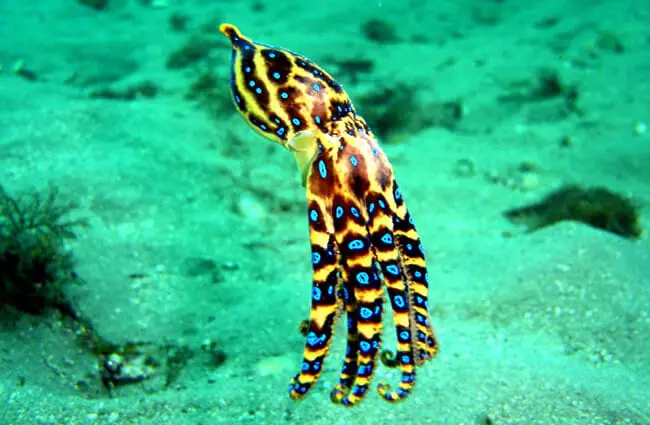
All octopuses are venomous but evidence shows that the animal does not make the venom by itself. It is produced by symbiotic bacteria instead. The blue-ringed octopus is the most venomous to humans and they are fatal. It is estimated that a single drop of tetrodotoxin is enough to kill about 27 people in a matter of minutes.
This is why I don’t go in water!!!
Octopuses are fast swimmers, but they usually prefer to crawl rather than swim. While swimming, the systemic heart becomes inactive and stops delivering blood to its organs and makes them exhausted very soon. They can, however, crawl on land…which is why I avoid the beach!































 Sew Colorful