In doing research for another open, I came across of whole slew of unusual plants and flowers and I thought I’d present one of them every month. Today’s entry is Monkey Orchids. (There are quite a few orchids on the list—they are very unusual as a group—but not all are.)
There are many orchids that bear flowers looking like animals and birds. But the one that is really amazing is the one that looks like the face of a monkey. This orchid called Monkey orchid is aptly named because of its striking resemblance to the simian primates. It is really surprising but Mother Nature has literally dittoed the details with two dark eyes, eyebrows that are fuzzy and dotted, a nose that is furry, and even the beard that one sees on the face of the simians. This is a very rare orchid so chances are that you might not see it in person. It grows at a high altitude of 3000 feet and more in the Cloud Mountains of Peru and southeastern Ecuador.
However, for those interested in having this prized addition to their home garden is that this rare orchid can be grown in cold to warm weather and it blooms year round. The most interesting fact about the Monkey faced orchid is that it smells like ripe oranges to easily make it the center of attraction of any garden where it is grown. However, it is a little ironic that its flower smells like ripe oranges as with a face like a monkey, you would expect the flower to smell like bananas, right?
The Dracula part of the name of this orchid comes from two long spikes from the sepals that look like fangs of Dracula as described in movies and fiction. One fact that many people are not aware of is that the scientific name Orchis Simia derives from the fact that this orchid plant grows from two oval shaped tubers that look like the testicles of a primate. The Greek word Orchis means testicles.
Monkey orchid is a perennial orchid and it has a very long life of many years. However, a plant starts to flower after 7 years of its germination requiring the owners to be patient to see the monkey faced flowers. But once it starts to flower, you can expect the plant to flower every year for nearly 19 years.
Leaves of Monkey Orchid are green in color and linear in shape. These leaves are rhizome and fleshy. A lot has already been said about the monkey faced flowers of this orchid. Interesting fact is that the flower of monkey orchid can be in different colors like red, purple, pink, blue, orange, white, green, and even brown. The three petals of the flower can have dots, stripes or bear no particular pattern yet look like the face of the monkey.
The best conditions for growing monkey orchid in your garden are temperatures of 42-46℉ at night and not more than a temperature of 68℉ during day time. This orchid requires a high humidity level of more than 65%. The soil should be made up of bark and sphagnum moss. Choose a pot that is large and has many holes in it. You can grow this orchid by planting the seed or through vegetative reproduction. The best thing with this species of orchid is that it can be grown any time of the year as it is perennial in nature. The size of the monkey orchid remains between 7 and 20 inches. It requires a heavy amount of water and shady conditions.
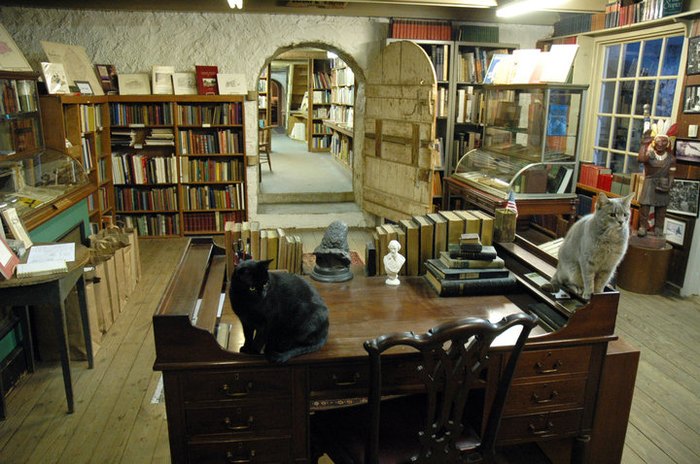
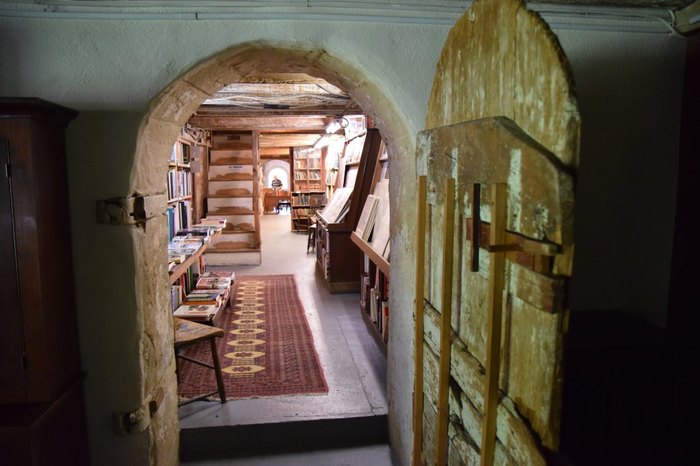
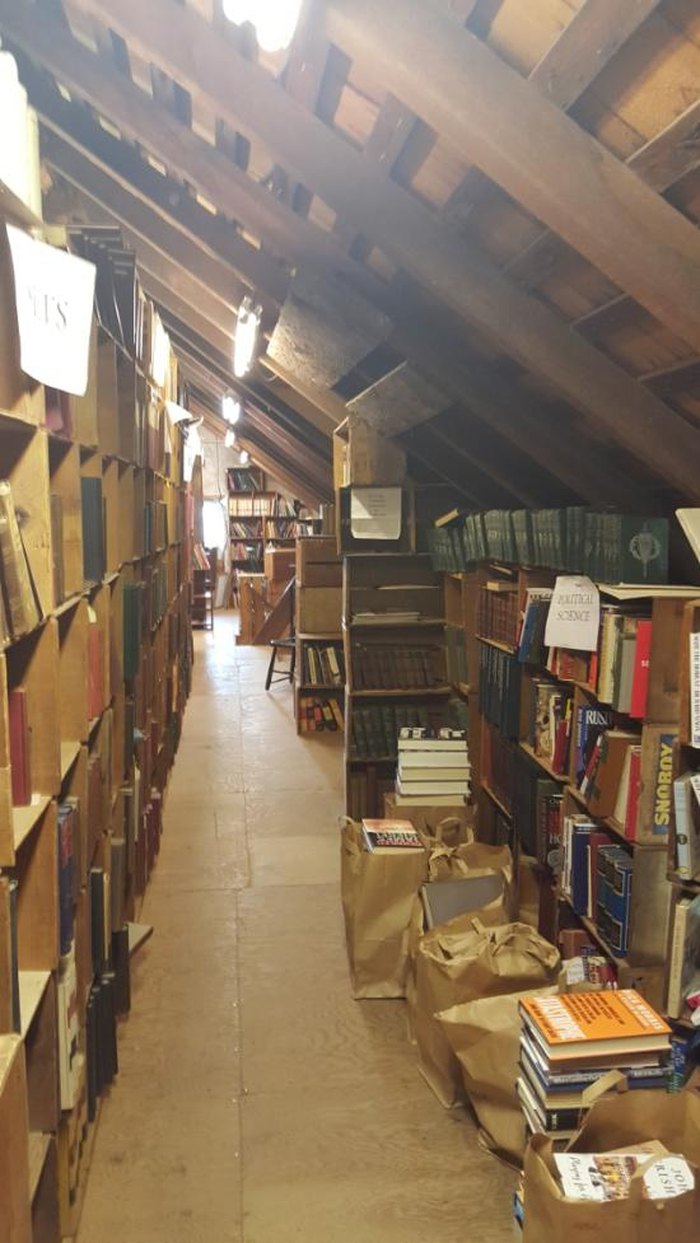
This 5-story bookstore in Pennsylvania, Baldwin’s Book Barn is a book lover’s dream! Need an escape from reality? Pull up a chair and open one of the thousands of rare books that sit on the shelves of the best bookstore in Pennsylvania. Book lovers won’t be the only ones enchanted by Baldwin’s Book Barn. This five-story bookstore in Pennsylvania, with its slanted ceilings and curved doors, provides ample opportunity to meet new people and explore a part of PA’s rich past.
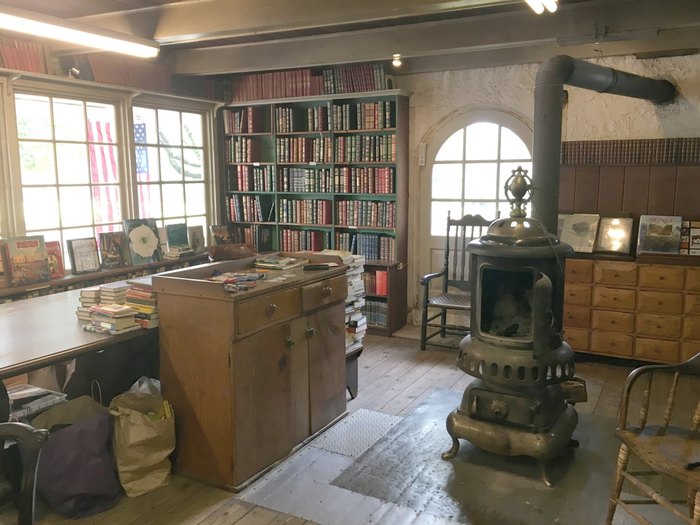
Time seems to stand still at Baldwin’s Book Barn. Nestled among the rolling farmlands in West Chester, the barn was built in 1822. The Book Barn, originally opened in Delaware in 1934, moved to the old barn in Pennsylvania in 1946.
Lilla and William Baldwin, who founded the famous bookstore, lived on the property in a converted milk house.
Today, Baldwin’s Book Barn beckons book lovers, historians, and curiosity seekers with its five floors of rare, out-of-print, and antiquarian collection of books.
But, that’s not all. You’ll also find an impressive collection of used books, maps, and prints among the more than 300,000 items that line the bookshelves.
In fact, you never know what treasures you will find on the bookshelves. Looking for a favorite book from childhood? A long out-of-print masterpiece you’ve always wanted to read? You just might find it at Baldwin’s Book Barn, what may be the largest bookstore in Pennsylvania.
Guests are invited to pull up a chair, sit back, and read for as long as they want during business hours. Don’t be surprised if one of the resident kitties rubs up against you as you read and relax.
Baldwin’s Book Barn welcomes shoppers daily between 10 a.m. and 6 p.m. It is closed on Thanksgiving, Christmas Day, and New Year’s Day.
Dolphins are amazing mammals! I visited Surfer Today to find 50 fun facts about them.
Dolphins evolved from a four-legged terrestrial animal that started spending more time in the water around 50 million years ago.
The name “dolphin” comes from the Greek words “delphis” and “delphus,” meaning “fish with a womb”.
There are around 40 different species of dolphins swimming in the oceans of the world.
Dolphins range in size from 5.6 feet to 31 feet long and weigh between 110 pounds and 10 tonnes, depending on the type of animal and species.
The killer whale is the largest member of the oceanic dolphin family.
The most common species – the bottlenose dolphin – inhabits all regions of the planet, except for the Antarctic and Arctic oceans.
The differences between dolphins and porpoises can be found in their body shapes, fins and faces.
Dolphins live in relatively shallow waters, but they can dive up to 900 feet.
Dolphins are piscivores and eat around 35 pounds of fish every day, including squid and crustaceans.
Dolphins don’t drink water because they get it from the food they eat.
Although dolphins have teeth, they swallow food without chewing it.
Dolphins have two stomachs – one for storing food and another one for digestion.
Dolphins have a skeleton with light, highly flexible, yet weaker bones compared with land animals.
Dolphins are “equipped” with highly effective healing processes, which means that they don’t hemorrhage to death easily.
Dolphins are believed to have the longest memory in the animal kingdom.
Dolphins use their echolocation/sonar for navigating through the water and obstacles and hunting prey.
Dolphins’ hearing system is so sophisticated and advanced that even a blind individual can survive.
Dolphins have no sense of smell and do not have a good sense of taste.
Dolphins can use their noses to kill sharks.
Dolphins have smooth skin to reduce drag while swimming – their outer skin layer can regenerate in only two hours.
Although dolphins have lungs and breathe like humans, they can’t live on land because they become dehydrated and overheat out of the water.
Dolphins sleep eight hours per day and spend the rest of the day swimming.
Dolphins typically resurface to breathe three to five times per minute, but they can hold their breath for up to 15 minutes.
Dolphins sleep with only one brain hemisphere at a time, in slow-wave sleep, to maintain enough consciousness to breathe and to watch for possible predators.
During the gestation period, female dolphins carry one baby at a time, but sometimes they may deliver twins.
After giving birth, female dolphins carry their calves for between 11 and 18 months.
Dolphin mothers feed their babies with extremely rich and fat milk.
The average life expectancy of a dolphin is 25 years, but they can live up to 50.
Dolphins are highly intelligent marine creatures – they can learn, play, socialize, and grieve just like humans.
Dolphins are altruistic individuals and tend to stay with ill or injured individuals for prolonged periods of time.
Dolphins communicate through whistles, clicks, and other nonverbal forms of communication.
Dolphins call out to each other by their names.
Dolphins usually travel in pods of up to 1,000 individuals.
Dolphins are not monogamous.
Dolphins usually swim at between 3 and 8 miles per hour, but their top speed is around 20 miles per hour.
A dolphin can travel up to 60 miles per day.
Dolphins not only know, but they also enjoy catching and surfing waves like humans do.
Scientists have not yet understood why dolphins jump out of the water – some of them leap over 20 feet in the air.
Dolphins have few enemies – only the great white shark, tiger shark, dusky shark, and the bull shark can be considered serious threats.
Dolphins only bite if they’re furious, angry, frustrated, anxious, or afraid.
Dolphins are trained by military forces to spot mines and find lost humans.
Japan, Peru, Solomon Islands, and the Faroe Islands are known for killing dolphins for human consumption.
The coat of arms of Anguilla and Romania feature dolphins.
India, Hungary, Costa Rica, and Chile have declared dolphins “non-human persons,” meaning that they can’t be captured and used for entertainment purposes, for example, in dolphinariums.
The desert city of Petra, established as early as 312 BC in Jordan, has images of dolphins carved in the rocks.
A group of dolphins is named a “school.” Female dolphins are “cows,” male dolphins are “bulls,” and juveniles are “calves”.
According to several animal welfare organizations, there are around 3,000 dolphins in captivity worldwide.
The most famous movies about dolphins are “Flipper,” “The Day of the Dolphin,” “Zeus and Roxanne,” “The Cove,” and “Dolphin Tale”.
In 2010, director Greg Huglin released a 20-minute film called “Surfing Dolphins,” featuring some of the world’s finest wave riding performers.
Nana and Nellie are the longest-living dolphins on record. They lived 42 and 61 years, respectively.
My Grandma was a tiny woman (barely 4’ 8” tall), born of Austrian immigrants. Her name was Anna, but all her neighbors affectionally called her Aunt Anna. She taught me to make potato candy and she also taught me to crochet.
I could sit and watch her crochet for hours. Her hands would bob and weave, seeming to dance with the needle and yarn. And she never focused on her pattern or her hands—she just focused on me and the others in the room and chatted. And that room—her sitting room—was full of items she made: afghans, pillows, and doilies. I adored the doilies—so dainty and delicate! (Sadly, I could never master the skill to make doilies—I crochet too loose to work with cotton thread.) But she had an afghan made of Granny Squares—I always called them Grammy Squares because they reminded me of her—that I adored!
I remember saving my allowance to buy yarn to make a blanket for my bed. I was so proud to purchase the pink and white skeins! I had decided to make granny squares and I began in earnest. I made square after square and saved them in a bag under my bed. Then the music bug bit me, and I wanted to learn to play the piano. My parents surprised me with an old upright piano for my birthday! But the more I practiced and learned the piano, the less time I had to crochet squares. Every time Grandma visited, she asked to see my squares and she was increasingly disappointed that I wasn’t progressing.
I made an extra effort to make more squares, and during one visit, I announced that I was close to being able to join the squares together! All I needed to do was purchase the joining yarn. She asked if I was going to use white or pink and I said neither…black! She looked appalled and said no! It would look awful she insisted. I insisted it would be beautiful (I seriously thought it would—what did I know?) Both she and mother went on and on about the hideousness of my idea and I got disgusted. I grabbed my squares and ran to my room and threw them under the bed.
On my very next birthday, Grandma gave me a large wrapped bundle. When I opened it, I was puzzled—it was a pink and white crocheted blanket. “TA-DA!” she said.
“I don’t understand,” I told her. “I’m making a pink and white blanket Grandma.” (This one was different though—not granny squares, but large solid-colored blocks in pink and white.)
“Not anymore,” she explained. “Your mom gave me your squares. I took them all apart and made you this!”
I was devastated! All my hard work—POOF—gone! I started to cry and ran from the room. I never even came out for cake. Years later she apologized and we made up. She encouraged me to keep crocheting and I have. Every winter I crochet at least a lap blanket and have donated quite a few to the homeless shelters around here. But I have never made another granny squares blanket.
Carnation flowers are symbolic of love, fascination, and distinction and are scientifically known as Dianthus. They are also known as “The Flowers of God.” According to a Christian legend, Carnations first appeared on earth as Jesus carried the Cross. Carnations sprang up from where the Virgin Mary’s tears fell as she cried over her son’s plight.
So, whether you love giving flowers or are an avid gardener, there’s something quite special about carnation flowers.
About the Carnation Flower and Plant
The single flowers of the Carnations species, Dianthus caryophyllus have 5 petals and vary from white to pink to purple in color. Border Carnation cultivars may have double flowers with as many as 40 petals.
When grown in gardens, Carnations grow to between 6 and 8.5 cm in diameter. Petals on Carnations are generally clawed or serrated.
Carnations are bisexual flowers and bloom simply or in a branched or forked cluster. The stamens on Carnations can occur in one or two whorls, in equal number or twice the number of the petals.
The Carnation leaves are narrow and stalk less and their color varies from green to grey-blue or purple. Carnations grow big, full blooms on strong, straight stems.
Growing Carnations
Carnations grow readily from cuttings made from the suckers that form around the base of the stem, the side shoots of the flowering stem, or the main shoots before they show flower-buds.
The cuttings from the base make the best plants in most cases.
These cuttings may be taken from a plant at any time through fall or winter, rooted in sand and potted up.
They may be put in pots until the planting out time in spring, which is usually in April or in any time when the ground is ready to be handled.
The soil should be deep, friable and sandy loam.
Carnation Plant Care
Carnations need some hours of full sun each day and should be kept moist.
Avoid over-watering as this may tend to turn the foliage yellow.
Spent flowers should be removed promptly to promote continued blooming.
The quality of the bloom depends on the soil and irrigation aspects for growing carnations.
Those who grow carnations should know the importance of pinching, stopping and disbudding.
At the time of plucking carnations, leave three to four nodes at the base and remove the stem.
The plant foliage should not be exposed to the direct heat of a stove or the sun.
Carnation Meaning
These flowers are one of the oldest cultivated flowers across the globe. As such, they have a rich history associated with symbolism, and there are several different meanings. The three most loved colors are pink, red, and white carnations.
Pink carnation flowers are known to reflect a mother’s love and gratitude. However, dark pink ones represent tenderness and are sometimes associated with the feeling of love that could bloom on a first date. Light pink carnations are the ones that most dearly express the love of a mother.
Red carnations are most commonly associated with feelings of deep love and affection. Light red ones symbolize admiration – the lightness of their hue enunciates a softer expression of the portrayal of love. While red roses are the ultimate in romance, red carnations are great if you want to convey something a bit less serious.
When it comes to pure love and good luck, white carnations are your best bet. White is a color of purity and luck. When gifting someone white carnations, you convey messages of good wishes for a prosperous life.
The Symbolism of The Carnation Flower
Believe it or not, carnations exude strong symbolism. Although these flowers could easily be taken for granted, they actually have a lot to teach us.
Carnation flowers have a different symbolic meaning in various cultures around the world.
Chinese culture: Carnations are typically used at weddings.
Rome and Greece: Carnations were used in ceremonial crowns, and the name was believed to derive from the Latin word for “wreath” or “garland.”
Korea: People wear pink and red carnations on Parents Day to express admiration, love, and gratitude.
Japanese culture: Carnation flowers are the most loved flower for Mother’s Day, and the red carnation is symbolic of love.
American culture: Carnations are the official Mother’s Day flower and are commonly used for special occasions such as weddings for corsages and boutonnieres for proms.
Victorian era: The colors of the carnation symbolized an answer to a secret question. A yellow carnation was indicative of ‘no,’ and a solid color meant ‘yes, and a striped carnation communicated rejection in a diplomatic way.
Growing Tips for Carnations
Carnation flowers are known to thrive in humid environments. This means that they flourish best in moist conditions. They also grow better when placed fully in the sun with soil that is either slightly alkaline or more neutral in alkalinity.
Caring for them requires little effort, and when stems are cut, they can last for a few weeks. This is what makes them so ideal for growing and using in flower arrangements and bouquets. To make sure that they grow well, it’s best to make sure that they get about four to six hours of sunlight a day.
Take care not to over water carnations. Watering them two to three times a week should suffice. If you notice that the petals or foliage turn yellow, you’re probably over watering them.
If you want to try growing them from seeds, it’s best to plant them in early spring or late fall. It’s also a good idea to grow them indoors. Allow the seedlings some time to grow, and when they are around five inches tall, you can transfer them into a bed that is well prepared or into a pot.
Carnation flowers will form small side shoots (or suckers) around their stems to allow for growth from their cuttings. The best time to take cuttings is in the summer. During this time, the plant cells divide at a faster pace, which promotes root growth. You can also use peat to add more nutrients to the soil to help your carnations grow better.
Uses Of Carnations
Throughout history, there have been several uses of carnations. A common use was to brew the flowers in tea. This is thought to help reduce stress and boost energy levels. Carnation tea can also be used to treat fevers and stomach aches.
In the beauty industry, some products include carnation oil as an ingredient to help moisturize the skin. In addition to this, carnation flowers have also been used in massage oils to help soften and heal the skin while providing a calming scent.
In A Nutshell
Carnation flowers are unique and special, and they should be given credit for their rich history and symbolism. They are robust plants – making them the perfect flowers to grow in your garden. Also, they pair well with other flowers and have a pleasant, calming smell.
Pelicans are a genus of large water birds that makes up the family Pelecanidae.
With 8 different species of pelicans, they can be found on all continents except for Antarctica.
Pelicans live throughout the world in tropic and temperate zones, and always near bodies of water.
Average life span in the wild is 10 to 25 years or more and up to 54 in captivity.
It is easy to identify pelicans, because they are one of the only birds with a pouch under their bill.
Along with the giant pouch, pelicans are a large bird with short legs, and they appear rather clumsy on land. Once in the water, they are strong swimmers, thanks to their webbed feet.
The largest is Dalmatian pelican (Pelecanus crispus) measuring from 5.2 to 5.9 feet in length.
The heaviest is great white pelican (Pelecanus onocrotalus) weighing from 20 to 33 pounds.
Thesmallest and lightest is brown pelican (Pelecanus occidentalis) measuring from 3.4 to 5 feet in length and weighing about 7.7 pounds.
The wingspan can range from 6.7 to 11.8 feet, depending on species.
Pelicans are splendid fliers and can soar like eagles with their giant wings.
Getting UP in the air can be challenging without the help of the wind. Pelicans must run over the water while beating their big wings and pounding the surface of the water with both feet in unison to get enough speed for takeoff.
They are social birds and typically travel in flocks, often strung out in a line.
Pelicans are carnivores (meat-eaters) and diurnal (hunt during the day).
While most pelicans eat fish exclusively, they can be opportunistic feeders, eating lizards, frogs, crabs and lobsters.
Many pelicans fish by swimming in cooperative groups. They may form a line or a “U” shape and drive fish into shallow water by beating their wings on the surface. When fish congregate in the shallows, the pelicans simply scoop them up.
The brown pelican, on the other hand, dives on fish (usually a type of herring called menhaden) from above and snares them in its bill.
Pelicans do not store fish in their pouch, but simply use it to catch them and then tip it back to drain out water and swallow the fish immediately.
When not eating, pelicans spend hours preening, snoozing, or sunbathing.
At dusk, pelicans all settle down for the night. Their head rests back on their shoulders, their eyes close and their feathers ruffled against the cold.
They nest in colonies in trees, bushes, or on the ground, depending on the species.
Breeding colonies often consist of hundreds of these birds all crowded onto one small island.
Males will use certain tactics to attract females during the breeding season. Certain males have colorful feathers and some others have the ability to change the color of their bill, pouch and neck into brighter colors during the interesting courtship.
Both females and males contribute to the making of the nest.
Pairs are monogamous for a single season, but the pair bond extends only to the nesting area; mates are independent away from the nest.
Females will usually lay 1 to 3 eggs and on some occasions 4 or 5 eggs. Incubation period lasts between 28 and 36 days.
The parents take turns incubating 1 to 5 bluish-white eggs, laid days apart, on the top of their feet.
The eggs hatch in the order laid, and the first chick to hatch is always larger and often attacks its younger siblings to get the most food.
The young are not fed from the pouch; instead, the parents open their mouth wide to allow the young to reach down into the gullet to get regurgitated food. The poor parents must feed their chicks up to 30 times a day for the first month of so!
By 6 to 8 weeks, they wander around, occasionally swimming, and may practice communal feeding.
Young of all species fledge 10 to 12 weeks after hatching. They may remain with their parents afterwards, but are now seldom or never fed.
They are mature at three or four years old.
Pelicans are a large bird, which makes them harder prey for most predators in their natural environment. Because of this, most animals do not hunt them. However, a wounded pelican that cannot fly is easy prey for wild dogs, feral cats and larger mammals. Humans are also predators of the pelican, hunting them for their feathers and eating the meat.
A gull often sits on a pelican’s head, trying to steal a meal when the pelican opens its bill slightly to empty out the water.
All pelicans have long bills, but the Australian pelican (Pelecanus conspkillatus) has the longest bill of any bird. The record-sized bill was 20 inches long.
The American white pelican can hold some 3 gallons of water in its bill.
Pelicans and their relatives—cormorants, gannets, and boobies—are the only birds with totipalmate feet (fully webbed; all four toes are united by ample webs).
Fossil evidence of pelicans dates back to at least 30 million years to the remains of a beak very similar to that of modern species recovered from Oligocene strata in France.
The Great Brinks Robbery was the biggest armed robbery in U.S. history at the time. Thieves vanished after stealing $2.7 million, leaving few clues. It was almost the perfect crime. Almost.
It happened on Jan. 17, 1950 at the Brinks Armored Car depot in Boston’s North End. The gang of 11 that stole the money after two years of meticulous planning almost got away with it. They failed because they fell out over the division of the spoils. Police arrested all of them five days before the statute of limitations ended.
The Brinks Robbery
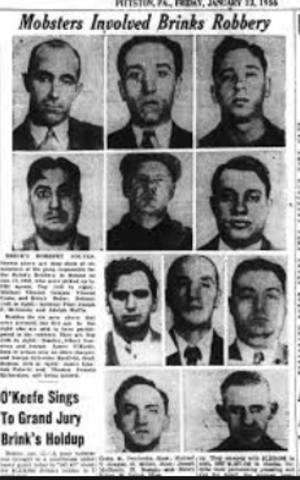
The idea for the heist came from Joseph ‘Big Joe’ McGinniss, but career criminal Anthony ‘Fats’ Pino. McGinness masterminded the crime. Pino also recruited a gang to watch the depot for 18 months to figure out when it held the most money.
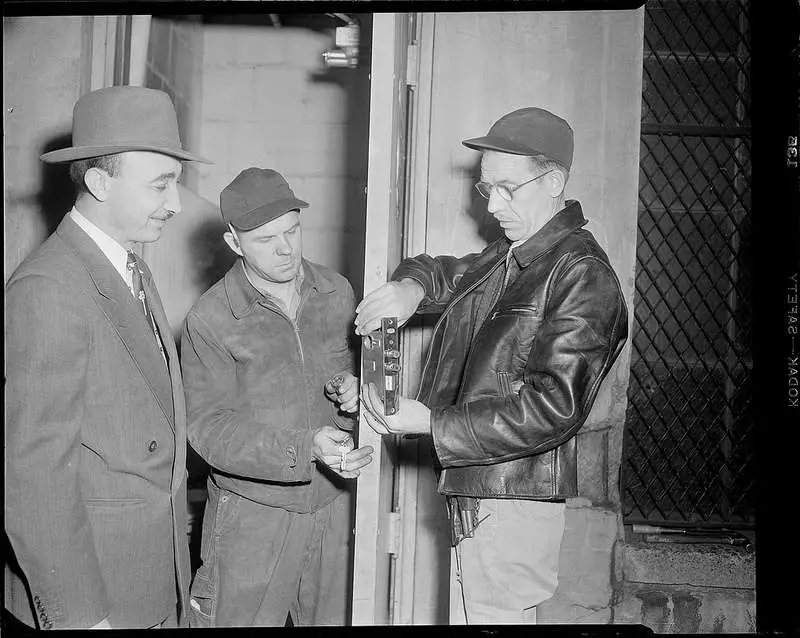
The gang stole plans for the depot’s alarm system, and then returned them undetected. They also removed the cylinders from locks, one by one, and had a locksmith duplicate the keys. Planning for the Brinks robbery took two years and included six failed attempts.
The gang wore outfits similar to Brinks uniforms – Navy pea coats and chauffeur’s caps – and rubber Halloween masks. At 6:55 p.m. on Jan. 17, 1950, seven of the gang members entered the counting room. They surprised the five employees and bound and gagged them face down on the floor.
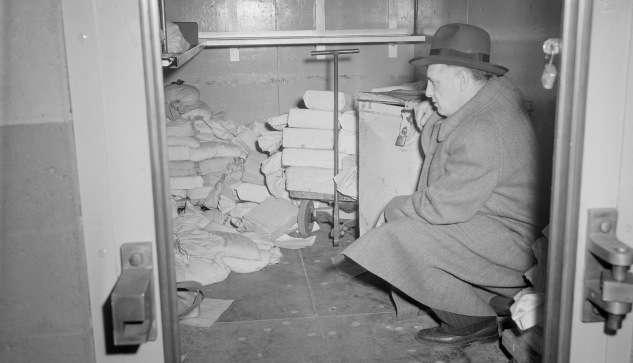
The thieves cleaned out everything except the General Electric payroll. It took them only 35 minutes to load 14 canvas bags with a half ton of cash, coins, checks, securities and money orders. Two of the gang members waited outside in the getaway truck.
3 Clues
They left but three clues: a chauffeur’s cap, the adhesive tape used to gag the Brinks employees and the rope used to tie them up. No one was hurt. The thieves divided up some of the loot and promised each other they wouldn’t touch the money for six years so the statute of limitations would run out. Then they split up to establish alibis.
They almost made it. Investigators had few leads and little solid evidence. Law enforcement officers interviewed hundreds of people who lived and worked near the Brinks depot and questioned known criminals. According to the FBI, “in the hours immediately following the robbery, the underworld began to feel the heat of the investigation.”
Police picked up and questioned well-known Boston hoodlums. From Boston, the FBI quickly spread the pressure to other cities.
“Veteran criminals throughout the United States found their activities during mid-January the subject of official inquiry,” the FBI reported.
The robbers’ truck was found cut to pieces in Stoughton, Mass., but it didn’t offer many clues. The FBI was flooded with unhelpful tips.
The Rat
One gang member blew it for all of them. Joseph ‘Specs’ O’Keefe left his loot with another member when he served a prison sentence for a different crime. While behind bars, he wrote angry letters to his cohorts demanding money and suggesting he might talk.
When O’Keefe got out of prison, Fats Pino sent a hit man to kill him. The hit man shot at O’Keefe with a machine gun in the Dorchester section of Boston. O’Keefe escaped with minor wounds and made a deal with the FBI to testify against the gang. All eight were caught and convicted. Two died before they were tried.
Police recovered only $58,000 of the $2.7 million stolen. The crime inspired at least four movies and two books, including The Story of the Great Brink’s Robbery, as Told by the FBI.
Eight of the Brink’s robbers were caught, convicted and given life sentences. Two more died before they could go to trial. Only a small part of the money was ever recovered; the rest is fabled to be hidden in the hills north of Grand Rapids, Minnesota. In 1978, the famous robbery was immortalized on film in The Brink’s Job, starring Peter Falk.
Lastly, Wikipedia had additional details which may or may not be true at this point.
Planning
The robbery was first conceived in 1947; however, in 1948, after months of planning, the group learned that Brink’s had moved to a new location. While the theft was originally intended to be a burglary, rather than an armed robbery, they could not find a way around the building’s burglar alarm. After observing the movements of the guards, they decided that the robbery should take place just after 7 pm, as the vault would be open and fewer guards would be on duty. Over a period of several months, the robbers removed each lock from the building and had a key made for it, before returning the lock. Two vehicles were stolen: a truck, to carry away the loot from the robbery; and a car, which would be used to block any pursuit. Vincent Costa was the group’s lookout, and signaled with a flashlight from a nearby rooftop when he saw the vault being opened. After five aborted runs, Costa finally gave the go-ahead on the night of January 17, 1950.
Robbery
Seven of the group went into the Brink’s building: O’Keefe, Gusciora, Baker, Maffie, Geagan, Faherty, and Richardson. They each wore a chauffeur cap, pea coat, rubber Halloween mask, and each had a .38 caliber revolver. At 7:10 pm, they entered the building and tied up the five employees working in the vault area. They spent about twenty minutes inside the vault, putting money into large canvas bags. Approximately a million dollars in silver and coins was left behind by the robbers, as they were not prepared to carry it. The total amount stolen was $1,218,211 in cash and $1,557,183 in checks and other securities. By 7:37, one of the Brink’s employees managed to free themselves and raise the alarm.
Investigation and falling out
Immediately following the robbery, Police Commissioner Thomas F. Sullivan sent a mobilization order for all precinct captains and detectives. Thirteen people were detained in the hours following the robbery, including two former employees of Brink’s. Brink’s, Inc. offered a $100,000 reward for information leading to the arrest and conviction of those involved in the robbery, with an additional 5% of recovered cash offered by the insurance company. Director of the Federal Bureau of Investigation, J. Edgar Hoover, took over supervision of the investigation.
The only physical evidence left at the crime scene was a cap and the tape and rope used to bind up the employees. Most of the cash stolen was in denominations of $1 to $20, which made it nearly impossible to trace the bills through serial numbers. Any information police could get from their informers initially proved useless. The truck that the robbers had used was found cut to pieces in Stoughton, Massachusetts, near O’Keefe’s home.
In June 1950, O’Keefe and Gusciora were arrested in Pennsylvania for a burglary. O’Keefe was sentenced to three years in Bradford County Jail and Gusciora to 5-to-20 years in the Western State Penitentiary at Pittsburgh. Police heard through their informers that O’Keefe and Gusciora demanded money from Pino and MacGinnis in Boston to fight their convictions. It was later claimed that most of O’Keefe’s share went to his legal defense.
FBI agents tried to talk to O’Keefe and Gusciora in prison but the two professed ignorance of the Brink’s robbery. Other members of the group came under suspicion but there was not enough evidence for an indictment, so law enforcement kept pressure on the suspects. Adolph Maffie was convicted and sentenced to nine months for income tax evasion.
After O’Keefe was released, he was taken to stand trial for another burglary and parole violations and was released on a bail of $17,000. O’Keefe later claimed that he had never seen his portion of the loot after he had given it to Maffie for safekeeping. Apparently in need of money he kidnapped Vincent Costa and demanded his part of the loot for ransom.
Pino paid a small ransom but then decided to try to kill O’Keefe. After a couple of attempts he hired underworld hitman Elmer “Trigger” Burke to kill O’Keefe. Burke traveled to Boston and shot O’Keefe, seriously wounding him but failed to kill him. The FBI approached O’Keefe in the hospital and on January 6, 1956, he decided to talk.
On January 12, 1956, just five days before the statute of limitations was to run out, the FBI arrested Baker, Costa, Geagan, Maffie, McGinnis, and Pino. They apprehended Faherty and Richardson on May 16 in Dorchester. O’Keefe pleaded guilty January 18. Gusciora died on July 9. Banfield was already dead. A trial began on August 6, 1956.
Eight of the gang’s members received maximum sentences of life imprisonment. All were paroled by 1971 except McGinnis, who died in prison. O’Keefe received four years and was released in 1960. Only $58,000 of the $2.7 million was recovered. O’Keefe cooperated with writer Bob Considine on The Men Who Robbed Brink’s, a 1961 “as told to” book about the robbery and its aftermath.
I believe the assertion—that Biden got 81 million votes—is the BIGGEST HOAX ever perpetrated on the American people. Sadly, it’s not the first, nor will it be the last hoax the public will fall for. Throughout history, we’ve had some doozies!
The War of the Worlds
Orson Welles didn’t mean to mastermind one of the greatest hoaxes in history. Mass hysteria was simply a byproduct of a high-quality radio play in an era where world war loomed, the space race was in its early stages, and most people got news and entertainment from their receivers. According to History.com, the October 30, 1938, broadcast began at 8 p.m. with an introduction presenting the Mercury Theater’s update of H.G. Wells’ science fiction novel The War of the Worlds, but unfortunately, many people were listening to a popular ventriloquist on another station until 8:12 and therefore missed the disclaimer. Welles take on Wells’ Martian invasion tale started with a weather report and a concert live from the Hotel Park Plaza before news alerts about explosions on Mars, a meteor crashing into a New Jersey farm, and eventually aliens with tentacles, heat rays, and poisonous gas broke in. Terrified announcers were then saying cylinders had landed in Chicago and St. Louis, 7,000 National Guardsmen had been wiped out, and that people were fleeing.
Only the panic part turned out to be real as potentially a million listeners thought Earth was under attack. People crowded the highways, armed themselves, begged police for gas masks, requested their power be shut off so the aliens wouldn’t see them, and were treated for shock at hospitals. A woman ran into an Indianapolis church during evening service to proclaim, “New York has been destroyed. It’s the end of the world. Prepare to die!” When CBS got wind of hysteria IRL, Welles went on the air as himself to remind listeners that it was fiction. The FCC investigation found no wrongdoing but networks agreed to be more cautious regarding programming going forward. The attention scored Welles a Hollywood contract, which enabled him to write, direct, and star in his 1941 masterpiece Citizen Kane.
The Shed at Dulwich
For just six short months in 2017, The Shed at Dulwich, where patrons ordered entrees by mood, became the highest-ranked restaurant in London on TripAdvisor and the hardest reservation in town to get. Calls and emails poured in begging to be squeezed in for birthday dinners, romantic dates, and media coverage. All were ignored or told to call back as they were booked solid for more than half a year. Except that was a lie. The reason they couldn’t score a table was actually because the business was bogus. It was an experiment in algorithm manipulation and buzz creation by freelance writer Oobah Butler, who had been paid in the past by owners to review their restaurants positively without ever stepping foot inside on the site. To turn the South London garden shed he resides in into a fake fine dining experience, he bought a burner phone and a domain, created a website with soft-focus pictures of delicious-looking dishes made with ingredients you wouldn’t want to eat (paint, bleach tablets, shaving cream, the heel of his foot), and drummed up interest by providing minimum details, making it an appointment-only establishment, lying about it being full, and soliciting friends to write glowing reviews. According to The Washington Post, people contacted him looking for work and companies sent him free samples of their food products. He opened The Shed for one night and served canned soup—and some diners still asked to come again. Butler outed himself in an article and video for Vice a month after hitting the top spot and TripAdvisor removed the listing.
The Cardiff Giant
This gentle giant remains one of 19th-century America’s most legendary hoaxes. Gideon Emmons and Henry Nichols unearthed a ten-foot petrified “man” on October 16, 1869, while digging a well on the New York farm owned by William Newell. Word spread about the discovery and Newell put up a tent and started charging a quarter (and then 50¢ as business boomed) to take a peek at the ground Goliath. Hundreds of curious onlookers and amateur archaeologists made the pilgrimage, many believing it was an ancestor of the Onondaga people and some claiming it was proof of the giants mentioned in The Bible—even after most professionals like Yale paleontologist Othniel C. Marsh said it a fake. The “mummy” was eventually sold to a group of businessmen who sent him on tour. Greatest showman PT Barnum offered to buy it for $50,000, and when they declined to sell, he made a plaster knockoff and arranged for it to be shown in a New York City museum. By December, Binghamton cigar salesman George Hull admitted this was a stone-cold swindle. He’d commissioned a German stone cutter in Chicago to carve it out of a block of gypsum he’d bought in Iowa before he and his cousin Newell buried the 2,990-pound statue. While it was a get-rich-quick scheme, Hull, an atheist, was also trying to prove a point about what he considered silly religious stories and how science could disprove most of them. Even after the hoax was revealed, the Cardiff Giant still made appearances and money. According to Archaeology.org, he showed up at the 1901 Pan-American Exposition in Buffalo and was sold in 1947 to the Farmers’ Museum in Cooperstown, where he’s on display today.
Michael Jordan is dead
In February 2015, an article published on the Cronica MX website said that former Chicago Bull Michael Jordan had gone to that big basketball court in the sky after suffering a heart attack while he slept. It even quoted his wife, Yvette Prieto. They also posted a video clip designed to resemble a breaking news segment on YouTube with footage of a tearful ESPN reporter Rich Eisen saying goodbye. According to Snopes.com, the footage was real but recycled from a NFL Game Day episode from a month earlier when Eisen had learned that his longtime co-worker and friend Stuart Scott had lost his battle with cancer. It recirculates every once in a while, always trying to lure fans to click through to a spammy site or to provide their personal information. The same story was used again in 2017, this time by a site called Viral Mugshot, according to Inquisitr.com. Despite it containing the same spelling and grammar errors, it went viral on social media until debunking sites and news agencies reported it as fake news. And Jordan isn’t the only celebrity targeted by pranksters and hackers. If you believed everything you read on stars’ sites, fake Twitter accounts, or items reported by newspapers erroneously, many of your favorites would have been gone long before their time, including: former President Barack Obama (assassinated while campaigning in an Iowa restaurant), Will Ferrell (died in a 2006 paragliding accident), Nick Jonas (heart attack after a lap dance in a Dallas strip club), Justin Bieber (suicide twice, nightclub shooting, and an overdose), and, of course, Mikey from the Life cereal commercials (a deadly combo of Pop Rocks and soda made his stomach explode).
Piltdown Man
Since Charles Darwin released his evolution theories in 1859, scientists have been on the lookout for proof of the missing link—a phase between full ape and full man—and in 1912, Englishman Charles Dawson announced he’d found it in a gravel pit in Piltdown. He used the fossils to build a skull model with a human-sized brain and an ape-like jaw and England declared itself the real birthplace of modern humanity. But other scientists immediately took issue, mostly because it didn’t match other fossils found around the world including the Australopithecines one dug up in South Africa. In 1915, Dawson doubled down and claimed he retrieved a second similar fossil, which was enough evidence for many average Joes. The hoax was not revealed until 1953 when British scientists used new technology to date the Piltdown pair. They deduced that the remains were only 500 years old, not the 1 million years old needed to be the link. They also took a bite out of his claim by discovering that the jaw was from an orangutan whose teeth had been filed to resemble human wear patterns and that the bones had been stained to match each other. Most people involved were dead by the 1950s so the prank plotter was never identified. One whodunit theory, according to the BBC: The doer was none other than Sherlock Holmes author Sir Arthur Conan Doyle. He lived near the pit and was a member of Dawson’s archaeological society. The motive was revenge for being constantly mocked by scientists for his belief in spiritualism.
The Cock Lane Ghost
Even royals can fall prey to paranormal pranks, according to The Daily Mail. In 1762, Prince Edward, Duke of York and Albany, visited a home on Cock Lane in London that was said to be haunted by Scratching Fanny, a woman who had died of smallpox in the rented house after her loan shark lover William Kent had lent their landlord money with a high interest rate. Kent took the landlord Richard Parsons to court over the loan and won. Strange noises that sounded like a cat scratching a chair were reported at the property around this time, and Parsons and his daughter Elizabeth, who the noises actually emanated from, claimed the ghost was Fanny. To prove it, they held séances regularly, which were written up in the newspaper and drew religious leaders, the prince, the mayor, and so many other onlookers that the street became impassable. At the time, people widely believed that a person would return from the great beyond to warn the living or seek revenge, so they quickly accepted that it was Fanny communicating via a system of knocks that Parsons and a preacher developed. During one such communing, the “ghost” accused Kent of poisoning her and requested he be hanged. To clear his name, Kent and two doctors who had tended to Fanny on her deathbed attended a séance, and again Fanny declared he was her killer. But during a later gathering, Dr. Samuel Johnson witnessed Elizabeth creeping from the bed where she was during encounters to pick up a piece of wood that she used to knock. She’d usually hidden the branch in her clothes. Parsons was trying to frame Kent after losing the case, but it was he who ended up behind bars for two years. (His wife also got a year in prison.)
The Hurricane Harvey freeway shark
Between social media sites and the 24-hour news cycle, it is impossible not to be bombarded with insane photos of daring rescues and heartbreaking destruction following any natural disaster these days. Hurricane Harvey hitting Houston in 2017 was no exception, with one image in particular proving you can’t always believe what you see. Twitter user @Jeggit posted a startling shot of a shark swimming in the floodwater that filled a Houston highway. It appeared to have been taken from the driver’s seat of a stalled car. It was retweeted almost 84,000 times and liked by 141,733 users fairly quickly. According to the Hollywood Reporter, Fox News host Jesse Watters was also fooled by the photo, even mentioning it during his show The Five. He later apologized for the mix-up on his Twitter account once Politifact tracked the doctored photo back to 2011. It appears to have first been circulated after Hurricane Irene struck Puerto Rico and posted on imgur.com. In 2012, social media users posted it saying it was taken in New Jersey during Sandy. It is believed that whoever created this fishy photo took the shark from an image that ran in Africa Geographic in 2005.
Hitler’s fake diaries
In 1979, Der Stern Magazine reporter Gerd Heidemann met with Nazi memorabilia collector Fritz Stiefel, who claimed to have a diary penned by Adolf Hitler. Stiefel said it’d been recovered from a 1945 crash of a plane transporting Hitler’s personal effects. (Records indicated the crash was real and that a chest was also recovered likely containing other journals.) After a couple of handwriting experts authenticated the script, more volumes turned up through Konrad Fischer, who’d procured them from an East German General who was planning to smuggle them out of Germany in pianos, according to the UnMuseum.org. Heidemann convinced his outlet to pony up 9.9 million marks (almost $4 million) for 60 diaries. The magazine knew it could make their money back and then some from reprints. In April 1983, Stern broke the story and then Newsweek and London’s Sunday Times ran excerpts.
Historians immediately balked, as Hitler loathed writing and there had been no indication from those close to him that he’d kept notes. Also, the content sparked skepticism as they portrayed Hitler as having little knowledge of concentration camps and wanting to deport, not exterminate, Jews. After many experts questioned the handwriting, the West German Federal Archives ran more tests. They concluded that the paper, ink, and glue were manufactured after the war had ended and Hitler had died. Heidemann, who always maintained he wasn’t in on it but had inflated the asking price and skimmed money off the top, was fired. Fischer turned out to be Konrad Kujau, a criminal specializing in forgery. He faked memorabilia first and worked his way up to whole documents and paintings. (In fact, a quarter of the works that were featured in the 1983 book Adolf Hitler: The Unknown Artist were done by Kujau.) Both Kujau and Heidemann were sentenced to almost five years in prison. Most of the money was never retrieved. While Heidemann was a pariah after serving, The Guardian reports that Kujau made regular appearances on talk shows and became a minor celebrity.
Balloon Boy
On October 15, 2009, the nation could not take its eyes off the non-stop news coverage of a homemade silver helium-filled balloon that looked like a UFO floating around the Colorado skies. After releasing it from Fort Collins, Richard and Mayumi Heene called 911 to report that their six-year-old son Falcon was trapped aboard. National Guard helicopters and local police followed the blimp, which topped out at 7,000 feet, for 90 minutes and 50 miles until it landed 15 miles from the Denver airport. Falcon was not inside, but as some had seen something fall from the balloon, a land search ensued. That too turned up nothing. Several hours later he came out from hiding in the attic at home. When interviewed on air by Wolf Blitzer, the kid slipped and said his father had told him they were doing it to get a reality show. The first responders didn’t like their time or money wasted and the Heenes were arrested for the hoax. According to CNN, the Larimer County Sheriff’s Department tallied the cost to be at least $47,000. In addition, the FAA imposed an $11,000 fine because airport traffic was delayed because the balloon had flown and landed close to it. The case’s judge decided it was “clearly a planned event done for the purpose of making money” and that it was “exploitation of the children, exploitation of the media, exploitation of the emotions of the people.” Both parents were sentenced to jail, four years probation, and more than 100 hours of community service and agreed to pay restitution of $36,016. On the five-year anniversary, USA Today found the family living in Florida and the sons had started a heavy metal band. One of their CDs has a song called “Balloon Boy No Hoax.”
Russian royal or insane Polish factory worker?
The 1918 grisly basement execution of Tsar Nicholas II, Tsarina Alexandra, and their five children aged 13 to 22 in the dead of night by bullet and bayonets by Bolshevik revolutionaries is hardly the stuff of fairy tales. Which is likely why so many people wanted to desperately believe the rumors that the youngest daughter, Anastasia Romanov, had escaped. The mystery and hope were fueled by the fact that no bodies had been found. Women popped up all over the world claiming to be her, the most believable of which was Anna Anderson, according to Refinery29. She had tried to kill herself by jumping off a Berlin bridge two years later and landed in an asylum for two years. She was the right age, had scars on her body, and a Russian accent. Some relatives and former Romanov friends and servants confirmed her identity while others denounced it. The murders had become common knowledge and Soviet counterintelligence did nothing to quell survival rumors. Her tale inspired multiple books, tabloid fodder, an Ingrid Bergman classic, an animated film, a stage musical, and an Amazon Prime TV series.
After leaving the hospital, Anderson bounced around Europe, staying with distant relatives and wealthy supporters, but she was usually uncooperative, even malicious, when people tried to prove or disprove her identity. She also knew things the late royal would have known, which is how the son of a doctor who was killed with the family became her most ardent defender. Together they hired an attorney to try to get legal recognition of her title and access to the Tsar’s estate. The case lasted 32 years, the longest in German history, and ended without any conclusions. During the investigation, her detractors posited that she was Franziska Schanzkowska, a Polish worker who disappeared after being declared insane after being injured in a factory explosion shortly before the incident at the bridge. Anderson died in 1984. Seven years later, five skeletons were found in a forest near the town where the family was executed and DNA testing identified them as Romanovs. With two bodies still missing, people argued she had been telling the truth all along. But that did not last long, as they tested their DNA against an intestinal sample from a prior Anderson surgery. No match. In 2007, the final two bodies were found at a different gravesite.
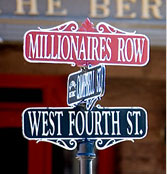
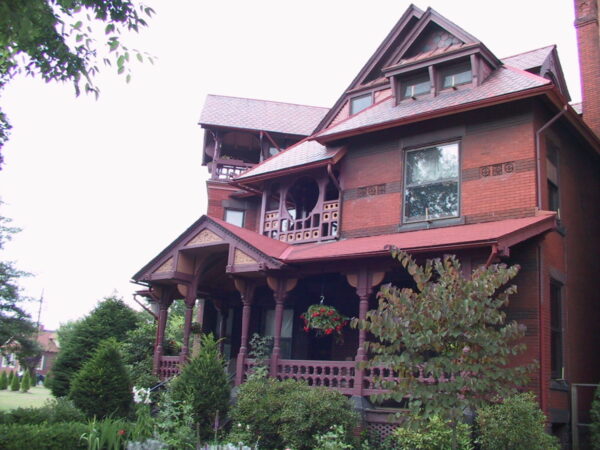
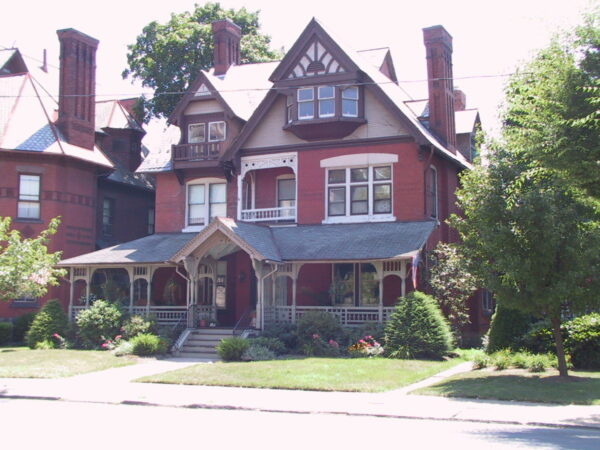
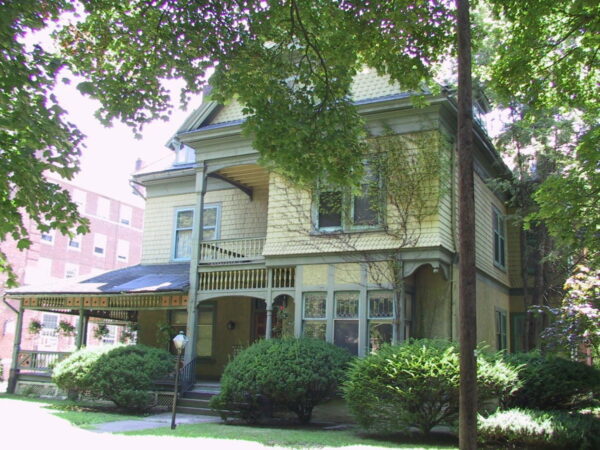
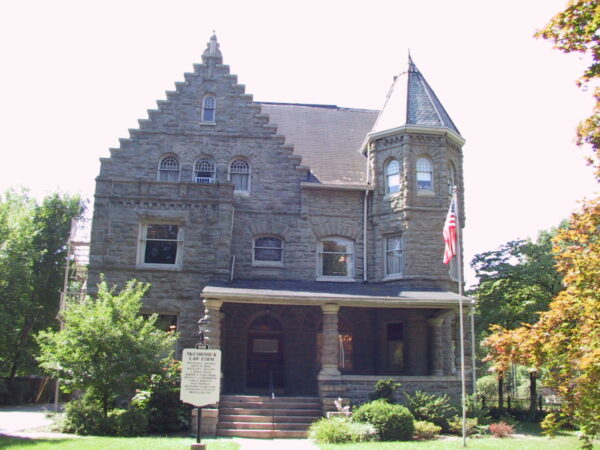
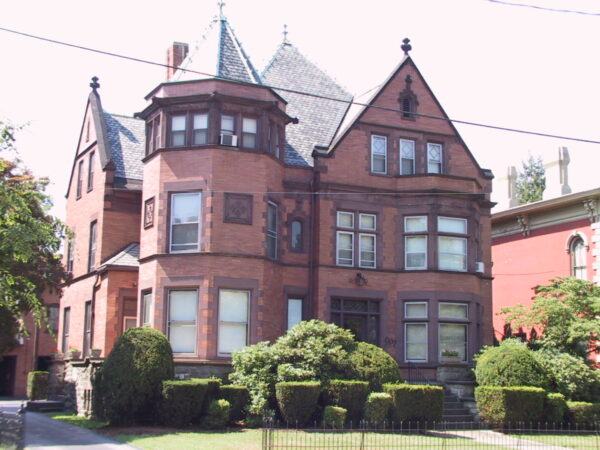
Whenever we travel home, we pass through Williamsport, PA. It’s a larger city in PA with a lovely historic district, a vast commercial district and The Little League Museum. The crown jewel of Williamsport was West Fourth Street in the 1800s. The city was home to more millionaires per capita than anywhere else in the country. This was due to the lumber business and the lumber barons that contributed to the boom in home and church construction. Many of these homes can still be seen today!
The A.D. Hermance House
The Rowley-Hermance Company manufactured woodworking machinery. This 20-room building is an example of the Richardsonian-Romanesque style of architecture. The interior features beautiful cherry and oak hand-carved wood work by Giovanni Ferrari.
The Peter Herdic House
This home was built in 1854 and changed hands several times, but remained a single-family dwelling until 1957 when it was converted into apartments. A fire destroyed portions of it in 1977, but it was renovated and restored and turned into a restaurant. The home features ornate plaster moldings and arches, acanthus columns and a mahogany stairway that curves three floors to a cupola.
The Hiram Rhoads House
Designed by Eber Culver in the late 1880’s for Hiram Rhoads, the man responsible for bringing the telephone to Williamsport, this building is an example of the Queen Anne style. This house has many notable features such as an upstairs bathtub which is encased in mahogany, a solid pecan floor in the living room, and the most magnificent chandeliers in the city.
There are plenty more houses on Millionaire’s Row that have now been converted to apartment buildings and no detail is available about them.But I have included a bunch of the pictures I could find.
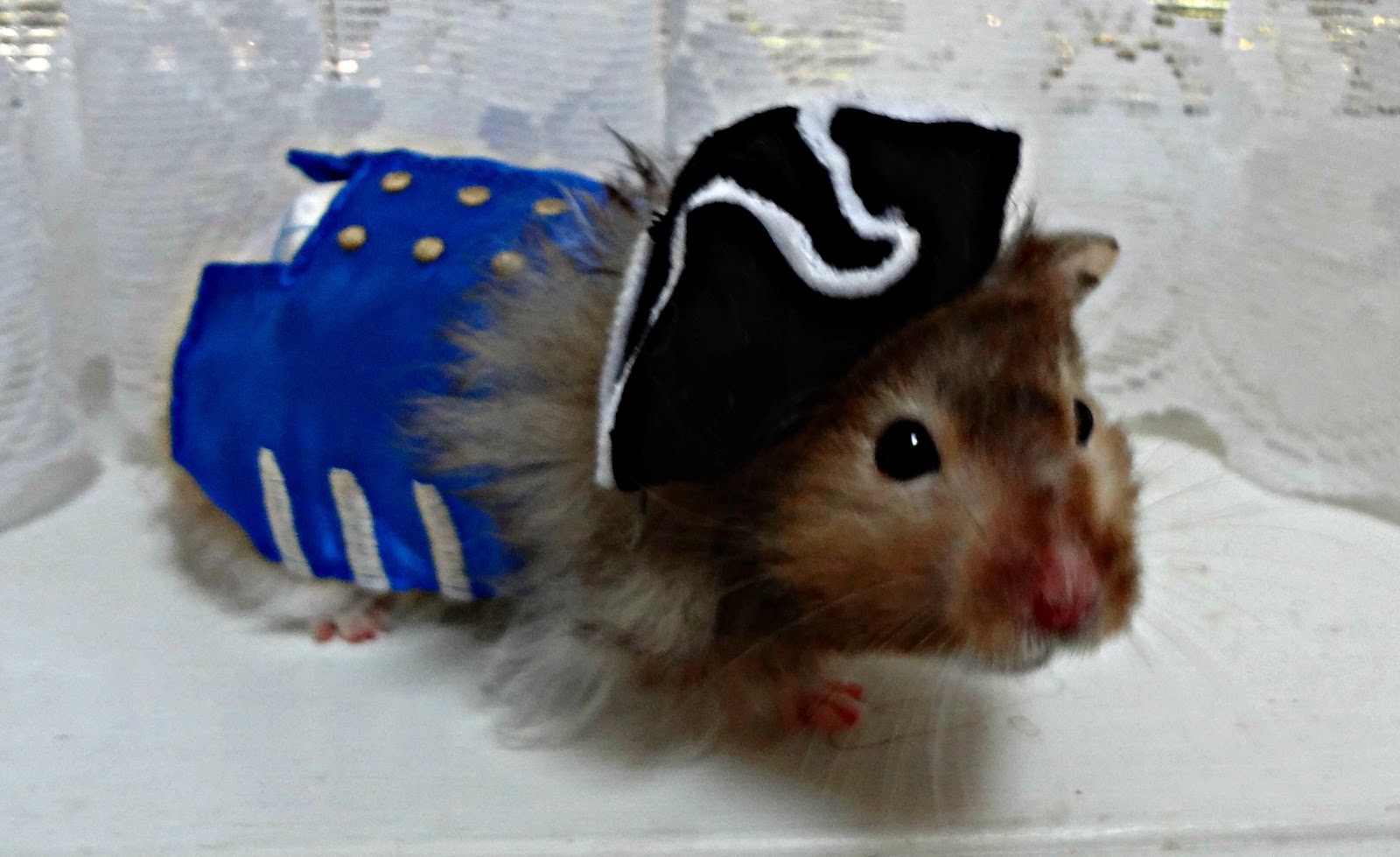
Today is National Dress Up Your Pet Day. In high school, one of my good friends had an Irish Setter.For every project Carol (my friend) had to do, she always managed to sneak in pictures of her Irish Setter in costumes—sunglasses, hats, ties—and our class LOVED them. And the teachers received them well too! (Of course, it didn’t hurt that Carol was the Superintendent’s daughter…LOL)So without further ado…some of my favorite pictures…please add you own!































































 Sew Colorful