
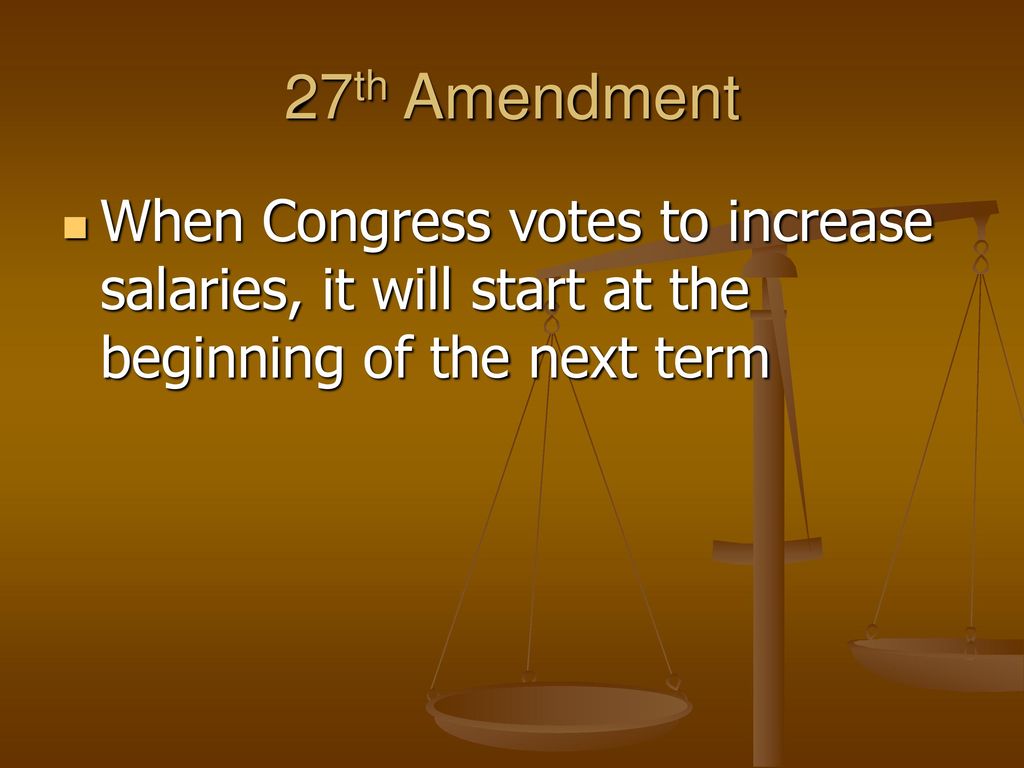
This amendment, limiting the extent to which Congress could raise their salaries, was nearly 200 years in the making.
FROM: ARCHIVESFOUNDATION.ORG:
(Very) Early Origins
The text of the 27th Amendment reads: “No law, varying the compensation for the services of the Senators and Representatives, shall take effect, until an election of Representatives shall have intervened.”
The issue of lawmakers’ salaries was quite contentious during the Constitutional Convention. The framers held competing visions about the extent to which congressmen should be paid, if at all. One of the most vocal opponents to congressional pay altogether was Benjamin Franklin.

Franklin argued that public servants should work without pay, believing that they should be virtuous in their commitment to governmental service. Ultimately, his view was on the more extreme end and did not make its way into the draft constitution. While representation in the early iterations of Congress was still quite limited to white landowning men, the provision for a salary at least opened the opportunity to more than the wealthy.
While the inclusion of compensation was eventually agreed upon, many framers and the general public still worried that people would greedily enter public office to enrich themselves. James Madison foresaw the complication of allowing Congress to adjust its own salary without some guidelines. He also worried that having the President control congressional salaries could lead to bitter politicking and corruption.
In 1789, Madison and other framers submitted 12 amendments to the U.S. Constitution to the first Congress. The first 10, known as the Bill of Rights, were fully ratified in 1791. The congressional pay provision, however, was only ratified at the time by six states. Because there was no time limit on ratification, what eventually became the 27th Amendment lay dormant for nearly two centuries.
An Unexpected Voice for Change
Gregory Watson was a sophomore studying political science at the University of Texas at Austin in 1982. In a class on constitutional law, students were asked to write about constitutional change and process. Watson’s paper argued that since time limits on ratification were not enumerated anywhere in the Constitution, the congressional pay provision was still “live” and thus could be ratified and implemented.
While Watson received a grade of C for his argument, he did not let that stop his momentum. He initiated a letter-writing campaign to various state legislatures in the hopes of closing the loop on ratification. Starting with Maine and Colorado, states began ratifying the amendment. Watson’s movement gained quite a bit of traction and media attention nationwide.
By 1992, three-quarters of the states reached the necessary consensus as laid out in Article V of the Constitution to legitimize the 27th Amendment. For the first time in history, the Archivist of the United States certified the amendment.

Concerns were raised about the legality of the ratification process after its passage, since the first six states signed on in the 18th century. Some scholars interpret the process of ratification laid out in Article V as needing to be a simultaneous event, with state-by-state ratification taking place within a short time span. This is in sharp contrast to the elongated timeline for the 27th Amendment. The Speaker of the House at the time even proposed litigating its legitimacy until it was clear that the provision had gained widespread popularity among the general public.
The amendment process is an important cornerstone of checks and balances inherent to our democratic system. During every two-year term in the House of Representatives, members of Congress typically propose about 200 amendments, although few ever make it out of committees. Despite its unusual path to ratification, the 27th amendment’s saga is the realization of the framers’ wishes for a participatory and engaged citizenry.
 Sew Colorful
LikeLiked by 1 person
I LOVE STEAK OUTS!!!!
LikeLiked by 1 person
LOL – me, too!
LikeLiked by 1 person
Good old Grade A Nebraska Beef! None better!!!
LikeLiked by 1 person
LikeLiked by 1 person
LOLOLOL
LikeLiked by 1 person
Just The News: “Tennessee lawmakers on Thursday approved a new slate of congressional maps that eliminated the sole Democratic-leaning district centered on Memphis.
The vote of the state Senate sends the bill to Gov. Bill Lee, R-Tenn., who is expected to sign it into law. The legislation followed a Supreme Court ruling that eliminating race-based districts and narrowed the interpretation of Section 2 of the Voting Rights Act.
That decision has triggered a wave of map redraws across the South, including in Florida, Louisiana, Alabama, and Mississippi. Republicans are expected to gain more than one dozen seats from redrawing their maps in this cycle alone.
The Tennessee redraw will only eliminate one Democratic district, but is expected to help give the GOP an edge in the 2026 battle to hold the lower chamber of Congress.”
LikeLiked by 1 person
EXCLUSIVE: Yale Professor On State Department Advisory Committee Accuses Trump Of Waging “Illegal War” Against IranOona A. Hathaway recently published a lengthy anti-Trump rant claiming President Trump violated the Constitution, U.S. law, and the United Nations Charter through military action against Iran.
Laura Loomer, May 07, 2026
EXCERPT: “A Yale Law School professor who has spent more than two decades advising the U.S. State Department on international law is now publicly accusing President Donald Trump of waging an “illegal war” against Iran while continuing to serve on a State Department advisory committee.
Oona A. Hathaway, a professor at Yale Law School and Executive Editor at Just Security, recently published a lengthy anti-Trump rant claiming President Trump violated the Constitution, U.S. law, and the United Nations Charter through military action against Iran.
Hathaway has served since 2005 on the State Department’s Advisory Committee on International Law for the Legal Adviser at the U.S. Department of State, according to her official biography and federal advisory records.
Her article, published by Just Security, repeatedly attacks President Trump’s authority as Commander-in-Chief and portrays American military action as illegitimate under both domestic and international law.
She described the conflict as a “doubly illegal war” and warned it could become “triply illegal” if military operations continue beyond the War Powers Resolution’s 60-day window. President Trump knows this, which is why he told Congress the war was over before he breached the 60-day window.
Hathaway compares President Trump’s decision-making authority to authoritarianism itself, writing that “democracy… is incompatible with the ‘one man decides’ model,” echoing Democrat talking points that President Trump is an authoritarian. She also labels the U.S. military operation against Iran “a war of aggression,” language commonly associated with left-wing anti-American activists and international tribunals hostile to U.S. sovereignty.
Perhaps most outrageously, Hathaway invokes the United Nations Charter against the United States while serving on a State Department advisory body tasked with advising the U.S. government on international law matters.
Her argument hinges on three claims. First, she argues that President Trump lacked congressional authorization for military action against Iran. Second, she claims the operation violated Article 2(4) of the UN Charter because it allegedly did not meet the standard for lawful self-defense. Third, she argues continued military operations past the War Powers Resolution’s 60-day deadline would render the conflict “triply illegal.”
Hathaway also attacks Defense Secretary Pete Hegseth in the piece for defending the administration’s interpretation of the War Powers Resolution, dismissing the administration’s legal position as “impossible” and “not serious.” Perhaps Hathaway raised her concerns with other committee members, but instead of keeping her views private, she decided to publicly stab President Trump in the back in a media outlet she edits. If that was her motivation, she made a huge mistake.
The issue here is that an individual serving on a State Department advisory committee is publicly accusing the sitting President of the United States of illegal warfare while echoing the rhetoric of global governance institutions that have increasingly targeted nationalist leaders and American allies.
Her rhetoric raises serious questions about whether she supports the growing international lawfare movement against Western leaders. Hathaway’s repeated emphasis on “wars of aggression” and the authority of international legal bodies comes as the International Criminal Court has pursued politically charged cases against Israeli Prime Minister Benjamin Netanyahu, a close ally of President Trump…..”
https://lauraloomer.substack.com/p/exclusive-yale-professor-on-state
LikeLiked by 1 person
yup…sounds like sedition or something. BOOT HER ASS!
LikeLiked by 1 person
we got a notice back from NY about our tax return. they cut it because THEY didn’t adhere to their own printed directions. SO now we have to fight for the rest of our refund. They want to try to tax the interest we earned in PA. stupid asswipes!
LikeLiked by 1 person
Oh, FFS! Those people would fuck up a wet dream!!!
LikeLiked by 1 person
it’s such a pain in the ass. i think they’re betting on people just saying the heck with it. but not us…lol
LikeLiked by 1 person
That’s exactly what the expect! I’m like you – oh, hell no!!!! LOL
LikeLiked by 1 person
Aggiegirl
May 7, 2026 4:11 pm
Well, well, well, the plot thickens…talking about yesterdays info on an Aggie campus in Dallas with 30% of islamic studies going into a degree there….yesterday, I called it appeasement for closing the Doha campus…
…today….it looks like…appeasement or the money gets shut off.
“What I found was quite alarming,” he told The Gateway Pundit. “It turns out Qatar is not just one of Hamas’s biggest financial backers, having poured billions into them, but it’s also one of the largest foreign contributors to American universities.” For example, Texas A&M received $1 billion from its state-sponsored Qatar Foundation.”
“The Qatar Foundation not only awarded Hamas leader Ismail Haniyeh, but it also operates Education City, which comprises a network of international satellite campuses, including Texas A&M Qatar.”
https://www.thegatewaypundit.com/2026/05/concerns-grow-qatars-influence-american-universities-amid-terrorism/
LikeLiked by 1 person
I’ve always thought our relationship with Qatar was ludicrous!!!
LikeLiked by 1 person
RIGHT???
LikeLiked by 1 person
Well then…..I went outside just to water the flower seeds I planted in the south garden bed, then decided the new lilac bush could use some, and the 2 flower pots, then I noticed the leaves built up again around the base of the A/C unit…..next thing ya’ know, I’m spraying off the entire back patio since it was so dirty. Watered the cantaloupe seeds and finally quit. Phew! Built up a sweat since I was still wearing my sweatshirt/pants. Those came off quick when I came inside. Up to 74 outside now.
I hate the semis that keep coming down my road – they’ve been rumbling by all day! The bitch of it is, my road only goes to the county road, which runs up to Hiway 20 and south to Hiway 13. These trucks are coming from the Hiway 20 direction down 4th Street – if they’re taking the branches, tree limbs, etc. to the local dump, they have to go back north again and cross Hiway 20. Then what is the fucking purpose of coming down MY road!!??!! Grrrrrr…..kicking up all kinds of dust!!!!
LikeLiked by 1 person
maybe an accident somewhere?
i haven’t even gotten out to weed the garden yet–it’s so freaking wet!!!
LikeLiked by 1 person
No, I don’t think so. We are dry here, w/o much rain recently.
LikeLiked by 1 person
Huh….well, that was weird…..how the heck did the State Department get my e-mail address???? They’re on Substack now….
“Views of America”
StateDept, May 07, 2026
Author: U.S. Secretary of State Marco Rubio
EXCERPT: “On March 31, 2026, Rizzoli released Views of America: The Diplomatic Reception Rooms at the U.S. Department of State, a richly illustrated volume celebrating the fine and decorative arts housed in 42 rooms at the Harry S. Truman building in Washington D.C. These rooms, which are open to the public, are home to a significant yet little-known cultural collection.
Many of the objects in the Diplomatic Reception Rooms were created, owned, and used by the men and women who dreamed of self-government and who made independence a reality. The collection reflects the pride, craftsmanship, and spirit of 18th- and early 19th-century America.
Remarkably, the Rooms and their collection were constructed, amassed, and continue to be maintained exclusively through the private gifts of philanthropic and patriotic individuals. Collectively, they are a testimony to the civic engagement and generosity of the American people and to their desire to advance American diplomacy.
In celebration of the 250th anniversary of the Declaration of Independence and the birth of our nation, Secretary of State Marco Rubio penned the following foreword to Views of America:
Perhaps the greatest architectural symbol of American diplomatic hospitality is named in honor not of a Secretary of State or President but of one of our first diplomats. At first glance, the monumental Benjamin Franklin State Dining Room – with its gold-topped neoclassical columns, expansive and sumptuous carpets in the style of the finest 18th century British country estates, and magnificent views of our capital city – might seem at odds with the homespun reputation of the father of American diplomacy.
But on reflection, besides being an appropriate tribute to an American hero, the room reflects the uniquely American perspective on diplomacy that developed even from Franklin’s vital diplomatic mission during the Revolutionary War, when he set sail for France in the months following our Declaration of Independence two hundred and fifty years ago…..”
https://statedept.substack.com/p/views-of-america
LikeLiked by 1 person
oh wow…maybe you’re being monitored…LOL
LikeLiked by 1 person
Well, that would be the dullest of dull duties for whoever’s doing the monitoring! LOL – it’s probably because I follow quite a few authors on Substack.
LikeLiked by 1 person
THIS is the result of allowing illegals into the country…TB OUTBREAK in SF highschool
https://www.sfgate.com/bayarea/article/tb-sf-private-school-22244806.php
LikeLike
Porch Picture
Dodge still rolling on
Fire in the Sky
Jalopy
Dean was aging better than Frank
LikeLiked by 1 person
cool pix!
LikeLiked by 1 person
Abandoned and Forgotten
Wow – that’s a helluva trout!!!
LikeLiked by 1 person
yuck…fish
LikeLiked by 1 person
Ya’ gotta admit – it’s pretty! LOL
LikeLike
“It’s 1779. Somewhere outside Paris. A crowd gathers at the edge of a fenced field. Torchlight flickers across their faces. Inside the perimeter, men with muskets pace back and forth. Armed guards. Hired. To protect potatoes.
You read that right. For decades, French peasants wouldn’t touch the lumpy tubers. Why? Rumor said potatoes caused leprosy. Your neighbor grows them? Stay away. Your soup has one? Throw it out. Then came Antoine-Augustin Parmentier – a pharmacist who’d survived on potatoes as a prisoner of war. He knew the truth: this ugly vegetable could stop famines cold.
But knowledge wasn’t enough. He needed drama. So he planted a field. Not huge. Unremarkable soil. Then he did something strange: he ordered guards to protect it day and night. Official-looking. Very serious. Locals stared. Why guard ordinary food?
That’s when Parmentier whispered to his men: “Accept small bribes. Look the other way… after dark.”
Within days, people snuck past the sleepy guards, dug up the “forbidden” tubers, and smuggled them home. They’d stolen what they once feared. By 1795, potatoes covered French fields. Bread riots faded.”
LikeLiked by 1 person
LOL
LikeLiked by 1 person
LikeLiked by 1 person
^^^^^^^^^^^^^^^^^^ this is a pysops. i. DO. NOT. TRUST. FETTERMAN.
LikeLiked by 1 person
I agree!
LikeLiked by 1 person
LikeLiked by 1 person
6942…LOLOLOLOLOL
LikeLiked by 1 person
IKR? ROFL
LikeLiked by 1 person
LikeLiked by 1 person
there’s not a good democrat in the bunch.
LikeLiked by 1 person
Nope
LikeLiked by 1 person
Trump Admin Cuts $11M Contract With Catholic Charities
President Donald Trump’s administration has terminated an $11 million federal contract with Catholic Charities of the Archdiocese of Miami, effectively shutting down their taxpayer-subsidized operation housing and caring for unaccompanied illegal migrant children.
The contract, funneled through the Department of Health and Human Services (HHS), supported the Msgr. Bryan O. Walsh Center, an 81-bed shelter and broader reunification program that has been running for over 60 years. That gravy train is now over. The program will be forced to shut its doors within the next three months.
This is Trump delivering on his promise to end the radical left’s open borders nightmare that turned Catholic Charities and other NGOs into multi-billion-dollar facilitators of the Democrat invasion.
The Miami Herald reported: The Archdiocese of Miami said late Tuesday that Archbishop Thomas Wenski was not immediately available to discuss the contract’s cancellation or the Trump Administration’s rift with the church. But it shared a statement that Wenski, a longtime immigrant-rights advocate, wrote for the Miami Herald’s editorial board.
“The U.S. government has abruptly decided to end more than 60 years of relationship with Catholic Charities in the Archdiocese of Miami,” Wenkski wrote.
“The Archdiocese of Miami’s services for unaccompanied minors have been recognized for their excellence and have served as a model for other agencies throughout the country.”
Wenski added: “Our track record in serving this vulnerable population is unmatched. Yet, the Archdiocese of Miami’s Catholic Charities’ services for unaccompanied minors has been stripped of funding and will be forced to shut down within three months.”
LikeLiked by 1 person
and then there’s this…
Brain eating amoeba found in national parks.
LikeLike
LikeLiked by 1 person
LikeLiked by 1 person
Good night, Pat!
LikeLiked by 1 person
Good Night Filly!
LikeLiked by 1 person
Good Night All!
LikeLike