Eerie Pennsylvania is not about Lake Erie, or the town or the county either. Instead it refers to the WEIRD stuff found IN Pennsylvania. And trust me, there’s some weird stuff! ( I’m saving the creepy, spooky stuff for October though!)
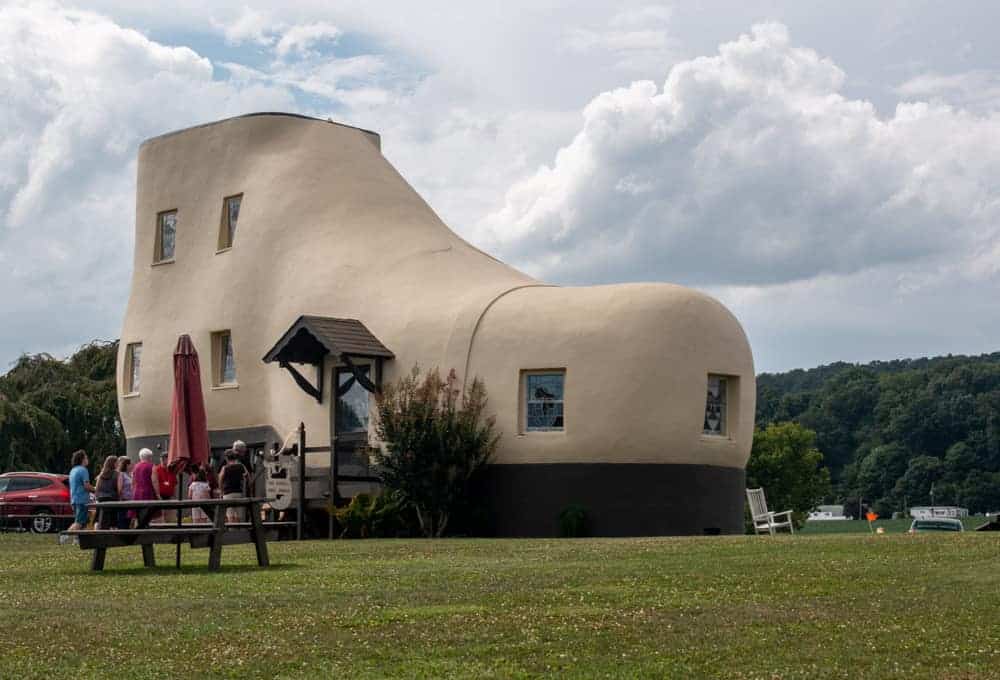
The Haines Shoe House in York
The giant Haines Shoe House
Without a doubt, one of the strangest and most popular roadside attractions in PA has to be the Haines Shoe House. Located along Route 30 east of York, the Shoe House has been drawing curious stares since it was completed in 1949. The Shoe House was built as an advertisement for a local shoe company and never served as more than a temporary residence. Today, it is open for tours, which offer the chance to learn more about this amazing oddity.
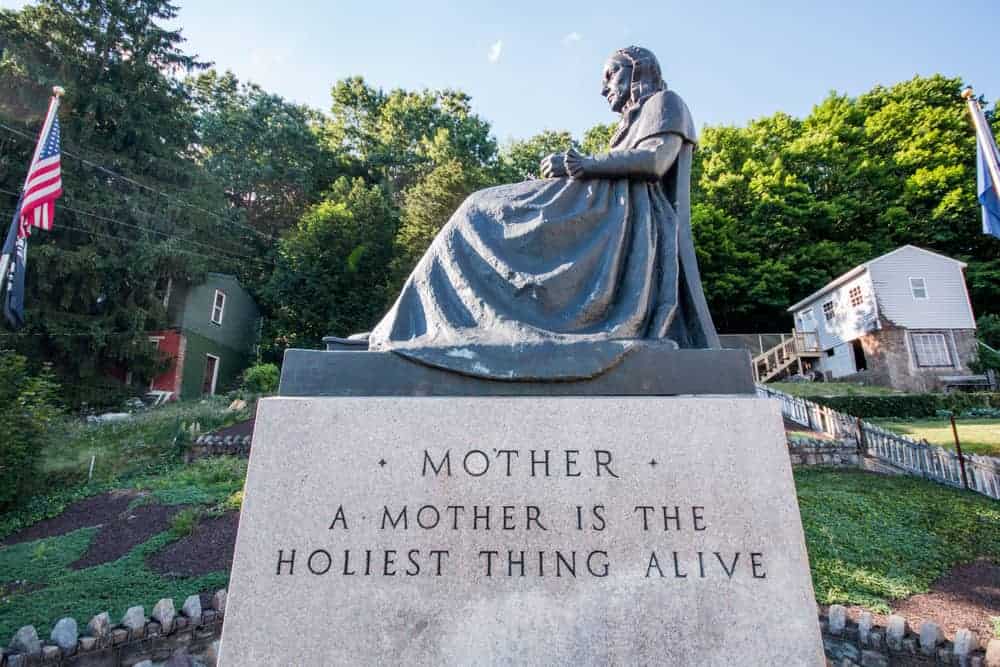
Whistler’s Mother Statue in Ashland
Enchanting, isn’t she?
Located in Ashland, PA, which is better known as the gateway to Centralia and the home of the Pioneer Coal Mining Tour, the Whistler’s Mother Statue is well worth a quick stop. Known officially as the Mother’s Memorial, it was designed to appear like like 1871 painting “Arrangement in Grey and Black: Portrait of the Painter’s Mother” by artist James McNeil Whistler. The statue was completed in 1938 by the Ashland Boys Association to honor the mothers of the world. The statue is very stark and appears rather humorless and severe, which is quite different from how we typically picture mothers today. The phrase “A mother is the holiest living thing” appears on the statue. It claims to be the only statue dedicated to all mothers in the country.
Flying Saucer in Mars
With a name like Mars, you gotta have a flying saucer somewhere in town!
A miniature flying saucer might seem out of place in western Pennsylvania, but when the town’s name is Mars, it almost seems logical. That’s right, in a small park in the center of Mars, Pennsylvania, is a small UFO statue. The flying saucer stands three feet tall and is six feet around. But what it lacks in imposing height or intergalactic history, it certainly makes up for in humorous curiosity. While visiting the town, take a few minutes to walk around and notice some of the humorous Mars stores, such as “Mars Travel” or “Mars National Bank.” The Flying Saucer in Mars, Pennsylvania, is located at 100 Pittsburgh St., Mars, PA 16046.
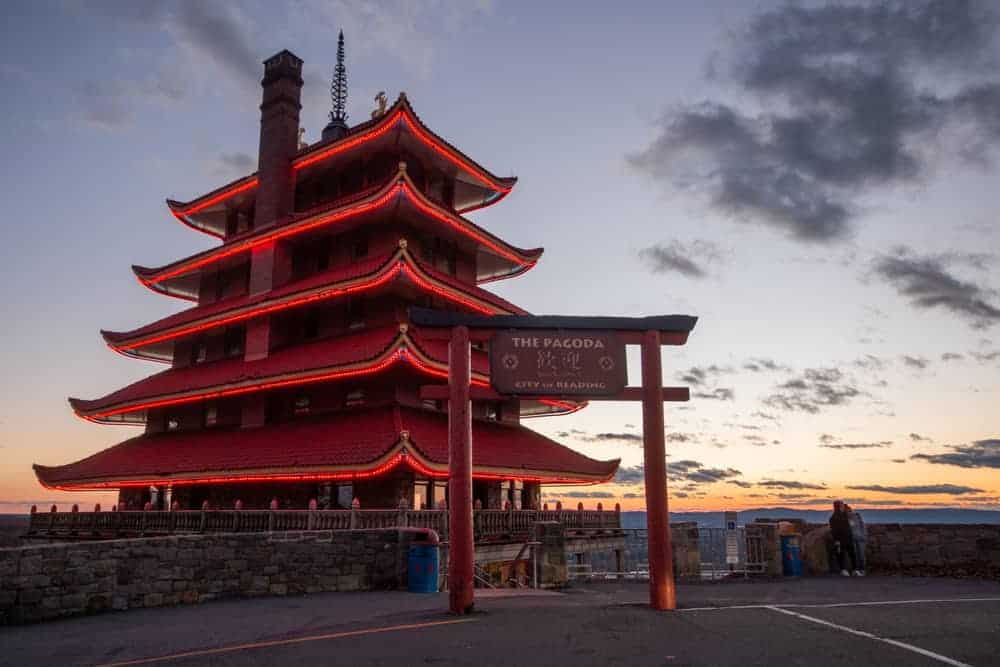
The Reading Pagoda in Reading
The Reading Pagoda is a beautiful and odd spot in eastern PA. Located high atop a hillside above Reading, Pennsylvania is a curious sight. The Reading Pagoda is a Japanese-style pagoda that was built at the beginning of the 20th century and was planned to be one part of a resort that would site on the top of Mount Penn. However, the rest of the resort never came to be. While the Reading Pagoda can be seen from throughout the valley below, you can also drive right up to it and enjoy breathtaking views of the surrounding area. Visiting in the evening offers the chance to see this amazing spot lit up at night.
Sherman Memorial Lighthouse in Tionesta
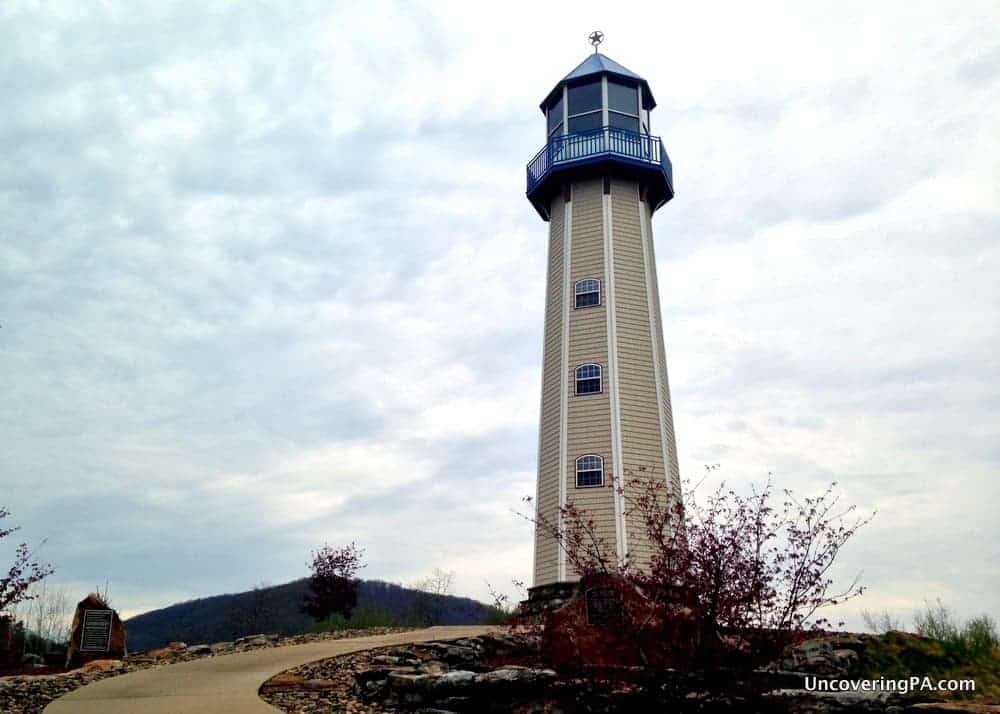
Towering above the small borough of Tionesta, in the middle of Forest County, rises the Sherman Memorial Lighthouse which serves absolutely no significant purpose. In fact, the lighthouse is located roughly 60 miles from the closest navigable body of water, Lake Erie. The 75-foot tall lighthouse was completed in 2004 and was built by local Jack Sherman as a memorial to his family and to hold his large collection of miniature lighthouses.
The Giant Cowboy
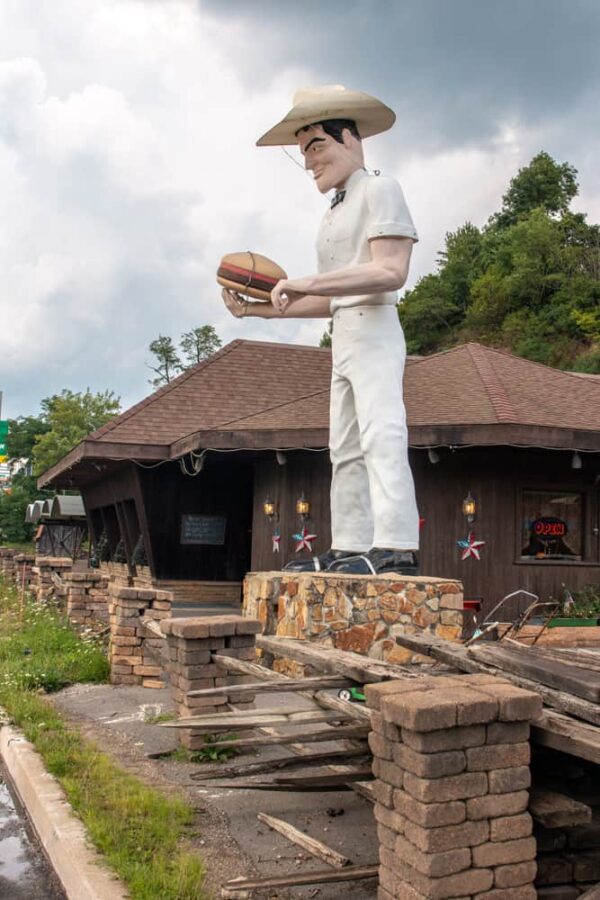
If you are driving along Route 422 just east of Kittanning, you can’t miss another roadside oddity in Pennsylvania: the Giant Cowboy. Located outside of the Cadet Restaurant since 1962, this 30-foot cowboy known as Sam welcomes guests with a giant hamburger in his right hand. Interestingly, Sam was one of many characters made from the same mold in the 1960s. The first was a Paul Bunyan statue that was placed in Flagstaff, Arizona. The statues would be commonly seen outside of car shops holding a muffler and became known as a “Muffler Man.” The Giant Cowboy can be found outside the Cadet Restaurant at the following address: 13514 US-422, Kittanning, PA 16201.
Schaefer’s Auto Art
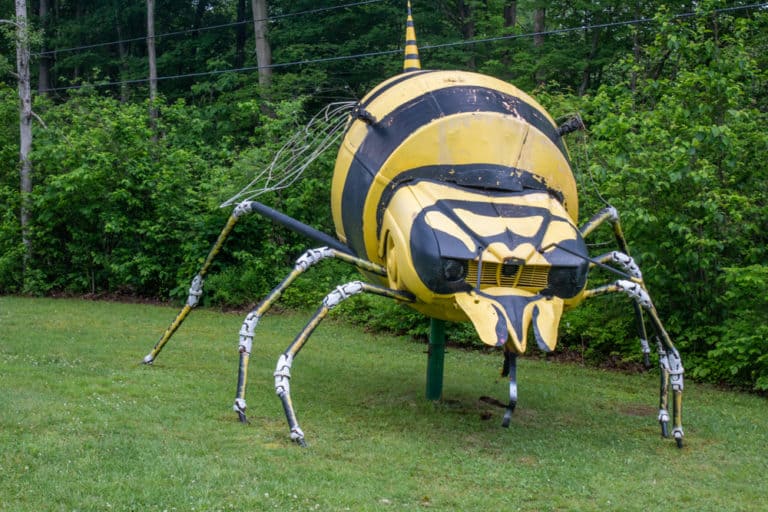
Schaefer’s Auto Art is located a few minutes south of downtown Erie and is the work of local artist Richard Schaefer. Schaefer uses old cars to create interesting sculptures that are well worth taking the time to see. In the front yard of his house, visitors can see everything from a giant bumblebee to a rocket and a two-headed dinosaur. Visitors are welcome to park and walk amongst these strange, but quite awesome creations. Schaefer’s Auto Art is located at 3705 Hershey Rd, Erie, PA 16506.
The Statue of a Hooded Man on the Gallows
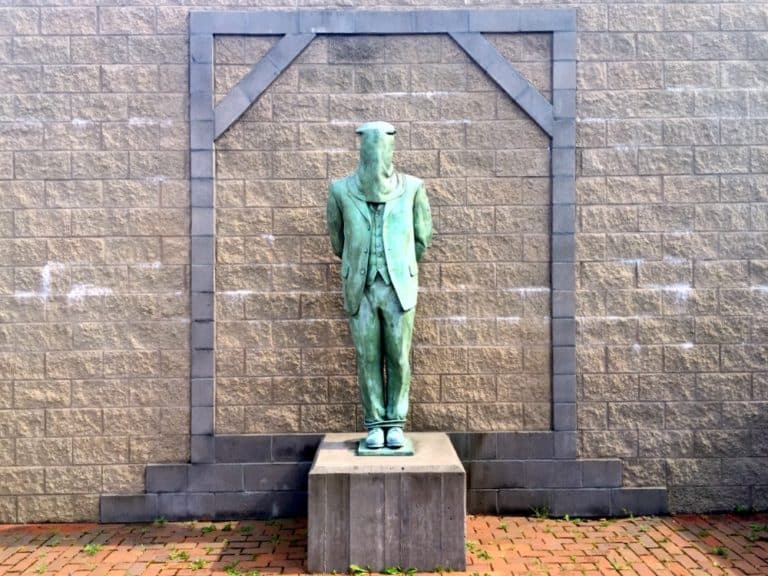
The Statue of a Hooded Man on the Gallows is located in the heart of Mahanoy City and pays tribute to the Molly Maguires. The Molly Maguires were comprised of Irish immigrants that worked in the anthracite coal mines in northeastern PA. In the 1870s, there are labor issues in the mines that threatened to upend the systems that had been created. Whether the Molly Maguires were a real secret society or more of a boogeyman, at least 20 miners were hung in Schuylkill County between 1877 and 1879 for crimes associated with the group. This statue, which is somewhat hidden behind a stone wall (presumably because of the subject matter), is a sad reminder of this history. The statue can be seen at 212 W Centre St, Mahanoy City, PA 17948.
The Pioneer Woman and Child Statue
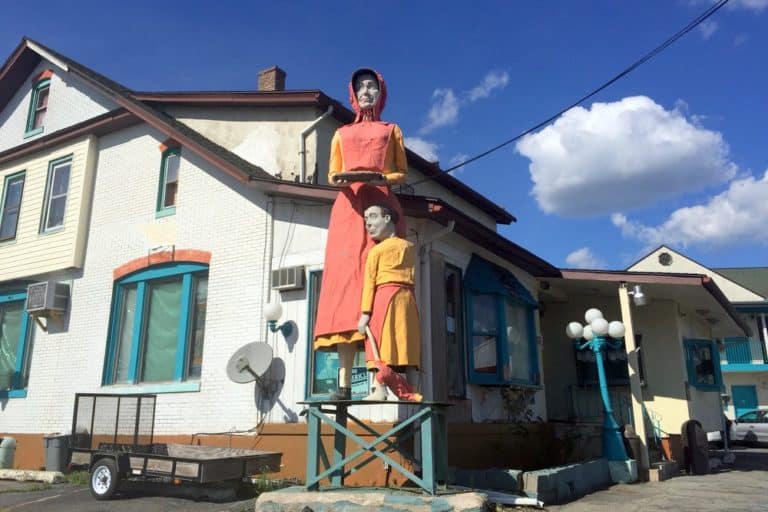
Without a doubt, the Pioneer Woman and Child Statue in Frackville is one of the strangest roadside oddities in Pennsylvania. Located just off of I-81 in Frackville, the statue consists of a 15-foot tall mom in pioneer clothing being clutched by her daughter. While the subject is certainly nice, the actual statue is somewhat disturbing. The large mom is clutching a pie and has a rather odd look on her face. No matter how strange she is, however, it’s nothing compared to her daughter. Standing about half as tall as the mother statue, the daughter is clutching her mother’s leg and holding a giant decapitated doll. The strangest part, however, is the daughter’s head, which would be more appropriate looking on the statue of a middle-aged man. This is simply an odd statue that seems totally out of place in the middle of Pennsylvania’s coal country.The Pioneer Woman and Child Statue stands next to the closed Granny’s Restaurant at 115 W Coal St, Frackville, PA 17931.
Let’s talk about being inspired. Young Jim Bishop in 1959, at the ripe old age of 15, paid four hundred and fifty dollars for a two and a half acre parcel of land enclosed on three sides by the majestic San Isabel National Forest in southern Colorado. It was money saved from mowing lawns, throwing newspapers, and working with his father Willard in the family ornamental iron works. Jim had dropped out of high school that year over an argument from his English teacher who yelled at him “You’ll never amount to anything Jim Bishop!” Ever since he was a boy, Jim was powerfully drawn up towards the mountains visible to the west from Pueblo, and having found a small 2-1/2 acre parcel one weekend on a bicycle journey with some friends, convinced his parents to buy it for him with his money.
So Willard and ma Polly signed for the land deal which Jim wasn’t even old enough to do himself, and the family now had a heavily forested two and a half acres at 9000 feet. Jim and his dad spent the next ten summers camping out on the land and doing the groundwork for a family cabin on the site. Setting the stage for what was to come, Jim soon learned that he really enjoyed swinging an axe and wielding a shovel or pick in building their clearing with a drive up to it, which is now the court-yard between the family cabin and the castle itself with it’s driveway.
It was in 1967 that Jim and Phoebe got married, a union they still enjoy to this day, and in 1969 at the age of twenty-five, Jim decided it was time to start building a cabin in the mountains they so loved. Since rocks were plentiful, everywhere, and free, he chose to start building a one room stone cottage…
NOTE: Stock photo – The Bishop cabin had windows on all sides and big double doors in front. When they left the door open, the hummers would sometimes fly in – the hummers got so familiar with them that when they wanted to leave and the door was closed, the would hover in front of the door until they opened it for them. They also had chairs that were tree stumps, with the seat hollowed out.
Snow doesn’t melt completely at 9000 feet usually until the middle of May, sometimes even into June, so the summer building season is a short one. Jim started building his cabin, and after a while Jim and Willard started trading off two week stints, one at the shop running the business and one up the mountain working on the family cabin. This lasted until the late spring of 1971, when the problem of getting running water into the cabin arose. Willard suggesting putting in a large metal tank that he had salvaged from a welding job to be a gravity fed cistern. Jim thought it’d be functional, and construction began on the water tank. It is a 40 foot metal cylinder which Willard surrounded with stonework.
Jim continued to build his cottage, and the walls grew. Throughout the summer, family friends, a couple local ranchers, and even some family members commented that it looked like they were building a castle! “Hey Jim! That looks like a turret or something!” “What are you building, a castle?!”
Jim heard that enough times that by the time late spring 1972 rolled around, his imagination had been stirred something fierce, and Mr. Jim Bishop started telling friends and family that he was in fact going to be building a castle! When Willard first heard this, he stated as a matter of fact that castles tended to be pretty huge and that he wasn’t going to have anything to do with it! “That’s just too much work!” Jim kept right on building, and the construction that began as a one room stone cottage with an Eiffel Tower shaped fireplace gave birth to this country’s, and maybe even the world’s, largest one man project – The Bishop Castle.
It Just Keeps On Growing! As the castle grew, so did word of the guy up in the mountains who was pursuing the American Dream – to be King of your own Castle! People came to visit more and more often, and Jim would often be asked if he wanted help building his castle. For the first eight years, the answer was always Sure! And in those eight years, not a single person ever kept their word and showed up to help. In a fit of cynical frustration, Jim vowed that “By God, I’ve gotten this far by myself. If you’re going to do something right, do it yourself!” So like the castle itself, the idea of the castle being a one man project was born in the process of the doing and was not an original intention or a childhood dream like many people think. And he kept building. And building. And the Bishop Castle grew…
Other Discoveries Along the Way
Many of the features of the Bishop Castle were discovered intuitively or stumbled upon as the building unfolded. In the process of the castle building, Jim discovered that he also really enjoyed building his body too. He even set up an old army wall tent in the clearing, where he would workout with weights for a couple of hours in the evenings after having built with stone and mortar all day! As he became increasingly involved in the weight lifting regime physically, he also discovered that realm of mind where his principles in building could also be applied to his life – balance in everything! This became an ideal he strove for in this proving of himself, through his stonework, his body, and in his mind. It was through this approach that Jim soon realized that he would find himself completely visualizing what he could build next and how it would all fit together on such a large scale.
There are no plans, blueprints or drawings other than the one Jim did to illustrate his book “Castle Building from my point of view”. The more Jim experienced how certain features lined up or fell into place is when he started suspecting that maybe something “more” was going on, that maybe it was the Creator of All Things working through him in this magnificent endeavor that seemed to have a spirit of it’s own. Jim started describing the Bishop Castle as “Built by One Man with the Help of God.” There’s really no other way to explain it!. And it kept growing…
Feats of Strength
In order to pursue the totality of what he could visualize, Jim employed anything and everything that was available to him. He had apprenticed and then mastered with his father in the family’s Bishop Ornamental Iron shop welding and scroll bending and learning how things fit together for most of his life. Jim did everything – hauling rock from the state highway ditches, felling timber and then milling it into lumber, building railroad ties into forms for his arches, (he’s used the same form over and over), building scaffolding as he went. He hand dug holes up to 12 feet deep for the foundations, mixed all his own mortar, carried it, usually up, to wherever he was working, created and rigged complex systems of pulleys and come-alongs to hoist such things as tree trunks for the floor supports, and, stone by stone, his dreams were being made manifest. Jim handles each and every stone in the castle on average of SIX TIMES before it rests in it’s final configuration in this massive re-organizing of the scattered granite in the Rocky Mountains into the form of the Bishop Castle.
Structural Ornaments
The beginning of the square tower on the south side of the main keep saw the first massive use of ironwork in the construction. Up until then Jim had incorporated his ironwork as window frames, stairs, and the purely ornamental. Now his use of iron and steel became structural, with a core frame for the tower starting from it’s foundations. The rock work formed around this base and created such strength that Jim had no fear contemplating the heights that the tower might one day climb to. Wooden forms soon gave way to ornamental iron forms in the arches of the second floor, some of the most incredible examples of precision geometry found in the castle. And the most magnificent feature of all, the inner roof support trusses and the main central arch which are so detailed, yet so massively functional that they boggle the mind. Everywhere one looks something will boggle the mind, such as the fact that the hand railing going up the S.W. corner, named Roy’s Tower, with all of it’s bizarre twists and turns, was hammered cold into it’s highly custom shape!
Perhaps the water cistern is contained inside of this tower.
The Dream Defined
Over the years as the castle grew, more and more people heard about this phenomenon up in the mountains and began showing up in increasing numbers. Friends told Jim that he should be making some money off what was becoming an attraction! Jim felt differently though – he hated it when he was a kid and couldn’t go to the zoo or the ballpark because admission for the whole family was too high for a bunch of working class folks. Since the original idea for a castle came from people visiting the property, Jim figured that if people were welcomed onto the property FOR FREE then he could put out a donation box and people could put in there what they felt comfortable putting in there. The honor system would be the financier! This increased Jim’s feeling of the castle truly being a place of American Freedom. He felt like he worked hard enough down in Pueblo to support the family that he would build as much as the visitors provided for. This has frustrated him at times over the years, wanting to build larger items such as an elevator and not having the funds to do so, but he feels so strongly about the dream being kept intact that he’s even written into legal documents that the Bishop Castle will always remain free as long as it stands. This belief in America being a Free Country made up of Free Persons has fueled his passions in building the castle to represent the American Dream in an undeniably tangible and awe inspiring form!
Enter The Dragon
In the mid 1980’s, a friend of Jim’s was driving a truck full of discarded stainless steel warming plates from the Pueblo County Hospital to the landfill. He decided that Jim could probably put this motherload of expensive stainless steel to better use than the dump could, so dropped it off at the Bishop Ornamental Iron Shop instead. Jim spent the winter building a chimney out of the steel, riveting thousands of hammered “scales” that he had cut out of the plates together around a steel frame. The dragon was completed in the spring and Jim hauled it up the mountain to tackle the daunting task of raising and installing this incredible sculpture to where it rests today, perched off of the front of the Grand Ballroom eighty feet in the air! Later came the addition of a burner from a hot air balloon (that was donated!) which Jim put in the back of the dragons throat, making it a true Fire Breathing Dragon!
Unimaginable Heights Reached
Jim is often told that he must not be afraid of heights! The way he figures it, he began at the bedrock base of the earth and has been gradually building up, so gradual that as the height grew, he was as comfortable with it as with being on the ground. Jim’s experience with the castle has been so intimate, (he’s held EVERY SINGLE STONE IN THERE ON AN AVERAGE OF SIX TIMES), that he’s grown stone by stone as well and doesn’t mind the heights at all. In 1994 Jim reached a point with the square Andreatta tower, named after the family that donated the old school bells that hang in it, where he felt satisfied that it was high enough. That didn’t last long, as in 1995 he built and installed a thirty foot tall steel steeple on top of the masonry, taking the total height to roughly 160 feet! That’s about the size of a 16 story building! Jim has remained satisfied with the overall height of his castle to the present, though he’s recently been threatening to build one of the corner outer wall towers to 250 feet because a local zoning official told him he couldn’t build over 25 and he just added a zero.
Ballroom inside Castle
As It Stands
Today’s visitors to the Bishop Castle will find an impressively monumental statue in stone and iron that cries loud testament to the beauty and glory of not only having a dream, but sticking with your dream no matter what. Most importantly, that if you do believe in yourself and strive to maintain that belief, anything can happen! Three full stories of interior rooms complete with a Grand Ballroom, soaring towers and bridges with vistas of a hundred miles, and a Fire-Breathing Dragon make the Bishop Castle quite the unforgettable experience! Visitors are always welcome FREE of charge, and the castle itself is always OPEN. Please respect this trust and honor while visiting!
Passing motorists on highway 322 or the combined 11 and 15 just outside of Harrisburg might notice something odd atop an old railroad bridge piling in the middle of the Susquehanna River. In the few fleeting seconds that it’s visible from either road, it can elicit an almost confused feeling. I’m sure the words “Was that the Statue of Liberty?” have been uttered more than a few times by those driving by.
In fact, it IS a replica of the Statue of Liberty. The unique replica of the Statue of Liberty stands in the Susquehanna River in Dauphin County. She currently rises 25 feet from an old bridge piling in a section of the Susquehanna River known as the Dauphin Narrows. “Of all the replicas across America, it’s one of the larger ones,” says Gene Stilp, who also believes his statue has the best location. The original was erected in 1986 and constructed from fiberglass and venetian blinds.
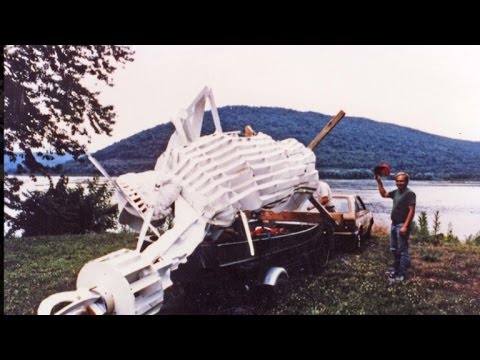
The inception of the statue was veiled in secrecy, only known by a few local men in Dauphin. The idea was the brainchild of Stilp, a non-practicing lawyer and engineering hobbyist. He drafted plans and began construction of the statue using plywood and venetian blinds in a friend’s garage. Upon completion, Stilp gathered a few of his friends whom he could trust with his secret, and on the night of July 1, 1986, 12 men set out to put their Lady Liberty in her place.
One of the men, safety coordinator Steve Oliphant recalls, “I was concerned about taking a bunch of knuckleheads with a 450-pound statue out into the Dauphin Narrows. It can get dangerous out there.” With only a few small boats, Stilp and his men paddled out onto the Susquehanna to the old Marysville Bridge piling. “We were 32 feet in the air, and it was pitch black, and we had to be very careful,” mused Stilp. Using only ropes and their combined man power, the men hoisted the 450 pound construction up the 30 feet to her perch. The men then convened over pizza and beer, not knowing they had sown the seeds of local legend.
Only meant to last for a few weeks, the first statue stood until 1992 when a series of storms forced her removal.
Six months of construction later, a four-ton replica of Lady Liberty was airlifted to the stone pedestal from which she had fallen five years earlier. This new statue, constructed of metal, wood, and fiberglass with a polyester finish cost an estimated $33,000 to complete. It was a triumphant moment for the people involved and the surrounding communities, with over 100 spectators watching the event. The statue was met with applause and cheers as it was secured into place. This small Pennsylvania town had its landmark back. “I knew we were going to get it done, no matter what the naysayers said. I’m not a sculptor; I’m just an amateur who is winging it,” Stilp said.
Stilp’s creation remains to this day. She endures freezing temperatures and howling winds, the baking sun and violent storms. Stilp is still involved with the statue, organizing a cleanup every few years that draws large numbers from the community. “It’s a tough time for America, so it’s nice to have a reminder of what people will do together. Everyone coming out and helping out. That’s a community,” said local songwriter Alex Kaschock.
Construction of The Great Wall of China doesn’t take a few days or months, “China Long Wall” has a very long and exciting history — more than 2,300 years. It has different sections that were built in various areas of China by different dynasties. The primary motive of its construction was to protect different territorial borders from Mongols and other invaders. Another reason was to make the Silk Road a safe and secure trade route to flourish the economy of the state.
Qin Dynasty and The Great Wall of China:
When we jump into the defense history of China when the land was divided into multiple kingdoms the northern borders were being protected by small walls even before the idea of a grand wall. During the period of Qin Shi Huang who was the first emperor of a unified China and his dynasty was known as the Qin dynasty the idea of a single and strong wall with multiple surveillance booths was presented. The idea got approved and previously built small walls were demolished to create The Great Wall of China. The idea was to construct a strong 10,000 li long wall (a li is about one-third of a mile) with bricks and after small distance lookout towers would be created for guards, these towers were also supposed to give strength to the wall.
General Meng Tian initially directed the project and gathered a labor force. The people who participated in construction were mostly soldiers, the rest of the force consisted of convicts and commoners and rebels. During the construction of the Great Wall of China, many of the workers died due to work overload, weather conditions and lack of food and other survival resources.
Great Wall of China After the Qin Dynasty:
The wall didn`t serve the purpose of its construction well and the internal affairs of the country didn’t allow its people to focus on it much. So after the death of Qin Shi Huang, the Qin Dynasty fell and much of the Great Wall parts too fell into disrepair.
The locals tried to maintain some part of the wall but they couldn’t be that effective and after the downfall of the Han Dynasty, frontier tribes took the control of northern parts of China. Among those tribes, Northern Wei Dynasty was powerful and the need for safety alarmed them once again. Under the supervision of the Wei Dynasty, the wall was repaired as well as extended to ensure the safety of other tribes as well.
Later the Bei Qi Kingdom commanded to repair some part of the Great Wall of China. Their repair activities were for 900 miles. In times of Sui Dynasty repair and extension of the wall took place again and again. It was the last dynasty that gives the Great Wall of China as a fortification value.
When the Tang Dynasty raised The Great Wall lost its importance because China defeated the Tujue tribe to the north and long-drawn-out past the original northern border protected by the wall. Later came the era of the Song Dynasty and once again state security had a threat from external forces. At that time Liao and Jin peoples from the north side were trying to take over both sides of the Great Wall of China and the nearby areas. So once again the wall played a role in controlling the safety concerns not perfectly but too high extent.
In the 1206 Yuan Dynasty which was established by Mongols, mainly Genghis Khan who conquered China and some parts of Asia and Europe. eventually controlled all of China, parts of Asia and sections of Europe. The Great Wall of China became a center to control security issues and once again the wall started to serve its military fortification purpose. This time Mongols used it for the safety of their dynasty.
Soldiers marched through the wall to guard the borders and the caravans traveling to and from Silk Road Trade Routes.
Wall Building During the Ming Dynasty:
Most of the walls that we see today were not originally constructed by the Qin Dynasty. The time, nature and multiple invasions damaged the original construction of the Great Wall of China. The Dynasties coming ruling the land one after another repaired and extended some parts from time to time.
In 1368, Ming Dynasty took control of China and reconstructed the great wall. It was the time when Chinese culture flourished and the trading system became strong. In the starting period of the Ming Dynasty, the border security and construction of the wall was not among the interests of rulers. In 1421, threats from external forces increased and due to trade reasons the capital of China was shifted to Beijing.
The importance of the Great Wall of China highlighted one more time and the Yongle who was the emperor of that order to rebuild the wall. He took great wall reconstruction as the major defensive stance. The new strategy was to not just construct the wall but also provide suitable facilities to on-duty soldiers and their families so that they can settle properly near the wall. So the current long, standing wall was basically constructed in the Ming Dynasty. Major construction activities started in 1474 and the new Great Wall of China also include temples, pagodas, and bridges. Later the wall was extended from the Yalu River in Liaoning Province to the eastern bank of the Taolai River in Gansu Province. It was also winded its way from east to west through today’s Liaoning, Hebei, Tianjin, Beijing, Inner Mongolia, Shanxi, Shaanxi, Ningxia, and Gansu.
Now the west of Juyong Pass of the great wall is split into southern and northern lines respectively named Outer and Inner Walls. Strategic “pass-ways” (i.e., fortresses) and their gates were positioned along the wall. The Juyong, Darma, and Zijing passes are closest to Beijing, were called the Three Inner Passes, while the added side west was Yanmen, Ningwu, and Piantou, the Three Outer Passes.
All these six pass-ways were heavily garrisoned during the Ming Dynasty period and considered vivacious to the defense of the capital.
Mid-17th Century and Great Wall of China:
In the mid-17th century, the Manchus invaded China from central and southern Manchuria and broke through the Great Wall. They encroached on Beijing and the war evoked that eventually forced the fall of the Ming Dynasty. The Manchus established the Qing Dynasty.
The Qing Dynasty didn’t consider the Great Wall of China as a fortification for the security of their borders. But between the 18th and 20th centuries, the site of the Great Wall appeared as an emblem of strength and modern defensive approach of the Chinese nation. It is not just a wall created by emperors; it is now known as a manifest to showcase the strong historical connection and struggle of the Chinese nation. On the other hand, it psychological represents a barrier to deter foreign cultural, physical and other kinds of influences and exert force over its citizens.
Great Wall China Today:
As now China is a socialist democratic state so the look-after and maintenance of the Great Wall of China is the responsibility of the ruling government. Now the wall is considered the most impressive architectural wonder of human history and is also one of the most visited tourist destinations in the world.
In 1987, UNESCO designated the Great Wall of China a World Heritage site. In the 20th century, the state claimed it to be considered as the only man-made structure that can be seen from the moon or space. UNESCO considered the pledge but now the scientists claim that it is not true that the China wall can be seen from the moon. However, in the world maps and satellite pictures people can easily trace the Great Wall of China because of its continuously running miles and miles long.
Over the ages, roadways and small bridges have been cut through the wall or to connect different ways to the wall in various points. Whereas after centuries of negligence many sections have also deteriorated. Approximately 30%+ sections have deteriorated till now.
On the other hand, some sections were reconstructed and some are maintained regularly. In 1950s last major rebuilt was observed at the best-known section of the Great Wall of China. This section is known as Badaling and is located 43 miles (70 km) northwest of Beijing. Every day hundreds of foreign tourists visit this section particularly.
I don’t know about you, but I love that first cup of coffee in the morning! The hot, bring-me-back-to-life liquid makes getting out of bed in the morning well worth it! No one, and I mean NO ONE makes a better cup of coffee than my husband. This is not up for debate.
That being said, I have often wondered what makes a great cup of coffee? Is it the beans, freshly ground? (Hubby’s does not use those.) Is it an expensive crap-o-chino machine? (Hubby uses a Mr. Coffeemaker.) I believe it’s the perfect blend of coffee beans and water (that perfect ratio IS apparently a HUGE secret…lol) AND atmosphere. The house is warm and cozy and the views are spectacular!
looks too complicated
If i had to venture outside the house to buy a cup of coffee, what might i look for? A good name, I expect. Starbucks does not convey good coffee taste to me–nor does Dunkin Donuts–McDonald’s? forget about it! Okay, maybe atmosphere would be a better choice to lead me to that perfect cup!
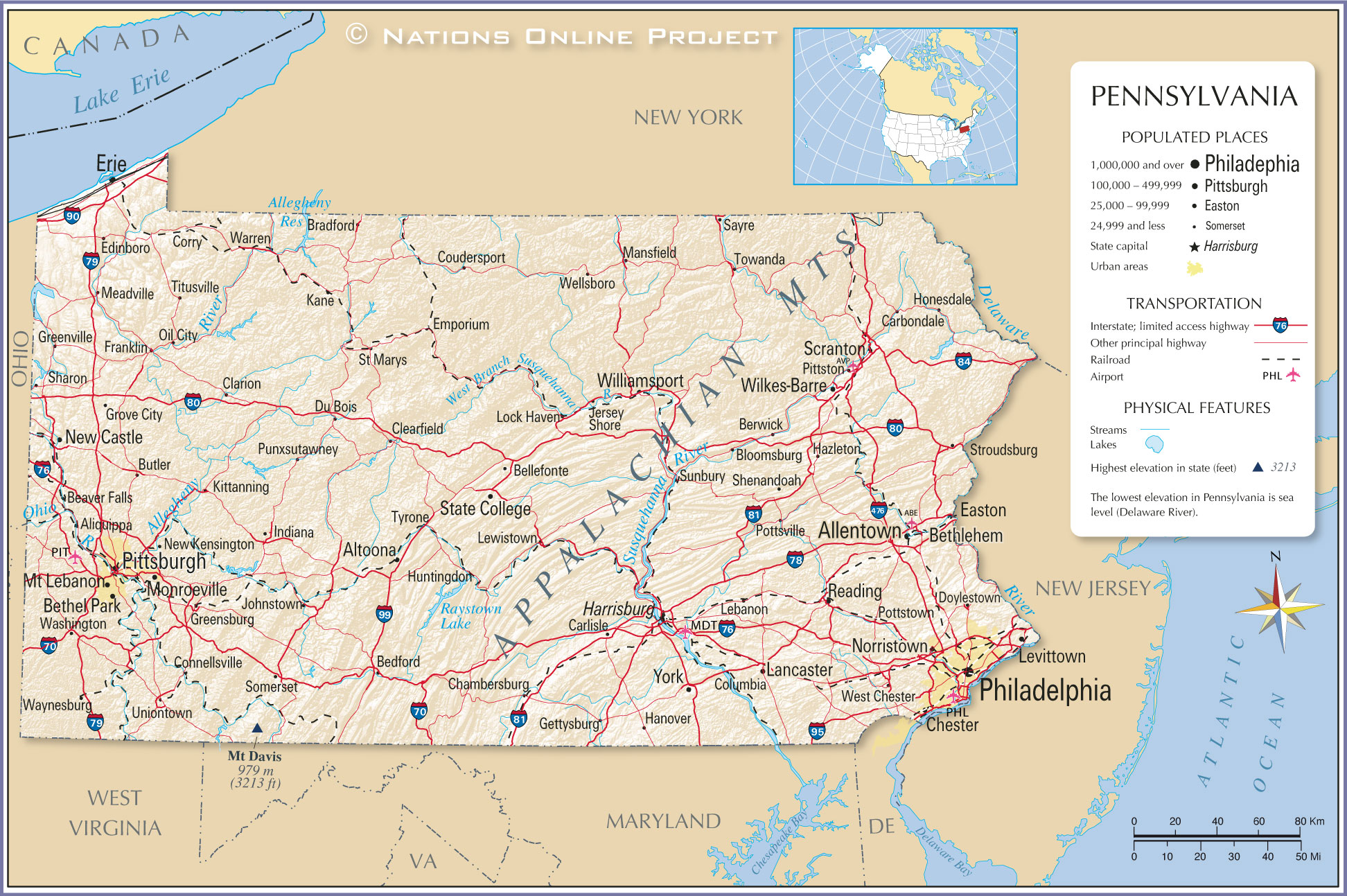
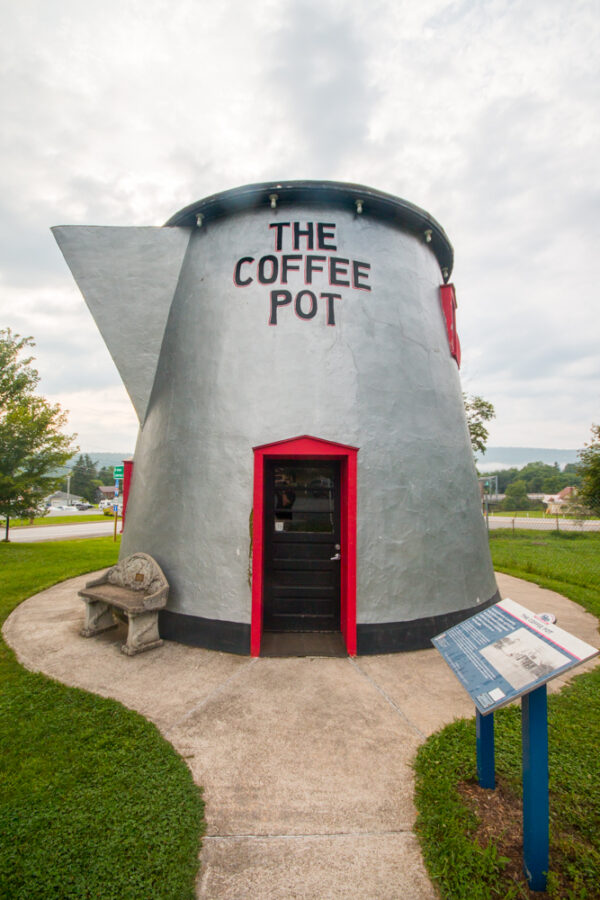
So I went looking into Pennsylvania travel spots for recommendations on a great cup of coffee. What i found was so much more interesting! I present…The Coffee Pot of Bedford, PA!
The restored Coffee Pot in Bedford, PA
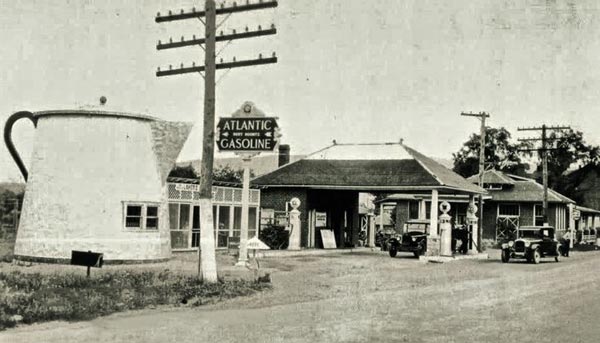
This coffee pot really is giant. In fact, it’s 18 feet tall and 22 feet in diameter, making it big enough to hold over 800,000 cups of coffee! It was originally built in 1927 by David Koontz, a local gas station owner. He constructed the coffee pot of brick and metal sheeting to attract travelers along Route 30 (also known as the Lincoln Highway) to stop at his gas station.
original Coffee Pot
When it was originally built, the Koontz Coffee Pot was used as a small restaurant. In 1937, it became a bar and was attached to a hotel. It also served as a bus stop, but, rather interestingly, it was never a coffee shop.
In the 1980s, the Bedford Coffee Pot was officially closed and, by the 1990s, it was in bad shape and was nearly torn down. Fortunately, the local community came together, along with the Lincoln Highway Heritage Corridor, to save this incredible roadside oddity.
In 2004, the Bedford Coffee Pot was moved across Route 30 to the entrance of the Bedford County Fairgrounds. And, over the years, it has been beautifully restored.
Sad though, never a coffee house. But what a gimmick!
Overall, Nebraska is pretty good at keeping secrets. There are still tons of people who have no idea that ours is a state full of impressive natural beauty and enviable attractions. Even for those of us who have lived here forever, there’s always more to explore and discover…like these 15 places.
1. Kregel Windmill Factory Museum, Nebraska City
This fun museum is all about that most ubiquitous of rural Nebraska sights: the windmill. Kregel Windmill Factory Museum is filled with the machinery and tools that were used to manufacture windmills at the beginning of the 20th century.
2. Florence Mill, Omaha
Just down the street from the Mormon Winter Quarters is the historic Florence Mill, built under the supervision of Brigham Young in 1846. The original mill has been rebuilt and added onto several times over the years, but it contains the only remaining structural components of the original Winter Quarters settlement. Today it’s an art gallery and a meeting space – there’s even a farmers market on the grounds in the summer.
3. Bone Creek Museum of Agrarian Art, David City
This fairly new museum is the nation’s only museum displaying exclusively agrarian art. Bone Creek has received much praise from the art community for its thoughtful, complex, and well-organized exhibits. This is a must-visit for anyone who sees the agricultural life as rich with artistic opportunities.
4. Happy Jack Peak and Chalk Mine, Scotia
Those of you who know and love Happy Jack will be shocked to learn that there are so many Nebraskans who have no idea it exists. This diatomite mine – and the big hill and gorgeous surroundings outside – should be a required destination for all Nebraskans. Read up on its history and plan your own visit on the attraction’s website.
5. The Speakeasy, Sacramento (Holdrege)
Being located in the middle of nowhere, in a town that doesn’t actually exist anymore, doesn’t hurt the Speakeasy’s business at all. If anything, it seems like people are drawn to this mysterious oasis of gourmet food in south-central Nebraska. The formally trained chef brings a creative element to the food that is hard to find in rural areas. Read more about the Speakeasy here.
6. Alpha Omega Labyrinth, North Platte
There are, perhaps surprisingly, quite a few labyrinths in Nebraska. This one, however, was constructed as an Eagle Scout project in 2007. We think that makes it pretty unique. The Alpha Omega Labyrinth is located just outside of the First United Methodist Church in North Platte, and the public is welcome to come walk the path and seek enlightenment.
7. Crescent Lake National Wildlife Refuge, 30 miles north of Oshkosh
The peace that you’ll feel out in the still air on the western edge of the Sandhills is indescribable. This place is truly magical.
8. Old Poor Farm Animal Sanctuary, Dodge County
This farm has a long and fascinating history – you can read all about it here. Today it houses animals that would otherwise have nowhere to go. It’s open seasonally for historical tours.
9. Heron Haven, Omaha
It comes as a surprise to many that there’s such a relaxing, serene natural place within Omaha city limits. The spring-fed wetland sanctuary offers education on conservation and natural history, and of course it’s the perfect place for birders.
10. Terry’s Steakhouse, Virginia
Yes, Nebraska, there is a Virginia – it’s near Beatrice in Gage County. In the extremely tiny town with fewer than 60 residents is a steakhouse that’s definitely worth the drive. Terry’s Steakhouse is a true gem with more than its share of devoted fans.
11. Johnson Lake State Recreation Area, near Elwood
The large lake at this recreation area is surrounded by a relatively small amount of land, leaving the focus firmly on the water. You can camp, swim, fish, and generally just enjoy the outdoors at Johnson Lake, and it’s less crowded than some of Nebraska’s other recreation areas.
12. Museum of Shadows, Plattsmouth
Are you afraid of the things that go bump in the night? This is where they live. This unique museum is the only one of its kind in the Midwest, and it’s sure to delight ghost hunters and paranormal enthusiasts. The Museum of Shadows isn’t just for Halloween; its exhibits are open to entertain and enlighten all year round.
13. Rock Creek Station Historical Park, Fairbury
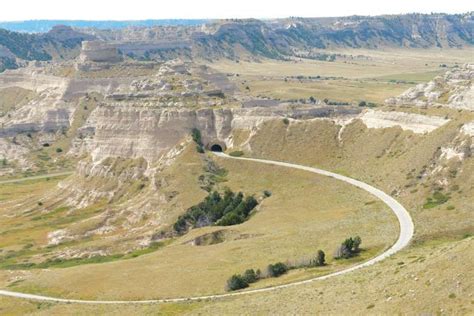
This is one of several places in Nebraska where you can actually see and touch the ruts worn into the ground by wagons on their westward journey on the Oregon Trail. Visit Rock Creek Station in the summer and you’ll see living history reenactments that will really bring the past to life.
14. The Most Unlikely Place, Lewellen
This place definitely lives up to its name; you wouldn’t expect to find healthy food, an organic farm, and a thriving art community out here in western Nebraska, but The Most Unlikely Place delivers them all.
15. The underground missile silo house, near Kimball
Driving past this property may not alert you to the wonder that exists below the surface. An abandoned Cold War-era missile silo has been converted into a large subterranean home with all – ok, most – of the amenities you’d find above ground. Find more information about this unique home here.
Show of hands: is there anyone who already knew about every one of this hidden treasures? How many of them are you planning to visit now?
The National Museum of Roller Skating in Lincoln, Nebraska is home to the largest collection of roller skates in the world, going back as far back as 1819. The museum aims at educating skating enthusiasts from all around the world about the history and evolution of skating as something more than just a hobby.
At the museum, the staff works towards collecting and preserving the enriching past of skating. Along with the biggest collection of historical roller skates, the National Museum of Roller Skating also houses patents, trophies, artworks, photographs, costumes, videos, and any other memorabilia related to the world of Skating.
There are approximately 1,500 books and journals related to roller skating. Among the museum’s most prized collections are the James L. Plimpton (the Father of contemporary roller skating) family collection, Antonio Pirello’s jetpack skates, and pictures of Scott Baio on roller skates.
Panorama Point, Pine Bluffs
The highest natural point in Nebraska, Panorama Point in Pine Bluffs stands at 5,429 feet above the sea level and as opposed to what you may believe, it’s not a mountain or even a hill – it’s just a small rise on the High Plains!
Located on the ground of High Point Bison Ranch, the summit at the Panorama Point has a stone marker and a guest register. There used to be several bison roaming freely in the area as well, but now they remain behind fences. As you reach the Point, vast plains extend in front of you as far as your eyes can see and on a clear day, you can spot the Rocky Mountains in the distance.
As a visitor, pay the nominal entrance fee and if you come across a bison on your way, don’t scare it away.
Old Lincoln Highway in Omaha, Omaha
Originally constructed in 1913 to run between New York City to San Francisco, the Old Lincoln Highway was the first coast-to-coast highway built in the United States of America. Among the 13 states that it catered to, Nebraska’s section of the highway ran between Omaha and Elkhorn.
However, in 1929, after the Abraham Lincoln Memorial Bridge was constructed, the highway was rerouted onto U.S. Route 30 through Blair (a city in Nebraska). After the rerouting was completed, officials from Blair, inhumanely, dug up the markers from the highway section in Omaha and placed them in their town.
Though this resulted in a long-standing resentment between the two towns, it is perhaps also the reason behind this century-old stretch of an old highway to remain so well-reserved.
This three-mile stretch may not remain as crucial as it once was, but it definitely is the longest surviving brick-paved section of America’s first coast-to-coast highway. The Old Lincoln Highway was registered on the National Register of Historic Places in 1984.
Ole’s Big Game Steakhouse and Lounge, Paxton
Established by Rosser O. Herstedt (aka Ole), the Steakhouse and Lounge is not just a simple steakhouse, although it does serve some mean steaks. It, in fact, is a private collection of taxidermy gathered by Ole during his 30+ years as a Game Hunter.
Purchased in 1933, the Big Game Steakhouse and Lounge got its first taxidermy object in 1938, an elk’s head that Ole had killed during one of his many hunting sprees. He traveled the world in search of bigger, better, and rare games and brought home the heads of his catch as a medal to be showcased at the steakhouse. Among the rare collection are giraffes, elephants, moose, and even a full-size taxidermy polar bear, which is also the bar’s mascot.
Ole retired from hunting in 1988, however, new owners kept adding to the collection. Today, over 200 taxidermy mounts, as well as celebrity photos, are on display at the Steakhouse and Lounge and the watering hole continues to attract local hunters to date.
Hudson-Meng Bison Kill, Harrison
In 1954, Albert Meng, a Nebraskan cattleman, decided to expand a historic spring to provide water for his cattle when he stumbled upon bones – lots and lots of them!
Discovered within the grounds of Oglala National Grasslands, the seriously alarming number of carcasses were later confirmed by researchers and scientists to have belonged to over 600 bison from approximately 10,000 years ago.
Meng consulted with his friend, Bill Hudson, an amateur archaeologist, and after digging for almost three years, Meng and Hudson were accredited with unearthing the largest collection of Alberta Culture bison found anywhere on earth.
Though the area was reportedly a hunting ground from the time when Native American tribes inhabited the land, research showed that the bison found at the Hudson-Meng Bison Kill died of inexplicable natural causes.
Once known as the “Great American Desert,” Nebraska is a state situated on the Great Plains region of the United States of America. It is the only state in the nation to be triply landlocked, meaning that one must travel across three other states to get to the nearest body of water.
The state derives its name from the Omaha words Ní Btháska and Otoe words Ñí Brásge, both meaning “flat water.” The state houses 93 counties, split into two different time zones – the eastern part of Nebraska follows Central Time whereas the western part follows Mountain Time.
Did you know that Nebraska’s Lied Jungle rainforest is the largest indoor rainforest in the world? Did you also know that the ‘911’ emergency call system was first used in the capital of Nebraska – Lincoln?
Indigenous tribes such as Omaha, Otoe, Pawnee, and Missouria occupied the state for several thousand years before settlers from Spain and France sought control over the region. Nebraska, the 37th state of U.S., was admitted to the union in 1867. Nebraska is rich in history, geography, and culture yet it is one of the least visited states. Let us explore some of the hidden gems in Nebraska and see what they offer us.
Sioux Army Depot, Potter Founded on March 23rd, 1942 as Sioux Ordnance Depot, the Sioux Army Depot was the only Ammunition Depot of the U.S. Army in Nebraska that was in use during World War II, the Korean War, as well as the Vietnam War. Initially managed by the Ordnance Department, the Army Depot was handed over to the U.S. Army Materiel Command.
The Depot was established with an aim to receive, store, and issue all types of weaponries ranging from small arms to 10,000-pound explosives. The Depot was also responsible for providing all types of automobile parts and other critical materials that may be required by the U.S. Army.
Spread across 19,771 acres of land, the Sioux Army Depot comprised 801 ammunition storage igloos, 392, supportive buildings, 225 residential quarters, 22 general warehouses, 203 miles of road, and 51 miles of rail tracks.
Deactivated in June 1967, the “igloos” are now used by farmers as a storage facility and garage to house their supplies and equipment.
Source: Edwin Verin / shutterstock
Carhenge, Alliance An unusual way to commemorate a loved one, Carhenge in Alliance, Nebraska was created by Jim Reinders, an experimental artist, as a way to honor his beloved father who passed away in 1982.
Greatly inspired by Stonehenge, the iconic monument in Wiltshire, England, Carhenge was established in 1987 with a bunch of 38 automobiles arranged in the exact structure of the original England monument. The vehicles used in the composition include cars, trucks, a 1962 Cadillac (the heel stone), and an ambulance.
All the pieces in this unique formation have been spray painted in the shade of grey and the installation was completed just in time for the Summer Solstice. A visitor center was added in 2006. Carhenge has played a significant part in several movies and television programs. Most recently, it was the site where State Governor Pete Ricketts and 4,000 Nebraskans watched the solar eclipse that occurred on August 21st, 2017.
Source: Harold Warp Pioneer Village/Facebook
Harold Warp’s Pioneer Village, Minden
Spread over 20 acres of land, Pioneer Village is a replica town which was established by a small-time business turned millionaire, Harold Warp, who, through his creation, wanted to portray the typical rags-to-riches American dream.
Warp, a boot-strapping businessman from Minden, Nebraska worked his way through from living in a “soddy” to becoming a millionaire. And, once he acquired all that wealth, instead of investing it in a mansion or a yacht, he decided to dedicate his life’s earning in creating a replica town that celebrated the opportunities that America rewarded him with.
Founded in 1953, the Pioneer Village includes a collection of 28 buildings which include some of the historic buildings from Warp’s hometown, an exact replica of his sod house, a vast collection of automobiles, and unusual artifacts such as Lincoln’s sugar bowl. All the structures in the village are positioned in a chronological order, depicting a gradual process of America’s evolution and achievements.
Source: Peter Forman/Facebook
William Thompson’s Scalped Scalp, Omaha
In August 1867, William Thompson, an English repairman hired by the Union Pacific Railroad in Omaha, was sent to the small town of Lexington to fix an inoperative telegraph wire. Thompson, along with his fellow repairmen, were on their way to the town when a group of 25 Cheyenne tribe members attacked the train.
The rail coach derailed, and all men aboard were killed except for Thompson – he was shot in the shoulder and his scalp was scraped off of his skull. Thompson fainted due to the torture, which must have saved his life since the attackers mistook him as dead and left the scalp next to him.
Upon regaining senses, Thompson went back to Omaha and consulted Dr. Richard Moore on reattaching his scalp. Unfortunately, it wasn’t possible, so Thompson put his scalp on display instead and capitalized it. In 1900, Thompson sent the scalp back to Dr. Moore, who in turn donated the weird specimen to the public library.
Today, William Thompson’s scalp rests in a darkroom and is displayed only on special occasions.












 Sew Colorful