The Lighthouse Keepers Vanished

From the allthatsinteresting.com website:

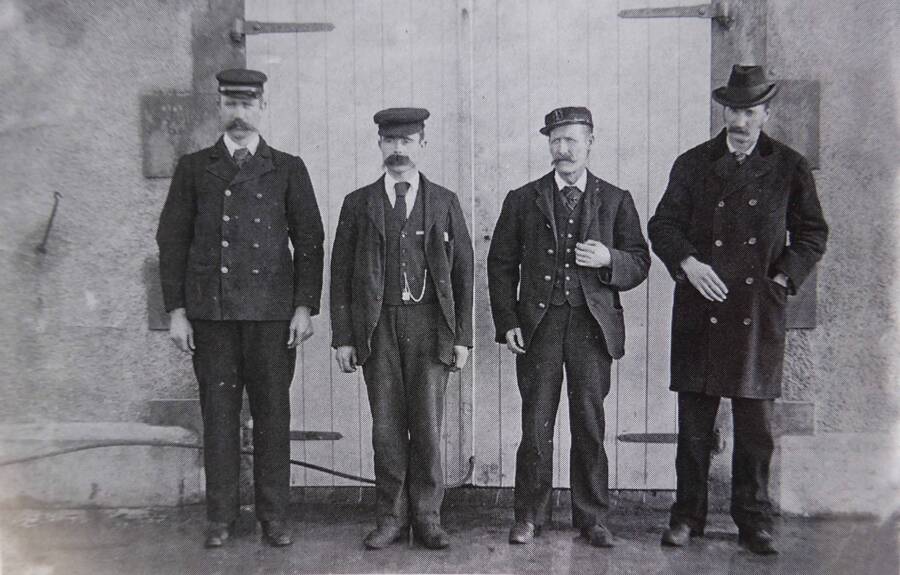
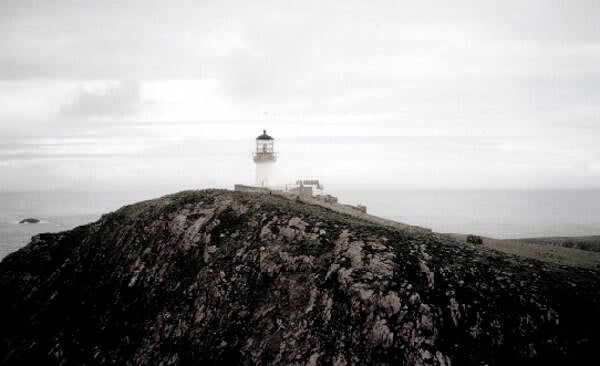
In December 1900, the keepers of the Flannan Isles Lighthouse off the northwest coast of Scotland mysteriously disappeared — and to this day, no one knows what happened. “A dreadful accident has happened at the Flannans,” reported a ship captain in 1900.

After a lighthouse went dark in the wild islands north of Scotland, a ship traveled to the Flannan Isles to investigate. They discovered that all three lighthouse keepers had vanished The captain added, “On our arrival there this afternoon no sign of life was to be seen on the Island.” What happened to the vanished lighthouse keepers? Was the Flannan Isle mystery an accident, or something darker?

Investigating The Flannan Isle Mystery

Three lighthouse keepers – James Ducat, Thomas Marshall, and William MacArthur – manned the remote outpost on Eilean Mòr, one of the Flannan Isles. Built only a year earlier in 1899, the lighthouse was sturdy and sound.

The men likely disappeared around December 15, 1900, about the time a storm had swept across the North Atlantic.  Near the end of December, the ship Hesperus sailed north to investigate under Captain Jim Harvie. On December 26, 1900, The Hesperus docked at the bottom of a steep cliff. Alone, relief lighthouse keeper Joseph Moore climbed the 160 steps up to the lighthouse. When he opened the door, Moore discovered a scene frozen in time. The clock on the wall stood silent. The table was set, waiting for men who would never return. Moore found only one living creature at the lighthouse – a canary who sat quietly in a cage. “I did not take time to search further, for I only too well knew something serious had occurred,” Moore later reported. “I darted out and made for the landing.”

At the Hesperus, Moore reported what he’d found. Two more sailors joined the search for the missing men. But the investigation only deepened the Flannan Isle mystery.

In the lighthouse, the searchers discovered an oilskin, protection against the rough northern weather, meaning one of the lighthouse keepers must have run from the lighthouse during the storm without his rain gear.

On the western side of the isle, the storm’s power left its mark. Iron railings had bent in the wind. A railway track was torn away from the concrete. An enormous boulder had rolled out of place. And a supply box lay smashed on the ground, with its contents spread across the rocky land.  But there was no sign of the three vanished men. “Poor fellows, they must been blown over the cliffs or drowned trying to secure a crane or something like that,” declared Captain Harvie in his report to the Northern Lighthouse Board. In his telegram report, the captain also noted, “Nothing appears touched at East landing to show that they were taken from there. On West side it is somewhat different. We had an old box halfway up the railway for holding West landing mooring ropes and tackle, and it has gone.”

Was the west landing where the men died? “Now there is nothing to give us an indication that it was there the poor men lost their lives,” the captain warned. Robert Muirhead, the lighthouse board superintendent, had personally recruited the three missing men. He traveled to the Flannan Isles to conduct his own investigation.

The Official Report And Surrounding Rumors

Muirhead declared that the Flannan Isle mystery was merely an accident. In his official report, Muirhead stated that two men had traveled to the west landing around dinner time on December 15. They hoped to secure ropes and the supply box.

“An extra-large sea had rushed up the face of the rock,” Muirhead speculated, “had gone above them, and coming down with immense force, had swept them completely away.” Wind could not have been the cause, Muirhead reasoned, because the direction of the wind would have pushed the men toward the island rather than out to sea.

The official report did not end speculation. Along the windswept islands of the Hebrides, some blamed a sea serpent for devouring the men. Others claimed the keepers had tried to escape the island only to be swept away.  Another theory claimed that a fight had broken out. One of the keepers killed another. While covering up the crime, the survivors were swept out to sea. Or did MacArthur, known for his short temper, kill both men and throw himself off the cliffs?

In the years after their tragic disappearance, the rumors surrounding the lighthouse keepers only intensified. Stories of a logbook containing suspicious entries began to surface. In this supposed logbook, Marshall had written about their despair during the storm, praying for protection before it finally ended on December 15. But if the storm had ended before the men disappeared, it seemed foul play was much more likely than previously thought.

However, no evidence of these logbook entries has ever surfaced. Official reports at the time show the final entry in the lighthouse log being made on December 13, with small notes about the weather being made on the morning of December 15.

The Unsolved Mystery of the Flannan Isles

The bodies of the missing lighthouse keepers were never found. For over 120 years, the mystery has remained unsolved. Whether an accident or something worse, the disappearance was a tragedy. The men left behind families who never learned the truth. Muirhead also found himself reeling after the deaths.  “I visited Flannan Islands when the relief was made so lately as 7th December, and have the melancholy recollection that I was the last person to shake hands with them and bid them adieu,” Muirhead recalled.

Did a storm or a large wave kill the missing lighthouse keepers? Or did violence claim their lives? Over a century later, we may never learn the true story.

SOURCE: ALLTHATSINTERESTING.COM

Weird Wednesdays: Abandoned Mansions–The Los Feliz House

This month’s entry is a house in Los Feliz, CA valued originally at $2.4 Million!

From: SFGATE.COM:

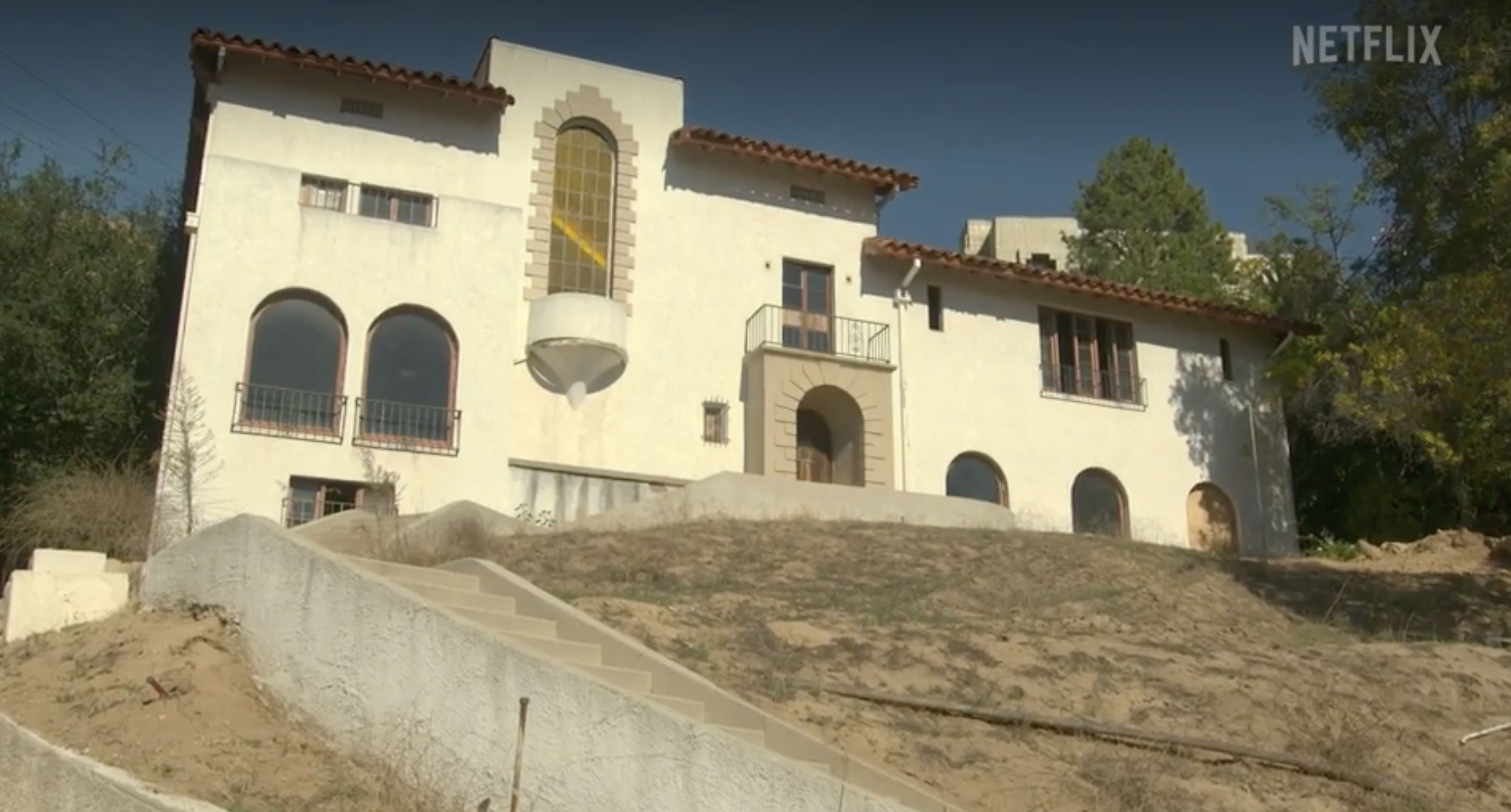
I approached a real estate sign on the edge of the property depicting artistic renderings of the home, complete with a swimming pool and manicured lawn. They looked nothing like the broken building looming over me. As I tried to get a closer look, two squirrels fought over an acorn on the wrought iron gates, carefully avoiding the razor wire spiraling above the wall, recently installed by someone to keep the likes of me out.

The most striking thing about the home at 2475 Glendower Place is not the history of violence or the mystery surrounding its abandonment. It’s the staircase. Through the grand central window, the original century-old stairs diagonally bisect the pane. The design choice makes little sense. Why boast an ornate 12-foot-tall arched window as a centerpiece to your mansion, only to cut through it with the side view of some yellow steps? The color of the stained glass isn’t dissimilar to the ochre of the acacia flowers hanging over the grass. But it seems more sour, more grimy, more, well, murdery.

If you’ve heard anything about the Los Feliz Murder Mansion before reading this, it probably goes something like this:

On Christmas Eve 1959, a successful LA doctor bludgeoned his wife to death with a ball-peen hammer and beat his daughter nearly to death inside their mansion in the Hollywood Hills. The doctor then lay on his bed and read a passage from Dante’s “Divine Inferno,” before drinking a glassful of acid, killing himself.

The bloodstained house was eventually bought by a mysterious family who never moved in, the story often goes. They locked the door, leaving the home frozen in time as it was on the night of the horror. Ribbon-wrapped children’s gifts still sit under the Christmas tree in the ballroom. The cursed home stands empty, a perfectly preserved murder scene, to this day.

“Folklore happens when facts are short and time is long,” journalist John Branch once wrote. Much of the legend isn’t true, but some of it is. Many of these wrongs were recently righted by filmmaker Stacy Astenius, who spent seven years investigating the home for “The Los Feliz Murder Mansion” podcast. In doing so, she revealed that the bodies of the doctor and his wife were not the only ones found in the house over its 99-year history.

“I wanted to get down to the truth, because everyone wants to believe the urban legend,” Astenius said of her podcast. “I thought about doing another one, but I have never found a house like this one.” 

Built in 1925, the 5,000-square-foot Los Angeles mansion was in the heart of what was then sold as Los Feliz Heights — a new development in the Hollywood foothills that catered to moneyed folks with “taste and discrimination.”

The first owners of the house were a wealthy couple who moved down the coast from Seattle named Harold and Florence Schumacher. The Schumachers made their family home on Glendower Place, albeit briefly. Death records reveal that on July 1, 1928, Florence died in the home of heart disease at the age of 40. Harold, 41, died of pneumonia a few weeks later.

Two years later, a movie magazine editor named Welford Beaton and his son Donald lived in the home. Donald soon became bedridden, suffering from an infection caused by a blister while playing tennis; he succumbed to his illness at home, just 21 years old. Welford left the home and filed for bankruptcy the following year.

The mansion on the hill was just 5 years old and had a death count of three, but it was just getting started.

‘Go back to bed, baby — this is just a nightmare’

Heart physician Dr. Harold N. Perelson, his wife Lillian, and their three children, Judy, Joel and Debbie, moved into the mansion from a far more modest home in Silver Lake in 1956. Despite the lavish purchase, Harold’s medical practice was in significant debt. A letter later found written by 18-year-old Judy to an aunt spoke of problems between her parents caused by the family being in “a bind financially.”

Here’s what we know is true about the morning of Dec. 6, 1959 (not Christmas Eve, the date often misattributed to the rampage), based on the police report, autopsies and newspaper articles at the time:

At around 5 a.m. that Sunday morning, Dr. Harold Perelson, 50, attacked his wife, Lillian, 42, with a ball-peen hammer as she was sleeping, killing her. He then went to his daughter Judy’s bedroom and attacked her with the same weapon. Judy’s screams awakened her sister Debbie, 11, in another bedroom. Harold told Debbie, “Go back to bed, baby — this is just a nightmare,” she later told police.

Debbie then awakened the Perelsons’ son, Joel, 13. This distraction allowed Judy to escape to a neighbor named Marshal Ross. Ross tended to Judy’s injury and had her go to bed, before calling the police and walking across the street to the Perelsons’ house. There, he found Debbie and Joel “dazed by the events” but unhurt and sent them to his house. Ross found Harold on the second floor and told him to lie down and then went to Lillian’s room. Police arrived and found Harold lying face down on Judy’s bed. He had swallowed 31 pentobarbital tablets. His body was found near the hammer and empty pill bottles. A copy of Dante’s “Divine Comedy” was found next to Harold’s bed.

The press blamed the doctor’s financial problems for his murderous frenzy. Medical records would later reveal that a year earlier, Perelson had been admitted to Temple Hospital for a week; he was given Thorazine, a drug used at the time to treat schizophrenia and other psychiatric disorders.

The story hit some front pages in LA, and a few wire stories ran in other states, but by the week’s end, the event was old news: It wouldn’t be mentioned in the press again for nearly 50 years.

The lives of the Perelson children (after waking up that Sunday with no parents) have also been rightfully uninvestigated in the subsequent years. While reporting for her podcast, Astenius did manage to find Judy, now in her 80s, but she asked to never be contacted again.

The Enriquez mystery

A year after the murder, the home was bought at probate by an older couple named Emily and Julian Enriquez, and so began another mysterious chapter in its history.

The Enriquez family owned the infamous address for decades. Julian died in 1973, and Emily in 1994, and — as they’d always planned — the home was then passed to their son, Rudy, a record store manager in LA. Speculation and rumor centered on Rudy as an apparently elusive figure, the last line of an unknown family that may have never even moved inside the home. Why would Rudy choose to leave his bequeathed mansion empty, save for some storage boxes and the belongings of the Perelsons?

“They never lived there, they visited the place,” neighbor Sherry Lewis told CBS News in 2010. “There are no furnishings other than in the living room furniture that belonged to the Perelson family.” Countless YouTube segments on the murder mansion deduce that the home was never lived in by the new owners due to the intense paranormal activity keeping them out.

Rudy himself told a different story to Astenius when she finally found him outside his home in Mount Washington, a neighborhood around 5 miles from Los Feliz. She described Rudy as a kind man, happy to answer any of her questions.

“I kind of wanted him to be this weird guy,” Astenius said. “But he was just this sweet old man. The house was just too big for him.”

It was during Rudy’s arm’s-length ownership of the home that the story of 2475 Glendower Place took on a life of its own, largely due to a house painter who liked to prank his friends.

‘I’m not a journalist’

In 2000, Steve Kalupski was making some cash painting houses. While on a job at Glendower Place, he was told about a grisly murder-suicide that had happened years ago in the home next door. He peered through the window and saw old furniture, boxes and some wrapping paper. Over the next few years, Kalupski delighted in taking his friends up to the home late at night and telling ever more embellished tales. The rolls of wrapping paper turned into perfectly wrapped Christmas gifts under a lit tree. Kalupski spooked friends with the story of how the Perelsons were gathered around the tree and about to open their gifts when the mad doctor attacked them with a hammer.

“I’m not a journalist. I wasn’t taking people up there to tell the truth,” Kalupski told Astenius. “I was taking them up there as a form of entertainment on a Friday night to scare some people. It’s what I do. I make s—t up.”

A real reporter, however, did eventually come around to tell the story — or at least a version of it.

In 2009, the LA Times ran a story that made the “Los Feliz Murder Mansion” a sensation. In fact, the term had never been used online or in print before that year.

A version of Kalupski’s tale made it to reporters, who correctly decided it would be interesting to readers. Headlined, “On a Los Feliz hill, murder — then mystery,” the LA Times article tells almost as many falsehoods as Kalupski told his friends on Friday nights.

In recapping the 1959 murder-suicide, the story states that after the attack, Dr. Perelson “fatally poisoned himself by gulping a glass of acid.” This detail of the much-repeated story is shocking and memorable. It made it into the titillating opening lines of nearly every subsequent story on the home.

Suicide by drinking acid is extremely rare. We know from his autopsy, and the pillboxes found by his body, that Perelson died after swallowing barbiturate tablets, not by gulping acid. It’s unclear how and why the article described the death this way, but it helped color the urban myth that was about to be retold on a thousand blogs. A Google search yields nearly 1,000 videos that use the term “Los Feliz Murder Mansion,” as well as over 7,000 blogs and articles. All were published after 2009.

The LA Times article also states that “gaily wrapped Christmas gifts sit on a table.” Even Kalupski, the yarn-spinning painter, admitted the gift detail was a lie. Other anecdotes in the story include a ghost-fearing neighbor being bitten by a black widow spider when trying to enter the home, and sex workers frequenting the house.

After 2009, dozens, if not hundreds, of “urban explorers” illegally entered the home, all while Rudy still owned it. One told Astenius he stole an army jacket that he thought must have belonged to the Perelsons (it turned out to be Rudy’s). Another woman unscrewed and stole Judy’s painted light switch from her bedroom, which appeared to have a small bloodstain on it next to her name. A Tumblr post from 2013 appears to show the actual “Christmas” scene from up close.

Rudy Enriquez died in 2015. Shortly before his death, he told Astenius that his mom had indeed lived in the home before she died. He never moved in himself but couldn’t bring himself to sell the property because it was a gift from his parents, whom he sorely missed, and he didn’t need the money. He also said that he used the rooms for storage, including some Christmas paraphernalia.

Some of the mysteries around the home went to the grave with Rudy, such as why neighbors were certain that his mom never lived there or why so many of the Perelsons’ belongings — such as Judy’s hand-painted light switch and Dr. Perelson’s medical records — were never removed.

Rudy “was very sentimental,” Astenius said. “He kept the house like a treasure trove. He was maybe a hoarder but was really just a sweet old man.”

In 2016, TV attorney Lisa Bloom and her husband Braden Pollock bought the home at a probate sale for $2.3 million. But neighbors who hoped the decrepit house would finally be lived in were left disappointed. After tearing the interior of the house down to the studs, the couple told Astenius that they never completed their planned renovation due to permitting issues.

The home was purchased by a developer named Ephi Zlotnitsky for $2.35 million in 2020. Zlotintsky has never spoken to the press about the house and did not return a request for comment for this story. It does appear, however, that he allowed one person inside. In 2023, Zak Bagans and his “Ghost Adventures” team went into the home for a “very tactical-style investigation.” While inside, they found an unusual force pushing them up the stairs by the arched window, and they all freaked out.

It appears that the new owner has no intentions of moving in. His website bio says, “Mr. Zlotnitsky has purchased, stabilized and sold over 80 real estate assets.” His development company put up the renderings of a luxurious future home I found on the gate. The flashy new plans apparently didn’t work — the property was listed again in the summer of 2022, and subsequently delisted in November that year, having not found a buyer.

It’s hard not to attribute some sentience to homes like the Glendower mansion. If it has a personality, it’s one of loneliness. Everyone wanted the home to be something it wasn’t. The Schumachers wanted a place to live out a sunny California retirement. The Enriquezes wanted a home for their beloved boy Rudy. The LA Times wanted the house painter’s spooky stories to be true. Zlotnitsky wanted another million-dollar house flip to add to his portfolio. Bagans wanted to find a cosmic ghoul.

But save for a five-minute burst of violence on a terrible Sunday morning 65 years ago, the Los Feliz Murder Mansion is really just an empty house, waiting for a family.

SOURCE: SFGATE.COM

The Disappearance of Glenn Miller

D.B. Cooper. Amelia Earhart. Jimmy Hoffa. All prominent Americans whose unexplained disappearances have fascinated and confounded armchair historians and professionals alike—and created fertile ground for all manner of wild explanations and conspiracy theories.

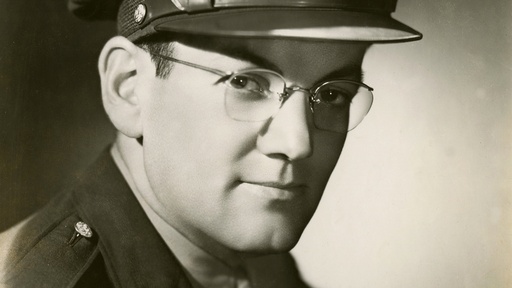
Ditto for Glenn Miller, one of the University of Colorado Boulder’s most illustrious alumni, who was the nation’s most famous big-band leader when he disappeared Dec. 15, 1944, after heading out over the English Channel on a small military plane bound for Paris.

Almost from the moment the world learned Miller had gone missing, conspiracy theories began to emerge like puffs of smoke from the Chattanooga Choo Choo. And they’ve never really stopped, as each new generation discovers the mystery and publishes books and articles purporting to have solved it.

But Dennis Spragg of the College of Music’s American Music Research Center—and Miller’s family—is doing his best to end all the crazy speculation.

“In 2009, Steve Miller, Glenn’s son and a big donor to the Glenn Miller Archive”—the definitive Miller collection, housed at the AMRC—“asked me if I would consider dealing with the latest series of sensationalistic conspiracy books. He said, ‘enough is enough,’ says Spragg.

The three most prominent theories over the years:

Miller never boarded the plane, but was assassinated after Gen. Dwight D. “Ike” Eisenhower sent him on a secret mission one or two days earlier to negotiate a surrender from Nazi Germany.

He made it to Paris, where he died of a heart attack in a bordello.

The small plane he was on was destroyed by bombs jettisoned from a phalanx of Allied bombers passing overhead on their way back from an aborted mission over Germany.

More than four years—and dozens of trips to Washington, D.C., London and U.S. Air Force archives—later, Spragg is confident he knows what happened: The plane went down in mere seconds over the channel, instantly killing Miller, another officer and a young pilot, likely because fuel lines from wing tanks froze. The steel-framed, wood and fabric plane all but disintegrated, sending its heavy Pratt-Whitney engine plunging to the bottom.

Ironically, as Spragg told the producers of the PBS show “History Detectives,” which will air “The Disappearance of Glenn Miller” nationwide on July 8, that not-so-mysterious conclusion was reached by investigators just days after the plane went down. But documents from the investigation were boxed up after the war, sent to the United States and locked away.

“It was right there all this time, but all the researchers trying to follow the trail of Glenn Miller just didn’t have access to it,” says Alan Cass, founder and curator of the Glenn Miller Archive.

But Spragg, who surely knows more about Miller’s time in the U.S. Army Air Force and his mysterious disappearance than anyone else alive, was as driven as Sherlock Holmes in his quest to find the answers.   

“I just went for it. I didn’t realize it would take four years. Nobody else had been in the files at Maxwell Air Force Base until me,” he says by phone from Cape Cod, where he is spending the summer.

The more melodramatic tales simply don’t stand up to scrutiny, based on unambiguous documentation from a board of inquiry investigation at the time.

A little background: The musician, who attended CU—he received an incomplete in the only music class he took—for three semesters before leaving, became the nation’s most popular band leader from 1939 to 1942. He enlisted for the war effort and as a captain led band performances in England.

In 1944, after the Allies recaptured Paris from the Germans, Eisenhower asked Miller to head up a joint British-American radio production team, to perform for troops and to record for broadcast back home. Miller was agitated by complications in Paris and when weather grounded normal transport flights, he hitched a ride on a small C64 Norseman with his friend Lt. Col. Norman Baessell and a 20-year-old pilot.

“He was mad, he was in a rush. He was a type-A personality with the intestinal fortitude of a general,” Spragg says. “He was a leading celebrity in America and he got his own way.”

Contrary to popular myth, the flight was not unauthorized, and conditions were not foggy, as depicted in the film “The Glenn Miller Story.” It was a “casual” flight in a plane whose model had been recalled due to defective carburetor heaters, but it was at the end of the triage line behind combat planes and bombers. Heavy clouds aloft had the pilot flying on “visual flight rules” relatively close to the water and the temperature was below freezing.

“The guy flew right into freezing conditions,” says Spragg, who strongly believes fuel-line freezing, engine overheating and circumstances doomed the plane.

The mystery arose in part because the Germans launched the counteroffensive that became known as the Battle of the Bulge the next morning, and nobody knew Miller was missing for 72 hours. As soon as Orville A. Anderson of the U.S. 8th Air Force—coincidentally Miller’s cousin by marriage—was notified of the missing aircraft on Monday, he said, “They’ve had it. I can mount a search but it won’t matter.”

“This was a non-survivable accident with immediate trauma,” Spragg says. “Anybody who thinks this plane could have been ditched has rocks in his head, but even if it could, they would have survived just 20 minutes in the water because of the temperature.”

And the other yarns told and repeated over the decades? All easily disproven by clear, documentary evidence.

·      More than a dozen witnesses saw Miller board the plane on the 15th with Baessell.

·      Those titillating rumors of a heart attack in a French bordello were concocted by Nazi propaganda chief Hermann Goering and broadcast only after the Supreme Headquarters of the Allied Expeditionary Force announced Miller’s death on Dec. 24. (“And he was a straight arrow,” Spragg says. “Anyone who says that has just been regurgitating a story that originated with the Germans.”)

·      Using flight logs and the discovery that another plane actually was accidentally bombed, Spragg has shot holes in the friendly-fire theory. In order for Miller’s plane to have been taken down by the flight of Lancaster bombers, time would have had to shift by an hour and the small plane would have had to be 20 degrees off course. This theory grew out of a tall tale told by one of the Lancaster pilots in a bar in South Africa in 1984, Spragg says—“So why not tell the story in 1944?”

Spragg is absolutely confident about his conclusions—“Nobody else has gone to the documents”—but not at all sure it will lay the myths to rest.

“I went through a logical process of elimination,” Spragg says. “I went through all the possibilities and knocked them down or verified them. Of course, there is always a segment of the public that will never be convinced by logic.”

SOURCE COLORADO.EDU

Unsolved Mysteries: Cynthia Anderson

From: Unsolved.com:

CASE DETAILS

Cynthia was plagued by bad dreams.

In 1980, 20-year-old Cindy Anderson of Toledo, Ohio, was plagued by a series of frightening dreams. In one episode, the acquaintance she lets in the door betrays her trust. Cindy’s sister, Christine Savidge, heard her sister talking about the dreams:

“One morning while I was getting ready for work, I overheard Cindy talking to my mother. I do believe that the dreams could’ve been a premonition of fears that Cindy actually had in her subconscious at the time.”

Police searched for clues

On August 4, 1981, Cindy went to work as usual. She was employed as a legal secretary and, in the mornings, usually worked in the office alone. She kept the door locked at all times. A buzzer had even been installed at her desk so that she could alert the shop next door if there was trouble.

One day, at noon, Jim Rabbitt and Jay Feldstein, two of the lawyers, arrived back at their office after a meeting. According to Jim Rabbitt:

“Jay and I came back from downtown, got to the door and the lights were on, the door was locked. We unlocked the door, went inside, yelled for Cindy and there was no answer. I started to look around out front. Cindy, when she would leave, would place the phones on hold and that wasn’t done either.”

Jim Rabbitt said that Cindy had left her romance novel open to the only violent scene in the book, where the heroine is abducted at knifepoint:

“It wasn’t until really looking at the book, particularly reading the passage in the novel, that I had a sickening feeling that something was wrong.”

Cindy was never seen again. There was no body, no farewell letter, no hint where she had gone, or why she had disappeared. Were Cindy’s dreams premonitions of a terrible fate? Or, were they just a coincidence?

A mystery caller provided a new lead

Cindy was raised in a strict religious environment. Her family, boyfriend, and most of her social circle were all devout Christian fundamentalists. Cindy’s father, Michael Anderson:

“She was a very quiet, obedient type of a girl. She never made waves with either myself or her mother. And she had lots of friends. She was the type of daughter that you just enjoy, I mean, just a beautiful young girl.”

Cindy’s sister had no idea why she might leave on her own:

“At the time of Cindy’s disappearance, there were no circumstances in her life that any of us were aware of that would’ve caused her to have run away. She was looking forward to quitting her job in two weeks and going to a Bible college that she would attend with her boyfriend. She was very excited about it.”

Cindy’s dad said he noticed a change in his daughter’s behavior:

“Just before she disappeared however, she was becoming like a debutante. She was spending a lot of time on her face and herself and she’d skip breakfast for this reason. And that may be part of the problem.”

The day Cindy vanished, the police immediately began a search for clues. Cindy’s car keys and purse were missing. But the office was undisturbed, and according to Toledo Police Det. William Adams, there were no signs of a struggle:

“Her car was parked in front of the law office. Her bank account, which had a nice substantial amount of money, was never touched. Her social security number has never shown up under any other work place. It’s a complete mystery how and why Cindy disappeared.”

Larry Mullins was a client of the law office where Cindy worked:

“The day before Cynthia Anderson disappeared, I had been in the law offices to pay off a legal fee. She got a phone call. She kind of reacted like maybe it was obscene or something and hung up real quick. And the look on her face, still, I can picture it today. She was scared. She was honestly and sincerely scared. It gives me shivers to think of the look on her face. I went home and I called the police department and asked them to do a drive-by and check on her. Something scared the hell out of her, in my opinion.”

In September, 1981, a month after Cindy vanished, another strange phone call gave police a new lead. According to Det. Adams, a woman called to report that Cindy was being held in the basement of a white house:

“She said that she was scared and she was talking in low whispers. She kept saying she had to go. I kept begging her to stay on the line, give me more information, give me an exact address, something that we could act on. A short while later, she again called. The lady mentioned that there were two houses side by side owned by the same family, and that the family was out of town. But their son was home and he was the party that was holding Cindy in the basement. We did check street after street on the north end to see if we could find two houses side by side. There’s many, but you can’t find any positive location to the house.”

Michael Anderson has wondered if his daughter isn’t living somewhere with amnesia:

“If she herself is out there, we want her to know we love her and we certainly want her to come back, whatever the case may be. The door is open, we certainly want anybody and everybody that can possibly help in this situation to do so.”

After Cindy’s disappearance, a local grand jury indicted nine people for drug trafficking. Some suspect that Cindy knew one of them, and she was killed after she overheard incriminating comments. No charges were ever filed.

Theories on her disappearance–from coldcaseexplorations.com:

Arrests Made in 1995 Tangentially Related

In November 1995, Anderson’s employer, Richard Neller, and one of his friends, Jose Rodriguez Jr., were indicted on running a drug distribution ring in Toledo. Police also announced that they believed that Anderson had been killed by Neller because she’d heard too much about the drug ring while working for him.

While Rodriguez was on trial, a witness testified that he’d confessed to killing Anderson. The reason was supposedly to “send a message” to Neller — a lawyer — for not representing him properly during a previous trial. However, authorities were unable to confirm if this confession was legitimate and neither Rodrigues nor Neller have ever been charged in connection to Anderson’s death.

Rodriguez Killed Anderson

As stated before, there were allegations that Jose Rodriguez Jr. confessed to the killing of Anderson at some point, although there wasn’t enough evidence to prosecute him for it. The alleged motive was that Anderson had heard too much about the drug business that Rodriguez and her boss, Richard Neller, were involved in. 

Anderson Ran Away

Some have suggested that Anderson up and left to start a new life elsewhere, and there were some unconfirmed reports that she was seen in Texas. However, there is little to no evidence to support this theory. The fact that she had plans to attend a Bible college with her boyfriend shortly indicates that she had made plans for the future. 

Additionally, Anderson went missing from her place of work, apparently taking only her car keys and her purse and leaving even her car behind. Authorities have also stated that they don’t believe she ran away. “Everything we know, everything we’ve found out leads us to believe she wouldn’t do that,” said a detective working on her case.

Anderson Was Killed by a Serial Killer

In the summer of 1981, at least four other young people were killed in the Toledo area, and two brothers — Anthony and Nathaniel Cook — were eventually convicted of nine murders between them in the 1980s. Both brothers deny having any involvement in Anderson’s disappearance, however. It’s possible that one or both of them abducted and killed Anderson. 

Anderson was Killed by a Stalker

Recall that there was the strange graffiti written on the walls near Anderson’s place of work reading “I Love You Cindy — By GW” which was covered up and then graffitied again later. The person who wrote this strange love note was never found, and some believe that it was a stalker who had been watching Anderson for months, if not longer. 

However, authorities were never able to figure out who this GW person was, despite interviewing a number of people with those same initials. Many people have speculated that the person who did the graffiti was the same one who made threatening calls to Anderson, although this has never been confirmed.

SOURCES: UNSOLVED.COM & COLDCASEEXPLORATIONS.COM

The Mary Celeste

From: All That’s Interesting:

The Mary Celeste was discovered abandoned near the Azores Islands on December 5, 1872 — and to this day, experts are unsure about what happened to its crew.

On December 5, 1872, while sailing through rough weather, the Canadian brig Dei Gratia sighted a seemingly abandoned ship drifting through the Atlantic between Portugal and the Azores Islands. It was the Mary Celeste, an American brigantine that had left New York nearly a month prior.

When the crew of the Dei Gratia boarded the Mary Celeste, they found everything in perfect order. The crew’s clothes were even neatly packed away. Yet there was not a living soul to be found aboard the ship. The only possible clues that could explain the crew’s whereabouts were a disassembled pump in the hold and a missing lifeboat. And so began one of the most enduring mysteries of the sea.

The Crew Of The Dei Gratia Finds The Mary Celeste Abandoned At Sea

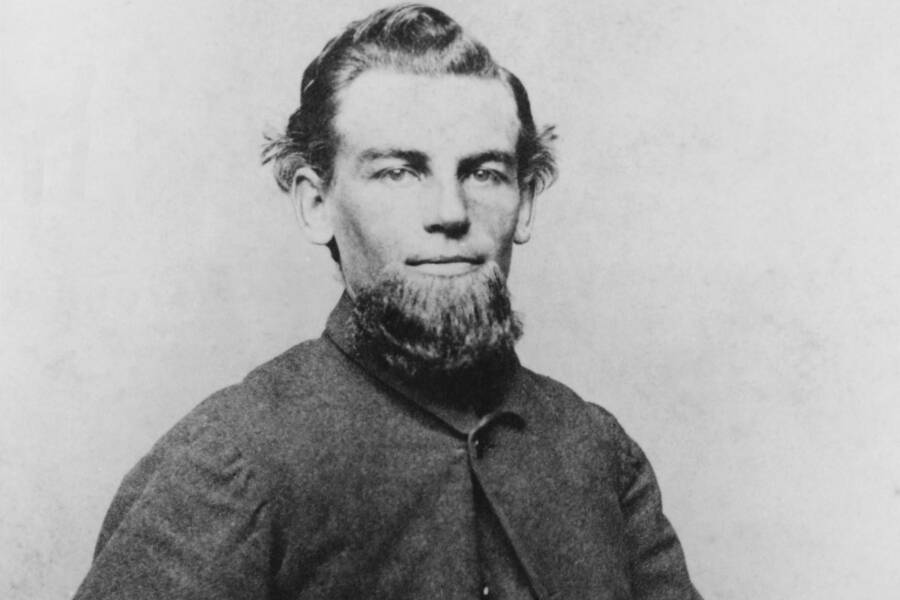
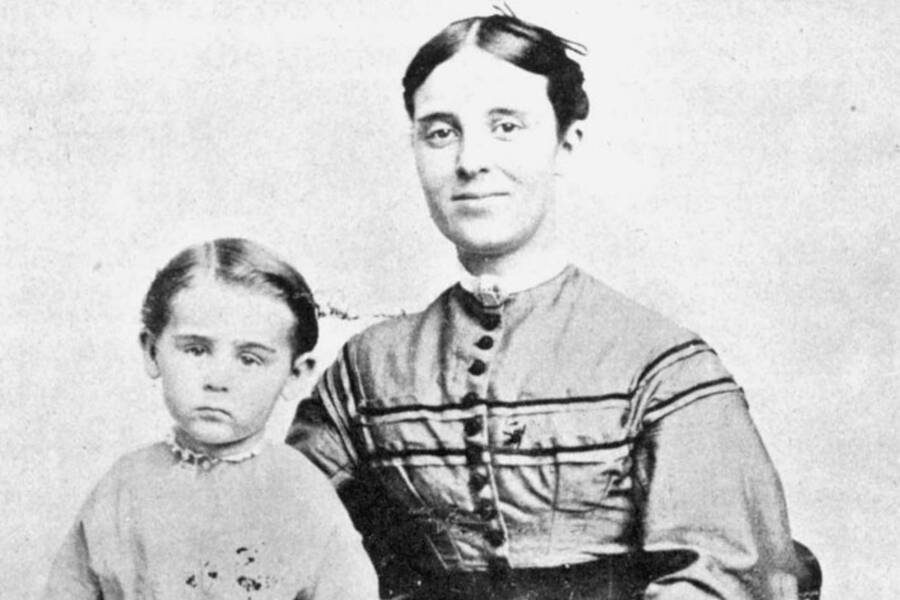
On Nov. 7, 1872, a merchant ship with a cargo of denatured alcohol left New York Harbor for Genoa, Italy. The Mary Celeste sailed forth, helmed by Captain Benjamin Briggs and his handpicked crew of seven men. Accompanying the sailors were Briggs’ wife and two-year-old daughter.

The ship and its crew spent two weeks at sea fighting against raging storms and treacherous seas before reaching the Azores. Captain Briggs chronicled the rough journey in his journal, but curiously, his log ended abruptly on Nov. 25, 1872, at 5 a.m.

The night prior, his log recalled, the ship and its crew had continued to face rough seas and winds of more than 35 knots, but by the morning they had come out on the other side unscathed with the island of Santa Maria in sight. All, it seemed, was well.  But when the crew of the Dei Gratia came across the Mary Celeste just over one week later, on December 5th, they found it abandoned, drifting in the seas 400 miles east of the Azores.

Celeste and found the ship in near-perfect condition. Aside from a few feet of water in the ship’s bilge — the lowest point of the ship, which rests beneath the waterline — things seemed to be mostly in order. A few charts had been tossed about below deck, but the crew’s belongings were neatly tucked away, and the ship was stocked with enough food and water to last six months. The only thing missing was its crew.

Theories About The Disappearance Of The Crew Of The Mary Celeste

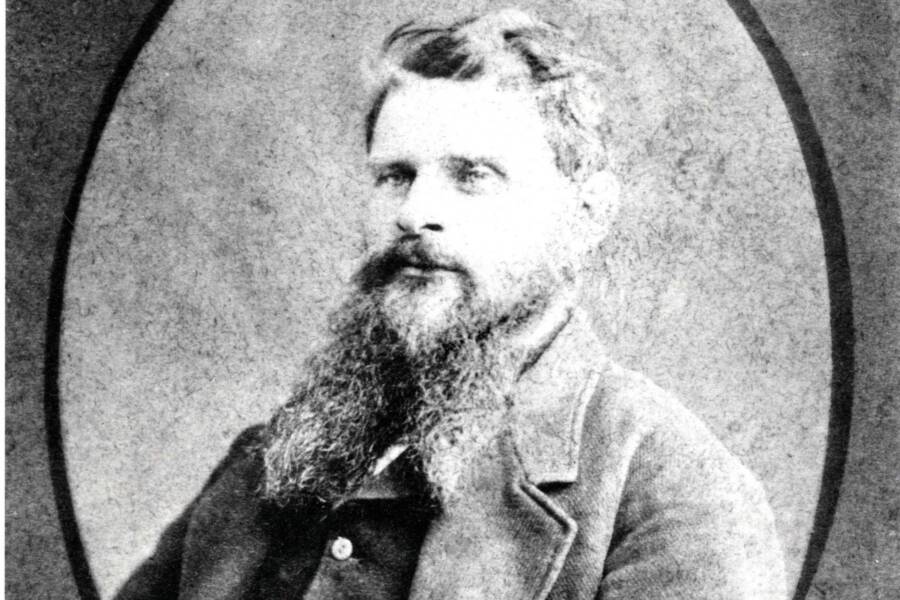
It made no sense that Briggs, an experienced seaman, would abandon a perfectly seaworthy ship. In fact, Daily Nautica reports, Morehouse had dined with Briggs in New York just before each of the men and their respective crews set sail, and he considered the man to be a friend. He knew just how capable of a captain Briggs was.

Morehouse and his crew towed the merchant ship with them to Gibraltar, where authorities conducted an investigation that ultimately yielded no conclusive results. At this point, several theories began to surface. English inspector Frederick Flood was the first to hypothesize about the disappearance of the crew. With the knowledge that Morehouse and Briggs were friends, the inspector suspected that the two captains may have concocted a scheme to defraud the insurance company and split the profit earned from the eventual sale of the Mary Celeste.  Per the laws of the sea, the abandoned ship did now belong to Morehouse, after all. The inspector then theorized that Briggs had killed his crew and hidden himself away in the cargo hold of the Dei Gratia.

Flood’s theory, however, was full of holes. Briggs had in fact held property shares in the ship, so he would have gained nothing from the scheme. The theory also failed to account for Briggs’ wife and daughter.

The crew of the Dei Gratia eventually received payment. However, it was only one-sixth of the total $46,000 value of the Mary Celeste. Apparently, the authorities weren’t totally convinced of their innocence. Additional theories suggested that the crew had gotten drunk off the ship’s alcohol cargo and mutinied — but there were no signs of violence. Others said the ship must have been raided by pirates, yet no valuables were missing.

The mystery may very well have been left alone had author Arthur Conan Doyle not written the 1884 short story “J. Habakuk Jephson’s Statement,” a fictitious account of an ex-slave who captures a ship called the Marie Celeste. The story reignited interest in the ship, but as a theory, the story is entirely baseless.

Naturally, stories of sea monsters became associated with the missing crew, as did explanations of water spouts and, much later, extraterrestrial abduction.  Yet for all of these theories, none of the evidence ever matched.  Perhaps the most plausible theory was that vapors from the alcohol had blown the hatch cover off. Then, fearing fire, the crew abandoned the ship. However, the hatch cover was securely fastened, once again leaving no feasible explanation.

How A Documentarian May Have Solved The Mystery Of The ‘Mary Celeste’

In 2002, documentarian Anne MacGregor sought to investigate the story of the now-infamous ghost ship.  “There are obvious limitations for historic cases,” she said. “But using the latest technology, you can come to a different conclusion.”

Per Smithsonian magazine, MacGregor enlisted the help of a physical oceanographer at the Woods Hole Oceanographic Institution in Massachusetts named Phil Richardson, and together they reconstructed the drift of the ghost ship and deduced that Briggs’ chronometer — which helps determine a vessel’s position at sea — had been faulty.

The Mary Celeste was hopelessly off course — 120 miles west of where it should have been. The captain thus expected to spot land three days earlier than he did. MacGregor also analyzed Flood’s notes from the time to determine that all had indeed been going as planned with the course of the Mary Celeste — until about five days before Briggs’ final log.

Significantly, Briggs’ logs and Flood’s notes show that the ship had changed course the day before it reached the Azores — Briggs was now sailing directly north towards Santa Maria Island. It’s possible the crew was seeking haven from the foul weather.

But even all of this wouldn’t make a captain abandon ship.

However, MacGregor also discovered that the ship had carried a load of coal on a previous voyage. Coal dust and debris from a recent refitting had potentially clogged the ship’s pumps, meaning any water that made it onto the ship’s lower decks didn’t have a way back out.

It’s possible that Briggs then decided that, with the ship off course, the crew’s best bet was to cut their losses and simply try to save themselves by abandoning ship and heading for the nearest piece of land. In this case, it was Santa Maria Island. Their lifeboat may have then tipped over, causing all ten of them to drown.

MacGregor’s theory is by no means universally accepted or even provable, but it at least lines up with the evidence (the disassembled pump, for example) in a way that other theories do not. Finally, some 130 years after the crew eerily vanished, the mystery of the Mary Celeste may finally have an answer.

SOURCE: ALLTHATSINTERESTING.COM AUTHOR: AUSTIN HARVEY

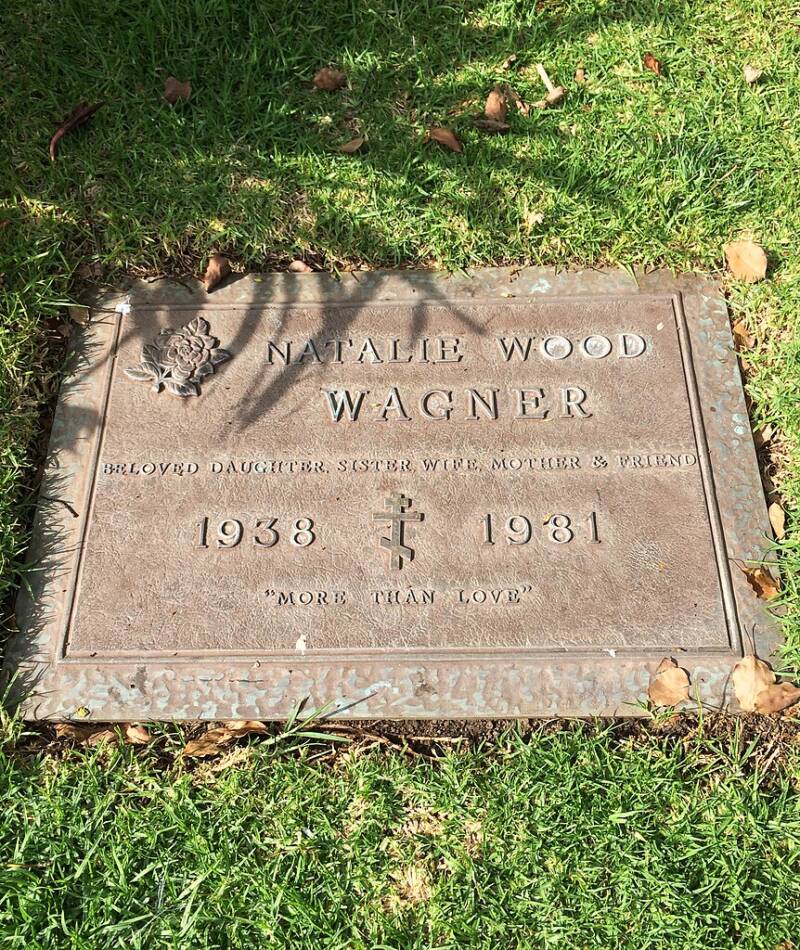
Natalie Wood

Today is the anniversary of Natalie Wood’s terrible death.  Was it an accident or something else?  We may never know. This article from All That’s Interesting explores the story in greater detail.

From All That’s Interesting:

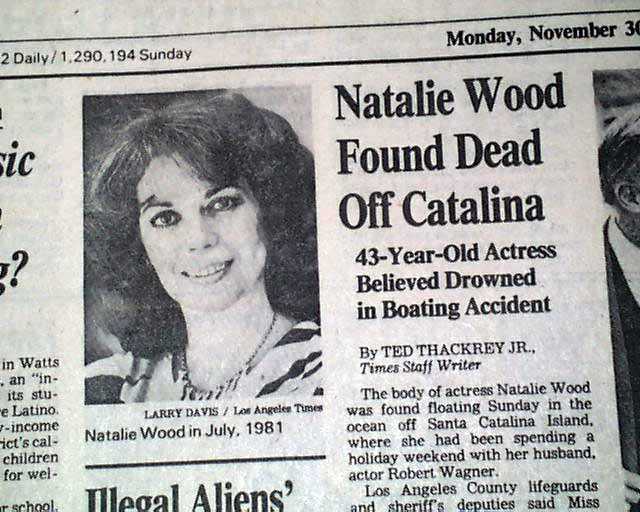
Natalie Wood died off the coast of California’s Catalina Island on November 29, 1981 — but some say her drowning may not have been an accident.

Before Natalie Wood’s death brought her life to a tragic end, she was an Academy Award-nominated actress who was in some of the most famous films of all time. She co-starred in Miracle on 34th Street when she was only eight years old. When she was a teenager, she earned her first Oscar nomination, for 1955’s Rebel Without A Cause. Natalie Wood was so talented and widely beloved that she was nominated for three Oscars before she turned 25. And her larger-than-life presence on camera was only matched by her glamorous offscreen life.

While the San Francisco-born star took Hollywood by storm, working with legendary directors such as John Ford and Elia Kazan, her romantic conquests included the likes of Elvis Presley before she tied the knot with actor Robert Wagner in 1957. Indeed, for decades before Natalie Wood’s death, she lived the American Dream, but one that would tragically devolve into a Hollywood nightmare. It all came crashing down during a fateful yacht trip around California’s Catalina Island in November 1981.

On November 28, 1981, Wood set off aboard her yacht Splendour with Wagner, co-star Christopher Walken, and boat captain Dennis Davern. But in the early morning hours of November 29, Natalie Wood disappeared from the boat, only to be found dead in the water due to drowning at age 43 the next morning.

The discovery of her body only yielded more questions than answers. Though Natalie Wood’s death was initially classified as an accident and “probable drowning in the ocean,” Wood’s death certificate would later be updated to “drowning and other undetermined factors.” And her widowed husband has since been officially labeled a person of interest. What really happened aboard the Splendour that night in 1981 remains a mystery. However, to this day, some suspect foul play in the death of Natalie Wood. This is the haunting story of how Natalie Wood died and what the true cause may have been.

A Young Natalie Wood’s Meteoric Rise In Hollywood

Natalie Wood was born Natalia Nikolaevna Zakharenko on July 20, 1938, in San Francisco, California to an alcoholic father and stage mother. Studio executives changed the young starlet’s name shortly after she started acting. Her mother Maria was highly eager to make Wood the breadwinner and regularly pushed her to audition for roles despite her young age.

Maria’s encounter with a fortune teller when she herself was a child yielded an ominous premonition. The gypsy said her second child “would be a great beauty” and famous, but that she should “beware of dark water.” Wood quickly grew into a professional, memorizing not only her lines but also everyone else’s. Dubbed “One Take Natalie,” she was nominated for an Oscar for her role in Rebel Without a Cause when she was just a teen.

But behind the scenes, her love life was rocky. Wood had affairs with both the director, Nicholas Ray, and co-star Dennis Hopper. She also dated stars like Elvis Presley before she met Robert Wagner at age 18. The two married in 1957 but divorced five years later. They found their way back to each other in 1972, remarried, and had a daughter.

Though Wood’s career began to wane, she did act opposite Oscar winner Christopher Walken in her last picture, Brainstorm. The two became fast friends — with some suspicion that they were dating. “It wasn’t like they were lovey-dovey on the set or anything like that, but they just had a current about them, an electricity,” said the film’s first assistant director, David McGiffert.

It was Thanksgiving weekend of 1981 when their alleged relationship became a problem. Wood and Wagner invited Walken to join their sailing trip around Catalina Island — and that’s when everything went wrong. The scene was set for the tragic death of Natalie Wood.

The Story Behind The Death Of Natalie Wood

What happened on the evening of November 28, 1981, the night Natalie Wood died, is unclear. What is clear is that authorities recovered Wood’s body the following morning, floating a mile away from the Splendour. A small dinghy was found beached nearby.

The investigator’s report chronicled the events as follows: Wood went to bed first. Wagner, having stayed up chatting with Walken, later went to join her, but noticed that both she and the dinghy were gone. Wood’s body was found around 8 a.m. the next morning in a flannel nightgown, down jacket, and socks. The chief medical examiner in the L.A. County Coroner’s Office announced that Natalie Wood’s death was an “accidental drowning” on November 30.

The autopsy showed Natalie Wood had multiple bruises on her arms and an abrasion on her left cheek. The coroner explained Wood’s bruises as “superficial” and “probably sustained at the time of drowning.” But in 2011, Captain Dennis Davern admitted that he left out key details about the night Natalie Wood died. And as the years went on, Wood’s loved ones only had more questions.

How Did Natalie Wood Die? Inside The Haunting Evidence

Davern said the weekend of Natalie Wood’s death was filled with arguments — and that the main issue was the glaring flirtation between Walken and Wood. “The argument started the day before,” said Davern. “The tension was going through the whole weekend. Robert Wagner was jealous of Christopher Walken.”

Davern said Wood and Walken spent hours at a Catalina Island bar before Wagner showed up, furious. All four then went to dinner at Doug’s Harbor Reef Restaurant, where they shared champagne, two bottles of wine, and cocktails. Employees couldn’t recall whether it was Wagner or Walken, but one of them threw a glass at the wall at some point. At around 10 p.m., they used their dinghy to get back to the Splendour.

Accounts of the night of Natalie Wood’s death have changed over the years. Walken did admit to investigators that he and Wagner had a “small beef,” but that it regarded the couple’s prolonged film shoot-related absences from their child.

Though reports initially stated that the fight died down, Davern claimed otherwise in 2011. He said everyone continued drinking when back on board and that Wagner was enraged. He allegedly broke a wine bottle over a table and screamed at Walken, “Are you trying to f–k my wife?” Davern remembered Walken retreating to his cabin at this point, “and that was the last I saw of him.” Wagner and Wood returned to their room, too, when a shouting match ensued. Most ominously, Davern said he later heard the fight continue on deck — before “everything went silent.” When Davern checked on them, he saw only Wagner, who said, “Natalie is missing.”

Robert Wagner’s Suspicious Behavior After His Wife’s Death

For many to this day, it’s Robert Wagner’s behavior just after Natalie Wood’s death that is strangest and perhaps most suspicious. At first, Wagner told Davern to go look for her, and then said “the dinghy is missing too.” The captain knew Natalie was “deathly afraid of water,” and doubted she’d taken the dinghy out alone. But then Davern said that Wagner didn’t want to turn the boat’s floodlights on nor call for help — because he didn’t want to draw any attention to the situation.

Key witness Marilyn Wayne, who was in a boat 80 feet away that night, told Sheriff’s investigators she and her boyfriend heard a woman screaming around 11 p.m. “Somebody please help me, I’m drowning,” the cries implored, until 11:30 p.m.

Their call to the harbormaster went unanswered, and with a party on another boat nearby, the pair concluded it may have been a joke. As for Wagner’s hesitance to call anyone, he did eventually did — at 1:30 a.m.

This, among other things, left Wood’s sibling Lana confused. “She would have never left the boat like that, undressed, in just a nightgown,” she said. But that’s exactly how her body was found, mere hours later. With that, Natalie Wood was dead at age 43. The investigation into Natalie Wood’s death continued throughout the decades, however, with new details, questions, and suspicions arising as recently as 2018.

Changing Stories About Natalie Wood’s Cause Of Death

The case was reopened in November 2011 after Davern admitted he lied during the initial investigation and alleged that Wagner was “responsible” for Natalie Wood’s death. Since the bombshell report, Wagner has refused to talk to authorities. However, Walken has cooperated fully with investigators. According to the BBC, Wood’s death certificate was later amended from accidental drowning to “drowning and undetermined factors.”

In 2018, a spokesperson for the Los Angeles Sheriff confirmed that Natalie Wood’s case was now undeniably a “suspicious” death. And Robert Wagner was officially named a person of interest.  “As we’ve investigated the case over the last six years, I think he’s more of a person of interest now,” said L.A. County Sheriffs Department Lieutenant John Corina. “I mean, we know now that he was the last person to be with Natalie before she disappeared.”

“I haven’t seen him tell the details that match… all the other witnesses in this case,” he added. “I think he’s constantly… he’s changed the — his story a little bit… and his version of events just don’t add up.” Investigators digging into Natalie Wood’s death made multiple attempts to speak with him, to no avail. “We would love to talk to Robert Wagner,” said Corina. “He’s refused to talk to us… We can never force him to talk to us. He has rights and he can not talk to us if he doesn’t want to.”

What Really Happened The Night Natalie Wood Died?

Walken hasn’t publicly spoken much on the events of the night that Natalie Wood died, but he did appear to believe that it was an unfortunate accident. “Anybody there saw the logistics — of the boat, the night, where we were, that it was raining — and would know exactly what happened,” said Walken in a 1997 interview. “You hear about things happening to people — they slip in the bathtub, fall down the stairs, step off the curb in London because they think that the cars come the other way — and they die.”

Meanwhile, Corina maintains that Natalie Wood’s death was likely no accident. He said, “She got in the water somehow, and I don’t think she got in the water by herself.” In the end, Robert Wagner’s refusal to cooperate is legal and may simply stem from a desire not to revisit the tragedy. Natalie Wood’s death may have been the result of foul play, but the truth is, we may never know for sure.

SOURCE: ALLTHATSINTERESTING.COM

Weird Wednesdays: Abandoned Mansions: The John List House

History of the John List House

The John List House became famous for a terrible family murder on November 9, 1971. Here, John List, an accountant and Sunday school teacher, killed his family. This included his wife Helen and their three kids – Patricia, John, and Frederick. After the crime, List carefully hid the bodies, turned all the lights on, and ran away.

The crime stayed hidden for a month until neighbors saw the lights always on at the John List House. This was in Westfield, New Jersey. When police arrived, they found the dead bodies. This started a big search for List that only ended in 1989. He got caught, and not long after that, he passed away in prison.

John Emil List was a character John Graff in the family massacre. He was seen as an accountant and a faithful Lutheran. He faced money problems and a lot of personal disappointment. Even though people thought he was a great family man, List killed his family at their Breeze Knoll home. His crime shook the country, leaving a deep mark on the community, still haunted by the memories of the 1971 family tragedy perpetrated by John List.

John List House

The John List House was a 19-room mansion on Hillside Avenue in Westfield, New Jersey. It belonged to John List, his wife, and their three kids. List, a stern Lutheran, and Sunday school teacher, lived there until something shocking happened in 1971. On November 9, 1971, John List did something terrible. He carefully planned and killed his whole family.

John List was a man who followed a detailed plan. After the awful events in 1971, he ran away. For 18 years List hid his real identity before the law caught up with him in 1989. The old List home burned down in 1996. Some believed it was set on fire on purpose. List’s story was covered by ABC News. People were captivated by his escape for nearly two decades.

List faced the public’s fury and was given five life sentences in prison. He died in 2008 at 82. The tragedy at the John List House still deeply affects its community and fans of true crime. Today, the mansion’s Tiffany glass skylight is a sad symbol of what happened there.

Architectural Importance of the List Residence

The John List House was designed in the Prairie School architectural style. This style was inspired by the famous architect Frank Lloyd Wright. Its key features include a low-pitched roof, wide eaves, and horizontal lines. These make it a prime example of early 20th-century residential design. A year after the tragic events in the house, it became a National Historic Landmark in 1972.

Frank Lloyd Wright and his peers led the Prairie School design movement. This was an American style that stood out from traditional European designs. The prestige of the John List House, in Oak Park Illinois attractions and famous architectural residences, reveals its modern approach to architecture. It welcomes visitors exploring architectural tours and those interested in prairie-style house museum experiences.

The John List House earned a title as a national historic landmark. This recognition highlights its role in early 20th-century residential design and its connection to Frank Lloyd Wright’s architecture. The designation protects the house as a special architectural legacy. This is true even after the terrible events that took place there.

Manhunt for John List

After the murders on November 9, 1971, a nationwide manhunt began for John List. He had started a new life and run away from his home in Westfield, New Jersey. This case caught everyone’s eye across the US. List managed to hide for 18 years until his arrest in Colorado, in 1989. There, he was living as “Robert Clark”.

John List was searched for far and wide after he killed his wife and three kids in their 19-room mansion, called “Breeze Knoll.” He executed his plan with precision and then vanished. The mysteriously burned Victorian mansion was left behind, still holding its Tiffany glass.

Finally, in 1989, after avoiding capture for 19 years, a viewer of “America’s Most Wanted” recognized List. He was found guilty of the terrible murders. At 82, List passed away in prison in 2008.

Exploring the Crime Scene

When the police found the bodies at John List House, it was horrifying. List killed his wife Helen, daughter Patricia, and sons John and Frederick in the home’s ballroom. He then hid the bodies, turned on all lights, and ran away. He assumed a new identity and fled to Colorado.

Before the bodies were found, neighbors saw the lights on for a long time. This tells us List planned everything carefully. He even killed his mother before running. The fire that later destroyed the mansion is still a mystery. This event made the house even more frightening.

The John List House became a reminder of a gruesome act. The list ended the lives of his family in the ballroom. This room, usually for joy, witnessed something horrible.

Neighbors were deeply shocked. A neighbor spotted List on TV news after the murders. This added to the feeling of betrayal and shock in the community. The fire, which burned the house, made the place even scarier. It made people wonder if the house was forever cursed by this sad event.

Rumors and Legends Surrounding the House

After the brutal murders at the John List House, it became a center of ghost story myths and tales. Locals said they saw ghostly figures in the windows and heard strange noises. The mystery deepened when the house burned in 1996 in an unsolved arson case.

Those interested in true crime and the supernatural are often intrigued by this place, especially knowing it was once the residence of family killer John List. Some say they felt the presence of a hidden “watcher” or experienced odd events in the attic closet. The John List House has earned a reputation as a major “murder house” in the U.S.

The Associated Press and Connie Chung have covered the ongoing rumors and myths about the house, making it a landmark in true-crime show history. Even years after the murders and the arson, the List House remains a subject of interest.

Local tales from N.J. speak of odd noises and sightings at night under the glass skylight. Some claim to have seen a “watcher” on the property. This has led to the belief that the ghosts of the List family remain among sleeping bags in the house.

The mystery surrounding the John List House is a mix of reality and legend, all tied to its dark past. It remains a place of fascination for fans of the macabre and the mysterious. Even a month later, after the neighbor recognized List and authorities were called, the mansion still captures people’s interest.

Preservation Efforts and Future Plans

The John List House has a tragic past, but people aim to honor it. The Antieau Gallery in Westfield, New Jersey organized shows about its history. These included the 1971 murders. Sadly, a fire in 1996 destroyed the house. Now, only the foundations and a Tiffany glass skylight remain.

The future of the site is unclear. The property, once home to the 19-room mansion called “Breeze Knoll”, attracts many. Historians, true-crime lovers, and people interested in the dark tale of murderer John List. New Jersey’s history is eager to see what comes next.

Conclusion

The John List House in Westfield, New Jersey, is a haunting reminder of the tragic events that unfolded on November 9, 1971. What was once a beautiful 19-room mansion, designed in the Prairie School style and influenced by Frank Lloyd Wright, became a symbol of horror and tragedy. The brutal murder of John List’s family, including his wife and three children, sent shockwaves across the nation, and the house became a focal point of the crime. Despite efforts to preserve the site, the house was destroyed by a mysterious fire in 1996, leaving only the foundations and a Tiffany glass skylight as remnants of this dark piece of history.

The story of John List and the murder of his family is a chilling tale of betrayal, deception, and horror. List’s careful planning and execution of the crime, followed by his escape and 18-year evasion of the law, captivated the nation and earned him a reputation as one of the most infamous family killers in American history. The John List House, with its eerie legacy and dark past, continues to fascinate true-crime enthusiasts and architectural buffs alike, serving as a haunting reminder of the horrors that can unfold in the most unexpected places.

SOURCE: ROBERT NIGHT; ARTERIORSHOME.CO.UK

Unsolved Mysteries: The Watcher House

In June 2014, Maria and Derek Broaddus and their three young children were getting ready to move into their new home, 657 Boulevard in Westfield, New Jersey. They claimed the six-bedroom house was their “dream home” and was located just a couple of blocks away from Maria’s childhood home in one of the top 30th safest cities in the United States.

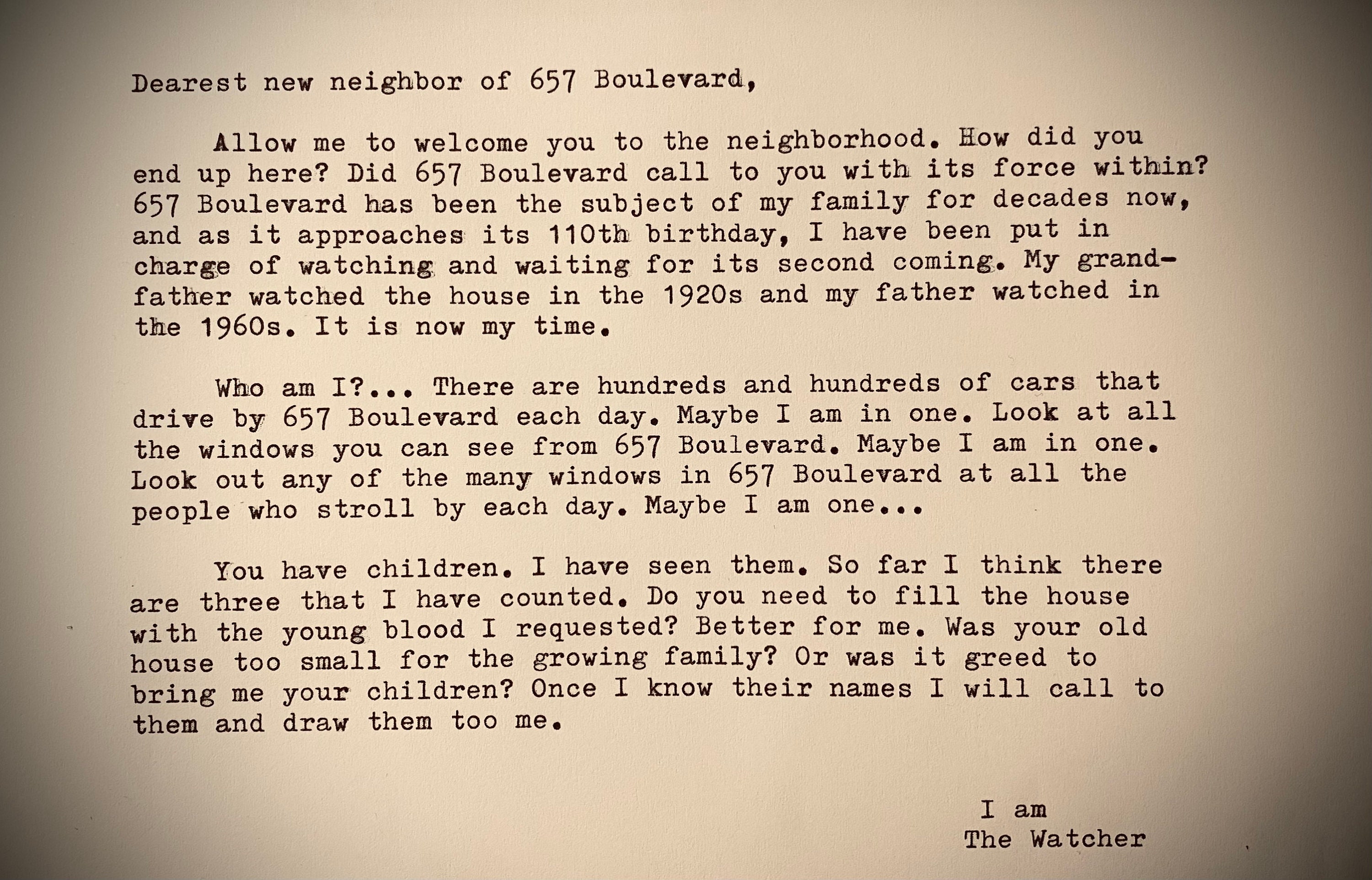
Three days after closing the sale, before the Broaddus family had even begun to move in, a letter arrived in their new mailbox. The letter was addressed to “The New Owner” in big, clunky handwriting. The typed letter read as follows:

“Dearest new neighbor at 657 Boulevard, allow me to welcome you to the neighborhood. How did you end up here? Did 657 Boulevard call to you with its force within? 657 Boulevard has been the subject of my family for decades now and as it approaches its 110th birthday, I have been put in charge of watching and waiting for its second coming. My grandfather watched the house in the 1920s and my father watched in the 1960s. It is now my time. Who am I? There are hundreds and hundreds of cars that drive by 657 Boulevard each day. Maybe I am in one. Look at all the windows you can see from 657 Boulevard. Maybe I am in one. Look out any of the many windows in 657 Boulevard at all the people who stroll by each day. Maybe I am one.”

The letter also mentioned specifics about the Broaddus family. “You have children. I have seen them,” the letter continued, “So far, I think there are three that I have counted. Do you need to fill the house with the young blood I requested? Better for me. Was your old house too small for the growing family? Or was it greed to bring me your children? Once I know their names, I will call them and draw them to me.” At the bottom of the letter, the author used a cursive font to sign “The Watcher.”

After receiving the letter, the Broaddus family reached out to the previous family who had sold them the house, John and Andrea Woods. They stated that during the 23 years of living at 657 Boulevard, they had never received a letter like that, except once a few days before they were getting ready to move out of the house.

The Woods family also stated they had never felt watched in the two decades they had lived at the house and, in fact, rarely felt the need to lock their door at night. While they thought the note they received was odd, they threw the note away without much concern. Still, the two families went to the police with the letter, and an investigation was opened.

The police warned the families not to tell anyone about the letters, including their neighbors, who were now all suspects. Two weeks later, even though the Broaddus family still hadn’t moved in, they received a second letter with even more chilling specifics about the family, including the children’s birth order and nicknames.

The Watcher also asked, “will the children sleep in the attic? Or will you all sleep on the second floor? Who has the bedrooms facing the street? I will know as soon as you move in. It will help me to know who is in which bedroom. Then, I can plan better.”

Several weeks later, the Broaddus family had put their plans on hold to move in, a third letter arrived saying, “Where have you gone to? 657 Boulevard is missing you.”

By the end of 2014, the case had stalled. There was no digital trail, and the mental effects were taking a toll on the Broaddus family. There were no fingerprints and no way to place somebody at the scene of the crime. Only six months after they received the letters, they decided to sell the home. 657 Boulevard has been sold and is currently off the market, while The Watcher’s identity still remains a mystery.

SOURCE: PARADE.COM

Unsolved Mysteries: Elisa Lam

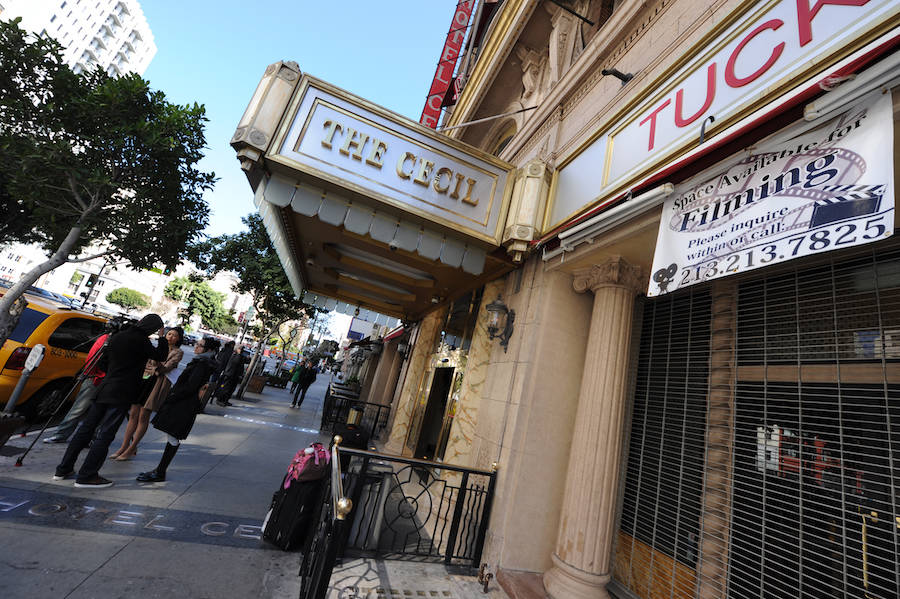
On January 31, 2013, a 21-year-old Canadian student named Elisa Lam vanished inside Los Angeles’ Cecil Hotel — then her dead body turned up in its water tank.

To this day, nobody knows how exactly Elisa Lam died. We know that the 21-year-old Canadian college student was last seen in the Cecil Hotel in Los Angeles on January 31, 2013. But the infamously chilling hotel surveillance video that captured the bizarre final moments before her disappearance — let alone the other details that have emerged since — have only elicited more questions than answers.

And ever since her body was discovered in the hotel’s water tank on February 19, her tragic demise has remained shrouded in mystery.

“In 22 years plus of doing this job as a news reporter, this is one of those cases that kinda sticks with me because we know the who, what, when, where. But the why is always the question,” said NBC LA reporter Lolita Lopez in reference to the mysterious death of Elisa Lam.

Although the coroner’s office ruled her death as an “accidental drowning,” the strange details of Elisa Lam’s case have fueled rampant speculation about what may have really happened. Internet sleuths have come up with a myriad of theories about the tragedy, involving everything from murder conspiracies to evil spirits. But when it comes to the disturbing death of Elisa Lam, where does the truth lie?

The Vanishing Of Elisa Lam

On Jan. 26, 2013, Elisa Lam arrived in LA. She had just come by Amtrak train from San Diego and was headed to Santa Cruz as part of her solo trip around the West Coast. The trip was supposed to be a getaway from her studies at the University of British Columbia in Vancouver, where she was originally from.

Her family had been wary of her traveling by herself but the young student was determined to go at it alone. As a compromise, Lam made sure to check in with her parents every day of the trip to let them know that she was safe.

That’s why it struck her parents as unusual when they didn’t hear from their daughter on Jan. 31, the day she was scheduled to check out of the Cecil Hotel in LA. The Lams eventually contacted the Los Angeles Police Department. The police searched the premises of the Cecil but couldn’t find her.

Police soon released surveillance footage taken from the cameras at the Cecil Hotel on their website. This is where things took a turn into the truly bizarre.

The hotel video showed Elisa Lam in one of its elevators on the date of her disappearance acting rather strangely. In the pixelated footage, Lam can be seen stepping into the elevator and pushing all the floor buttons. She steps in and out of the elevator, poking her head out sideways toward the hotel’s hallways in between. She peers out of the elevator another few times before stepping out of the elevator entirely.

The last minutes of the video show Lam standing by the left side of the door, moving her hands in random gestures. Nobody else was captured on the video, except Lam.

Public reaction to the inexplicable video crossed all the way to Canada and China, where Lam’s family is originally from. The four-minute video of Lam’s strange elevator episode has amassed tens of millions of views.

The Accidental Discovery Of The Body In The Cecil Hotel’s Water Tank

On Feb. 19, two weeks after the video was published by authorities, maintenance worker Santiago Lopez found Elisa Lam’s dead body floating in one of the hotel water tanks. Lopez made the discovery after responding to complaints from hotel patrons about low water pressure and a weird taste coming from the tap water.

According to a statement by the chief of the Los Angeles Fire Department, the tank in which Lam’s body was found had to be drained completely and then cut open from the side to remove her five-foot-four frame.

Nobody knows how Lam’s corpse — floating lifelessly next to the same clothes she wore in the surveillance video — ended up in the hotel’s water tank or who else might have been involved. Hotel staff told authorities that Lam was always seen by herself around the hotel premises.

But at least one person did see Lam soon before her death. At a nearby shop, eerily named The Last Bookstore, owner Katie Orphan was among the last to see Elisa Lam alive. Orphan remembered the college student buying books and music for her family back in Vancouver.

“It seemed like [Lam] had plans to return home, plans to give things to her family members and reconnect with them,” Orphan told CBS LA.

When the autopsy results for Elisa Lam’s case came out, it only served to ignite more questions. The toxicology report confirmed that Lam had consumed a number of medical drugs, likely to be medication for her bipolar disorder. But there were no indications of alcohol or illegal substances in her body.

An Incomplete Autopsy Fuels Wild Theories About What Happened To Elisa Lam

Soon after the toxicology report came out, amateur sleuths began poring over any information they could find in hopes of solving the mystery behind the death of Elisa Lam. For example, one summary of Lam’s toxicology report was posted online by a Reddit sleuth with an obvious interest in medicine.

The breakdown pointed out three key observations: 1) Lam took at least one antidepressant that day; 2) Lam had taken her second antidepressant and mood stabilizer recently, but not that day; and 3) Lam had not taken her anti-psychotic recently. These conclusions suggested that Lam, who had been diagnosed with bipolar disorder and depression, may have not been taking her medications properly.

It is an important finding to note given that the use of antidepressants to treat bipolar disorder can risk inducing manic side effects if done without caution. Some sleuths have understandably latched onto this detail and suggested it was a likely explanation behind Lam’s strange behavior in the elevator.

Hotel manager Amy Price’s statements in court strongly support this theory. During Lam’s stay at the Cecil Hotel, Price said that Lam was originally booked in a hostel-style shared room with others. However, complaints of “odd behavior” from Lam’s roommates forced Lam to be moved to a private room by herself.

But even if Elisa Lam had been suffering from mental health issues, how did she end up dead? Furthermore, how did she end up in the hotel’s water tank?

The autopsy did not show any foul play from the evidence that was processed. But the coroner’s office noted that they were unable to do a full examination because they could not examine the blood from Lam’s decomposing body.

Who’s Responsible For The Death Of Elisa Lam?

David and Yinna Lam filed a wrongful death suit against the Cecil Hotel several months after their daughter’s death was uncovered. The Lams’ attorney stated that the hotel had a duty to “inspect and seek out hazards in the hotel that presented an unreasonable risk of danger to [Lam] and other hotel guests.”

The hotel fought back against the suit, filing a motion to dismiss it. The hotel’s lawyer argued that the hotel had no reason to think that someone would be able to get into one of their water tanks.

Based on court statements from the hotel’s maintenance staff, the hotel’s argument is not entirely far-fetched. Santiago Lopez, who was the first to find Lam’s body, described in detail how much effort he had to exert just to find her body.

Lopez said that he took the elevator to the 15th floor of the hotel before walking up the staircase to the roof. Then, he had to first turn off the rooftop alarm and climb up on the platform where the hotel’s four water tanks were located. Finally, he had to climb another ladder to get to the top of the main tank. Only after all that did he notice something unusual.

“I noticed the hatch to the main water tank was open and looked inside and saw an Asian woman lying face-up in the water approximately twelve inches from the top of the tank,” Lopez said. Lopez’s testimony suggested that it would have been difficult for Lam to make it to the top of the water tank on her own. At least, not without anyone noticing.

The hotel’s Chief Engineer Pedro Tovar also made it clear that it would be difficult for anyone to access the rooftop, where the hotel water tanks were located, without triggering the alarms. Only hotel employees would be able to deactivate the alarm properly. If it was triggered, the sound of the alarm would reach the front desk as well as the entire top two floors of the hotel.

Los Angeles Superior Court Judge Howard Halm ruled that the death of Elisa Lam was “unforseeable” because it had happened in an area that guests were not allowed to access, so the lawsuit was dismissed.

The Chilling Backstory Of The Cecil Hotel

Elisa Lam’s mysterious demise was not the first to happen at the Cecil Hotel. In fact, the building’s sordid past has earned it a reputation as one of the most supposedly haunted properties in Los Angeles.

Since opening its doors in 1927, the Cecil Hotel has been plagued by 16 different non-natural deaths and unexplained paranormal events. The most famous death associated with the hotel, other than Lam’s, was the 1947 murder of actress Elizabeth Short, a.k.a. the “Black Dahlia,” who was reportedly seen drinking at the hotel bar in the days before her grisly demise.

The hotel has also hosted some of the country’s most notorious killers. In 1985, Richard Ramirez, also known as the “Night Stalker,” lived on the top floor of the hotel during his monstrous killing spree. The story goes that after a murder, Ramirez would dump his bloody clothes outside the hotel and return half-naked. Back then, the hotel was in such disarray that Ramirez’ nude stunt barely raised an eyebrow.

Six years later, another murderous patron moved into the hotel: Austrian serial killer Jack Unterweger, who earned the nickname “Vienna Strangler.”

With such a macabre history, one would think that the Cecil Hotel would soon be condemned. But actually, the building was recently granted landmark status by the Los Angeles City Council. The hotel was given the distinction because of the building’s opening back in the 1920s, which is considered the beginning of the lodging industry in the United States.

Meanwhile, the tragic death of Elisa Lam at the hotel has inspired pop culture adaptations like Ryan Murphy’s American Horror Story: Hotel.

During a press conference for the show, Murphy stated that the new season “was inspired by a surveillance video from a Los Angeles-based hotel that surfaced two years ago. The footage showed a girl in an elevator who was never seen again.” An obvious reference to Elisa Lam and her bizarre elevator episode.

More recently, a gaming studio came under fire after users of the game YIIK: A Postmodern RPG found undeniable resemblances to Lam’s case in the storyline. In one scene of the game, main character Alex receives a video file showing another character, Sammy, in an elevator. The elevator door opens to reveal an alternate dimension on the other side; Sammy is then captured by a demon, kicking and screaming all the while.

In a 2016 interview with Waypoint, Andrew Allanson, co-founder of Acck Studios, which is the company behind the YIIK game, talked about how the death of Elisa Lam had influenced its development, saying that:

“There still hasn’t been a great official story about her… I remember on local news they reported it from the gross-out angle because people drank water that a corpse had been floating in. That’s unfortunate, but what about the poor girl who died? It’s easy to say she was off her meds, but why can’t people think a bit more about her as a person?”

While an answer to the mystery behind the death of Elisa Lam remains unclear, the obsession surrounding that mystery has remained in the public consciousness ever since.

SOURCE: ALLTHATSINTERESTING.COM

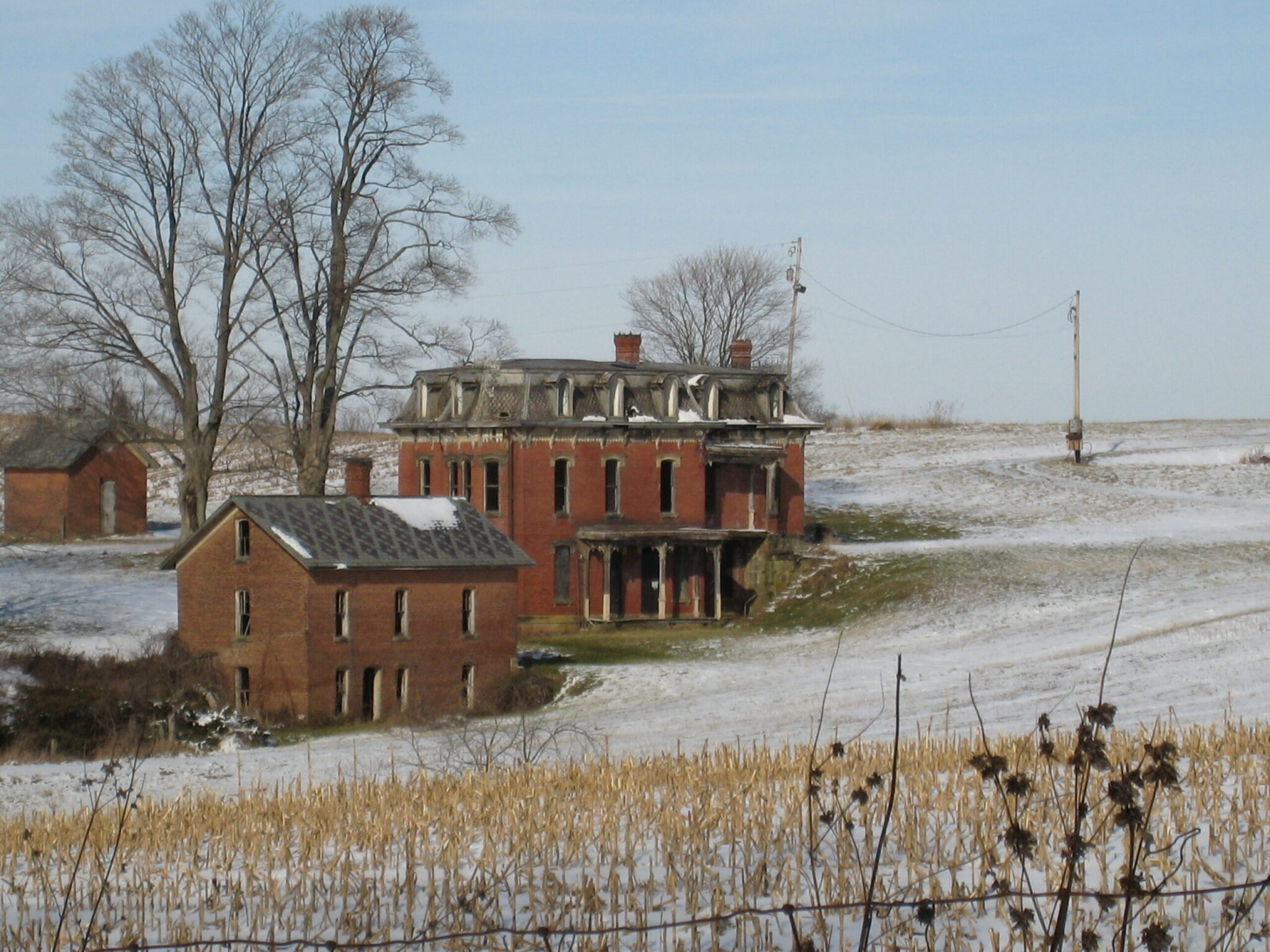
Weird Wednesdays: Abandoned Mansions: Mudhouse Mansion

The origins of Mudhouse Mansion trace back to the 19th century, deriving its unique name from the Mudhouse family, the estate’s earliest recorded occupants. Known also as “Hartman Place,” this grand residence epitomized the Gothic Revival architectural style prevalent during that era. Despite the passage of ownership and decay over time, the mansion’s allure persisted until its eventual demolition in 2015 due to structural concerns. Yet, the legends and the aura of mystery surrounding the mansion continue to thrive, fueled by tales of the paranormal.

Mudhouse Mansion Haunted?

Mudhouse Mansion has a dark reputation not only among locals but also among paranormal enthusiasts nationwide. It is without a doubt, one of the most haunted places in Ohio! There are many local tales and legends as to the origin of the haunting in Mudhouse Mansion. One legend says that a government official lived there after the Civil War and kept slaves. It is told that he locked the slaves in one of the outbuildings every night and generally treated them poorly.

One night a slave dug his way out, entered the house and slaughtered the official and his entire family. It is the spirits of these people which haunt the house. However, according to some it is another more recent family that got murdered in the house.

According to local legend, there was a man who actually bought the house in 1892 and he moved in with his wife and their three children. Neighbors never saw them after they entered the house and they thought it very weird that the family would spend all their time indoors. One neighbor went out to the house to investigate and all he could see was the figure of a woman dressed in white, standing on the second-floor window. The figure was just standing there and staring at her.

The following day the neighbor checked again and saw the figure again, standing on the same position. She checked for 10 days and would see the same figure. On the tenth day she called the police and when they came to investigate, they were met by a terrible sight. All the 5 family members were hanging lifeless dressed in white night gowns. The figure which the neighbor had seen was the mother and she was not standing at the window. She had actually been hanging there for several days/weeks.

Mudhouse Mansion is said to be the home of the original “Bloody Mary”. If you say her name three or five times while in front of the mirror, she will appear. Children in town have even called Mudhouse the House of Mary. According to traditional folklore, all her children were killed either by her or her husband.

A woman named Colleen once explored Mudhouse in 2001 and she recalls hearing a whole group of people moving around the third floor of the house. They went upstairs to talk to the people they assumed were causing all the noise but they found the entire floor and the rest of the house completely deserted. There was no one else there but them. The mansion’s neighbors reported hearing shrieks and groans coming from the empty mansion when it lay abandoned.

History

Mudhouse Mansion was built sometime between 1840 and 1850. Christian and Eleanor Rugh purchased the property, where Mudhouse Mansion now stands, from Henry Byler and Abraham Kagy. The property was then sold to Henry and Martha Hartman in 1919. When Henry died, the property was inherited by his daughter Lulu. Her descendants still own the land today and locals have also labeled the mansion as “Hartman Place”.

No one has lived in the home since 1930 although transients and a group of hippies in the 1960’s did call it their home for a short period of time. The grand structure has been damaged by vandalism and fire.

Note: Mudhouse Manor was demolished September 21, 2015.