Sudoku

sample puzzle

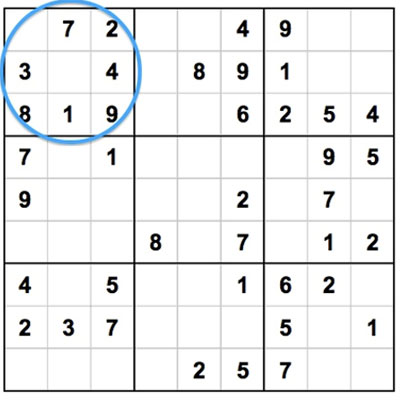
Sudoku is played on a grid of 9 x 9 spaces. Within the rows and columns are 9 “squares” (made up of 3 x 3 spaces). Each row, column and square (9 spaces each) needs to be filled out with the numbers 1-9, without repeating any numbers within the row, column or square. Does it sound complicated? As you can see from the image above of an actual Sudoku grid, each Sudoku grid comes with a few spaces already filled in; the more spaces filled in, the easier the game – the more difficult Sudoku puzzles have very few spaces that are already filled in.

In the above puzzle, the upper left square (circled in blue), already has 7 out of the 9 spaces filled in. The only numbers missing from the square are 5 and 6. By seeing which numbers are missing from each square, row, or column, we can use process of elimination and deductive reasoning to decide which numbers need to go in each blank space.

We know we need to add a 5 and a 6 to be able to complete the square, but based on the neighboring rows and squares we cannot clearly deduce which number to add in which space. This means that we should ignore the upper left square for now, and try to fill in spaces in some other areas of the grid instead.

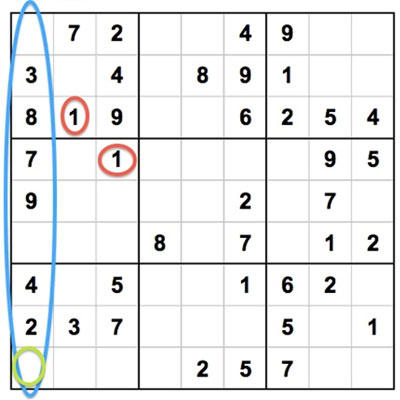
One way to figure out which numbers can go in each space is to use “process of elimination” by checking to see which other numbers are already included within each square – since there can be no duplication of numbers 1-9 within each square (or row or column). Looking at the same puzzle below, we can use the process of elimination to determine where another number should go. In the far left-hand vertical column (circled in Blue) the 1, 5 and 6 missing.

In this case, we can quickly notice that there are already number 1s in the top left and center left squares of the grid (with number 1s circled in red). This means that there is only one space remaining in the far left column where a 1 could possibly go – circled in green. This is how the process of elimination works in Sudoku – you find out which spaces are available, which numbers are missing – and then deduce, based on the position of those numbers within the grid, which numbers fit into each space.

Sudoku rules are relatively uncomplicated – but the game is infinitely varied, with millions of possible number combinations and a wide range of levels of difficulty. But it’s all based on the simple principles of using numbers 1-9, filling in the blank spaces based on deductive reasoning, and never repeating any numbers within each square, row or column.

There is no guessing in sudoku…reasoning and logic are key…and there’s NO MATH required…LOL.

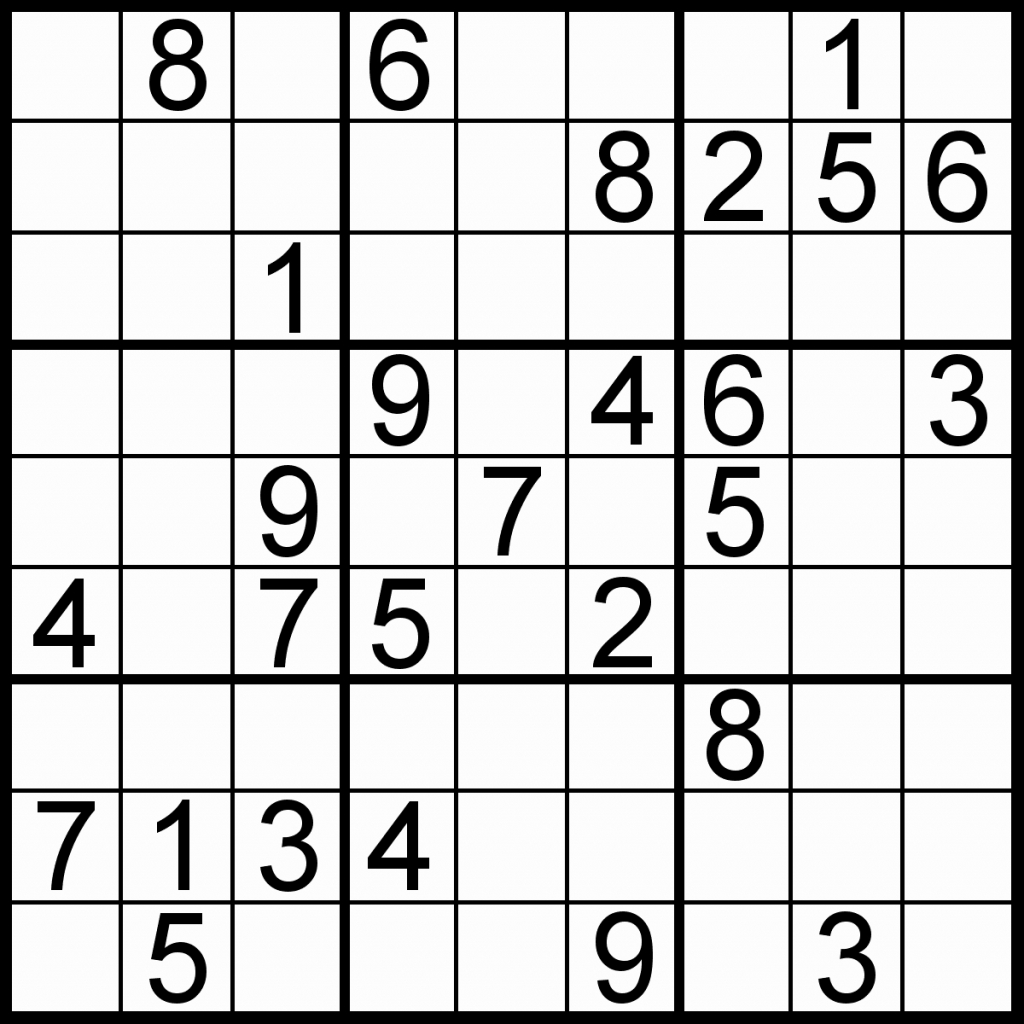
Pat’s Apology: the above sample puzzle requires a little more than basic skills to complete but most puzzles i found on line were like this. (I liked the circles and details in the explanations to help you see exactly what they were talking about.) I have included a puzzle below which requires ONLY the most basic process of elimination skills to solve and I will post the answer if anyone requests it.

History of Playing Cards

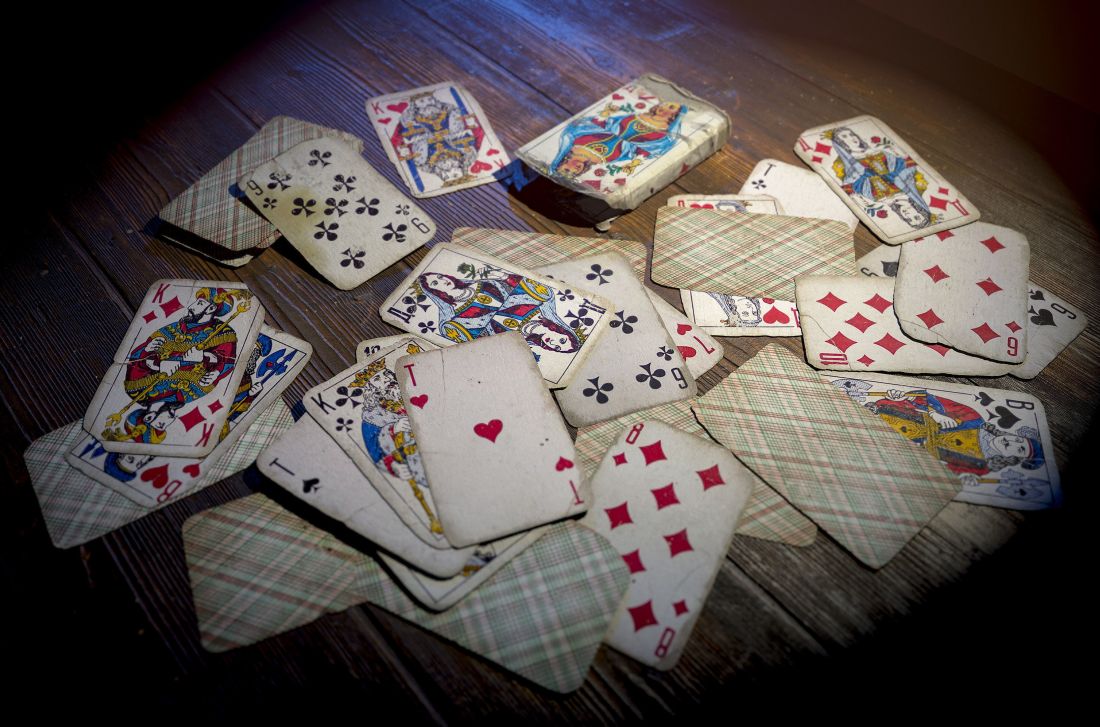
When playing cards first arrived in Europe toward the end of the 14th century AD, they caused quite a furor. In 1377, the town council of Florence complained that the playing of “a certain game called naibbe has recently been introduced into these parts,” and by a vote of 98 to 25 decided to prohibit it. In the same year cards reached Paris, where new city regulations cracked down on working-class cardplayers but apparently left nobel devotees alone.

European Playing Cards

The following year, in the Bavarian city of Regensburg, the council tried to limit card games to small stakes. By 1387, cards had arrived in the Spanish kingdom of Castile, where the government tried to ban them.

The killjoys were fighting a losting battle, however, for even at this early stage, cards began to acquire royal patrons. In 1379, the prince of Brabant, in Belgium, bought a highly decorated pack of cards, while in 1392 the mad French king Charles VI received three packs of cards painted by artist Jacquemin Gringonneur “for his amusement during the intervals in his sad illness.”

Charles VI/Gringonneur Cards

Playing cards soon led to the emergence of cardsharps, and the mother of all card swindles is recorded in the Parisian court annals for 1408. Two dubious characters lured a traveling merchant into an inn with talk of a good currency deal. One of them then produced a pack of cards from his pocket and demonstrated an amusing game of guessing the identity of a card while seeing only its back. The astute merchant soon noticed that one of the cards had a slight but distinctive mark on the reverse, so he happily joined in when the betting started. When the marked card turned up, the trader put his shirt on it, only to find that the front of the card was not the same, as it had been switched for another.

The French also made one great contribution to the development of playing cards by inventing, around 1480 AD, the names and shapes of the four suits (spades, hearts, diamonds, and clubs) we still use today. These simple geometric shapes did much to encourage card playing. By the end of the 15th century, playing card manufacture was a major industry, and even Johannes Gutenberg, often claimed to be the inventor of movable type, became involved.

Johannes Gutenberg Card

He developed some of the mechanical methods of production and, at a time when his finances were in desperate straits, he used drawings that his artists had prepared for his famous Bible to decorate the back of a deck of playing cards.

From this point the history of Western playing cards is clear. But who brought them to Europe in the first place? The subject is swathed in mystery, and it has at different times been claimed that they were introduced by Marco Polo (1254-1324), the Crusaders, or the Gypsies. The most exotic theories credit the Gypsies with the invention of cards (as a means of divination), and it has therefore been argued that their origins lie in India or even Egypt. The truth is that playing cards are a Chinese invention, but the problem has been that little is known of their transmission from China to the West.

Ancient Chinese Playing Cards

Playing cards had been invented in China by at least the 9th century AD when, according to tradition, a princess and her relatives played the “leaf game,” or cards. Women were certainly important in the development of card games, for one apparently wrote the world’s first book on the subject (now lost), later in that century.

By the 11th century, cards were printed with woodcut blocks, and in the early Ming dynasty (1369-1644 AD) famous artists were employed to design card backs with portraits of characters from favorite novels, such as The Water Margin. Chinese cards were much smaller than ours (about 2 inches long and 1 inch wide) and were printed on fairly thick paper, which made them hard-wearing but difficult to shuffle. Chinese “money cards” had four suits: cash, strings (of cash), myriads (of strings) and tens (of myriads), with the numbers 2 thru 9 in the first three and 1 thru 9 in the fourth.

Ancient Woodcut Playing Cards

The Chinese of yesteryear were enthusiastic cardplayers and gamblers, as they are today. Ming Dynasty books on cards praised them as superior to all other amusements, for they “were convenient to carry, could stimulate thinking and could be played by a group of four without annoying conversation, and without the difficulties which accompanied playing chess or meditation.” Also, “cards could be played in almost any circumstances without restrictions of time, place, weather, or qualification of partners.”

But this still leaves us without a link to Europe, for early Western cards don’t resemble Chinese ones and have different suits. The missing link appears to be the Islamic world, despite the fact that card playing was frowned on by Muslim clerics.

In 1938, Professor L.A. Mayer came across a pack of 52 cards while searching through the collections of the famous Topkapi Museum, in Istanbul, Turkey. They had been made in Egypt about 1400 AD, using designs that closely resemble those of early Italian cards.

Second card from left: The Seven of Swords (equivalent to Seven of Clubs)

Third card from left: the Malik of Cups (equivalent to the King of Hearts)

The Arabic inscriptions on the court cards make clear the origin of the word naibbe for cards (used by the Florence council); they are called the Malik (King), Na’ib Malik (Governor), and Na’ib Thani (Deputy Governor). They are in 4 suits – swords, polo sticks, cups, and coins (equivalent to modern clubs, spades, hearts and diamonds).

The only significant difference between these and early Italian cards is that the Egyptian ones are, like the Chinese, long and thin. Even this difficulty seems to have been overcome by the find of a single card with an Arabic inscription made around 1200 AD; its dimensions are like those of Italian cards, which are still slightly narrower than those made today in the rest of Europe.

There can now be little doubt that the Arabs were the intermediaries for the widespread transmission of one of ancient China’s most popular inventions.

Source: Ancient Inventions

That’s GARBAGE!

Garbage is an easy to learn card game for 2 or more players using a standard 52 card deck. The object is to get your cards in a specific sequence. To begin, shuffle the deck.

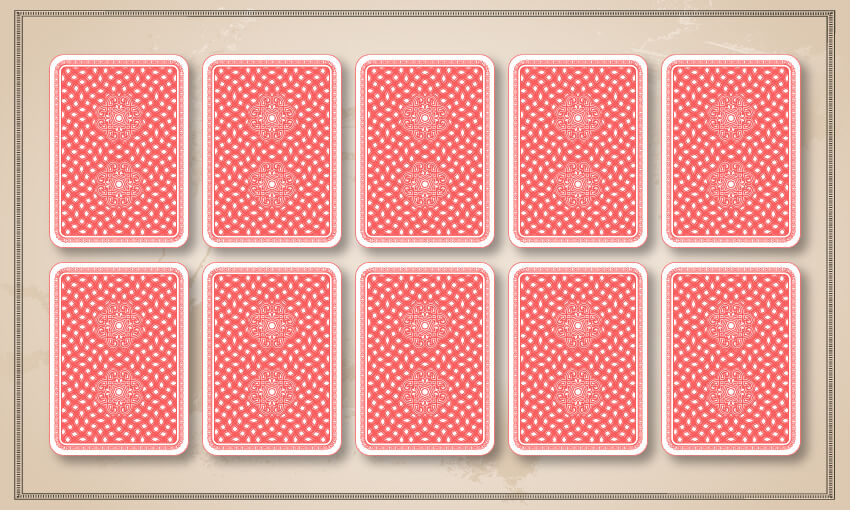
The dealer deals 10 cards to each player (if 3 or more people are playing, 2 decks will be required). The players then place their cards face down in 2 rows, and the dealer puts the remaining cards in a pile in the middle. This is called the GARBAGE pile. The top card is placed face up creating the discard pile.

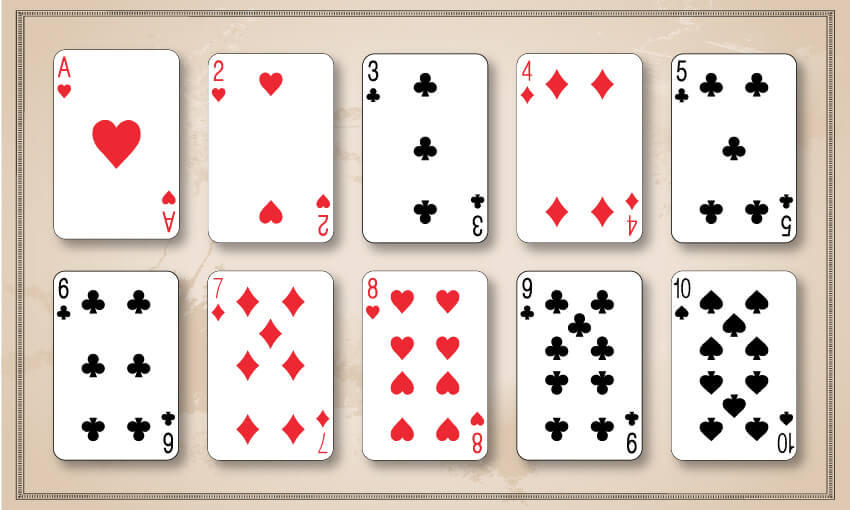
The first player to make a move is the player immediately to the dealer’s left. They will either draw the top card off the draw pile or use the card in discard pile. If the card is between an Ace and a ten, they will place it face up in the corresponding spot in the layout before them. For example, if they draw a five, it would be placed on the fifth spot in the layout.

Then, the player would turn over that first card that is being “replaced” by the card they just drew. It would be moved accordingly, if possible. So, if you flip over the fifth card in the lineup and have a ten, you would move that ten to the tenth spot and continue.

This continues until the player reveals a number already face-up in the line-up or until they draw a Jack or a King. The Jacks and Kings are garbage and end up in the discard pile. That signifies the end of a turn.

The Queens are wildcards and can replace any face-down card in the layout. If a Queen is being used as a wildcard and the player reveals the correct card for that wildcard spot, the card can replace the wildcard. Then, the wild card can be moved to another spot. When a move is no longer possible, the last card a player has is placed in the pile and the game moves onto the next player.

no, not THESE queens!

A player wins when the cards are all face-up and in sequential order from Ace to ten, with any Queens in the appropriate wildcard slots. At this point, the player wins the round.

In this next round, the cards are reshuffled and dealt again. The player who won the previous round is dealt one less card than the round before.

For example, if this is the second round and the first layout of ten was just cleared, the winner of the round would be dealt nine cards instead of ten. Every other player receives the same number of cards they had in the previous round.

Being dealt one less card makes it just slightly easier for the player to clear their layout. Instead of going Ace to ten, they will now only need to go Ace to nine. This continues until a player is down to one card in the layout.

The final win occurs when a player is down to just one card and is able to clear it with an Ace or a wildcard. There are many variations in this game–some prefer to use Kings as wildcards, some allow every player a final turn after the winning player completes their turn.

My granddaughter taught us this game several years ago and it has become a family favorite. So much so that the Garbage Champion is a much contested opinion. I believe myself to be the champion while my granddaughter believes herself to be the champion.

To settle the disagreement, I have challenged her to a championship match and fashioned a Garbage Trophy to boot!

I’ll update when a winner is determined!

UPDATE: The Garbage Championship was played this weekend. My granddaughter won the first 2 rounds…I came back defiantly and won the next 2 rounds…so it came down to the final round! We were neck and neck, but in the end she finally beat me!

She’s taken the trophy home to put proudly on her trophy shelf, with an offer to let me take another crack at her at Christmas! Challenge accepted!!