How Well Do You Know…

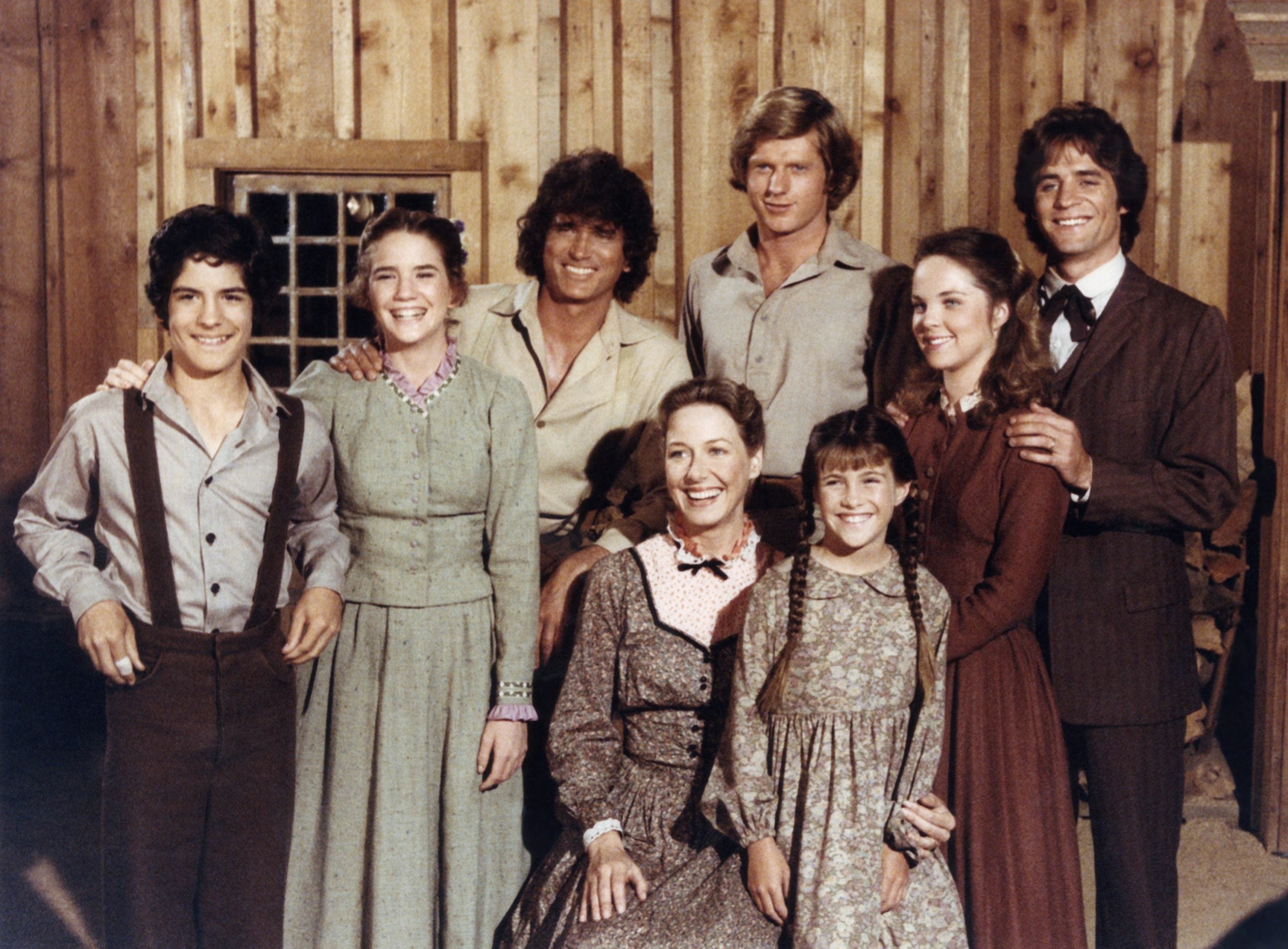
Little House on the Prairie

1. Who is Nels Olesons’ sister?

Diana

Annabelle

Harriet

Christine

2. What is the name of the woman Reverend Alden marries in the episode entitled “The Preacher Takes a Wife”?

Ellen

Jessie

Anna

Gloria

3. What is the name of Albert’s real (biological) father?

James Kirk

George Hall

John Phinn

Jeremy Quinn

4. Name Alice Garvey’s first husband.

5. Several times throughout the program Almanzo’s brother comes to visit him. What is this brother’s name?

Jimmy

Royal

Percival

Jonah

NO PEEKING AT THE ANSWERS!

6. Doctor Baker is romantically involved with Mrs Oleson’s niece.

True

False

7. Who does Willie Oleson marry in the final series of “Little House on the Prairie”?

Belinda

Rachel

Melissa

Michelle

8. What is the full name of Mary’s only child?  

Adam Holbrook Kendall

Adam Charles Holbrook Kendall

Charles Adam Kendall

Charles Holbrook Kendall

9. Who is Mr Edward’s adopted daughter?

Ellen

Alicia

Grace

Sara

10. What does Carrie name her imaginary friend?  

Alyssa

Emma

Alicia

Tessa

You’re almost done!

11. What is the name of Mr Edwards’ pet orangutan?

Annabelle

Fifi

Blanche

Trixi

12. What is Charles’ mother’s first name?

Eliza

Beth

Laura

Jane

13. In the sixth series Brewster Davenport’s grandson comes to stay with him. What is the name of this boy?  

Bart

Tod

Sam

Tim

14. Who is Julia Sanderson’s eldest son?

Carl

Elmer

James

John Jr.

15. Name John Carter’s wife.

Here are the answers:

  1. Annabelle
  2. Anna
  3. Jeremy Quinn
  4. Harold
  5. Royal
  6. True
  7. Rachel
  8. Adam Charles Holbrook Kendall
  9. Alicia
  10. Alyssa
  11. Blanche
  12. Laura
  13. Tod
  14. John Jr
  15. Sarah

So how did you do? Do you qualify to be the Mayor of Walnut Grove?

History of Playing Cards

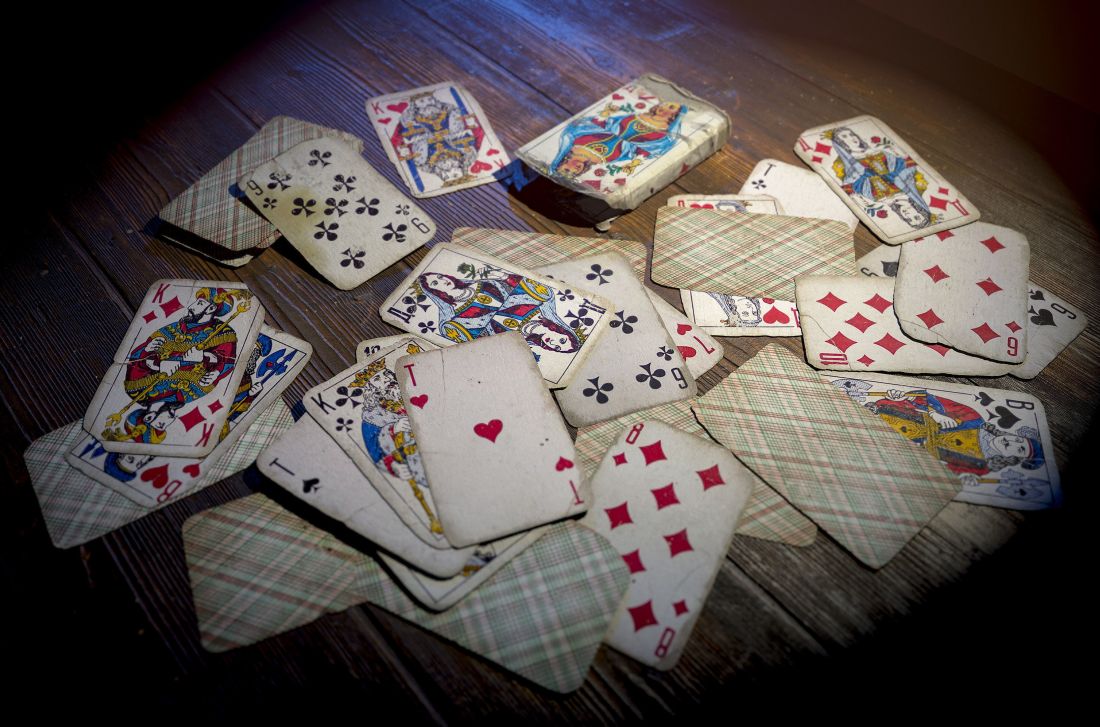
When playing cards first arrived in Europe toward the end of the 14th century AD, they caused quite a furor. In 1377, the town council of Florence complained that the playing of “a certain game called naibbe has recently been introduced into these parts,” and by a vote of 98 to 25 decided to prohibit it. In the same year cards reached Paris, where new city regulations cracked down on working-class cardplayers but apparently left nobel devotees alone.

European Playing Cards

The following year, in the Bavarian city of Regensburg, the council tried to limit card games to small stakes. By 1387, cards had arrived in the Spanish kingdom of Castile, where the government tried to ban them.

The killjoys were fighting a losting battle, however, for even at this early stage, cards began to acquire royal patrons. In 1379, the prince of Brabant, in Belgium, bought a highly decorated pack of cards, while in 1392 the mad French king Charles VI received three packs of cards painted by artist Jacquemin Gringonneur “for his amusement during the intervals in his sad illness.”

Charles VI/Gringonneur Cards

Playing cards soon led to the emergence of cardsharps, and the mother of all card swindles is recorded in the Parisian court annals for 1408. Two dubious characters lured a traveling merchant into an inn with talk of a good currency deal. One of them then produced a pack of cards from his pocket and demonstrated an amusing game of guessing the identity of a card while seeing only its back. The astute merchant soon noticed that one of the cards had a slight but distinctive mark on the reverse, so he happily joined in when the betting started. When the marked card turned up, the trader put his shirt on it, only to find that the front of the card was not the same, as it had been switched for another.

The French also made one great contribution to the development of playing cards by inventing, around 1480 AD, the names and shapes of the four suits (spades, hearts, diamonds, and clubs) we still use today. These simple geometric shapes did much to encourage card playing. By the end of the 15th century, playing card manufacture was a major industry, and even Johannes Gutenberg, often claimed to be the inventor of movable type, became involved.

Johannes Gutenberg Card

He developed some of the mechanical methods of production and, at a time when his finances were in desperate straits, he used drawings that his artists had prepared for his famous Bible to decorate the back of a deck of playing cards.

From this point the history of Western playing cards is clear. But who brought them to Europe in the first place? The subject is swathed in mystery, and it has at different times been claimed that they were introduced by Marco Polo (1254-1324), the Crusaders, or the Gypsies. The most exotic theories credit the Gypsies with the invention of cards (as a means of divination), and it has therefore been argued that their origins lie in India or even Egypt. The truth is that playing cards are a Chinese invention, but the problem has been that little is known of their transmission from China to the West.

Ancient Chinese Playing Cards

Playing cards had been invented in China by at least the 9th century AD when, according to tradition, a princess and her relatives played the “leaf game,” or cards. Women were certainly important in the development of card games, for one apparently wrote the world’s first book on the subject (now lost), later in that century.

By the 11th century, cards were printed with woodcut blocks, and in the early Ming dynasty (1369-1644 AD) famous artists were employed to design card backs with portraits of characters from favorite novels, such as The Water Margin. Chinese cards were much smaller than ours (about 2 inches long and 1 inch wide) and were printed on fairly thick paper, which made them hard-wearing but difficult to shuffle. Chinese “money cards” had four suits: cash, strings (of cash), myriads (of strings) and tens (of myriads), with the numbers 2 thru 9 in the first three and 1 thru 9 in the fourth.

Ancient Woodcut Playing Cards

The Chinese of yesteryear were enthusiastic cardplayers and gamblers, as they are today. Ming Dynasty books on cards praised them as superior to all other amusements, for they “were convenient to carry, could stimulate thinking and could be played by a group of four without annoying conversation, and without the difficulties which accompanied playing chess or meditation.” Also, “cards could be played in almost any circumstances without restrictions of time, place, weather, or qualification of partners.”

But this still leaves us without a link to Europe, for early Western cards don’t resemble Chinese ones and have different suits. The missing link appears to be the Islamic world, despite the fact that card playing was frowned on by Muslim clerics.

In 1938, Professor L.A. Mayer came across a pack of 52 cards while searching through the collections of the famous Topkapi Museum, in Istanbul, Turkey. They had been made in Egypt about 1400 AD, using designs that closely resemble those of early Italian cards.

Second card from left: The Seven of Swords (equivalent to Seven of Clubs)

Third card from left: the Malik of Cups (equivalent to the King of Hearts)

The Arabic inscriptions on the court cards make clear the origin of the word naibbe for cards (used by the Florence council); they are called the Malik (King), Na’ib Malik (Governor), and Na’ib Thani (Deputy Governor). They are in 4 suits – swords, polo sticks, cups, and coins (equivalent to modern clubs, spades, hearts and diamonds).

The only significant difference between these and early Italian cards is that the Egyptian ones are, like the Chinese, long and thin. Even this difficulty seems to have been overcome by the find of a single card with an Arabic inscription made around 1200 AD; its dimensions are like those of Italian cards, which are still slightly narrower than those made today in the rest of Europe.

There can now be little doubt that the Arabs were the intermediaries for the widespread transmission of one of ancient China’s most popular inventions.

Source: Ancient Inventions

MAGIC LANTERNS

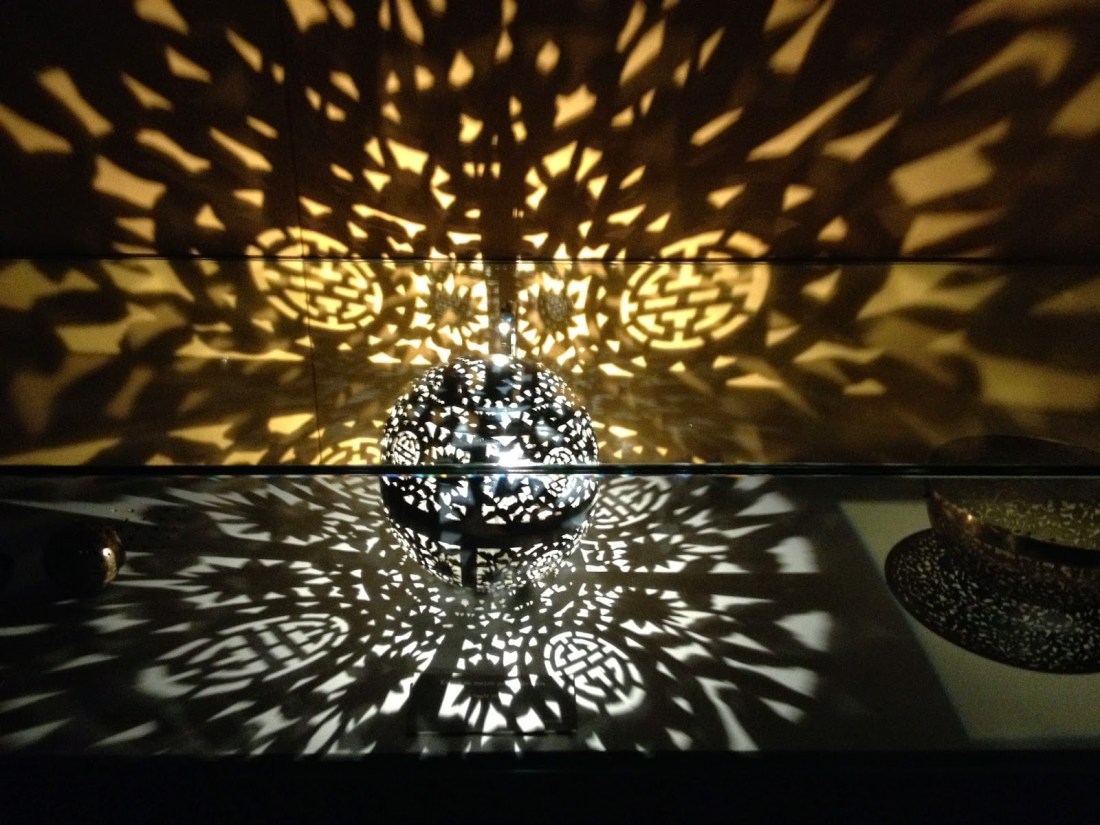
The magic lantern, or zoetrope, is little known today but it amazed and delighted audiences in Victorian drawing rooms. It also led, in the 20th century, to the invention of the slide projector and the cinema. In its final form, the zoetrope was a cylinder-shaped canopy of thin material suspended over a lamp. Vanes placed at the top caught the hot air rising from the lamp and made the cylinder rotate slowly.

On the sides of the canopy were thin panes of paper on which were painted pictures. As the cylinder revolved around the lamp, the light shone through the succession of pictures to give the illusion that the painted figures were moving — exactly the same principle as that behind modern motion pictures.

From Athanasius Kirchner’s “An Magna Lucis et Umbrae” of 1671

In 1868 Mr. W.B. Carpenter, the vice president of the Royal Society of London, stated with some confidence that the magic lantern had been invented by Michael Faraday, the famous pioneer of electricity as recently as 1836. He was certainly wrong, as one John Bate had already written about the zoetrope early in the 17th century. However, even Bate was merely describing a device long known elsewhere.

The principal of using heat to make small figures rotate is extremely ancient. In the Near East it goes back to Heron of Alexandria, who invented a toy with moving dancers in the 1st century AD. The Chinese version is even older, and far more advanced, as it involved the projection of images.

In 121 BC, a magician named Shao Ong staged a sort of seance for the Emperor Han Wu-ti, using moving images projected onto a screen. An earlier emperor, Han Gaozu, had a lamp in his possession in 207 BC that, when lit, showed the sparkling scales of turning dragons.

Around 180 AD the inventor Ting Huan created a “nine-storied hill censer,” which was apparently an extremely complicated multiple magic lantern. On it were strange birds and unusual animals, which turned around as the lamp burned.

By the 12th century AD, the most common form of zoetrope was the “horse-riding” or the “horse-pacing” lamp. After the lamp was lit a succession of prancing horses was projected onto the walls, moving as if they were alive. More sophisticated examples probably used lenses to produce stronger images. This was the type of magic lantern seen by early European visitors, and is undoubtedly provided the inspiration for the Jesuit priest of the China Mission Martin Martini (1614-1661). Martini presented the first lantern slides in Europe at Louvain, Belgium, in 1654, soon followed by other European scientists fascinated by the properties of light.

Bull Run Country Jamboree

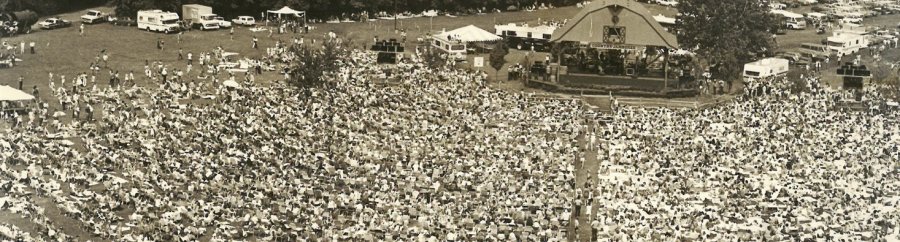
One of the fun activities in which I used to participate when I lived in No. Virginia was the Bull Run Country Jamboree. It began in 1982 at Bull Run Park in Manassas, VA and was held for 2 days the first year – in the following years, it became a 1 day show. It was much like an old fashioned carnival, craft show and concert – hairiest legs contests, smoothest legs contests, greased pig contests, with all of the attendant food and beverage trucks – yes, beer was included Yummmm…..funnel cake!!!!  This was HB giving my Mom a talking to that first year.

1982

What was so wonderful about Bull Run was the attitude of the people who attended. The gates to the park usually opened at 6 am – people would line up in their vehicles the night before, and party while they waited. It was open-air lawn seating, except for the campground area, and it was important to get there early to get a good spot. What was so unusual was that you could stake out your spot, spread out your blankets and chairs, and then simply walk away to peruse all the other entertainment. Come back an hour later and NOTHING would be touched!!! Everyone looked out for everyone else!

1982 Crowd

We attended Bull Run every year until 1988, when we moved to NE for 2 years. Of course, it was during that period that Garth Brooks played there and I missed it!!! If you listen to his song, “The Old Stuff,” you will hear him talk about Bull Run……there was a thunderstorm that knocked out the power!

In 1986, I gathered up a bunch of family – brother, sister, Mom, ex-hubby – and friends and off we all went to Bull Run, setting up our lawn chairs next to our vehicles to sleep until the gates opened – or partied – depending on one’s choice.

Carol and Mom

Towards the end of the concert, park staff would bring around trash bags and everyone cleaned up their own trash, with not a speck left once everyone was gone.

Most years, we had young children with us and those using intoxicants besides beer or wine generally congregated at the campsites. One of the few times I attended without HB, I went with a group of the young project officers from DHR, most of whom consumed MJ. 3 women, 2 guys. Since we weren’t camping, we would team up to visit the Port-O-Johns. One would go in first, do their thing, hit the bowl and set it on the side of the seat. The next person came in and repeated it, then everyone headed back to our spot.

It was my turn in the John…..I was unaware that outside, the police were trying to evict a drunk who insisted he just HAD to pee first! They bumped my friend from the line and placed the drunk there instead.

Debbie and Me

I did my thing, put the bowl on the side, against the wall, and opened the door! There stood 2 policemen on either side of the line, thankfully about 10 feet away…..I said, “Oh, excuse me, I left my wallet!” Grabbed that sucker and stuffed it in my pocket, and we walked away. That ended THAT activity for the day!!!!

The festival was moved to a new concert venue outside Haymarket, VA around 2007 or 2008. I attended one time and, frankly, it sucked!!!! No more open seating, no more food and beverage trucks, no more crafts. Never went again!!!! But, ah, the memories!!