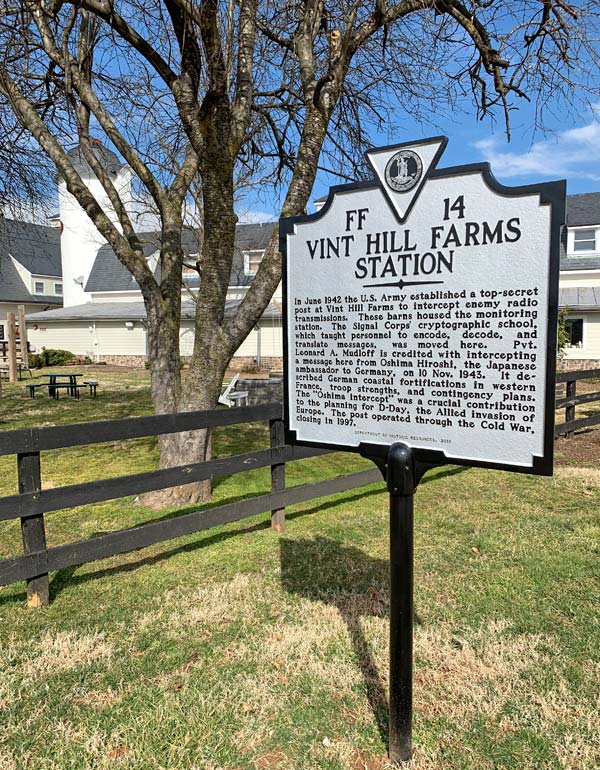
Vint Hill Farms Station is in a very rural area and Warrenton was chock full of rednecks. I was concerned about the reception the Egyptians would get in that area but it turned out not to be a problem at all. It was up to me to arrange all of their needs: hotel, meals, transportation, entertainment, etc., etc. I was told to go out and purchase a 15-person van so they could be transported back and forth. Got a pretty good deal, if I do say so myself.
I put them in a hotel on the outskirts of Warrenton and arranged with The Inn at Vint Hill (a historic building that used to be the home of the base commander) to provide all their meals, stressing that they were Muslim and would need special menus. I had to pick them up at the airport, which entailed several trips since they got hung up in NY and were split up. My roommate helped with his truck, and so did Heather.
One of them, young Magdi, was engaged (arranged by his family) and was supposed to purchase a wedding gown for his fiance. Yeah, no, THAT didn’t happen!!! By the end of their visit, he didn’t even want to return to Egypt – and his Father was an Admiral in the Navy!! I talked him out of staying and convinced him the right thing to do was to return to Egypt. I am in contact with Aziz on FB and he told me Magdi did end up marrying the girl!
Aziz is on the left, Magdi is on the couch
I invited them to my house for an old fashioned American bar-b-cue. They loved my Z, of course, given his Egyptian bloodlines, and had a ball playing basketball on the cement court. And, man, did they ever love Gage! I invited them for Thanksgiving dinner and, in return, they came to my house and prepared the Ramadan meal. Pffftt….burned the hell out of my pyrex pans (they didn’t know how to cook in them)…..but the food was great. First time I ever had Cilantro, which they used in the salad.
Next to the basketball court near the pasture
Moved the party to the deck!
They all varied in the depth of their religiosity – one of them, Mo, asked me if I had a room where he could pray where no dogs had been present. During Ramadan, most adhered to the rules but Magdi…..oh, Magdi…..he struggled!
The REAL fun, however, was when Heather took them out partying in DC. She worked as a bartender at the time and the bar owner had a limo all decked out with a full bar in the trunk that he let her have for the night. I told her in no uncertain terms – DO NOT LET THEM GET ARRESTED!!!! Of course, I was worried sick and was up at 5 am waiting for Heather to get home. Seven o’clock comes and goes and still…..no Heather. I am freaking by this time. I got on the phone and finally tracked her down at some friend’s apartment; however, she couldn’t come to the phone because she was in the bathroom puking. Oh, Lord!!!! I’m like: WHERE ARE MY EGYPTIANS????
I finally decided to just go over to their hotel to see if they had shown up there. Sure enough – just as I pulled in, here came the company Tahoe, with one of the Egyptians driving. Peter, who was supposed to be “in charge,” was passed out in the back!!! I haven’t a clue when or how they got hold of the Tahoe!!!
Peter
All-in-all, a very enjoyable and educational experience! The company closed down ever year between Christmas and New Years and, since I lived only a mile from the office, Hans told me I could have extra vacation time if I went into the office to take care of the daily needs during that period. I told him I would prefer going along on one of the teams’ trips to Egypt; he agreed and I got my passport updated. It did not surprise me when he backed out of that promise!!! Have I said yet that I do NOT like Austrians???!!?? He was a little man in many ways, NOT just physical status!!!! And that’s all I’ll say about Hans!!!!
Hans is on the left
I am wondering how many of you have had the experience of introducing foreigners to our country……it is interesting to listen to their expectations and views and fun to show them our way of life.
In 2001, I was working as Office Manager for an Austrian company, Schiebel Technology, that manufactured land-mine detectors and a new remote-controlled mini-helicopter – this was back when the UAVs (unmanned aerial vehicles) were really starting to come into use. It was called the Cam-Copter. The company had sold 4 systems to the Egyptian Navy and 8 Naval officers were scheduled to come to the US for training.
And then 9/11 happened…..we figured they would surely re-schedule but the owner, Hans, said no. He had to send over another trainer from Austria because the two Mikes who worked as training officers immediately re-enlisted to work with the Army UAVs. The office was located on the old Vint Hill Farms Station Army base. It was deactivated in 1997 and the land sold in 1999.
So, we had our work cut out for us – well, I did anyway. The Egyptians were due in about 10 days. We contacted the FBI, the State Patrol, and the local Sheriff’s office to notify them there were foreign nationals on their way. I printed up and laminated ID cards for them that gave a brief explanation of who they were, why they were here, and provided a contact phone number.
Every single one of them, to a man, supported the US in those horrible days. They were truly outraged that we had been attacked and were unfailingly polite and respectful. When I would ask them what they wanted to do, it was ALWAYS “go to the mall.” Sheesh! I DESPISED going to the mall! *sigh* Oh, well, duty calls. They all bought so much crap, they joked about getting their “pregnant suitcases” to the airport!!! We had to use my roommate’s trailer to get it all in!
I took them for a tour of Skyline Drive. Along the way, at one of the stops, there was a man who had stumbled and fallen on the rocks. He was bleeding pretty heavily and two of the Egyptians were medics. They immediately jumped in to care for him.
They were always looking for things to do on the week-ends and part of my responsibility was arranging for entertainment. Wajdi (who wanted to be a chef – he LOVED my big country kitchen) wanted to rent a car and go somewhere, suggesting Florida. I said, naw, way too boring, nothing but old retired people, and you already know what beaches are like. No, I said, YOU need to go to NY!
So he rented a car and off he went to NYC. As he was walking around, people kept asking him if he was from Spain. He kept explaining, no, I am from Egypt. About the sixth time someone asked him that, he decided to just say yes – it was easier. As chance would have it, there was an undercover FBI agent nearby who overheard him. He immediately approached him and gave him the 3rd degree about lying. Wajdi said at one point, he was thinking “Should I call a lawyer? No, I’ll just call Judy.” I was their American Mom!!!
One day, their minder/translator, Mr. Shehata (a guy from the Egyptian company with whom Schiebel partnered) came to me and said one of the guys had a problem and he was hoping I could help. He had been making calls to a 900 number, had spent his personal money, and was now broke.
I went over to the hotel and at first, got the brush-off. I put my foot down and insisted I wanted to talk to their Regional Manager and finally got a hard-copy printout of the calls. As I went through them, I could see that calls were made during the day, when they were at Vint Hill training. So, back to beard the Regional Manager in his den. I ended up getting ALL of his money refunded to him. After that, I was a Goddess and could do no wrong!!!!
Mr. Shehata is the only one in a suit
They were scheduled to fly out on Christmas day. Magdi and Aziz stayed at our house Christmas Eve, sharing our gift opening and celebrating with us. Truly amazing, wonderful group of guys! Except for Aymon, the one at the drums!!! His name became “Troublemaker Aymon” after he taught Gage what fun it was to throw a nerf ball into the ceiling fan!!!! We had soooo much fun!!!!
Gage jammin’ on his new guitar with Aymon
Before they left, they took all of us (me, my roommate Tom, Heather, and Gage) out to eat at the Olive Garden to show their appreciation for all we had done for them.
In 1895 Tesla’s New York lab burned, destroying years’ worth of notes and equipment. Tesla relocated to Colorado Springs for two years, returning to New York in 1900. He secured backing from financier J.P. Morgan and began building a global communications network centered on a giant tower at Wardenclyffe, on Long Island. But funds ran out and Morgan balked at Tesla’s grandiose schemes.
Tesla lived his last decades in a New York hotel, working on new inventions even as his energy and mental health faded. His obsession with the number three and fastidious washing were dismissed as the eccentricities of genius. He spent his final years feeding—and, he claimed, communicating with—the city’s pigeons. Tesla died in his room on January 7, 1943. Later that year the U.S. Supreme Court voided four of Marconi’s key patents, belatedly acknowledging Tesla’s innovations in radio.
Patent After Nikola Tesla was found dead in January 1943 in his hotel room in New York City, representatives of the U.S. government’s Office of Alien Property seized many documents relating to the brilliant and prolific 86-year-old inventor’s work
What happened to Tesla’s files from there, as well as what exactly was in those files, remains shrouded in mystery—and ripe for conspiracy theories. Three weeks after the Serbian-American inventor’s death, an electrical engineer from the Massachusetts Institute of Technology (MIT) was tasked with evaluating his papers to determine whether they contained “any ideas of significant value.”
Dr. John Trump
According to the declassified files, Dr. John G. Trump reported that his analysis showed Tesla’s efforts to be “primarily of a speculative, philosophical and promotional character” and said the papers did “not include new sound, workable principles or methods for realizing such results.” The scientist’s name undoubtedly rings a bell, as John G. Trump was the uncle of the 45th U.S. president, Donald J. Trump. The younger brother of Trump’s father, Fred, he helped design X-ray machines that greatly helped cancer patients and worked on radar research for the Allies during World War II.
Tesla, Trump, Trump
At the time, the FBI pointed to Dr. Trump’s report as evidence that Tesla’s vaunted “Death Ray” particle beam weapon didn’t exist, outside of rumors and speculation. But in fact, the U.S. government itself was split in its response to Tesla’s technology. Marc Seifer, author of the biography Wizard: The Life & Times of Nikola Tesla, says a group of military personnel at Wright Patterson Air Force Base in Dayton, Ohio, including Brigadier General L.C. Craigee, had a very different opinion of Tesla’s ideas.
Wizard: The Life & Times of Nokola Tesla
“Craigee was the first person to ever fly a jet plane for the military, so he was like the John Glenn of the day,” Seifer says. “He said, ‘there’s something to this—the particle beam weapon is real.’ So you have two different groups, one group dismissing Tesla’s invention, and another group saying there’s really something to it.”
Then there’s the nagging question of the missing files. When Tesla died, his estate was to go to his nephew, Sava Kosanovic, who at the time was the Yugoslav ambassador to the U.S. According to the recently declassified documents, some in the FBI feared Kosanovic was trying to wrest control of Tesla’s technology in order to “make such information available to the enemy,” and even considered arresting him to prevent this.
Yugoslavan Ambassador Sava N. Kosanovic
In 1952, after a U.S. court declared Kosanovic the rightful heir to his uncle’s estate, Tesla’s files and other materials were sent to Belgrade, Serbia, where they now reside in the Nikola Tesla Museum there. But while the FBI originally recorded some 80 trunks among Tesla’s effects, only 60 arrived in Belgrade, Seifer says. “Maybe they packed the 80 into 60, but there is the possibility that…the government did keep the missing trunks.”
Despite John G. Trump’s dismissive assessment of Tesla’s ideas immediately after his death, the military did try and incorporate particle-beam weaponry in the decades following World War II, Seifer says. Notably, the inspiration of the “Death Ray” fueled Ronald Reagan’s Strategic Defense Initiative, or “Star Wars” program, in the 1980s. If the government is still using Tesla’s ideas to power its technology, Seifer explains, that could explain why some files related to the inventor still remain classified
Although some of his more sensitive innovations may still be hidden, Tesla’s legacy is alive and well, both in the devices we use every day, and the technologies that will undoubtedly play a role in our future. “Tesla is the inventor of wireless technology. He’s the inventor of the ability to create an unlimited number of wireless channels,” Seifer says of the inventor’s lasting impact. “So radio guidance systems, encryption, remote control robots—it’s all based on Tesla’s technology.”
Serbian-American engineer and physicist Nikola Tesla (1856-1943) invented the first alternating current (AC) motor and developed AC generation and transmission technology. Though he was famous and respected, he was never able to translate his copious inventions into long-term financial success—unlike his early employer and chief rival, Thomas Edison.
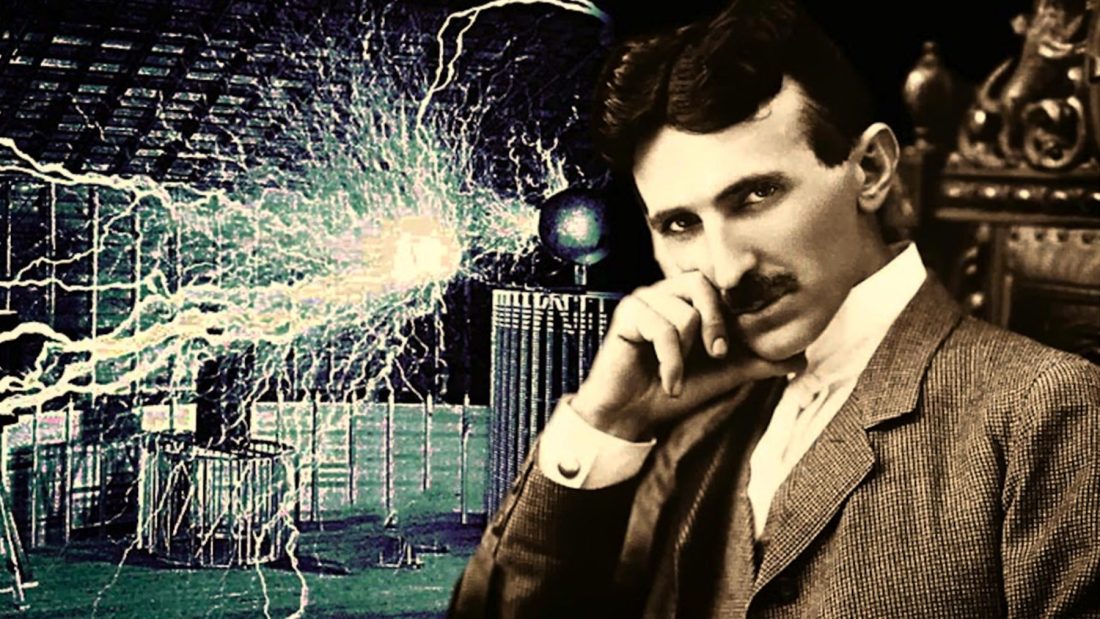
Nikola Tesla
Nikola Tesla was born in 1856 in Smiljan, Croatia, then part of the Austro-Hungarian Empire. His father was a priest in the Serbian Orthodox church and his mother managed the family’s farm. In 1863 Tesla’s brother Daniel was killed in a riding accident. The shock of the loss unsettled the 7-year-old Tesla, who reported seeing visions.
Young Tesla in the lab
In 1870, Tesla moved to Karlovac (Carlstadt) and stayed with his Aunt and Col. “Old War Horse” Brankovic. He attended “Higher Real Gymnasium” where teacher Martin Sekulic taught him math and physics and had a decided influence over him. Tesla graduated Gimnazije Karlovac a year early.
House where Tesla lived in Karlovac
Did you know? During the 1890s Mark Twain struck up a friendship with inventor Nikola Tesla. Twain often visited him in his lab, where in 1894 Tesla photographed the great American writer in one of the first pictures ever lit by phosphorescent light.
Tesla and Twain
Tesla studied math and physics at the Technical University of Graz and philosophy at the University of Prague. In 1882, while on a walk, he came up with the idea for a brushless AC motor, making the first sketches of its rotating electromagnets in the sand of the path. Later that year he moved to Paris and got a job repairing direct current (DC) power plants with the Continental Edison Company. Two years later he immigrated to the United States.
Nikola Tesla and Thomas Edison
Tesla arrived in New York in 1884 and was hired as an engineer at Thomas Edison’s Manhattan headquarters. He worked there for a year, impressing Edison with his diligence and ingenuity. At one point Edison told Tesla he would pay $50,000 for an improved design for his DC dynamos. After months of experimentation, Tesla presented a solution and asked for the money. Edison demurred, saying, “Tesla, you don’t understand our American humor.” Tesla quit soon after.
Nikola Tesla and Westinghouse
After an unsuccessful attempt to start his own Tesla Electric Light Company and a stint digging ditches for $2 a day, Tesla found backers to support his research into alternating current. In 1887 and 1888 he was granted more than 30 patents for his inventions and invited to address the American Institute of Electrical Engineers on his work.
His lecture caught the attention of George Westinghouse, the inventor who had launched the first AC power system near Boston and was Edison’s major competitor in the “Battle of the Currents.” Westinghouse hired Tesla, licensed the patents for his AC motor and gave him his own lab. In 1890 Edison arranged for a convicted New York murderer to be put to death in an AC-powered electric chair—a stunt designed to show how dangerous the Westinghouse standard could be.
Edison’s Electric Chair
Buoyed by Westinghouse’s royalties, Tesla struck out on his own again. But Westinghouse was soon forced by his backers to renegotiate their contract, with Tesla relinquishing his royalty rights. In the 1890s Tesla invented electric oscillators, meters, improved lights and the high-voltage transformer known as the Tesla coil.
Early Tesla Coil
He also experimented with X-rays, gave short-range demonstrations of radio communication two years before Guglielmo Marconi and piloted a radio-controlled boat around a pool in Madison Square Garden. Together, Tesla and Westinghouse lit the 1893 World’s Columbian Exposition in Chicago and partnered with General Electric to install AC generators at Niagara Falls, creating the first modern power station.
World Otter Day occurs on the last Wednesday of May, which is May 31 this year. Otters are beautiful, playful animals that live in wetlands across the world. Species are declining due to habitat destruction, reduction of prey, roadkill, and illegal trade for fur and as pets.
There are 13 different species, 12 of which are disappearing. Seven of these species are classified as vulnerable and five are endangered. The International Otter Survival Fund founded World Otter Day with two goals in mind. First, to help raise awareness of the dangers that otters face. Second, to educate people on how to protect their habitats.
River Otters
Sea Otters
HISTORY OF WORLD OTTER DAY
World Otter Day had humble beginnings as Otterly Mad Week, a week of events, education, and fun. Then International Otter Awareness Day was founded before becoming the International Otter Survival Day, then World Otter Day, whose singular purpose is to ensure that future generations can enjoy these charming animals.
International Otter Survival Fund began in 1993 to protect and help the different species of otters worldwide. It was inspired by observing otters in their natural habitats. The Fund is one of the world’s leading charities with various projects that protect otters. They have dedicated over 20 years of research to conserving, protecting, and caring for otters and have developed a worldwide program to encourage education on otters.
To date, they have supported projects in 44 countries and helped cubs in 33 countries.
Since 2009, they held workshops across the world in places such as Cambodia, Indonesia, Bangladesh, and China. The workshops provide training in otter field techniques, public awareness programs, law enforcement, and general conservation issues. Some other activities include research, campaigns, training, and otter hospitals.
5 FACTS ABOUT OTTERS
1. Most of them live in Alaska: About 90% of all sea otters live on the coast of Alaska.
Alaska Otters Rebound
2. They have their own tools. Otters use rocks to open clams and carry them around in case they are needed.
3. They are amazing at holding their breath. Sea otters can hold their breath for five minutes and river otters can hold theirs for eight.
4. They have a thick fur. Sea otters lack any blubber, so their thick, dense, water-resistant fur keeps them warm.
5. Their dung tells a story. Scientist believe they may be able to determine the sex, age, and reproductive status of an otter just by studying it’s dung.
WHY WORLD OTTER DAY IS IMPORTANT
Otters are cute. We don’t need too much convincing to spend the day learning about them. They are the cutest, quirky, furry animals.
Conservation is always a plus. World Otter Day focuses on teaching people about the conservation of our planet and our wildlife.
It’s a worthwhile global cause. Otters are found all over the world. They are also celebrated in over 20 different countries.
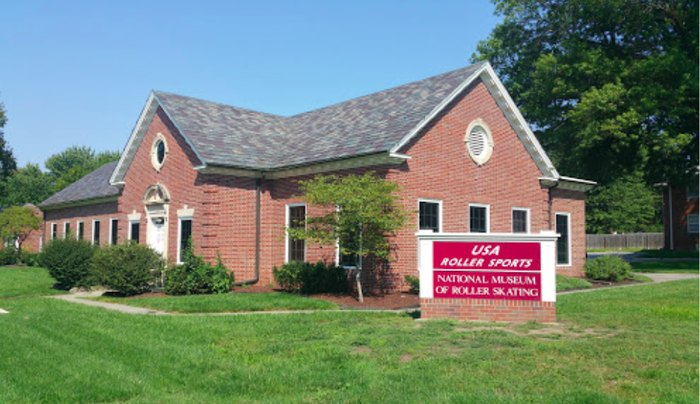
Since 1980, Lincoln, Nebraska has been the home of a one-of-a-kind museum that most people aren’t even aware of. The National Museum of Roller Skating sits in an unassuming little brick building that it shares with the headquarters of USA Roller Sports, the national governing body of roller sports. The next time you’re in the area, don’t pass by this hidden gem; step inside and get to know a fascinating part of American history.
The people behind the National Museum of Roller Skating believe that everyone should know about this delightful activity and its long history. What comes to mind when you think of roller skating? If you’re of a certain age, you probably picture couples gliding hand-in-hand around a hardwood floor as live music floats through the air from the on-site organist.
Younger people may picture a similar scene, but with a DJ and colorful flashing lights in place of a live organist. No matter what your personal experience is with roller skating, chances are you’ve got some positive associations with the activity.
Those fond memories – and much more – are all on display in this unique museum. The exhibits trace the history of roller skating back through the generations, all the way to the early 19th century.
When you visit, you’ll see some early versions of roller skates, beginning with the most primitive pieces of wood with wheels attached.
Some of the crowd-favorite exhibits are the rare and unusual types of roller skates. Would you ever try to race around the rink in these cowboy-boot skates?
Other exhibits tell little-known stories of roller skating as a sport, a hobby, and an all-around cultural phenomenon.
The museum houses the world’s largest collection of roller skating items, making it a must-visit for anyone who has ever felt a rush of excitement as they laced up a pair of skates.
The museum also contains the National Roller Skating Archives, a collection of publications and other information on all aspects of roller skating’s history.
Roller skating is explored here as a sport and an art form, as a diplomatic tool, and a unifying experience that just about everyone can enjoy. See old costumes and uniforms and read all about the surprising ways in which roller skating has influenced the world.
Whether your interest lies in leisurely rolls around the rink, dominating in a roller derby league, or even competitive speed-skating, you’ll find fascinating information at the museum about this underrated all-American activity.
Address: National Museum of Roller Skating, 4730 South St, Lincoln, NE 68506, USA
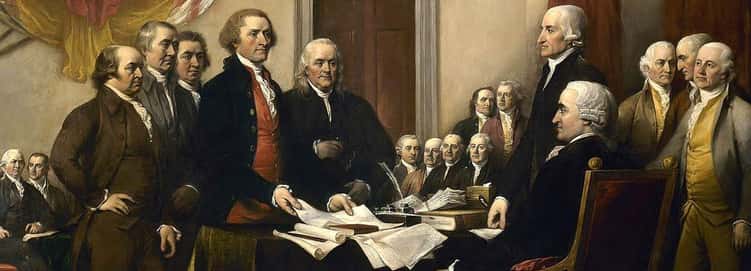
America’s history is a brief yet rich one. Relative to the rest of the world, we are still just a little baby of a country. We often forget that our founding fathers were humans just like the rest of us — they just happened to have lived some 300 odd years before we did, and, you know, wrote the Declaration of Independence. But these American heroes had their flaws and their secrets, too.
These secrets about the founding fathers are both surprising and eye-opening. There are myths about these men that we’ve all gone along believing our whole lives without a second thought. But in some cases, we may have been entirely wrong!
Thomas Jefferson
Thomas Jefferson Was A Terrible Public Speaker
The author of the Declaration of Independence and our third president only ever gave two speeches, one at each of his inaugurations. While he was elegant with words on paper, he didn’t like speaking out loud, much less in front of large crowds. The speeches he did give were delivered very quietly, too.
Thomas Jefferson was also addicted to learning. Born April 13 (April 2 on the pre-Gregorian calendar), 1743 at his father’s Shadwell plantation in Virginia, Jefferson was one of 10 children (eight of whom survived to adulthood). While he attended the College of William and Mary, he was said to have studied for 15 hours daily on top of violin practice. The hard work paid off: Jefferson moved into law studies before becoming a lawyer in 1767. Two years later, he became a member of Virginia’s House of Burgesses, the Virginia legislature. His autodidact ways continued throughout his life: Jefferson could speak four languages (English, Italian, French, Latin) and read two more (Greek and Spanish).
John Adams
John Adams And Jefferson Were Rivals
John Adams and Jefferson were the only two signers of the Declaration to become president, but they also hated each other’s guts. Before Jefferson passed away on July 4, 1826, he had finally made amends with John Adams, the president who preceded him in office and for whom Jefferson served as vice president. The two men, once on the same side, had grown to resent the other’s approach to diplomacy and politics, with Jefferson lamenting Adams’s preference for centralized and meddlesome government—though according to Jefferson, the major issue was the so-called “Midnight Judges,” appointments that Jefferson felt “were from among [his] most ardent political enemies.”
Strangely, Adams passed away the same day as Jefferson, just five hours later. The date, July 4, was also the 50th anniversary of the Declaration of Independence being adopted.
George Washington
George Washington Didn’t Have Wooden Teeth
This is a fun fact that lots of people like to pull out of their back pocket, but it isn’t even true. George Washington’s teeth were actually made of bone, hippopotamus ivory, human teeth, brass screws, lead, and gold metal wiring. That’s quite the mouthful right there. And his hair was all real but it looks white because he powdered it.
He was a very moral and virtuous man, and he watched carefully everything he did. But he certainly doesn’t fit into our conception of a Christian evangelical or somebody who read his Bible every day. He was not an atheist on the one hand, but on the other hand, he was not a devout Christian. But what about he story of him kneeling in the snow at Valley Forge to pray? “That’s a story that was made up by [early Washington biographer] Parson Weems.” Oh, and Parson Weems, who wrote a myth-filled biography of Washington shortly after he died, made up the cherry tree story. The Mount Vernon Digital Encyclopedia identifies that book, The Life of Washington, as “the point of origin for many long-held myths about Washington.”
Benjamin Franklin
Adams Was “Out Of His Senses”
Well, at least according to Benjamin Franklin. And it seems the feeling was mutual. The two were at the French court of Versailles together as ambassadors when Adams wrote that a statue in the court would make a better ambassador than Franklin. Harsh!
Adams thought Franklin uncouth, vulgar, pretentious…and those were his good qualities. Their poor relationship got off to a rocky start in the fall of 1776. Franklin and Adams had to share a room and a bed in Brunswick where Adams and Franklin went to parley with Adm. Lord Richard Howe over a possible end to hostilities. Adams wanted to sleep with the window closed. Franklin wanted it open. Adams thought it would cause him illness. Franklin thought it would cause good health. After much argument, Franklin prevailed.
Adams grew to dislike Franklin more in Paris. Franklin wore plain clothes for effect. Adams disapproved of his garb. Franklin was a particular favorite of French women. Adams could not understand why this was the case. Adams thought Franklin behaved disreputably and immorally. He did not see how Franklin was using his conduct to obtain contacts and access. What Adams could not understand was how Franklin used these idiosyncrasies to advance the nation.
Paul Revere Wasn’t The Only Midnight Rider
A 16-year-old girl named Sybil Ludington rode 40 miles, twice Revere’s distance, when the British took Danbury, CT. She may have even staved off a band of highway robbers on the way. On April 26, 1777, at age 16, Ludington, the daughter of a colonel in the Colonial militia, Henry Ludington, is said to have made an all-night horseback ride 40 miles (64 km) to rally militia forces in neighboring towns after the burning of Danbury, Connecticut by British forces.
Relatively unknown through the 1870s, Ludington became widely recognized around the time of World War II, after historic road markers were placed in locations she was speculated to have visited on her ride. Memorial statues honor her, and books have been written about her. She was honored on a United States Bicentennial postage stamp that was released on March 25, 1975, which depicts her on a horse.
Peggy Shippen
Benedict Arnold Had Help With His Famous Betrayal
Arnold’s wife, Peggy Shippen, was half his age when they met. She’d previously had a fling with a British spy, John André, and introduced her old lover to her new husband. Together, the three of them plotted to give West Point to the British, which would have squashed America’s independence entirely.
Benedict Arnold
Rumors Swirled Around Washington’s Lack Of Children
Many historians have speculated that perhaps George Washington struggled with infertility, as he had no children of his own. Experts say that tuberculosis often causes this extremely common condition in men. Throughout his life, Washington suffered from a laundry list of ailments: diphtheria, tuberculosis, smallpox, dysentery, malaria, quinsy (tonsillitis), carbuncle, pneumonia, and epiglottitis—to name a few.
“Classic studies of soldiers with tuberculous pleurisy during World War II demonstrated that two-thirds developed chronic organ tuberculosis within five years of their initial infection. Infection of the epididymis or testes is seen in 20 percent of these individuals and frequently results in infertility.”
James Madison
James Madison Used A Secret Code
Madison—like any good politician—was terrified by the idea that someone might intercept one of his private letters. Along with Jefferson and many mutual allies, Madison used complicated encryptions when relaying delicate info. “Having now the use of my cypher,” he informed Jefferson in 1784 after mastering a new system, “I can write without restraint.”
Said to be shy and reserved, Madison apparently had a counterbalance in wife Dolley, who entertained the whole of Washington. At the time, the city was not exactly a hotbed of partying, and her lavish affairs helped endear congressional members to the idea of Madison as president. To date, Madison remains our smallest president at 5 feet, 4 inches and 100 pounds.
Both of James Madison’s vice presidents died in office. George Clinton kicked the bucket in 1812. His short-lived replacement was former Massachusetts governor Elbridge Gerry, who’d redistricted that state to tip the political scales in his favor—a process we now call “Gerrymandering.” Gerry also died in office, and is the only signer of the Declaration of Independence to be buried in Washington, D.C.
He also had a sharp sense of humor. Politics is a pretty serious career, but that didn’t take away Madison’s sense of humor. Among friends, he was known for his quick wit, quippy banter, and well-timed personal anecdotes.
Franklin House
Skeletons Were Buried Under Franklin’s London Home
No, he didn’t murder the people. There was a human anatomy class being run from his basement, which was a very tricky subject at the time. The bones from 15 different bodies were found when, in 1998, work was being done on the historic home.
While all of the Founding Fathers are renowned for pushing the idea of liberty and independent choice, Benjamin Franklin apparently came to the idea a little late. In 1725, when he was just 19 years old, Franklin self-published a pamphlet titled ‘A Dissertation Upon Liberty and Necessity, Pleasure and Pain,’ which argued that humans didn’t actually have free will and weren’t responsible for their behavior. Maturity prevailed, however, and Franklin later burned almost every copy of the booklet he could find.
Ben Franklin’s eccentricity wasn’t limited to that strange philosophy. He once had a plan to rearrange the English alphabet by eliminating the letters C, J, Q, W, X, and Y, declaring them redundant. It didn’t katch on.
If you’re reading this while watching a sunrise, you might have Ben Franklin to thank. A more reasonable Franklin contribution: bifocals, which he invented in order to both see from a distance and read text up close without having to switch lenses.
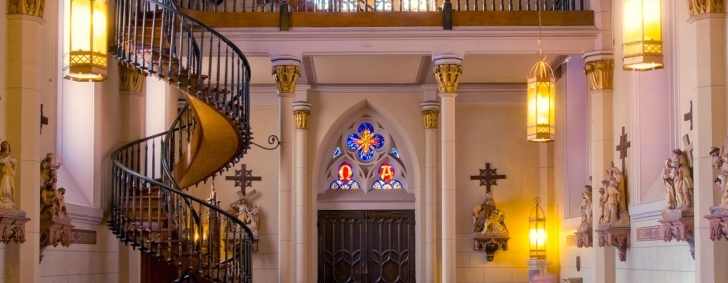
In the center of Sante Fe, NM stands a former Roman Catholic Church, known as the Loretto chapel, that was constructed in the popular Gothic Revival style by French architect Antoine Mouly. To Bishop Jean-Baptiste Lamy’s dismay, Mouly didn’t live to see the chapel completed. The renowned architect passed away when the chapel was nearly done, leaving the chapel unfinished.
Despite the beauty and craftsmanship of the chapel, it lacked a critical component, a staircase. As the story goes, the chapel was completed in 1878, but there was no way to get to the choir loft, which is 20 feet off the ground. The Sisters believed this to be a test of faith and set out to find a new carpenter to finish the work promptly.
Legend of the Loretto Chapel Staircase Miracle
According to legend, which has since been made into a movie called “The Staircase” (1998), the nuns didn’t want the staircase to be big because it would take up too much space, so they went to get advice from the local carpenters.
Unfortunately, they met with many carpenters, none of whom could provide a solution that worked for the Sisters. Some said it couldn’t be done, while others quoted an outrageous price. The only option was to use a ladder, which was deemed inappropriate due to the sister’s attire.
In 1880, the Sisters started praying to the patron saint of carpenters, St. Joseph. They asked for a solution to their dilemma and prayed for over a week. According to the historical account, on the 9th day, a man arrived on his mule with some tools. He revealed to the Sisters that he was a carpenter by trade, and they eagerly invited him in.
This carpenter was unlike any who had come before him, and shortly after viewing the problem, he admitted that putting a staircase in was possible, even ones that wouldn’t take up too much space or be an eyesore.
But he asked to be alone in the chapel for three months and, with only simple tools including a saw, T-square, and a hammer, he built the ‘miraculous’ staircase. It is a spiral staircase making two complete 360 degrees rotations but without using a central pole and without using any nails, only wooden pegs.
The bannister of the staircase is perfectly curved, a remarkable accomplishment considering the basic tools that were used. The shape of the helix is not a stable weight-supporting structure, and without the middle column it shouldn’t be able to withstand the weight of people using the staircase.
When the man finished the staircase, he left without asking for a cent. The nuns tried to find him but they could not. They did not know who he was or where he got the wood. Ten years later the railing was added to the staircase by Phillip August Heasch for safety reasons.
The order decided to honor the carpenter’s deed with a banquet, but when it was time to feast, they could not find him. He had disappeared without a trace; he did not identify himself during his time there or ask for payment. Because his identity remains a secret, the Sisters believed him to be St. Joseph, answering their prayers. The number of steps is of religious significance because it was Jesus’ age during his crucifixion. This realization only further convinced the Sisters and fueled the story that St. Joseph had come to their rescue.
With the staircase finished, the chapel was finally complete, but the mystery of its construction was impossible to ignore, and many pondered how the carpenter accomplished the job. The manager of the privately owned chapel (1991-2006), Richard Lindsley, took a piece of wood from the staircase and sent it for analysis. When the results came back, they showed that it was spruce, but of an unknown subspecies. This specific wood was very strong with dense and square molecules – which is something that you usually find in trees that grow very slowly in very cold places like Alaska.
However, there was no such wood in the area and no local trees grow in the Alpine tundra in the surrounding area. The closest place that he would find this density in trees was in Alaska, but of course back then transport was not the same as it is now and wood was not transported over such long distances.
Were the Stairs Created by a Man from a French Secret Society?
Santa Fe New Mexican offers an alternative explanation for the amazing staircase. It’s said that when historian Mary J. Straw Cook researched the stairs for a book she was writing, she “found information in an 1881 nun’s daybook that a man named Rochas was paid for wood.” Francois-Jean Rochas, an alleged “member of a French secret society of highly skilled craftsmen and artisans called the Compagnons, which had existed since the Middle Ages” has been named as the skilled woodworker who apparently “came to the U.S. with the purpose of building the staircase with wood shipped from France.”
When a group of stair-building professionals convened at the Loretto Chapel a few years ago to see the staircase they were shocked at the beauty, design, and engineering of the stairs. A couple of their comments on the workmanship after analyzing the stairs are:
“We all like to think we create creative stair designs and nice curved staircases, but to think how they did it that long ago and still attain the same quality is breathtaking” and
Later, Cook found a newspaper article mentioning Mr. Rochas and that he was a skilled woodworker who built the staircase. Rochas was a member of a secret French society of skilled artisans known as the Compagnons and had come to the U.S. to design the Santa Fe staircase specifically; the wood came from France.
Even with all the advances in technology and engineering, no one can determine how the staircase was built. The stairs are a beautiful and mysterious element of the Loretto Chapel, regardless of the facts around its construction.
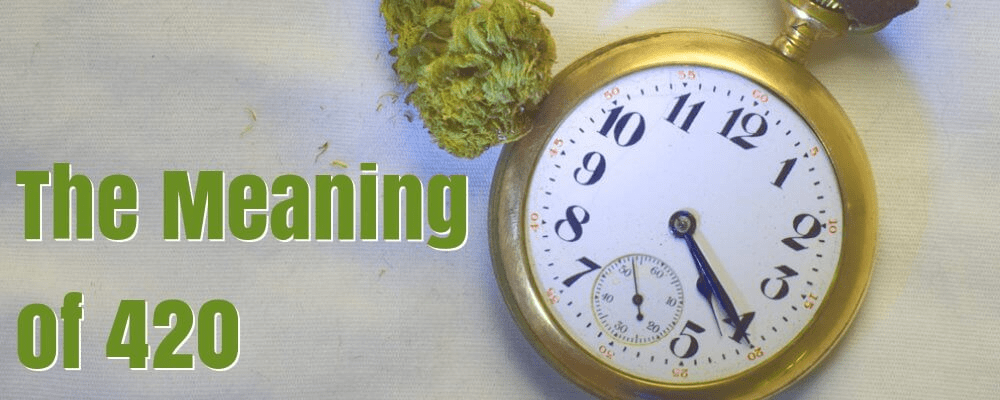
There have been many misconceptions, fallacies, falsehoods, and media inaccuracies about the beginnings of ‘420’, and even about The Waldos. Rogues and fogged burnouts turn up across the internet claiming they started ‘420’, fictionally making up dates that precede The Waldos’ creation date with their revisionist history. Unfortunately, as things grow in popularity, sometimes people “crawl out of the woodwork” to claim they were part of it.
The Waldos, from left, Mark Gravitch, Larry Schwartz, Dave Reddix, Steve Capper and Jeffrey Noel by the statue of Louis Pasteur at San Rafael High School in San Rafael, California in 2018. (Photo: Associated Press/Eric Risberg)
The Waldos are the only ones with multiple pieces of physical-evidence proof of the very earliest usage of the term ‘420’. In fact, The Waldos are the only ones in the world with any proof at all. The Waldos story/proof of ‘420’ origination has been investigated, and verified, by numerous credible journalistic news organizations. The Waldos are the real creators of the term 420.
This photo shows dried cannabidiol (CBD) flower buds on February 16, 2022 in Paris. April 20 or “4/20” is the event in the calendar that stoners look forward to every year, becoming a celebration of cannabis culture.
Meet The Waldos
“In the fall of ’71, Waldo Steve was given a treasure map to a patch of weed on the Point Reyes Peninsula. The map was given to him by a friend whose brother was in the U.S. Coast Guard and was growing cannabis. The coastguardsman was paranoid he would get busted so he granted permission to harvest. The Waldos™ all agreed to meet at 4:20 p.m. at the statue of chemist Louis Pasteur on the campus of San Rafael High. They met, got high, and drove out to search for the patch.
In the ensuing school days the Waldos would use the term ‘420 Louie™’ to remind each other of their after school quest. They eventually dropped the ‘Louie’ part and just said ‘420’ to refer to cannabis. Originally ‘420’ was nothing more than the Waldos’ secret slang–their own private joke–however, it was picked up by others and spread from generation to generation, city to city, country to country, across decades, and throughout all media around the globe. The Waldos have published multiple pieces of “evidence” to give credence to their theory, including letters from college and the original “420” flag from the 1970s.
Point Reyes Forest
Spreading the Word
Initially “420” began as private joke for their own meetups, but the phrase supposedly caught traction via the group’s connection with the rock band ‘The Grateful Dead,’ also based in Marin County Hills at that time, only blocks away from the high school the Waldos attended. One of the Waldos, Mark Gravitch, had a father who managed real estate for the band, while the brother of Dave Reddix (another Waldos member) managed a Grateful Dead side-band and was close friends with Grateful Dead bassist Phil Lesh.
Grateful Dead
The Grateful Dead practiced at a rehearsal hall in San Rafael, California and the Waldos used to hang out there at watch, Reddix said. His older brother Patrick spread the “420” phrase with the band through Lesh. “And me, too, because I was hanging out with Lesh and his band [as a roadie] when they were doing a summer tour my brother was managing,” Reddix added.
Capper added: “We’d go with [Gravitch’s] dad, who was a hip dad from the ’60s. There was a place called Winterland and we’d always be backstage running around or onstage and, of course, we’re using those phrases. “When somebody passes a joint or something, ‘Hey, 420.’ So it started spreading through that community.”
“Winterland Auditorium stage in 1976”
Capper said Marin County was “ground zero” for the California counterculture, which saw hippies smoke weed as a form of protest against government policies, such as the Vietnam War. Later, banners calling from 4:20 p.m. meetings on 4/20 were found circulating at gatherings ahead of Grateful Dead concerts.
Today, 4/20 can mean a whole host of different things to weed smokers, as well as the industry. Hundreds of sellers show off their marijuana products at 4/20 rallies each year. For example, the aptly-named California town Weed hosts its own 4/20 festival:
“The City of Weed, California, Threw Huge Blowout to Celebrate 420
Published April 21, 2022, by Chris Moore
“What better place to celebrate the year’s biggest cannabis holiday than a town named Weed? Yesterday, a tiny Northern California city called Weed hosted its fourth annual festival to celebrate 4/20, the official cannabis holiday. The event was held by La Florista Cannabis dispensary, which just happens to be the only weed shop in Weed. Organizers shut down a block of the city’s Main St. for a blowout featuring bands, a DJ, a taco truck, and – you guessed it – legal cannabis. The dispensary offered special “swag bags” for customers, plus promos on flower, pre-rolls, vape carts, edibles, and pretty much every other product they sell.
With all the hype surrounding California’s fabled cannabis industry, one might speculate that the town of Weed might have adopted this name just to cash in. But the town’s unique name actually comes from its founder, a pioneer named Abner Weed. In 1897, Weed bought a 280-acre lumber mill in the area that eventually became the current City of Weed.
Weed was initially quite reluctant to embrace its cannabis namesake. Residents and elected officials initially resisted attempts to capitalize on the town’s potential for pot tourism but did agree to allow La Florista to open in 2018. Since then, Weed has slowly been warming up to weed. Last January, the city council voted to impose a 3% local cannabis sales tax, which city officials predicted would bring them about $100,000 a year.”
Watch a marijuana documentary….Learn more about the history of cannabis and the controversies surrounding it today by watching a marijuana documentary, such as “Grass is Greener, High Country: The Future of Weed,” “The Culture High” and “The Legend of 420.”
Those are all movies that require payment. This one, however, is surprisingly honest, even tho it came via PBS. The FDA (i.e., HHS) consciously CHOSE to block ALL study on the efficacies of MJ for health purposes simply by refusing to take it off the list of dangerous drugs to free up research $$$. They want to control ALL of it!!!! Bayer/Monsanto has been locking up the medical MJ business for a very long time!!!
Try some cannabis recipes
Try a recipe or two from “The Official High Times Cannabis Cookbook,” which features more than 50 tasty recipes to get you high.
Listen to a marijuana podcast
Learn more about the ins and outs of the cannabis industry on ‘The Adam Dunn Show,’ ‘Brave New Weed’ and ‘Cannabis Cultivation and Science Podcast.’
Video of the effects of CBD on Parkinsons and Epilepsy:
Parkinson’s Sufferer Shows The Incredible Effect Marijuana Has On His Tremors
A Little Girl With Epilepsy Tries Cannabis Oil
Toddler’s seizures treated with medical marijuana
“20 Medical Studies That Show Cannabis Can Be A Potential Cure for Cancer”
EXCERPT: “Let’s take a look at the science behind cannabis and cancer. Although cannabis has been proven to be an effective treatment for a wide range of ailments, this article will focus mainly on its effects on cancer.
Cannabinoids, which refer to any of a group of related compounds that include cannabinol and the active constituents of cannabis, may very well be one of the best disease- and cancer-fighting treatments out there. They activate cannabinoid receptors in the body, and the body itself produces compounds called endocannabinoids that play a role in many processes within the body that help to create a healthy environment.
Cannabinoids are also involved in immune system generation and re-generation. The body regenerates best when it’s saturated with phyto-cannabinoids.”
This disappeared and I had to use the Wayback Machine:
A picture taken at the Archaeological Museum in Athens on September 14, 2014 shows a piece of the Antikythera Mechanism, a second-century B.C. device known as the world’s oldest computer which tracked astronomical phenomena and the cycles of the solar system.(Image credit: LOUISA GOULIAMAKI/AFP via Getty Images)
The Antikythera mechanism is an ancient shoebox-sized device that is sometimes called the world’s oldest computer for its ability to perform astronomical calculations. Discovered by sponge divers off the Greek island of Antikythera in 1901, the remains of the mechanism are now preserved in the National Archaeological Museum in Athens. Only 82 fragments, consisting of about one-third of the original mechanism, survive today, It was built around 2,200 years ago.
The mechanism was capable of performing different calculations, and it could help track the motions of the sun, moon and five of the planets; it could even tell when athletic competitions, such as the Olympics, were set to take place, the researchers wrote. Since the discovery of the Antikythera mechanism, scholars have been trying to understand the device. And although they have made considerable progress, many questions remain unanswered. For example, researchers still aren’t sure who made it. The inscriptions on the mechanism are written in Greek.
An engraving illustration of the last hour of Archimedes, the mathematician who died in 212 B.C. or 211 B.C. when the Romans captured Syracuse, Sicily. (Image credit: mikroman6 via Getty Images)
The recovered fragments of the mechanism contained writing and inscriptions, and over the past two decades, scientists have been able to read more of these Greek inscriptions using high-tech imaging methods, such as 3D X-ray scanning. This has enabled them to learn more about how the mechanism worked.
CT scans “revealed inscriptions describing the motions of the sun, moon and all five planets known in antiquity and how they were displayed at the front as an ancient Greek cosmos.” The mechanism used “cycles from Babylonian astronomy, mathematics from Plato’s Academy and ancient Greek astronomical theories.”
More pieces of the Antikythera Mechanism at the Archaeological Museum in Athens.(Image credit: LOUISA GOULIAMAKI/AFP via Getty Images)
Between the front and back of the mechanism were a vast array of gears, designed in such a way that all the dials would depict the correct timing of all the cycles. “Suppose a user of the Antikythera Mechanism wants to check eclipse predictions for a particular month some years ahead. The user winds the mechanism forwards to the desired date, as shown on one of its calendars,” Tony Freeth, a researcher with the Antikythera Mechanism Research Project, wrote in a paper published in 2014 in the journal “PLOS One.”
Though the ship that held the Antikythera mechanism was discovered more than a century ago, the wreck has not been fully excavated. Its location and depth make it hard to excavate. Despite these difficulties a new program of excavation is being carried out by a team of archaeologists and new artifacts continue to be found, shedding light on what the ship, which likely sank around 65 B.C. was like.
Marine archeologists also found a bronze arm from a sculpture in the same shipwreck. Credit: Greek Ministry of Culture
Researchers have noted that many of the artifacts were luxury goods intended for the wealthy. So far, the recent excavations have not uncovered any new remains of the mechanism.
Excavations in 2016 at the Antikythera shipwreck found a nearly intact skull, including the cranial parietal bones. (Image credit: Brett Seymour, EUA/WHOI/ARGO)
Antikythera Mechanism rewrote the history of science
In 2015, Kyriakos Efstathiou, a professor of mechanical engineering at the Aristotle University of Thessaloniki said: “All of our research has shown that our ancestors used their deep knowledge of astronomy and technology to construct such mechanisms, and based only on this conclusion, the history of technology should be re-written because it sets its start many centuries back.”
In 2016, yet another astounding discovery was made when an inscription on the device was revealed—something like a label or a user’s manual for the device. It included a discussion of the colors of eclipses, details used at the time in the making of astrological predictions, including the ability to see exact times of eclipses of the moon and the sun, as well as the correct movements of celestial bodies.
A model of the Antikythera Mechanism was made by Derek De Solla Price. Credit: Public Domain
Inscribed numbers 76, 19 and 223 show maker “was a Pythagorean”
On one side of the device lies a handle that begins the movement of the whole system. By turning the handle and rotating the gauges in the front and rear of the mechanism, the user could set a date that would reveal the astronomical phenomena that would potentially occur around the Earth. Physicist Yiannis Bitsakis has said that today the NASA website can detail all the eclipses of the past and those that are to occur in the future. However, “what we do with computers today, was done with the Antikythera Mechanism about 2000 years ago,” he said.
Making this incredible machine even more impressive is the fact that the movements of the planets are directly linked to specific observation sites around the known world at the time, suggesting that the creator of the Antikythera Mechanism had provided for the use of the machine in more than one location.
Bones found at the Antikythera Mechanism shipwreck site
Greece’s Ministry of Culture issued a statement in late 2019 informing the public that ”bones were collected, which now need to be analyzed, (as well as) olive kernels, and bronze nails from the ship as well as a bronze ring, whose use remains unknown.”
Among the findings which were discovered were sections of the bodies of ancient amphorae, as well as the bases and the necks from the main bodies of the vases. The types of amphorae are identified as those which were typically used on the island of Kos and in Southern Italy in ancient times.
The Greek Ministry noted ”this scientific mission of October 2019 completed the first five-year research program. Based on the results of the latest research, preparations for the new five-year program, starting in May 2020, will begin immediately with the continuation of excavation research in various areas of the wreck, where there are good indications that impressive new findings will come to light.”
“The mission was concluded with great success despite adverse weather conditions and the limited length of time for the rescue research,” the Ministry added.
A video titled “2017 Return to Antikythera Expedition” looks at the delicate and often hazardous work marine archeologists do in recovering ancient gems from the depth of the seas. That expedition, led by the Greek Ephorate of Underwater Antiquities, Lund University, and Woods Hole Oceanographic Institution, was conducted between September 4th to September 20th of that year, and as per previous trips to the wreck, the team did not leave disappointed.
With excellent weather conditions above them, the divers managed to recover an “orphaned” right arm of a bronze statue, pottery shards, nails, lead sheathing fragments, and an odd metal disc, among other artifacts. Prior to that expedition, the Return to Antikythera project team managed to recover glassware, luxury ceramics, anchors, counterweights, tools, and even an ancient skeleton, which is still undergoing DNA analysis.




















 Sew Colorful