

During the early spring of 1863 in Richmond, Virginia—the capital of the Confederacy—thousands of working-class Southern women were struggling as their husbands were either off fighting the Civil War or had died in battle. Then, hyperinflation from spending and a weak Confederate currency drove the prices of food and other goods way up, and families started to go hungry.
The nation had convulsed in division and the lives and futures of America’s enslaved hung in the balance, but frustration also simmered among white people within the Confederacy. Seething class resentment was building among working-class white women at the seemingly fruitless sacrifices they were making. Wealthy, families who owned several enslaved people weren’t affected as much by conscription and the economic struggles. By the beginning of April, it reached a boiling point, leading to one of the largest civilian uprisings during the Civil War. The Richmond Bread Riot became one of several throughout the South led by women.
“They had as many reasons to be mad as possible,” says Edward L. Ayers, a Civil War historian with the University of Richmond and founding chair of the board of the American Civil War Museum in Richmond.
“Not only are they losing their husbands, but they are losing them for a cause that doesn’t seem to offer any award for them,” says Ayers, Tucker-Boatwright Professor of the Humanities.
Richmond Leaders ‘Alarmed’ by Women’s Actions
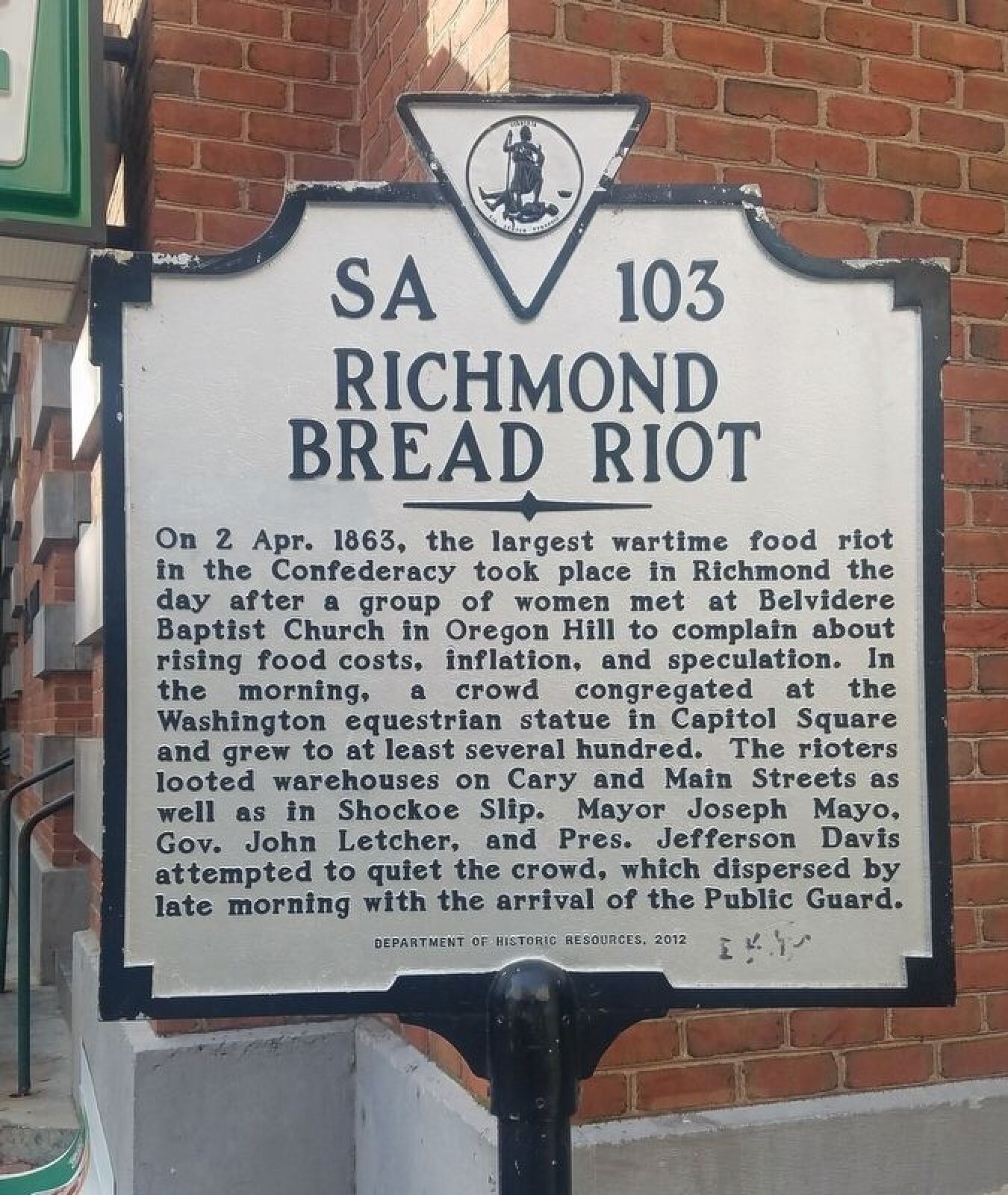
The women had tried demanding help from the government—to no avail. In fact, the government had recently made things worse with the March 26, 1863 passage of the Impressment Act, which empowered Confederate forces to seize food and other supplies as needed in the field. So, on April 2, the Thursday of Easter week in 1863, hundreds of women (and some men) took to the streets of Richmond and attacked and raided businesses.
Gregg D. Kimball, director of public services and outreach for the Library of Virginia, says that Richmond leaders were alarmed by the women’s actions, and did their best to downplay it and condemn the rioters. Many said the participants “are from the dregs of society.”
“For women to do something this provocative in Southern society was not something that was looked upon positively,” Kimball says. “It went against this whole notion of the Southern woman that was constructed.”
The Bread Riot Ringleaders
History records two main women who planned and instigated the protest: Mary Jackson and Minerva Meredith. Jackson was a 34-year-old mother of four and a huckster who worked in the Richmond open market selling groceries, and loudly complaining about rising food prices to anyone who would listen. Little is known about Meredith, but she had a reputation of being very tall with a robust, and somewhat imposing presence, Kimball says.
Jackson and Meredith initially met with a small group of women on April 1 at Belvidere Hill Baptist Church. They resolved to meet at Capitol Square the next morning and demand to speak to Virginia Governor John Letcher, and word spread. On April 2, Jackson and Meredith and a group of as many as 200 to 300 women went to the George Washington Equestrian Statue, erected in 1857.
The leaders demanded to the governor’s aide that they speak to Letcher. There are some conflicting accounts: Some say the governor refused to see them, while others say he did speak to the women.
Regardless, the women were displeased with the governor’s dismissive attitude and unwillingness to help them. The protesters, many armed with knives and pistols, stormed off down Richmond’s 9th Street, crying out: “We celebrate our right to live! We are starving! Bread or blood!”
They marched along the cobblestones of 9th Street right by the capitol building, both of Virginia and the Confederacy itself. As onlookers watched the march, hundreds joined in. Some men also joined, most likely as opportunistic looters for merchants like jewelry stores rather than crusaders for hungry families, Kimball and Ayers say.
The rioters—at least 400 to 500 of them, by estimates—plundered warehouses where bacon and flour and other foods were stored, along with grocers and other stores. The Bread Riot name reflects stealing flour for baking bread more than stealing loaves of bread, Ayers explains. The word “bread” served as a general word for food.

Although some injuries were reported, nobody was killed during the incident, which was more like a mass looting and protest than a violent riot. The mayhem lasted about two hours, during which both Gov. Letcher and Confederate President Jefferson Davis reportedly went out to the streets to tell the rioters to stop. Richmond Mayor Joseph Mayo read the protesters the Riot Act—a British edict for stopping insurgents that the American government adopted in the Militia Act of 1792, and individual states personalized. Law enforcement then came in to squelch the riot.
Aftermath of the Riot
Many participants later were brought to trial and charged with crimes for their rioting, but fewer than 100 were punished, Kimball says. A lot of the older and poorer women were convicted, but younger, better-dressed women were not.
Douglas O. Tice Jr., author of The Richmond Bread Riot: Women at War, says there are many conflicting accounts about details, and like war battles, it’s not likely any one person witnessed the whole thing. But the Richmond Bread Riot got women noticed, and the effects were lasting.
“Women, up until this event, were basically ignored as far as their needs and desires were concerned,” Tice says. “This was a desperate act, which took great courage and stamina to put in place. It was an enormous act to acquire the very basics for their struggling families and in doing so gave them some attention into the gravity of their circumstances. … They stood up for once and were noticed.”
SOURCE: HISTORY.COM
 Sew Colorful
LikeLiked by 1 person
SPIT!!!!!!!!!!!!!!!!!!!!!!!!!!!!!!
maybe she’s born with it…..LOLOLOLOLOL soooo true!
LikeLiked by 1 person
LikeLiked by 2 people
I loved the Calvin one!!! i did stuff like that in my creative writing classes…even in college…LOLOLOLOL
LikeLiked by 1 person
LikeLiked by 1 person
awwwwwwwwwwwwww…I want lab results too!!!!!
LikeLiked by 1 person
Adorable, right? Every now and then, I think about getting another dog….but no puppy that has to be trained!
LikeLiked by 1 person
me either. I want one potty trained…lol
LikeLiked by 1 person
what kind would you want?
I’ definitely want a short haired dog. preferably a lab
LikeLiked by 1 person
Australian Shepherd is my favorite breed but I’d like a mini.
LikeLiked by 1 person
whoa..I had to look that one up. pretty dog, but the long hair? that wouldn’t work for me. We had a collie growing up and she was faithful and smart. but the long hair all over drove Mom nuts…lol
LikeLiked by 1 person
It’s not that bad – nowhere near as long as a collie – but it’s best to keep them clipped if you can’t brush frequently.
LikeLiked by 1 person
we never took the dogs to the vet. we couldn’t afford it. we got the collie because a road crew found her and she didn’t have a collar and they asked everyone in the area and no one claimed her. they saw our house had kids and asked if we wanted a free puppy and Mom fell in love with her. She named her Hobo…lol
LikeLiked by 1 person
I’d just buy a clipper and do it myself.
LikeLiked by 1 person
the new acting AG
LikeLiked by 1 person
LikeLiked by 1 person
Industrial designer Luigi Colani with his famous Frog motorbike, 1973.
Wombats can be a handful
The Wright Brothers could never have imagined this.
Meanwhile, in Thailand….
Pull up a stool, coffee’s on
LikeLiked by 1 person
Pledging Allegiance
Newsletter | April 2, 2026
“America is at a pivotal point in the arc of its history. What started nearly 250 years ago as an arrangement between freeborn men and women to preserve faith, family, and freedom has, over time, been abused by those we’ve chosen to lead us. And this week, they’ve used the supreme law of the land, the Constitution, to betray us in the birthright citizenship case argued before the Supreme Court.
The argument that anyone born in our country, despite their parents’ immigration status, is entitled to citizenship has been based on the Fourteenth Amendment to the Constitution. Ratified in 1868, the amendment stipulates that “All persons born or naturalized in the United States, and subject to the jurisdiction thereof, are citizens of the United States.” It was written to guarantee citizenship to the descendants of formerly enslaved people after the end of the Civil War. Since then, it’s been applied broadly to anyone, save the children of foreign diplomats and a few others, born on U.S. soil. And that has created perverse incentives that may spell doom not only for our social cohesion but also our political system.
Political officials on both sides of the aisle have promoted birthright citizenship to demonstrate that America is a just and diverse society. In reality, they just see it as a way to grow a constituency that is dependent on handouts, an electoral base more like a third-world patronage network rather than knowledgeable American voters. Thus, birthright citizenship is an instrument to rig American politics.
Citizenship based solely on place of birth minimizes the significance of the cultural integration and civic participation that are signs of allegiance to our flag and devotion to our country. That’s what real patriotism is. Without a meaningful bond between citizens and our nation, citizenship is nothing but a transaction, and a dangerous one at that. Giving those who happened to be born here access to public benefits that come at taxpayer expense threatens to bankrupt America and divides it between those who bear the burdens of paying for benefits and foreign freeloaders.
Equally dangerous is the phenomenon known as “birth tourism.” Ask any immigration official or employee at a large U.S. airport who weekly sees hundreds, maybe thousands of visibly pregnant foreign women flying in from every continent to give birth here. It’s illegal to enter America with the primary intent to obtain citizenship for their child, but it’s hard to prove that intent and stop them. Some countries have even established networks to send women here to give birth, set up hostels, provide post-natal care, and obtain U.S. citizenship for their newborns, who then act as “anchors .” The People’s Republic of China has turned the birth tourism business into a political operation designed to weaken America.
Consider this “nightmare” scenario put forth on social media by a former federal prosecutor, and similar disastrous outcomes raised by others: Eventually, tens of millions of Chinese nationals become U.S. citizens via birthright citizenship, and vote by mail is adopted nearly nationwide. Vote by mail ballots are forwarded en masse to U.S. citizens who are actually Chinese nationals. The Chinese Communist Party directs all those ballots in favor of one candidate, which means that Beijing will come to control the outcome of our presidential elections. That is, birthright citizenship may in time strip us of our birthright — the right to choose our own leaders.
Patriots have a vital interest in the outcome of this Supreme Court case because we have a stake in the future of our country. Take a stand, stay informed, and remember the words of Founding Father Benjamin Franklin, it’s “A Republic, if you can keep it.” Two hundred and fifty years on, we’re still fighting for our freedom!”
LikeLiked by 1 person
Good night, Pat!
LikeLiked by 1 person
Good Night Filly!
LikeLiked by 1 person
Good Night All!
LikeLike
I take note of the timing. G. Washington died in 1799. His statue was erected in 1857. That was almost 60 years before conflict separated north and south.
LikeLike