

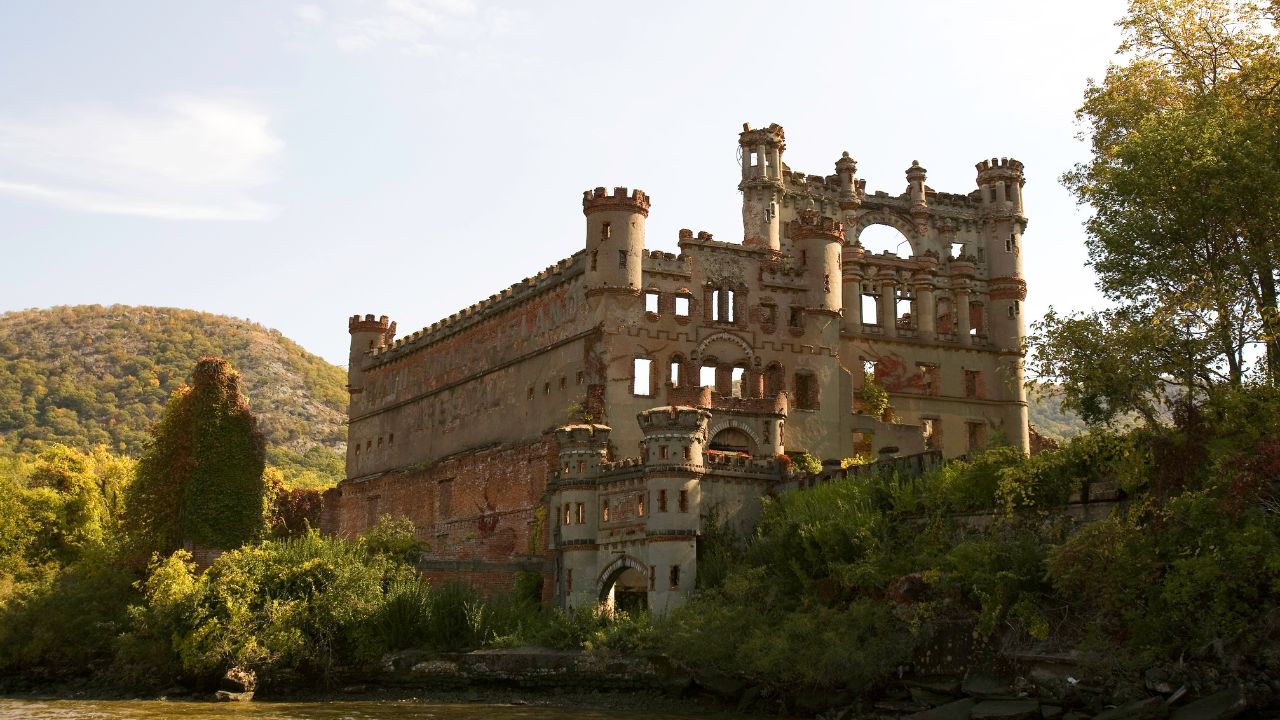
Today’s entry is an abandoned castle on the Hudson River in New York.
From: allthatsinteresting.com:
Built by an eccentric arms dealer on the isolated Pollepel Island, the Scottish-influenced Bannerman Castle looks like something out of a fairytale — but it has a spooky mythology all its own.
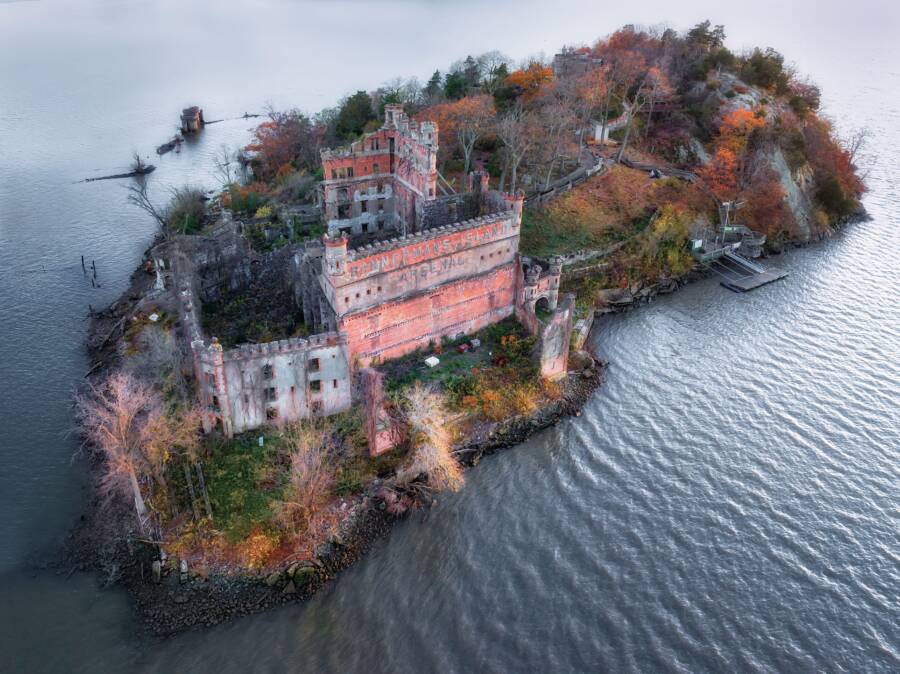
About 60 miles north of New York City, on the supposedly haunted shores of Pollepel Island in the Hudson River, sits the ruins of a 20th-century fortress known as Bannerman Castle. Originally built in the early 1900s as an army surplus arsenal, the castle was abandoned after it was damaged in a series of fires and explosions.
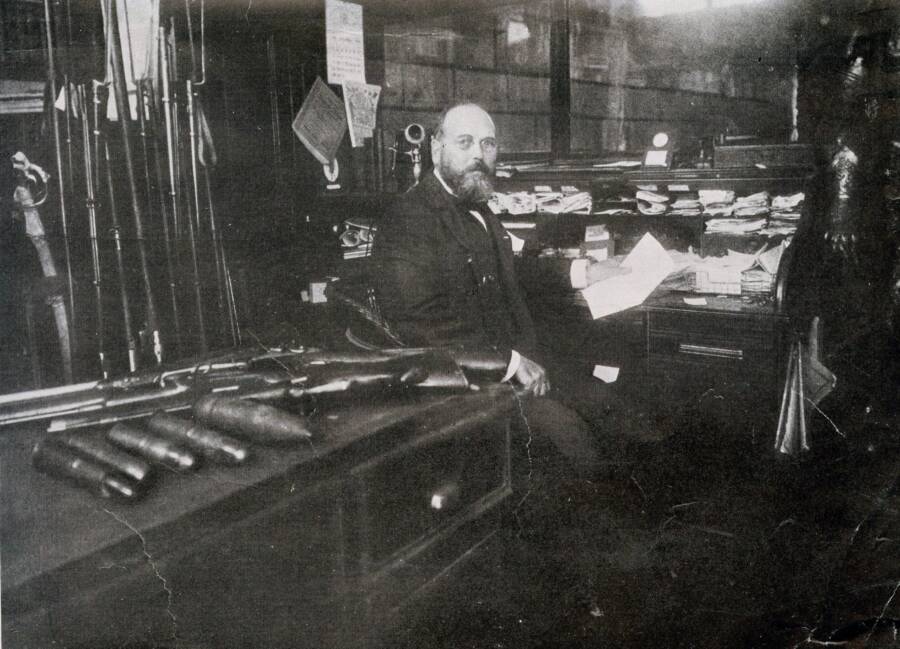
Francis Bannerman, the eccentric weapons tycoon who built the castle, was not your average arms dealer. A first-generation Brooklynite of Scottish descent, he was a pacifist who regarded his vast military collection a tribute to the lost art of weapon making. However, his castle and its grounds would prove to be his greater legacy.
Originally based in Manhattan, Bannerman’s business — and vast supply of flammable black powder — grew so large that the city of New York forced him to move out. His son discovered Pollepel Island while out canoeing on the Hudson, and Bannerman purchased it in 1900 to build a huge arsenal to store his weapons stock.
From there, he brought the baronial, Scottish-inspired Bannerman Castle into existence.
The Construction Of Francis Bannerman’s Architectural Oddity
Francis Bannerman was not an architect. That’s what makes the Gaudi-esque character of the castle and its accompanying buildings so astounding. Rather than work with professional architects, Bannerman designed the castle almost entirely by himself, often drawing up plans on the backs of napkins and envelopes to create the estate in the style of a Scottish fortress.
When Bannerman Castle was nearly finished, barges ferried cannons and artillery up the river for storage. But Bannerman and his wife Helen decided to keep building. They designed an additional castle to serve as a family summer residence, complete with lovely gardens, a dock, a moat, and even an outhouse built for two.
The Bannermans landscaped the gardens themselves, importing soil, digging winding pathways around the island, and building the garden walls. Helen Bannerman enhanced the terraces with plants, flowers, and shrubs — some of which are still alive today.
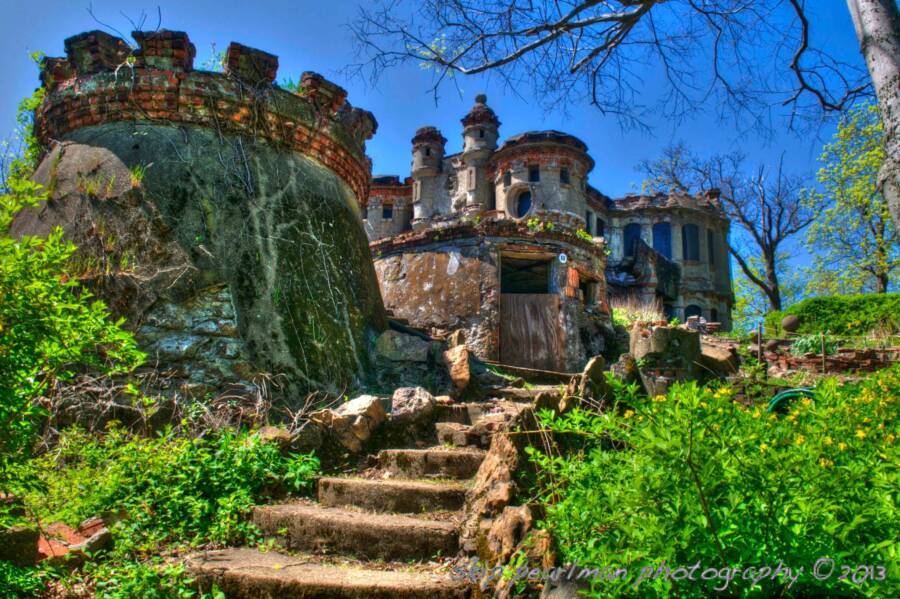
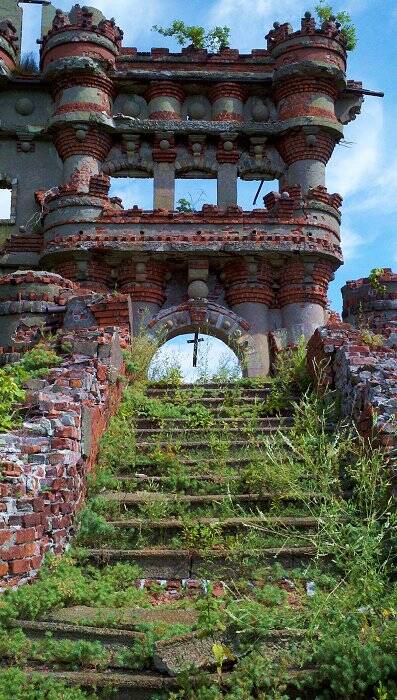
With Scottish, Moorish, and Belgian design influences, the castle was alive with intricate stone and brickwork. Everything was elaborately adorned with thoughtful details. Bannerman even had the name “Bannerman’s Island Arsenal” emblazoned on its façade.
“There is no way to describe something so eccentric,” said Thom Johnson, vice-president of the Bannerman Trust, according to the non-profit Historic Hudson River Towns. “Look at the north view — there’s no right angles on these buildings! Look at all these textures, all that he did with masonry. It’s a piece of sculpture! The style is almost gaudy, but somehow, he manages to pull it off. Bannerman knew exactly what he was doing, and he did it his own way.”
The Haunted History of Pollepel Island
Before Bannerman Castle, Pollepel Island had a spooky history all its own. The portion of the river surrounding the island had a reputation for violent storms and howling winds. According to local Hudson Valley legend, Dutch sailors in the 17th and 18th centuries attributed these storms to a sinister Goblin king who resided on the island.
The sailors named this being the “Heer of Dunderberg” — “Heer” meaning King, “dunder” meaning thunder, and “berg” meaning mountain. The Heer of Dunderberg was said to rule an army of imps, and had the power to summon the violent storms that wreaked havoc on passing ships.
According to believers, during these infamous squalls, you can still hear the captain of the ghost ship The Flying Dutchman barking orders to his crew.
However, it’s possible that this “folk legend” was invented by Washington Irving, author of The Legend of Sleepy Hollow. Irving’s literary success is due in part to his knack for writing tales of lore that sound like they could be true — and he detailed the legend of the Heer of Dunderberg in his 1822 short story “The Storm-Ship.”
Bannerman Castle Falls To Ruin
Unfortunately, Bannerman Castle has seen its share of catastrophe.
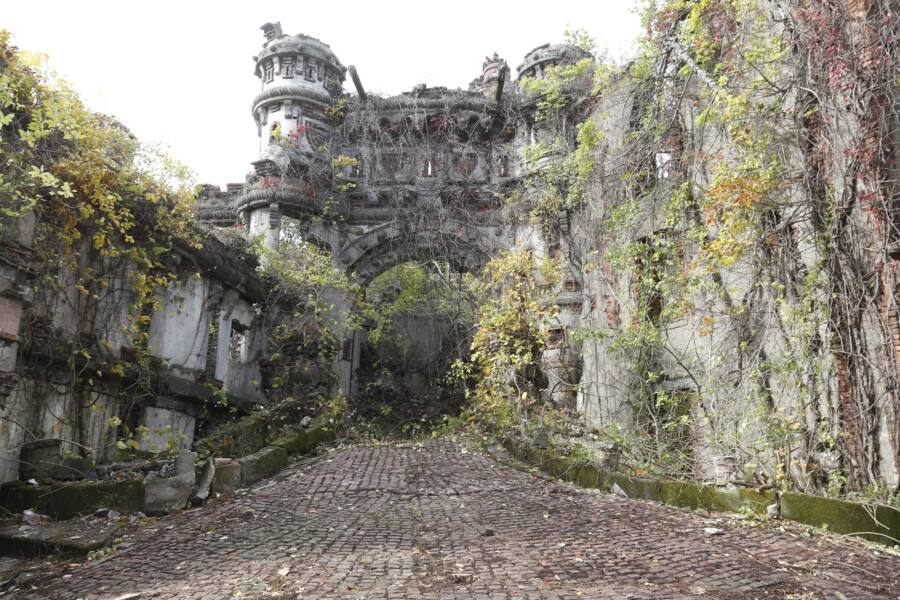
In 1918, Frank Bannerman died before the castle was 100 percent complete. Then, in 1920, the arsenal’s powder house exploded, lending credence to New York City’s decision to boot Bannerman from city limits.
“The explosion was heard from Poughkeepsie to Peekskill,” Steve Santangelo, a tour guide at the castle, said to the New York Times. And 6sqft reports that about 200 tons of shells and powder were involved in the blast.
The explosion damaged the castle, shattering the windows and jettisoning part of the tower into the river. The Bannerman family, narrowly escaping death, remained in the residence until about 1930. That’s when the castle began crumbling.
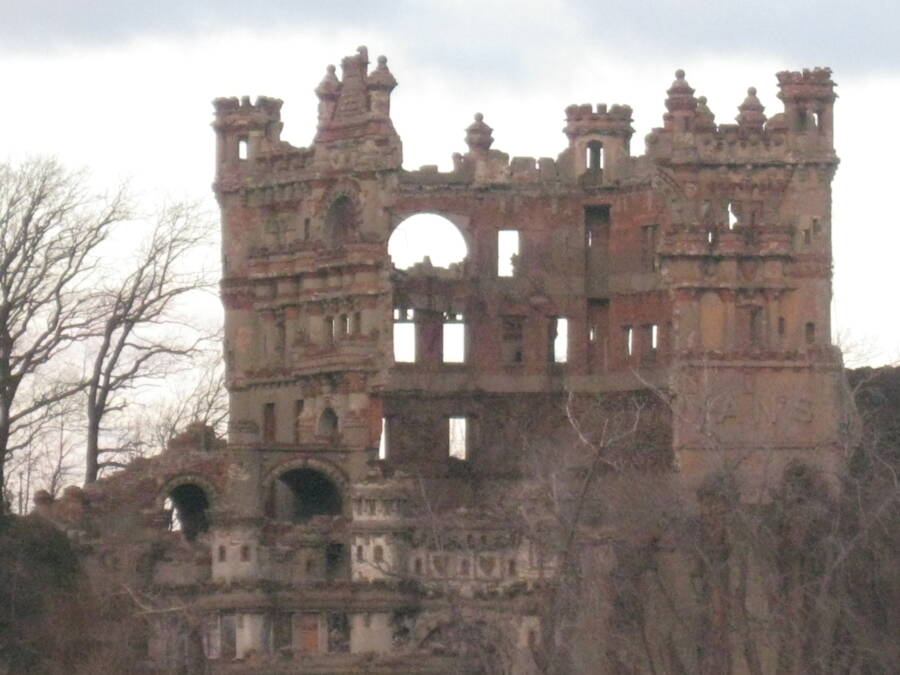
In 1967, the Bannerman family sold the island to New York State; two years later, it’s suspected that an arsonist set the mysterious fire that reduced the castle to ruins.
Eerily, seven years before the blaze, Frank’s grandson Charles had written prophetically: “No one can tell what associations and incidents will involve the island in the future. Time, the elements, and maybe even the goblins of the island will take their toll of some of the turrets and towers, and perhaps eventually the castle itself.”
For years, New York banned visitors from Pollepel Island because it was too dangerous. That didn’t stop people from illegally visiting and photographing the abandoned castle. Poison ivy ran rampant and snakes infested the grounds, but visitors still braved these hazards — and the choppy waters of the Hudson River — for a glimpse of the crumbling historic ruin.
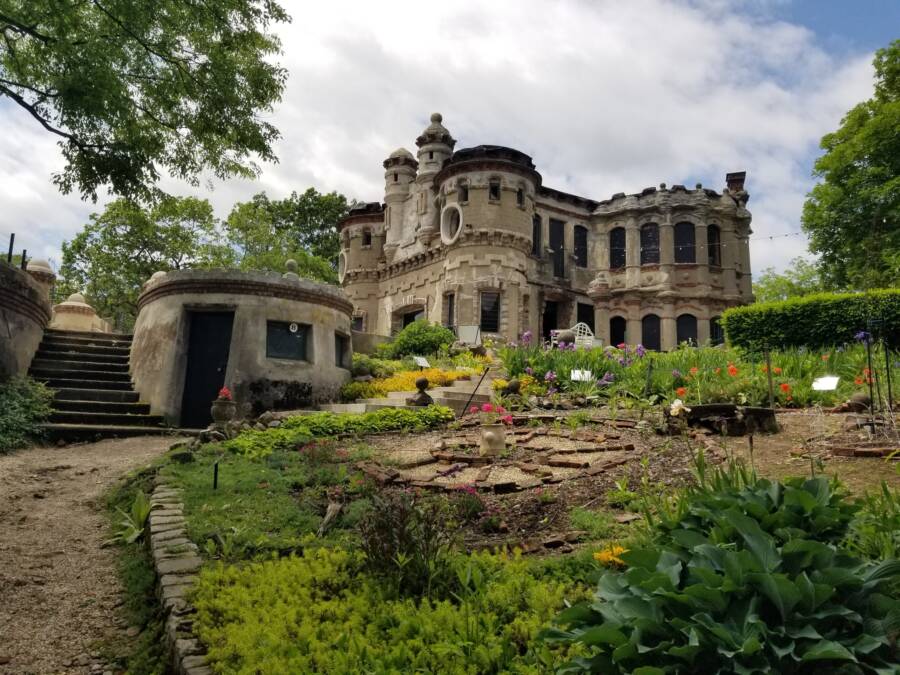
However, this was not the end of Bannerman Castle’s story. In 1992, a Hudson Valley local named Neil Caplan founded the Bannerman Castle Trust, which has raised funds to stabilize the castle ruins, clear overgrown pathways, and revitalize the landscaping.
Today, Bannerman Castle is a haven for enjoying cultural events. Tours of the grounds run from April through October and include the boat ride over to the island. The Bannerman Castle Trust also hosts horror movie nights, theater performances, kayak tours, and farm-to-table dinner events. Last year, in an exclusive dining experience, the Trust even recreated an 11-course, first-class dinner that was served on the Titanic.
Over 100 years after Bannerman Castle was built, the historic Hudson Valley landmark is now closer to a museum than a bomb site. We can only assume that’s what Francis Bannerman would have preferred.
SOURCE: ALLTHATSINTERESTING.COM
 Sew Colorful
LikeLiked by 1 person
hey me either!!! i hate crocs!
LikeLiked by 1 person
LikeLiked by 1 person
ooops^^^^^^^^^^^^^^ lol
LikeLiked by 1 person
LikeLiked by 1 person
“How President Trump Can End a Lost War: President Trump’s Upcoming Summit in Alaska With President Putin”
Michael T. Flynn LTG USA (RET), Aug 13, 2025
ENTIRE ARTICLE: “President Trump’s upcoming summit in Alaska with President Putin will be a defining moment not just in U.S. relations with the Russian Federation, but also for the safety and survival of the world. I do not believe that most Americans fully understand the gravity of the situation. My personal assessment is that if these two leaders cannot reach an agreement this weekend, then the chances increase dramatically that events could spiral out of control, leading to an unthinkable catastrophe.
Zelensky appears to be trying to box in President Trump by his trip to Germany to continue funds flow to him for his war. Certainly, continued assistance from Europe could prolong the killing, but what happens this weekend, is critical to bring it to an end.
I have had many friends and colleagues on both sides of the original debate as to whether the Ukraine War was originally worth fighting. Since then, friends have disagreed as to whether it was worth the enormous financial cost to our country and whether it was worth the terrible toll of the blood of young men on both sides. Official spending figures since February 2022 total $175 billion, but other estimates range far higher when including both expenditures since the Russians moved back into Crimea in February 2014 and estimates of classified “off budget” activities.
But those debates have been overtaken by events. Despite Ukrainian men often fighting valiantly, Ukraine has lost, and the dying must now be stopped. The Book of Ecclesiastes teaches that there is “a time for war,” and I believe with all my heart this is the “time for peace.”
I sometimes think that in Washington, D.C. and NATO, President Trump is just about the only person who really wants the killing to stop and stop now. He campaigned on this promise, and he says it all the time. I believe if peace is achieved, President Trump’s first and most important objective will be achieved.
There are some in our midst, particularly Neocons who really don’t want peace, as they seem to lust for war. They demand that President Trump somehow reverse the substantial battlefield victories of the Russian Federation over the Ukrainians at the bargaining table. If so, this would be the first time in military history of which I am aware that to the loser goes the spoils. History teaches us that winning on the battlefield has consequences.
And, losing on the battlefield has even bigger consequences. Ignoring that reality is foolish and self-defeating. If we refuse to recognize the reality of the battlefield, there should be no need for a summit — just let the fighting continue to the last drop of Ukrainian blood — but this would be insanity.
I am about to state some hard truths for my friends, so even though I don’t think I need to state my MAGA credentials, I’m going to give you a flavor. In the 2016 campaign, I travelled nationally with President Trump. I spoke for him at the Republican National Convention. I served briefly as his National Security Advisor until the Deep State deep-sixed me with lies about my efforts to defuse a tense diplomatic situation created by Obama in my dealings with the Russian Ambassador.
I lost almost everything my wife and I possessed in defending against entirely phony charges by the corrupt Obama Justice Department. But I clawed my way back, and I stayed in the game to fight for and with President Trump. And for the years President Trump was under indictment, I travelled as many miles as anyone in America to keep his flame alive. Since then, my nonprofit has done as much as any in the country to support and defend his policies in the courts.
So, I have a message for my MAGA friends from the perspective of someone who has great personal affection for the President: You can help the President, the nation, and the world by reducing your expectations for what can be achieved. No matter how good President Trump may be at the “art of the deal,” this is one of those situations where — as he told Zelensky in the Oval office — we don’t have the cards.
A man I have gotten to know who was a senior official in the Reagan Administration tells me that even President Reagan never asked the Russians to do what was against their interests — which likely explains why he was so successful in achieving American objectives.
The hand that President Trump has been dealt is largely due to the incompetence and corruption of so-called President Zelensky and the Ukrainian government. Ukraine regularly described as one of the most corrupt countries in Europe — and even the World. It was a Ukrainian energy company that paid Hunter Biden for being Joe Biden’s son.
How many stories have I read about the money that has been siphoned off by Ukrainian government officials instead of meeting the needs of Ukrainian troops, all to ensure Ukrainian elites receive a soft landing when they are forced out of Kiev? Although Zelensky was once elected President of Ukraine, his term ended 15 months ago, and he declared martial law and cancelled elections to cling to power.
· This is the same man who jeopardized world peace with an insane drone attack on the Russian Federation’s strategic (i.e., nuclear) bombers.
· This is the man who one day agrees to give territory for peace and the next day says that kind of trade could never happen.
· This is the man whose key military units in his government have been using Nazi-like symbols without apology.
· This is the man who, as the Vice President explained, continued to make demands on America while never expressing any appreciation for what we have done.
The truth is, even with enormous U.S. aid for his war effort, plus more from Europe, Zelensky fumbled the ball. He is drafting, and his henchmen are now kidnapping, 60-year-old men to serve in his military, given little training, offering them up as cannon fodder. His popularity with the Ukrainian people is in the tank. Only 24 percent of the Ukrainian People want this war to continue, but he demands it grind on. Zelensky has no right to be at the table in Alaska. The adults need to take over. It is largely because of Zelensky that we are where we are.
So we, the MAGA movement, must reduce our expectations for what can be achieved from this summit. I am going to take a leaf from President Kennedy’s famous peace speech at American University when he said: “Let us reexamine our attitude toward the Soviet Union.”
Maybe you will think this is making a silk purse out of a sow’s ear, but let’s try to do what President Kennedy suggested.
First, if the situation were reversed, and the now-abolished Warsaw Pact was recruiting Mexico and Canada to join it, to surround the United States with friends of the now-abolished Soviet Union, how would we feel? That’s how the Russian Federation feels about being surrounded by NATO. NATO was organized to prevent a war, not to cause one. NATO expansion presents an existential threat for Russia. Many Americans believe who governs Eastern Ukraine is absolutely no concern of ours — but for sure, it is not a vital national security interest of ours.
Second, we say we believe in self-determination. People in the four Oblasts — where the Russian culture, Russian language, Russian Orthodox Church predominate — voted overwhelmingly in 2022 (in an election likely fairer than our 2020 election) to join Russia. They are part of Russia. For years, these same Oblasts begged President Putin to protect them from the Ukrainian government, which was attacking them, but he held back. If you forgot that history, for a sample watch this early CNN report. So, why is it in the vital national interest of America to thwart the will of the people who want to be part of Russia to be part of Russia?
Third, when the United States promised the Soviet Union, and then Russian Federation, it would not expand eastward, and we broke our word, should we now believe it tragic that the Russian Federation finally acted to stop this expansion when it reached its doorstep? Remember how we felt about Soviet missiles in Cuba when we were ready to go to war?
Fourth, the Soviet Union is the world’s largest country geographically, spanning 11 time zones, with only about 140 million people. Are we really afraid they will march into Poland (which largely hates them) and then into Germany? The threat of President Putin dreaming to recreate the old Soviet Union is delusional Neocon thinking.
And, even if you disagree with all these propositions, how much is enough? War always has a prudential component. Can we really afford to continue? Luke 14 instructs: “For which of you, intending to build a tower, sitteth not down first, and counteth the cost, whether he have sufficient to finish it? … Or what king, going to make war against another king, sitteth not down first, and consulteth whether he be able with ten thousand to meet him that cometh against him with twenty thousand.” Our national debt just passed $37 trillion. Wasn’t the massive amount of money already spent enough? If not, what would be enough?
Anyone who has followed me for very long knows of my admiration for President Kennedy’s quest for peace. He urged: “Let us reexamine our attitude toward the cold war, remembering that we are not engaged in a debate, seeking to pile up debating points. We are not here distributing blame or pointing the finger of judgment. We must deal with the world as it is, and not as it might have been….”
So, as for me, I am willing to leave this to President Trump. I believe he will end the war, negotiating to get the “best deal” he can get for our country and the people of Ukraine — not its government. This conflict has continued for decades, and President Biden left him with a terrible mess. I, for one, will not criticize the terms on which President Trump achieves peace.”
LikeLiked by 1 person
LikeLike
U.S. Marines CH-53K helicopter refuelling while transporting an F-35 airframe between test sites in Maryland, NJ, April 24, 2024.
Palm Springs
“Somewhere in Iceland”
“Blustery and Dangerous In Every Way”
“Maximized traction” — I guess it’s some kind of dune buggy?
LikeLiked by 1 person
“A British researcher’s remains were discovered in a melting Antarctic glacier after he died from a fall while on a research mission 66 years ago. I guess everyone who disappears in a crevasse will melt out eventually.
Dennis “Tink” Bell fell into a crevasse while working for Falkland Islands Dependencies in 1959, the predecessor of the British Antarctic Survey, which reported the discovery on Monday. Bell was working alongside four men and two dog sledges, a surveyor Jeff Stokes, meteorologists Ken Gibson and geologist Colin Barton.
Stokes and Bell believed a crevassed area was in the clear. But as the team and its dogs were struggling to make it through the snow. Bell went ahead of the group as an act of encouragement but he suddenly disappeared leaving a gaping hole down 100ft in the crevasse bridge.
Stokes called repeatedly out to Bell, lowering a rope almost a hundred feet. He told Bell to tie himself on, Stokes and the dogs began to pull him up but Bell had tied the rope through his belt instead of around his body due to the angle he was laying at in the crevasse. When he reached the top his body jammed against the lip, his belt broke, and he fell down again.
Stokes and Bell were initially ahead of Gibson and Barton. So, Stokes went down the glacier to meet with the two. They attempted to return to the crevasse but the weather had taken a turn for the worse. “It was probably 12 hours before we found the site. There was no way he could have survived,” said GIbson.”
LikeLiked by 1 person
LikeLiked by 1 person
LikeLiked by 1 person
Good Night All!
LikeLiked by 1 person
Good night!
LikeLiked by 1 person
Good Night Filly!
LikeLiked by 1 person