
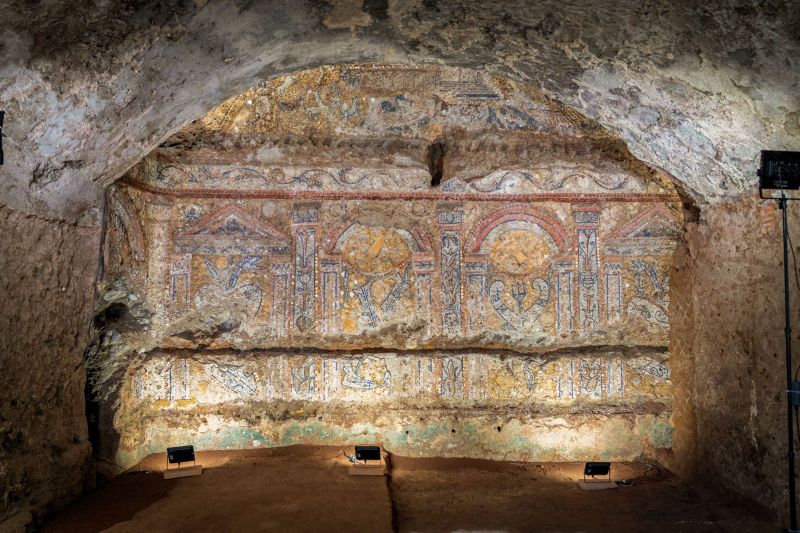
This story was found on CNN.com and it’s about an ancient mosaic found buried under Rome. It’s gorgeous!
From the article:
Rome, Italy CNN —
A five-year dig into the side of Rome’s Palatine Hill yielded treasure last week when archaeologists discovered a deluxe banquet room dating from around the first or second century BC, featuring a sizable, intact and brightly colored wall mosaic.
Estimated to be around 2,300 years old, the work is part of a larger aristocratic mansion, located near the Roman Forum, that has been under excavation since 2018.
Almost five meters long (16.4 ft) and featuring depictions of vines, lotus leaves, tridents, trumpets, helmets and mythological marine creatures, the mosaic scene was painstakingly created using mother of pearl, shells, corals, shards of precious glass and flecks of marble. The piece is framed by polychrome crystals, spongy travertine, and exotic, ancient Egyptian blue tiles.
What makes this discovery “unmatched,” said archaeologist Alfonsina Russo, head of the Colosseum Archaeological Park in charge of the site, is not only the incredible conservation of the mosaic, but its decoration which also features celebratory scenes of naval and land battles likely funded — and won — by an extremely wealthy aristocratic patron who commemorated the victories on their walls.

The intricacy of the mosaic’s depictions of victory have surprised the team working on the project. They show a coastal walled town with lookout towers and loggias — which Russo said could be an ideal or a real-life location — sitting atop a cliff designed with pieces of travertine rock. Scenes of sailing ships with raised sails also feature, alongside depictions of mythical sea monsters swallowing enemy fleets.
Archaeologists are trying to ascertain whether the delicate — and expensive, for the time — coral branches used in the display came from the Mediterranean or the Red Sea (the nearest and most common oceans used by Romans to extract materials). A rare bluish glass paste also featured in the design likely came from the ancient Egyptian city of Alexandria, the team believe.
“This banquet hall, which measures 25 square meters (270 square foot), is just one space within a ‘domus’ (the Latin word for house) spread on several floors,” Russo told CNN in an interview. “In ancient times, when powerful noble families inhabited the Palatine Hill, it was customary to use rich decorative elements as a symbol to show-off opulence and high social rank.”
The chamber, deemed a “jewel” by Russo, was an outdoor banquet hall overlooking a garden, likely used during summer to entertain guests.
Such an elaborate space would also have been used to impress guests with water games, which were very popular amongst nobility at the time. “We have found lead pipes embedded within the decorated walls, built to carry water inside basins or to make fountains spout to create water games,” said Russo.

Marco Rossi, professor of Roman antiquities and head of the mosaic lab at Rome’s Università degli Studi di Roma Tre pointed out that these summer banquet rooms were not only somewhere that hosts and guests would go to relax but also used by the mansion owner as a signifier of their wealth and rank.
“Mosaics are usually found on floors, but this runs across the entire front wall and has been incredibly well-preserved,” said Rossi of the piece. “It’s not been ruined by the weight of debris — as can happen to some mosaics on the ground — and despite being delicate, it hasn’t so much as chipped across the centuries.”
The discovery of an entire wall mosaic is extremely rare, Rossi added, not least because these pieces are more delicate than those for the floor which were designed to be walked upon and withstand pressure.
The location of the grand home has also helped the wall’s preservation, scientists believe. Positioned on the side of Rome’s famous Palatine Hill and subsequently covered over by centuries of mud and earth as the land has moved, the structure and treasures within it have been protected from the air and light by layers of ground.
While this new discovery still has a lot of secrets to reveal — why the property was abandoned and how long ago, for example — Russo believes there is one mystery archaeologists could perhaps solve: The identity of its owner, likely a Roman senator.
“The person was so rich they could afford to import such precious elements from across the empire to decorate this mansion,” Russo said. “We have found nothing so far to shed light on their identity, but we believe more research might enable us to pinpoint the noble family.”
Russo and her team aim to open the space to the public in early January. “We (will) continue to dig the other layers and areas of this evocative place (to try to discover more),” she said. “It is really an incredible display of Roman luxury.”
SOURCE: CNN.COM
By Silvia Marchetti
 Sew Colorful
Good night, Pat!
LikeLiked by 1 person
Good Night Filly!
LikeLiked by 1 person
“The Pentagon and Its Pet NATO Monkey — As the world’s largest military alliance celebrates its 75th birthday, it ought to just retire”
MATT BIVENS, M.D., JUL 10, 2024
EXCERPT: “The North Atlantic Treaty Organization is today celebrating its 75th birthday in Washington, D.C., to the tune of all kinds of happy talk about how tirelessly the alliance works for peace, democracy and world stability.
And yet, as a new and timely book reminds us, NATO is no good at any of those things.
“NATO: What You Need to Know” is a concise and caustic introduction to the world’s largest military alliance, written by longtime peace activists Medea Benjamin, a founder of the peace group Code Pink, and David Swanson, an author and talk radio host. The two cover a lot of territory, including how and why NATO was formed, the way it has metastasized since the collapse of its Soviet rival (and original raison d’etre), the havoc it has wreaked, and the grim future it holds out. In the authors’ telling, NATO’s demonstrated skills have little to do with peace and stability, and everything to do with drumming up wars, disenfranchising the average citizen, nurturing the international arms trade, and dragging us ever-closer to a species-level annihilation event.
Washington’s pet monkey
You’d never guess it from U.S. press coverage, but around the world, NATO has few fans. Benjamin and Swanson describe a Gallup poll conducted ten years ago, across 65 nations, which found that people everywhere considered the United States to be the world’s gravest threat to peace (!) — a wolf dressed in NATO sheepskin. Gallup’s findings, the authors note wryly, were widely shared, “and the lesson learned: Gallup never did that poll again.”
Here in America, views of NATO are vaguely-kinda-sorta positive. For many of us, NATO is hazily conflated with the United Nations. Outwardly, the similarities are uncanny. NATO was set up just four years after the UN was established. Both are international structures that authorize the movements of thousands of soldiers into troubled foreign lands — as “peacekeeping forces” — and both are headed by a “general secretary.”
NATO’s North Atlantic Council is designed to mirror the UN Security Council, and NATO has a Parliamentary Assembly designed to evoke the UN General Assembly. The briefly-worded treaty that created NATO — which the U.S. Senate ratified and then President Harry Truman signed in July 1949 — even opens with a statement that all signatories “reaffirm their faith in the purposes and principles of the Charter of the United Nations,” as well as “their desire to live in peace with all peoples and all governments.” …….”
https://mattbivens.substack.com/p/the-pentagon-and-its-pet-nato-monkey
LikeLiked by 1 person
I am adding a short daily prayer to the board. I would invite each of you, if you wish, to also add one or maybe two of your own liking. I do not want to stifle anyone but please limit yourself to one or two religious postings. here’s one I found that I liked.
LikeLike
LikeLike
LikeLike
LikeLike
LikeLike
Good Night All!
LikeLike