
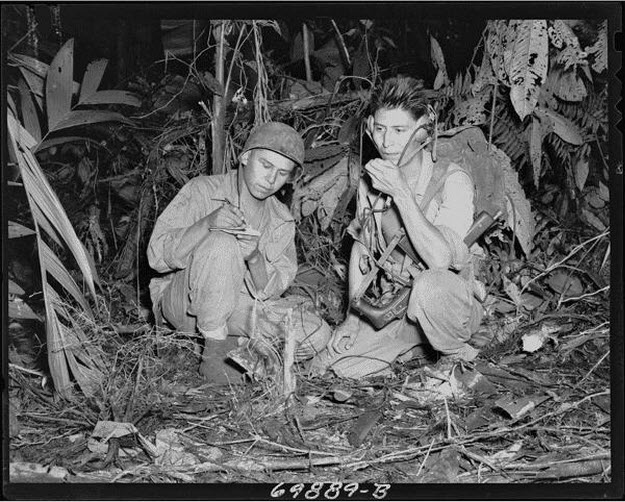
Navajo Code Talkers Day, celebrated every year on August 14, is a day that holds great importance in the history of the U.S. This is because the day recognizes the contributions of Navajo marines during World War II. Yes, Navajo marines encoded and transmitted messages using a complex Navajo language-based code during a time when secret communication was essential to win a war. And guess what? The code was never broken by Japanese forces in the Pacific and proved to be of great assistance to the U.S. Marines. On this day, celebrate the great American heroes and their service to the nation!
During both World Wars I and II, the U.S. military needed to encrypt communications from enemy intelligence. American Indians had their own languages and dialects that few outside their tribes understood; therefore, their languages were ideal encryption mechanisms. Over the course of both wars, the Army and the Marine Corps recruited hundreds of American Indians to become Code Talkers. Records at the National Archives document the origins of this program and the group’s wartime contributions.
World War I
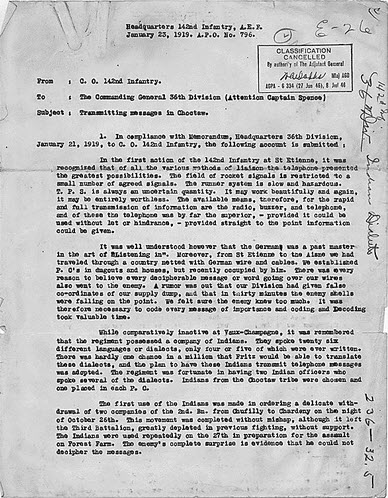
Stationed in France in 1918, Choctaw Indians from the 142nd Infantry Regiment, 36th Division, became the first Code Talkers. At the time, the enemy frequently intercepted Allied communications, inhibiting tactical plans and troop movements.
Leaders of the 142nd turned to American Indian soldiers in the regiment for help. They selected two Choctaw officers to supervise a communications system staffed by eighteen other tribal members. This team began transmitting battle messages in the Choctaw language. The enemy never broke their “code,” and Allied leaders deemed their efforts a success.
For the remainder of the war, the Army continued to enlist soldiers from other tribes as Code Talkers, including the Cheyenne, Comanche, Cherokee, Osage, and Yankton Sioux.
World War II
When the U.S. entered World War II, military leaders remembered the success of the Choctaw Code Talkers and enlisted new recruits from the Navajo, Kiowa, Hopi, Creek, Seminole, and other tribes to encrypt messages for the Army and Marine Corps. (Some sources say Philip Johnston, the son of a missionary who had grown up in the Navajo Nation, suggested using the Navajo language as a code.)
Working with Navajo leaders, the Marine Corps initially recruited 29 Navajo men to train as Code Talkers in specially designed courses. By the end of the war, the Marines had over 400 Navajo men trained as Code Talkers, many of them serving in the Pacific Theater. The Army had similar training programs for its Code Talkers, who generally served in Europe and North Africa.
Their special communication services were used in one of the most extensive military operations ever, the one that happened in Normandy in June of 1944, known as D-Day. They were also pivotal when it came to the battle of Iwo Jima when they secretly transferred more than 800 messages between the command centers and the battlefield.
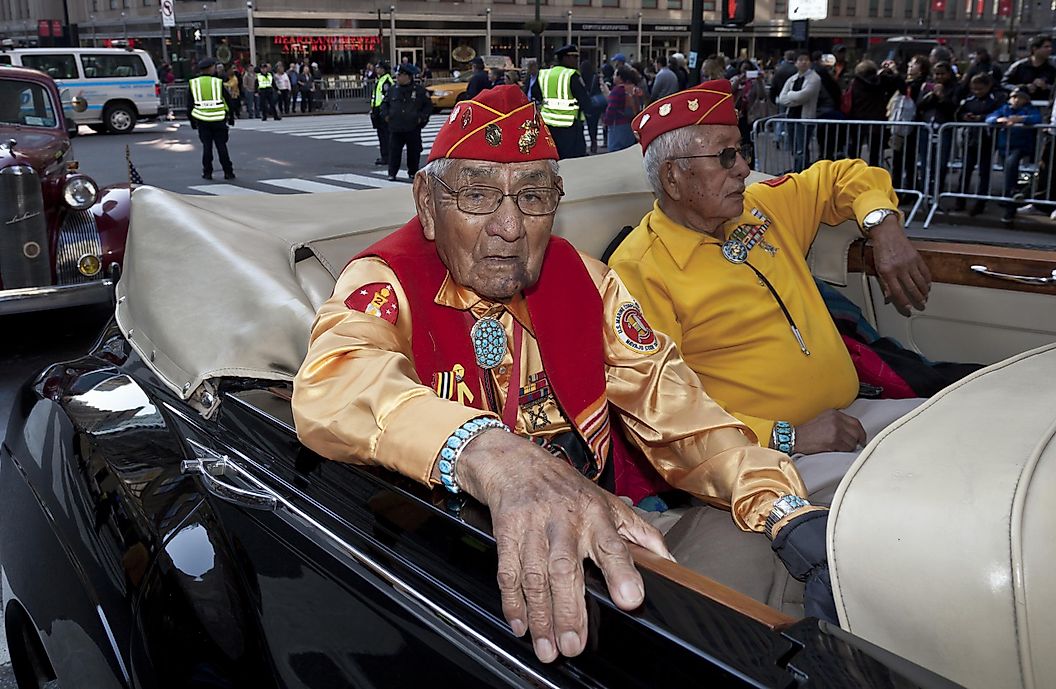
However, it was not until the 1990s that the value of Navajo code talkers was publicly recognized. In 2001, the veterans that were still alive received the highest honor that can be awarded by the Congress – the Congressional Gold Medal. In the years that followed, their contributions were legally recognized by the Congress, as they passed the Code Talkers Recognition Act in 1982. In 2014, Arizona passed legislation declaring every August 14 Navajo Code Talkers Day in Arizona.
The Navajo Code
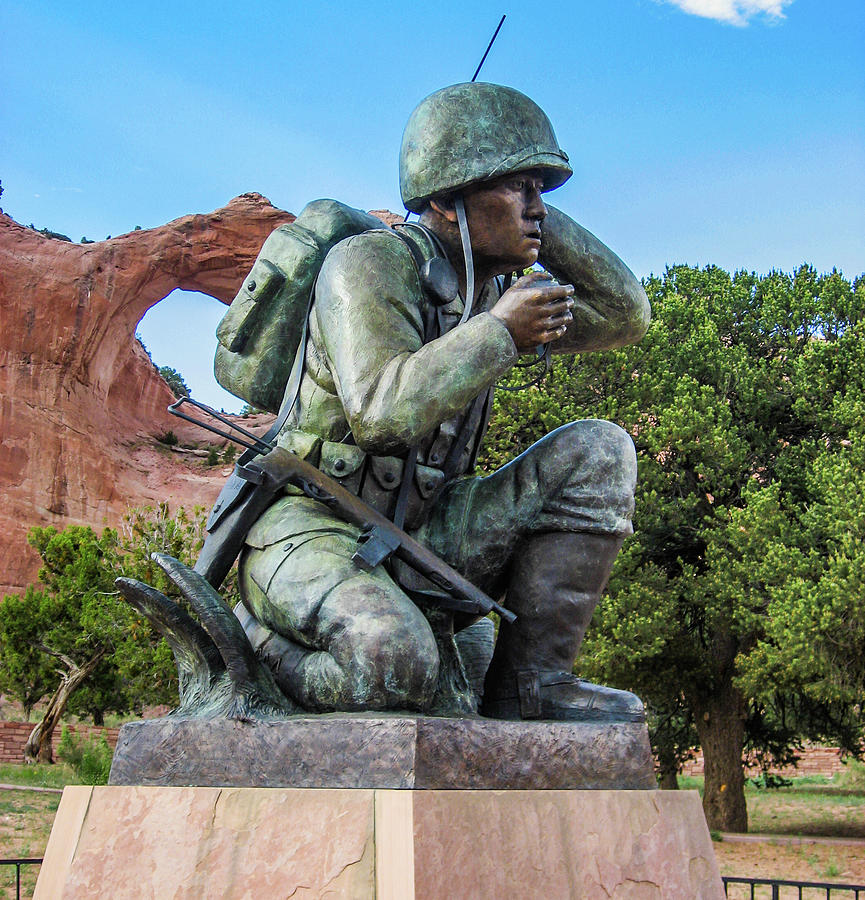
When the Navajo code was first developed, the original selection of 211 words was ascribed with different meanings. In World War II, that number went up to 411. The reason why this code was so difficult to crack is that the Navajo language did not contain any military terminology. To make this work, the Navajo code talkers created an alphabet system that used Navajo words, instead of standard spelling. Also, certain words got a particular meaning, and it looked like this:
The Navajo word for an eagle was atsa, which was a code for a transport plane. Paaki (Hopi language) stood for houses on water, which meant that they were talking about ships. Comanches used the word wakaree’e to name a turtle, and when transferred to code – this was a tank. The Choctaw tribe used the words tushka chipota, which translated to warrior soldier, or just soldier when it came to code. Besh-lo was an iron fish, which obviously meant that a submarine is spotted.
 Sew Colorful
LikeLiked by 1 person
NYT trying to create a narrative–“according to a person familiar with the footage…
LikeLiked by 1 person
from tcth
Sandra Opines
August 14, 2022 2:21 pm
Trump Truth’d
Donald J. Trump
@realDonaldTrump
·
21m
Just left a large gathering of people and all they could talk about was the complete and total stranglehold that the Radical Left Democrats have over the DOJ & FBI. It shouldn’t be that way. Nobody goes after BLM, ANTIFA, or the rest, despite murder, beatings, and burning down large sections of cities, a very unfair double standard. They definitely won’t attack the home of a former Democrat President, nor should they. It is all so out of control, great simmering anger!
LikeLiked by 1 person
LikeLiked by 1 person
Entire Article @ WND: “A rainbow-colored jersey meant to promote the LGBT ideology has been rejected by seven Australian rugby league players who withdrew from a match rather than wear the article of clothing that offended their faith. Sky News reported the players are from the Manly Warringah Sea Eagles, based in Sydney, Australia.
The seven players said they would not wear the jersey based on religious and cultural grounds. The report explained the team, without consulting the players, got the jerseys with rainbow logos replacing the previously white stripe and collar on the ordinary jersey.
“Coach Des Hasler defended the players, saying the club was at fault for not properly consulting them,” the report explained. The seven players are Josh Aloiai, Jason Saab, Christian Tuipulotu, Josh Schuster, Haumole Olakau’atu, Tolutau Koula and Toafofoa Sipley. They were not even given the choice of wearing the standard jersey, because under National Rugby League rules, all players on a team must dress alike.
The coach told reporters he accepted the players’ decision. He said, “These young men are strong in their beliefs and their convictions and we will give them the space and the support they require.” The team didn’t even bother to let the players know of its social-ideology advocacy before it boasted of the new jerseys to the media. The coach said, “Sadly, the execution of what was intended to be an extremely important initiative was poor. There was little consultation or collaboration between key stakeholders, both inside and outside the club.”
Hasler said the intent was to provide support for “all diverse groups,” but the poor management of the situation caused “confusion, discomfort and pain for many people.” The Christian Institute reported Sea Eagles captain Daly Cherry-Evans “warned other clubs not to force players to back specific causes.”
While team owner Scott Penn claimed that the seven players would be open to wearing the rainbow jersey in the future, if properly consulted, a representative of the players said that’s nonsense. The players will not “backflip on religious beliefs,” the spokesman said, and suggestions they would cave to LGBT pressure was “totally untrue.”
The Institute reported, “Rev. Dr. Ma’afu Palu from the Tongan Evangelical Wesleyan Church said he was ‘very proud’ of the players’ stand. ‘Christianity takes a very strong root in our people,’ he explained. ‘Whatever the Bible says is very authoritative to us.'”
A similar exhibition of courage appeared in the United States earlier in the year, when five Tampa Bay Rays baseball players refused to be forced to promote the LGBT lifestyle choices.”
LikeLiked by 1 person
good for these people standing up. thrusting woke beliefs on erbody is nonsense
LikeLiked by 1 person
LikeLiked by 1 person
LikeLike
I am adding a short daily prayer to the board. I would invite each of you, if you wish, to also add one or maybe two of your own liking. I do not want to stifle anyone but please limit yourself to one or two religious postings. here’s one I found that I liked.

LikeLike
LikeLiked by 1 person
From his coffee-table book:
LikeLiked by 1 person
LikeLiked by 1 person
LikeLiked by 2 people
well, I’m heading out. hubby has Grumpy Old Men ready to play…
Good Night!
LikeLiked by 2 people
Have a good one! Great movie!
LikeLiked by 1 person
Great opening Hats off to the idea of usingNavajo as code talkers
LikeLiked by 1 person
thanks!
I AGREE–stroke of genius!!
LikeLiked by 1 person
Cavers rescue dog 500 feet underground that had been missing in US for two MONTHS: Mixed-breed poodle Abby was too weak to wag her tail or even whimper
Abby, 13, was stranded in Missouri cave 500ft (152m) below ground for 62 days
Owner Jeff Bohnert said he never expected to see the mixed-breed poodle again
But cavers Gerry Keene and Rick Haley led 90-minute mission to bring her back
Abby was skinny, covered in dirt and curled on the mud floor, unable to wag tail
https://www.dailymail.co.uk/news/article-11106429/Cavers-rescue-dog-500ft-missing-two-MONTHS-Abby-weak-wag-tail.html
LikeLiked by 1 person
awwwwwwwwwww
LikeLiked by 1 person
LikeLiked by 1 person
HAHA
LikeLiked by 1 person
LikeLiked by 1 person
wow!!!!!!!!!
I forwarded this to my son…he’s into wood working…he will love this!!!
LikeLike
LikeLiked by 1 person
neat!
LikeLike
LikeLiked by 1 person
LikeLiked by 1 person
this was good!!
bookmarked!
thanks!!
LikeLike
LikeLiked by 1 person