
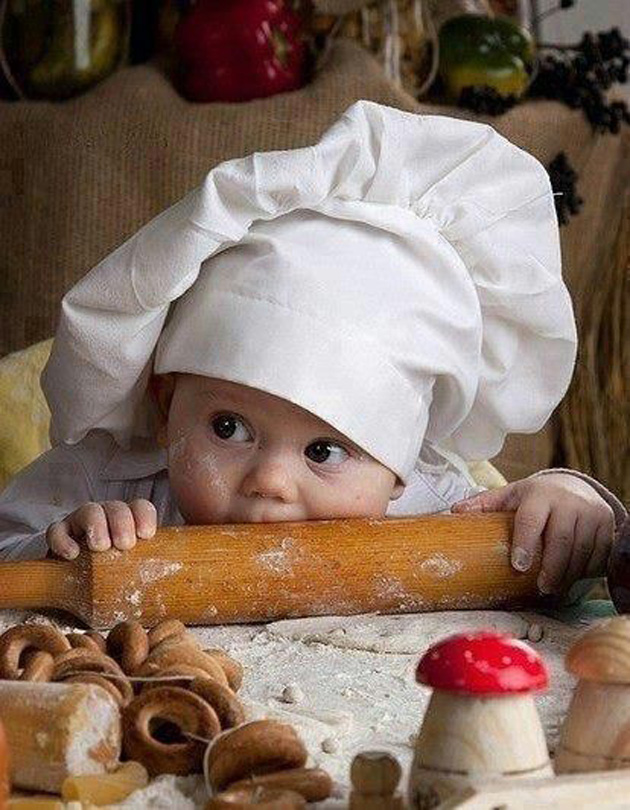
Since Father’s Day is rapidly approaching, I thought it would be a good time to look at some options to make Dad a special cake for his special day.
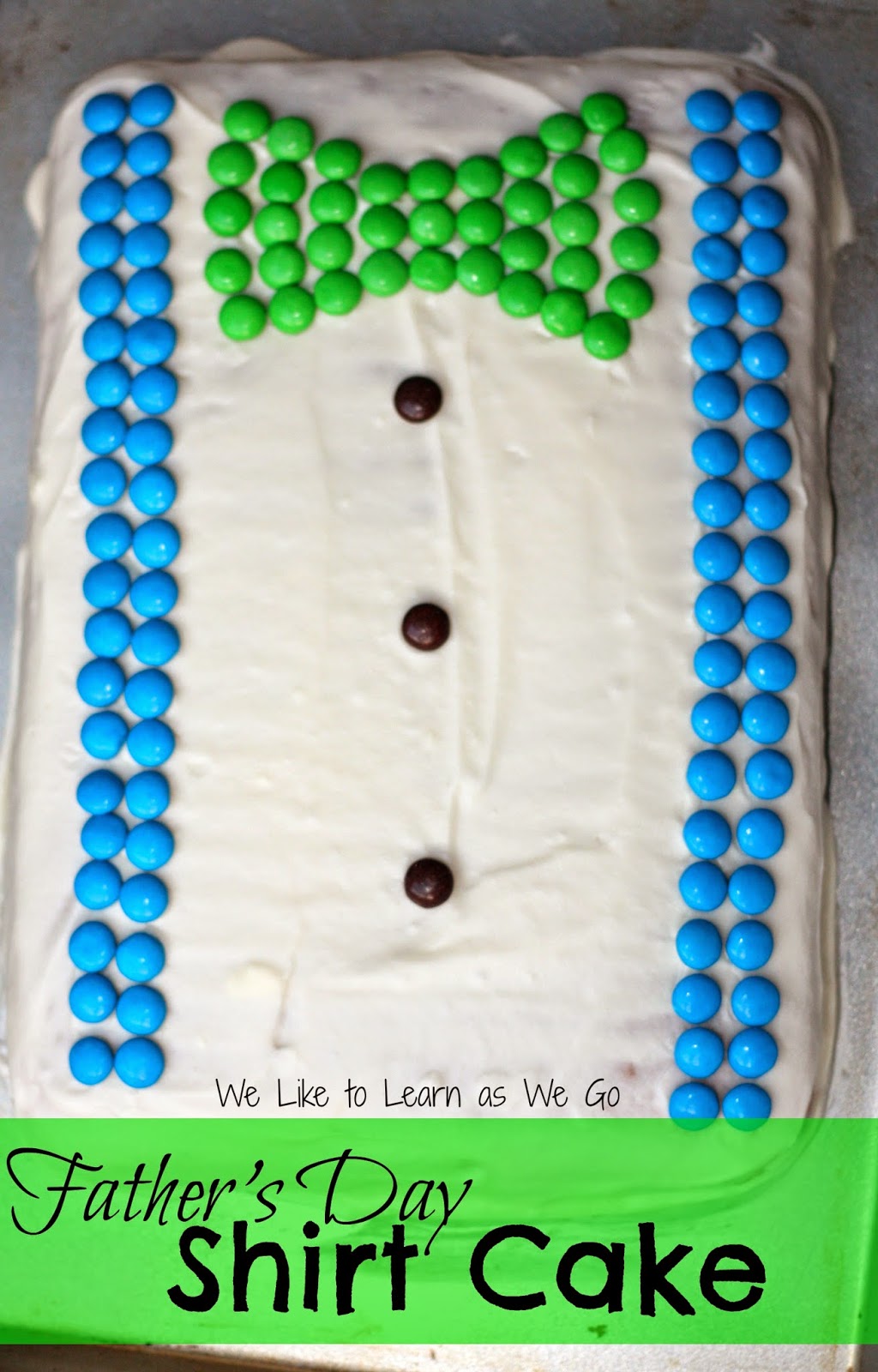
Let’s begin with a super easy one first. This cake can be made with any flavor box mix baked in a 13 x 9 pan. When cooled, you simply frost with white frosting and add M&M’s to make the suspenders and the bow tie. (You can get fancy and make a regular tie as well.)
If that seems too easy and you’d like to try your hand at more involved decorating, I suggest the Beer Mug Cake. (There are 3-D versions of this cake that are very involved, so I suggest this flat version.) It merely requires any flavor cake baked in a 13 x 9 pan, cooled and then inverted onto a baking sheet. The corners are trimmed into a rounded mug shape and the frosting is piped on in long lines in gold. White frosting is then piped in swirls to mimic foam and a handle is fashioned from white fondant. (Roll the fondant into a rope and make an elongated “U”. Insert toothpicks into the 2 ends and attach to the side of the mug.

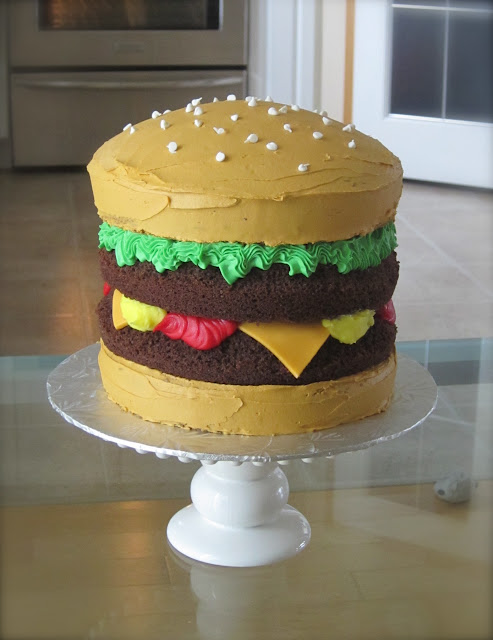
If you’re feeling even more daring, there’s always the Hamburger cake. This will require 2 cake mixes—one vanilla (for the bun) and one chocolate (for the hamburgers). The “cheese” in this hamburger is actually colored fondant. (If that sounds too involved or difficult, skip the cheese!) The sesame seeds on the top bun are mini white chocolate chips. The rest of the details, lettuce, ketchup, mustard are all tinted frostings.
If cupcakes are more your style, you can decorate them in numerous ways to honor the sports Dad loves: tennis, baseball, basketball, soccer, are all easy choices.

And while we’re discussing cupcakes, if Dad’s a beer lover, what better cake than one made of both cupcakes AND beer?

Lastly, might I recommend a real show stopper? The Bacon cake! A vanilla layer cake, frosted with vanilla icing infused with maple flavoring and surrounded by…BACON!

 Sew Colorful
EXCERPT: “Television advertisements for prescription drugs are illegal in virtually every country on the planet — but not in the U.S., where 80 such ads air, on average, every hour on Americans’ televisions. “Ask your doctor,” the narrators tell viewers, urging them to bring up the latest name-brand drugs at their next physician’s visit.
Before the 1980s, these types of direct-to-consumer (DTC) ads were unheard of, even in the U.S., but within a few decades, they became among the most common public health messages seen by Americans. This marketing shift turned out to be incredibly lucrative for Big Pharma, but its effects on public health — and individual health — are highly questionable, as the ads continue to drive consumers to request drugs from their doctors, whether they need them or not. FDA’s loose guidelines paved the way for TV drug ads
Before the 1980s, pharmaceutical companies marketed directly to doctors, instead of to patients. Drug industry executives even told Congress at the time that they believed directly advertising drugs to consumers was not “in the public health interest” and “cannot safely be accomplished.” A cultural shift soon emerged, however, to empower patients to be more involved in their own healthcare, instead of solely listening to their doctors. Advertisers jumped on the trend but, still, drug advertisements to consumers only appeared in print ads, including in magazines, but not on TV.
This was due to the U.S. FDA’s requirements to include all drug risks and side effects in the ads, which could be done on pages of print but was much more difficult to accomplish on TV or radio commercials. A strange loophole existed, however, which allowed drug ads to run without stating the risks and side effects, as long as it also didn’t mention the disease the drug was intended to treat. This is highly likely related to the industry finally capturing the federal regulatory agencies responsible for protecting the public.
Not surprisingly, this led to confusion, prompting a loosened requirement from the FDA in 1997, which stated that ads only had to include the drug’s “major” side effects and refer viewers to a source where they could find the rest.
Even if viewers do end up seeking out the full list of side effects, the info seldom scares patients away. Everything is designed to make you tune out the risks and view the drug in a desirable light, from actors who use an appealing voice tone to beautiful images and music choices.
The removal of the requirement to list all drug side effects in ads paved the way for on-air drug ads, and the rest is history. By 2004, annual spending on drug advertisements quadrupled, making name-brand drugs like Lipitor, Lunesta, Xanax and Ambien household names.”
https://childrenshealthdefense.org/defender/pharmaceutical-ads-prescription-drug-advertising/
LikeLiked by 2 people
Don’t forget Bendectin!!!!
EXCERPT: “In the U.S., the FDA approves new drugs, including vaccines — or, as is the case with COVID-19 vaccines, grants them Emergency Use Authorization. The CDC then recommends them. Once that process is completed, it’s assumed the public — and the mainstream media — will unquestionably trust that the drugs or other treatments are safe and effective.
But as we’ve seen recently — when Newsweek last week broke with mainstream media and published two opinion pieces criticizing the U.S. government’s response to COVID-19 and claiming Americans don’t trust the CDC — not everyone buys everything the FDA and CDC are selling. As history shows, the FDA and CDC don’t always get it right — in fact, sometimes they’re dead wrong.
Whether they err because they allow pharmaceutical companies to deceive them, or because the agencies are populated with “experts” whose financial conflicts of interest cloud their judgment, the results are the same. There is a lack of a firewall between the FDA and drugmakers who pay much of the agency’s fees. For example, the current FDA commissioner, Dr. Robert Califf, who had previously served in that role and was again nominated by President Biden, has 50 conflicts of interest.
——————–
As the FDA and CDC unleash risky, experimental COVID-19 vaccines on babies and toddlers, it’s worth looking back at some of their deadliest mistakes.
Vioxx: FDA’s ‘poster child’ for getting it wrong
Belviq: What’s wrong with this picture?
Diet drug combo fen-phen caused fatal pulmonary hypertension
The statin Baycol: 100 deaths, more than $1 billion in settlements
https://childrenshealthdefense.org/defender/fda-cdc-approved-prescription-drugs/
LikeLiked by 2 people
what’s bendectin?
LikeLiked by 1 person
See below.
LikeLiked by 1 person
Bendectin is the drug my ob gyn gave me when I was pregnant with HB in 1980. Thankfully, I never took it since I only had mild nausea for a couple of weeks. I found out not long after, from an article in The Enquirer, about the birth defects and took it to show my doctor – he pooh-poohed it.
EXCERPT: “On the day Jeffrey Blum was born with clubfeet, which would require eleven surgical procedures in thirteen years, James Newberne, Merrell Dow VicePresident for drug safety, was addressing the Maternal Advisory Committee of the Food and Drug Administration. He testified unequivocally that Bendectin was safe for maternal use during pregnancy He under-represented the incidence of clubfeet found in animal studies. He overstated the number of animals studied. He failed to disclose that an inadequate number of animals had been tested, or that test animals had died due to improper care. He did not disclose that dosing accidents had killed test animals. He did not reveal that the tests were scientifically inadequate due to insufficient dosing levels. He did not tell the FDA that he was not proud of Merrell Dow’s testing procedures. He did not reveal that Merrell Dow “chose” what information to report to the FDA, or that relevant testing on Bendectin was hidden by being reported to the FDA Decapryn file.2 Fifteen years later, at this trial, a jury of twelve citizens learned the rest of the story.
After nine weeks of testimony in 1986, a jury found that the drug Bendectin, taken by Joan Blum to control morning sickness in pregnancy, was a legal cause of Jeffrey Blum’s clubfeet. That jury awarded one million dollars in compensatory and one million dollars in punitive damages. On June 3, 1993, the Supreme Court reversed that verdict because “. . . Merrell Dow was deprived of its constitutional right of trial by jury when the trial judge overruled its Motion for Mistrial and proceeded to verdict with only eleven jurors, after one juror became ill.”4 The Supreme Court affirmed the order of the Superior Court which had declared that verdict “a nullity.”5
At the retrial in 1994, after seven weeks of evidence, twelve jurors rendered a constitutionally valid, unanimous verdict awarding Joan and Fred Blum two hundred thousand dollars for medical expenses. They also rendered a constitutionally valid unanimous verdict of four million dollars as compensation for the pain and the disfigurement and the emotional affliction Jeffrey Blum endured during his twelve years of life prior to trial, as well as for all the injury he will suffer for the remainder of his life. The jury also awarded fifteen million dollars in punitive damages. Following this verdict, damages for delay pursuant to Rule 238 were awarded in the amount of four million, nine hundred eighteen, one hundred forty seven dollars ($ 4,918,147.00).”
Link to 3 PDF documents: https://birthdefects.org/bendectin/
LikeLiked by 2 people
floating the Trump as Speaker in 2023 idea again
https://thelibertydaily.com/wayne-allyn-root-says-donald-trump-is-considering-running-for-speaker-of-the-house/
LikeLiked by 1 person
Calling it a night…hubby’s looking pretty good sitting there…LOL
Good Night All!
LikeLiked by 2 people
Be sure to come back and read what I just posted. Have a good night!
LikeLiked by 2 people
Good night all!
LikeLiked by 1 person
Night y’all…
and thank you both for showing up everyday!
LikeLiked by 3 people
Nice opening!!!!
LikeLiked by 2 people
hiya kea!
hope you, your mom and pup are doing well!
LikeLiked by 1 person
Hi. Doing well. No heat wave today….
LikeLiked by 1 person
good!
sounds like Filly is getting hit with it today!
LikeLiked by 1 person
Next week it’s suppose to be hot hot hot….
LikeLiked by 1 person
stay safe!!!
LikeLiked by 1 person
👍
LikeLiked by 1 person
LikeLike