
Much speculation has gone into discovering the origins of American football. Perhaps this was where the game originated…..in the 1st millenium B.C.? From “Ancient Inventions:”
“The most extraordinary sport of the ancient world was without doubt the sacred ball game of Central America and the southern United States. It was first played in about 1000 B.C. by the Olmecs, who lived along the Bay of Mexico, and by all the later great civilizations of the region.

From its very start, it was played by the most important members of society. The colossal Olmec heads — carved from basalt brought down from mountains 50 miles away and weighing up to 44 tons — show Olmec rulers wearing head coverings. A plausible explanation is that these are protective helmets (like those of modern football players) worn by the Olmecs when playing their sacred ball game.

The earliest ball courts were simple basins with earthen retaining walls, but by 1000 A.D., they had become far more elaborate. At Chichen Itza the parallel walls were 283 feet long, 100 feet apart and 27 feet high. In Aztec times, ball courts were shaped like a capital “I,” with temples at both ends and banks of seating along the sides. In the middle of the walls, which were usually 12 feet high, were set stone or wooden rings. The ball was a solid rubber sphere about 6 inches in diameter.

Detail from the 15th century Codex Magliabecciano, showing the Mexican ball game about to start. The rings, here shown outside the court, actually projected into it at right angles to the side walls.
To protect themselves against injuries from the heavy ball, the noble players (and a sprinkling of professionals) wore protective helmets, wide belts of hard wood and leather, hip pads, knee pads, and a single glove.

Representation of Protective Gear
After the ball was thrown into play, players had to pass it to their teammates using their hips, elbows, or legs, without letting it run into the other side’s end of the court, for this counted as a point against them. The excited crowd would bet on the outcome: according to a Spanish chronicler they would wager “gold, turquoises, slaves, rich mantles, even cornfields and houses.”

Star players were able to hit the ball up through the ring on the side of the court, thereby winning the game. The victorious side had the right to grab the clothes and jewelry of any spectators who couldn’t get away fast enough. That the game also had a religious significance is shown by the fact that omens were read from the movements of the ball and the nature of the victory.
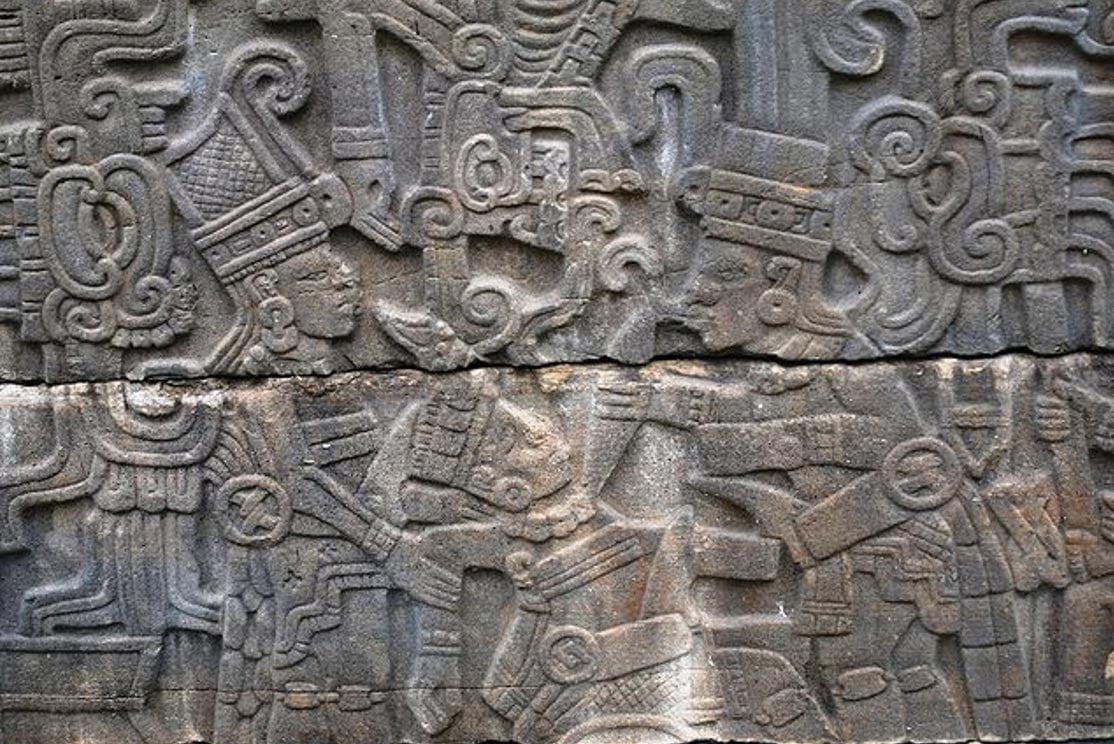
Pre-Columbian art often depicts acts of decapitation as authors such as Christopher L. Moserhave pointed out. The practice is also known from the ball court game that was commonly played by all the Mesoamerican cultures prior to the arrival of the Spanish, from the Olmecs to the Aztecs. The game began to feature sacrificial elements when the Maya took it over from the Toltecs. Archaeologists had mostly dismissed these depictions as figurative, but recent evidence, including the discovery of a collection of decapitated human heads, has provided physical proof of its existence among Pre-Columbian cultures.
That the losing team may have paid the ultimate price for defeat is suggested by the sculptural reliefs found next to many ball courts, which show a ball player being decapitated as a sacrifice to the gods.

 Sew Colorful
LikeLike