
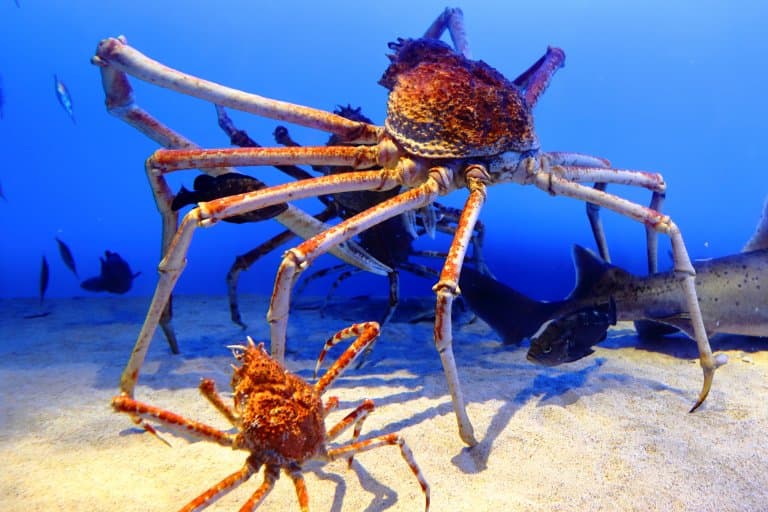
Today I present Reason #5 on why I don’t go in the water: Things like THIS live there!
The Japanese spider crab is a giant crustacean that can grow up to 12.5 feet that is most commonly found on the Pacific side of Japan. At first glance, they look like ancient monsters that have crawled straight out of a sci-fi movie. However, in the marine community, they are known to be gentle giants. Understandably, their names are inspired by their resemblance to a well-known arachnid – spiders.
As a species of marine crab, these crabs are often found inhabiting holes and pits on the ocean floor between 160 – 2,000 feet in depth. Living at such deep depths and covered in a thorny protective exoskeleton, with 10 giant legs – these animals have few natural predators. They are omnivorous, and they diet on dead and decaying animals and plant matter on the sea bed. They may at times also eat live fish that come their way.
It has the largest leg-span out of all arthropods
They can have leg-spans wider than two full grown men. These long legs are covered in small spikes which are also known as tubercles.
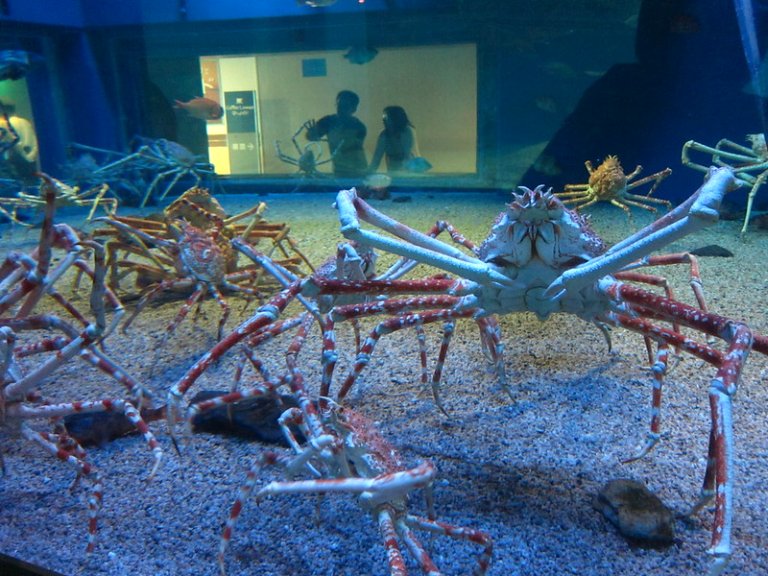
The Japanese spider crab legs can grow up to 12 feet! in length. The largest ever caught was named ‘Crabzilla’, which was over 12 feet across and caught in the Pacific Ocean in 2019. It was exhibited at the Scheveningen Sea Life center in The Hague, Netherlands before moving to Paris.
Males are typically bigger and armed with larger claws
Males have larger claws, called chelipeds, to fend off predators and opposing crabs. Females tend to have wider and rounder bodies to house their eggs.
They are scavengers
Japanese spider crabs are scavengers and often do not actively hunt for prey. They prefer to scour the ocean floor for dead animals or plants.

In Japan, they are considered to be a culinary delicacy
The savory meat contained in the long legs of Japanese spider crabs are enjoyed by many in Japan. During breeding season, fishing is prohibited so that an adequate number of crabs can be maintained in the ecosystem.
Japanese spider crabs like to dress up
This species belongs to a group of crabs termed “decorator crabs” which have been observed decorating their shells with sponges, plants, and anemones. This ornamentation allows them to camouflage and blend in with their environment, protecting them from predators and other threats.
Their legs can regenerate
Due to their length and spiny attachments, the legs of Japanese spider crabs may get torn off when caught in fishing nets or by predators. These limbs can regrow when the crab goes through a molting cycle.
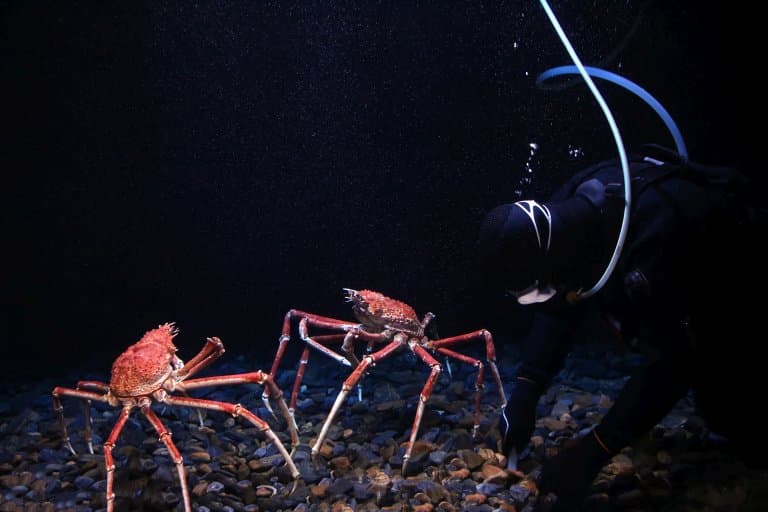
They can lay up to 1.5m eggs at a time!
However, only a few survive to hatch. Those that do survive hatch approximately 10 days after and are approximately 0.03 inches in size.
They go through a larval stage
Japanese spider crabs go through a larval stage after hatching and before maturing into adults. In this phase, they do not appear structurally similar to adults. They are transparent and legless.
There is a limit as to how large their bodies can grow
The carapace, or hard upper shell, of Japanese spider crabs cap at a particular size once it reaches adulthood. Their legs, however, keep on growing and elongating.
They molt to grow
Like other crustaceans, Japanese spider crabs shed their exoskeletons—through a process called molting—as they grow. Enzymes and physical force help the crab separate from its shell. Immediately following, the soft vulnerable bodies of the crab are exposed and require about a week’s time to harden up again.
Females have “aprons”
Female Japanese crab abdomens have also been termed “aprons”. This area is where she carries her fertilized eggs. Fertilization is internal. Males insert a sperm packet into the female while their abdomens are in close proximity.
They mate and spawn in shallower waters
While adults tend to live at deeper depths (as low as 2,000 feet), Japanese spider crabs will migrate to shallower waters during their mating season which is normally between January and April.
They are gentle giants
Despite their intimidating and spiky appearance, these crabs are quite calm and slow in nature. They do not hunt and spend the majority of their time crawling around, searching for their next meal.

Their Japanese name translates to “long-legged crab”
The Japanese name for this species of crab is ‘taka-ashi-gani’, which translates into “long-legged crab”.
It may have the longest live span among crabs
Commonly known crabs—such as Dungeness crabs, king crabs, and snow crabs—live for several decades (between 10 to 30 years). Japanese spider crabs have been proposed to possess the longest lifespan of any crab—surviving for up to 100 years.
SOURCE: Fact Animal
:max_bytes(150000):strip_icc()/japanese-honeysuckle-vines-2132890-05-3ac7f6ca3359418b932dcac1fb7b3010.jpg)

/GettyImages-107563388-5c5200c246e0fb0001a8ebb8.jpg)
/cape-honeysuckle-growing-tips-3269216-07-6bc4ac9858fb44b29293b0cc874d14fd.jpg)





:max_bytes(150000):strip_icc():format(webp)/penguin-chicks-5758973f5f9b5892e860cb46.jpg)
:max_bytes(150000):strip_icc():format(webp)/male-seahorse-575898195f9b5892e860d2fc.jpg)
:max_bytes(150000):strip_icc():format(webp)/dart-frog-575899cb3df78c9b4614d9c0.jpg)
:max_bytes(150000):strip_icc():format(webp)/water-bug-57589ad23df78c9b4614dc22.jpg)
:max_bytes(150000):strip_icc():format(webp)/grizzly-bear-57589c545f9b5892e860e2a4.jpg)
:max_bytes(150000):strip_icc():format(webp)/assassin_bug-57589dbe3df78c9b4614eb3c.jpg)
:max_bytes(150000):strip_icc():format(webp)/sand-goby-57589f085f9b5892e860e9e2.jpg)
:max_bytes(150000):strip_icc():format(webp)/lion-and-cub-57589fae3df78c9b4614ede1.jpg)












:max_bytes(150000):strip_icc():format(webp)/hibiscus-growing-guide-5192541-hero-615db48a744245c49517f7f4bef54d18.JPG)
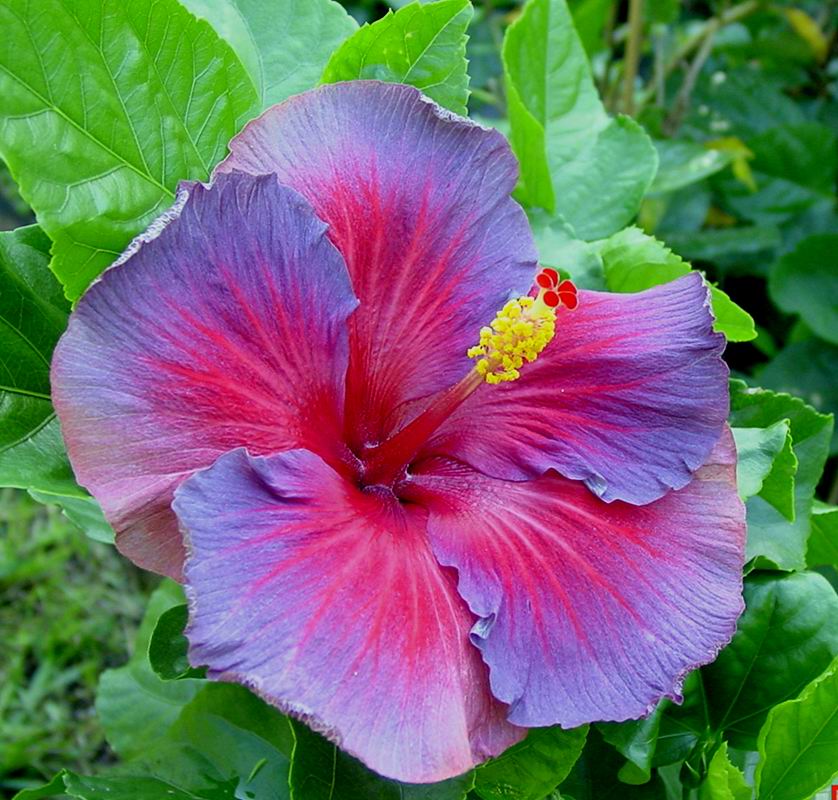



/grow-storm-hibiscus-rose-mallow-4125795-06-c3f2ae0b2c974f32bdc7aa39e5d79c91.jpg)
 Sew Colorful