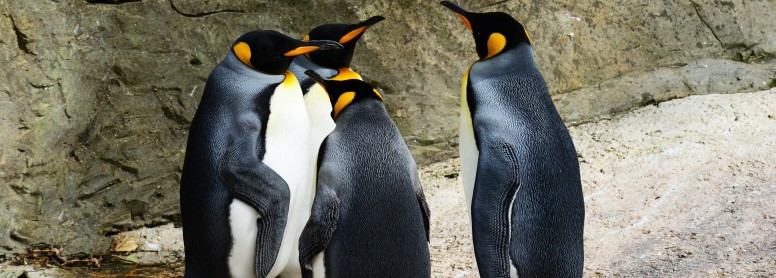
Happy National Penguin Day!

Penguins are flightless, aquatic birds that spend half their lives in water, and on land. They mainly habitat the Southern Hemisphere, with only the Galapagos penguin, north of the equator. They are members of the order Sphenisciformes and family Spheniscidae, and the number of extant penguin species is debated, somewhere between 17 – 20 current living species in total.

They range in size from the Little Blue (or Fairy) Penguin (Eudyptula minor) which stands just 40-centimetres tall to the Emperor Penguin (Aptenodytes forsteri) which averages just over 1-metre tall. Depending on the species, Penguins can weight from as little as 1-kilogram up to 40-kilograms and can live to 20 years. These meat eaters are usually found in coastal waters as well as areas that that are covered in ice.
One misconception about penguins is that they are all cold weather creatures. They are native to the southern hemisphere and are found not just in the Antarctic. Many species inhabit warmer climates with one in particular – the Galapagos Penguin – that calls the region near the Equator home.

Penguins can’t fly, but they sure can swim.

The wings of the Penguin have actually become flippers. This means they are somewhat clumsy on land, but can really move underwater. In fact, they are so agile ducking and weaving about that their actions in water look much like a bird in flight in air.

Penguins are speedy underwater and are deep sea divers.

When a Penguin dives into the water it can reach a speed of up to 12-kilometres per hour and when in high gear, some can reach up to 27 km/h. As for diving, the larger penguins can go deeper, with Emperor Penguins capable of diving down to depths of 565-metres – with dives lasting up to 22-minutes.

The average Penguin spends as much time on land as it does in the water.

Actually, they will spend half of their life in one or the other.

Penguins have devised ways to travel on land that would otherwise be hampered by their overall body shape and length of their legs.

They slide across snow on their bellies in a move known as tobogganing. When upright, Penguins waddle on foot or jump with both feet together in order to navigate terrain.

Although the actual number is not clearly known, there are many Penguin species.

The common belief is that there are between 17 and 20 different Penguin species on the planet.

Penguins use a layer of air for various benefits.

When underwater, the layer of air that is trapped in the smooth plumage of the bird provides buoyancy. The air layer also acts as an insulator when in cold water.

The diet of the Penguin is met with underwater diving.

It may look like they are playing, but since the Penguin feeds on sea life while swimming, it spends a lot of time in the water. One species, the Gentoo Penguin, can make up to 450 dives in a day when foraging for food.

Penguins have special underwater vision.

The eyes of the Penguin have special adaptations which provide superior underwater vision. It assists in finding food and spotting predators.

Penguins are highly social.

Because they tend to live in large colonies, Penguins have constant opportunities for social interaction and as a result have a number of vocal and visual signals that they have developed in order to communicate with one another.

They have large extended families.

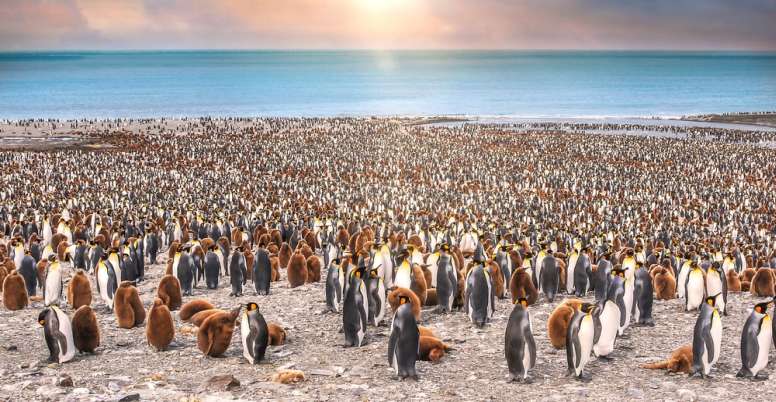
Penguins also breed in large colonies. The Gentoo Penguin colonies can number just 100 pairs where other species have colonies in the size of several hundreds of thousands.
Penguins know the value of working together.

In harsh environments, Penguins will huddle together to stay warm and conserve energy. Once a bird in the center has warmed up, it moves to the perimeter and this continues so that each Penguin gets a turn in the center of the huddle.

Monogamy is common in the Penguin world.

Pairs will stick together during the breeding season. Often they will re-couple afterwards, or it depends. Sometimes a couple just goes their separate ways after the young have hatched and grow old enough to take care of themselves.

Homosexuality is part of the Penguin culture.

Penguins have the distinction of having the most widely publicized homosexual relationships of the entire animal kingdom.

Penguins have small families.

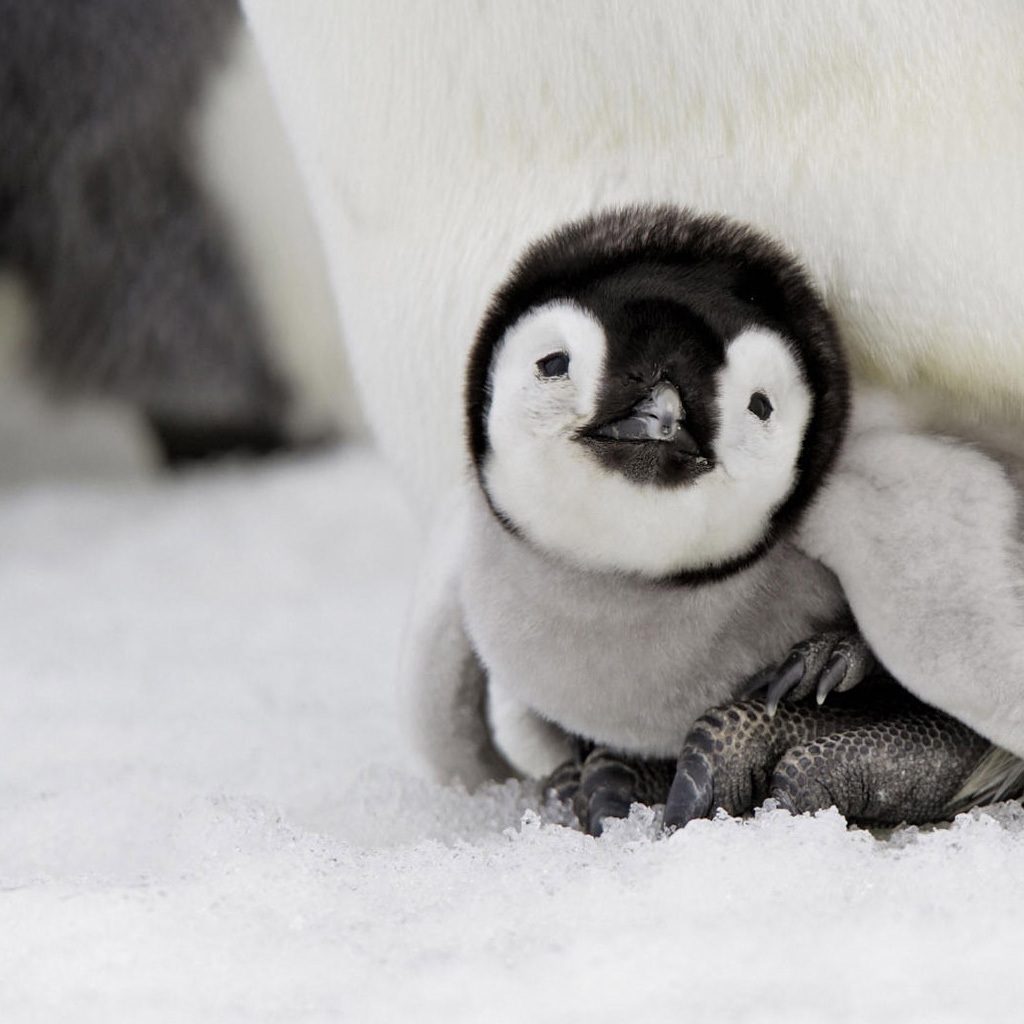
A typical clutch is two eggs however, the King and Emperor – the largest of the Penguin species – only have a single egg in a clutch. When measured proportionately to the adult Penguin body weight, these birds have the smallest eggs of any bird species on the planet.

Roughly 99.999% of the Penguin species will share the incubation duties.

It’s true, males take on as much of the work as females in the care of the eggs of their young. Well, that is with one exception. The male Emperor Penguin does not participate in this process.

It’s a good thing that most of the male Penguins pitch in with incubation shifts.
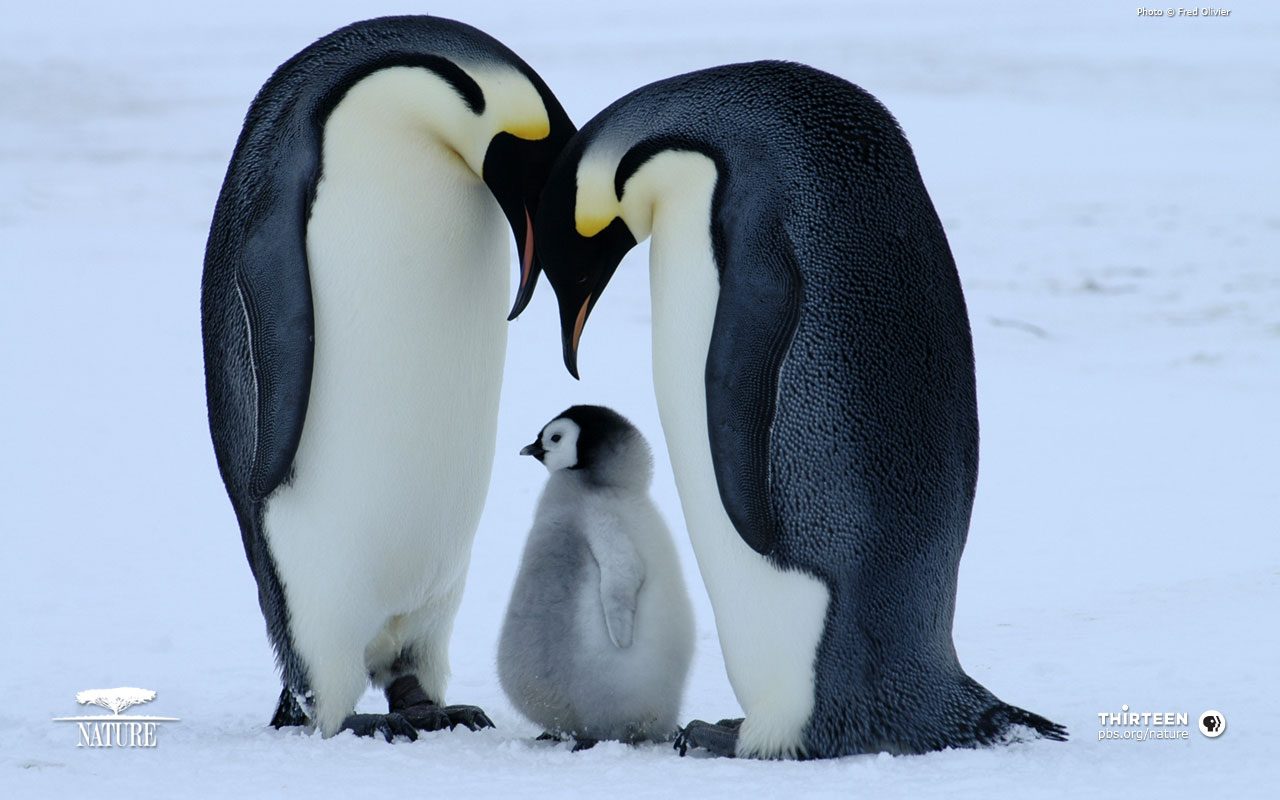
When one part of the Penguin couple ventures off to sea in order to feed, the incubating egg is left with the other partner. Sometimes the shift can go days and even months simply because the ice pack can form leaving open ocean as much as 80-kilometres away from the colony.

Penguins have incredible hearing.

It is with their sensitive hearing that parents and chicks are able to locate each other in a crowded colony.

Penguins have a built-in camouflage.

The counter shading of the Penguin plumage – black backs with white fronts – protect these birds from most prey that cannot distinguish a swimming Penguin from sun shimmering on the water surface when viewed from deep in the water below. The dark plumage on their backs helps to ‘hide’ them from above.

They have no land predators.

Penguins are safe in colonies on land as they have no predators except those living in the water. This is very likely why Penguins have little or no fear of humans. Humans have taken advantage of this and have been able to conduct many studies on these interesting birds without much problem.

The size of the Penguin can tell you where they are from.
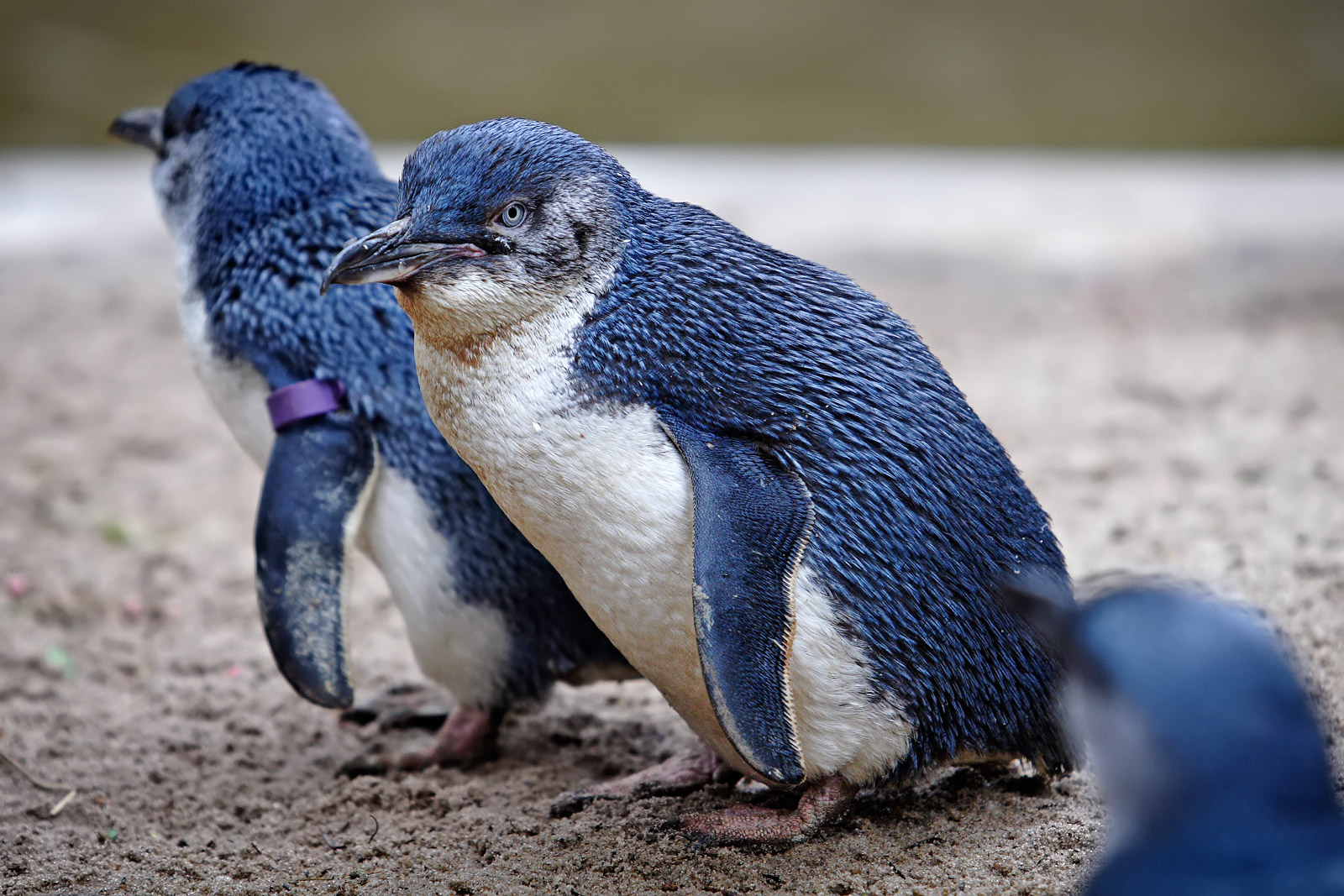
The larger Penguin species inhabit the colder climates. This obviously means that the smaller Penguin species would live in the warmer climates of the world.

SOURCE: FACT ANIMAL
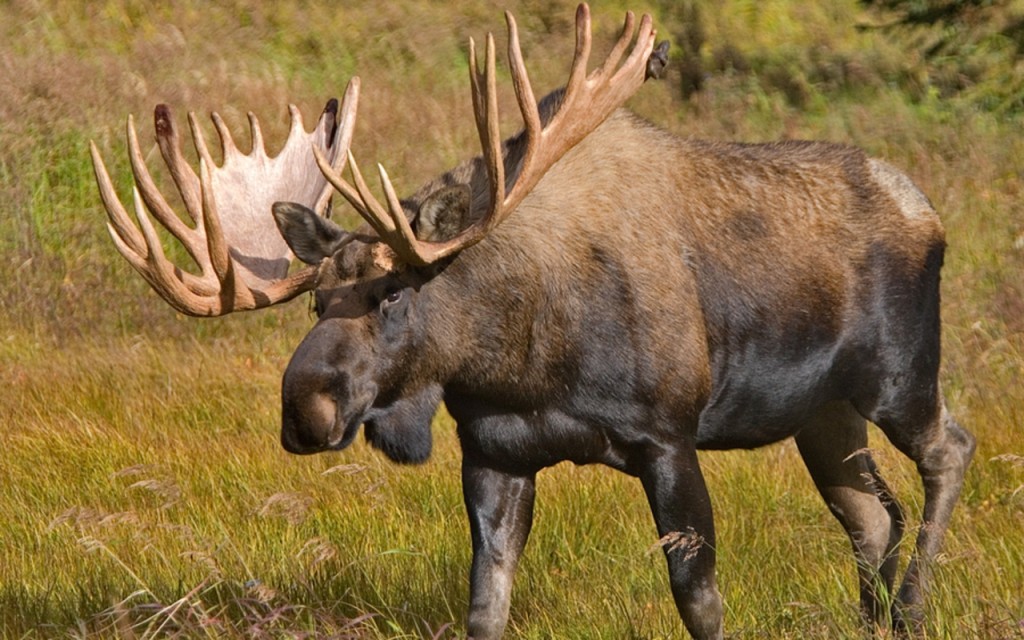
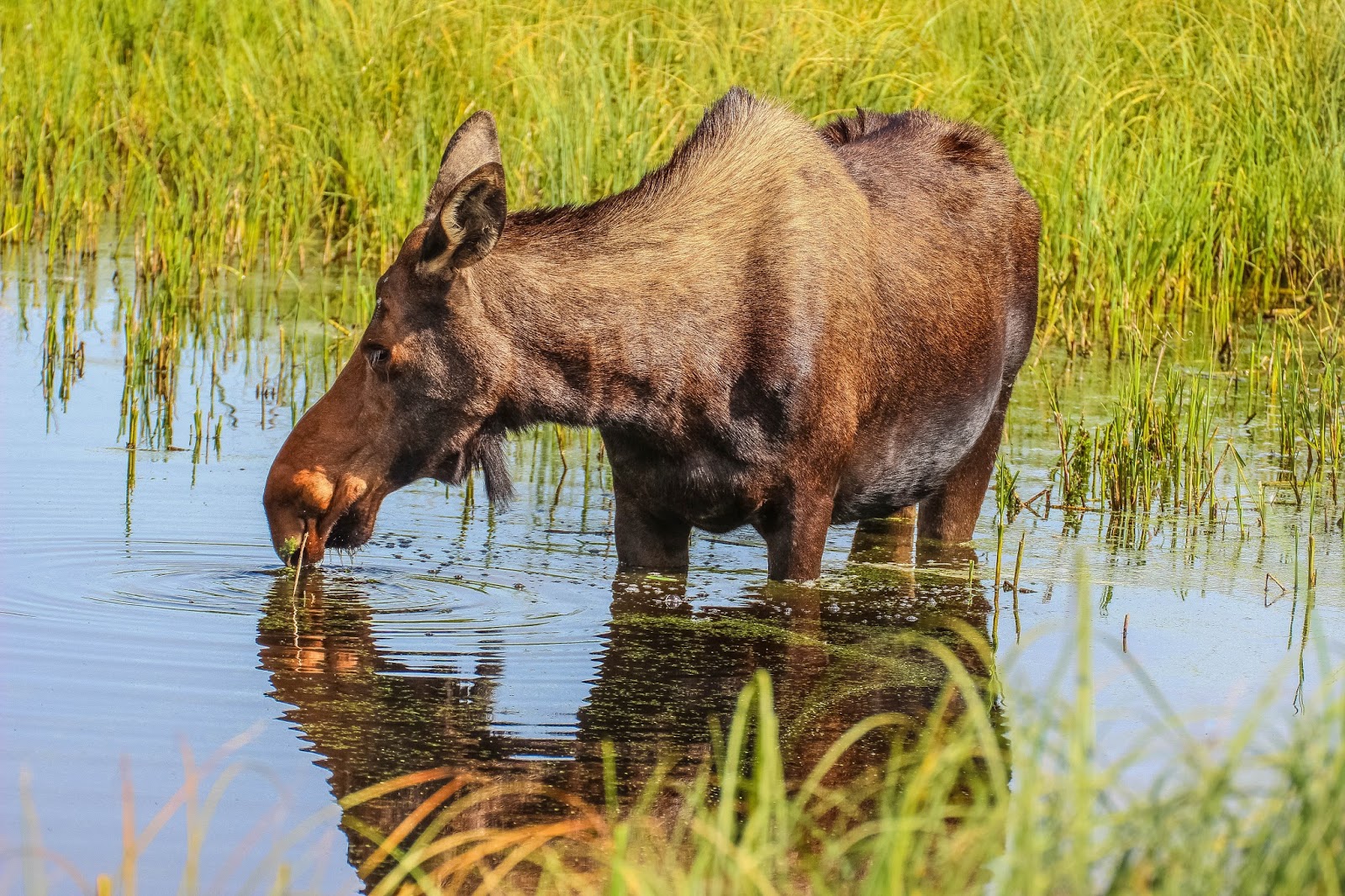
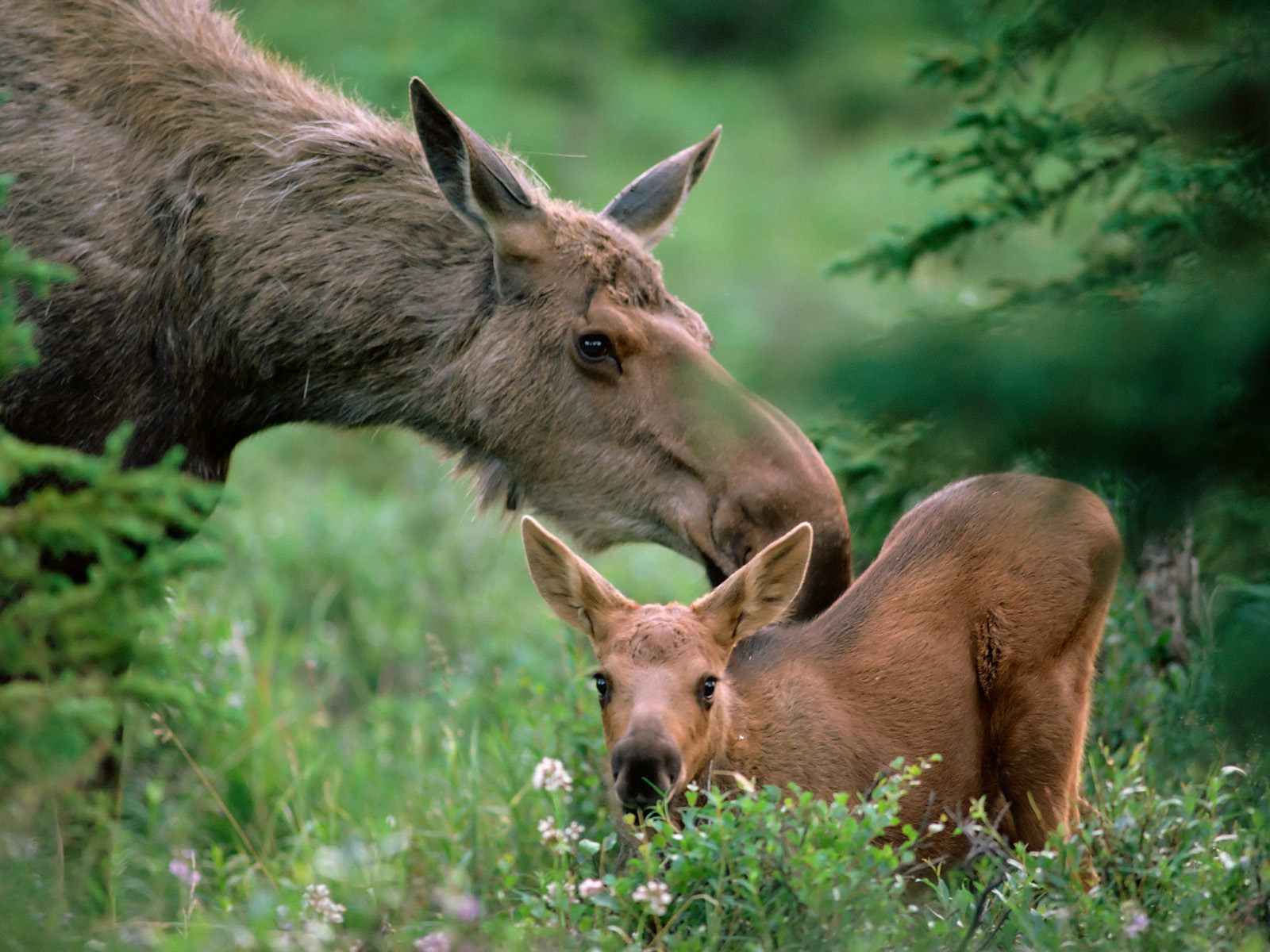
Alaska State Mammal: Moose

General Description

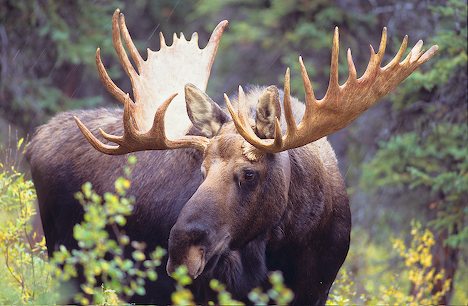
Known as moose across North America, but called elk in Europe, Alces alces is the largest member of the deer family. The Alaska-Yukon race (Alces alces gigas) is the largest of all of these creatures. Adult moose can range in size from 800 pounds (small adult female) to 1,600 pounds (large adult male), and they can be up to almost 6 feet tall. Moose can range in color from golden brown to almost black, depending on the season and the age of the animal. Newborn calves have a red-brown coat that fades to a light rust color within a few weeks. By late summer, the calves have shed this coat and grown one that is similar in texture and color to that of adults.

Moose are often easily recognized by their antlers, carried only by the males. These bony protrusions form within the first year, and are produced every summer after that. Trophy class bulls are found throughout Alaska, but the largest come from the western portion of the state. The largest sized antlers are usually produced when bulls are 10 – 12 years old, but bulls can reach trophy size as young as 6 years of age. In the wild, moose rarely live more than 16 years.

Hunting

Moose are valued for their meat and as a game animal. At least 7,000 moose are harvested annually in Alaska, amounting to about 3.5 million pounds of meat.

In 2007, Alaskans took home 90 percent of the 7,400 total moose harvested. About 6,750 moose were harvested by Alaskans and 685 by nonresident hunters. The resident take is certainly higher than this, based on information collected by the Division of Subsistence, and considerable unreported or illegal harvest likely occurs in some areas.

Viewing

Wildlife viewing is becoming increasingly important in Alaska. In a questionnaire completed by users of the Koyukuk Controlled Use Area, moose is the species people want to see the most. While the majority of respondents reported they were hunting only, an increasing number of people were both hunting and viewing, or only viewing. Moose viewing is particularly important along the road system.

Managing moose involves looking at predators, habitat, human harvest, other non-harvest mortality (severe winters, vehicles and trains), and the composition of populations – cows, calves and bulls – and these elements are touched upon in this section. Population density, habitat, and harvest vary from area to area, so each Game Management Unit (GMU) is presented separately in this section.

In some areas, habitat limits the potential size of moose populations, and concentration of moose and open habitat creates the potential for excessive harvests in accessible areas. In other regions it is unknown whether predators or habitat are more limiting moose populations, although some are clearly held back by bear and wolf predation. Moose mortality due to vehicles is significant in some areas where human population and vehicle traffic continues to increase. Land clearing activities associated with agriculture, development and road construction has been responsible for the increase in moose browse that attract moose to highways. The number of moose killed by trains seems to be related to snowfall and varies widely from year to year.

Without fire or other disturbance, forests mature and browse – and moose populations – decrease. Fire, mechanical manipulation, and post-logging site work, which encourage hardwood regeneration, are beneficial for moose habitat and have been conducted on some sites. Ice-scouring also helps to rejuvenate willow stands. After logging, if site preparation is not conducted or is done inadequately, blue-joint grass initially crowd out hardwood and spruce seedlings, creating less desirable moose habitat and slowing forest succession.

SOURCE: ALAKSA DEPT. OF FISH & GAME

I found these additional interesting facts from the coniferous forest website:

Interesting Facts

The antlers of the male Alaskan moose are the largest in the deer family.

The Alaskan moose is widely hunted throughout its range and its meat is considered a delicacy in those snow-laden regions.

The antlers of two fighting bulls sometimes get locked, and they eventually starve to death.

SOURCE: coniferousforest.com

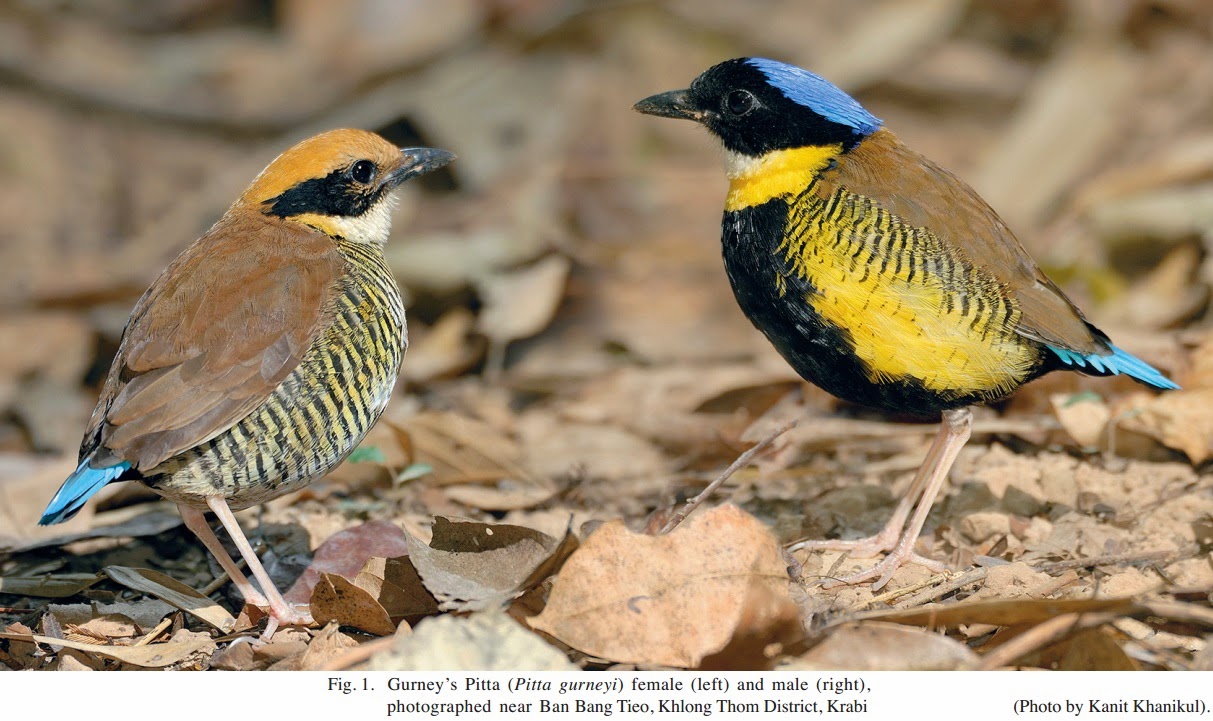
Gurney’s Pitta

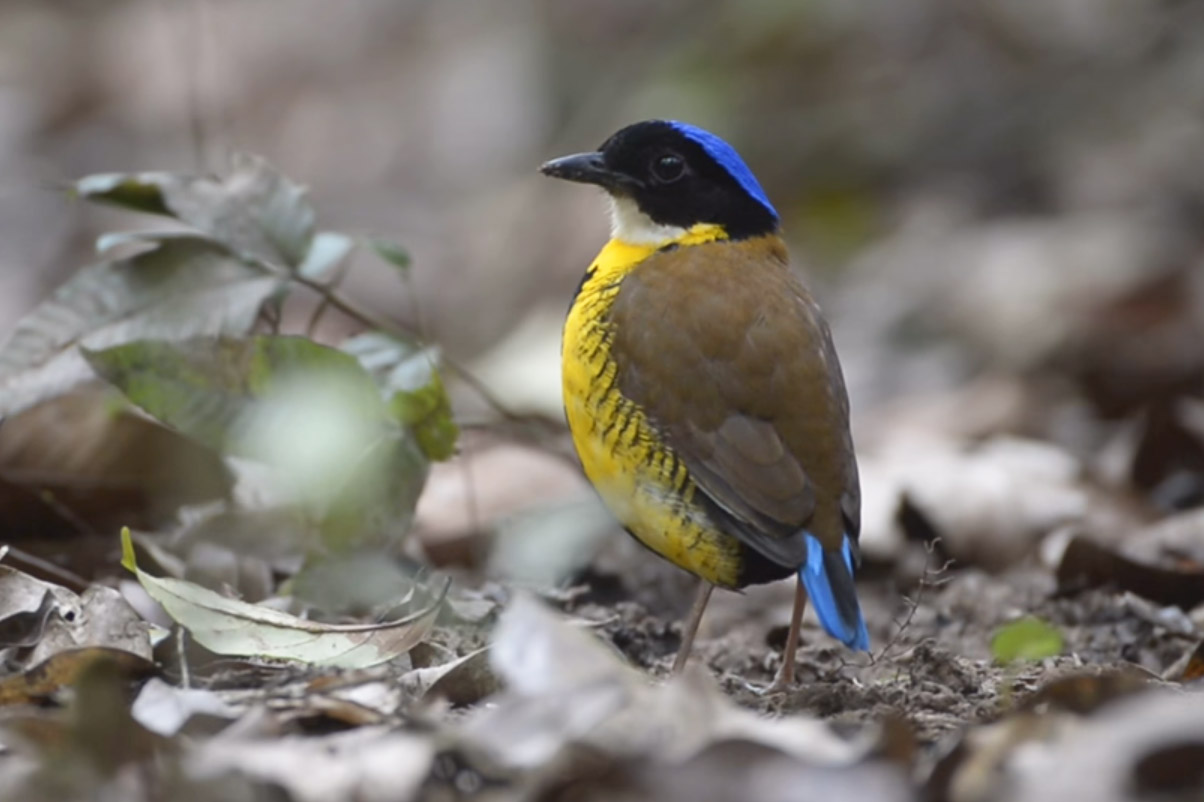
Gurney’s pitta (Hydrornis gurneyi) is a medium-sized passerine bird. It breeds in the Malay Peninsula, with populations mainly in Myanmar. The common name and Latin binomial commemorate the British banker and amateur ornithologist John Henry Gurney (1819-1890). Its diet consists of slugs, insects, and earthworms.

Description

The male has a blue crown and black-and-yellow underparts; the rest of the head is black, and it has warm brown upper parts. The female has a brown crown and buffy-whitish underparts.

Status and conservation

Gurney’s pitta is endangered. It was initially thought to be extinct for some time after 1952, but was rediscovered in 1986. Its rarity has been caused by the clearance of natural forest in southern Burma and peninsular Thailand.

Its population was estimated at a mere nine pairs in 1997, then believed one of the rarest bird species on earth. A search for it in Burma in 2003 was successful and discovered that the species persisted at four sites with a maximum of 10-12 pairs at one location. This granted the species a reassessment from the IUCN, going from critically endangered to endangered. Later on, further research completed in Burma by 2009 provides strong evidence that its global population is much greater than previously estimated, owing to the discovery of several new territories in this country.

The pitta was voted the “most wanted bird in Thailand” by bird watchers visiting that country.

SOURCE: THAI NATIONAL PARKS

Alabama State Mammal: The Black Bear

Black bears are native to Alabama. When the state joined the Union in 1819, they could be found in every corner of the Yellowhammer state. “Their demise occurred more than a century ago due to over harvesting and habitat manipulation,” Hannah Leeper, a bear researcher at Auburn University told us. As a result, the state hosts the smallest and most fragmented black bear populations in North America.

In 2006, the plight of the Mobile black bears was amplified by Escambia County students, who campaigned to have the bears designated our state mammal. On April 12th of that year, Governor Bob Riley signed a law making the black bear our official state mammal. 

That act elevated the bear’s significance.

In the 2010s a second population of bears was discovered in DeKalb and Cherokee counties in Northeast Alabama. This is a game-changer. These bears are recolonizing from the north Georgia bear population. Early research studies of these bears are encouraging. The mothers are producing larger-than-usual litters and the cubs are healthy, like our four cubs.

In 2014, the state of Alabama secured federal funding that focuses on species at risk. ‘State Wildlife’ grants will fund black bear research in partnership with Auburn University until 2024 and hopefully beyond.

“We are just learning how black bears behave in Alabama,” stated Traci Woods, Habitat and Species Conservation Coordinator with the Department of Conservation. “Why is their population growing or not growing? What is contributing to their survival or mortality? We are just now getting good population estimates and information on how they are moving.”

Alabama’s black bears go by two nicknames. Berry bears or honey bears.  And yes, they are kin to the most famous bear of them all—Winnie the Pooh.

When Beth Sewell, an educator at the JSU Field School asks students to describe the size of our bears, they have an image of big 600 to 1000 pound menacing grizzly or brown bear from out West. She has to assure them our black bears are much smaller, with a kinder temperament.

For example, female black bears in Alabama weigh 125-135 pounds. Males are about twice that, the size of an Auburn University linebacker. 

They are omnivores. Their diet? Pretty much anything a racoon would eat—insects, roots, berries, acorns and other nuts, mushrooms, grasses and other plant materials, as well as small mammals such as mice and ground squirrels, fish, crayfish, and of course rubbish left by humans in trash cans and campsites.  Vegetation normally makes up over 80 percent of their diet.

North Alabama bears now have a viable population.

Bears generally avoid humans. 

Virtually all the dens located in south Alabama were ‘nests,’ very similar to the nests that birds build. 

North Alabama bears mostly utilize wind rows and rock outcrops.

North Alabama population is estimated at 35-50. North Alabama population is growing. These bears have a good genetic influence, have quality denning habitat and larger tracts of unfragmented land with suitable habitat. The northern population could triple within the next 5 years.

The state expects Birmingham will see more sightings of male bears roaming in the summer months, not necessarily establishing a population. Be mindful. Male bears go on walkabouts that may extend a hundred miles from dens in North Alabama. 

The people of Birmingham are going to have to adapt to that and live with it 20 years down the road.

Are we going to see moms and cubs? Very unlikely.  Hannah Leeper’s research indicates the bears in the Northeast are moving very slowly southward. She does not expect the bears to take up permanent residence anywhere near Birmingham because of the poor habitat—not enough unbroken forests and people around. 

JSU’s Sewell concluded:

‘Bears are the state mammal for a reason. They were here first. The fact that they are naturally returning is almost a miracle. Welcome the bears—they should be revered as a sacred species. They are beautiful.”

SOURCE: BHAMNOW.COM

Narcissus

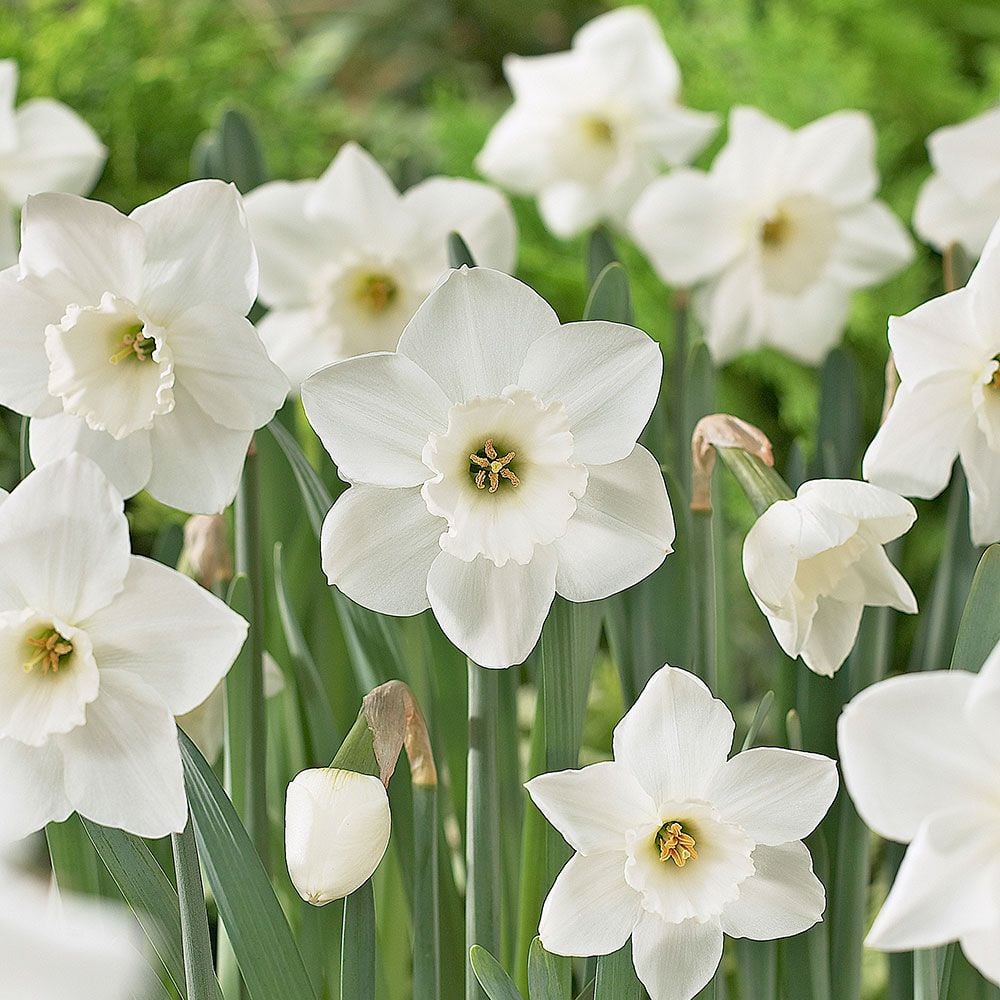
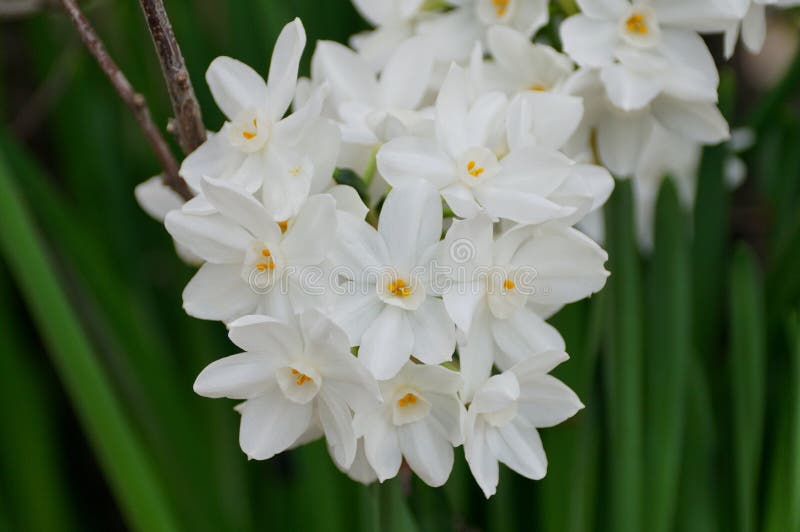
Paperwhites (Narcissus papyraceus) are flowering bulbs known for their fragrant clusters of tiny white, yellow, or orange flowers. The narcissus genus also includes daffodils and jonquils. You can force paperwhites to bloom indoors in the winter anywhere, or plant bulbs outdoors in fall to grow as a spring perennial in certain regions. Forced bulbs planted in pots or in water-filled vases are a traditional holiday gift plant. Here’s how to grow paperwhite flowers in your home or garden.

Paperwhite Flower Care

Give paperwhites direct light before they bloom, then move them to a spot with indirect light.

Plant paperwhite bulbs in a well-drained potting mix or grow them in water using pebbles or gravel.

Water potted paperwhites when the top inch of soil has dried out.

Skip fertilizing if forcing paperwhite bulbs indoors.

Light

For forced paperwhites in winter, start with bulbs in a place with bright, direct sunlight, such as a south-facing window. When plants begin to bloom, move them to a cool place with indirect light. This will help extend the bloom period. Paperwhite bulbs planted outdoors in warm regions can grow well in full sun or part shade.

Soil

You can force paperwhite bulbs by planting them in a typical plant pot with drainage holes using a standard houseplant potting mix. Leave the top of the bulbs above the soil line. You can also force bulbs by placing them in a glass vase or dish filled with one to two inches of clean pebbles or gravel. Place bulbs on top of the stones, then add more stones over and around the bulbs to hold them in place with the tops still visible. Add water just to the base of the bulbs so the roots are submerged.

Water

Water potted indoor paperwhites when the top inch or so of soil has dried out. If forcing paperwhite flowers in water, add water as needed to maintain the water level at the base of the bulbs.

Temperature and Humidity

Once paperwhites flower, cooler temperatures will help preserve blooms. Move plants to the coolest place in your home with indirect light after flowers appear. Paperwhite bulbs don’t require a chilling period the way some other bulbs do. However, these Mediterranean native plants require hot, dry summers to bloom repeatedly as outdoor perennials. Gardeners in states like California, New Mexico, and Texas tend to have the most success with planting paperwhite bulbs outdoors for this reason.

Fertilizer

There’s no need to fertilize forced paperwhite bulbs, since this growing process is designed to be used for only one bloom period. For bulbs planted outdoors in appropriate regions, while it is possible to plant forced paperwhite bulbs outdoors after they flower, it may take plants a few years to replenish their energy stores enough to flower again.

Types of Paperwhites

‘Ziva’: This popular variety is valued for its prolific, pure-white flowers and musky aroma.

‘Ariel’: A more compact paperwhite, ‘Ariel’ is known for its early blooms.

‘Chinese Sacred Lily’: This cultivar native to China has flowers with buttery-yellow cups against white petals and a citrusy scent.

‘Grand Soleil d’Or’: Though you’ll wait longer for blooms, this fragrant variety pops with cheery yellow petals centered around orange cups.

‘Nir’: An early-blooming, all-white cultivar with even more flowers per stem than ‘Ziva’.

SOURCE: THE SPRUCE

Seneca White Deer

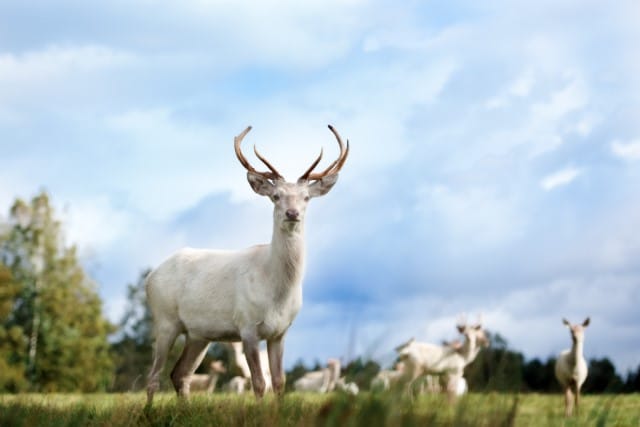
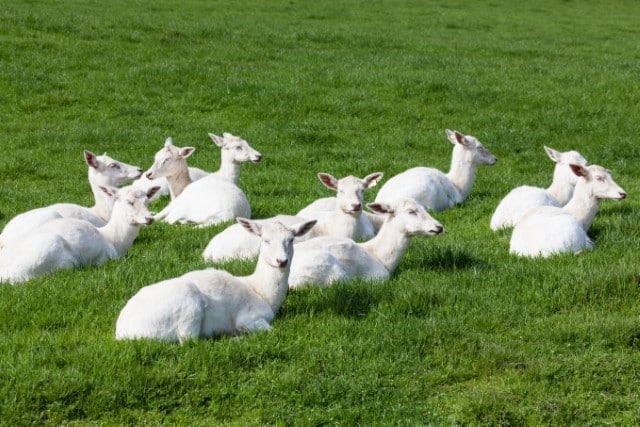
Even some of the most ardent deer enthusiasts and hunters have never heard of the Seneca white deer herd. This unique group of deer boasts a beautiful white coat that makes it notable throughout the world. Keep reading to learn everything you need to know about this mysterious herd.

The History of the Seneca White Deer Herd

The Seneca white deer herd’s history stretches back to 1941. Humans were inadvertently instrumental in the creation of this unique group of deer.

In 1941, New York’s Seneca Army Depot in Seneca County enclosed 10,600 acres to create a compound where since then, we’ve seen this herd’s development.

A fence positioned around the compound trapped in a deer population, keeping it separate from other deer in the area. This fence stretched 24 miles, and it was high enough that the deer inside the compound weren’t able to jump over.  While the compound’s number of deer was small at the beginning, it has obviously grown exponentially since then.

Some of the original deer on the compound carried recessive genes that create all-white coats. As inbreeding became common in this deer population, white coats became common. The white coat genes got stronger and stronger as time passed.

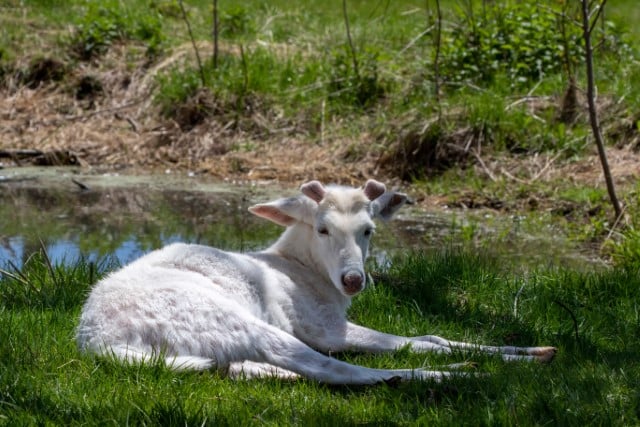
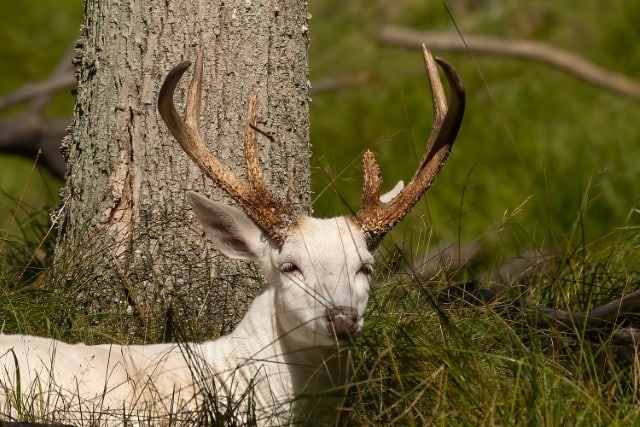
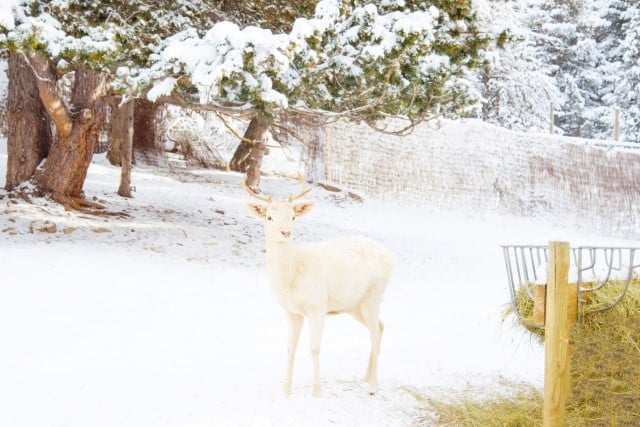
Some people believe the Seneca white deer herd is made up of albino deer, but this isn’t true. Leucism, not albinism, causes the white coat that is so common in this herd, and the white deer in the Seneca herd are actually leucistic deer.

The Seneca White Deer Herd is a Leucistic Deer Herd

The gene for leucism means that the deer’s fur doesn’t have any pigmentation. While deer usually have a coat in a shade of brown, deer with leucism lack the pigmentation to create that kind of coat.

That is why their coats are completely white. While leucism is a recessive gene, constant inbreeding in the Seneca white deer herd over several decades has made this herd mostly white-coated.

Are Seneca White Deer Always Completely White?

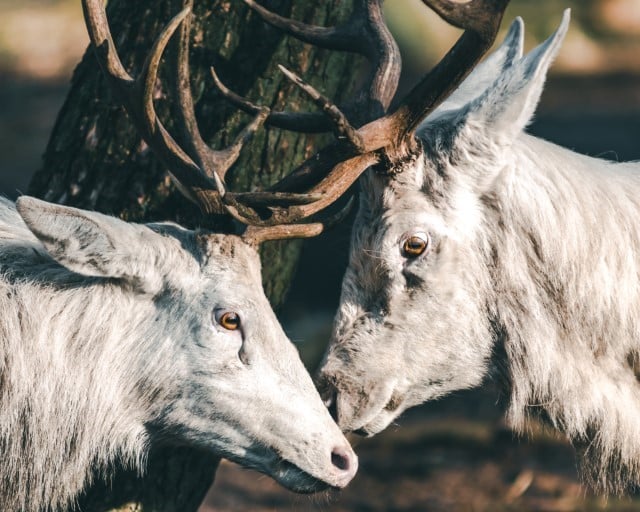
While deer with leucism, such as the ones in the Seneca white deer herd, are usually completely white, there can be some variations. For example, a leucistic deer may be only primarily white, with other markings. Even completely white leucistic deer still have a black nose.

Leucism vs Albinism

One difference between a leucistic deer and an albino deer is that the albino deer has pink eyes. Leucistic deer like the ones in the Seneca white deer herd, on the other hand, have brown eyes like any other deer. Albinism is much rarer than leucism.

Overall, deer with leucism are healthier than albino deer. That is why leucistic deer tend to enjoy longer lives than deer with the albino trait.  One major disadvantage of any kind of white deer, however, is their difficulty with camouflaging themselves and hiding from predators in the wild.  Of course, this herd is protected, so they don’t have this challenge – a fact which may help to explain how the deer became more and more white over time.

Other Facts About the Seneca White Deer Herd

The fact the deer herd on the former Seneca Army Depot had become overwhelmingly white-coated was first noticed in the 1950s.  That was when the United States Army decided to keep this deer herd intact and protected.

It was in 2000 that this property ceased being an army depot. It was transformed into Seneca White Deer, Inc., which is a conversation park devoted to the herd.  The property also holds a Cold War Museum. Without question, the Seneca white deer herd preserve is a unique wildlife park with a fascinating heritage.

How is the Seneca White Deer Herd Doing Today?

The Seneca white deer herd is still thriving. However, the White Deer Tour program officially ended in 2019.  The Seneca White Deer, Inc., organization and Hobart and William Smith Colleges’ Finger Lakes Institute have established a special scholarship fund in honor of the herd and its preservation.

This herd is found in New York State towns called Varick and Romulus. They’re in the Finger Lakes Region. The preserve spans an impressive 3,000 acres. Its deer herd is the largest herd of deer with visible leucism on the planet.

Are There Health Problems Associated with White-Coated Deer?

Remember that leucism is a recessive trait. Like many other such traits, it only becomes prevalent when there is inbreeding.  And inbreeding, in turn, is linked to many potential health problems. That is why a deer with leucism is more likely to have certain health problems than a deer without this condition. Some problems commonly linked to leucism in animals include birth defects, such as a cleft palate and cross eyes.

Myths and Legends About White-Coated Deer

The recessive leucism gene exists in deer all over the world, so leucistic white deer do pop up in populations outside of the Seneca herd.

That is why we see the symbolism of white deer in myths and cultures around the globe.

For example, there are white-coated deer in Asian, European, and Native American stories. We see white deer treated as magical creatures in European mythology.

Are White Deer an Endangered Species?

No, white deer aren’t an endangered species of deer. They aren’t actually a species separate from regular deer.  White deer are the same species as the other deer in your area, but they have either leucism or albinism.

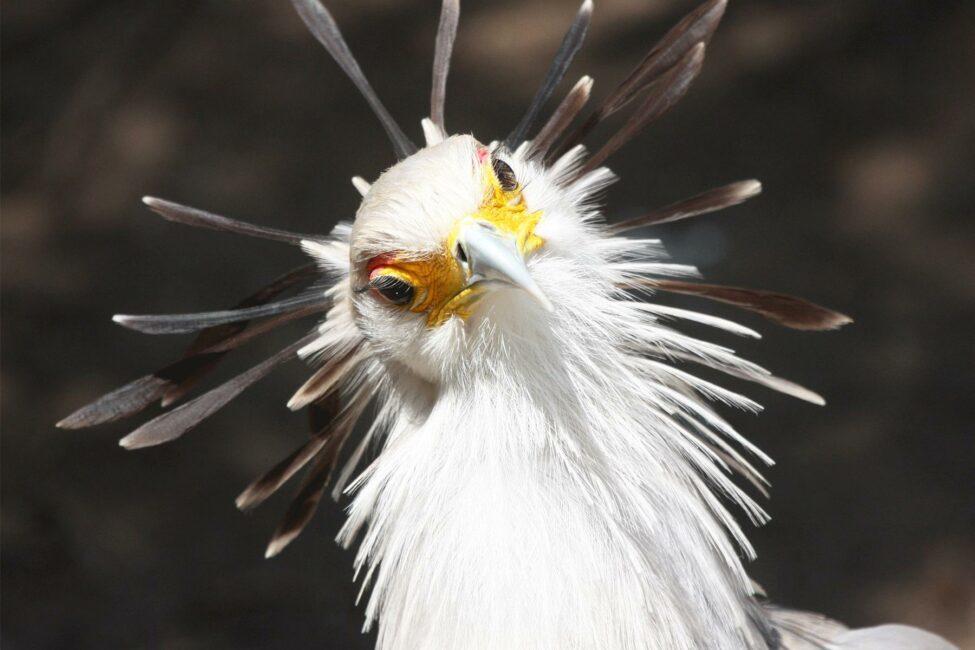
The Secretary Bird

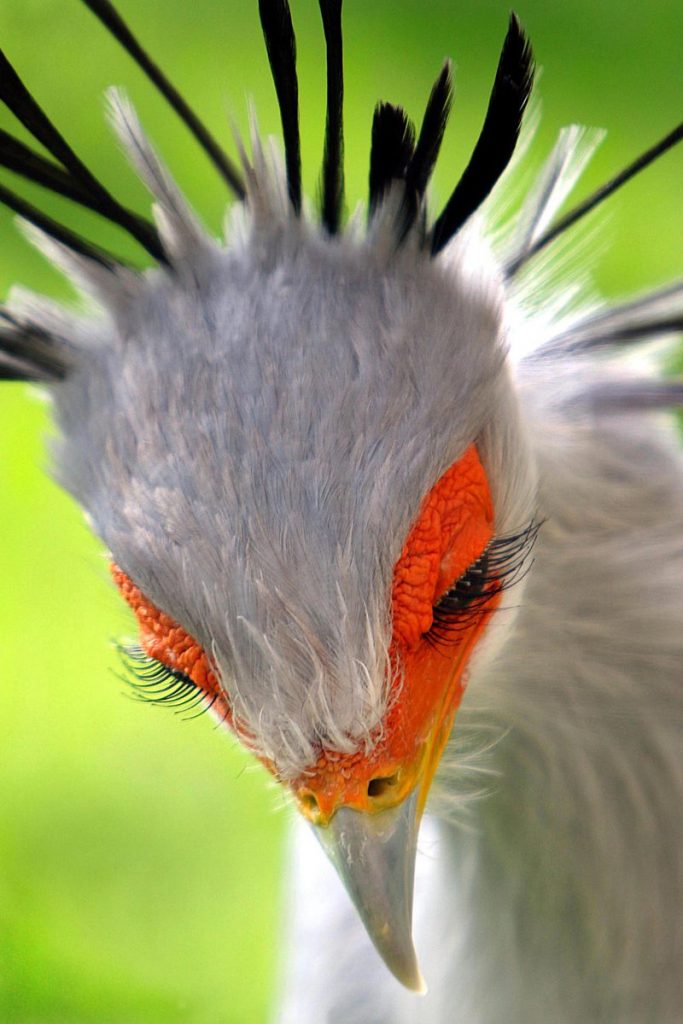
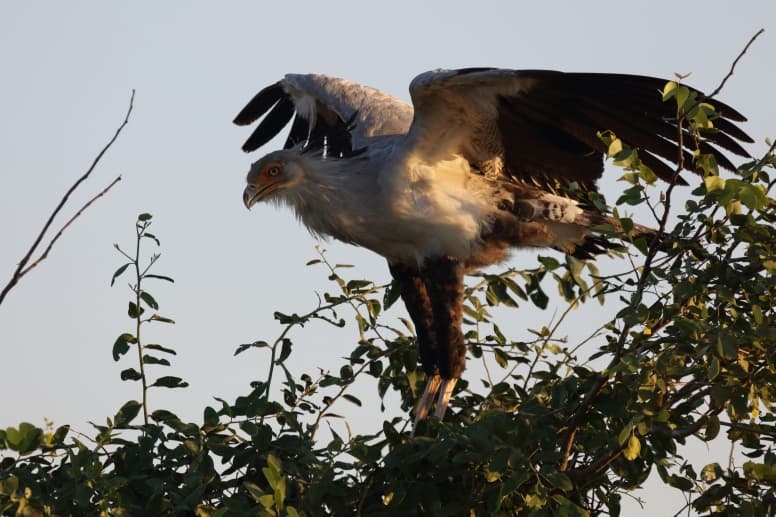
Its preferred habitat is open savannas or grasslands in sub-Saharan areas. It hunts in these open areas, using its long legs to strike prey and stomp them to death. It is famous for eating snakes, but it also hunts insects and small mammals. They mate for life and one pair inhabits and defends a territory of up to 50km. Pairs lay eggs in a nest of their own making at the top of Acacia trees. They live 10-15 years in the wild and up to 19 in captivity. They are classed as endangered, with their numbers rapidly decreasing due to habitat loss.

Interesting Secretary Bird Facts

No one is quite sure where it got its name.

There are a few different theories, including that it was named by Dutch Settlers because of its resemblance to 19th Century Lawyers’ Secretaries. Another theory suggests that the name is a corruption of an originally Arabic word, meaning “hunter bird”.

Its scientific name means “the archer of snakes”.

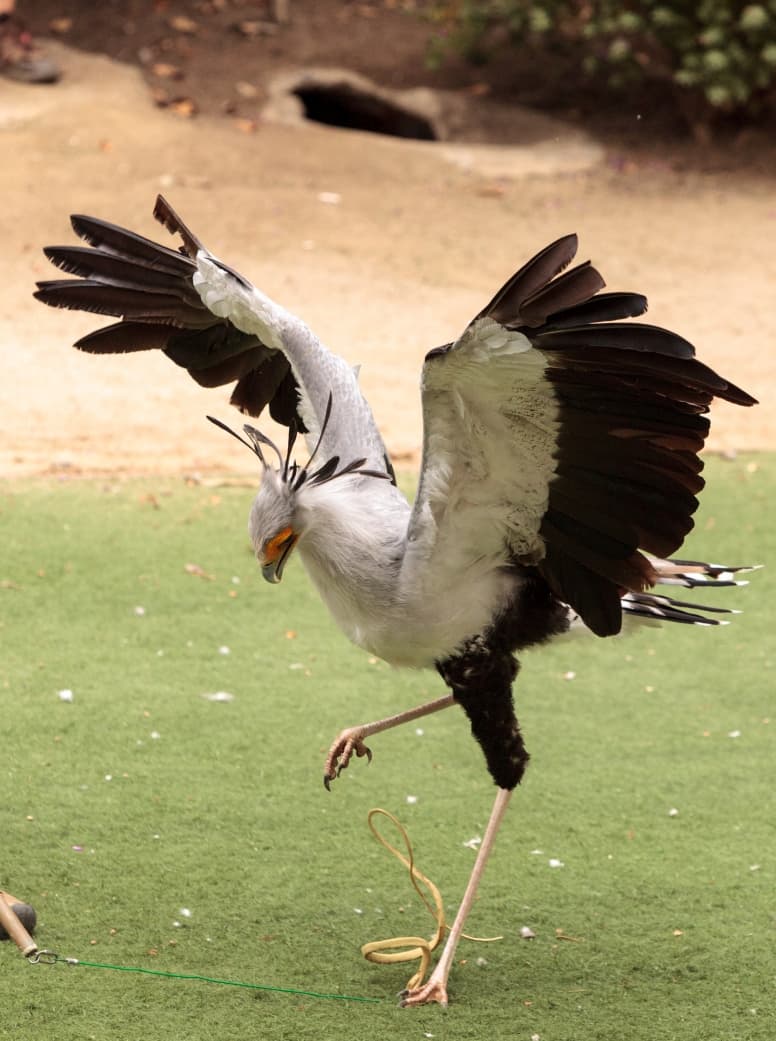
This is because secretary birds love to hunt snakes. They use their large wingspan to distract the snake, while their scaley legs prevent snake bites.

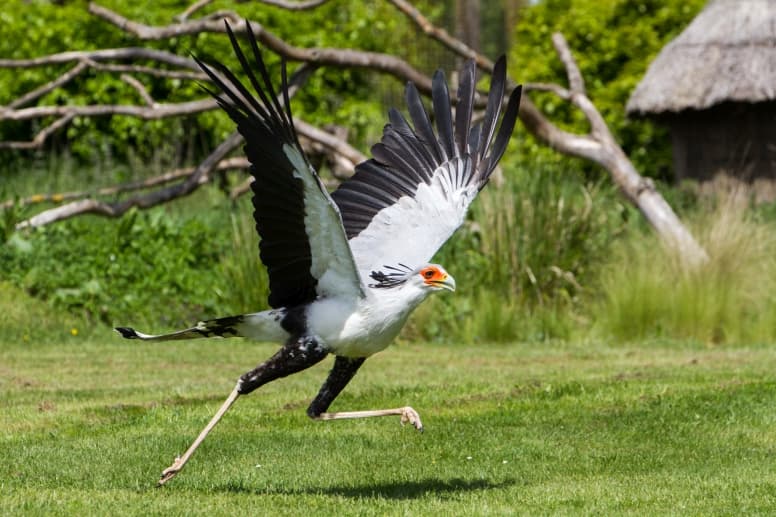
They rarely fly.

They move around on foot most of the time, only taking to the air to reach their nests or for courtship displays.

They have a wingspan of 2m.

This is huge! They use their wings while hunting to distract their prey, and also during mating rituals.

They are one of just two birds of prey that hunt on the ground.

The only other birds that hunt on the ground are caracaras.

Secretary birds have one of the strongest (and fastest) kicks in the animal kingdom.

They can kick with a force 5-6 times their body weight. It happens fast too, in 15 milliseconds the foot can go from still to making contact.

They have been seen hunting juvenile big cat.

They’ve been spotted using their stomping hunting technique to kill juvenile cheetahs, and also baby gazelles.

They hunt in pair.

Monogamous pairs, and sometimes familiar groups, will hunt together.

Secretary birds mate for life.

Once paired up, they will stay together for life. They even use the same nest year after year.

They have elaborate mating display.

Even though they mate for life, they still perform their elaborate mating displays. They will perform “pendulum flights”, swooping up and down again. And on the ground, they dance together.

Secretary birds have large territories.

Pairs of secretary birds will inhabit, and defend, areas of up to 50 km2. However, many can be spotted together around important resources, such as watering holes.

They make their nests on the top of thorny trees.

This is almost always in an acacia tree. The nests are large, platform-like and often softened with grass and dung.

They lay 2-3 blue-green eggs.

These eggs are a few inches long and hatch after 45 days of incubation.

Sadly, the secretary bird is endangered.

This is because their grassland habitats are cleared and used for cattle.

SOURCE: FACT ANIMAL

Turquoise

Turquoise is a popular gemstone that has long been prized in many cultures. It’s said to bring luck, peace, and protection, and it’s also one of the birthstones associated with December.

Turquoise stones have many meanings that go above and beyond the beauty of the blue color they provide.

What Is Turquoise?

Turquoise is an opaque stone that ranges from blue to green in color. The most valuable turquoise stones generally have a more smooth, solid color, while many stones have brown veins throughout. It has a calming, soothing, protective energy that can be beneficial for various feng shui applications. The word turquoise comes from a French word meaning “Turkish,” likely because the stone was introduced to Medieval Europe by Turkish sources. Turquoise has a Mohs scale ranking of 5 to 6, which means it has a fair to good hardness rating.

Properties of Turquoise

There is not one rare or best turquoise stone. But there are many rare types of turquoise with unusual colors. There are rare specimens of turquoise with blue-violet colorations and highly valuable transparent or translucent turquoise crystals that come from Virginia, for example.

Here are more common properties of turquoise stones:

Color: Blue, green

Chakra: Throat, third eye

Number: Vibrates to 1

Planet: Jupiter, Venus, Neptune

Zodiac: Scorpio, Sagittarius, Pisces, Rabbit

Bagua areas: Zhen, Qian

Elements: Wood, metal

Origin: Afghanistan, Arabian Peninsula, China, Egypt, France, Iran, Mexico, Peru, Poland, Russia, Tibet, United States

Spiritual Meaning of Turquoise

What does turquoise mean spiritually? The stone has a calming, grounding energy that makes it a great stone for when you are feeling overwhelmed, or to aid in meditation. It is said to connect heaven and earth and help you connect to the spiritual world. Turquoise can strengthen your connection to intuition, and it is also helpful for protection and purification. 

Gemsbok

The Gemsbok (Oryx gazella) is the common name given to the largest and most well-known of the 3 species of Oryx. Due to their horns being so lethal, Gemsbok have also been called the ‘Sabre Antelope’. Its name is actually derived from the German word for a male chamois, although they are not related. Gemsbok are distributed around deserts, scrublands and brushlands in South Western Africa.

There are two types of Gemsbok, a northern and a southern variety. The only difference between them is that the northern variety have black fringes on their ears while the southern variety have longer horns and their ears are more rounded in shape. Southern gemsbok are more abundant than the northern gemsbok. Gemsbok have also been introduced in Mexico and the southwestern United States.

Gemsbok Description

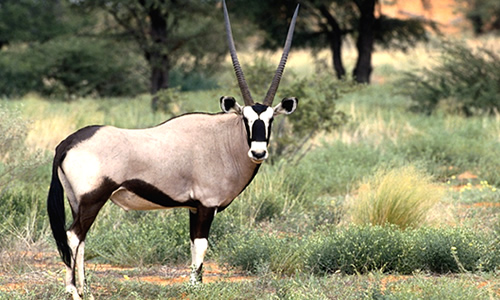
Gemsboks stand around 4 feet 7 inches at shoulder height and weigh between 230 – 250 kilograms (females weigh slightly less than males at around 200 – 210 kilograms). Gemsboks’ coats are a light brown/grey color with lighter patches to the bottom rear of their rump, and sandy grey flanks. A dark stripe extends from their chin and travels down to the bottom of their neck, over their shoulder joints and leg along their lower flanks and on each side of their rear legs. All four legs are black on their top half, with white below the knees and black patches on the shins.

Gemsbok have a horse-like posture and gallop and have muscular necks and shoulders. They have a long tail with black flowing hair. Both male and female gemsbok have long, sharp, pointed horns (female horns are longer and more slender). These horns can extend up to 33 inches in height. The tips of the horns are pointed and sharp and native Africans have used the tips for spear points. Gemsbok also have very distinctive tan, black and white facial markings which make them easily identifiable.

Gemsbok are able to survive in even the harshest conditions thanks to an intricate network of blood vessels called carotid rete, situated in the nose which cool down the blood supplied to the brain. This happens because of the rapid inflow and outflow of air created by the gemsboks panting and therefore protects the gemsbok from deadly temperatures. At the same time, however, the gemsboks body temperature is allowed to rise – eliminating the need to perspire (sweat), and therefore preserving water.

Gemsbok Habitat

Gemsboks are desert dwelling animals that prefer deserts, scrubland and brushland. Southern gemsbok tend to inhabit open, arid areas, such as the Kalahari duneland and bush savanna while northern gemsbok inhabit open grasslands.

Gemsbok Diet

Gemsboks are herbivores and grazers and consume mainly tough dry grasses, supplemented with foliage. Gemsboks are dry-region roughage eaters, with a great capacity to digest fiber. Desert dwelling gemsbok do not rely on water to satisfy their thirst, instead they obtain moisture from tsama melons and by digging up tubers, roots and eating plant bulbs. Grassland gemsbok have plentiful water in their habitat that is readily available.

Gemsbok Behavior

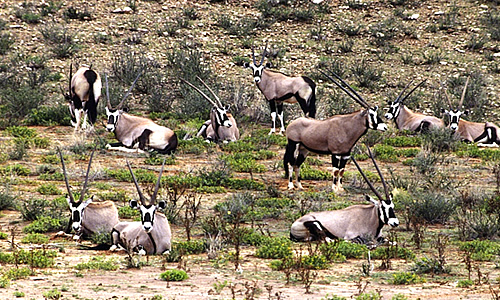
Gemsboks are gregarious and sociable animals, spending time on open plains. Gemsboks can be seen in herds of 10 or more individuals, however, when food is scarce, usually during the dry season, they break up into smaller groups.

After the rain season, gemsboks usually gather into larger herds of up to 300 individuals. Herds are usually led by a territorial male who marks his territory with piles of dung pellets to warn off male intruders. If intruders do come on to the territory, duel conflicts usually occur involving horn clashing and body bashing. As calves in the herd grow, they test each other in what looks like games, but in reality are tests of strength. As the hierarchy becomes established, the need to fight is reduced. Bachelor herds are rare.

Gemsboks do not shy away from large animals of prey. When holding off predators such as lions, their horns are lowered parallel to the ground and they lunge at their rivals with great accuracy. They are swift runners and can outpace a horse or a pack of African Hunting Dogs.

Gemsbok Reproduction

Gemsboks do not have a specific breeding season. A single calf can be born at any time of the year after a gestation period of 9 months. Males reach sexual maturity at about 5 years of age whereas females start breeding as young as 2 years of age. The young remain hidden in the grass and are suckled by their mother for 3 – 6 weeks after which calves will join their mothers and the rest of the herd or a nursery herd. The female Gemsbok comes into heat again shortly after giving birth. The horns of the calves grow extremely fast and when they emerge from concealment after birth their horns are very prominent. The life span of a gemsbok is 18 – 20 years.

Gemsbok Conservation Status

Gemsboks are classed as ‘Conservation Dependent’ by the IUCN. Gemsboks are prized for their meat and their horns by many hunters.

SOURCE: ANIMAL CORNER

Bohemian Waxwings

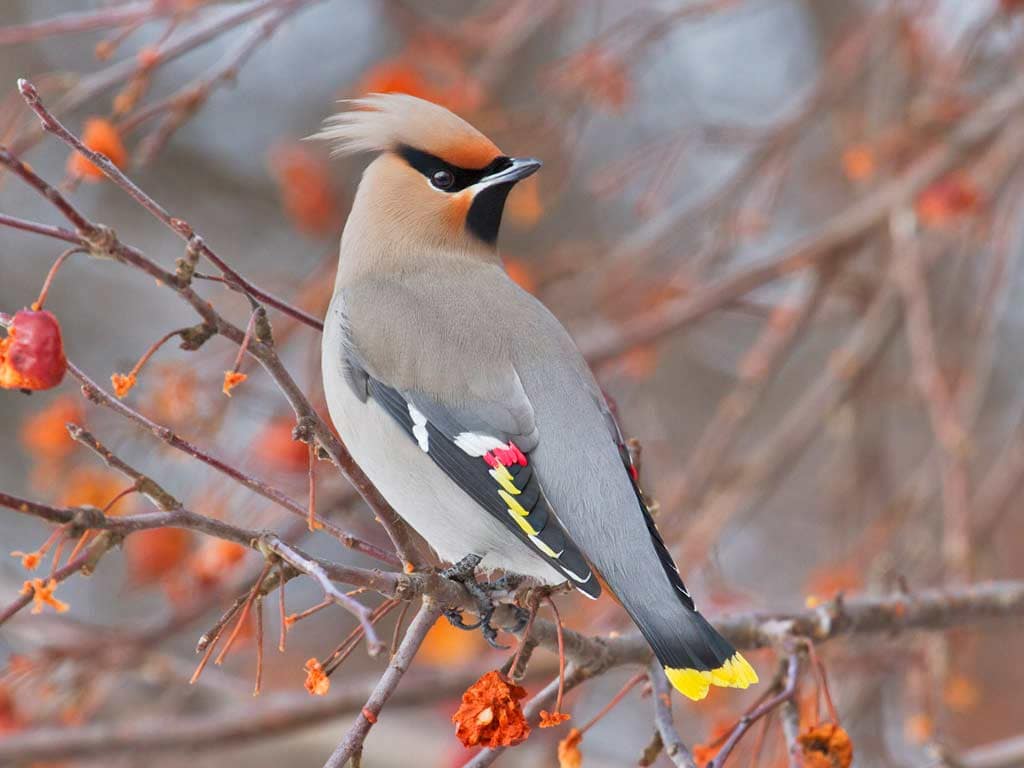
True to their name, Bohemian Waxwings wander like bands of vagabonds across the northern United States and Canada in search of fruit during the nonbreeding season. High-pitched trills emanate from the skies as large groups descend on fruiting trees and shrubs at unpredictable places and times. These regal birds sport a spiky crest and a peach blush across their face. Unlike the familiar Cedar Waxwing, they have rusty feathers under the tail and white marks on the wings.

Bohemian Waxwing’s nomadic nature makes it difficult to predict if and when they might show up in your yard to visit a platform feeder. But they are fruit connoisseurs, so planting a native tree or shrub that holds its fruit late into the fall and winter may bring in any that pass through your area. Find out more about what this bird likes to eat and what feeder is best with the Project FeederWatch Common Feeder Birds tool.

Bohemian Waxwings are movers. One waxwing banded by researchers in British Columbia was recovered 13 months later in South Dakota. Another individual flew 280 miles in 11 days.

Bohemian Waxwings, unlike many songbirds, do not hold breeding territories, and they also don’t have a true song. Bohemian Waxwings communicate with high-pitched calls as they roam around in large groups looking for fruit.

Only three species of waxwings exist in the world, the Bohemian Waxwing of North America and Eurasia, the Cedar Waxwing of North America, and the Japanese Waxwing of eastern Asia.

Bohemian Waxwings have an uncanny ability to find fruit nearly everywhere, almost like they have a GPS tracker for berries. Flocks sometimes turn up in desert areas, find an isolated shrub, devour its fruit in minutes, and move on.

Waxwings have red, waxy tips on some of their wing feathers and yellow tips on the tail. The color comes from carotenoid pigments found in the fruit waxwings eat. As the birds get older, the waxy tips get bigger.

The oldest recorded Bohemian Waxwing was at least 5 years and 10 months old. Researchers banded the individual in 1968 in Saskatchewan and recovered the same individual in 1973.

The bohemian wanderings of this waxwing make them a little unpredictable to find. The best place for most people to see them is during migration and winter (September–March) in the northern United States and Canada, when they come south from their breeding range and move around in search of fruit. Check dense patches of fruiting shrubs like mountain ash and listen for their high-pitched trills. Watch the skies for tight flocks that descend en masse towards fruiting trees and shrubs. If you see or hear a group of American Robins or Cedar Waxwings, check the flock for Bohemian Waxwings as they sometimes flock together.