Buckeye Butterfly

Description and Identification

Caterpillar

The larval stage of the Common Buckeye can last between two and four weeks, during which the caterpillar can grow up to 1.5 inches in length. Its body is adorned with orange spots on a black base, highlighted by spine-like structures that protrude significantly. These spines have a striking blue hue at their bases, adding to the caterpillar’s distinctive appearance. Unlike many butterfly species, Common Buckeye caterpillars are solitary and do not engage in group behaviors.

Pupa

Transitioning into the pupal stage, the chrysalis of the Common Buckeye takes on a dark brown color, seamlessly blending into its surroundings like twigs and dry leaves for camouflage. This stage, lasting 1 to 2 weeks, features lighter brown patches and subtle dotted marks that enhance its mimicry of the natural environment.

Adult Butterfly

Sexual Dimorphism:
Adult Common Buckeyes exhibit sexual dimorphism, meaning that males and females can be distinguished by differences in their appearance.

Color and Appearance:
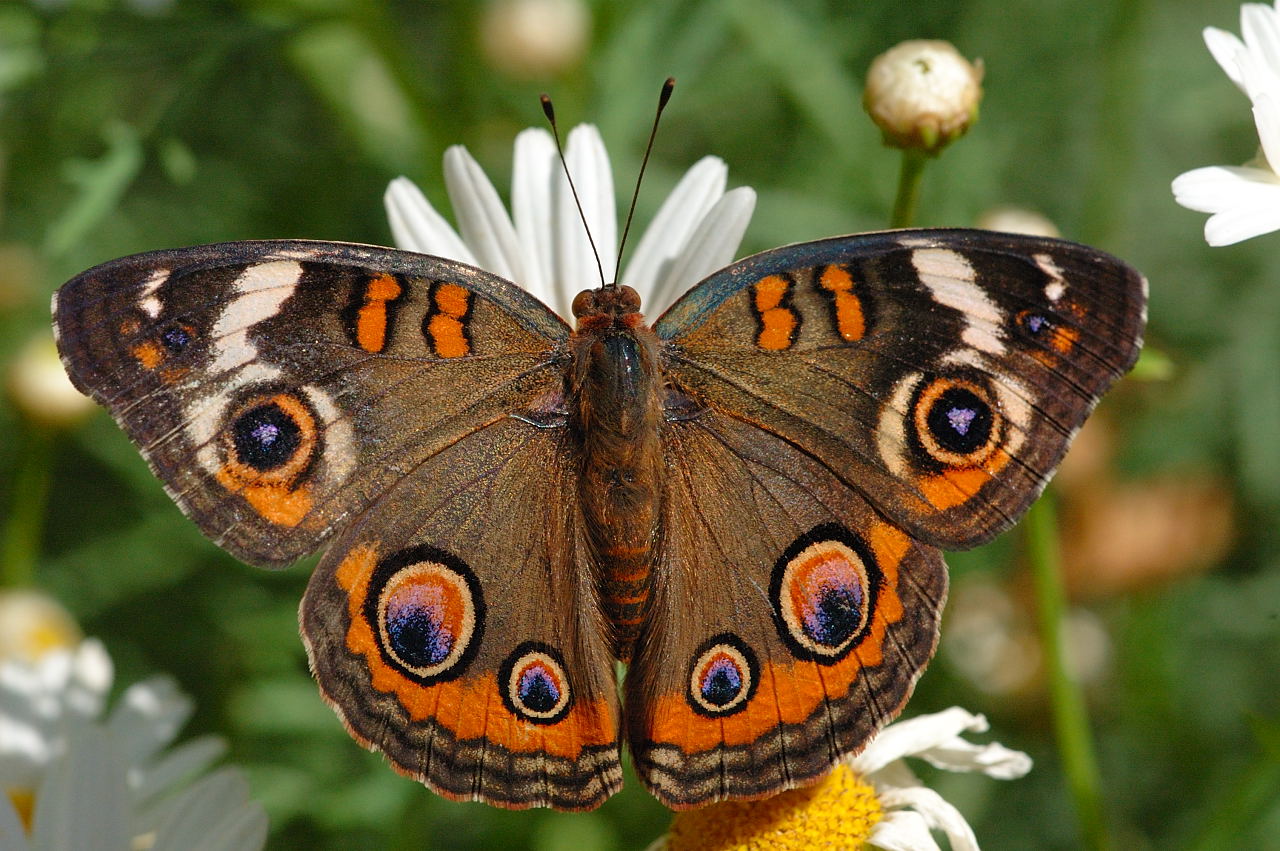
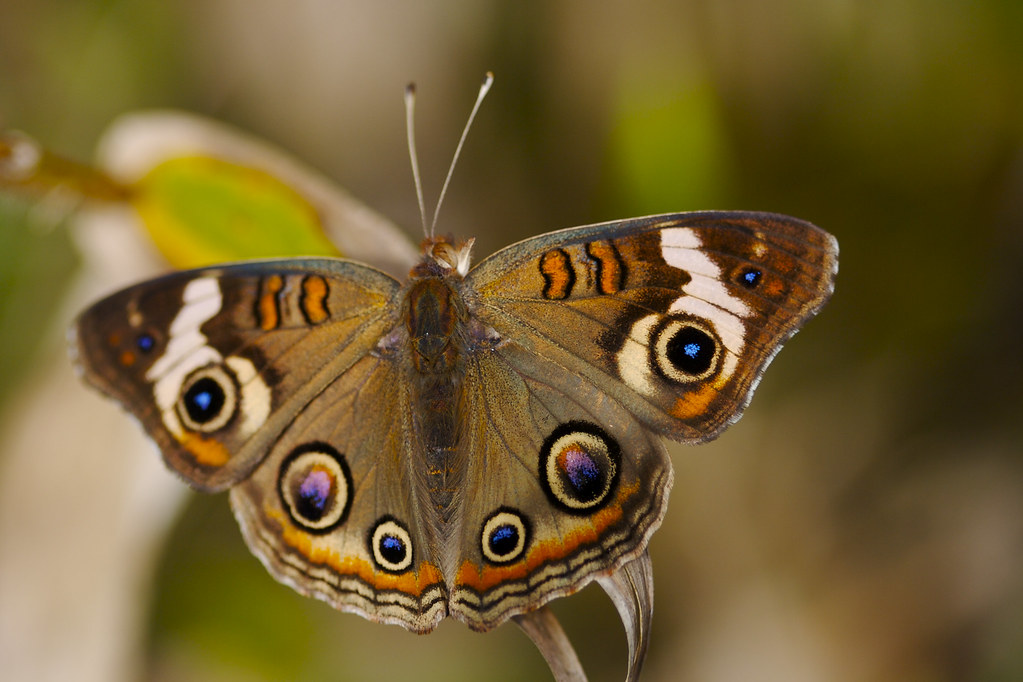
When their wings are open, the base color of both sexes is brown, with the forewings displaying two bright orange cell bars and two eyespots. The largest eyespot is found on the lower forewing. The hindwings feature two more eyespots, with the uppermost showing a magenta crescent. The underside of the hindwings varies seasonally in color from brown to tan in summer and to rose-red in autumn, with males sporting distinctive blue-to-black eye markings not present in females.

Average Wingspan:
The wingspan of the Common Buckeye ranges from 1.65 to 2.8 inches (4.2 to 7 cm), allowing for a swift and agile flight.

Flight Pattern:
These butterflies have a fast and periodic flight pattern, typically hovering around the low branches.

Eggs

The eggs of the Common Buckeye are tiny, green, and round, laid singly on the tender buds or upper sides of leaves, ensuring the next generation’s survival.

Identifying the Buckeye

Identifying the Common Buckeye Butterfly is a rewarding experience for any nature enthusiast. Look for the characteristic eye-like markings on the wings, which are the butterfly’s most distinctive features. The combination of brown base coloration with bright orange bars and eyespots on the wings, especially the large lower eyespot on the forewings, makes identification straightforward. Seasonal changes in the coloration of the hindwing undersides also provide clues to their identification. Observing these traits, along with the butterfly’s unique flight pattern, can help differentiate the Common Buckeye from other species.
Did You Know?

The striking eyespots on the Common Buckeye’s wings are not just for show; they play a crucial role in predator deterrence, mimicking the eyes of larger animals.

Migration is a behavior observed mainly in the southern populations of the Common Buckeye. During late spring and summer, these butterflies migrate northward in search of optimal breeding conditions.

Common Buckeye caterpillars have a diet rich in iridoid glycoside, a chemical compound that makes them less palatable to predators such as wasps, birds, and ants. This adaptation allows them to deter predators effectively, ensuring a higher survival rate.

SOURCE: BUTTERFLYIDENTIFICATION.COM

Painted Bunting

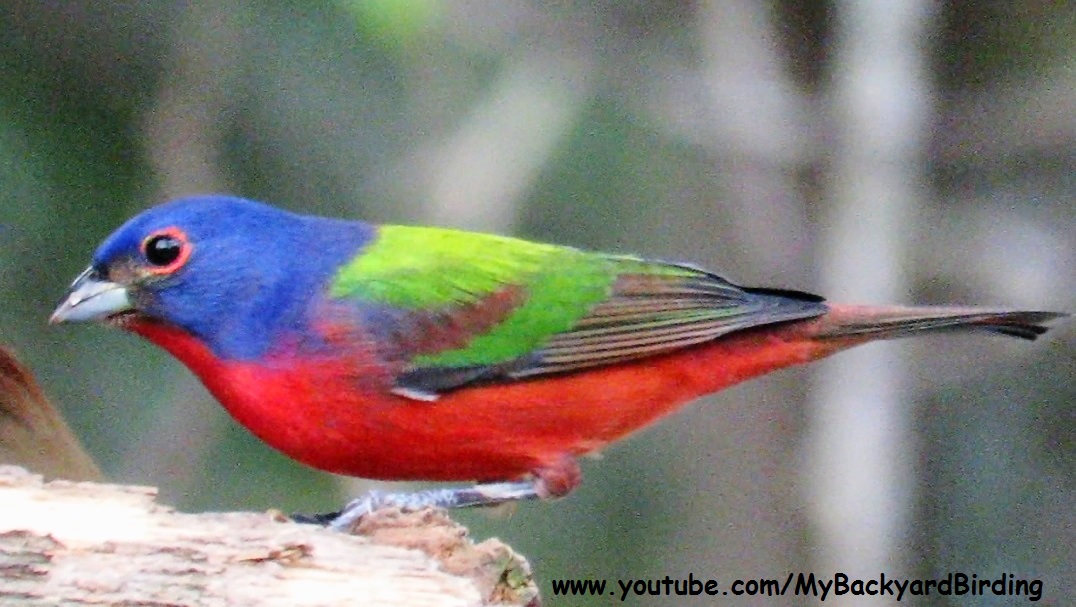
The Painted bunting (Passerina ciris) is a species of bird in the cardinal family, Cardinalidae. It is native to North America. The bright plumage of the male comes only in the second year of life and in the first year, the male can only be distinguished from the female by close inspection. The male is considered by many to be North America’s most beautiful bird, and they are one of the most popular visitors to bird feeders. Due to their attractive appearance and lovely warbling song, Painted buntings often live out their lives as cage birds. Habitat destruction and capture for the pet trade have meant that their numbers have decreased since the mid-1960s.

The male Painted bunting has been nicknamed nonpareil, or “without equal”. Its colors, dark blue head, green back, red rump, and underparts, make it extremely easy to identify, but it can still be difficult to spot since it often skulks in foliage even when it is singing. The plumage of female and juvenile painted buntings is green and yellow-green, serving as camouflage. Once seen, the adult female is still distinctive, since it is a brighter, truer green than other similar songbirds. The juveniles have two inserted molts in their first autumn, each yielding plumage like an adult female. The first starts a few days after fledging, replacing the juvenile plumage with an auxiliary formative plumage; and the second a month or so later giving the formative plumage.

Painted buntings are divided into an eastern and a western population. The eastern population lives only in the coastal regions of northern Florida up to North Carolina. The population in the west ranges from Louisiana and Texas up to Kansas and winters mainly in Mexico and southwards to Panama, while those from the east winter in southern Florida, the Florida Keys being one of these locations, and occasionally in Cuba and the Bahamas. The western population breeds in a habitat consisting of partially open areas with scattered brush, shrubbery, and riparian thickets. The eastern birds choose scrub communities and the edges of maritime hammocks. The winter habitats are similar to each other, being tropical savanna and tropical forest margins.

Painted buntings are social birds. They feed by day hopping along the ground, cautiously stopping every few moments to look around. They are shy, secretive, and often difficult to observe with the human eye, though can be fairly approachable where habituated to bird feeders. The males are frequently heard singing songs that may last 30 seconds or more, being a means of self-advertisement and/or territorial defense during the breeding season when they become highly territorial. They also engage in visual displays including flying bouncingly like a butterfly or in an upright display, body-fluff display, bow display, and wing-quiver display.

Painted buntings are nocturnal migrants, and migrate over short to medium distances. Fall migration starts at the end of July and runs to mid-October, with the spring returning from early April until mid-May. The populations from the west undergo a molt in northern Mexico and southern Arizona (between their breeding and wintering habitats) before arriving at the wintering grounds in the south, in Mexico and Central America. Those from the east molt before migration travel straight to their wintering habitat in southern Florida, Cuba, and the Bahamas. When alarmed, these birds flutter frantically and utter alarm calls.

This species is usually monogamous, though there is some polygyny, with a number of males taking more than one mate. During the breeding season, the birds remain on their own or in pairs. Males arrive first at the breeding habitat, one week before the females, and proceed to select and defend their mating territory. The breeding period, from late March until early August, involves various visual displays such as an upright display, bow display, body-fluff display, and wing-quivering display. The breeding season peaks between mid-May and mid-July. Nests are built in low-lying vegetation by the females, woven into surrounding vegetation for strength. A female raises two broods each season, laying 3 to 4 eggs per brood. Incubation is by the female alone and is for around 11 to 12 days. The mother feeds her altricial chicks with the male occasionally helping. The chicks fledge at 12-14 days and there is further parental care for about 3 more weeks.

The French word ‘nonpareil’, is used for this species. It means “without equal,” and refers to the bird’s splendid plumage.

Males of this species perform displays of short flights with rapidly beating wings. These may show unique flight patterns, like “butterfly flights”, with slow, deep wing beats and undulating flight, and “moth flights”, a slow descending flight with a wing-quivering display.

Painted buntings are one of the most spectacularly colored and visually impressive birds in the United States and are the only U.S. bird with a blue head along with red underparts.

The species name ‘ceris’ is from the Greek myth that tells about Scylla, a princess who was turned into the sea bird keiris.

An American Indian legend tells that when the great spirit gave colors to all the birds, he was running out of dye, so the Painted bunting, being the very last one, received plumage of many colors from dabs of the colors that were left.

SOURCE: ANIMALIA

Connecticut State Flower: Mountain Laurel

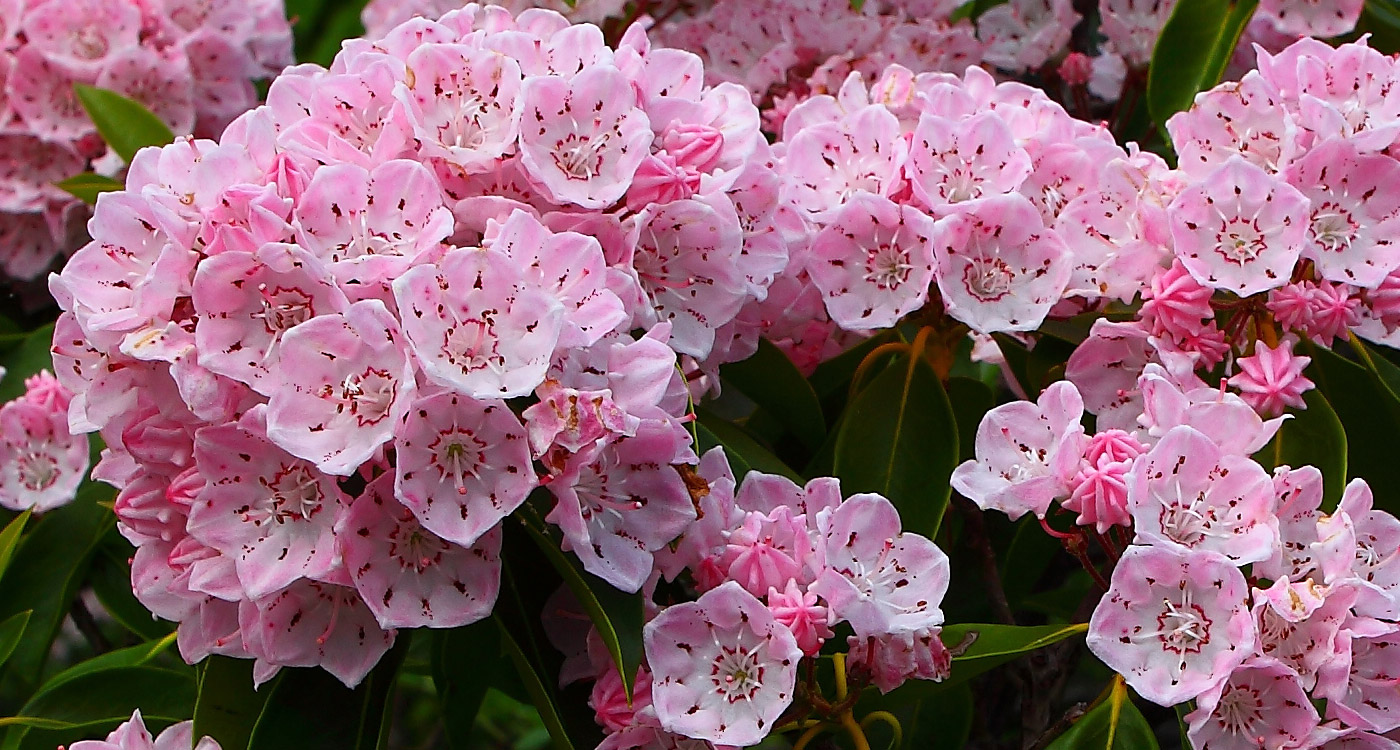
At the turn of the 20th century, over 3,000 women urged Connecticut’s state legislature to adopt the beautiful Mountain Laurel as the Connecticut state flower. However, not everyone embraced the idea at first. One senator grumbled that floral emblems were unnecessary. Ultimately though, as supportive lawmakers received sprigs of Mountain Laurel on their desks, it prevailed becoming the state flower of Connecticut in 1907.

As one of the most beautiful flowering plants in America, it’s easy to see why all of those women wanted the Mountain Laurel as the Connecticut state flower. Every year in the months of May and June, the Mountain Laurel bursts with masses of bright tiny blooms. These colorful flowers turn roadsides, wildernesses and suburban yards throughout the state delightful colors of pink, white or red.

The Mountain Laurel grows throughout the eastern half of the U.S., including the southern region of Connecticut. During blossom time, the Mountain Laurel’s beautiful flowers line the roadsides and put on a floral show for drivers along Interstate 95. Clumps of the Connecticut state flower are also prominent along the scenic Merritt Parkway as well as in the northern half of Connecticut.

Each year visitors head to Haystack Mountain State Park in Norfolk to hike amongst the laurel bushes. Hikers can view these beauties under stands of spruce fir or in the open clearings along the trails. In addition to being the state flower of Connecticut, the Mountain Laurel is also the state flower of Pennsylvania where it appears annually in the Appalachian Mountains.

Fun Fact

Almost all of the parts of the mountain laurel are poisonous to wildlife and humans.

Akitas

The Akita Inu is handsome, calm, dignified, clean (easy to housebreak), and quiet (seldom barks). So it’s understandable that he might be viewed as a desirable pet!

However…. the Akita Inu has a complex personality that makes him very challenging to raise.

Physically powerful, reserved with strangers, and protective, the Akita Inu must be accustomed to people at an early age so that his guarding instincts remain controlled rather than indiscriminate.

Akitas can be so aggressive with other dogs of the same sex that two males or two females should never be left alone together. The problem is that this breed can be difficult to “read” – often he does not “posture” (display obvious signs of aggression) – instead, an Akita may co-exist peacefully with another dog until suddenly, apparently out of the blue, a minor disagreement occurs, or perhaps the other dog pushes the Akita too far or approaches the Akita’s food bowl or favorite toy, and then the Akita may attack with ferocity. Akitas can be very possessive of their food – keep children and other pets away from them during mealtime.

As you might guess, cats and other small animals are also at risk around an Akita. In general, it is simply safest to keep this breed as an only pet.

Training can be a challenge, for the Akita Inu is assertive, strong-willed, and bores easily. He may use his intelligence in ways that suit his own purposes.

Yet owners who know how to lead will find him eminently trainable. This breed must be treated with respect – absolutely no teasing – but you must insist that he return that respect, or he will walk right over you. Akitas are a terrible choice for a first-time or easygoing dog owner who doesn’t know how to enforce “No.”

Unlike many other large breeds, the Akita Inu doesn’t require hours of running exercise. He does well with long brisk walks and an occasional vigorous run, especially in cold weather. Akitas LOVE snow and cold.

If you want a dog who…

Is large, rugged, and powerful, with a wolf-like appearance

Has a thick coat that comes in many colors and patterns

Carries himself with a dignified, impressive presence

Looks imposing, so makes an effective deterrent

Despite his size, doesn’t need a great deal of exercise

Doesn’t bark much – the “strong and silent” type

Isn’t clingy or overly-dependent

An Akita Inu may be right for you.

If you don’t want to deal with…

Potential aggression toward people when not socialized properly

Aggression toward other animals

Strong-willed mind of his own, requiring a confident owner who can take charge

Possessiveness of food – children and other animals should not be allowed near an Akita who is eating

Heavy shedding

Legal liabilities (public perception, future breed bans, insurance problems, increased chance of lawsuits)

An Akita Inu may not be right for you.

Source: Michele Welton’s Honest Advice about Dogs

Delaware State Mammal: Gray Fox

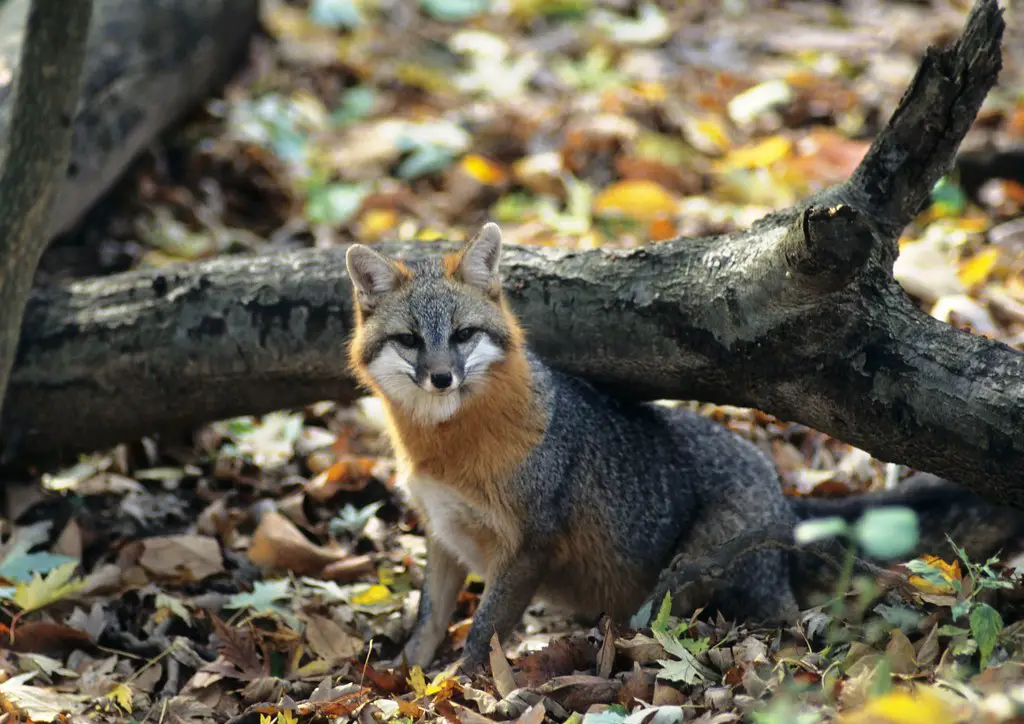
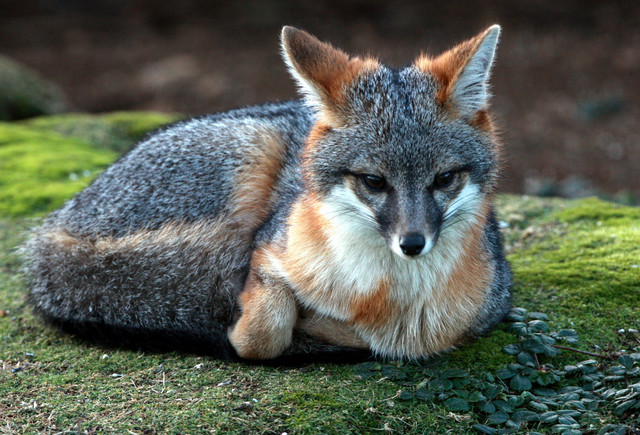
Slightly smaller than its cousin, the red fox, the gray fox prefers wooded habitat. It is also known as the flying fox or tree fox because unlike most canids the gray fox has semi-retractable claws, which enable it to climb.

Habitat

The gray fox prefers dense hardwood or mixed hardwood/softwood forests. Gray fox habitat is commonly located along the banks of streams and rivers. It also prefers overgrown fields for foraging.

The gray fox requires den sites, which may be a hollow log or tree, rock crevice, piles of wood or a brush pile. It often lines the den with shredded bark or leaves and will return to the same one year after year.

The gray fox is nocturnal and crepuscular, which means it is most active at dusk and dawn. During the day, it remains in the den. The gray fox is extremely territorial of its small (often only one square mile) home range.

This fox is unlike any other canid in its ability to climb trees. It will climb trees to escape ground predators, to pursue tree dwelling animals, or to attack ground prey from above. The gray fox can climb up a tree by grasping the trunk with its forepaws and forcing itself up higher by the strength of the claws on its back feet. To descend, it can scramble down head or feet first by jumping from branch to branch.

Reproduction

The gray fox breeds and raises one litter annually, beginning the first year of its life. The breeding season for the gray fox ranges from February to March. During this time, it is not uncommon for males to fight aggressively in competition for females.

After mating, a male will stay with a female to provide her with food during denning and to assist in caring of the young. After a gestation period of 53 days, young are born in a litter ranging in size from one to seven pups.

The dark brown pups are born blind and are dependent on their parents for survival. They are weaned, or stop suckling, at about six weeks of age. Gradually they learn how to fend for themselves.

At three months, the pups leave the den with their parents and learn to hunt. By four months of age the pups are able to forage on their own. The young remain with the parents until fall, at which time they reach sexual maturity and disperse.

Diet

The gray fox is an omnivore, eating a wide variety of plants and animals. Common prey includes rabbits, rodents, birds, crickets, grasshoppers, squirrels, opossum and fresh carrion (dead animals). The gray fox also supplements its diet with apples, grapes, corn and other plants that are seasonally available and abundant.

SOURCE: Vermont Fish & Wildlife Dept.

(Pat’s Note: The gray fox is NOT the state mammal for Vermont…lol)

Connecticut State Mammal: Sperm Whale

Connecticut designated the sperm whale (Physeter macrocephalus) the official state animal in 1975.

The sperm whale played a significant role in the history of Connecticut (in the 1800’s Connecticut ranked second only to Massachusetts in the whaling industry). The sperm whale is now on the federal endangered species list.

The largest of the toothed whales, sperm whales grow to 70 feet in length and can weigh 59 tons. The brain of the sperm whale is the largest of any animal (reaching up to 20 pounds). The sperm whale was immortalized as Herman Melville’s leviathan “Moby Dick.”

Among whales, the sperm whale is unique in both appearance and social behavior. The enormous box- like head sets it apart physically from other whales. Females and their young travel in permanent units (pods), while the much larger males rove between breeding and feeding grounds, and also among groups of females when breeding. Sperm whales are among the deepest diving cetaceans, capable of diving two miles in search of deep water squid, their main food source (a sperm whale consumes about one ton of food each day – squid, fish, skate, octopus, etc.). Sperm whales can be found in all oceans of the world.

Members of a whale pod form strong and long lasting bonds. They protect young calves and the sick or injured of their pod. Other females protect a calf that is not yet capable of deep diving while the mother dives for food.

From Sperm Whale: American Cetacean Society Fact Sheet:

The sperm whale’s head houses a large reservoir containing spermaceti, a clear liquid oil that hardens to a wax- like consistency when cold, and has long been prized by whalers. Ambergris (a strange substance found in large lumps in the lower intestine of sperm whales, formed around squid beaks that remain in the stomach) was used in the making of perfume, and continues to be valuable in spite of its widespread replacement by synthetics.

Sperm whales are still fairly numerous, but selective killing of the larger breeding-age males over many years upset the male-to-female ratio, and the birth rate has seriously declined in some populations. Sperm whales were killed in two massive hunts, the Moby Dick whalers who worked mainly between 1740-1880, and the modern whalers whose operations peaked in 1964, when 29,255 were killed. Most recent estimates suggest a global population of about 360,000 animals down from about 1,100,000 before whaling.

SOURCE: STATE SYMBOLS USA


Azure Kingfisher

Appearance

An Azure kingfisher is a small aquatic kingfisher. It has a long black beak and a whitish rear eye spot. This bird gets its name from its beautiful coloring, being dark glossy blue, its underside an orange-rufous; its legs and feet red. Males and females have very similar appearance and juveniles are less vibrant in color.

Geography

Azure kingfishers live in Tasmania, Northern and Eastern Australia, the lowlands of New Guinea and the neighboring islands, and North Maluku and Romang. These birds are generally sedentary, although they can perform some seasonal migration. Azure kingfishers live near streams and rivers, billabongs (small, stagnant lakes joined to waterways), swamps, mangroves, tidal estuaries, lagoons, and various other bodies of water that have low, overhanging branches.

Habits and Lifestyle

Azure kingfishers hunt in the same way as most other kingfishers, by searching the water for prey from a low-lying branch, then diving swiftly, catching the prey, and returning to the branch. Then the bird flips its prey around until the head is in its mouth, so it can swallow its head first and whole to avoid being cut by the bones or scales. They can eat snakes in the same way. They are experts at diving deep for their prey. Their flight is direct and quick. They will often bob their head and move their wings in anticipation of sighting a fish. To catch a fish they stab it, with either a closed or open bill, depending on the prey’s size, and kill it by beating it on the ground or their perch to break the bones. They are most active in the morning and evening, but if it’s not too hot, they may also hunt in the afternoon. Most kingfisher species are solitary, only pairing up with a mate during the breeding season. Azure kingfishers are usually silent, but make a sharp, squeaky call when breeding. Their voice is a high-pitched, shrill ‘pseet-pseet’, often in flight.

Mating Habits

Azure kingfishers are monogamous birds and form a pair that will defend a breeding territory. A pair builds its nest together, taking three to seven days to construct the tunnel. Kingfishers are fiercely territorial when defending their nests. Mating is from October to March. The female lays 5-7 glossy, white eggs. The eggs are incubated for three weeks by both parents. The chicks grow quickly. They are altricial (naked and helpless) on hatching and require constant feeding and care by their parents, who will bring the food to the nesting chamber. Soon the nestlings travel towards the tunnel entrance, where they meet their parents and wait to be fed. They fledge at around 30 days, from when they will feed themselves and be on their own.

Fun Facts 

Azure kingfishers take it, in turn, to burrow out a tunnel using their feet, then they hollow out a thin chamber at the tunnel’s end where they lay their eggs. These nesting tunnels can be as long as 1 meter.

Transparent membranes on these birds’ eyes protect them when they dive.

Kingfishers dive so quickly that they can cut through the ice to catch fish.

Kookaburras are a kind of kingfisher.

Kingfisher nests will contain piles of droppings and a smelly pile of fish bones.

Kingfishers can look bright blue but are actually a dull brown color. The iridescent coloring we see is due to a difference between structural and pigmented coloration. If we saw light reflected directly from their wings we would see brown, but the light is bouncing around the structure of their wings.

SOURCE: ANIMALIA

The Rose-Veiled Fairy Wrasse

Around the Maldives, between 130-230ft beneath the Indian Ocean, there are flickering shoals of brightly colored, finger-length fish that never venture up to the coral reefs at the surface.

The rose-veiled fairy wrasse (Cirrhilabrus finifenmaa) is one of many species that deep-diving scientists have found in the mesophotic (or twilight) zone, which lies between the sunlit shallows and the dark, deep ocean. It extends about 150 meters down and contains its own distinct mix of species.

“The mesophotic zone is one of the least explored regions in coral reefs,” says Yi-Kai Tea, postdoctoral fellow at the Australian Museum Research Institute in Sydney, by email from a research ship in the Indian Ocean. “This area is generally situated at an awkward depth – not deep enough to survey with submarines, too complex to trawl and dredge, and too deep to dive with traditional scuba techniques.”

The rose-veiled fairy wrasse was named in 2022: finifenmaa means rose in the local Dhivehi language – a double nod to the colorful fish and the Maldivian national flower, the pink rose, which goes by the same species name. One of the scientists involved in finding and naming the new wrasse is Ahmed Najeeb from the Maldives Marine Research Institute. This is the first time a Maldivian researcher has described a new species native to the region, Tea says.

Like other species of wrasse, the rose-veiled fairy wrasse change their appearance and sex as they age. They start life as females and mature into males, becoming considerably more colorful. The males adorn themselves in stunning nuptial colors during the mating season, presumably to impress females.

The finding was part of the California Academy of Sciences’ Hope for Reefs initiative, which aims to better understand and protect the world’s coral reefs, focusing on mesophotic reefs.

Irish Setters

Characteristics of the Irish Setter

Irish setters are the quintessential family dog, with a sweet and playful temperament that makes them ideal companions for owners of any age. They are highly intelligent and easy to train, whether you want to participate in a sport alongside them or just want them to walk by your side on a leash. They typically get along great with other pets and often make friends (human and otherwise) wherever they go. Irish setters are known for being highly affectionate with their family and open to meeting strangers wherever they go.

History of the Irish Setter

Irish setters were developed in Ireland to assist bird hunters before the advent of firearms. Setters are a group of dog breeds that use their keen sense of smell to detect birds and “set”—or take a low stance with their body nearly touching the ground. When the bird is flushed from its hiding spot, the hunter makes the shot, and the dogs eagerly retrieve the fowl.

Bird hunters in Ireland were searching for a bird dog that would move swiftly over the rather open terrain of the Irish countryside but retain the attentive and patient demeanor of prized hunting companions. In the early 1800s, hunters looked to spaniels, English setters, and Gordon setters to breed an eager, attentive, and quick bird dog.

The result was a red-and-white setter-type dog that became known as the Irish setter. Over time, further breeding resulted in a dog with an exclusively red coat with no patches of white. Today, a coat with traces of black is considered a fault in the breed’s appearance, though it isn’t a disqualifying factor for show dogs. The rich red of the Irish setter’s coat is equally eye-catching in the field or walking down the street.

With such striking good looks and an eager-to-please temperament, it’s no surprise that these dogs quickly began spreading across Britain and into the United States. While the Irish setter only appeared on the scene at the turn of the 19th century, this breed was one of the first nine breeds to gain early AKC-recognition in 1878. Along with the English setter and Gordon setter, the Irish setter was well on its way to becoming a popular dog breed in the United States for hunting and companionship.

Red setters, as they’re sometimes called by breed enthusiasts, developed into two sub-types: field and show. Show-type setters are the most common and represent the mental picture that most people have of an Irish setter—thick, flowing red coat, heavy bones, tall stature with long legs and body. The field-type setter has been intentionally bred to retain its working abilities and has the same characteristically red or mahogany coat, but features significantly less feathering, finer bones, and more compact stature.

What both types share is a strong drive to work and please their owners. Today, the Irish setter excels in the field, show ring, and family room. This breed has had the distinction of winning the Westminster Kennel Club’s Sporting Group competition 11 times. Irish setters rank within the top 100 most popular dog breeds in the United States. 

Irish Setter Care

Caring for an Irish setter is a rewarding experience. This dog breed is loyal and affectionate but also has a playful side that delights owners young and old alike. It could be said that these dogs have never met a stranger; they seem to warmly welcome everyone, so an Irish setter probably won’t make a suitable watchdog.

Exercise

To help this sporting dog maintain a balanced, happy disposition, you’ll need to plan on at least an hour of vigorous activity each day. These dogs love a brisk walk, going for a run, or endlessly retrieving tennis balls. Ideally, a fenced yard gives this breed a safe place to roam and romp, but it won’t replace the need for a daily walk or run.

Grooming

Caring for the Irish setter’s gorgeous red coat isn’t as time-consuming as you may think. Their coat will benefit from a couple of brushing sessions per week, as well as an occasional bath, but the coat is relatively low-maintenance despite its flowing appearance.

The undercoat becomes heavier in winter to keep the dog warm and sheds as spring approaches. Expect to ramp up your grooming while the coat is blowing out and use a slicker brush to remove loose hair and keep fur balls from flying. 

Training

An affable nature doesn’t mean that training an Irish setter is a hands-off experience. Like all dog breeds, this breed requires a consistent and positive approach to training. If you start with your setter in puppyhood, be sure to provide plenty of socialization with people of all ages and animals large and small. Keep in mind that the setter was born to flush game, so their prey drive can sometimes be activated by smaller household pets. However, this tendency can often be molded and contained with consistent training.

Red setters are very intelligent and quick learners. Aside from being a natural fit for field trials, they do well in flyball, dock diving, canine agility, and obedience. Their attentive nature and calm demeanor also make them well-qualified as therapy or service dogs. However, the breed’s natural affinity for human companionship means that they can be prone to separation anxiety. Compared to some other dog breeds, they don’t tolerate being alone for extended periods particularly well, so they won’t be a good fit for someone who spends most of their day outside the home.

SOURCE: The SPRUCEPETS

Colorado State Flower: Columbine

The state flower of Colorado is the Rocky Mountain Columbine (Aquilegia caerulea). The Rocky Mountain Columbine is a beautiful and delicate wildflower with unique two-tone flowers. It features white petals and deep blue-violet sepals, giving it a striking appearance.

The flower’s colors are said to symbolize Colorado’s blue skies and snow-capped mountains. The Rocky Mountain Columbine was designated as the state flower of Colorado in 1899. It is cherished for its beauty and its connection to the state’s rugged and scenic landscapes.

The Rocky Mountain Columbine (Aquilegia caerulea) is a perennial wildflower native to the western United States, particularly the Rocky Mountain region. It is a member of the buttercup family (Ranunculaceae) and is known for its striking and distinctive flowers.

Flowers: The flowers of the Rocky Mountain Columbine are its most defining feature. They have a unique and elegant design with white petals that form a star-like shape and deep blue-violet sepals that extend backward. The sepals are often mistaken for petals, creating a visually stunning contrast. In the center of the flower are bright yellow stamens and delicate, nectar-filled spurs that attract pollinators.

Leaves: The Rocky Mountain Columbine has fern-like, light green leaves that grow along the stems. The foliage adds to the plant’s overall attractiveness, even when it is not in bloom.

Habitat: As its name suggests, the Rocky Mountain Columbine thrives in mountainous regions, often found at elevations between 6,000 to 10,000 feet (1,800 to 3,000 meters) above sea level. It prefers well-drained soil and is commonly found in open woodlands, meadows, and rocky slopes.

Blooming Season: The Rocky Mountain Columbine typically blooms in late spring to early summer, depending on the elevation and climate. Its flowers provide a valuable source of nectar for pollinators like bees and hummingbirds during this time.

Cultural Significance: The Rocky Mountain Columbine holds special significance for the state of Colorado, where it is designated as the official state flower. Its blue and white colors are said to represent the blue skies and snow-capped mountains of the region. It is celebrated in various festivals and events throughout the state.

SOURCE: The Garden Magazine

The white and lavender Rocky Mountain Columbine was designated the official state flower of Colorado in 1899 after winning the vote of Colorado’s school children.

Discovered in 1820 on Pike’s Peak by mountain climber Edwin James, the Rocky Mountain columbine (Columbine Aquilegia caerulea) is a lovely flower with a rich aroma to attract bees, hummingbirds and butterflies to its nectar. The Latin word aquila means “Eagle” and refers to the claw-like spurs at the base of the flower.

Columbines bloom in pastel shades of blue, violet, red, yellow and white. There are 70 species of columbines in the world and about 1/3 are native to North America. Colorado specifies the white and lavender Rocky Mt. Columbine which has blue-violet petals and spurs, a white cup and yellow center. Blue is a symbol of the sky, white represents snow, and yellow symbolizes Colorado’s gold mining history.

SOURCE: STATE SYMBOLS USA