
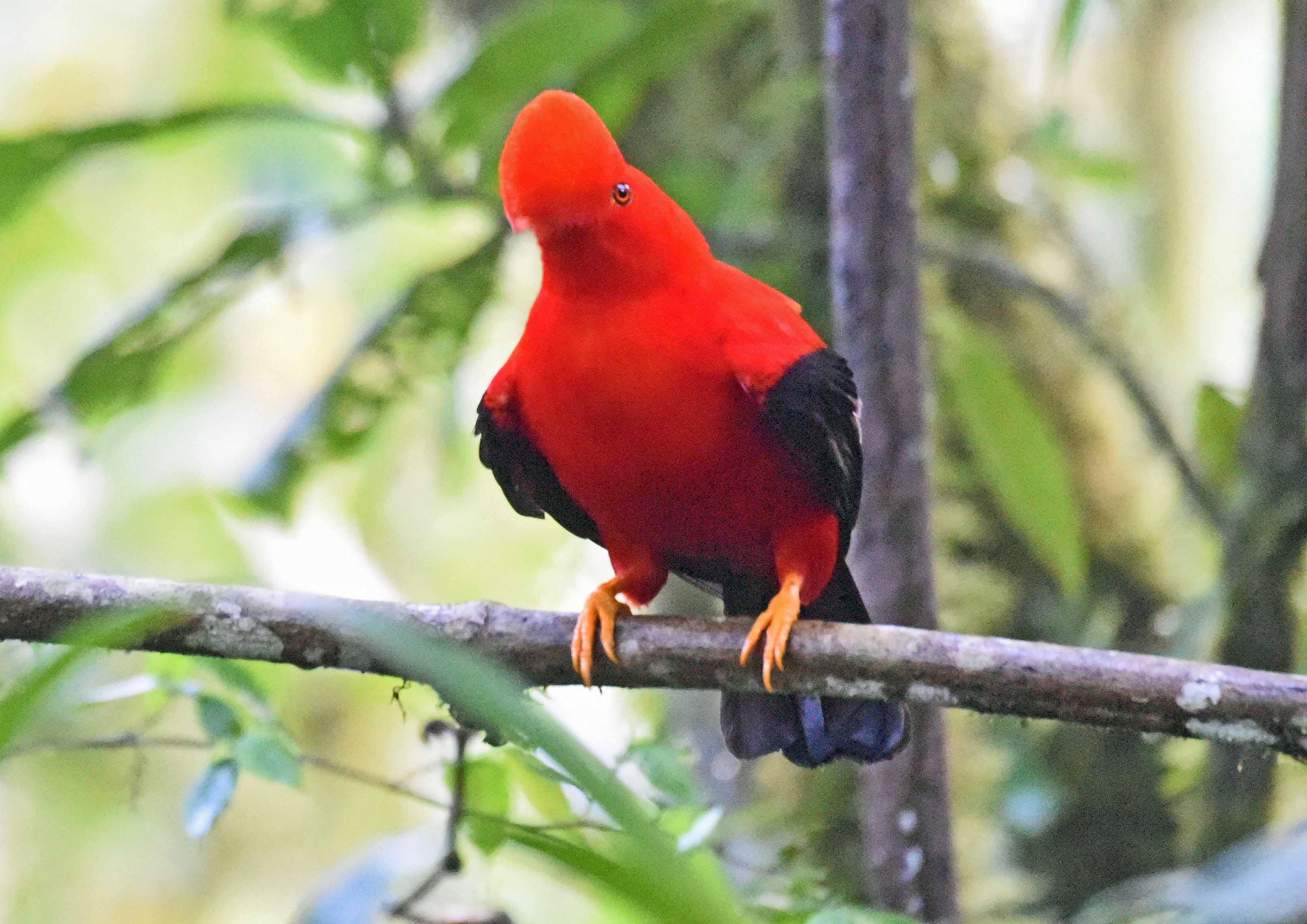
The Andean cock-of-the-rock is the national bird of Peru and the male and female are visually distinct. The male has a striking bright red head with a large crest which wraps around over the beak. Both males and females have the crest though it is larger on the males. Males also have red breast feathers. Down the back the wings and tail are black with a large white patch in the center of the upper side. These wings are wide and strong to provide maneuverability to move through the forest. Their wingspan is 23.6-25.6in across. Females are much duller in color. Their feathers are a greenish or olive-brown color across their entire body.
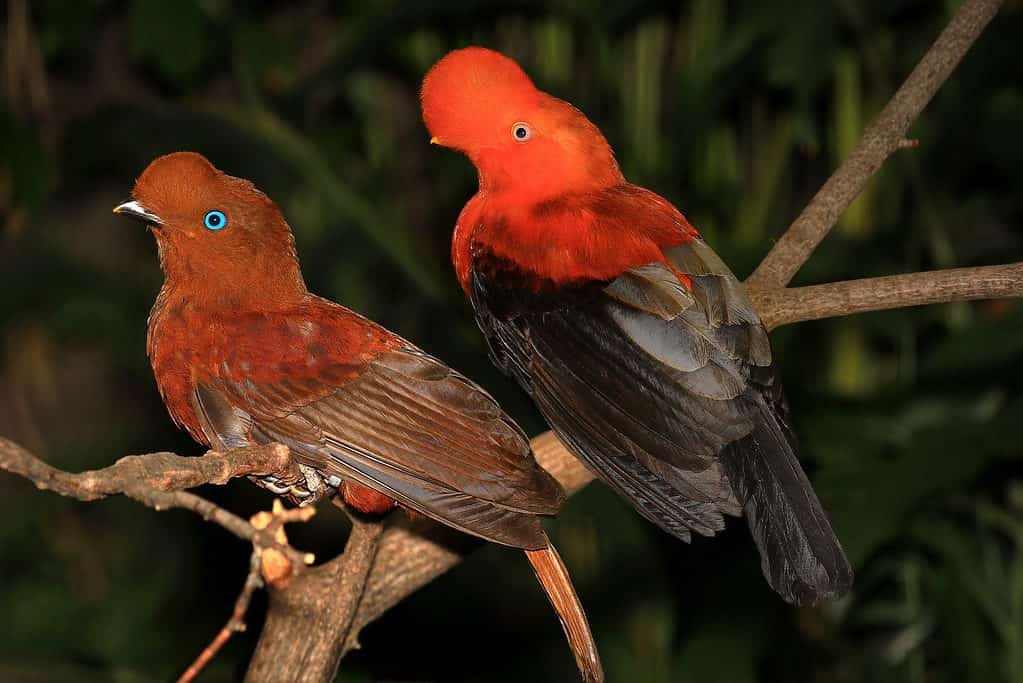
Both genders have a short bill with a hooked shape. Males are slightly larger than the females. On average an Andean cock-of-the-rock will measure 12-12.5in long and weigh 7-9.5oz.
The Andean cock-of-the-rock is an omnivore. Their diet includes a range of fruits, berries and insects. Small vertebrates may also be eaten on occasion. They perform an important role in dispersing seeds from fruits they eat through the forest.
South America is the native home of the Andean cock-of-the-rock. Here they can be found throughout Bolivia, Colombia, Ecuador, Peru and Venezuela. As their name suggests they live in parts of the Andes Mountain range.
They make their home in forests and wetlands. In addition to these they can be found in rocky gorges and ravines on the borders of rivers and streams. This habitat led to the rock portion of their name.
Breeding occurs from February to July though this can vary across parts of their range. Males will gather at a location known as a lek. Here up to 15 males will compete for the mating rights of a single family. A number of males will glare at one another before one dips its head and lets out their raucous call. The others begin to join before a display of wing-flapping and head bouncing occurs. Females may approach the males throughout and their displays intensify at this point. Young males will participate in the lek before sexual maturity to try and learn the ways to be successful.
Once a female selects the male she would like to mate with she will walk behind him and nibble at his feathers or peck his neck. Males will return to the lek after mating and try to attract another a mate. Females create a nest from mud, palm fiber and saliva which is shaped like a cup. This is built against a rock or in a cave. It may take a month for her to perfect her nest and she will not mate till this is complete.
Following a successful mating the female will deposit two eggs in the nest which she incubates alone for their 22-28 day incubation. One clutch is produced each year. At hatching the chicks are highly underdeveloped and the mother provides them with food. They require care for the next 45 days.







 Sew Colorful