

Just Birding lists these 8 birds as top picks for Birds That Mate for Life.
Albatross

When it comes to bird love, nobody does it like albatrosses. These birds may travel hundreds of miles across the oceans for long periods of time, but they always return to the same breeding spot and the same mate. How romantic is that? Considering the fact that they live up to 50 years and mate for life, that means they stay married longer than many humans. Plus, they prove that long distance relationships can work if you are dedicated.
Spending much of their time gliding in the wind over oceans near Antarctica, Australia, South Africa, South America, and the North Pacific, these large seabirds settle together in colonies on isolated islands when it’s time for amoré. Mostly white with dark wings and tails, webbed feet, wide wingspans, and long, hooked beaks, albatrosses are wise and take their time before marrying because they do not become sexually mature until five or ten years old. They actually need those years to master their elaborate courtship dance that involves a series of bowing, fencing and beak clattering. Albatross pairs take care of their single chicks for several months until they are ready to fledge out on their own.
Black Vulture
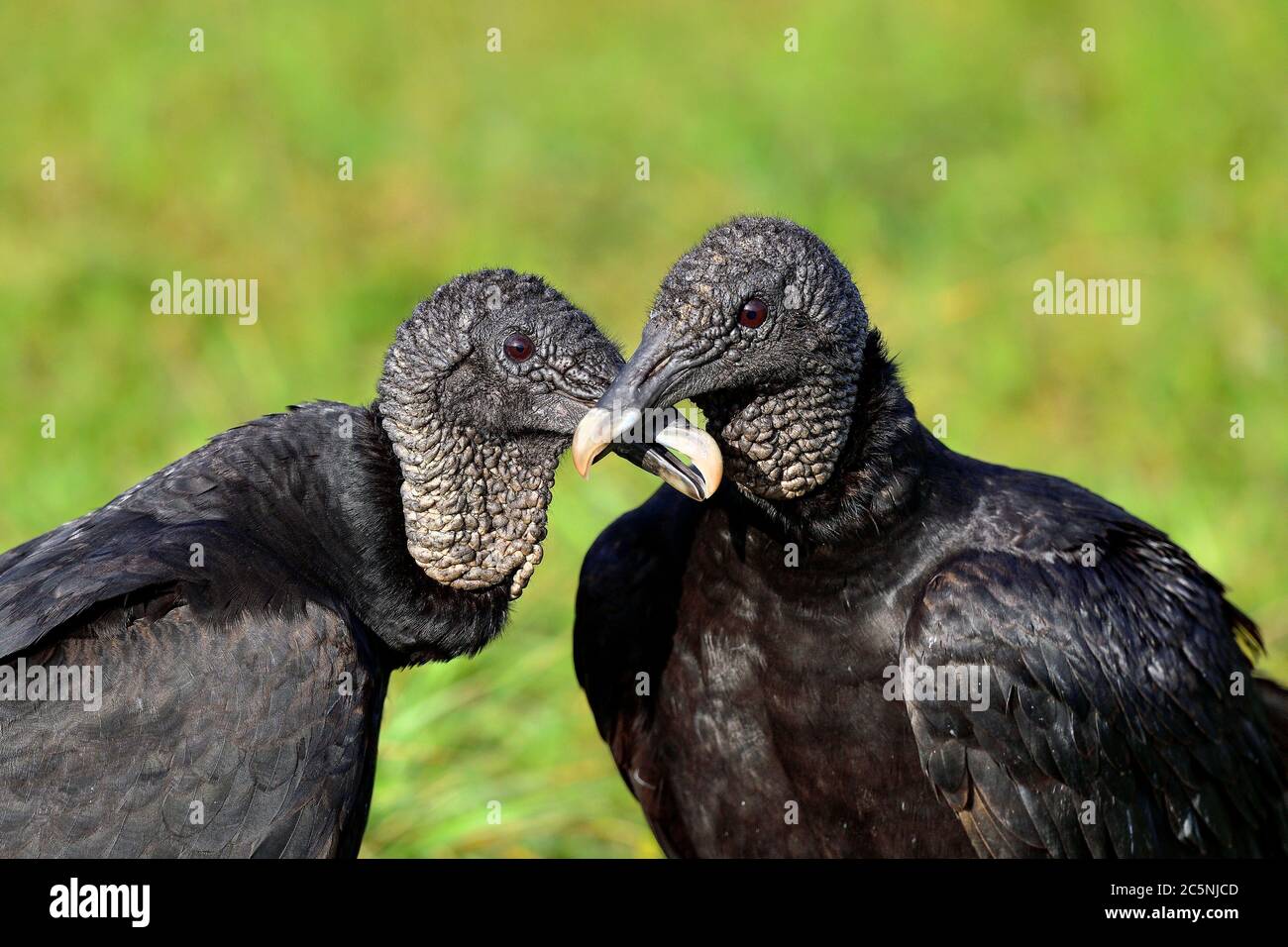
Black vultures prove you don’t have to be beautiful to enjoy a committed, long-term relationship. Looking dressed more for a funeral than a wedding, these scavenger birds feature all-black plumage with bumpy, featherless grayish-black heads, and short, hooked beaks. Found in open habitats and along roads from the southeastern United States to South America, black vultures are all about family life. They form bonds that last their whole lives (about 10 years).
Pairs hang out with each other all year-round instead of just during the breeding season. They take fidelity seriously, and there have been instances where males were observed attacking another male for the crime of adultery. Keeping strong family bonds are important to black vultures, and they often roost with large flocks of their relatives. However, they build their nests in tree hollows, caves, and abandoned buildings where both parents take care of their two chicks.
Geese

Male geese, or ganders, take their roles as providers and protectors seriously. They diligently root up plants for the female to eat. They are also devoted to guarding the female, especially when she is incubating eggs. They will fight an intruder and inflict injury if necessary. It is believed that one of the reasons ganders don’t cheat is because they have too much fear of leaving their mates vulnerable to predators.
Females build their nests with grasses, mosses, and other plant material along with down feathers nearby water and lay anywhere from two to nine eggs, depending on the breed. Goslings begin eating on their own within a day of hatching, but Mom and Dad both keep a close watch on them for several weeks until they are able to fly on their own.
Barn Owl
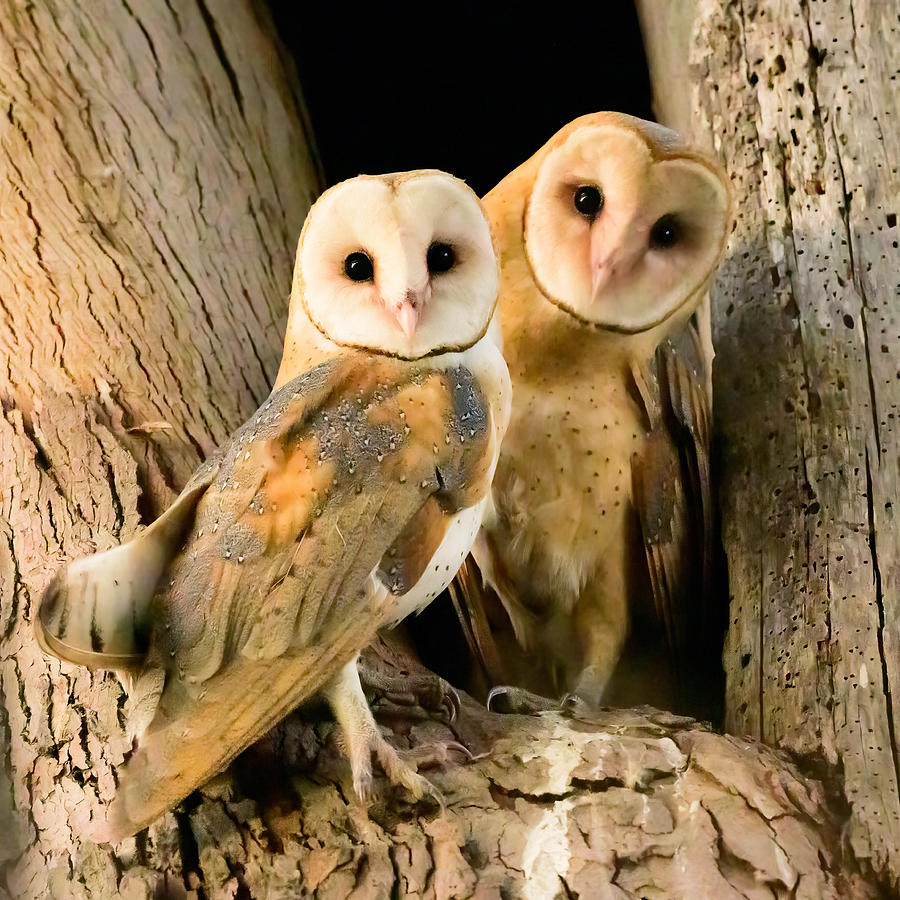
Barn owls have a short lifespan of only about 4 years, but they sure know how to make the best of that time. They don’t just mate for life. They love for life. Barn owls are said to be affectionate with their partners even outside of the breeding season. Some of the ways they do is this by mutual grooming, leaning on each other, and cheek-rubbing.
Distributed all over the world, except Antarctica, barn owls are beautiful birds with creamy white underparts and reddish-gold wings and tails. Their white, heart-shaped faces are not just for looks. They also have facial muscles that they use to communicate and convey emotions to one another. If a barn owl loses a mate, it may die of a broken heart by becoming catatonic and starving to death.
When a young, male barn owl is trying to woo a female, he seeks to impress her by offering her food, such as a dead mouse, from his beak while fluttering his wings open. (Doesn’t that just make you want to swoon?) Young lovers will also form new bonds by chasing one another in flight displays. After making a nest in an existing cavity, Mom incubates an average of five eggs while Dad goes out hunting for food to bring back to her. After the chicks have hatched, Dad will continue to bring the bacon home, and Mom will try to evenly distribute it to her chicks.
SOURCE: JUSTBIRDING.COM DREW HAINES
 Sew Colorful
Preserving The Flame Of Liberty
Newsletter | February 12, 2026
“Across the centuries, when the survival of liberty itself hung in the balance, there were those who rose to meet the moment with courage, conviction, and moral clarity. As Presidents’ Day arrives on Monday, consider three extraordinary presidents who confronted the defining conflicts of their times – the Revolutionary War, the Civil War, and the Cold War – and preserved the flame of liberty when it mattered most: George Washington, Abraham Lincoln, and Ronald Reagan.
From the 18th to the 20th centuries, their achievements in war remind us that keeping the flame of liberty alive requires not just vigilance but deep resolve and commitment. And their victories remind us that Americans can have no other purpose in war than to win our nation’s peace.
Washington’s leadership in war gave birth to the nation. He was the Continental Army’s commander-in-chief — a title still used today to designate the head of our armed forces — and faced the military might of Great Britain with a force that was often poorly supplied and inadequately trained. Nonetheless, his faith in their joint cause, freedom, kept the army intact through devastating winters and crushing defeats. His daring crossing of the Delaware and ultimate victory at Yorktown secured American independence and demonstrated that a free people could resist imperial rule.
In peace, Washington’s example proved equally powerful. As the nation’s first president, his leadership strengthened the Constitution and stabilized the fragile republic. By voluntarily stepping down after two terms, he reinforced the principle that leadership in America is temporary and accountable to the people. Washington not only won liberty; he modeled the restraint necessary to preserve it.
Nearly a century later, Abraham Lincoln confronted a crisis that threatened to unravel the nation Washington had helped create. Lincoln believed the Union represented humanity’s last best hope for self-government. Thus, when Southern states seceded in 1861, he mobilized the Union’s resources and ultimately prevailed. In peace, he sought reconciliation “with malice toward none,” believing that enduring liberty required healing as well as victory.
More than a hundred years after Lincoln, Ronald Reagan confronted a different kind of conflict: the Cold War between the United States and the Soviet Union. Unlike Washington’s and Lincoln’s wars, this struggle was defined not by traditional battlefields but by ideas — ideas about man and his place in God’s universe. Reagan rightly understood that communism was incompatible with human liberty and that American resolve could and should hasten its decline. When he visited Berlin and called on Soviet leader Mikhail Gorbachev to “tear down this wall” separating the free world from the Eastern Bloc, he expressed the moral clarity needed to define freedom’s superiority over tyranny.
Washington, Lincoln, and Reagan won their wars for liberty not only because of military or strategic strength but most fundamentally because of their belief in human dignity and faith in the principles of self-government. And it is to these giants that we owe our independence, our joint purpose, and our freedom. The struggles of these presidents teach us that the fight for freedom demands sacrifice, patience, and courage — liberty endures only when citizens and leaders alike are willing to fight for it, on battlefields, in legislatures, and in the hearts and minds of men and women. And we, their grateful heirs, are called to continue that fight for freedom every day of our lives.”
LikeLiked by 1 person
Good Night All!
LikeLiked by 1 person
Good night!
LikeLiked by 1 person
Good Night Filly!
LikeLiked by 1 person