
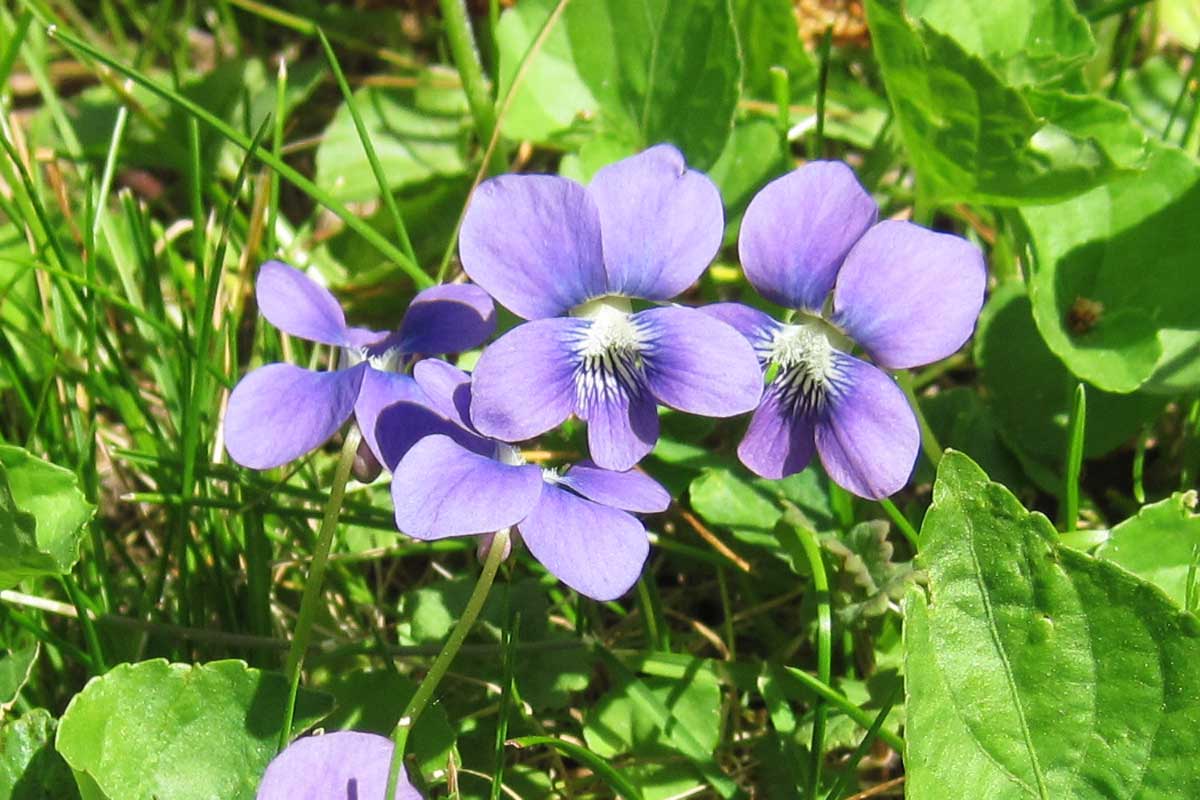
The Common Blue Violet (Viola sororia) is a perennial wildflower found across much of eastern and central North America. With its heart-shaped leaves and rich purple-blue blooms, it has captured the admiration of gardeners and herbalists alike. Beyond its beauty, Viola sororia plays a valuable role in ecosystems, traditional medicine, and even culinary traditions.
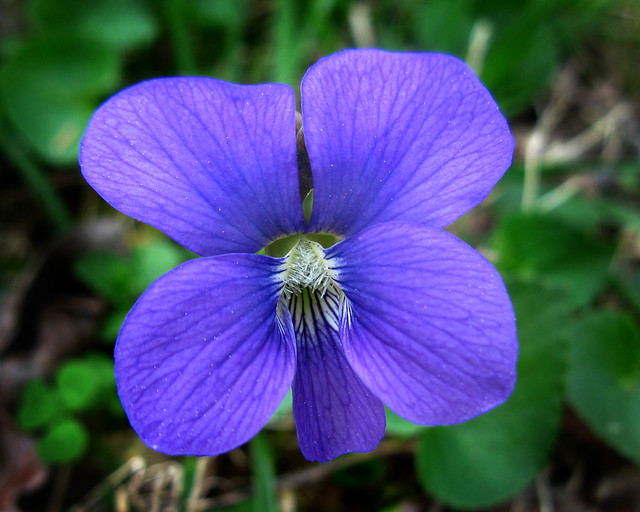
The most recognizable feature of Viola sororia is its striking, five-petaled flowers. They are typically a deep violet-blue, though white, pink, and speckled forms also exist. (Viola sororia f. rubra is the pink form.)
Blue violets bloom abundantly in springtime with flowers that that resemble miniature orchids. There are five dark blue/purple petals and white throats. Blue violet flowers emerge on flower stems separate from the leaves, and are about 1″ across. The blossoms have a delicate and distinctive fragrance.
Common violets are perennial, blooming in the spring/summer and dying back in fall/winter. They propagate mostly by underground runners, but also produce seeds – but not from the purple flowers.
Seeds set in autumn on small green flowers without petals that hide in the foliage (cleistogamous flowers). You won’t damage your patch at all by harvesting the purple flowers. The cleistogamous flowers are self fertile, and produce seeds during the summer, which get ejected from the seed capsules.
The heart shaped leaves curl slightly at the edges, but flatten as they age. The leaves are high on individual stalks rising from the base of the plant. They spread readily once established in a moist, shady area.
Wildlife Uses
The flowers are not popular with pollinators, but are sometimes visited by mason bees and pollinating flies. Fritillary butterfly caterpillars eat the leaves.
Mice and some birds, such as mourning doves, eat the seeds. Deer, rabbits, and livestock will eat the leaves, but it’s not a preferred forage.
Folklore
In Greek mythology, Zeus created a field of violets for a lover he turned into a white heifer to avoid the wrath of Hera. In Roman mythology, Venus beat maidens blue and turned them into violets. Why? Her son, Cupid, said the maidens were more lovely than his mother.
Early Christians said that violets turned downward after the crucifixion, and viewed them as symbols of modesty and humility. Pagan cultures associated them with love and lust.
 Sew Colorful
Holy cow! Temp is up to 93 now! Nope – not going outside! The TX stickers can live another day!!!!
LikeLiked by 1 person
gees! stay inside and cool!
LikeLiked by 1 person
I plan on it!
LikeLiked by 1 person
Good Night All!
Filly be sure to take care this evening!!!
LikeLiked by 1 person
Good night, Pat! Yep – I’ll be hitting my recliner soon! No more work tonight!
LikeLiked by 1 person