
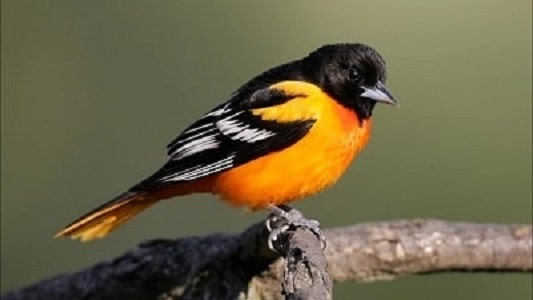
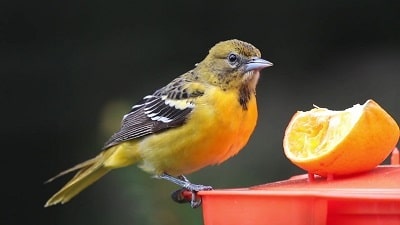
Baltimore Orioles measure 7 – 8 1/2 inches long. The male bird is black with orange underparts, rump, shoulders, and sides of the tail. His wings have 2 white wing bars. The female Baltimore Oriole looks quite different than the male. She is olive above, and yellowish below with 2 white wing bars. This particular Oriole bird is found east of the Rockies.
The breeding season begins in late April to early May. The males arrive 2 or 3 days before the females and begin claiming their territories. You’re likely to hear them singing from treetops in their effort to attract a mate. Their singing is almost constant until they mate with a female. Unlike the Northern Mockingbird though, these birds do not sing at night. Generally, any singing late in the season is from unmated or immature birds. Once the birds have found a mate they defend their territory and begin nesting.
The female selects a site for the nest, usually in a deciduous tree, often a tall one. Orioles prefer trees such as Elm, Cottonwood, or Maples to build their nest. The nest is typically located at the end of a branch, which provides some protection against predators. The female gathers materials for the nest, which can include plant, animal, and even human-made materials. This often includes grass, bark, hair, and twine. She may also use spider silk as a binding agent. The female weaves the nest, creating a small cup shape. She starts by weaving a loop around a twig. Then she weaves additional material, including long grasses and strips of bark, in and out of the loop. The weaving process can take as long as a week.
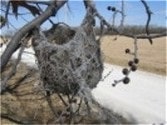
Once the basic structure is complete, the female lines the inside of the nest with soft materials, such as plant down, fur, or feathers, to provide a comfortable and warm environment for the eggs and chicks. The outside of the nest is often decorated with gray and white lichen, which helps to camouflage it against the tree. Nest can be anywhere from 6 to 90 feet above the ground.
While it’s quite common for them to return each year to the same territory, they will not use the same nest. They often take parts of the old nest to build a new one, so you may see them at the old nest site. Bird watchers will find the best viewing of the Baltimore Oriole’s nest when the leaves are off the trees. You’ll see them at the end of branches high in shade trees.
The preferred habitat of Orioles is in open woodlands of deciduous trees near parks, gardens, and suburban settings. In this tightly woven hanging nest, the female lays 3 to 6 pale blue with dark marks eggs. Incubation of the eggs is done by the female with the male always close by and watching. Incubation will last 12 to 14 days and the young birds will leave the nest in 12 to 14 days after hatching.
Baltimore Orioles nest only once each season and do not use birdhouses. Cowbirds have a difficult time laying eggs in the Oriole’s nest but still do. Orioles can tell the difference between their eggs and Cowbird’s eggs. Either the Oriole will eat the Cowbird’s eggs, or eject them from the nest.
The main diet of the Baltimore Oriole consists of insects, fruits, and flower nectar. At the feeding station orange halves or grape jelly placed in a shallow bowl will draw them in. Another option is by providing a sugar-water mixture. 1 part sugar to 4 parts water. No need to boil the sugar-water mixture. Replace often during hot weather.
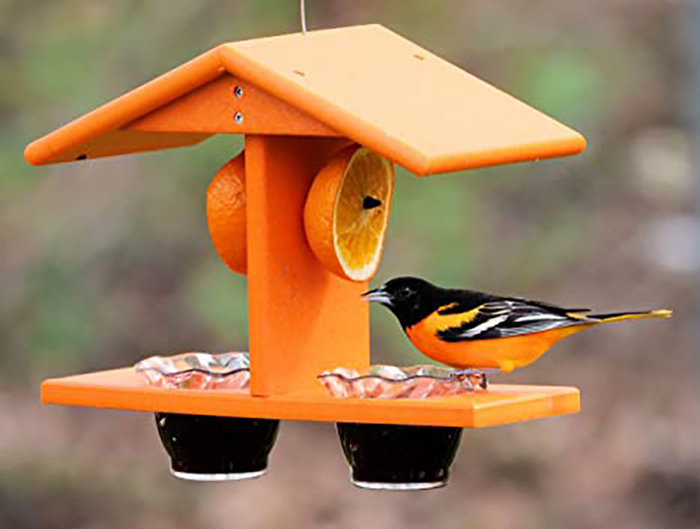
Often we’re asked “What happened to our Oriole birds”? “They were here every day eating our oranges and grape jelly and now they’re gone”. The simple answer is that Orioles often disappear from feeders because they switch to a protein-rich diet while nesting and feeding their young to ensure healthy growth. This means they are hunting insects instead of visiting your feeders. They also may have started migrating south. Don’t worry, sometimes the adults will bring their young to the feeders once they’ve left the nest. So be prepared for a return after a 4-week absence.
Spring migration begins in April when male Baltimore Orioles begin to arrive at their breeding grounds roughly East of the Rockies. The winter migration to the South can begin as early as July, which is much earlier than most species. Still, you may see some Orioles well into September or a little later in their Southern range.
SOURCE: WILD-BIRD-WATCHING.COM
 Sew Colorful
Ahhh! Powerful car! Mine was the 4-door, white/black interior hard top.
Yosemite Falls
Crater Lake, Oregon
Majestic 1929 Manufactured in France
LikeLiked by 1 person
LikeLiked by 1 person
LikeLiked by 1 person
awesome pix!!!!
LikeLiked by 1 person
James O’Keefe
@JamesOKeefeIII
BREAKING: Federal Government Whistleblower Exposes $347M Contract for Transporting Unaccompanied Minors – “What You Know, You Cannot Unknow,”
“My line in the sand moment was when I found out that GSA had awarded a contract to a company to transport unaccompanied minors,” shared current General Services Administration (GSA) Contract Specialist Clarissa Rippee, revealing shocking details about a $347 million contract awarded to the company responsible for transporting unaccompanied minors across the United States. “It felt like someone kicked me in the gut,” Rippee added.
Rippee, who works inside the General Services Administration (GSA), described the unaccompanied minors as being treated like “commodities… like potato chips on a truck.” The contract, which she highlights as an enormous “big money business,” involves moving children, often separated from their families, under inhumane conditions.
“What you know, you cannot unknow,” Rippee stated, saying that the horrifying conditions she witnessed inspired her to speak out: “It’s about the children, and it’s my duty now to speak up.”
Rippee also noted the troubling normalization of such activities within the government, saying, “It’s just an accepted part of the bureaucracy. But the reality is, this is exploitation, and it has to stop.” Rippee’s revelations come on the heels of Border Patrol Agent Zachary Apotheker (@ZachApotheker
) blowing the whistle on the U.S. Customs and Border Protection in the film “Line in the Sand.”
Support brave whistleblowers like Rippee and Apotheker by donating to the Citizen Journalist Foundation at https://okeefemediagroup.com/donate/. Your contribution ensures that courageous individuals can step forward and reveal the truth, helping to hold those in power accountable.
LikeLiked by 1 person
Good night, Pat!
LikeLiked by 1 person
Good Night Filly!
enjoy your book!
LikeLiked by 1 person
I am adding a short daily prayer to the board. I would invite each of you, if you wish, to also add one or maybe two of your own liking. I do not want to stifle anyone but please limit yourself to one or two religious postings. here’s one I found that I liked.
LikeLike
LikeLike
LikeLike
LikeLike
LikeLike
Good Night All
LikeLike