

I found this article on the Birds & Blooms website.
Whether you live in or are visiting the southern U.S., keep your eyes peeled for gorgeous a Gulf fritillary butterfly. And if you’re cultivating an outdoor space to benefit pollinators, think about adding their favorite host plant or a few nectar flowers they’ll love to visit.
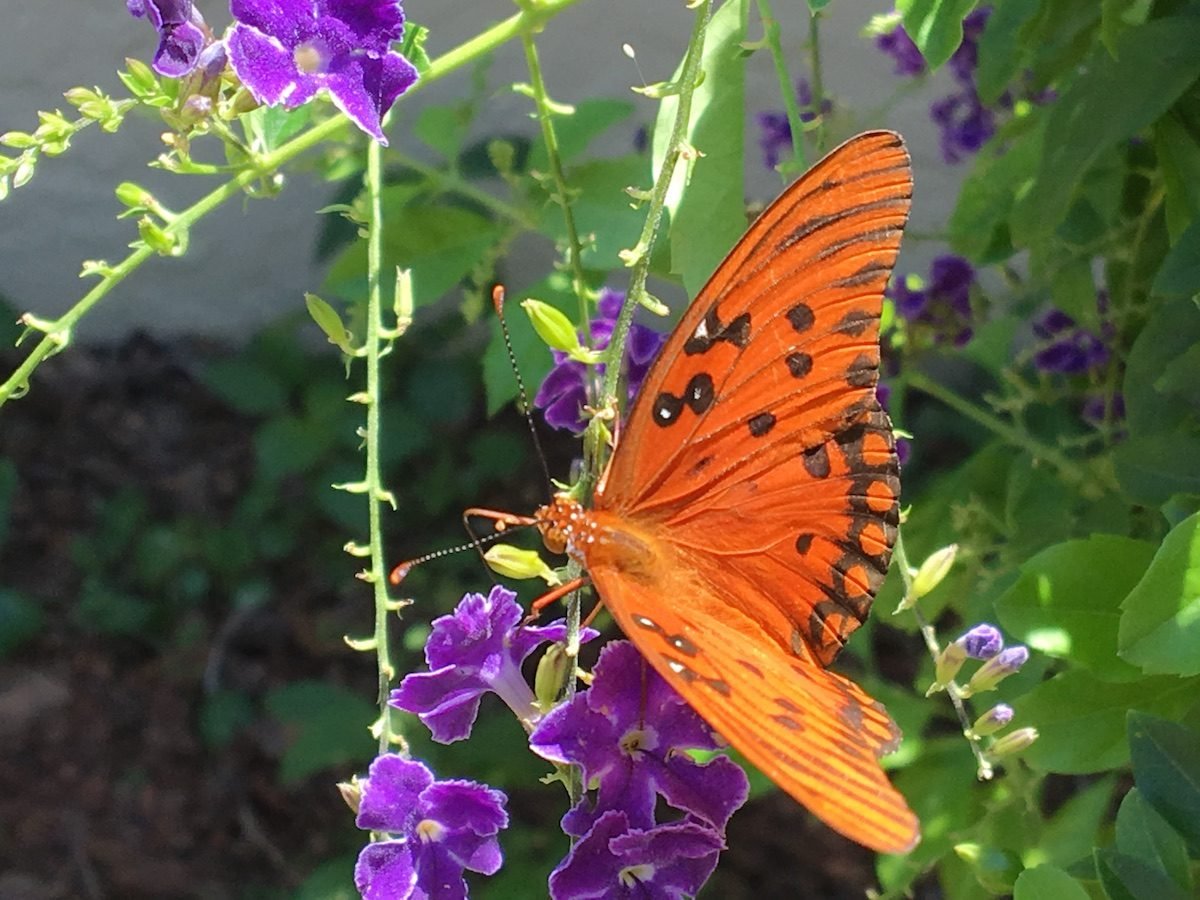
What Does a Gulf Fritillary Butterfly Look Like?
The best way to identify an adult Gulf fritillary butterfly is to look for bright orange wings that stretch between 2 1/2 to 3 3/4 inches. From above, there are black markings on the upper side and three white dots surrounded by black on the edge of the forewings. On the underside of the wings, there are long silver, iridescent spots.
Reader Tammy Peterson of Largo, Florida, notes that the markings stood out to her in person. She says, “I took this photo (above) at the Florida Botanical Gardens in Largo, Florida. The butterfly’s orange-and-black markings contrast significantly with the green foliage in the background.”
What Does a Gulf Fritillary Caterpillar Look Like?
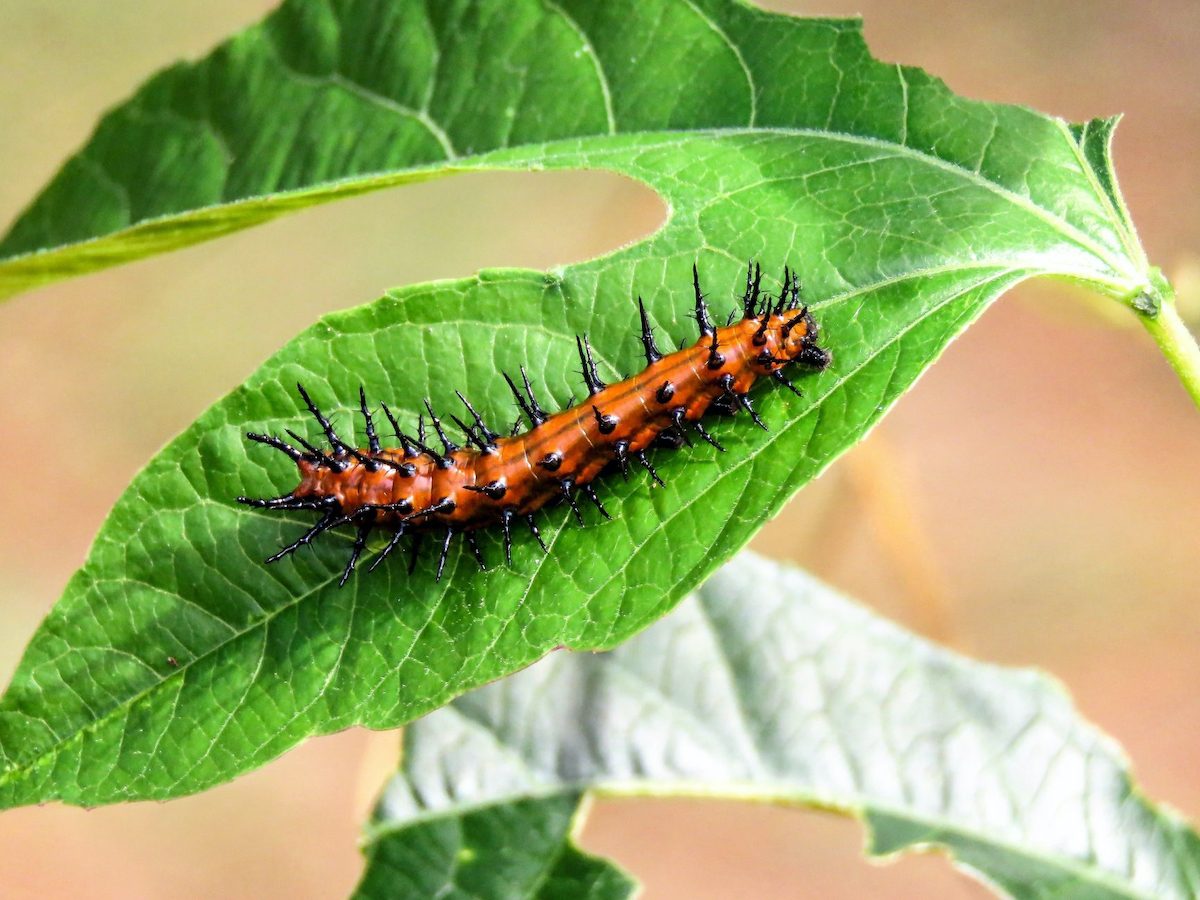
Gulf fritillaries start their lives in bright yellow eggs at first, which then become transparent as the caterpillar grows inside. A mature caterpillar has a bright orange body and is covered in black spikes.
Gulf Fritillary Range and Habitat
These butterflies have a large range and can be spotted anywhere from the southern U.S. through South America. They’re often found along roadsides or in fields, open woodlands, pastures, city gardens and parks.
How to Attract Gulf Fritillary Butterflies

If you want to support these butterflies, one easy way is to plant flowers they’ll visit. It’s not uncommon to see them visiting lantana, various asters, verbena and tickseed.
Reader Becky Litke of Panama City, Florida had luck attracting this butterfly (above) and other pollinators with the orange-and-yellow blooms of the lantana bushes in her front yard.
You can also grow their favorite host plant: passionflower. The caterpillars love a variety of passionflower vines, including purple passionflower (Passiflora incarnata), yellow passionflower (P. lutea) and corksystem passionflower (P. suberosa).

SOURCE: BIRDS&BLOOMS.COM
Kirsten Schrader
 Sew Colorful
Good morning, Miss Pat!
I think I have seen the Gulf Fritillary flitting around my garden amongst the blue and white salvia and the vinca and torenia blooms.
One of my favorite butterflies is the small sulphur yellow butterfly that migrate to N FL from S America. They hang around my yard in pairs.
LikeLiked by 1 person
Good morning, GA! I don’t see a lot of varieties of butterflies here but I do see the small yellow ones, as well as some Monarchs late in the summer. But NE does have a large variety of butterflies:
“Fun Fact: Nebraska hosts all four of the native Vanessa species, the American Lady, the West Coast Lady, the Painted Lady and the Red Admiral. The picture shows an American Lady butterfly. Notice the white spot in the forewing. That is the best field identification clue.”
I’ve definitely not seen any of these here: “It’s a bit out of place for a state to have more blues than hairstreaks and coppers. That’s an interesting tidbit that makes Nebraska butterflies exciting.
Azures can be identified by unmarked, light-blue upperwings. Females have wide dark edges around the forewings. From the side view picture, the underwings show a white background, coupled with a variable number of small black spots and chevrons across the top of the wings. Basically there are spring and summer varieties, depending on when they appear.”
https://greennature.com/nebraska-butterflies/
LikeLike
Deep State Pushing Trump VP Choices as Secret Service Ramps Up Security Detail
Um-hmmm….
LikeLiked by 1 person
None of those three, that’s for sure! I still like Ben Carson, personally.
LikeLike
LikeLiked by 1 person
“Following the lead of the tree huggers out in the Land of Fruits and Nuts, they’re getting up in arms about leaf-blowing in the Garden State now. They’ve already started to ban them in some cities and towns, and now the State is getting in to the act. They bitch about the noise, and, granted, it is a momentary pain in the ass, but their biggest complaint is pollution. Yup. Those little 2-cycles are supposed to be nasty little carbon factories. The bill they’ve introduces cites gas-powered leaf blowers as a heavy polluter, producing more carbon monoxide in one hour than a vehicle would produce over eight hours. The tool is also associated with health concerns, the bill says — due to the loud sounds emitted while in operation and the particles of pollutants it sends outward. Potential fines cited in the bill range from $25 all the way up to $1,000.00. God help us.”
LikeLike
“As if they didn’t have enough money already, it appears the boys in the band just hit the biggest friggin’ lottery of all time. Queen has reportedly sold their recording, publishing and all other rights to Sony Music for $1.27 billion. The deal also includes the band’s name and likeness rights as well as the possibility of musicals, commercial and film placements, merchandise and other opportunities, HITS Daily Double reported. However, live performances are not included in the deal, according to Variety.
The deal comes six years after “Bohemian Rhapsody,” an autobiographical film chronicling the life and career of the band, which earned over $900 million globally at the box office, and won four Academy Awards including a Best Actor accolade for Rami Malek who portrayed the late Mercury.
Disney and Universal Music Group will permanently keep the rights to distribute Queen’s records in North America, but the band’s royalties will now go to Sony Music. For global distribution, the rights will transfer from UMG to Sony Music in 2026 or 2027.
Original members Brian May and Roger Taylor have performed with singer Adam Lambert, while bassist John Deacon retired following frontman Freddie Mercury’s death in 1991.”
LikeLike