

The Painted bunting (Passerina ciris) is a species of bird in the cardinal family, Cardinalidae. It is native to North America. The bright plumage of the male comes only in the second year of life and in the first year, the male can only be distinguished from the female by close inspection. The male is considered by many to be North America’s most beautiful bird, and they are one of the most popular visitors to bird feeders. Due to their attractive appearance and lovely warbling song, Painted buntings often live out their lives as cage birds. Habitat destruction and capture for the pet trade have meant that their numbers have decreased since the mid-1960s.
The male Painted bunting has been nicknamed nonpareil, or “without equal”. Its colors, dark blue head, green back, red rump, and underparts, make it extremely easy to identify, but it can still be difficult to spot since it often skulks in foliage even when it is singing. The plumage of female and juvenile painted buntings is green and yellow-green, serving as camouflage. Once seen, the adult female is still distinctive, since it is a brighter, truer green than other similar songbirds. The juveniles have two inserted molts in their first autumn, each yielding plumage like an adult female. The first starts a few days after fledging, replacing the juvenile plumage with an auxiliary formative plumage; and the second a month or so later giving the formative plumage.

Painted buntings are divided into an eastern and a western population. The eastern population lives only in the coastal regions of northern Florida up to North Carolina. The population in the west ranges from Louisiana and Texas up to Kansas and winters mainly in Mexico and southwards to Panama, while those from the east winter in southern Florida, the Florida Keys being one of these locations, and occasionally in Cuba and the Bahamas. The western population breeds in a habitat consisting of partially open areas with scattered brush, shrubbery, and riparian thickets. The eastern birds choose scrub communities and the edges of maritime hammocks. The winter habitats are similar to each other, being tropical savanna and tropical forest margins.
Painted buntings are social birds. They feed by day hopping along the ground, cautiously stopping every few moments to look around. They are shy, secretive, and often difficult to observe with the human eye, though can be fairly approachable where habituated to bird feeders. The males are frequently heard singing songs that may last 30 seconds or more, being a means of self-advertisement and/or territorial defense during the breeding season when they become highly territorial. They also engage in visual displays including flying bouncingly like a butterfly or in an upright display, body-fluff display, bow display, and wing-quiver display.

Painted buntings are nocturnal migrants, and migrate over short to medium distances. Fall migration starts at the end of July and runs to mid-October, with the spring returning from early April until mid-May. The populations from the west undergo a molt in northern Mexico and southern Arizona (between their breeding and wintering habitats) before arriving at the wintering grounds in the south, in Mexico and Central America. Those from the east molt before migration travel straight to their wintering habitat in southern Florida, Cuba, and the Bahamas. When alarmed, these birds flutter frantically and utter alarm calls.
This species is usually monogamous, though there is some polygyny, with a number of males taking more than one mate. During the breeding season, the birds remain on their own or in pairs. Males arrive first at the breeding habitat, one week before the females, and proceed to select and defend their mating territory. The breeding period, from late March until early August, involves various visual displays such as an upright display, bow display, body-fluff display, and wing-quivering display. The breeding season peaks between mid-May and mid-July. Nests are built in low-lying vegetation by the females, woven into surrounding vegetation for strength. A female raises two broods each season, laying 3 to 4 eggs per brood. Incubation is by the female alone and is for around 11 to 12 days. The mother feeds her altricial chicks with the male occasionally helping. The chicks fledge at 12-14 days and there is further parental care for about 3 more weeks.
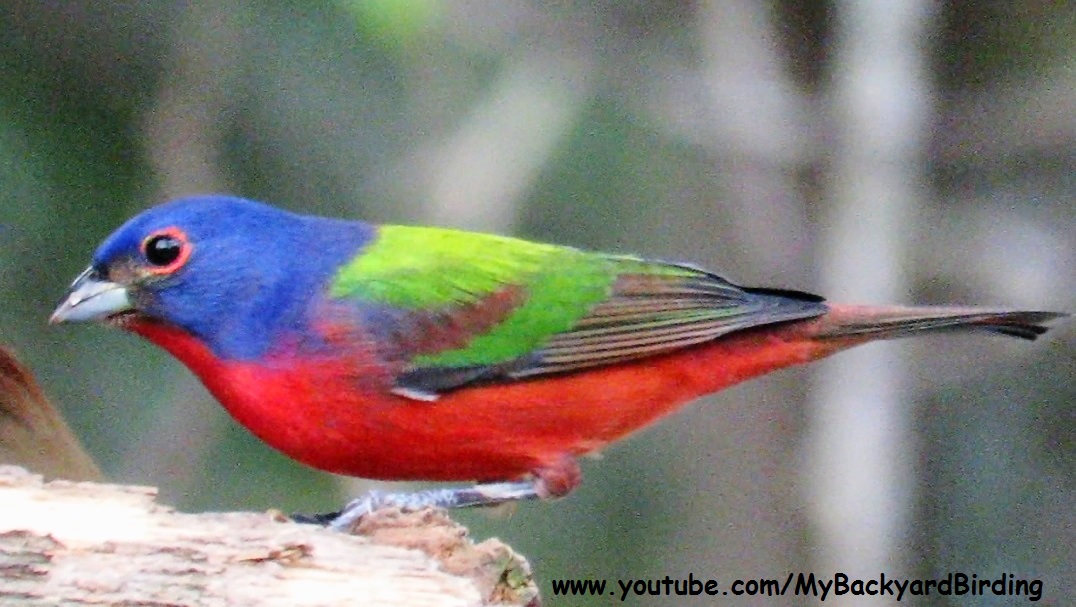
The French word ‘nonpareil’, is used for this species. It means “without equal,” and refers to the bird’s splendid plumage.
Males of this species perform displays of short flights with rapidly beating wings. These may show unique flight patterns, like “butterfly flights”, with slow, deep wing beats and undulating flight, and “moth flights”, a slow descending flight with a wing-quivering display.
Painted buntings are one of the most spectacularly colored and visually impressive birds in the United States and are the only U.S. bird with a blue head along with red underparts.
The species name ‘ceris’ is from the Greek myth that tells about Scylla, a princess who was turned into the sea bird keiris.
An American Indian legend tells that when the great spirit gave colors to all the birds, he was running out of dye, so the Painted bunting, being the very last one, received plumage of many colors from dabs of the colors that were left.
SOURCE: ANIMALIA
 Sew Colorful
amazing bird
LikeLiked by 1 person
i love the coloring!
LikeLiked by 1 person
It’s amazing what nature does.
LikeLiked by 1 person
Horrifying video captures alleged peeping Tom pointing camera up woman’s skirt in Target
https://nypost.com/2024/04/17/us-news/horrifying-video-captures-alleged-peeping-tom-pointing-camera-up-womans-skirt-in-target/
Volunteers at elementary school!
LikeLiked by 1 person
disgusting!
and these pervs are becoming bolder
LikeLiked by 1 person
LikeLiked by 1 person
LikeLiked by 1 person
NUTS!
LikeLiked by 1 person
LikeLiked by 1 person
LikeLiked by 1 person
LikeLiked by 1 person
LOL…happy to see they survived the jump tho
LikeLiked by 1 person
I know right!
LikeLiked by 1 person
but that first one to jump? he should be their KING!
LikeLiked by 1 person
LikeLiked by 1 person
LOL
LikeLiked by 1 person
LikeLiked by 1 person
smile’s a little on the creepy side…lol
LikeLiked by 1 person