

Alabama: Red Hills salamander

This official state amphibian is a long lean mean burrowing machine. Much larger than its other lung-less salamander peers at 11 inches, the Red Hills salamander breathes through its moist skin. It’s on the U.S. Fish & Wildlife endangered species list because much of the 60,000 acres of suitable habitat (i.e., the steep slopes and moist ravines of hardwood forests) are threatened by logging and deforestation.
Alaska: Ice worm

This relative of common earthworms and leeches makes its home inside glaciers and adjacent snowfields, moving through densely packed ice crystals with ease thanks to small bristles on the outside of their bodies. Its Latin name, Solifugus, meaning sun avoider, is basically a warning to the annelids who thrive best at zero degrees Celsius. According to the Alaska Centers public lands guide, when heated to 40 degrees Fahrenheit, an ice worm’s insides liquefy until it literally melts to death. Ouch!
Arizona: Javelina

Javelinas, also known as a collared peccary, are often confused for wild pigs thanks to their stumpy legs, porcine-like snouts, and tendency to communicate in snorts. But according to the Arizona-Sonora Desert Museum, these “new world” herbivores/frugivores (fruit eaters) are distinguished from their “old world” lookalikes by numerous physical features including a scent gland in their rump that they rub on rocks and stumps to mark territory and on each other for identification. Pigs, on the other hand, lack scent glands.
Arkansas: Ozark cavefish

These endangered and nearly translucent cave dwellers live most or all of their lives in total darkness. But they’re blind because they lack eyes altogether and therefore use sense organs to detect movement in the water and find food. Very little is known about their reproductive habits, but the U.S. Fish & Wildlife Service and the Missouri Department of Conservation suspect that spring floods get them in the mood for making whoopee.
California: Banana slug

The sex life of these gooey, yellow mollusks is even more bizarre than their coloring or the fact that they inch down from high tree branches on thin strands of slime in much the same way as spiders utilize their webbing. For starters, according to a 1916 paper by Stanford University zoology professor Harold Heath, they are hermaphrodites. Two, a slug penis, which emerges from its head, can be as long as its entire body. That makes for some of the largest male genitalia of any species in proportion to its overall size. Three, reproductive sessions last hours and sometimes end in apophallation, which is when a banana slug gnaws off and eats its partner’s privates. They do not grow back.
Colorado: Sage grouse

Although the low fast fliers have poor eyesight themselves, they are quite the spectacle to watch during the spring breeding season. Defenders of Wildlife explains that males develop white chest feathers and specialized head plumage and that is just the beginning of their fascinating mating ritual. At dawn or dusk, birds in the mood for love assemble on leks—ancestral strutting grounds returned to annually that can be as far as 50 miles from their winter habitats—and strut, fan tail feathers, and puff their chests until bright yellow air sacs are revealed and hens are smitten.
Connecticut: Star-nosed mole

Star-nosed moles, according to National Geographic, eat faster than any other mammal on Earth. They decide if something is edible in 8 milliseconds and devour their meal (mostly bugs) in less than two-tenths of a second. They owe part of their ability to the extremely efficient operation of their nervous system and partly to their hideous “noses.” The star, which contains 100,000 nerve fibers contained into a space smaller than your fingertip, is the most sensitive touch organ in any mammal. They are also the only mammal known to smell underwater and again they have their grotesque snouts to thank. Moles blow bubbles into the water and then re-inhale them to catch a whiff of potential prey.
Delaware: Common grackle

These birds may be labeled “common,” but their foraging techniques are anything but. Grackles follow plows to catch invertebrates and mice, snatch leeches from the legs of turtles, raid nests and steal worms from other birds, wade in shallow water to fish, and use the hard keel on the inside of their upper mandible to saw open acorns. They also practice the strange habit of anting, in which they get low to the ground, wings spread, and let ants crawl all over them. It is postulated that the formic acid deposited by the insects gets rid of parasites. When they can’t find ants, grackles have been known to use walnut juice, marigolds, lemons, limes, and mothballs to achieve the same results.
Florida: Manatee

Although manatees are born underwater and never go ashore in their lives, the mammals with egg-shaped heads are related to elephants, not dolphins or whales according to National Geographic. The blubbery gentle giants known as sea cows congregate near Florida power plant discharge pipes because the water is warmer there. Smithsonian.com reports that they eat for almost half the day, consuming 10 percent of their 1,200-pound body weight in plants.
Georgia: One-toed amphiuma

At first glance, it is easy to confuse the one-toed amphiuma for a water snake or an eel. In fact, one of its common names is the ditch eel. But, according to the Wildlife Resources Division of Georgia’s Department of Natural Resources, it is a very rare elongated salamander with a unique two pairs of tiny seemingly useless limbs (common to salamanders) with a single toe on each (unique to this species). It lacks external gills, and although it has gill slits, it breathes by periodically lifting its nose out of the mud or water.
Hawaii: Brahminy blind snake

Hawaii’s tourism boards would have people believe there are no snakes in paradise. And while there are not any that are indigenous to the 50th state, the claim is technically a fib. Let us be the first to introduce you to the blind snake, the world’s tiniest snake. Most likely spotted on Hawaii Island and Kauai, this earthworm lookalike was introduced to the state in the 1980s, likely in potting soil from the Philippines. They have managed to survive on the islands because they are the only known parthenogenic snakes, meaning their unfertilized eggs hatch into new female clones. (Geckos also utilize this adaptation.) And because they eat termites and ants, which are also non-native, they do not have any measurable effects on the ecosystem.
Idaho: Pygmy shrew

Weight watchers should be jealous of the second-smallest mammal in the world because despite consuming as much as three times its body weight every day and eating every three to four hours to maintain body heat, pygmy shrews usually only weigh less than an ounce and are two inches long. For them, their extraordinarily high metabolisms are more of a curse given it means they have to be on a constant hunt for food and can’t sleep for more than a few minutes at a time. Shrews swim, use the tunnels and nests of other animals, and burrow through snow in pursuit of the next meal. To compensate for a short food supply in winter, they may lose up to 40 percent of their body weight, which basically makes them a bag of bones and organs.
Illinois: Fishing spider

Spiders are generally creepy as a species, but a venomous one that can grow slightly wider than a human adult’s palm and submerge itself for more than 30 minutes to fish for small aquatic dwellers like tadpoles is next level sinister. The hairs on a fishing spider’s body trap air bubbles, which they use to breathe underwater while stalking their next meal. While down there, they also scope out the area above them because they can simultaneously eat insects skittering around and just above the water’s surface. Oh, and did we mention that as part of the nursery-web family, females lay eggs on a silken mat which they wrap into a ball and then carry said ball around in her jaws until she finds an ideal spot for them to hatch? It is attached to a web until hundreds of spiderlings emerge all at once and then disperse on their own silky threads to start fresh lives of hunting and haunting your nightmares.
Indiana: Hellbenders

These two-foot long and flattened aquatic salamanders with a devilish name once roamed nearly all of the Ohio River tributaries, but numbers are dwindling at a startling rate. Fewer than 300 remain in the state, all in the Blue River, according to The Nature Conservancy, thanks to degrading water quality, loss of habitat, accidental fishing, and fatal human interactions. A rumor even puts them on plates at a Harrison County fish fry in the 1970s. It would be a shame to lose what Popular Mechanics calls “a living fossil” because relatives of the gentle mud puppy show very little external evolutionary as far back as 160 million years.
Iowa: Common conehead

No, they don’t come from France but these insects with pointy pinched conical faces do consume mass quantities of grasses and corn crops. They have antennae longer than their bodies, strong jaws that can injure humans, and very long and powerful hind legs for jumping. Females have sword-like ovipositors to lay fertilized eggs inside plant tissue. According to InsectIdentification.org, they can be found by listening for their chirpy songs.
Kansas: Western hognose snake

If an animal Academy Awards existed, the hognose snake would be the reptilian Meryl Streep thanks to its convincing death scenes. (Although it can’t help but turn its nose up at fame.) When a hognose feels threatened, Reptiles Magazine explains it hisses, flattens its neck, raises its head like a cobra, and feigns strikes. If that fails to scare away its enemy, it will roll onto its back and play dead. It emits a stinky musk, poops, and lets its tongue hang out, sometimes even excreting blood droplets. If flipped upright while in this state, it will roll over again and continue the charade.
Kentucky: Scorpion fly

Scorpion flies look Frankenstein-ed together. According to The Wildlife Trusts, they have a tail that looks like the stinger of a scorpion although they don’t sting and it is not a tail at all. It’s actually the male’s clasper, which is used in courtship. Mating can be dangerous for males as the females have been known to kill their lovers. To dissuade her from post-mating murder, these garden/wood dwellers who have never met a stinging nettles bush they didn’t like will offer a dead insect or a wad of saliva. Its head contains a long beak used to feed.
Louisiana: Roseate spoonbill

The spoonbill is hard to miss thanks to its millennial pink feathers. But it’s the long speckled proboscis that leaves a lasting impression. Especially if you get to see one swinging it side to side to push away the muck in mudflats, tide pools, mangrove keys, and coastal marshes while on the prowl for crustaceans, snails, and various other residents of shallow waters. According to the Audubon Field Guide, they also use that beak as foreplay. Males and females first interact aggressively then huddle close, present twigs to each other, and wildly cross and clasp bills. For an unknown reason, the entire flock will suddenly fly up and circle the breeding area at the beginning of the season. They are no deadbeat dads either. They use the bill to gather materials to construct the nest should mating be successful and eventually help feed their young.
Maine: Tardigrade
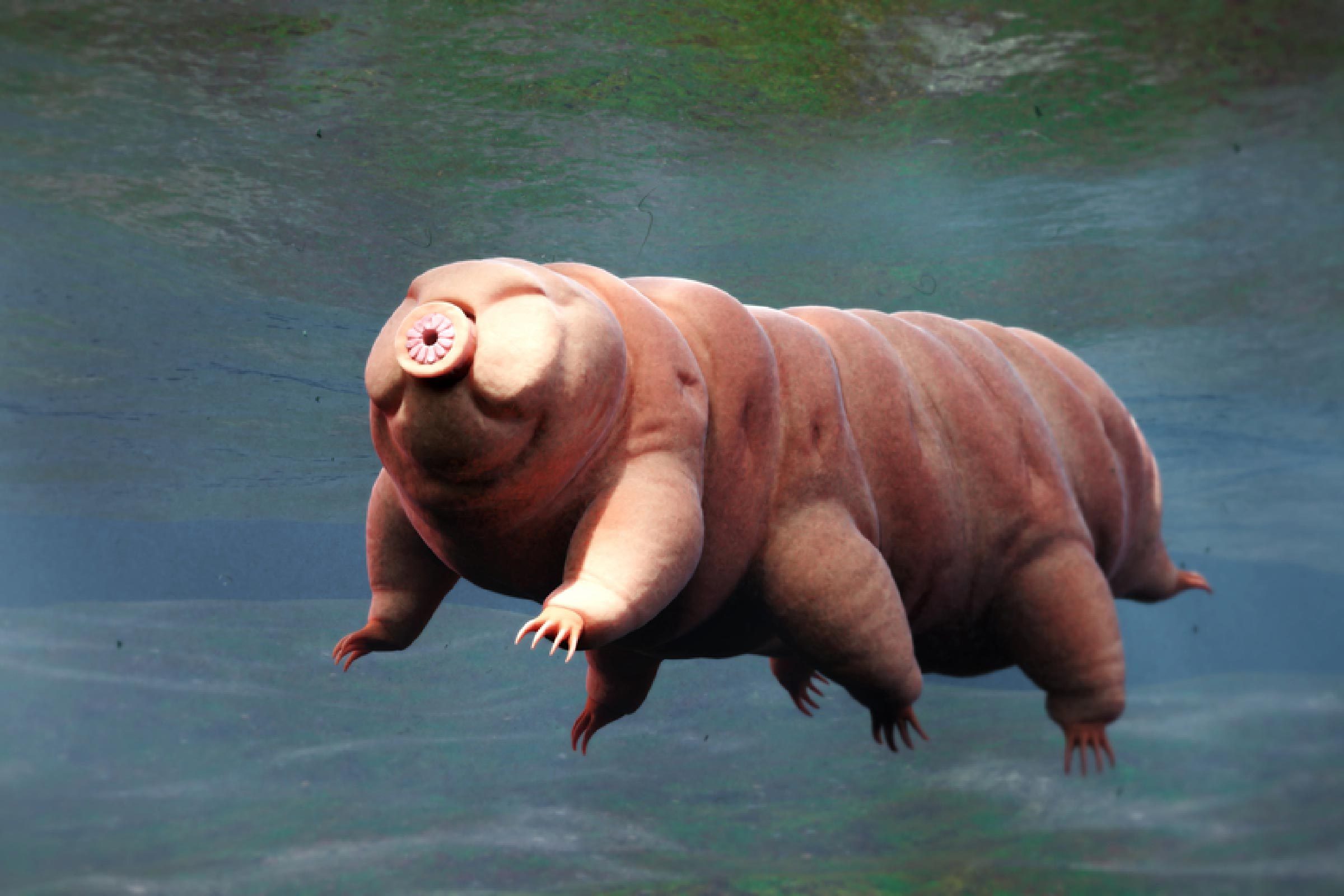
An Oxford University study revealed that Tardigrades, eight-legged microscopic critters with a sucker-like pharynx on their faces, could outlive humans by 10 billion years because the sturdy water bears can survive extreme conditions like dehydration, freezing, autoclaving, exposure to the vacuum of space, and irradiation by using cryptobiosis to shut down their metabolism. They live in water and on lichen and moss in most countries and states including Maine.
Maryland: Nutria

This massive semi-aquatic rodent was introduced to America back in 1899 to kickstart a fur-farm industry. When the market collapsed in the 1940s, U.S. Fish & Wildlife reports that thousands were released into the wild and have been reported in 40 states. Nutria spend their days demolishing vegetation and roots, damaging ditches and levies with its burrowing, reproducing like wildfire (females can breed 48 hours after giving birth), and frightening musophobes (someone afraid of rats) with their beaver-like looks. Their hind legs are smaller than rear ones giving them a hunchback appearance. They have large yellow-orange front teeth, heavy scaly tails covered in wiry hairs, and facial features set high on their heads. Then there’s the vestigial toe dangling unconnected to the webbing that holds the other toes together. It does not show up in tracks. Female teats are also on the side of the body instead of the chest.
Massachusetts: Hickory horned devil

This is the kind of repugnant mug you can’t un-see. The devil is the green, orange, and black caterpillar stage of the royal walnut/regal moth. But its looks are “an elaborate ruse.” The horns don’t even sting. Devils are also easily handled by humans. They molt five times becoming bright green on the fifth round. Before pupation, a larva expels its guts and changes color to turquoise before heading underground. When they emerge as moths, they have severely reduced mouths so they do not feed and can only live for about a week.
Michigan: Snapping turtles

Don’t go insulting the largest turtles in North America because the snapping turtle will clap back. Equipped not only with a ferocious albeit toothless mouth, they have a growth on the tip of their tongues that looks like a wiggly worm reports the University of Michigan’s Bio Kids website. While buried in the mud or hidden by vegetation, turtles use the “worm” to lure fish into their jaws and eventually bellies. Some scientists believe they have developed such an aggressive personality because unlike most of their relatives, they cannot retract their limbs or head into their shells for protection. The curmudgeonly turtles are solitary with social interactions limited to fighting with other males. To pick up a mate, turtles face each other and communicate with leg movements.
Minnesota: Grey tree frog

These frogs don’t look bizarre, but they have developed a pretty unique adaptation that comes in handy in a state with famously brutal winters. The Twin Cities Pioneer Press details its ability to partially freeze during the winter. It produces large amounts of glycerol to protect its body during the freezing process, but its heart, breathing, and other vital functions can stop. Once it thaws, the frog will reanimate.
Mississippi: Alligator gar

These behemoth fish, which can grow more than eight feet long, look like they belong in a natural history museum because alligator gars retain many of their Cretaceous ancestors’ primitive features including the ability to breath air, a body covered by sharp rigid scales, very sharp teeth, and much stronger bites than most lake fish you’ll find lurking in lakes in many Southern states. Popular Mechanics also says they have a similar digestive system to sharks.
Missouri: Scolopendra heros

It’s hard not to get the heebie-jeebies when looking at a photo of the giant desert centipede, the largest centipede in North America, and its 21 or 23 pairs of yellow legs, fangs, red head, and greenish-black body. The bright coloration is aposematic, meaning it should act as a warning to stay away. The centipede hunts invertebrates and small vertebrates including rodents and reptiles, sometimes reaching into the air to grab flying bugs, and uses its cell-rupturing, membrane-compromising venom to subdue its future food. It can also pinch with its last pair of legs to bring the pain according to the Missouri Department of Conservation.
SOURCE: READER’S DIGEST
 Sew Colorful
LikeLiked by 1 person
wow!
LikeLike
LikeLiked by 1 person
they do their perks, don’t they? and throw out the race card after
LikeLike
LikeLiked by 1 person
LikeLiked by 1 person
LikeLiked by 1 person
wait…what? grilled ice cubes? wouldn’t that be water?
LikeLiked by 1 person
LOL
LikeLiked by 1 person
people ARE dumb
LikeLike
LikeLiked by 1 person
whoa…i never knew they were wild!
LikeLike
LikeLiked by 1 person
LikeLiked by 1 person
https://www.linkedin.com/pulse/dpna-little-known-code-makes-traveling-easier-toby-joseph
DPNA – The little known code that makes traveling easier
LikeLiked by 1 person
LikeLiked by 1 person
LikeLiked by 1 person
great story!
LikeLike
LikeLiked by 1 person
LikeLiked by 1 person
LikeLiked by 1 person
LikeLiked by 1 person
LikeLiked by 1 person
LikeLiked by 1 person
thanks for the morning videos kea!
did Mom get her appointment yet???
how’s her knee?
LikeLiked by 1 person
We did a test this week but they never called me with the results. So I will have to call her doctor next week to ask.
Her knee is bad but she did help me clean the leaves in the garden the other day. 🙂
LikeLiked by 1 person
wow! sorry to hear that they’re giving her the run around and that she’s in pain. i have lost ALL respect for the medical corporation. i can’t call it a profession anymore–it’s all about the $$
LikeLiked by 1 person
Bingo
LikeLiked by 1 person
Enjoy the videos!!!!!
LikeLiked by 1 person
Good night, Pat!
LikeLiked by 1 person
Good Night Filly!
LikeLiked by 1 person
LikeLiked by 1 person
LikeLiked by 1 person
sweet story!!
LikeLike
I am adding a short daily prayer to the board. I would invite each of you, if you wish, to also add one or maybe two of your own liking. I do not want to stifle anyone but please limit yourself to one or two religious postings. here’s one I found that I liked.
LikeLike
LikeLike
https://i.pinimg.com/736x/a0/b4/2e/a0b42e4281a7d5bf0f4e1f1503587848.jpg
https://i.imgur.com/w2gsoRI.png
LikeLike
LikeLike
LikeLike
Good Night All!
LikeLike
LikeLiked by 1 person
LikeLiked by 1 person
lol
LikeLike
LikeLiked by 1 person
LikeLiked by 1 person
awwwwwwwwwwwww
LikeLike