
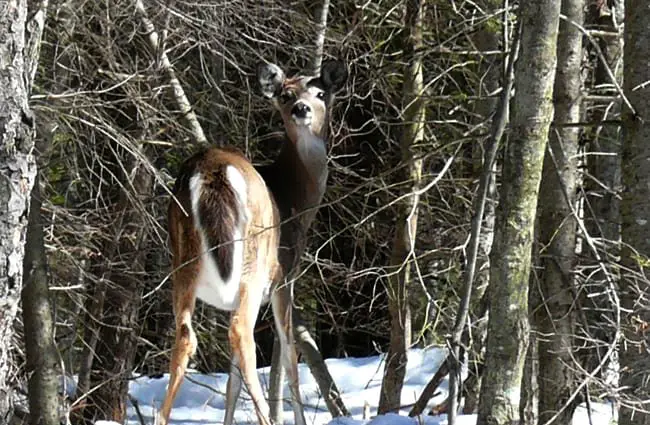
White-tailed deer, also known as “whitetail deer,” or “Virginia deer,” are an extremely common American mammal. These deer are the most widespread wild ungulate, or hoofed mammal, in the Americas. These frequently sighted animals have a number of sub-species throughout their range. Read on to learn about the whitetail deer.
Description of the Whitetail Deer
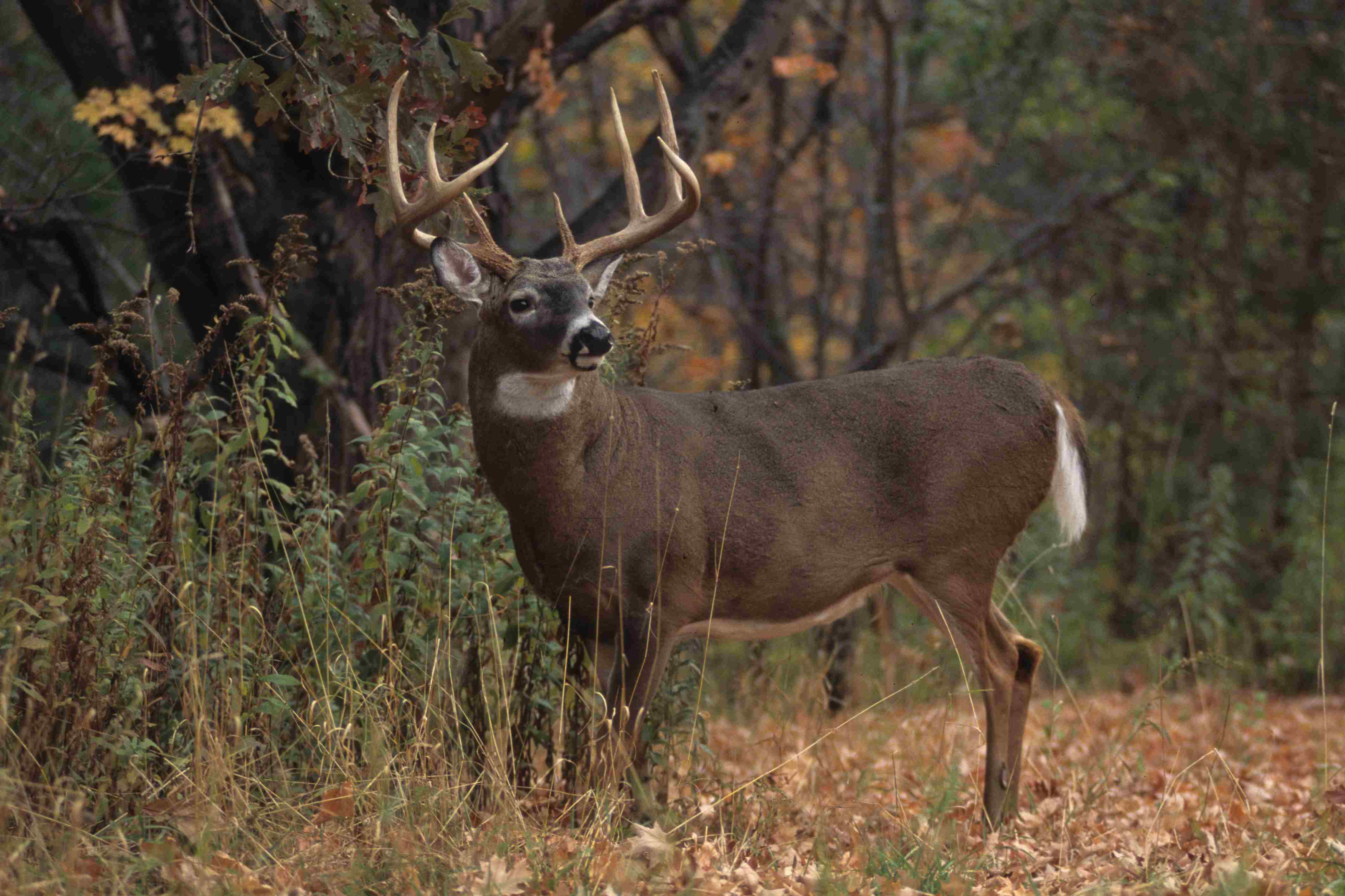
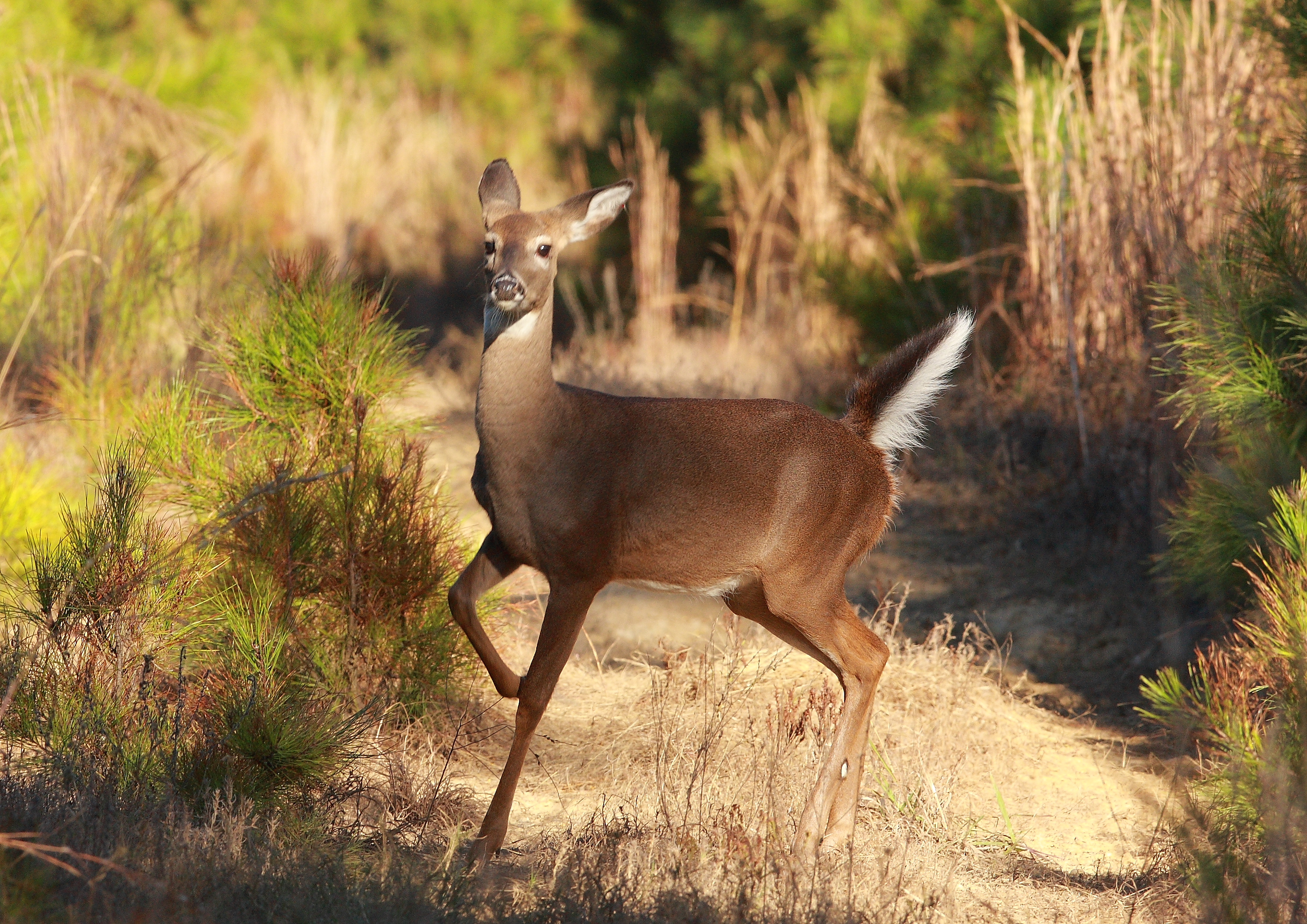
Whitetails range in color from reddish brown in warmer months, to grey in the winter and fall. The most recognizable characteristic is the deer’s white under-tail, which is visible when the tail is raised. The males, known as “bucks,” grow new antlers yearly. It is extremely rare for the does (female deer) to grow antlers.
Interesting Facts About the Whitetail Deer
While virtually everyone in the central and eastern United States has seen a white-tailed deer, most people know very little about them. There are a number of interesting tidbits about whitetail deer.
Bergmann’s Rule – Though there are exceptions, white-tailed deer typically follow the Bergmann’s rule, which states that the average size of an animal increases the farther away you get from the equator. The average weight of an adult male white-tailed deer is about 150 lbs., but in the northernmost end of their range the deer can exceed 250 lbs.!
Substantial Subspecies – Scientists estimate that there may be between 30 and 40 sub species of whitetail deer across their range. Some examples include the Columbian white-tailed deer, and the Florida key deer. Both of these sub species are listed as endangered on the S. Endangered Species Act.
Not-so-Camouflaged Camo – Despite the popularity of wearing intricate camouflage while hunting deer, safety-color orange shirts and hats work just as well as fancy leaf patterns! Whitetail deer have dichromatic vision, meaning that they see blue and yellow colors the best. This also means that they are very poor at distinguishing orange and red colors.
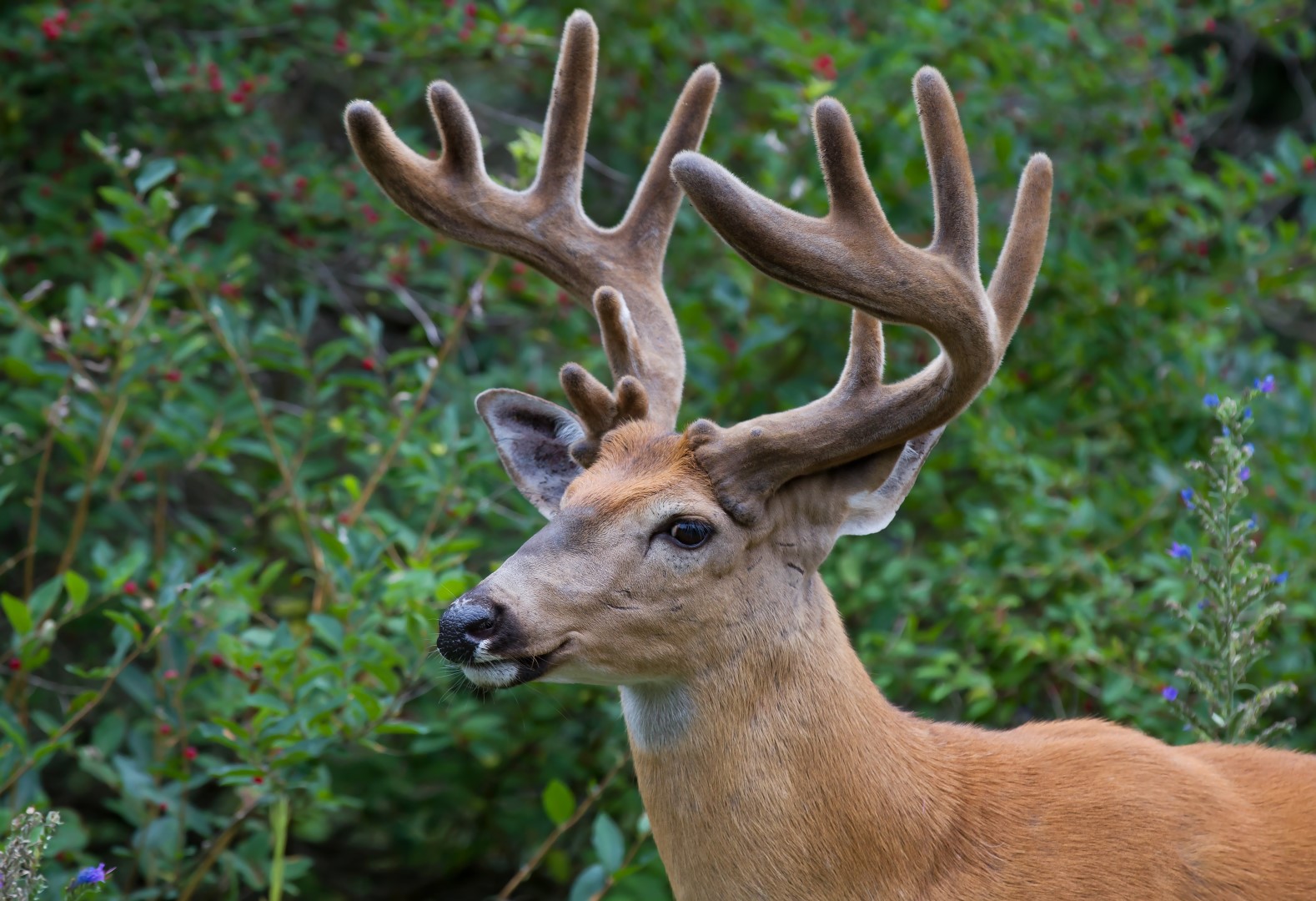
Velvet Cover – White-tailed deer bucks shed their antlers every year, and grow a new pair. The growing antlers take time to develop, and during this time a soft skin called “velvet” protects them. The velvet is filled with many veins, which supply blood to the antlers, allowing rapid growth to occur. Once the antlers are fully-grown, the velvet dries out and is shed.
Habitat of the Whitetail Deer
White-tail deer are extremely common and widespread because they are generalists. This means that they can adapt to a wide range of habitats. They are commonly found in temperate forests, partially wooded lowlands, open prairies, savannahs, mountains, tropical forests, and wetlands.
Distribution of the Whitetail Deer
In North America, whitetail deer can be found as far north as Canada, and as far south as Mexico. Their range spreads all the way to the eastern coast of the United States. They can also be seen across Central America, and into the northern edges of South America into Peru.
Diet of the Whitetail Deer
White-tailed deer eat a wide variety of vegetation. They frequently feed on legumes, including alfalfa and clover, but will also eat the shoots and leaves of many other plants and grasses. In desert habitats they will also feed on cactus. Whitetails have also been known to eat fruit, corn, acorns, mushrooms, and poison ivy.
Horns or Antlers?
Many people incorrectly refer to deer antlers as “horns,” but horns and antlers are extremely different. While deer, elk, and moose have antlers, cows, sheep, bison, and buffalo have horns.
Horns
Horns are made with a base of bone growing from the skull of the animal, similar to antlers. A sheath of keratin, the same material that makes up your fingernails and hair, covers the base of bone. The horns grow continuously throughout the animal’s life, and are never shed. Because the horns are live bone and keratin, they will bleed if broken.
Antlers
Antlers are shed every year, and will regrow. They are made entirely of bone. Antlers have no center “core,” consisting instead of a single structure of hardened bone.

Whitetail Deer and Human Interaction
Deer and humans have multiple negative interactions. Humans hunt deer, both for sustenance, as trophies or sport, and to control deer populations. Overgrown deer populations can cause the spread of disease, and vulnerable plant species to be decimated. Deer are also kept as livestock in a number of countries for their meat, antlers, and fur. Deer cause millions of car collisions each year, an increasingly serious problem in the United States.
Domestication
Farmed populations of whitetail deer have been domesticated to some extent. While they are not fully domesticated, like cattle or sheep, they have undergone selective breeding. When farming deer, farmers selectively breed docile individuals with good meat production, and large antlers.
Whitetail Deer Care
White-tailed deer must be provided with a large enclosure that allows for plenty of foraging. The fence should be at least eight feet tall, as deer are extremely proficient jumpers. Their diet should also be supplemented with vitamins and minerals, as well as additional vegetation if their habitat does not provide enough for them to maintain their weight.
Behavior of the Whitetail Deer
Bucks will compete amongst one another to determine a dominance hierarchy. More dominant males are able to reproduce with more females. During the breeding season, known as “rut,” the males will battle and attempt to breed with as many females as possible. During this time, they will lose significant amounts of weight, as they rarely eat or rest.
Reproduction of the Whitetail Deer
Females become receptive to mating in late October and early November, and they will give birth in May or June. She will give birth to 1 to 3 baby deer, called “fawns,” and nurse them for 8-10 weeks. Young bucks will stay with their mothers for about one year, and females will stay for two years.

SOURCE: ANIMALS.NET
 Sew Colorful
LikeLiked by 1 person
great pics!
LikeLiked by 1 person
LikeLiked by 1 person
Good night, Pat
LikeLiked by 1 person
Good Night Filly!
sorry i disappeared–everybody was calling tonight…
LikeLiked by 1 person
LikeLiked by 1 person
Awwwww Deer.
LikeLiked by 1 person
Bye Hollywood
LikeLiked by 1 person
but who will miss hollywood except for the overpaid actors?
LikeLiked by 1 person
LOL
LikeLiked by 1 person
LikeLiked by 1 person
lol
LikeLiked by 1 person
LikeLiked by 1 person
LikeLike
Don’t buy brand name
https://www.youtube.com/watch?v=0IyXYdW1hzg
LikeLiked by 1 person
says video unavailable?
LikeLiked by 1 person
I guess they pulled it
LikeLiked by 1 person
LikeLiked by 1 person
pretty dog!
LikeLiked by 1 person
LikeLiked by 1 person
LikeLiked by 1 person
LikeLiked by 1 person
Yeah we got snow!!!!!!!
LikeLiked by 1 person
you could have ours if you want it
LikeLiked by 1 person
LikeLiked by 1 person
LikeLiked by 1 person
she sounds like a street hood–“…tells me it a G…” who talks like that? thugs
LikeLiked by 1 person
LikeLiked by 1 person
seems he has divided loyalties
LikeLiked by 1 person
Hollywood Legend Billy Dee Williams Shuts Down Woke Talking Points on ‘The View’
Featuring a Hollywood actor on “The View” is usually a safe bet for the ladies who seem incapable of talking about anything but identity politics.
Even better if that actor belongs to one or more minority groups.
On Tuesday, however, the hosts interviewed one legendary actor who refused to play along with their left-wing talking points: Billy Dee Williams, best known for his role as Lando Calrissian in the original “Star Wars” trilogy.
Sunny Hostin, the host who was in the news recently for learning some of her ancestors were slave owners, asked Williams about his early career, saying, “So you did start … in the industry at a time when few people of color were on TV and in movies.” Before she could go on, though, Williams said, “Everybody is a ‘people of color.’” Hostin amended her words to say, “Well, a black man.”
“A brown-skinned man?” Williams asked.
Already this interview was more interesting than the average episode of “The View,” but Williams was not finished yet.
Hostin soldiered on, asking, “Early on you struggled to find work, being offered either stereotypical roles or nothing at all. … Did you ever think about quitting, and if you didn’t, what kept you going?”
“You just live from moment to moment,” he answered, “and do what you have to do and expect things to not always go your way, and you just find ways to be innovative, and you find ways to counter whatever you’re up against and move forward.”
Later, Williams got in a somewhat politically incorrect joke, asking the hosts, “What’s that phrase, the gender phrase?” Joy Behar eventually hit on “gender-fluid,” with Williams saying, “My daughter got very excited about that.” When asked why, he quipped that it was “because she’s a liberal.”
https://www.thegatewaypundit.com/2024/02/watch-hollywood-legend-billy-dee-williams-shuts-woke/
LikeLiked by 1 person
LikeLiked by 1 person
LikeLiked by 1 person
the neighbor’s know his name? so who is his owner i wonder…
LikeLiked by 1 person
LikeLiked by 1 person
whoa…bold suckers, aren’t they?
LikeLiked by 1 person
LikeLiked by 1 person
LikeLiked by 1 person
what assholes!
LikeLiked by 1 person
LikeLiked by 1 person
amazing!!
LikeLiked by 1 person
LikeLiked by 1 person
LikeLiked by 1 person