

Most authorities agree that the name topaz comes from Topazios, the old Greek name for a small island in the Red Sea, now called Zabargad. (The island never produced topaz, but it was once a source of peridot, which was confused with topaz before the development of modern mineralogy.) Some scholars trace the origin back to Sanskrit (an ancient language of India) and the word topas or tapaz, meaning “fire.”
The ancient Greeks believed that topaz gave them strength. In Europe during the Renaissance (the period from the 1300s to the 1600s) people thought that topaz could break magic spells and dispel anger. For centuries, many people in India have believed that topaz worn above the heart assures long life, beauty, and intelligence.
The name for imperial topaz originated in nineteenth-century Russia. At the time, the Ural Mountains were topaz’s leading source, and the pink gemstone mined there was named to honor the Russian czar. Ownership of the gem was restricted to the royal family.
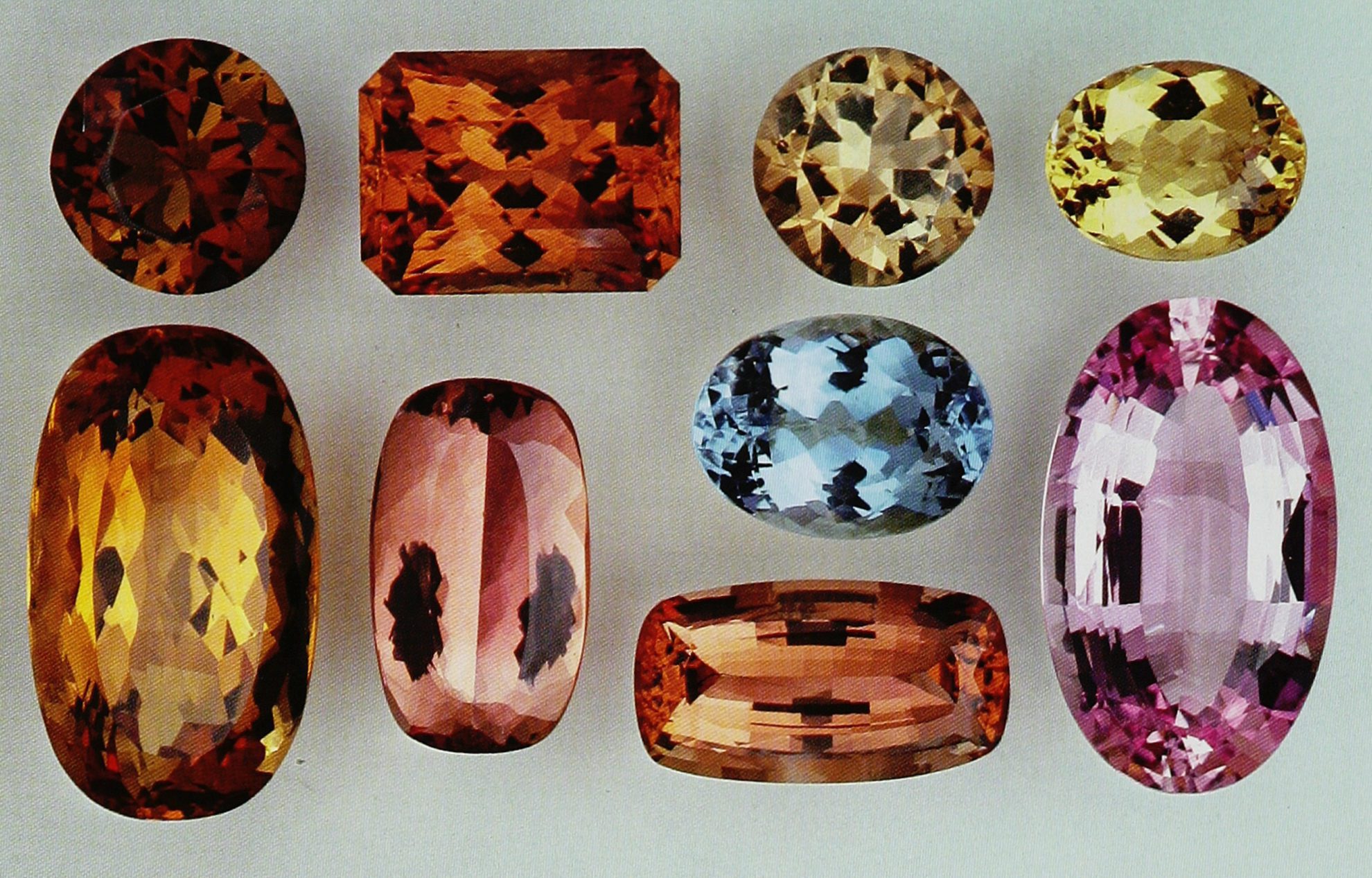
The name topaz has been used for any yellowish gemstones for at least two thousand years. Gem traders did not know that these yellowish stones were actually different minerals until about two hundred years ago. Gem traders recognized that quartz, beryl, corundum and olivine all had yellow variants and were not true topaz and that topaz could be other colors not just yellow. In addition, the island Topazios, after which the gemstone has been named, never produced topaz, but was a source of peridot, or olivine often confused as topaz. The island is now called Zabargad Island.
Ancient Egyptians believed that yellow topaz received its golden color from the Sun God, Ra. The ancient Greeks believed that topaz gave them strength and topaz is mentioned in the modern translation of the bible, although the word probably referred to a yellow stone, not necessarily true topaz.
During the middle ages, the main source of topaz was from a deposit in the Erzgebirge Mountains in Germany. Hundreds of kilograms of yellow to brown topaz crystals were mined from the deposit. Then in the 1730s, a large topaz deposit was discovered in the Minas Gerais region of Brazil. During this period, Brazil was a colony of Portugal, so in 1768, the Portugese Government officially recognised the deposit as an important commercial mine, and most of the gems were transported back to Europe. Brazil remains the largest producer of Topaz in the world.
Gem quality topaz was first found in Australia as a by-product of metal mining operations. In 1872, tin was discovered in the New England area of New South Wales and mining commenced shortly afterwards. When the miners concentrated the alluvial material, sometimes they found pebbles of topaz. Waterworn topaz was found associated with gold, tin and wolfram deposits throughout eastern Australia.
 Sew Colorful
LikeLiked by 1 person
LikeLiked by 1 person
LikeLiked by 1 person
LikeLiked by 1 person
LikeLiked by 1 person
LikeLiked by 1 person
LikeLiked by 1 person
LikeLiked by 1 person
LikeLiked by 1 person
FOR A BARN?????????????????????
LikeLiked by 1 person
Not in gold
LikeLiked by 1 person
LikeLiked by 1 person
LikeLiked by 1 person
wow! little fluff balls!!
LikeLiked by 1 person
LikeLiked by 1 person
LikeLiked by 1 person
COWARD!
LikeLiked by 1 person
LikeLiked by 1 person
who the hell does she think SHE is?
LikeLiked by 1 person
She’s insane
LikeLiked by 1 person
LikeLiked by 1 person
AWESOME!!!!!!!!!!!!!!!!!!!!!!!
12 months of MOOOOOOOSIE!!!
LikeLiked by 1 person
🤣
LikeLiked by 1 person
Trust the science
LikeLiked by 1 person
LikeLiked by 1 person
LikeLiked by 1 person
concussions? how about spinal injuries???
LikeLiked by 1 person
Inside chilling case of American missionary John Allen Chau, 26, who was killed in a hail of ARROWS by Indigenous tribe as he made desperate attempt to join their reclusive community so he could teach them about Jesus
https://www.dailymail.co.uk/femail/article-12636503/American-missionary-John-Allen-Chau-killed-tribe-documentary.html
LikeLiked by 1 person