

The strawberry finch (Amandava amandava), also known as the red munia or the red avadavat, is a sparrow-sized bird with spectacular bright red plumage speckled with white spots. However, the signature look of the males of the species is only temporary and worn only during the breeding season. Once the breeding season is over, the males take on a plainer and duller look like the female strawberry finches.
Native throughout South and Southeast Asia, these species of finches are most common in the tropical regions of Northwestern and Central India. They are usually found in the flat plains with an abundance of tall grasses. These finches belong to the waxbill group of birds that includes passerines (songbirds). Even though their general physical build is similar to sparrows, the strawberry finches are easily distinguished by their seasonal red beak and the striking vermilion red and white-spotted breeding plumage of the males.
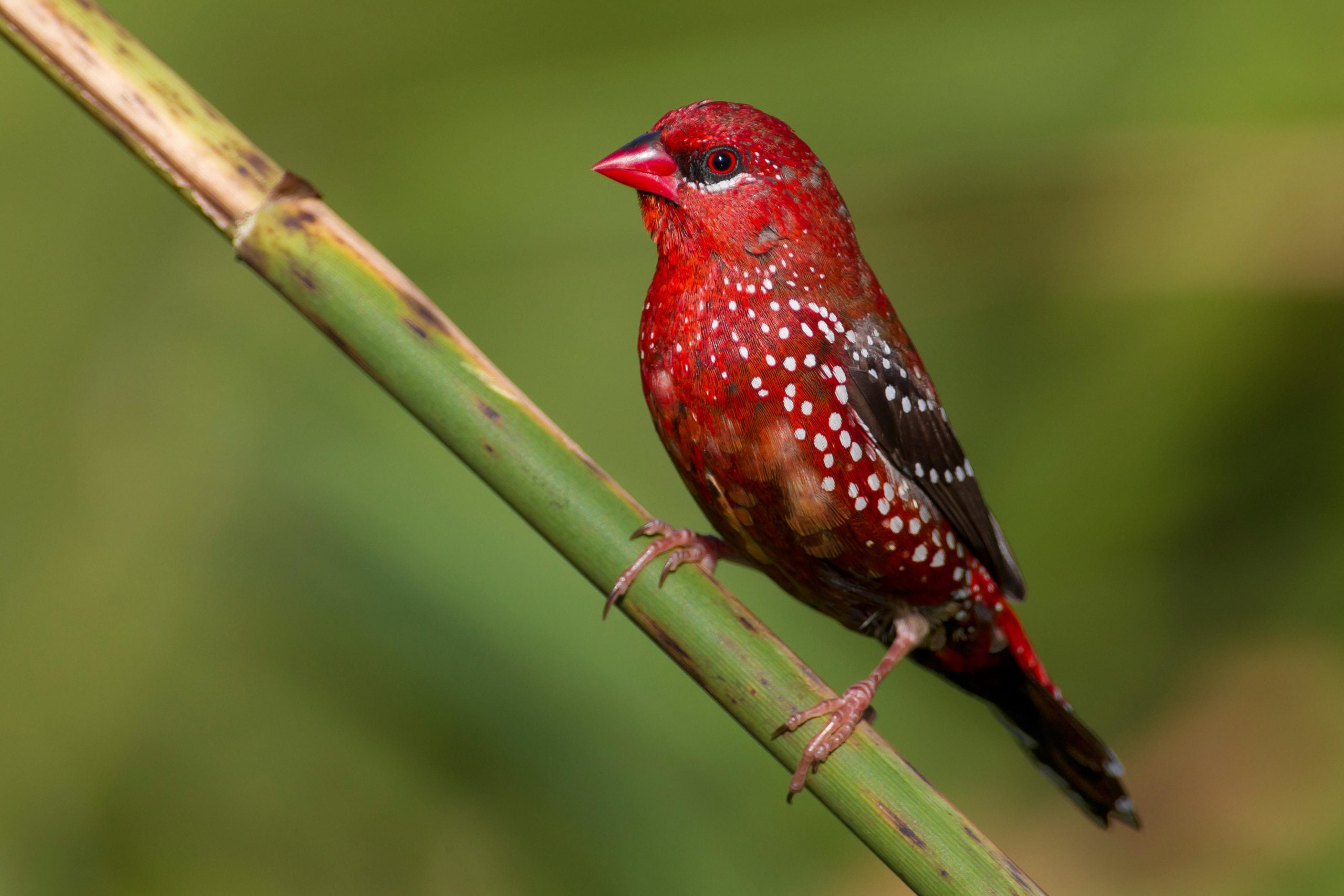
However, there are introduced populations of the strawberry finches that exist in Hawaii, Singapore, Puerto Rico, Portugal, Malaysia, Egypt, Fiji, Brunei, and southern Spain.
The gathering of strawberry finches is called clumping. During this time, they create and maintain bonds by engaging in social preening or grooming.
As part of their pre-mating ritual, the male finch of the breeding pair holds a feather or grass stem in its mouth, keeps its feathers erect, and deeply bows its head in front of the mating partner.

Strawberry Finch Interesting Facts
What type of animal is a strawberry finch?
A strawberry finch is a species of waxbill bird of the family Estrildidae.
Where does a strawberry finch live?
Strawberry finches mostly live in tropical flat plains with crops or tall grasses, preferably with a nearby water source.
What is a strawberry finch’s habitat?
The strawberry finch’s natural habitat and distribution extend throughout South and Southeast Asia from Pakistan to the Malay Peninsula and the adjoining islands. The nominate subspecies (Amandava amandava amandava) is found in Pakistan, India, Nepal, Bangladesh, and Sri Lanka, the Burmese form (Amandava amandava flavidiventris) is also common in Vietnam, Thailand, Indonesia, and China, and the Javan form (Amandava amandava punicea) is found in Cambodia.
How do they reproduce?
Before mating, the male birds try to attract the female finches with a vibrant display of their bright red plumage accompanied by a mating dance comprising bowing, singing, and hopping. The breeding pairs build nests and stick together throughout the breeding season.
The breeding season varies regionally but usually begins in the second half of the rainy season and extends into the following dry months. Female strawberry finches lay a clutch consisting of four to six eggs. The clutch of eggs is incubated by both the parents during the day and by the female of the breeding pair during the night. The eggs are incubated for 11-14 days. After hatching, the young birds take about 20 days to fledge. Both members of a breeding pair are involved in feeding their young.

How do they communicate?
Although not particularly loud, strawberry finches are quite vocal. The male birds have long location calls, but those of the females are softer, shorter, and used less frequently. Both members of a breeding pair use vocalizations during pre-mating ritualistic displays. A shrill call is typical of finches showing aggressive behavior. These birds also give out typical high-pitched calls in times of potential threat to the young. When in the nests, the juveniles learn songs from their father.
What do they eat?
The diet of these finches is quite diverse. They take an omnivorous diet consisting primarily of grass seeds as well as termites, ant larvae, mosquito larvae, caterpillars, and centipedes. They also feed on fruit when available.
SOURCE: kidadl
 Sew Colorful
Huge backlog of 200 ships are stuck trying to enter the Panama Canal as they wait WEEKS amid slowed traffic due to drought: Delays set to wipe $200M off profits and cause spike in US grocery and parcel prices
https://www.dailymail.co.uk/galleries/article-12428337/Huge-backlog-200-ships-stuck-trying-enter-Panama-Canal-wait-WEEKS-amid-slowed-traffic-drought-Delays-set-wipe-200M-profits-cause-spike-grocery-parcel-prices.html
LikeLiked by 1 person
GEES!
LikeLiked by 1 person
Damn its called clothing
Kanye West’s ‘wife’ Bianca Censori puts on a VERY risque display in nude co-ord for outing in Italy with rapper – after igniting fury in the country for ‘going around virtually naked’
https://www.dailymail.co.uk/tvshowbiz/article-12429793/Kanye-Wests-wife-Bianca-Censori-puts-risque-display-nude-outfit.html
LikeLiked by 1 person
oh look a libtard…they used to be called leotards
LikeLiked by 1 person
LikeLiked by 1 person
LikeLiked by 1 person
you can see the excitement in his whole body–that tail going!
LikeLiked by 1 person
LikeLiked by 1 person
LikeLiked by 1 person
whoa…i gotta ask Filly if this is tough for horses to learn
LikeLiked by 1 person
I don’t think so. Maybe depends on the horse
LikeLike
LikeLiked by 1 person
awwwww poor thing!
LikeLiked by 1 person
This happens all the time where I live. Its common in the midwest
LikeLiked by 1 person
LikeLiked by 1 person
LikeLiked by 1 person
hmmmmm
LikeLiked by 1 person
LikeLiked by 1 person
LikeLiked by 1 person
LOL FLUFF OFF!
LikeLiked by 1 person