
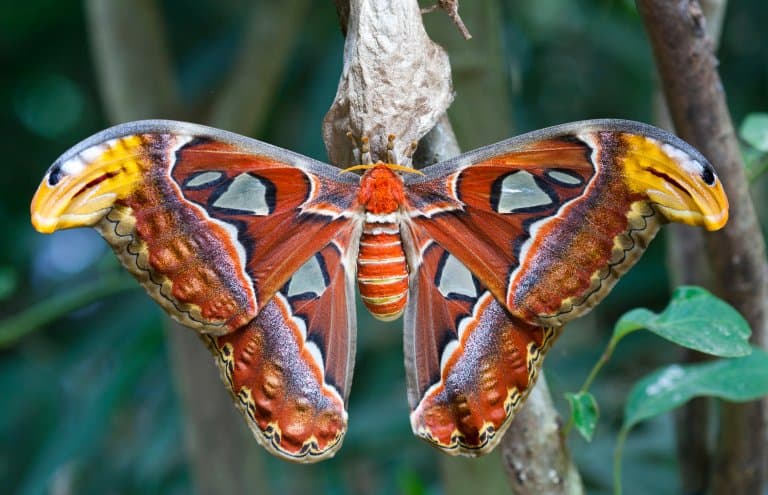
In Cantonese, it’s known as the “Snake’s Head Moth” and is said to resemble a cobra. In Indonesia, locals call it Kupu Gajah: the elephant, or “large” butterfly. And large it is!
This is one of the largest insects in the world, and one of the top three biggest moths. Named after a Titan of Greek mythology, the Atlas moth lives up to its name.
It’s a member of the Saturnids: a family known for their dazzling colors and enormous size, and it certainly doesn’t let the family down.
Atlas moths inhabit tropical forests and shrub lands across South and Southeast Asia.
They have the largest wing area of any moth, and its body is disproportionally small in comparison to its wings. This surface area gives it an advantage when it comes to defending against predators, but it makes the animal cumbersome in flight. As such, it prefers to relax for its short life as an adult moth, only taking action in defense or response to the smell of a mate.
These gentle giants can cause havoc in a citrus plantation, but they’re becoming very popular for their silk. This has led to a lot of research being done to figure out what they like to eat and the best living conditions for them. They also have some cool defense mechanisms!
Let’s take a look at some of the things that make this huge insect so special.
Interesting Atlas Moth Facts
They are the third largest moth in the world
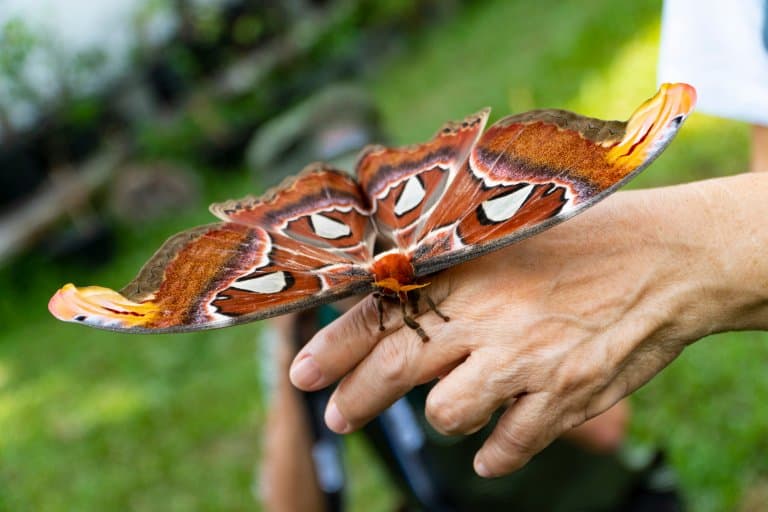
Their wingspan can measure up to 9.4 in and only the white witch (Thysania agrippina) and Attacus caesar moth have surpassed it. The white witch (Thysania agrippina) holds the record with an incredible 12 in wingspan.
They don’t eat
At least, once they emerge as adults, that’s the end of their feeding.
The mature moths have vestigial mouth parts that are small and useless, and as such, the adult stage will only live long enough to mate, which is usually no longer than a couple of weeks.
Atlas moths fly as little as possible
This means that they’re reluctant to use up their precious energy, and with such cumbersome wings, flying is quite resource-intensive. Instead, they spend most of their time within a short distance of the site of their emergence.
At night, or in the evening, they use their huge antennae, each one built like an FM radio antenna, to pick up on pheromone cues from the opposite sex.
Their wing motion is a species feature
Most insects have a rigidity to their wings that aids them in flight. In moths, the beating of a wing involves twisting and bending, which makes the motion very hard to analyze. Researchers trying to figure out the mechanics behind a moth’s flight found it too complex to compare against non-deformable wing simulations.
It’s thought that the nature of a wing’s motion in insects is so unique that it can be used to tell species apart. There’s still quite a lot that doesn’t make sense with these wing motions, and unlocking the mysteries might help engineers design new technologies.
They have a high mortality rate
Moths, like most (if not all) insects, reproduce using what’s known as R-strategy.
This is basically the scatter-gun approach to making babies, where an animal gets out as many eggs and offspring as possible and hopes for the best.
In Atlas moths, this translates to an 89% mortality rate, with most larvae dying not long after hatching from their eggs.
Their silk is prized
Though the silk from the silkworm tends to be produced in longer strands, it’s said that Atlas moth silk is stronger and more durable as a textile.
These properties have led to the cocoons being traditionally used as coin purses in parts of Taiwan, and have led also to more contemporary applications in shoes, jackets, lampshades and scarfs.
This has led to a lot of information on how to rear them
Despite the fact that each species has a supporting role in the sustainability of the ecosystem we live in, it seems like the world only takes an interest in one if there’s a financial gain to be made from it.
Fortunately for the Atlas moth, the quality of its silk has prevented it from being considered a pest – even though it eats a bunch of mango leaves – and instead, great care has been placed in the healthy rearing of captive specimens, to the point where there are entire catalogues of information on how to design the best artificial diet for them.
This information is primarily designed to help people get the best possible silk out of the caterpillars, but it’s also interesting for hobbyists and researchers alike.
The larvae have butt canons
When threatened, the caterpillars of this moth have a very irritating defense.
There are special glands in the abdomen that contain histamine, a compound responsible for allergy symptoms (the one that you take antihistamines to suppress), that, in response to a threat, explode out of pressurized channels to deter predators.
They also look like poo
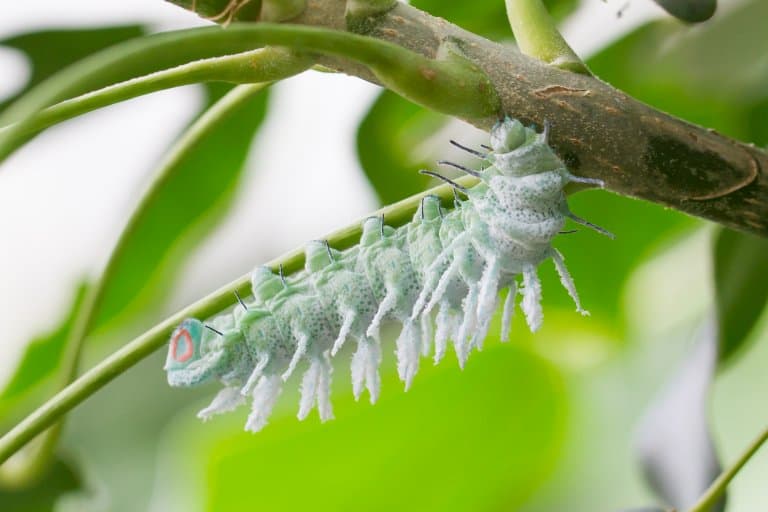
The bizarre-looking caterpillar of the atlas moth is thought to mimic bird feces as a way of avoiding predation. It produces a waxy white secretion that does make it look a lot like something even less appetizing than a caterpillar.
This wax also functions as a physical barrier against ants and parasites and presumably helps the animal maintain hydration.
Atlas moths even mimic snakes
The adult moth has a dappled and enormous wing area that is said to resemble a snake.
When attacked, they’ve been known to thrash around on the ground, apparently mimicking an uncurling serpent. They’re also known to play dead, blending in with the leaf litter of the forest.
Their local name in Cantonese translates to “snake’s head moth” because of the protrusions on the wings resembling a snake’s head.

SOURCE: FACT ANIMAL
 Sew Colorful
“Human-Trafficking, Mind-Control and the CIA — We need to be focused on the disease if we ever want to end this”
GREG REESE
JUL 21, 2023
ENTIRE ARTICLE: “In 1987 Tallahassee, Florida police responded to an anonymous phone tip about six malnourished children covered in bug bites and scratches being accompanied by two well-dressed men in a public park. The two men were arrested for child abuse and suspicion of trafficking children across state lines. And so the U.S. Customs Service, the Washington Metropolitan Police Department, and the FBI all got involved.
The two men arrested had multiple fake IDs and were found to be members of a group known as the Finders. The Finders owned multiple properties in the D.C. area. The investigation of these properties reportedly found evidence of child pornography, and photographs of “three children and three white-robed men dismembering two goats”.
The children described a harsh learning environment where a man known as the Game Caller was in charge of everyone. And could talk to the adults with a computer in the van. One of the games they played was responding to local newspaper advertisements for babysitters, tutors, and anything else that could get them into a family’s home where they would gather as much information as possible about their habits, identity, and occupation.
The Finders were labeled a “satanic cult.” And the media sensationalized it for a full week until the investigation was called off. It was reported that the mothers of the children were members of the Finders and that the two men had the full consent of the parents to be transporting them. The media narrative then blamed their own sensationalism. Claiming that the whole thing was blown out of proportion and that the Finders were just a harmless nineteen-sixties-style hippie community.
Years later the reports of U.S. Customs Special Agent Ramon J. Martinez began bringing attention back to the matter. Martinez claimed that evidence included the intent to traffick children, the ordering of children from Hong King through the Chinese Embassy, the instructions on the impregnation of female members of the Finders, and a library of books on the subjects of mind control and terrorist warfare strategy.
Martinez claimed that every attempt to review evidence was blocked. And was finally told by a member of the Metropolitan Police Department that the Finders had come under the protection of the CIA, who claimed jurisdiction by deeming it an “internal matter,” and had the entire case labeled “Secret.”
The leader of the Finders, Marion Pettie, bragged about infiltrating the C.I.A., his wife Isabelle worked for the C.I.A. and their son worked for the C.I.A. run Air America. Finder members’ Passports revealed travel visas to places such as North Korea, North Vietnam, and Russia all approved by the U.S. State Department.
This resurfaced evidence inspired outrage and an investigation was launched. The Department of Justice began investigating allegations that the C.I.A. had used a ‘front company’ run by a commune to train agency employees. Their investigation resulted in a verdict of no evidence of CIA interference and no evidence of criminal activity with the Finders.
During this same time period was the McMartin Preschool scandal wherein hundreds of parents reported that their children had suffered satanic sexual abuse at a preschool in Manhattan Beach, California. For some reason, evidence seized from the Finders included a map of this same Preschool.
This seems to be the norm. KinderCare, the biggest pre-school chain in America, was owned by Henry Kravis, who was a close associate of former C.I.A. Director, George Bush. Former Clinton Foundation official, Joel Getz, operated a huge chain of kindergartens in China where several parents complained that their children were molested.
Just as the C.I.A. and their partner groups manage the media, Hollywood, and the worldwide drug trade, they also manage the human slave trade. And as bad as the symptoms are, we need to be focused on the disease if we ever want to end this.”
LikeLiked by 1 person
LikeLiked by 1 person
LikeLiked by 1 person
LikeLiked by 1 person
^^^^^^^^^THIS!!!!!!
LikeLiked by 1 person
LikeLiked by 1 person
any ideas which 6 lucky states WON’T get them?
LikeLiked by 1 person
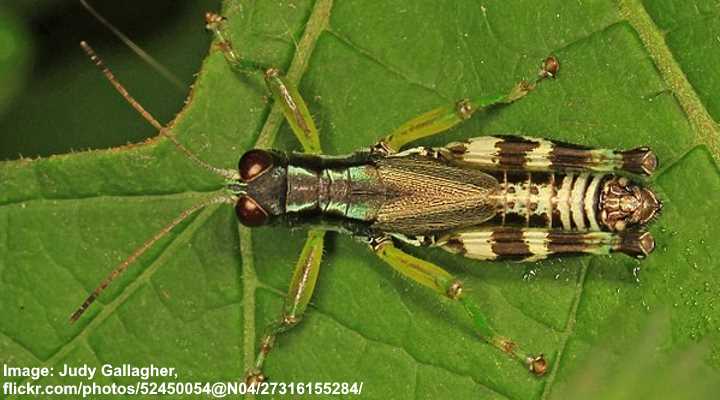
All of the rain we’ve had must had led to all the tiny frogs I was seeing everywhere today. And I’ve got small white grasshoppers eating my Lily of the Valley…I need to find out what those are and if I should spray…..weird looking things! OK, then….I looked up grasshoppers – I never dreamed there were soooo many different kinds! No white ones on this site…
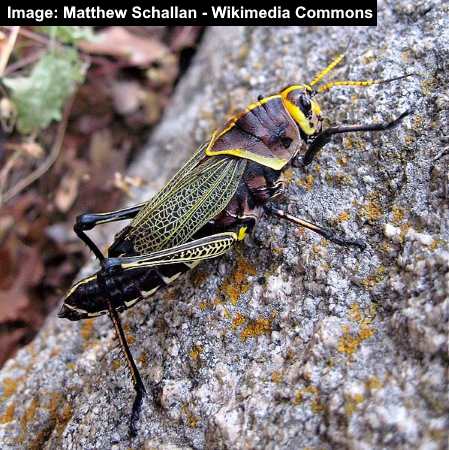

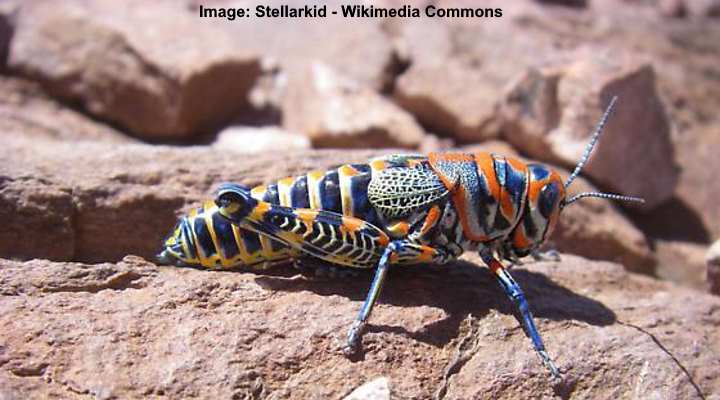
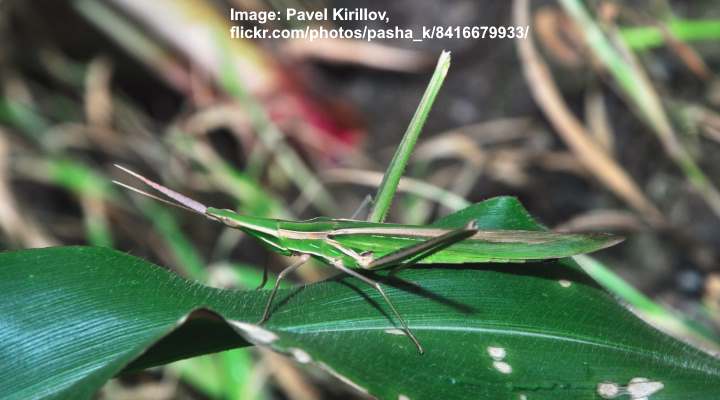
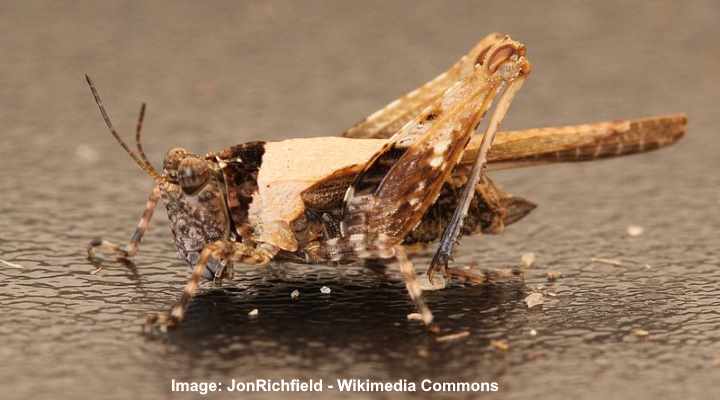
Green-legged
Western Horse Lubber (yes, that’s really it’s name!!!)
Eastern Lubber
Rainbow
Silent Slant-Faced
Pygmy
LikeLiked by 1 person
so cool!
LikeLiked by 1 person
I am adding a short daily prayer to the board. I would invite each of you, if you wish, to also add one or maybe two of your own liking. I do not want to stifle anyone but please limit yourself to one or two religious postings. here’s one I found that I liked.

LikeLike
LikeLike
LikeLike
LikeLike
LikeLike
LikeLike
LikeLike
LikeLike
LikeLike
LikeLike
LikeLike
Good Night All!
LikeLike
Good night
LikeLiked by 1 person
Those are soooo cool
LikeLiked by 1 person
and HUGE
LikeLike
LikeLiked by 1 person
Oh I forgot to mention this but do you recall back in November Mom lost her ring. We just found it. I guess it slipped off while she was making the bed.
I moved something and it was right there. I can’t believe we found it again.
The crazy thing is I tore the house apart. Even checked the garbage
I checked that room sooo many times,
So happy it’s back. She’s put it on her nightstand
She does not want to loss it again.
LikeLiked by 1 person
AWESOME!
my mom lost her favorite watch a little while back. she only takes it off to bathe or do dishes and she almost convinced herself that one of the people who comes in to help her sometime might have taken it. then she found it in her drawer. and she swears she would never put it in there.
i dunno…pixies maybe?
LikeLiked by 1 person
Glad she found it
LikeLiked by 1 person
me too! but it’s a mystery how it got in the drawer
LikeLiked by 1 person
Hmmmm
LikeLiked by 1 person
LikeLiked by 1 person
LikeLiked by 1 person
LikeLiked by 1 person
LikeLiked by 1 person
LikeLiked by 1 person
LikeLiked by 1 person
LikeLiked by 1 person
LikeLiked by 1 person
LikeLiked by 1 person
LikeLiked by 1 person
LikeLiked by 1 person
LikeLiked by 1 person
LikeLiked by 1 person
LikeLiked by 1 person
LikeLiked by 1 person