
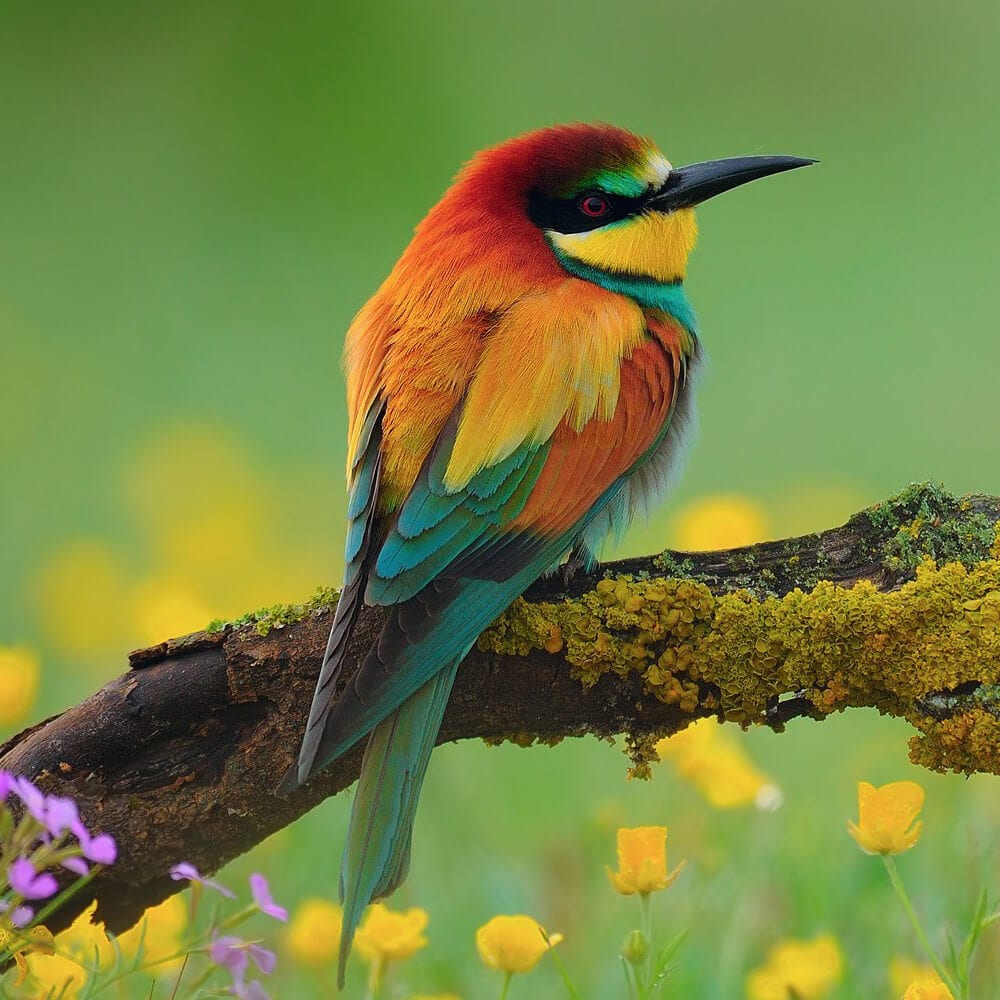
Bee-eaters birds are in the family Meropidae.
There are 27 species bee-eaters.
They are found from Europe to Australia. The center of diversity of the family is Africa, although a number of species also occur in Asia. Single species occur in each of Europe, (the European bee-eater), Australia (the rainbow bee-eater) and Madagascar (the olive bee-eater, also found on mainland Africa).
They inhabit a variety of habitats depending on what regional environments including forest, savanna, shrubland, grassland, and agricultural areas.
The average lifespan is 5 to 6 years in the wild.
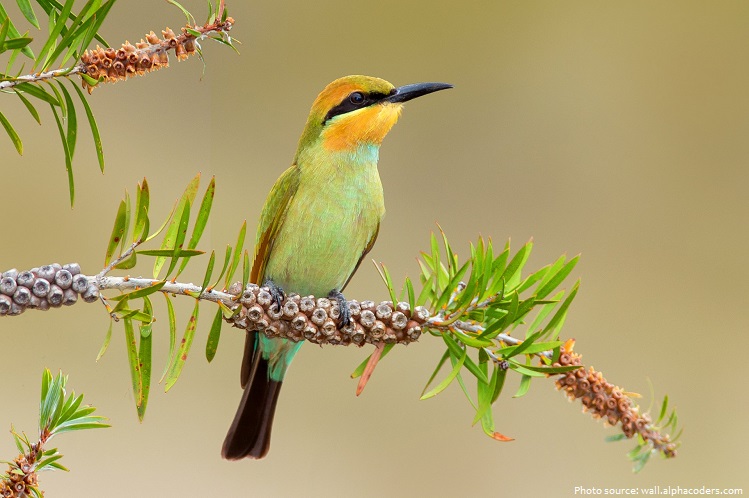
Bee-eaters range in length from 6 to 14 inches.
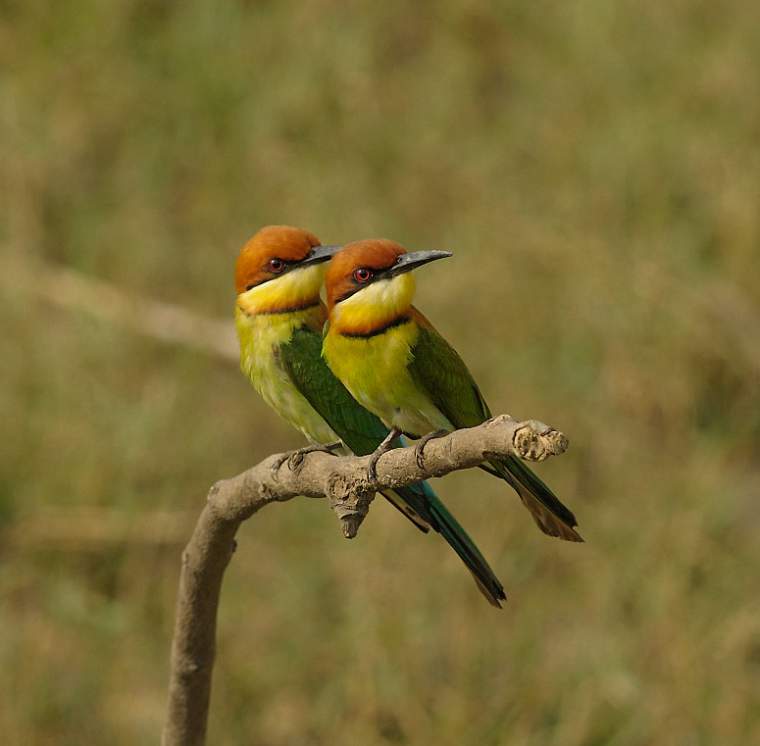
They are characterized by richly colored plumage, slender bodies, and usually elongated central tail feathers.
Brilliant plumage is characteristic; green predominates, but many species are partially colored with red, yellow, blue, or purple.
Male and female plumages are usually similar.
Bee-eater’s bill is moderately long, slightly down curved, and sharply pointed.
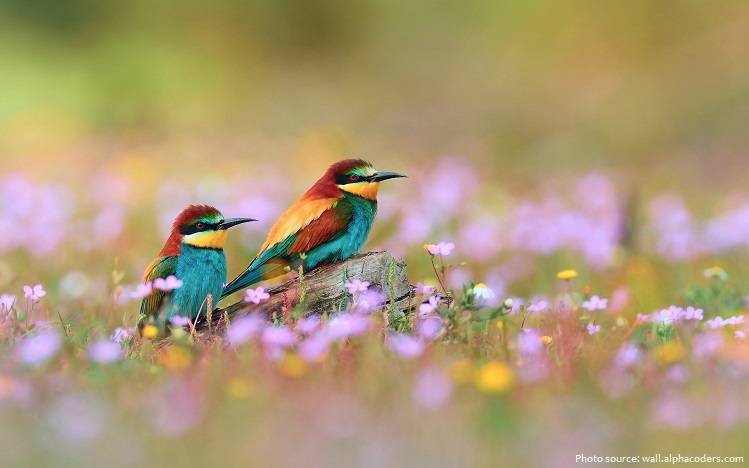
Bee-eaters have one of the most complex social systems of any bird species. Many species (but not all) are monogamous, cooperative breeders living in large colonies of over 100 birds, but can reach 200 birds if conditions are favorable.
Each bird lives in an extended family with members of four overlapping generations. They appear to recognize parents, siblings, offspring, friends, and nesting neighbors, likely from voice recognition. This cooperative behavior vastly improves survival of chicks. Females leave their natal group to join her mate’s family.
Many bee-eater names reflect their flashy feathers if not the lack of imagination of the namers: red-throated, blue-headed, black-headed, red-bearded, purple-bearded, blue-cheeked, and cinnamon-chested, white-fronted, rosy, and little green bee-eaters.

They form colonies, nesting in burrows tunneled into vertical sandy banks, often at the side of a river or in flat ground. As they mostly live in colonies, large numbers of nest holes may be seen together. The eggs are white, with typically five to the clutch.
All bee-eaters are earth-hole nesters, digging their tunnels with an oval chamber at the end for eggs. They lay a single clutch annually.
As their name suggests, bee-eaters predominantly eat flying insects, especially bees and wasps, which are caught in the air by flights from an open perch. The stinger is removed by repeatedly hitting and rubbing the insect on a hard surface. During this process, pressure is applied to the insect, thereby extracting most of the venom.

One white egg is laid each day until the typical clutch of about five eggs is complete. Incubation starts soon after the first egg is laid, with both parents sharing this duty in the day, but only the female at night. The eggs hatch in about 20 days, and the newly hatched young are blind, pink and naked. For most species, the eggs do not all hatch at the same time, so if food is in short supply only the older chicks survive. The chicks are in the nest for about 30 days.
The International Union for Conservation of Nature (IUCN) assesses species vulnerability in terms of total population and the rate of any population decline. None of the bee-eaters meet the IUCN vulnerability criteria, and all are therefore evaluated as “Least-concern species”.

Bee-eaters were mentioned by ancient writers such as Aristotle and Virgil, who both advised beekeepers to kill the birds.
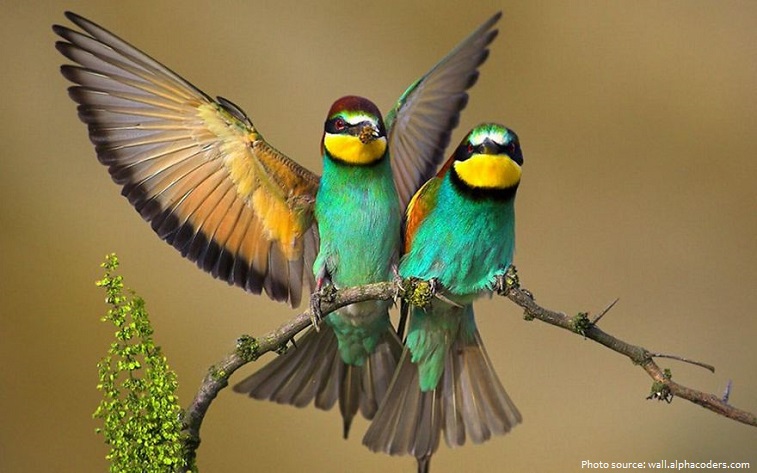
The Ancient Egyptians believed that bee-eaters had medical properties, prescribing the application of bee-eater fat to deter biting flies, and treating the eyes with the smoke from charred bee-eater legs to cure an unspecified female complaint.
In Hinduism, the shape of the bird in flight was thought to resemble a bow, with the long bill as an arrow. This led to a Sanskrit name meaning “Vishnu’s bow” and an association with archer gods.
Bee-eaters may be killed by raptors; their nests are raided by rodents and snakes, and they can carry various parasites.
 Sew Colorful
LikeLiked by 1 person
LikeLiked by 1 person
LikeLiked by 1 person
LikeLiked by 1 person
LikeLiked by 1 person
LikeLiked by 1 person
I will save these for Thursday or Friday–I’ve got jury duty tomorrow…
thanks!
LikeLiked by 1 person
Ugh jury duty Poor you
LikeLiked by 1 person
Enough snow has melted now that I can see the entire top row on both garden beds and the entire pink tub of Moss Roses in front. The snow was within a few inches of the top less than a week ago!!! Made it up to 48 earlier before it started down again. The squirrels have been absent today. They do that now and then – disappear for a day or two, then they’re back for a few days.
LikeLiked by 1 person
wow 48*!!!
LikeLiked by 1 person
I am adding a short daily prayer to the board. I would invite each of you, if you wish, to also add one or maybe two of your own liking. I do not want to stifle anyone but please limit yourself to one or two religious postings. here’s one I found that I liked.

LikeLike
LikeLike
LikeLike
LikeLiked by 1 person
LikeLike
LikeLike
LikeLiked by 1 person
LikeLike
LikeLike
Good Night All!
LikeLike
Good night! I’ll keep an eye on things tomorrow….maybe you’ll get lucky!

LikeLike
nope…LOL…gotta show up.
AND the lot behind the courthouse is now restricted and most of the town (touristy place) is METERED parking…so i gotta leave even earlier to try to find a dang parking spot…sigh
LikeLiked by 1 person
LikeLiked by 1 person
LikeLiked by 1 person
LikeLiked by 1 person
LikeLiked by 1 person