

The steep mountains and deep valleys of Elk and Cameron Counties make up “Elk Country,” where you can see Pennsylvania’s wild elk herd, now numbering nearly 1,400 majestic creatures. In spring, you can see calves frolicking in wildflower-filled meadows, while in the summer, elks spend their days relaxing in the shade, giving visitors the best viewing opportunities at dawn and dusk. In autumn, you can experience bulls battling for breeding rights during “the rut.” When the snow flies, elk gather in impressive herds, which easily stand out against winter’s backdrop and make for spectacular photos and unforgettable memories.

Elk once freely roamed all over Pennsylvania but the rapid settlement and exploitation by early immigrants threatened the herds. By 1867 there were no more elk in Pennsylvania. Unregulated hunting and habitat loss were the biggest factors of their demise. In 1913 the Pennsylvania Game Commission began reintroducing elk in Pennsylvania. The elk herd we know today originated from 177 elk that were trapped and transferred to northern areas of Pennsylvania. The reintroduction of elk took place from 1913 through 1926. The releases in north-central Pennsylvania were successful and the herd now numbers more than 1,400.
Visitors can easily see the majestic elk in areas of Elk and Cameron counties. Considered to be the heart of Pennsylvania elk country, the town of Benezette is located along State Route 555 in Elk County. To reach the public viewing area, start at the Benezette Hotel and travel north along Winslow Hill Road 3.5 miles. Follow the signs to the viewing area. Elk can also be seen along the roadways in the free-roaming herd range located in Elk and Cameron counties. The Moore Hill area in Cameron County is a favored viewing spot of local elk enthusiasts.

Cow elk normally give birth to a single calf in late May or early June. The calves are speckled with spots to complete their natural camouflage. Twins are a rare occurrence and happen less than one percent of the time. Normal gestation period is approximately 8 ½ months. After a short amount of time the cows and their new calves rejoin their family units comprised of cows, their calves and immature yearlings. Most yearling bulls will only grow spike antlers.

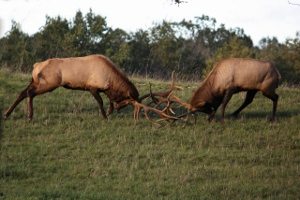
The mature bull’s antlers are fully grown by August and they now spend much of their time thrashing trees and shrubs with their antlers. Normal antler growth is up to 6 tines per side. A “royal” bull is one with a total of 12 points. An “imperial” bull has 14 points. September and October mark the mating season for the elk. While the beginning of the rut may vary somewhat from year to year, the unmistakable invitation or bugle of a bull elk can be heard echoing throughout the range. Bugling can be heard primarily during the rut or mating season. It starts as a low bellow and continues as a squealing or whistle. This is followed by several grunts.

The elk form harems of 15 to 20 cows, which are controlled by a mature bull. The bull has earned his status to lead his harem by fighting off lesser bulls for the opportunity to breed with these cows. Lesser bulls often mate also, the large bull will contain the group and be the prime breeder. These harems remain together for the duration of the breeding season. Cow elk are receptive to breeding for only about an 18-hour period. If they are not bred successfully, they will have two or three breeding cycles at 21-day intervals.
The elk remain in large groups throughout the winter months. They must dig through the snow to find grass, twigs and buds. They will eat the bark off trees and drink from the streams to sustain for the winter. The bulls shed their antlers around March. New antlers begin growing almost immediately in early April and full grown by mid-August.
 Sew Colorful
LikeLiked by 1 person
oh my…grow up…pull your pants up…and get the hell of out mommy’s house!!!!
LikeLiked by 1 person
LikeLiked by 1 person
gender dysphoria is a mental disease imo and i prefer not to put my life in the hands of a mental patient.
LikeLiked by 1 person
Bingo
LikeLiked by 1 person
I’m not sure why there is a stigma to mental disease. I have diabetes…it’s a disease. it is a fact. mental disease is also a fact. covering it up and pretending it doesn’t exist is detrimental to all involved
LikeLiked by 1 person
is this their way to queer the word “virgin”?
LikeLiked by 1 person
LikeLiked by 1 person
facts? we don’t need no stinkin’ facts!
LikeLiked by 1 person
LikeLiked by 1 person
LikeLiked by 1 person
wow! i didn’t realize she does all sorts of interviews…but really gives me some interesting “tells” and such to watch for in other people!
LikeLiked by 1 person
I am adding a short daily prayer to the board. I would invite each of you, if you wish, to also add one or maybe two of your own liking. I do not want to stifle anyone but please limit yourself to one or two religious postings. here’s one I found that I liked.

LikeLiked by 1 person
LikeLike
LikeLike
LikeLiked by 1 person
LikeLike
Well I’m going to keep hubby company!
Tomorrow starts our spooky/creepy month!!
Good Night All!
LikeLike
Have a good night!
LikeLiked by 1 person